
Xray Absorption Spectroscopy as a Probe of Chemical
X-ray Absorption Spectroscopy as a Probe of Chemical Identity Graham N. George Department of Geological Sciences University of Saskatchewan Tuesday, March 2 nd, 2004 Graham N. George

Overview • Introduction to X-ray Absorption Spectroscopy • X-ray Absorption Spectroscopy as a Probe of Sulfur Chemistry in Living Tissues Tuesday, March 2 nd, 2004 Graham N. George
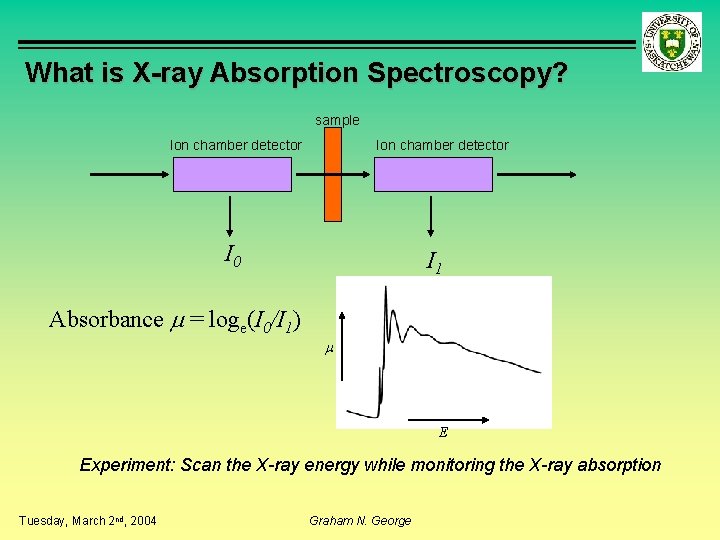
What is X-ray Absorption Spectroscopy? sample Ion chamber detector I 0 I 1 Absorbance = loge(I 0/I 1) E Experiment: Scan the X-ray energy while monitoring the X-ray absorption Tuesday, March 2 nd, 2004 Graham N. George
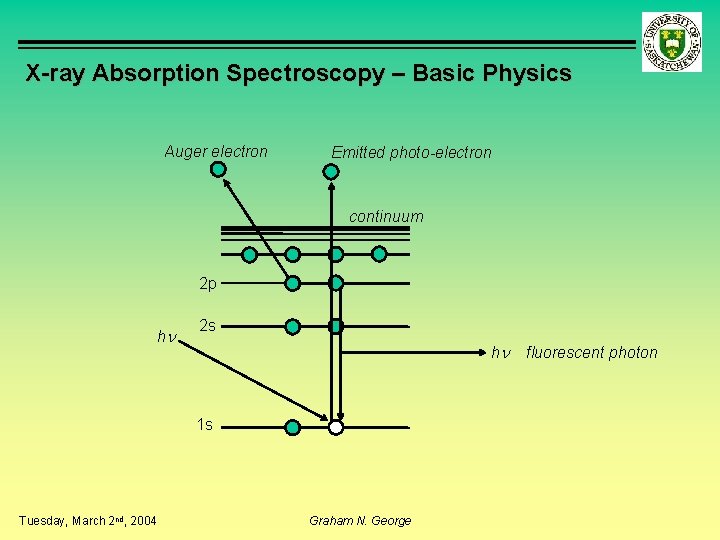
X-ray Absorption Spectroscopy – Basic Physics Auger electron Emitted photo-electron continuum 2 p h 2 s h 1 s Tuesday, March 2 nd, 2004 Graham N. George fluorescent photon
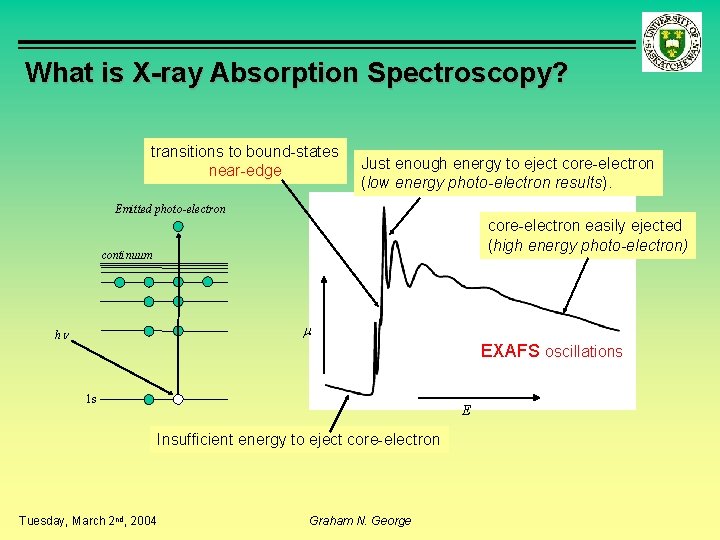
What is X-ray Absorption Spectroscopy? transitions to bound-states near-edge Just enough energy to eject core-electron (low energy photo-electron results). Emitted photo-electron core-electron easily ejected (high energy photo-electron) continuum h EXAFS oscillations 1 s E Insufficient energy to eject core-electron Tuesday, March 2 nd, 2004 Graham N. George
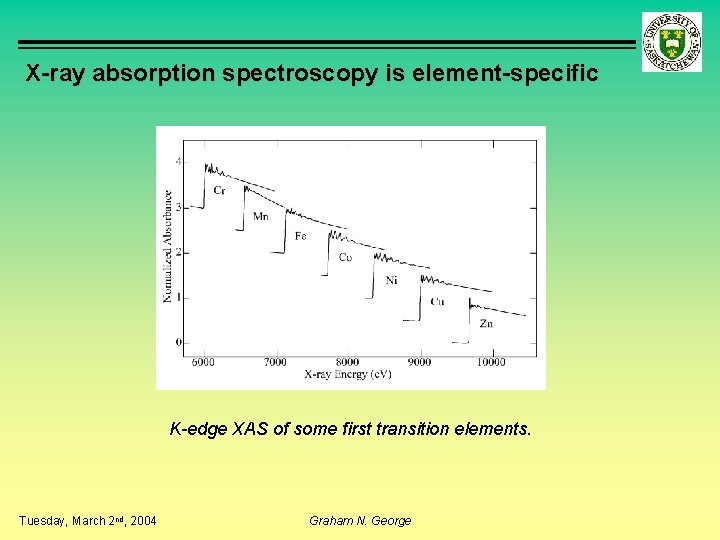
X-ray absorption spectroscopy is element-specific K-edge XAS of some first transition elements. Tuesday, March 2 nd, 2004 Graham N. George
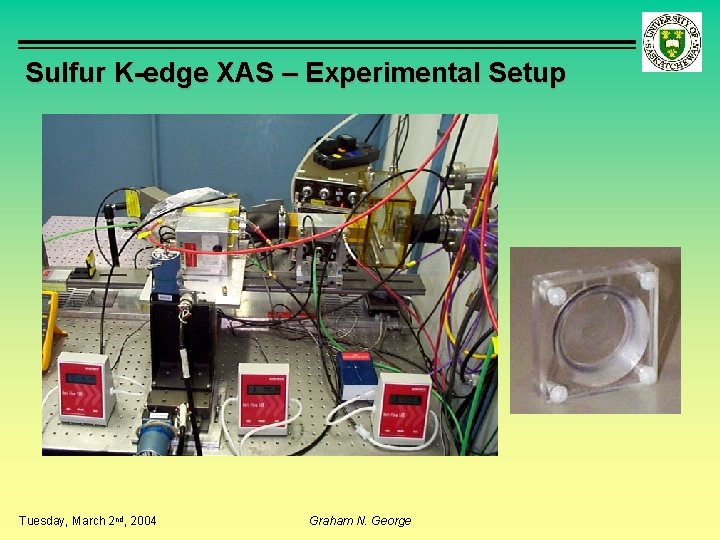
Sulfur K-edge XAS – Experimental Setup Tuesday, March 2 nd, 2004 Graham N. George
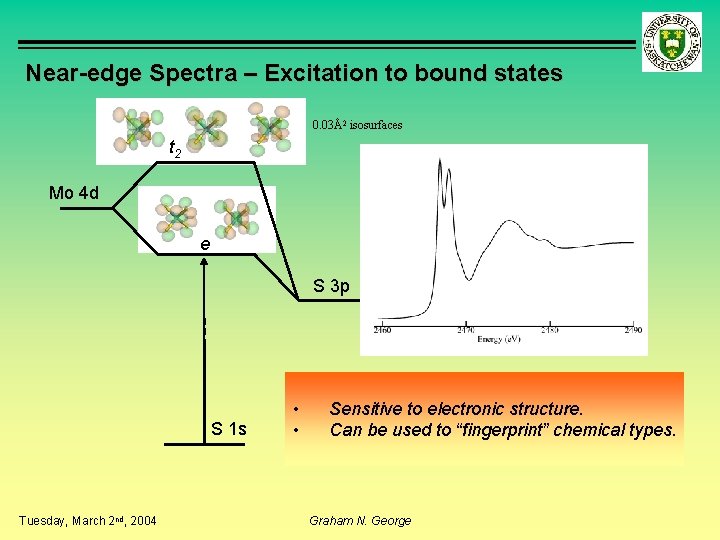
Near-edge Spectra – Excitation to bound states 0. 03Å2 isosurfaces t 2 Mo 4 d e S 3 p S 1 s Tuesday, March 2 nd, 2004 • • Sensitive to electronic structure. Can be used to “fingerprint” chemical types. Graham N. George
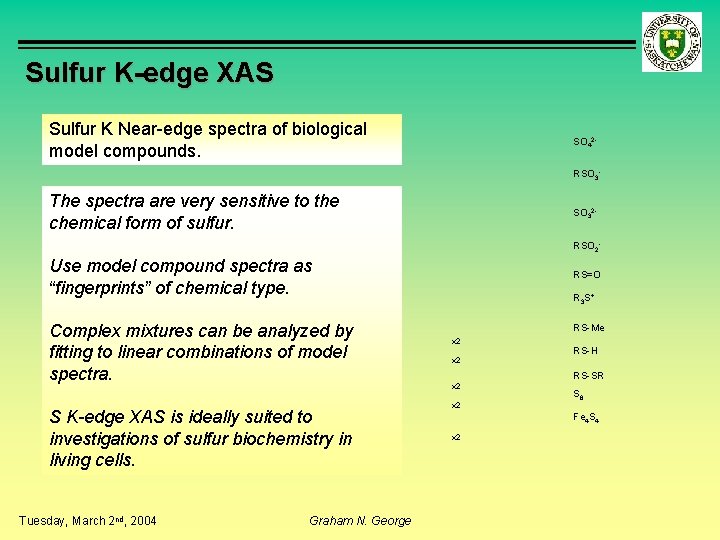
Sulfur K-edge XAS Sulfur K Near-edge spectra of biological model compounds. SO 42 RSO 3 - The spectra are very sensitive to the chemical form of sulfur. SO 32 RSO 2 - Use model compound spectra as “fingerprints” of chemical type. Complex mixtures can be analyzed by fitting to linear combinations of model spectra. S K-edge XAS is ideally suited to investigations of sulfur biochemistry in living cells. Tuesday, March 2 nd, 2004 Graham N. George RS=O R 3 S+ RS-Me x 2 RS-H x 2 RS-SR x 2 S 8 Fe 4 S 4 x 2
Sulfur K-edge XAS of Living Cells • Sulfur has a rich chemistry and biochemistry. • It is essential for life as we know it, being the seventh most abundant element in most living organisms. • It has been called Spectroscopically Silent. Our goal – has been to develop Sulfur K-edge XAS as a quantitative in-situ probe of sulfur in living tissues. Tuesday, March 2 nd, 2004 Graham N. George
Sulfur K-edge XAS of Living Cells The Ultimate goal of this work is to examine sulfur biochemistry of living mammalian tissues using S K-edge XAS. Previous work – “stepping stones” toward this goal Sulfur bacteria (easy, resistant to radiation damage) e. g. Pickering, I. J. , George, G. N. , Yu, E. Y. , Brune, D. C. , Tuschak, C. , Overmann, J. , Beatty, J. T. , Prince, R. C. “Analysis of Sulfur Biochemistry of Sulfur Bacteria Using X-ray Absorption Spectroscopy. ” Biochemistry 40, 2001, 8138 -8145. Plant systems (intermediate, fairly resistant to radiation) e. g. Yu, E. Y. , Pickering, I. J. , George, G. N. , Prince, R. C. “In-situ observation of the generation of isothiocyanates from sinigrin in horseradish and wasabi. ” Biochim. Biophys. Acta 1527, 2001, 156 -160. Immortalized Cell Cultures (difficult). Living systems are complex – ultimately use imaging to help deconvolute. This presentation will describe work on mammalian cell cultures. Tuesday, March 2 nd, 2004 Graham N. George
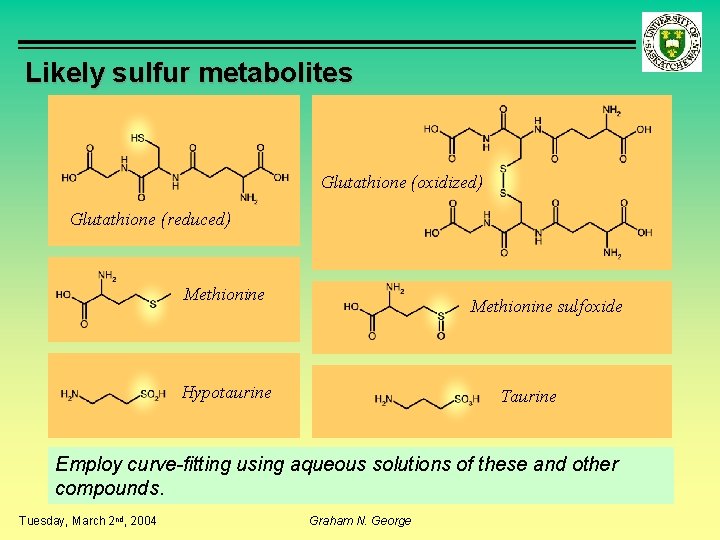
Likely sulfur metabolites Glutathione (oxidized) Glutathione (reduced) Methionine sulfoxide Hypotaurine Taurine Employ curve-fitting using aqueous solutions of these and other compounds. Tuesday, March 2 nd, 2004 Graham N. George
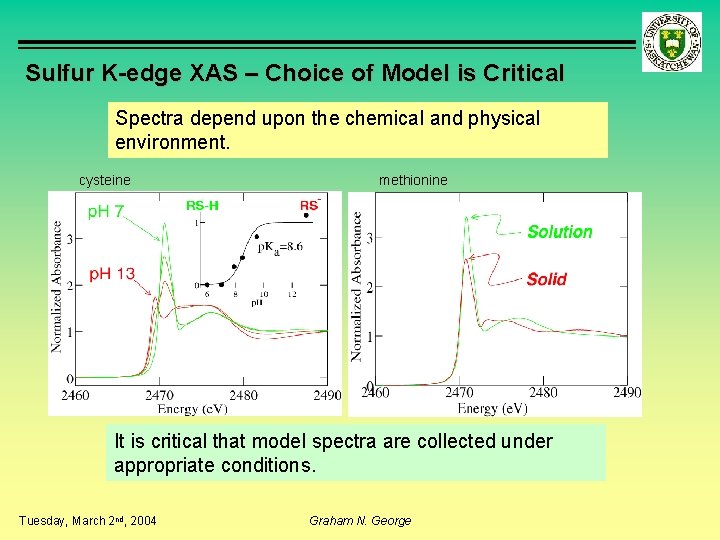
Sulfur K-edge XAS – Choice of Model is Critical Spectra depend upon the chemical and physical environment. cysteine methionine It is critical that model spectra are collected under appropriate conditions. Tuesday, March 2 nd, 2004 Graham N. George
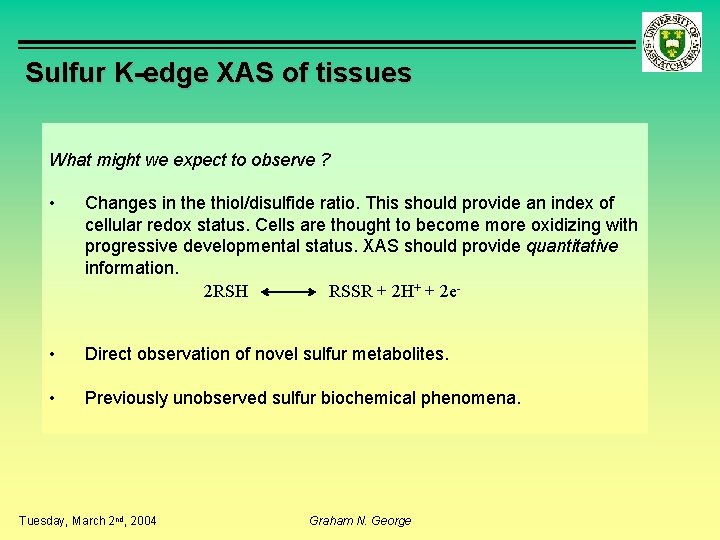
Sulfur K-edge XAS of tissues What might we expect to observe ? • Changes in the thiol/disulfide ratio. This should provide an index of cellular redox status. Cells are thought to become more oxidizing with progressive developmental status. XAS should provide quantitative information. 2 RSH RSSR + 2 H+ + 2 e- • Direct observation of novel sulfur metabolites. • Previously unobserved sulfur biochemical phenomena. Tuesday, March 2 nd, 2004 Graham N. George
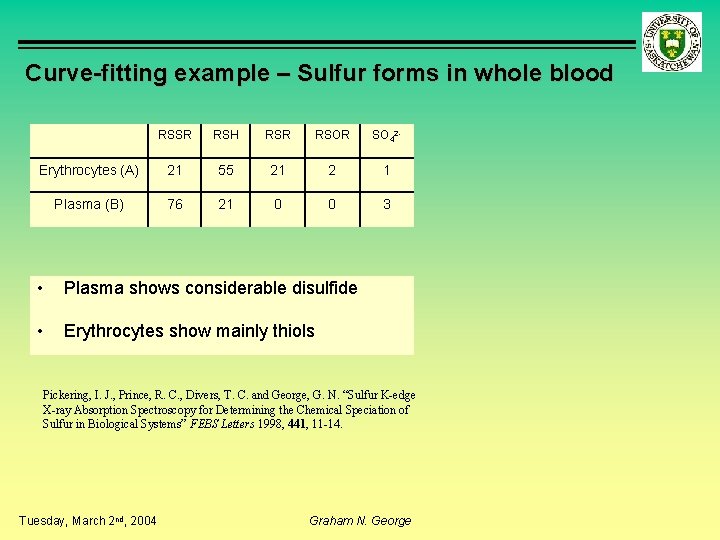
Curve-fitting example – Sulfur forms in whole blood RSSR RSH RSR RSOR SO 42 - Erythrocytes (A) 21 55 21 2 1 Plasma (B) 76 21 0 0 3 • Plasma shows considerable disulfide • Erythrocytes show mainly thiols Pickering, I. J. , Prince, R. C. , Divers, T. C. and George, G. N. “Sulfur K-edge X-ray Absorption Spectroscopy for Determining the Chemical Speciation of Sulfur in Biological Systems” FEBS Letters 1998, 441, 11 -14. Tuesday, March 2 nd, 2004 Graham N. George
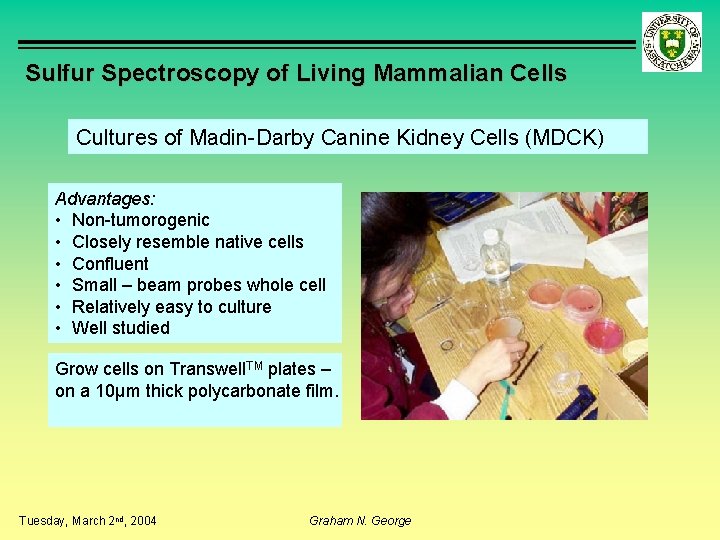
Sulfur Spectroscopy of Living Mammalian Cells Cultures of Madin-Darby Canine Kidney Cells (MDCK) Advantages: • Non-tumorogenic • Closely resemble native cells • Confluent • Small – beam probes whole cell • Relatively easy to culture • Well studied Grow cells on Transwell. TM plates – on a 10μm thick polycarbonate film. Tuesday, March 2 nd, 2004 Graham N. George
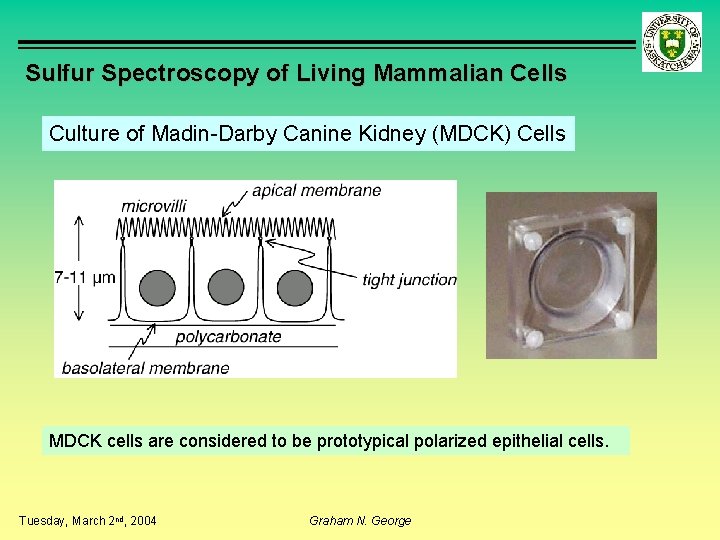
Sulfur Spectroscopy of Living Mammalian Cells Culture of Madin-Darby Canine Kidney (MDCK) Cells MDCK cells are considered to be prototypical polarized epithelial cells. Tuesday, March 2 nd, 2004 Graham N. George
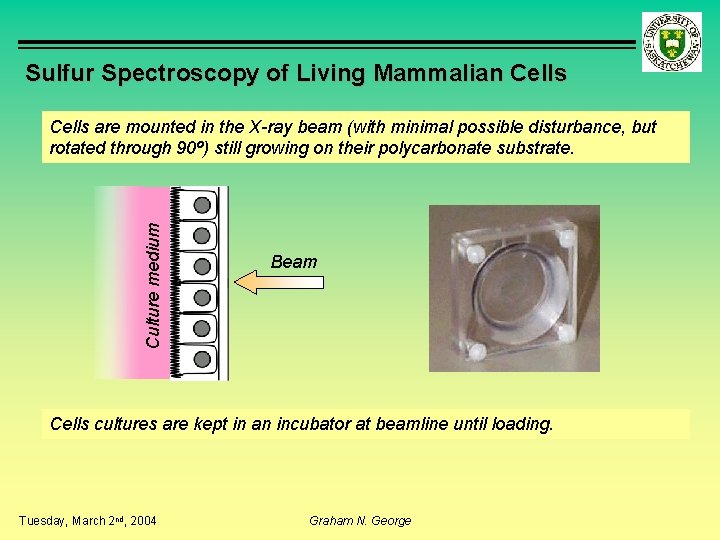
Sulfur Spectroscopy of Living Mammalian Cells Culture medium Cells are mounted in the X-ray beam (with minimal possible disturbance, but rotated through 90º) still growing on their polycarbonate substrate. Beam Cells cultures are kept in an incubator at beamline until loading. Tuesday, March 2 nd, 2004 Graham N. George
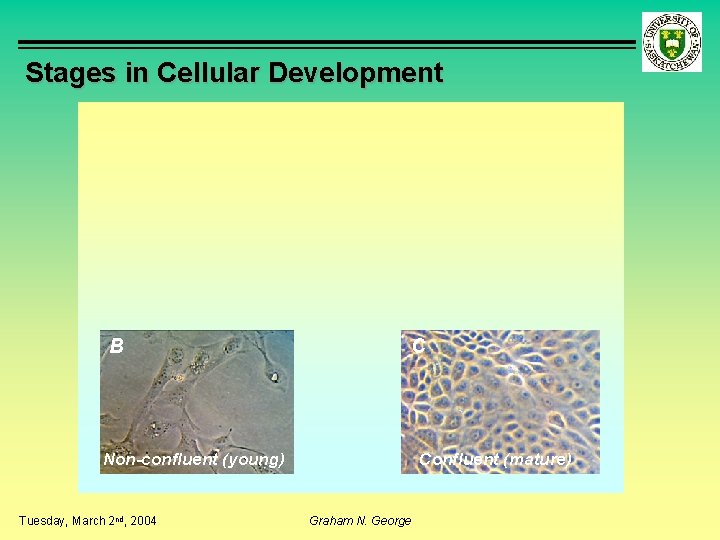
Stages in Cellular Development B C Non-confluent (young) Tuesday, March 2 nd, 2004 Confluent (mature) Graham N. George
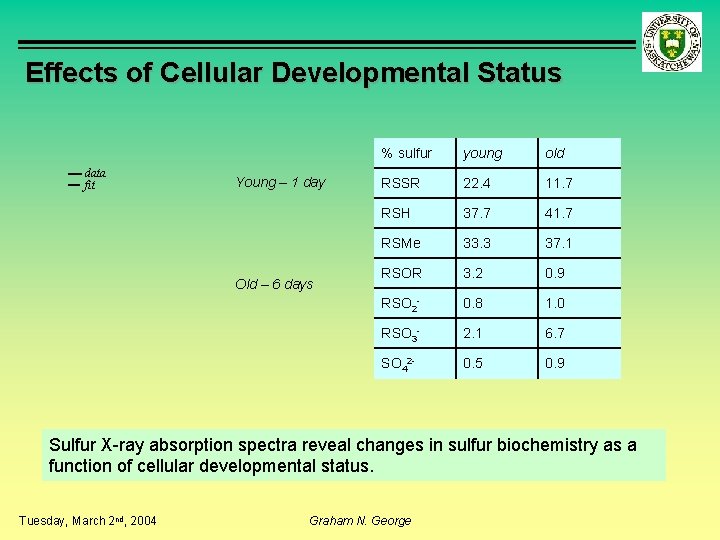
Effects of Cellular Developmental Status data fit Young – 1 day Old – 6 days % sulfur young old RSSR 22. 4 11. 7 RSH 37. 7 41. 7 RSMe 33. 3 37. 1 RSOR 3. 2 0. 9 RSO 2 - 0. 8 1. 0 RSO 3 - 2. 1 6. 7 SO 42 - 0. 5 0. 9 Sulfur X-ray absorption spectra reveal changes in sulfur biochemistry as a function of cellular developmental status. Tuesday, March 2 nd, 2004 Graham N. George
Effects of Cellular Developmental Status. Effects of cell maturity – the expected result [e. g. 1] is that cells should become more oxidizing with progression in developmental status. In the case of MDCK cultures this is NOT the case – the thiol/disulfide ratio increases from 1. 7 (non-confluent) to 3. 6 (confluent) indicating that cells become overall less oxidizing with progression in developmental status. Assuming that no compartmentalization is involved, then these ratios correspond to a cellular reduction potential difference of about 30 m. V (estimated values – non-confluent: -190 m. V, confluent: -220 m. V). This is important as the control of the progression through the stages of cellular development is thought to be exerted by changes in redox environment. 1. F. Q. Schafer and G. R. Buettner (2001) Free Rad. Biol. Med. 30, 1191. Tuesday, March 2 nd, 2004 Graham N. George
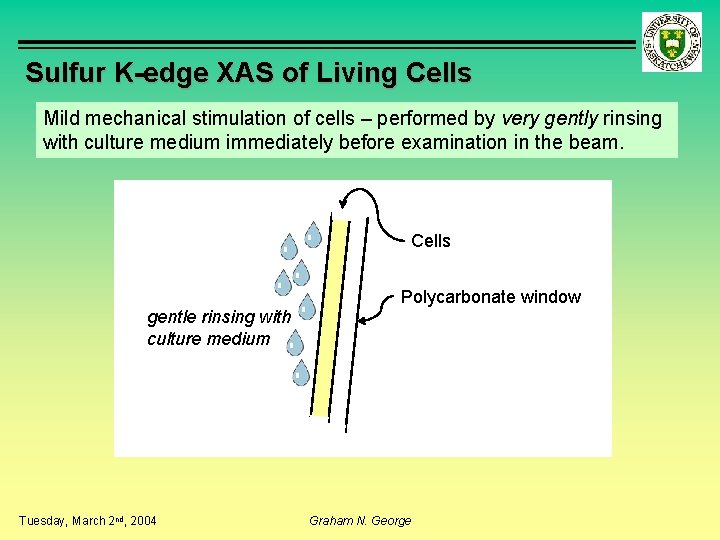
Sulfur K-edge XAS of Living Cells Mild mechanical stimulation of cells – performed by very gently rinsing with culture medium immediately before examination in the beam. Cells Polycarbonate window gentle rinsing with culture medium Tuesday, March 2 nd, 2004 Graham N. George
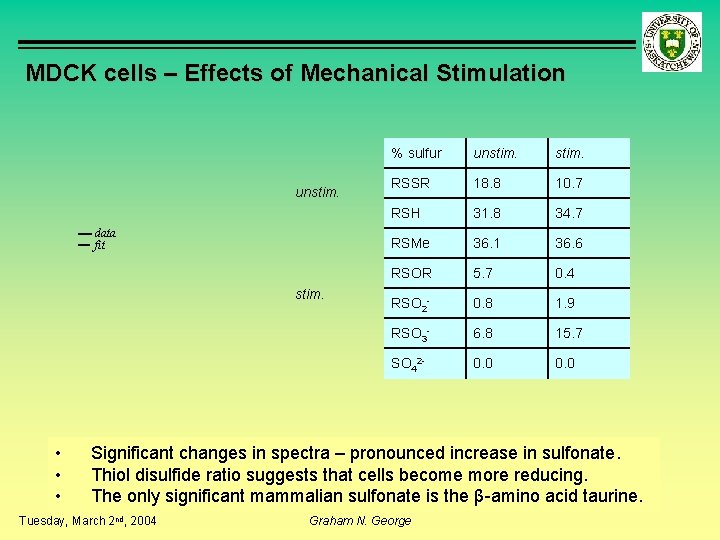
MDCK cells – Effects of Mechanical Stimulation unstim. data fit stim. • • • % sulfur unstim. RSSR 18. 8 10. 7 RSH 31. 8 34. 7 RSMe 36. 1 36. 6 RSOR 5. 7 0. 4 RSO 2 - 0. 8 1. 9 RSO 3 - 6. 8 15. 7 SO 42 - 0. 0 Significant changes in spectra – pronounced increase in sulfonate. Thiol disulfide ratio suggests that cells become more reducing. The only significant mammalian sulfonate is the β-amino acid taurine. Tuesday, March 2 nd, 2004 Graham N. George
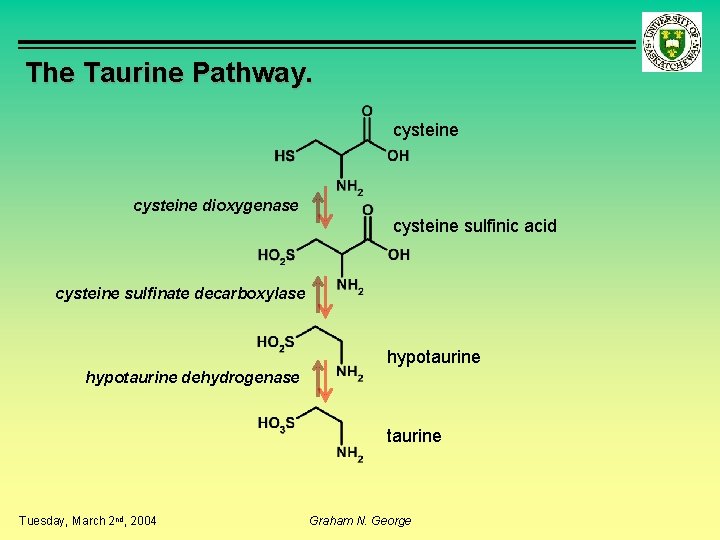
The Taurine Pathway. cysteine dioxygenase cysteine sulfinic acid cysteine sulfinate decarboxylase hypotaurine dehydrogenase taurine Tuesday, March 2 nd, 2004 Graham N. George
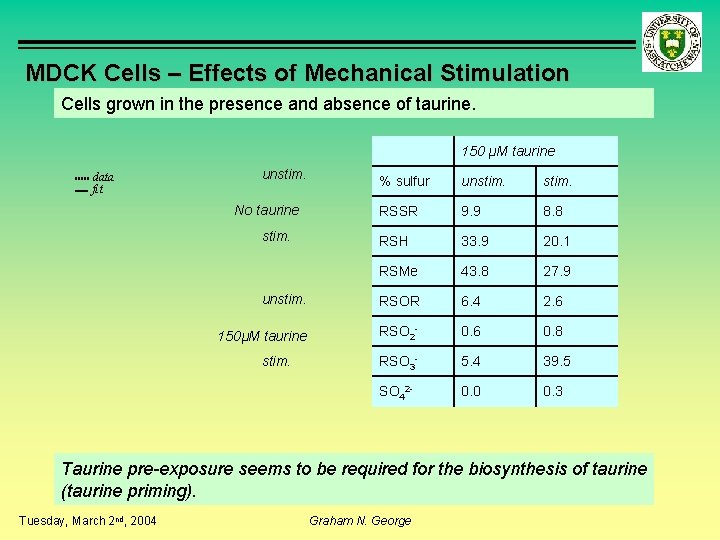
MDCK Cells – Effects of Mechanical Stimulation Cells grown in the presence and absence of taurine. 150 μM taurine data fit unstim. % sulfur unstim. RSSR 9. 9 8. 8 RSH 33. 9 20. 1 RSMe 43. 8 27. 9 unstim. RSOR 6. 4 2. 6 150μM taurine RSO 2 - 0. 6 0. 8 RSO 3 - 5. 4 39. 5 SO 42 - 0. 0 0. 3 No taurine stim. Taurine pre-exposure seems to be required for the biosynthesis of taurine (taurine priming). Tuesday, March 2 nd, 2004 Graham N. George
MDCK Cells – Response to Mechanical Stimulation The Taurine Response • Taurine is synthesized in response to mechanical stimulation. • The taurine response is very sensitive. More sensitive in confluent cell cultures than in non-confluent ones. • The taurine response happens fast (timescale is less than minutes). • The taurine response requires pre-exposure to taurine for the effect to be observed (taurine priming). • No large scale accumulation of taurine from taurine-containing growth media occurs. 14 C-taurine has been previously shown to be taken up from growth media. Taurine taken up must therefore be transformed to other more reduced sulfur species. Tuesday, March 2 nd, 2004 Graham N. George
MDCK Cells – Taurine and Ca 2+ • What we have observed is new biochemistry. • Taurine is known to control many Ca 2+ dependent processes. * • In ciliated epithelia: Mechanical stimulation Ca 2+ release increased ciliary beat. Is taurine involved in this? • Given the great sensitivity of the cells to stimulation, only an in situ technique such as XAS could have revealed these changes as all others require cell breakage and thus only stimulated cells would be observed. • Future Studies - use taurine pathway inhibitors to help understand metabolism of the response to mechanical stimulation. Use XAS imaging to help understand localization. * e. g. R. J. Huxtable, Physiol. Rev. 1992, 72, 101 -163. Tuesday, March 2 nd, 2004 Graham N. George
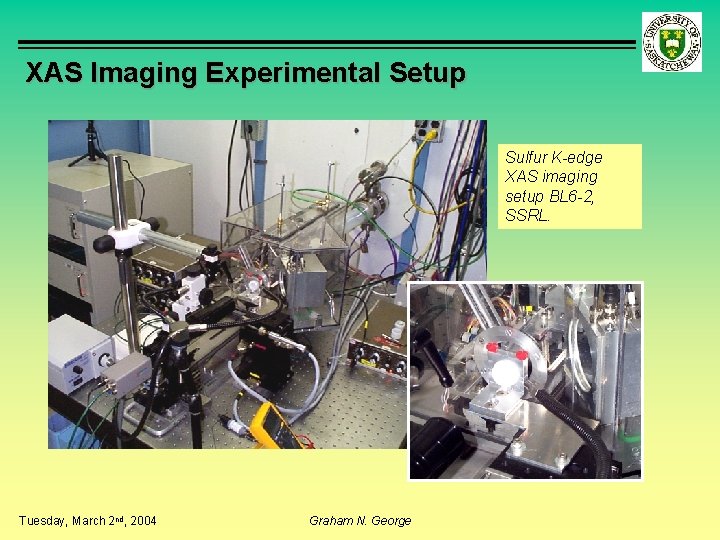
XAS Imaging Experimental Setup Sulfur K-edge XAS imaging setup BL 6 -2, SSRL. Tuesday, March 2 nd, 2004 Graham N. George
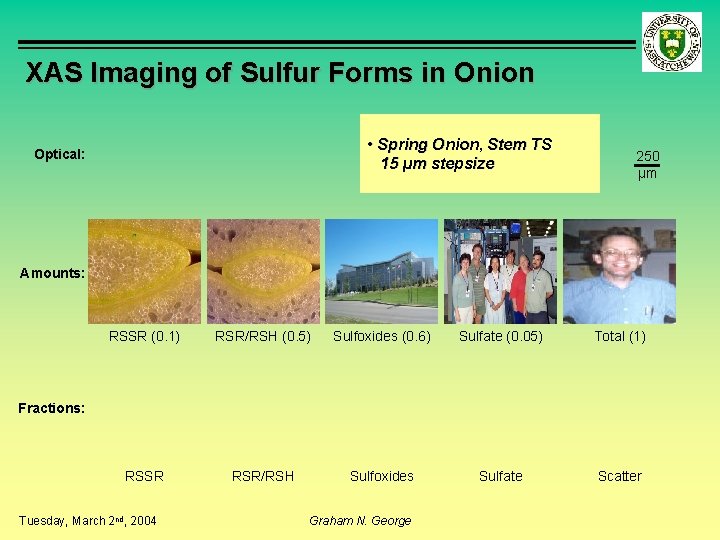
XAS Imaging of Sulfur Forms in Onion • Spring Onion, Stem TS 15 µm stepsize Optical: 250 µm Amounts: RSSR (0. 1) RSR/RSH (0. 5) Sulfoxides (0. 6) Sulfate (0. 05) Total (1) RSSR RSR/RSH Sulfoxides Sulfate Scatter Fractions: Tuesday, March 2 nd, 2004 Graham N. George
XAS Imaging of Mammalian Cells? • Stay tuned! • Requires brighter and smaller beams – Should be available at SPEAR 3 (Stanford) and CLS (Saskatoon) XAFS beamlines. • Important potential biomedical areas of application – e. g. Apoptosis (AIDS, Cancer? ) Tuesday, March 2 nd, 2004 Graham N. George
Acknowledgements Eric Block, University at Albany John Whitin, Stanford Children’s Hospital Harvey Cohen, Stanford Children’s Hospital Eileen Yu Sneeden, Stanford Synchrotron Radiation Lab. Hugh H. Harris, SSRL (now University of Syndey) Ingrid J. Pickering, University of Saskatchewan Helen Nichol, University of Saskatchewan National Institutes of Health Department of Energy (OBER) Province of Saskatchewan University of Saskatchewan Canada Research Chair Program Tuesday, March 2 nd, 2004 Graham N. George
Acknowledging Co-Workers Experiments at the Stanford Synchrotron Radiation Laboratory Dan Durkin John Whitin Ingrid Pickering Eileen Yu Sneeden Tuesday, March 2 nd, 2004 Helen Nichol Graham N. George Hugh Harris
- Slides: 32