
XPCS and Science Opportunities at NSLSII Bob Leheny
XPCS and Science Opportunities at NSLS-II Bob Leheny Johns Hopkins University
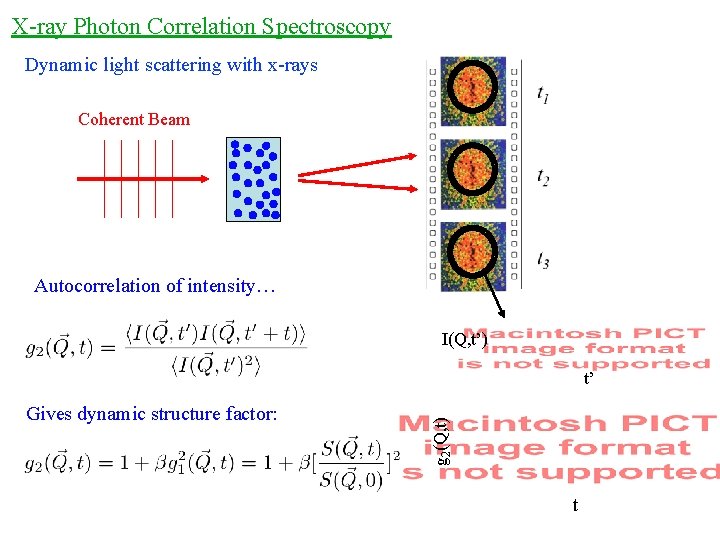
X-ray Photon Correlation Spectroscopy Dynamic light scattering with x-rays Coherent Beam Autocorrelation of intensity… I(Q, t’) Gives dynamic structure factor: g 2(Q, t) t’ t
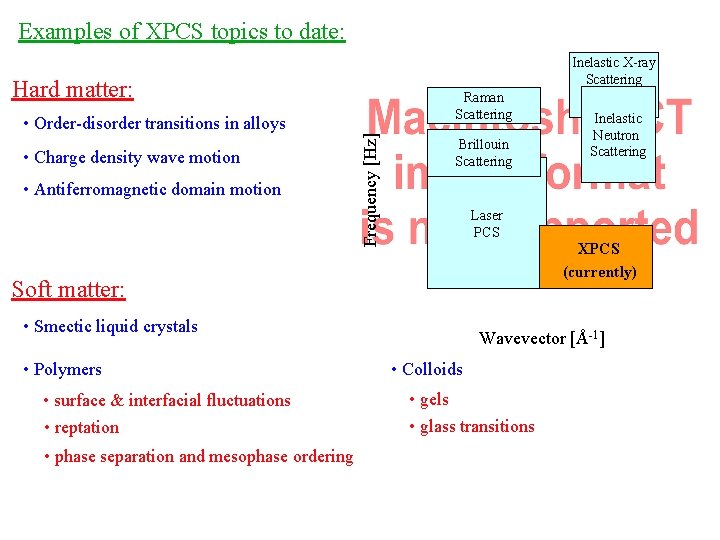
Examples of XPCS topics to date: Inelastic X-ray Scattering Hard matter: Raman Scattering • Charge density wave motion • Antiferromagnetic domain motion Frequency [Hz] • Order-disorder transitions in alloys Brillouin Scattering Laser PCS XPCS (currently) Soft matter: • Smectic liquid crystals • Polymers • surface & interfacial fluctuations • reptation • phase separation and mesophase ordering Inelastic Neutron Scattering Wavevector [Å-1] • Colloids • gels • glass transitions
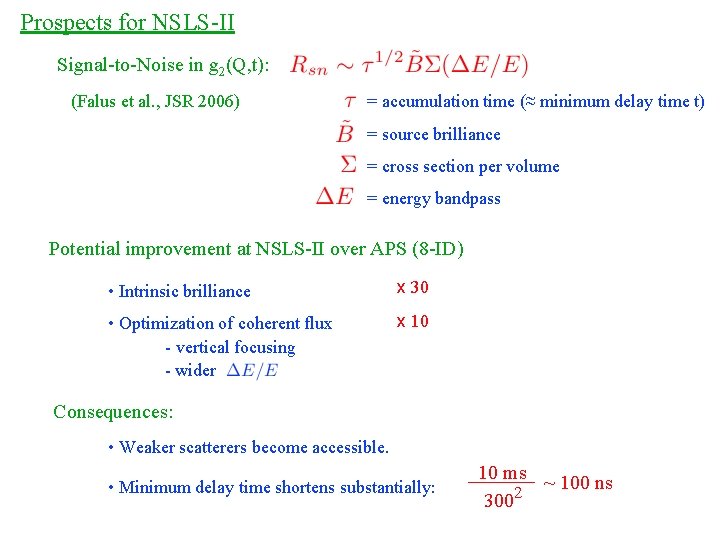
Prospects for NSLS-II Signal-to-Noise in g 2(Q, t): (Falus et al. , JSR 2006) = accumulation time (≈ minimum delay time t) = source brilliance = cross section per volume = energy bandpass Potential improvement at NSLS-II over APS (8 -ID) • Intrinsic brilliance x 30 • Optimization of coherent flux - vertical focusing - wider x 10 Consequences: • Weaker scatterers become accessible. • Minimum delay time shortens substantially: 10 ms ~ 100 ns 2 300
![Inelastic X-ray Scattering Frequency [Hz] Raman Scattering Brillouin Scattering Laser PCS Inelastic Neutron Scattering](http://slidetodoc.com/presentation_image/1059ba4f2113b5fe3de3d9509077c307/image-5.jpg "Inelastic X-ray Scattering Frequency [Hz] Raman Scattering Brillouin Scattering Laser PCS Inelastic Neutron Scattering")
Inelastic X-ray Scattering Frequency [Hz] Raman Scattering Brillouin Scattering Laser PCS Inelastic Neutron Scattering Overlap with Neutron Spin Echo in reach! S(Q, t) from 10 -11 s < t < 104 s Projected for NSLS-II XPCS Wavevector [Å-1] What occurs in 100 ns? E. g. , a 6 nm sphere in water diffuses its diameter Nanoscale dynamics in aqueous solution become accessible to XPCS Suggests studies of: • nanoparticle motion/self-assembly in low-viscosity solutions in bulk and on surfaces • biologically relevant systems
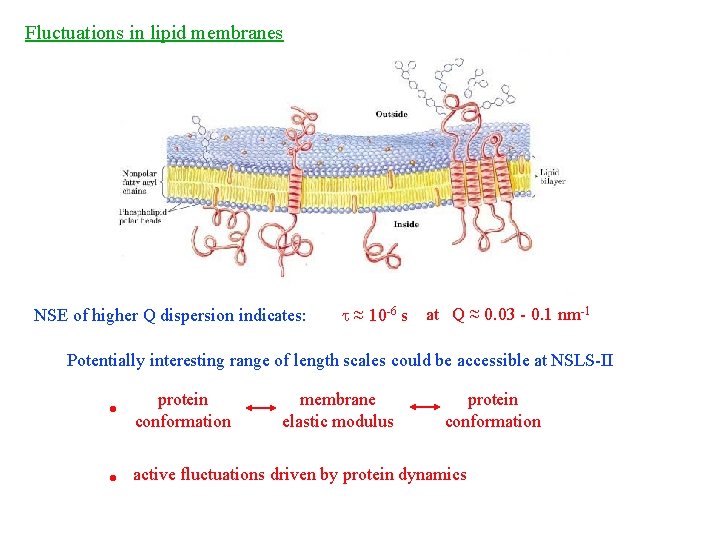
Fluctuations in lipid membranes NSE of higher Q dispersion indicates: t ≈ 10 -6 s at Q ≈ 0. 03 - 0. 1 nm-1 Potentially interesting range of length scales could be accessible at NSLS-II • protein conformation membrane elastic modulus protein conformation • active fluctuations driven by protein dynamics
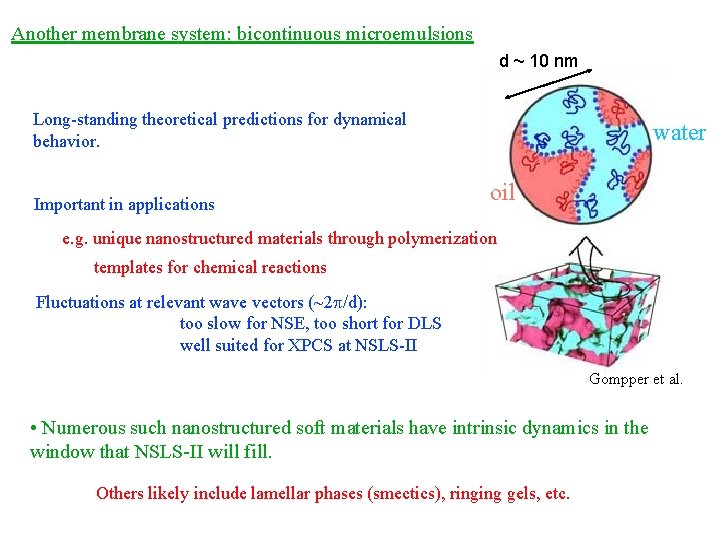
Another membrane system: bicontinuous microemulsions d ~ 10 nm Long-standing theoretical predictions for dynamical behavior. Important in applications water oil e. g. unique nanostructured materials through polymerization templates for chemical reactions Fluctuations at relevant wave vectors (~2 p/d): too slow for NSE, too short for DLS well suited for XPCS at NSLS-II Gompper et al. • Numerous such nanostructured soft materials have intrinsic dynamics in the window that NSLS-II will fill. Others likely include lamellar phases (smectics), ringing gels, etc.
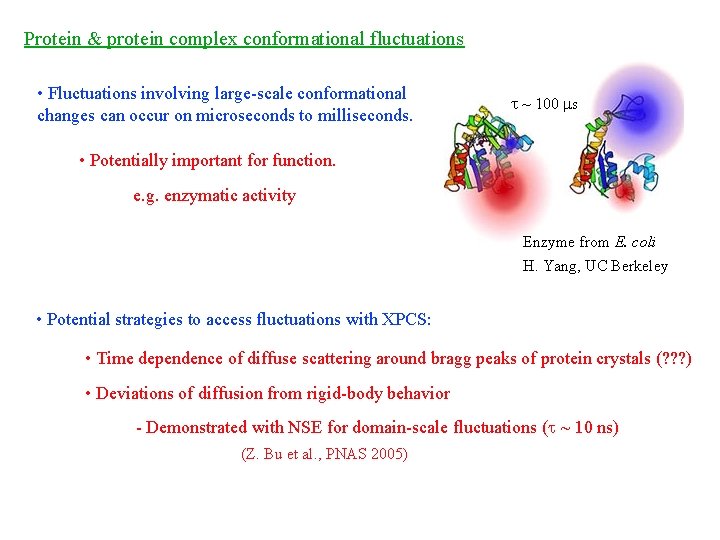
Protein & protein complex conformational fluctuations • Fluctuations involving large-scale conformational changes can occur on microseconds to milliseconds. t ~ 100 ms • Potentially important for function. e. g. enzymatic activity Enzyme from E. coli H. Yang, UC Berkeley • Potential strategies to access fluctuations with XPCS: • Time dependence of diffuse scattering around bragg peaks of protein crystals (? ? ? ) • Deviations of diffusion from rigid-body behavior - Demonstrated with NSE for domain-scale fluctuations (t ~ 10 ns) (Z. Bu et al. , PNAS 2005)
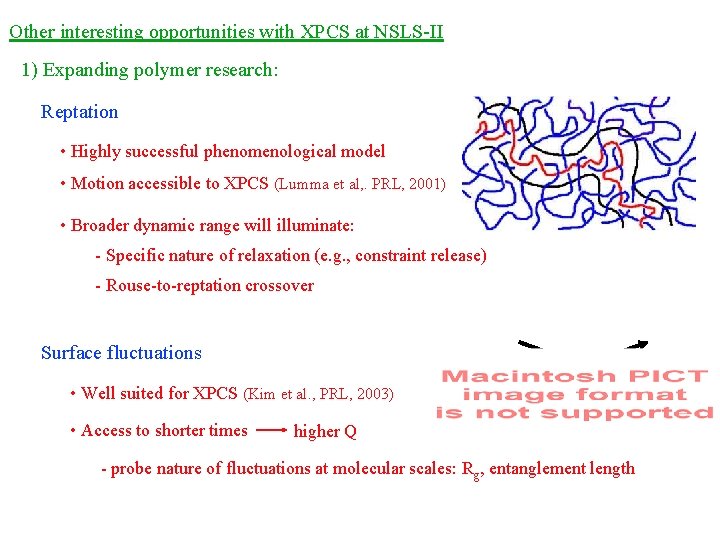
Other interesting opportunities with XPCS at NSLS-II 1) Expanding polymer research: Reptation • Highly successful phenomenological model • Motion accessible to XPCS (Lumma et al, . PRL, 2001) • Broader dynamic range will illuminate: - Specific nature of relaxation (e. g. , constraint release) - Rouse-to-reptation crossover Surface fluctuations • Well suited for XPCS (Kim et al. , PRL, 2003) • Access to shorter times higher Q - probe nature of fluctuations at molecular scales: Rg, entanglement length
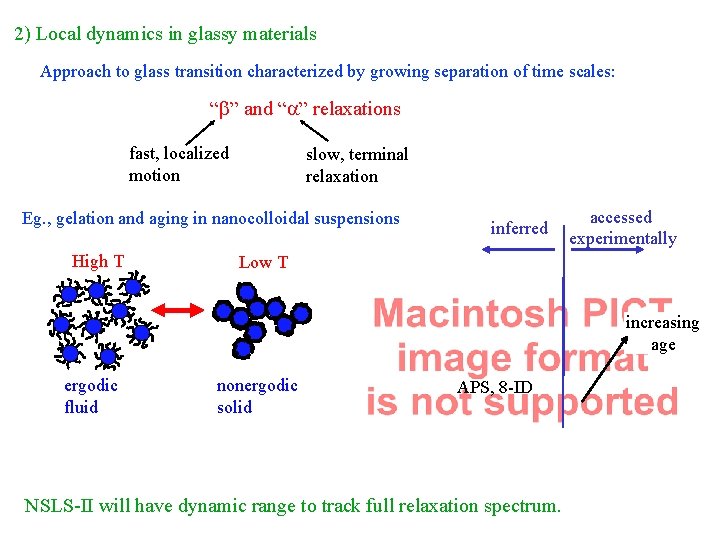
2) Local dynamics in glassy materials Approach to glass transition characterized by growing separation of time scales: “b” and “a” relaxations fast, localized motion slow, terminal relaxation Eg. , gelation and aging in nanocolloidal suspensions High T inferred accessed experimentally Low T increasing age ergodic fluid nonergodic solid APS, 8 -ID NSLS-II will have dynamic range to track full relaxation spectrum.
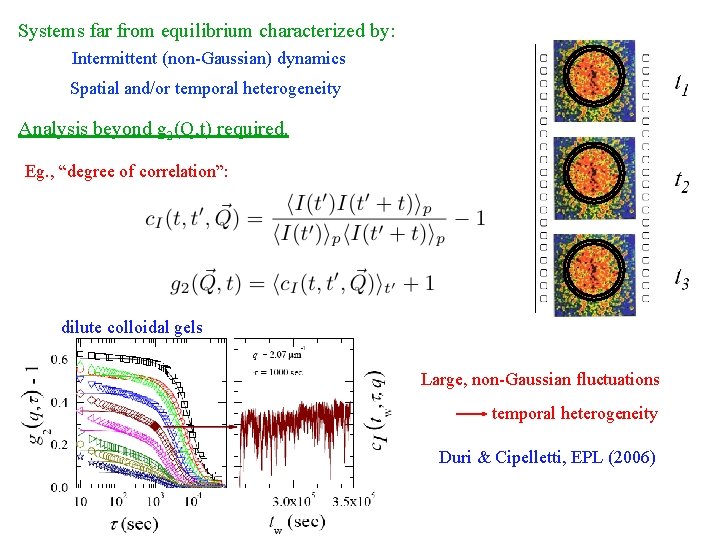
Systems far from equilibrium characterized by: Intermittent (non-Gaussian) dynamics Spatial and/or temporal heterogeneity Analysis beyond g 2(Q, t) required. Eg. , “degree of correlation”: dilute colloidal gels Large, non-Gaussian fluctuations temporal heterogeneity Duri & Cipelletti, EPL (2006)
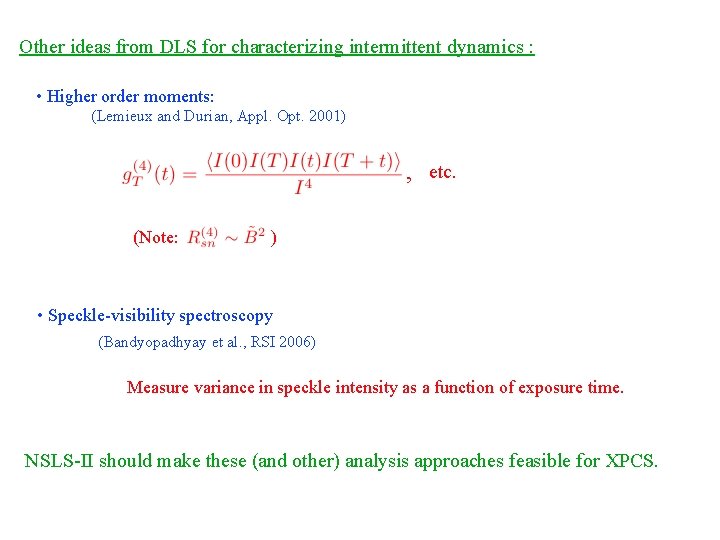
Other ideas from DLS for characterizing intermittent dynamics : • Higher order moments: (Lemieux and Durian, Appl. Opt. 2001) , etc. (Note: ) • Speckle-visibility spectroscopy (Bandyopadhyay et al. , RSI 2006) Measure variance in speckle intensity as a function of exposure time. NSLS-II should make these (and other) analysis approaches feasible for XPCS.
Conclusion NSLS-II will revolutionize XPCS. But, Realizing many of these advancements will require a corresponding improvement in detector technology…
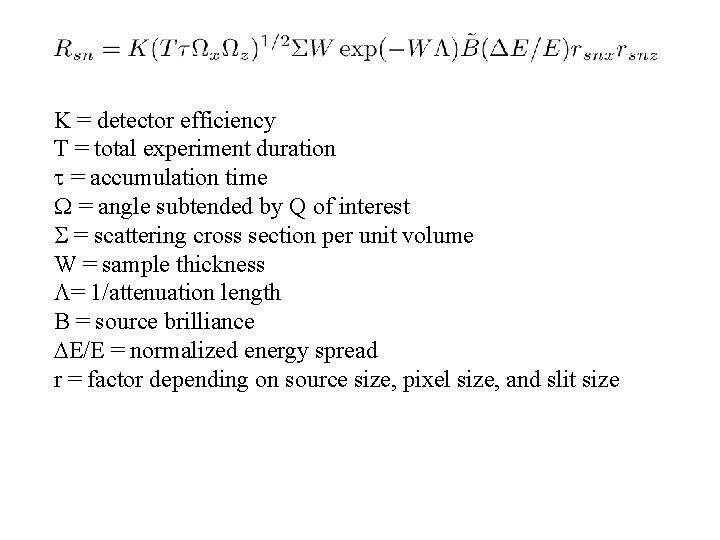
K = detector efficiency T = total experiment duration t = accumulation time W = angle subtended by Q of interest S = scattering cross section per unit volume W = sample thickness L= 1/attenuation length B = source brilliance DE/E = normalized energy spread r = factor depending on source size, pixel size, and slit size
- Slides: 14