
XML e Xtensible Markup Language Charles A Bradsher
XML e. Xtensible Markup Language Charles A. Bradsher Defense Technical Information Center
• • • e. Xtensible Markup Language World Wide Web Consortium (W 3 C) I. E. Legal XML Query. XML, Voice XML Promotes business to business exchange (B 2 B) Does not describe Formatting -It’s about content • Uses any kind of information any kind of content
<27573>
What is XML? • e. Xtensible - By applying Identifiers for elements of information in a neutral way, stored in a neutral form, independent of systems, devices and applications. • Markup - For adding information to a document relating to its structure and/or content.
What is XML? • Language - A standard methodology with formal syntax……. . However • XML is not a language but a toolkit for developing or defining languages • A common syntax for expressing structure in data
How are SGML, HTML & XML Related? • Standard Generalized Markup Language • HTML is an application of SGML • XML is a subset of SGML
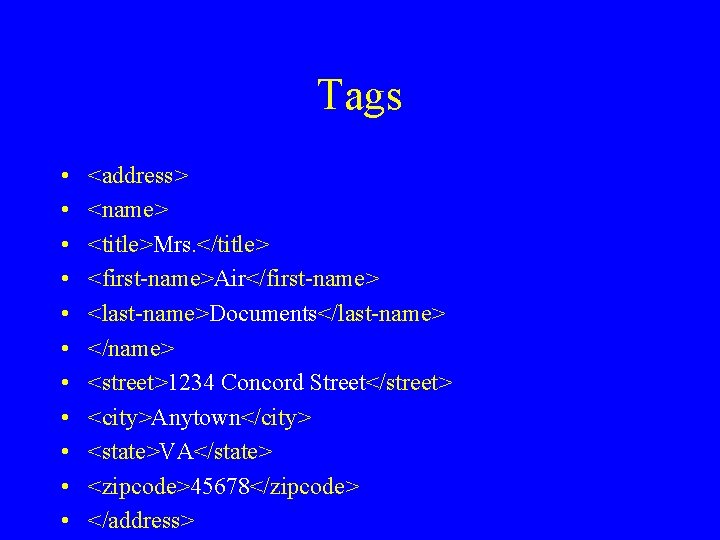
Tags • • • <address> <name> <title>Mrs. </title> <first-name>Air</first-name> <last-name>Documents</last-name> </name> <street>1234 Concord Street</street> <city>Anytown</city> <state>VA</state> <zipcode>45678</zipcode> </address>
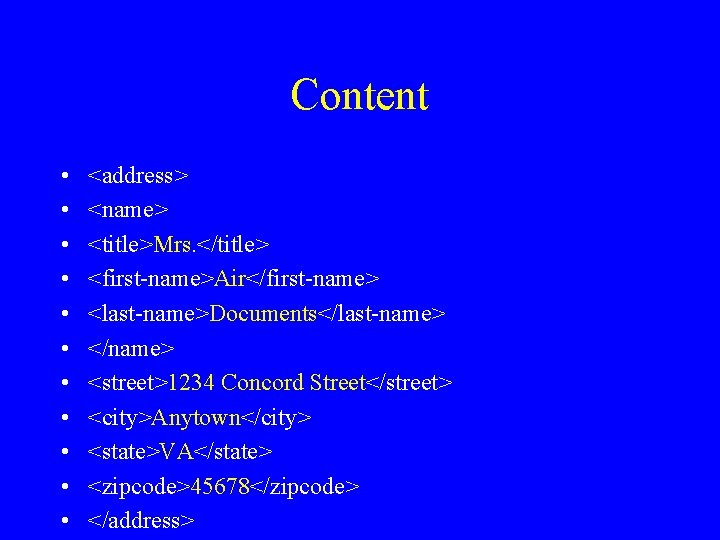
Content • • • <address> <name> <title>Mrs. </title> <first-name>Air</first-name> <last-name>Documents</last-name> </name> <street>1234 Concord Street</street> <city>Anytown</city> <state>VA</state> <zipcode>45678</zipcode> </address>
XML is Tags and Content A Hierarchical Data Representation A Tree Structure Data Representation
Why Do We Need XML? • Interoperability • Info can be separated from the way it is presented • Information can be presented in a variety of ways depending on the device the end user has.
Why Do We Need XML? • Future Web developments hinge on the use of XML W 3 C – Dependence on a single, inflexible document type (HTML) which was being abused for task for which it was never designed – SGML was too complex to fill the gap
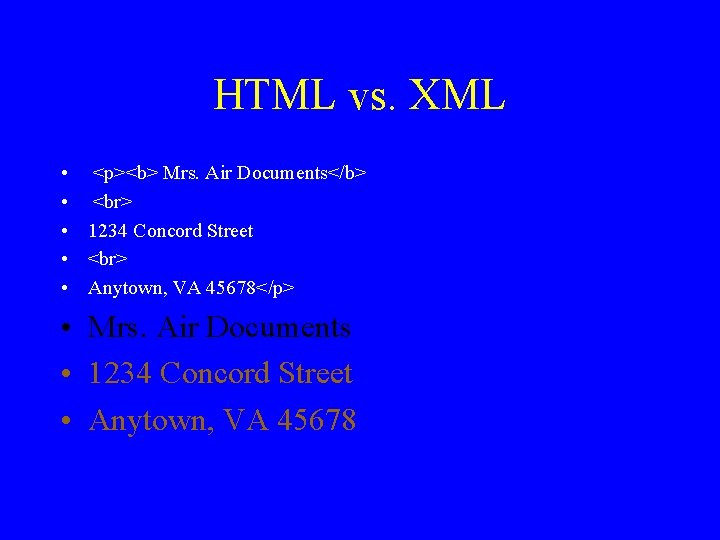
HTML vs. XML • <p><b> Mrs. Air Documents</b> • • 1234 Concord Street • • Anytown, VA 45678</p> • Mrs. Air Documents • 1234 Concord Street • Anytown, VA 45678
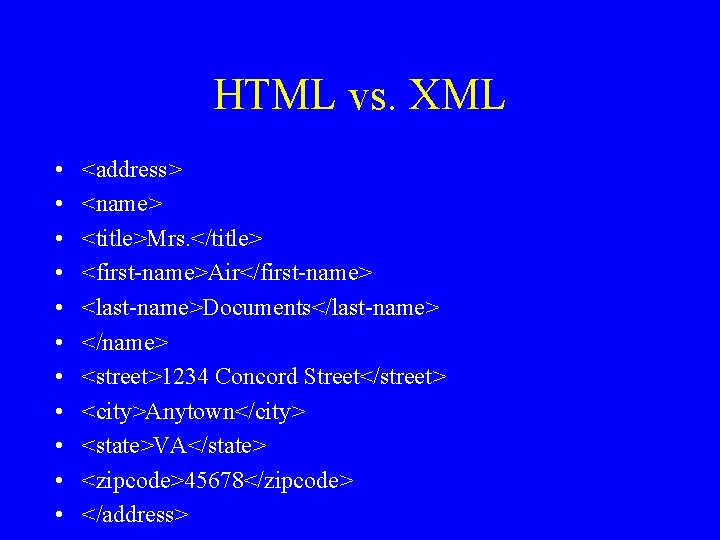
HTML vs. XML • • • <address> <name> <title>Mrs. </title> <first-name>Air</first-name> <last-name>Documents</last-name> </name> <street>1234 Concord Street</street> <city>Anytown</city> <state>VA</state> <zipcode>45678</zipcode> </address>
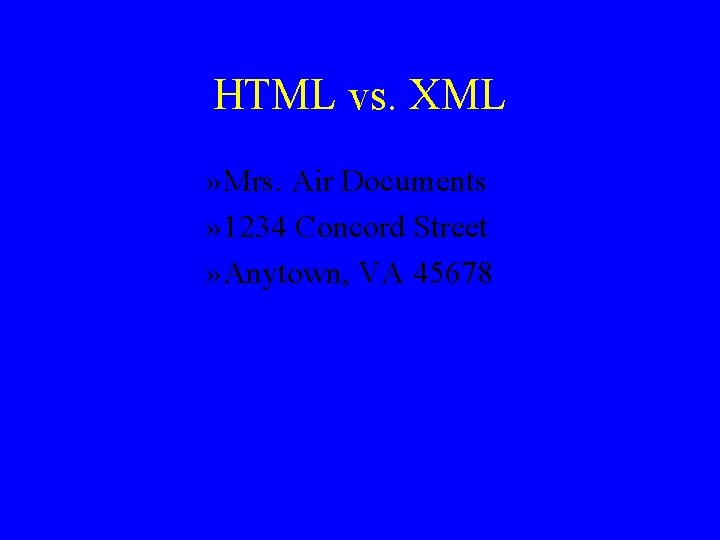
HTML vs. XML » Mrs. Air Documents » 1234 Concord Street » Anytown, VA 45678
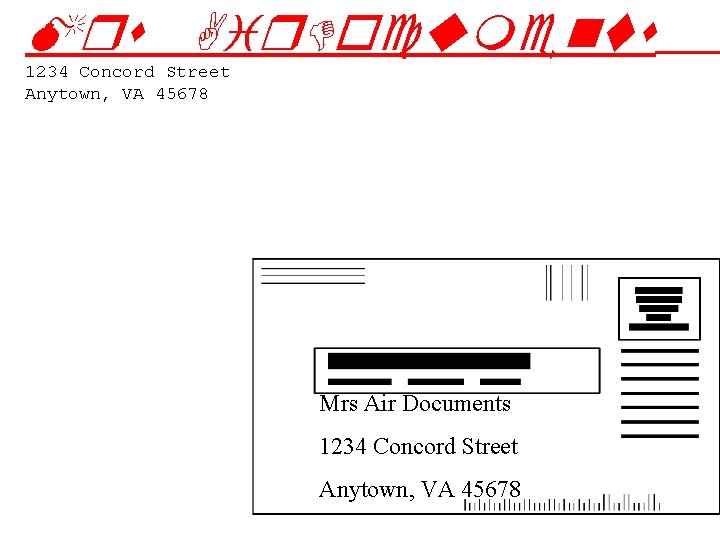
Mrs Air. Documents 1234 Concord Street Anytown, VA 45678 Mrs Air Documents 1234 Concord Street Anytown, VA 45678
OMB’s 24 e-government Initiatives
Why is XML Important? • Does not need a specific application • Perpetual preservation of Information • Could be future standardized mechanism for the exchange of data
How Does It Work? • XML Parser • XML Processor • XML does not provide an application programming interface (API). ( Just passes data to the application)
What is a DTD? • DTD - Document Type Definition • A set of syntax rules for tags – What tags you can use in a document – Where the tags appear – Which tags can appear inside other tags – A set of constraints for documents
DTD vs. Schema • DTD content models are closed and can’t reflect the openness XML supports. • DTD doesn’t support data types beyond the 10 primitive types. • It can’t express rich data types allowed in XML Schema
Schema • Microsoft proposed an alternative approach to DTDs called schema – Like DTDs, schema provide the rules of a document and indicate what tags are used. – Unlike DTDs, schema can define data types. – Designed to replace and amplify DTDs
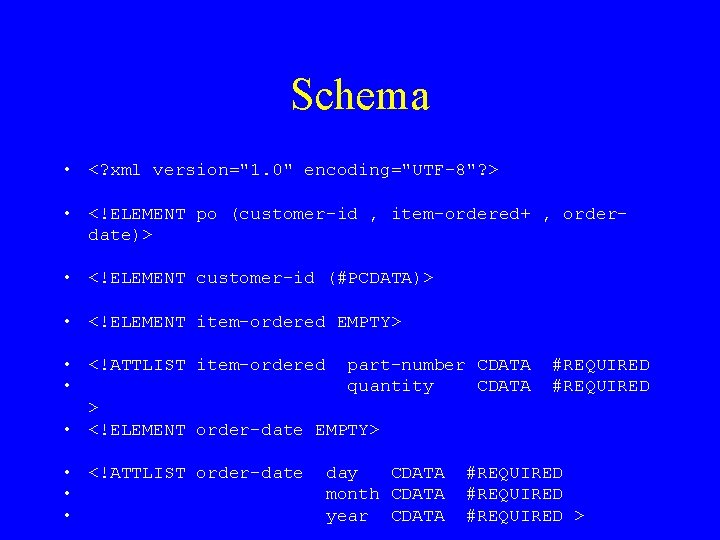
Schema • <? xml version="1. 0" encoding="UTF-8"? > • <!ELEMENT po (customer-id , item-ordered+ , orderdate)> • <!ELEMENT customer-id (#PCDATA)> • <!ELEMENT item-ordered EMPTY> • <!ATTLIST item-ordered part-number CDATA • quantity CDATA > • <!ELEMENT order-date EMPTY> • <!ATTLIST order-date • • day CDATA month CDATA year CDATA #REQUIRED #REQUIRED >
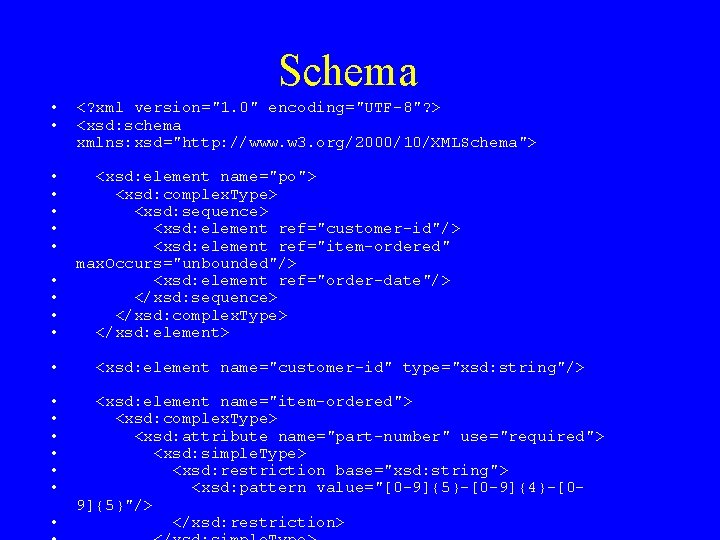
Schema • • <? xml version="1. 0" encoding="UTF-8"? > <xsd: schema xmlns: xsd="http: //www. w 3. org/2000/10/XMLSchema"> • • • <xsd: element name="po"> <xsd: complex. Type> <xsd: sequence> <xsd: element ref="customer-id"/> <xsd: element ref="item-ordered" max. Occurs="unbounded"/> <xsd: element ref="order-date"/> </xsd: sequence> </xsd: complex. Type> </xsd: element> • • • <xsd: element name="customer-id" type="xsd: string"/> • • • <xsd: element name="item-ordered"> <xsd: complex. Type> <xsd: attribute name="part-number" use="required"> <xsd: simple. Type> <xsd: restriction base="xsd: string"> <xsd: pattern value="[0 -9]{5}-[0 -9]{4}-[09]{5}"/> </xsd: restriction> •
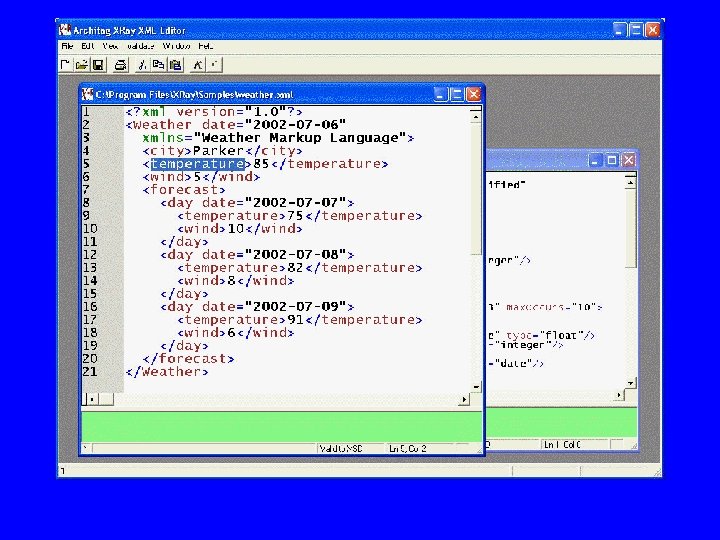
Schema
Schema • Example – A DTD might have a tag designated as <PRICE>, but the content contained within that tag could be a number or a character string. A schema would force you to enter a number. • DTD <$8. 00 or eight dollars> • Schema <$8. 00>
Stylesheets • Provides hints and algorithms for rendering or transforming the data in the XML document. • XSLT Extensible Stylesheet Language can transform from one XML format to another including HTML or plain text.
For More XML Information: • For basic Information on XML: http: //www. xml. org/xml/resources_focus_b eginnerguide. shtml • W 3 C: http: //www. w 3. org/ • Robin Cover's extensive list of online reference material and links to software: http: //xml. coverpages. org/
QUESTIONS?
- Slides: 28