
XMASS experiment S Moriyama for the XMASS collaboration
XMASS experiment S. Moriyama for the XMASS collaboration Kamioka Observatory, ICRR, University of Tokyo 8 th September 2004 @ IDM 2004 n Ultra-low BG, multi-purpose detector n 3 kg fiducial volume (FV) prototype detector n 1 ton (100 kg FV) detector for DM Search
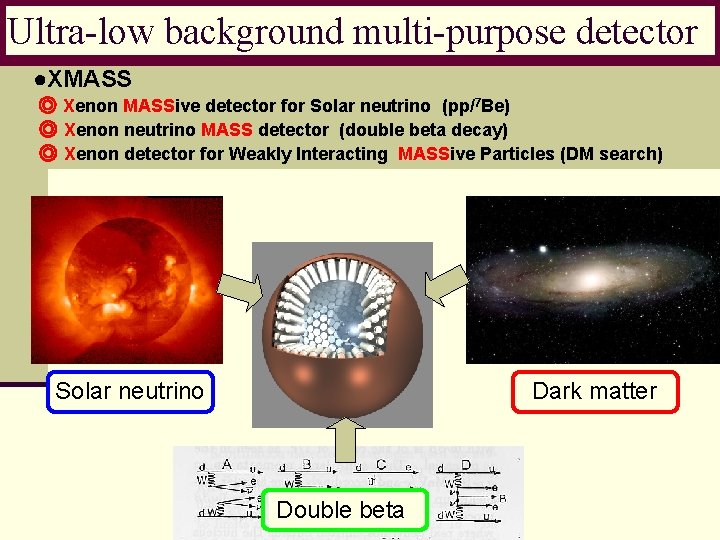
Ultra-low background multi-purpose detector ●XMASS ◎ Xenon MASSive detector for Solar neutrino (pp/7 Be) ◎ Xenon neutrino MASS detector (double beta decay) ◎ Xenon detector for Weakly Interacting MASSive Particles (DM search) Solar neutrino Dark matter Double beta
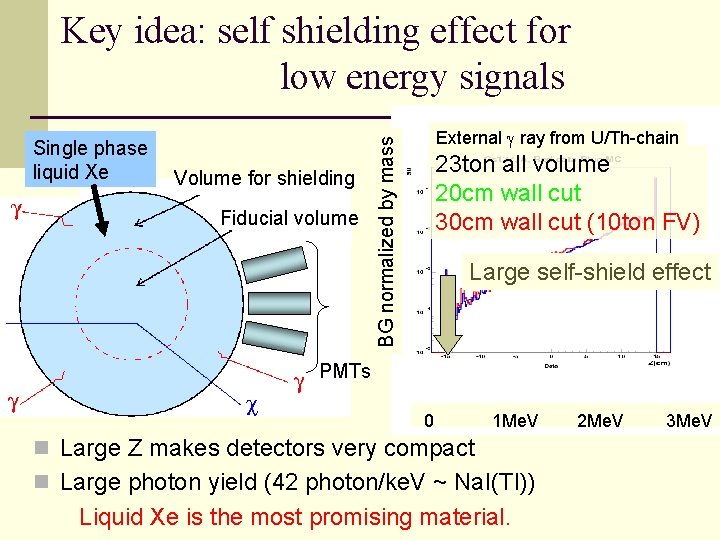
Key idea: self shielding effect for low energy signals Volume for shielding Fiducial volume External g ray from U/Th-chain BG normalized by mass Single phase liquid Xe 23 ton all volume 20 cm wall cut 30 cm wall cut (10 ton FV) Large self-shield effect PMTs 0 1 Me. V n Large Z makes detectors very compact n Large photon yield (42 photon/ke. V ~ Na. I(Tl)) Liquid Xe is the most promising material. 2 Me. V 3 Me. V
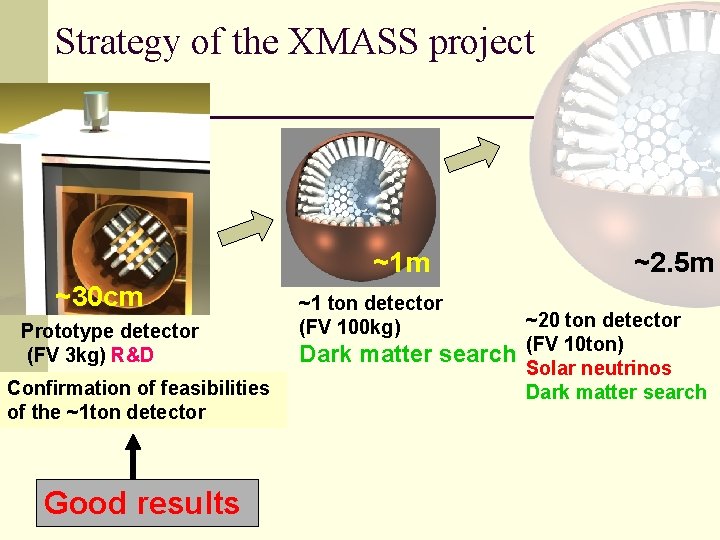
Strategy of the XMASS project ~1 m ~30 cm Prototype detector (FV 3 kg) R&D Confirmation of feasibilities of the ~1 ton detector Good results ~1 ton detector (FV 100 kg) Dark matter search ~2. 5 m ~20 ton detector (FV 10 ton) Solar neutrinos Dark matter search
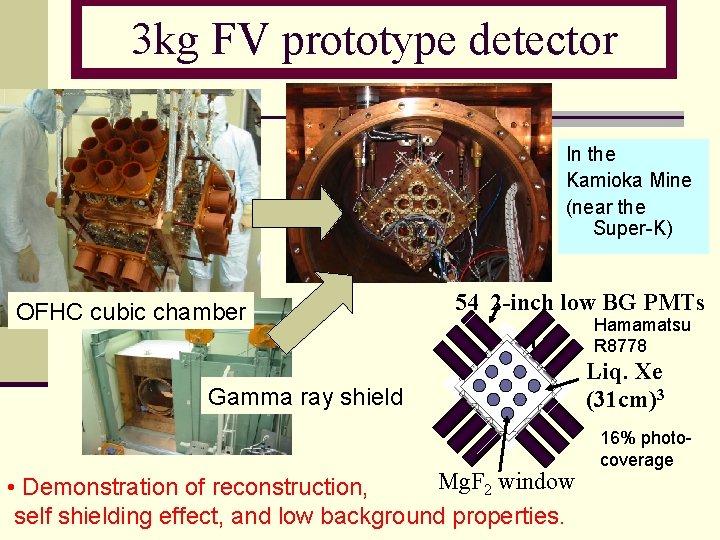
3 kg FV prototype detector In the Kamioka Mine (near the Super-K) OFHC cubic chamber 54 2 -inch low BG PMTs Gamma ray shield Mg. F 2 window • Demonstration of reconstruction, self shielding effect, and low background properties. Hamamatsu R 8778 Liq. Xe (31 cm)3 16% photocoverage
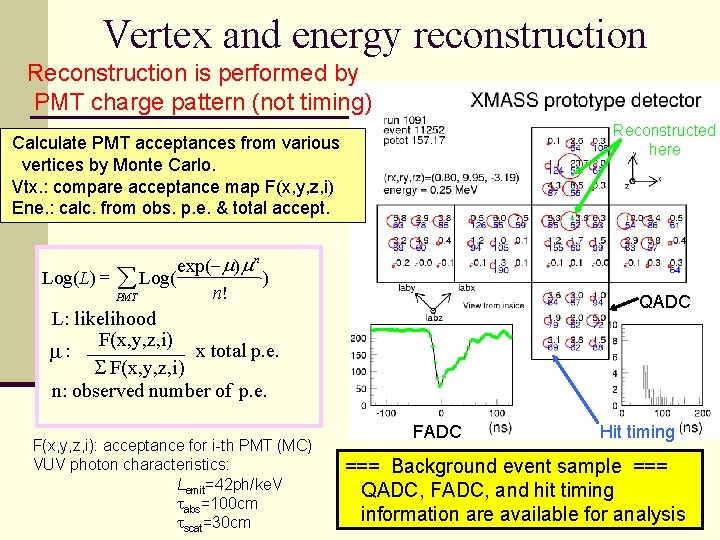
Vertex and energy reconstruction Reconstruction is performed by PMT charge pattern (not timing) Reconstructed here Calculate PMT acceptances from various vertices by Monte Carlo. Vtx. : compare acceptance map F(x, y, z, i) Ene. : calc. from obs. p. e. & total accept. exp(- m ) m n Log(L) = å Log( ) n ! PMT QADC L: likelihood F(x, y, z, i) x total p. e. m: S F(x, y, z, i) n: observed number of p. e. F(x, y, z, i): acceptance for i-th PMT (MC) VUV photon characteristics: Lemit=42 ph/ke. V tabs=100 cm tscat=30 cm FADC Hit timing === Background event sample === QADC, FADC, and hit timing information are available for analysis
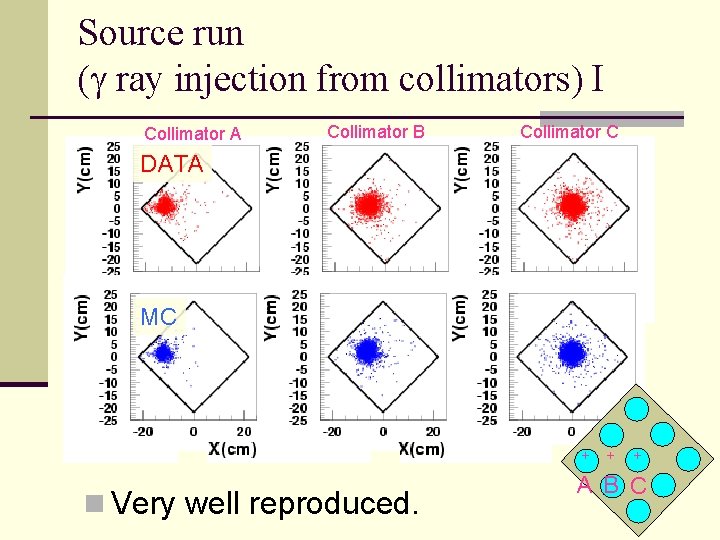
Source run (g ray injection from collimators) I Collimator A Collimator B Collimator C DATA MC + + n Very well reproduced. + A B C
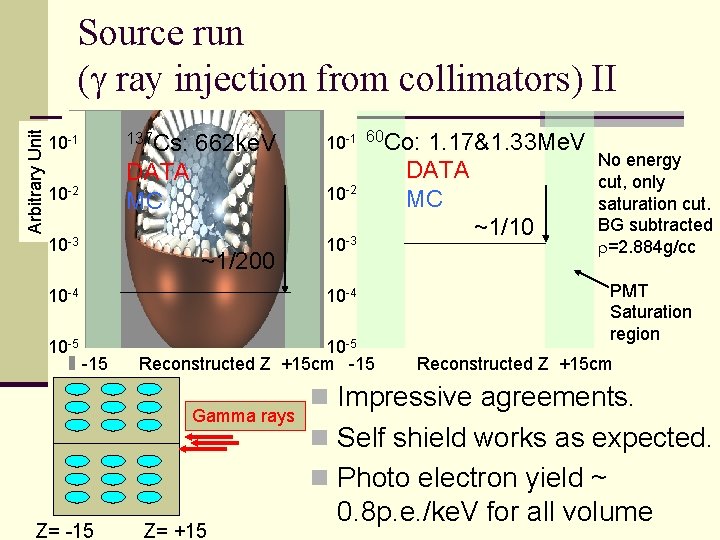
Arbitrary Unit Source run (g ray injection from collimators) II 137 Cs: 10 -1 662 ke. V DATA MC 10 -2 10 -3 10 -2 ~1/200 10 -3 1. 17&1. 33 Me. V DATA MC ~1/10 No energy cut, only saturation cut. BG subtracted r=2. 884 g/cc PMT Saturation region 10 -4 10 -5 10 -1 60 Co: -15 10 -5 Reconstructed Z +15 cm -15 Gamma rays Reconstructed Z +15 cm n Impressive agreements. n Self shield works as expected. n Photo electron yield ~ Z= -15 Z= +15 0. 8 p. e. /ke. V for all volume
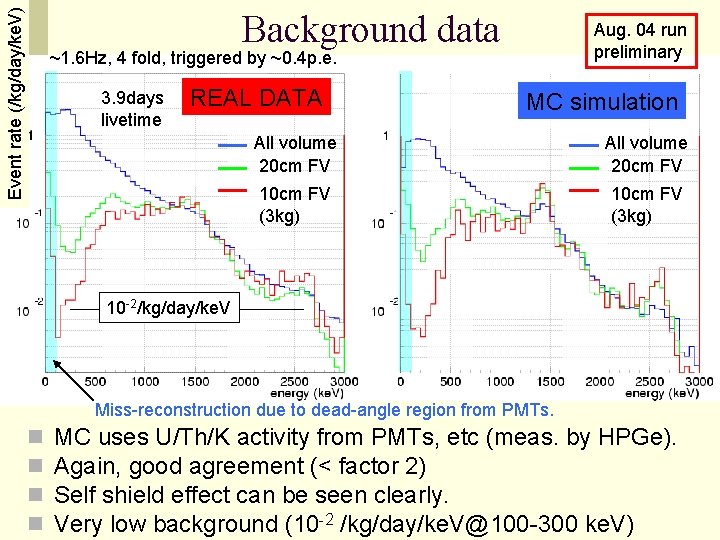
Event rate (/kg/day/ke. V) Background data Aug. 04 run preliminary ~1. 6 Hz, 4 fold, triggered by ~0. 4 p. e. 3. 9 days livetime REAL DATA MC simulation All volume 20 cm FV 10 cm FV (3 kg) 10 -2/kg/day/ke. V Miss-reconstruction due to dead-angle region from PMTs. n n MC uses U/Th/K activity from PMTs, etc (meas. by HPGe). Again, good agreement (< factor 2) Self shield effect can be seen clearly. Very low background (10 -2 /kg/day/ke. V@100 -300 ke. V)
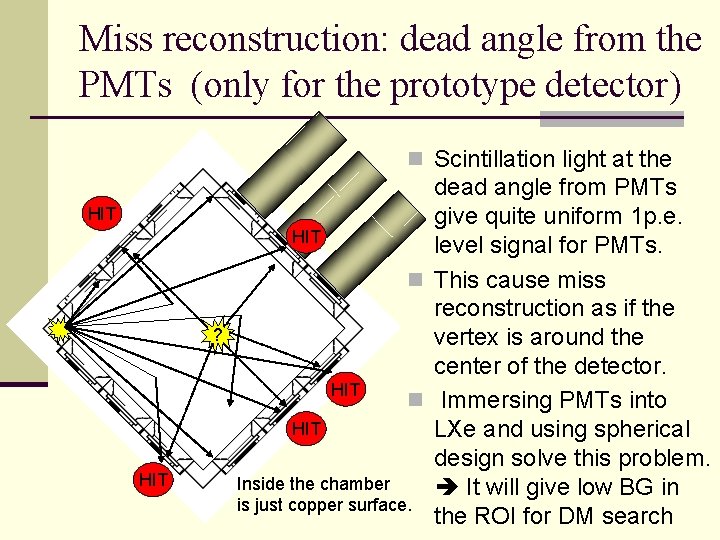
Miss reconstruction: dead angle from the PMTs (only for the prototype detector) n Scintillation light at the HIT ? HIT dead angle from PMTs give quite uniform 1 p. e. HIT level signal for PMTs. n This cause miss reconstruction as if the vertex is around the center of the detector. HIT n Immersing PMTs into HIT LXe and using spherical design solve this problem. Inside the chamber It will give low BG in is just copper surface. the ROI for DM search
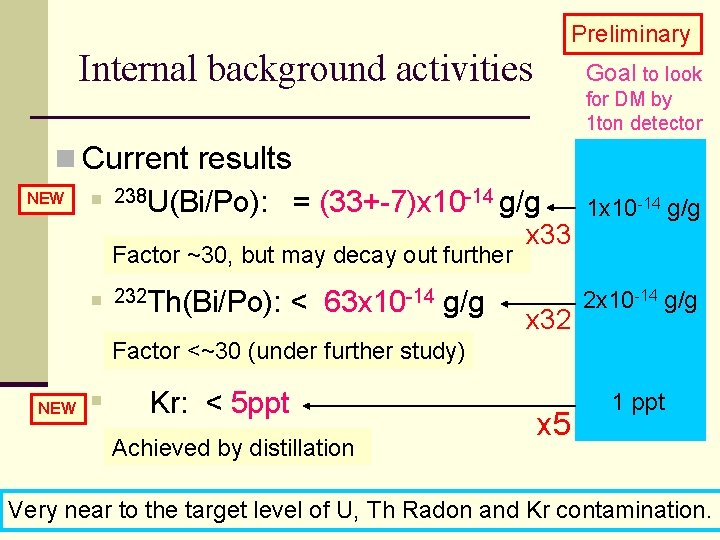
Preliminary Internal background activities Goal to look for DM by 1 ton detector n Current results NEW n 238 U(Bi/Po): = (33+-7)x 10 -14 g/g 1 x 10 -14 g/g x 33 Factor ~30, but may decay out further n 232 Th(Bi/Po): < 63 x 10 -14 g/g x 32 2 x 10 -14 g/g Factor <~30 (under further study) NEW n Kr: < 5 ppt Achieved by distillation x 5 1 ppt Very near to the target level of U, Th Radon and Kr contamination.
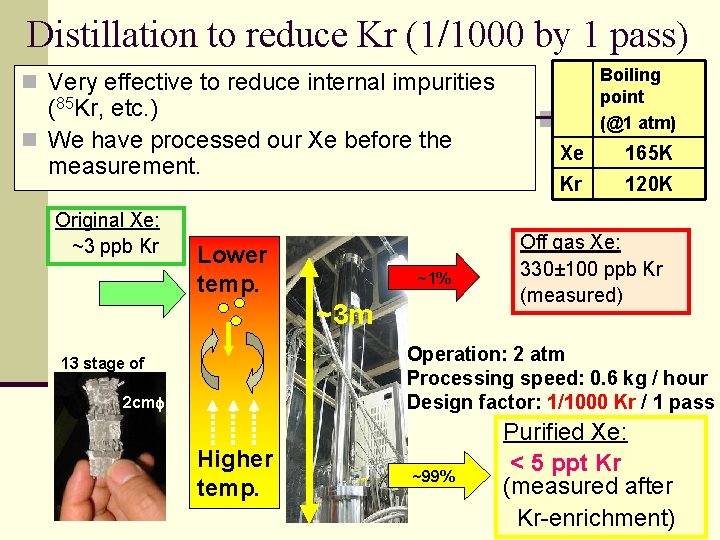
Distillation to reduce Kr (1/1000 by 1 pass) Boiling point (@1 atm) n Very effective to reduce internal impurities (85 Kr, etc. ) n We have processed our Xe before the measurement. Original Xe: ~3 ppb Kr Lower temp. ~1% ~3 m Xe 165 K Kr 120 K Off gas Xe: 330± 100 ppb Kr (measured) Operation: 2 atm Processing speed: 0. 6 kg / hour Design factor: 1/1000 Kr / 1 pass 13 stage of 2 cmf Higher temp. ~99% Purified Xe: < 5 ppt Kr (measured after Kr-enrichment)

1 ton (100 kg FV) detector for DM Search Solve the miss reconst. prob. immerse PMTs into LXe Ext. g BG: from PMT’s Self-shield effect demonstrated Int. BG: Kr (distillation), Radon Almost achieved Neutron: water or LS active shield (1/104) To be studied “Full” photo-sensitive, “Spherical” geometry detector external g ray (60 cm, 346 kg) external g ray: 8 x 10 -5/ke. V/kg/d (40 cm, 100 kg ) /kg/day/ke. V n n Achieved 7 Be 80 cm dia. ~800 -2” PMTs (1/10 Low BG) 70% photo-coverage ~5 p. e. /ke. Vee Dark matter (10 -6 pb, 50 Ge. V, 100 Ge. V) Q. F. = 0. 2 assumed pp 0 100 200 Energy(ke. Vee)
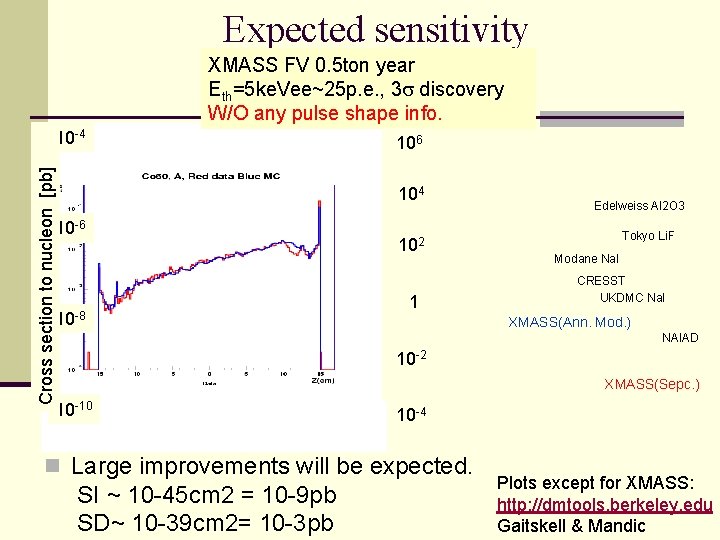
Expected sensitivity XMASS FV 0. 5 ton year Eth=5 ke. Vee~25 p. e. , 3 s discovery W/O any pulse shape info. Cross section to nucleon [pb] 10 -4 106 104 10 -6 10 -8 102 1 Edelweiss Al 2 O 3 Tokyo Li. F Modane Na. I CRESST UKDMC Na. I XMASS(Ann. Mod. ) NAIAD 10 -2 XMASS(Sepc. ) 10 -10 10 -4 n Large improvements will be expected. SI ~ 10 -45 cm 2 = 10 -9 pb SD~ 10 -39 cm 2= 10 -3 pb Plots except for XMASS: http: //dmtools. berkeley. edu Gaitskell & Mandic
Summary n XMASS project: DM search with 100 kg FV LXe. n R&D by 3 kg FV prototype is well going Demonstration of reconstruction, self shield, and low BG properties. n Ext g rays: 10 -2 /kg/day/ke. V further self shield Kr: <5 ppt requirement almost achieved. Radon (U) (33+-7)10 -14 g/g (Th) < 63 10 -14 g/g O(1/30) reduction is enough for 1 ton det. n Further study for neutron is needed. Within a few years, we are planning to build the 100 kg FV detector and start to search for DM!
- Slides: 15