
XIXth International Congress of the International Association for


- Slides: 22
XIXth International Congress of the International Association for Cross-Cultural Psychology, July 27 -31, 2008, Bremen, Germany Chirkov & Boski Symposium: Reflection on and analysis of current acculturation research in psychology July 2008 (c) Weinreich 2008 'Enculturation' not. . .
‘Enculturation’, not ‘acculturation’: Conceptualizing and assessing identity processes in migrant communities Peter Weinreich University of Ulster United Kingdom p. weinreich@ulster. ac. uk July 2008 (c) Weinreich 2008 'Enculturation' not. . . 2
Berry’s acculturation model n n n Berry’s model of ‘acculturation strategies’ is well-known and widely acclaimed: ‘integration’ ‘assimilation’ ‘separation’ ‘marginalisation’ July 2008 (c) Weinreich 2008 'Enculturation' not. . . 3
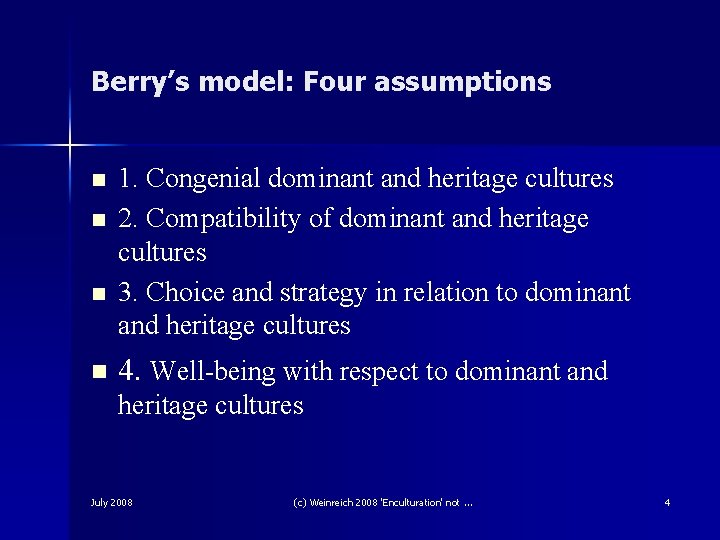
Berry’s model: Four assumptions n n 1. Congenial dominant and heritage cultures 2. Compatibility of dominant and heritage cultures 3. Choice and strategy in relation to dominant and heritage cultures 4. Well-being with respect to dominant and heritage cultures July 2008 (c) Weinreich 2008 'Enculturation' not. . . 4
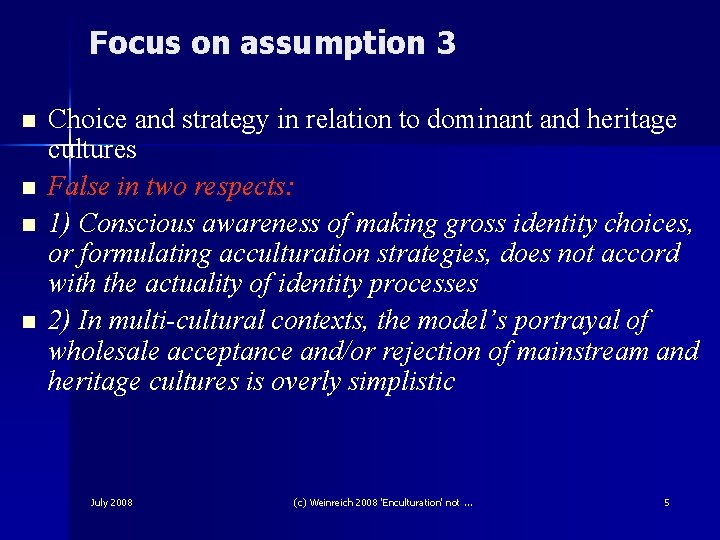
Focus on assumption 3 n n Choice and strategy in relation to dominant and heritage cultures False in two respects: 1) Conscious awareness of making gross identity choices, or formulating acculturation strategies, does not accord with the actuality of identity processes 2) In multi-cultural contexts, the model’s portrayal of wholesale acceptance and/or rejection of mainstream and heritage cultures is overly simplistic July 2008 (c) Weinreich 2008 'Enculturation' not. . . 5
Beyond critique n n ‘Heritage culture’ and ‘ethnic identity’ Ethnicity and ethnic identity consist of complex agentic processes in socio-historical contexts: more than a heritage culture of artefacts The psychology of identity processes Comprehending migration and ethnic identity in multicultural contexts requires an awareness of identity development and reformulation July 2008 (c) Weinreich 2008 'Enculturation' not. . . 6
Ethnic identity n Definition: n One’s ethnic identity is defined as that part of the totality of one’s self-construal made up of those dimensions that express the continuity between one’s construal of past ancestry and one’s future aspirations in relation to ethnicity July 2008 (c) Weinreich 2008 'Enculturation' not. . . 7
Persistence of ethnic identity n Long-term persistence of ethnic identity that involves psychological and societal processes that are in the political arena n Contested, updated and reformulated in sociohistorical contexts, but with a long-term intergenerational time-span from ancestry to progeny, with contrasting orientations July 2008 (c) Weinreich 2008 'Enculturation' not. . . 8
Alternative perspectives on ethnic identity n ‘Primordialist sentiments’ contrasted with ‘situationalist perspectives’ n Developmental psychological processes accord primacy to primordialist sentiments, such that those who subsequently adopt situationalist perspectives are in contestation with those who remain primordialist n Weinreich, Bacova & Rougier (2003) July 2008 (c) Weinreich 2008 'Enculturation' not. . . 9
Ramifications for Berry’s model primordialist ethnicity: ‘separation’ ? n n Developmental primacy of primordialist sentiments about ethnicity has profound ramifications for Berry’s notions of choices or strategies in respect of dominant and heritage cultures For those with primordialist sentiments, a resolute emotive orientation, choice is not an option [‘separation’ category? ] July 2008 (c) Weinreich 2008 'Enculturation' not. . . 10
Ramifications - primordialist ethnicity: ‘well-being’ n n n Primordialists tend to have the highest self-regard, such that those holding to community-encapsulated ethnic identity tend to have the greater sense of positive self-regard Their close identification with their own ethnicity modulates little according to mainstream or heritage context Kelly (1989) July 2008 (c) Weinreich 2008 'Enculturation' not. . . 11
Ramifications for Berry’s model situationalist ethnicity: ‘integration’ ? n n n Situationalists have progressed beyond restrictive primordial sentiments, and are sensitive to alternative views-of-theworld They could be considered as fitting into Berry’s ‘integration’ category, except that they 1) have not altogether relinquished the substratum of primordialist sentiment 2) modulate their identification with mainstream and heritage cultures according to social contexts They too rarely make choices or adopt strategies in respect of the dominant and heritage cultures July 2008 (c) Weinreich 2008 'Enculturation' not. . . 12
Ramifications – situationalist ethnicity: ‘well-being’ n n n Situationalists’ flexible adaptability carries a cost in diminished self-regard and greater stress, contrary to Berry’s view that the ‘integration’ category is the best in mental health terms Their lesser self-regard also modulates according to ethnic context Kelly (1989) July 2008 (c) Weinreich 2008 'Enculturation' not. . . 13
‘Enculturation’ not ‘acculturation’ n n Fundamental to how migrants and migrant offspring consider their cultural heritage and that of the dominant mainstream culture are their identity processes from early childhood through to adulthood People’s identity processes are evidently contingent on their biographical experiences such that enculturation is the operative consideration July 2008 (c) Weinreich 2008 'Enculturation' not. . . 14
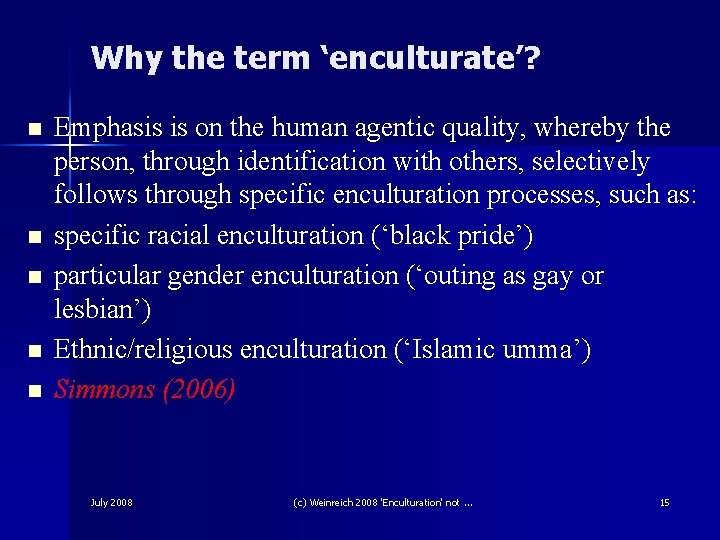
Why the term ‘enculturate’? n n n Emphasis is on the human agentic quality, whereby the person, through identification with others, selectively follows through specific enculturation processes, such as: specific racial enculturation (‘black pride’) particular gender enculturation (‘outing as gay or lesbian’) Ethnic/religious enculturation (‘Islamic umma’) Simmons (2006) July 2008 (c) Weinreich 2008 'Enculturation' not. . . 15
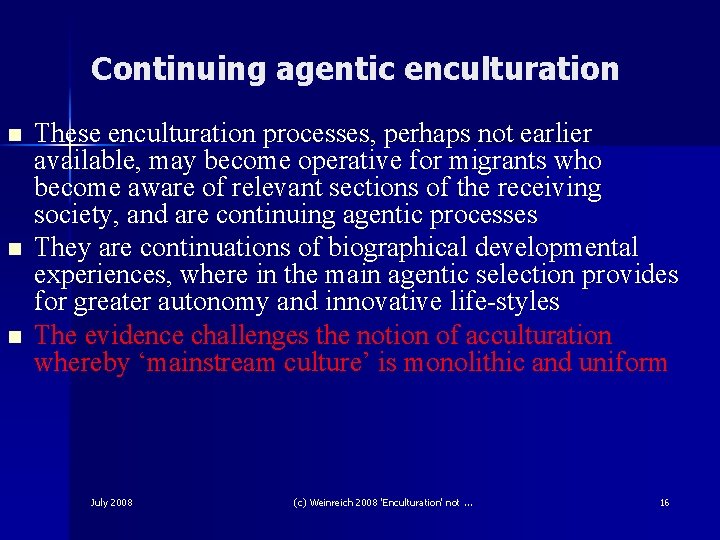
Continuing agentic enculturation n These enculturation processes, perhaps not earlier available, may become operative for migrants who become aware of relevant sections of the receiving society, and are continuing agentic processes They are continuations of biographical developmental experiences, where in the main agentic selection provides for greater autonomy and innovative life-styles The evidence challenges the notion of acculturation whereby ‘mainstream culture’ is monolithic and uniform July 2008 (c) Weinreich 2008 'Enculturation' not. . . 16
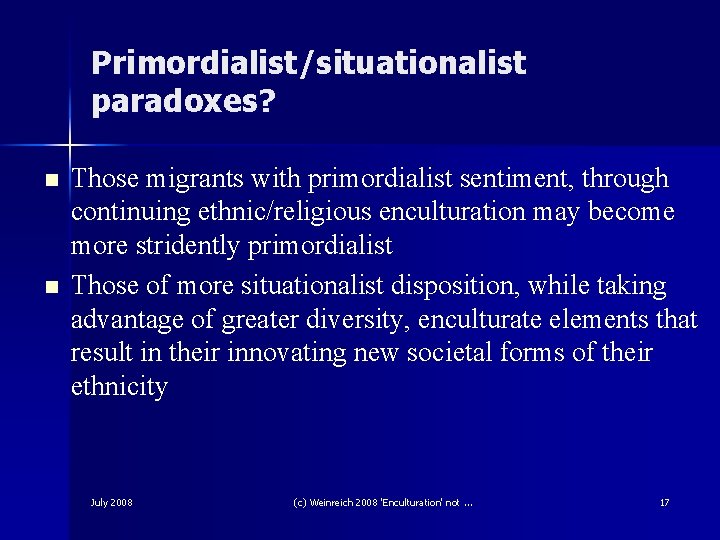
Primordialist/situationalist paradoxes? n n Those migrants with primordialist sentiment, through continuing ethnic/religious enculturation may become more stridently primordialist Those of more situationalist disposition, while taking advantage of greater diversity, enculturate elements that result in their innovating new societal forms of their ethnicity July 2008 (c) Weinreich 2008 'Enculturation' not. . . 17
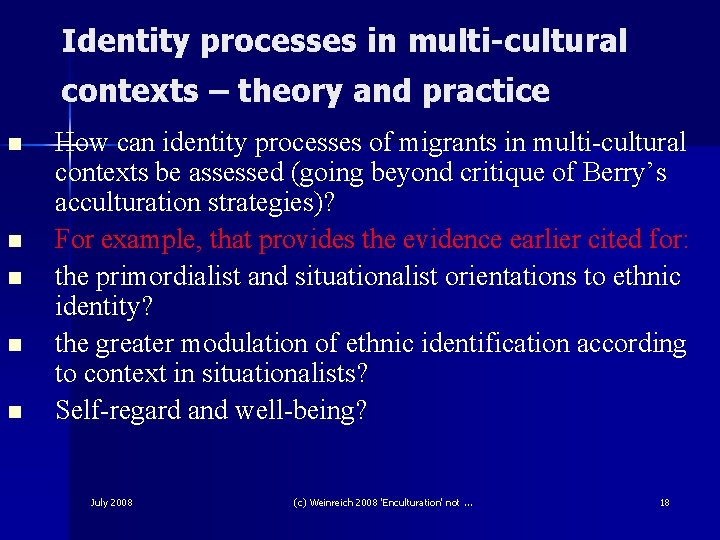
Identity processes in multi-cultural contexts – theory and practice n n n How can identity processes of migrants in multi-cultural contexts be assessed (going beyond critique of Berry’s acculturation strategies)? For example, that provides the evidence earlier cited for: the primordialist and situationalist orientations to ethnic identity? the greater modulation of ethnic identification according to context in situationalists? Self-regard and well-being? July 2008 (c) Weinreich 2008 'Enculturation' not. . . 18
Identity Structure Analysis (ISA) n n n The ISA conceptual framework consists of psychological concepts and process postulates It presents conceptual and methodological tools for the empirical investigation of fundamental identity processes that occur on migration and in multi-cultural contexts Weinreich, P. & Saunderson, W. (Eds. ) (2003) Analysing Identity: Cross-Cultural, Societal and Clinical Contexts. London & New York: Routledge/Taylor & Francis July 2008 (c) Weinreich 2008 'Enculturation' not. . . 19
ISA: a nuanced approach to multi-cultural inter-relationships n n n ISA can provide evidence on: the social and political ramifications of primordialist and situationalist orientations specific enculturated elements and the manner they are used to appraise self and others degrees of identification with individuals and ethnic groups according to context psychological well-being and distress July 2008 (c) Weinreich 2008 'Enculturation' not. . . 20
How ISA works n ISA theory and practice – Weinreich & Saunderson (2003): Analysing Identity n Practical operationalisation – Weinreich & Ewart(2007): ipseus computer software n Workshop (this Congress) - Ewart July 2008 (c) Weinreich 2008 'Enculturation' not. . . 21
Conclusion: Enculturation, not acculturation strategies n n n Migration : new opportunities Placing identity processes within the wider socio -historical and the individual biographical context (malign as well as benign) emphasises that processes of enculturation of elements or ‘partials’ of likely ‘disparate’ cultural heritages are fundamental rather than ‘acculturation’ strategies and choices ISA evidence – Horenczyk (2003) July 2008 (c) Weinreich 2008 'Enculturation' not. . . 22