
XII CHEMISTRY METALLURGY OCCURRENCE OF METALS v v



- Slides: 54
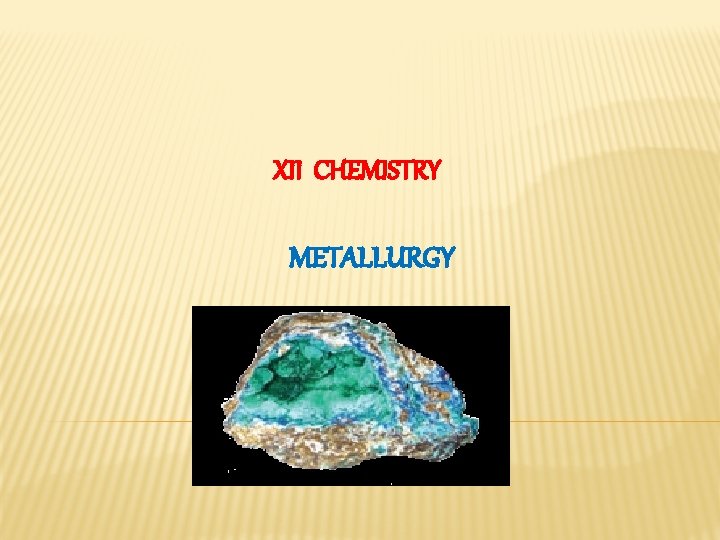
XII CHEMISTRY METALLURGY
OCCURRENCE OF METALS v v In general, pure metals are shiny and malleable, however, most of them are found in nature as compounds with different properties. Metals having least chemical reactivity such as copper, silver, gold and platinum occur in significant amounts as native elements. Reactive metals such as alkali metals usually occurs in their combined state and are extracted using suitable metallurgical process. State of occurrence: Free state & Combined state
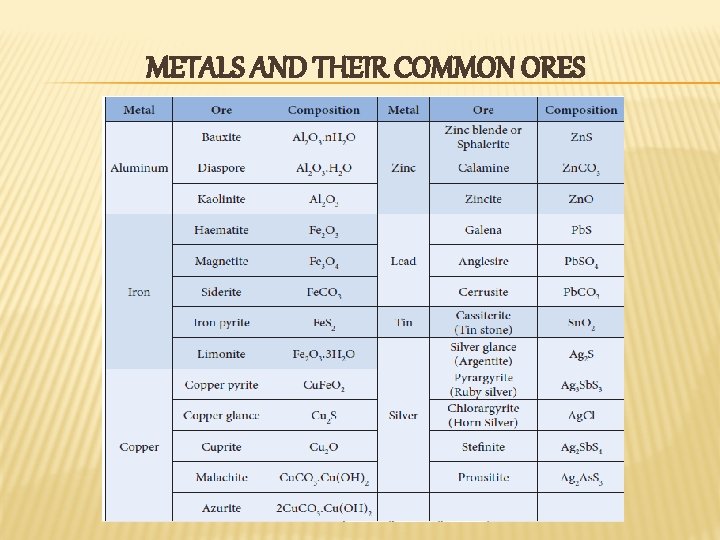
MINERAL & ORE v v A naturally occurring substance obtained by mining which contains the metal in free state or in the form of compounds like oxides, sulphides etc. . . is called a mineral Eg: Iron Minerals that contains a high percentage of metal, from which it can be extracted conveniently and economically are called ores Eg: Haematite , Magnetite , Limonite , Iron Pyrite etc. ,
PROCESS INVOLVED IN EXTRACTION OF METALS v The extraction of a metal of interest from its ore consists of the following metallurgical processes. (i) concentration of the ore (ii) extraction of crude metal (iii) refining of crude metal
METALS AND THEIR COMMON ORES
CONCENTRATION OF ORES v Generally, the ores are associated with nonmetallic impurities, rocky materials and siliceous matter which are collectively known as gangue. The preliminary step in metallurgical process is removal of these impurities. This removal process is known as concentration of ore.
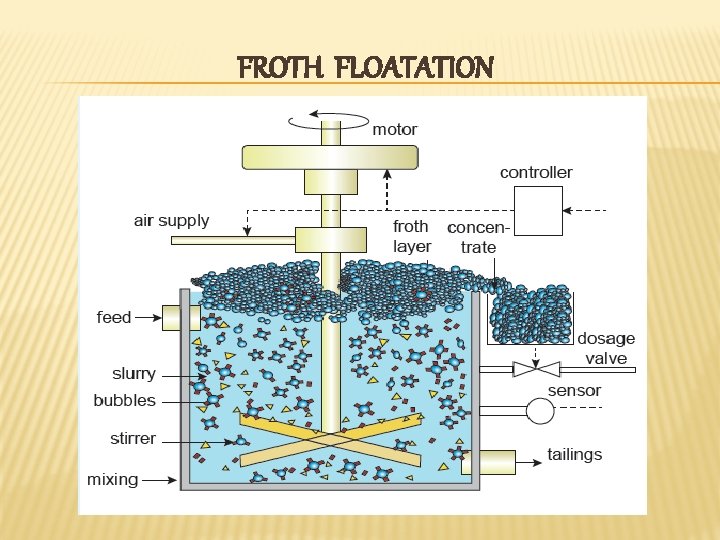
METHODS OF CONCENTRATION OF ORES v Gravity seperation or Hydraulic wash v Froth floatation v Leaching – Solubility based extraction Cyanide leaching Ammonia leaching Alkali leaching Acid leaching v Magnetic seperation
GRAVITY SEPERATION � In this method, the ore having high specific gravity is separated from the gangue that has low specific gravity by simply washing with running water. Ore is crushed to a finely powdered form and treated with rapidly flowing current of water. During this process the lighter gangue particles are washed away by the running water. This method is generally applied to concentrate the native ore such as gold and oxide ores such as haematite (Fe 2 O 3), tin stone (Sn. O 2) etc.
FROTH FLOATATION
LEACHING � This method is based on the solubility of the ore in a suitable solvent and the reactions in aqueous solution. In this method, the crushed ore is allowed to dissolve in a suitable solvent, the metal present in the ore is converted to its soluble salt or complex while the gangue remains insoluble.
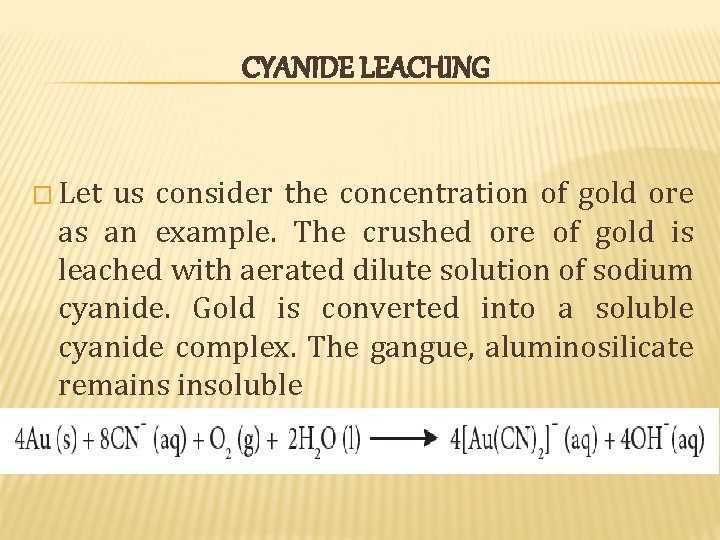
CYANIDE LEACHING � Let us consider the concentration of gold ore as an example. The crushed ore of gold is leached with aerated dilute solution of sodium cyanide. Gold is converted into a soluble cyanide complex. The gangue, aluminosilicate remains insoluble
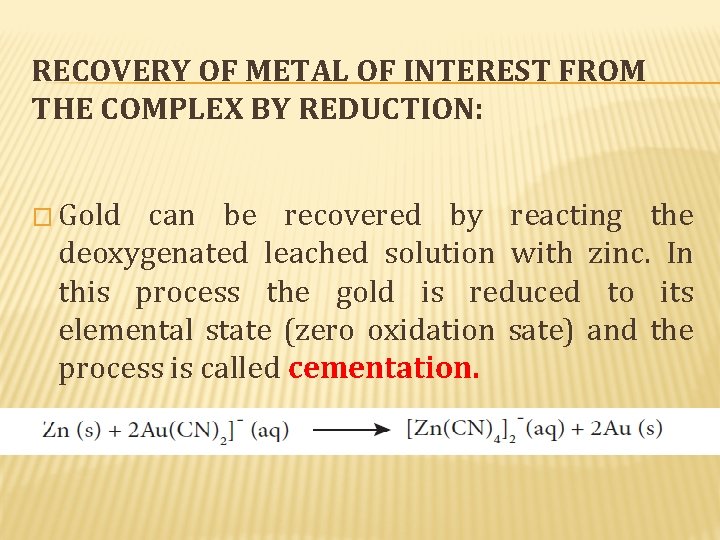
RECOVERY OF METAL OF INTEREST FROM THE COMPLEX BY REDUCTION: � Gold can be recovered by reacting the deoxygenated leached solution with zinc. In this process the gold is reduced to its elemental state (zero oxidation sate) and the process is called cementation.
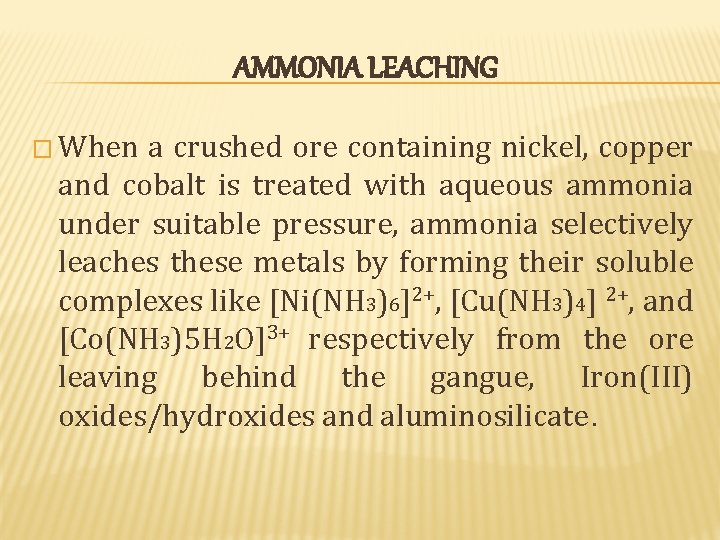
AMMONIA LEACHING � When a crushed ore containing nickel, copper and cobalt is treated with aqueous ammonia under suitable pressure, ammonia selectively leaches these metals by forming their soluble complexes like [Ni(NH 3)6]2+, [Cu(NH 3)4] 2+, and [Co(NH 3)5 H 2 O]3+ respectively from the ore leaving behind the gangue, Iron(III) oxides/hydroxides and aluminosilicate.
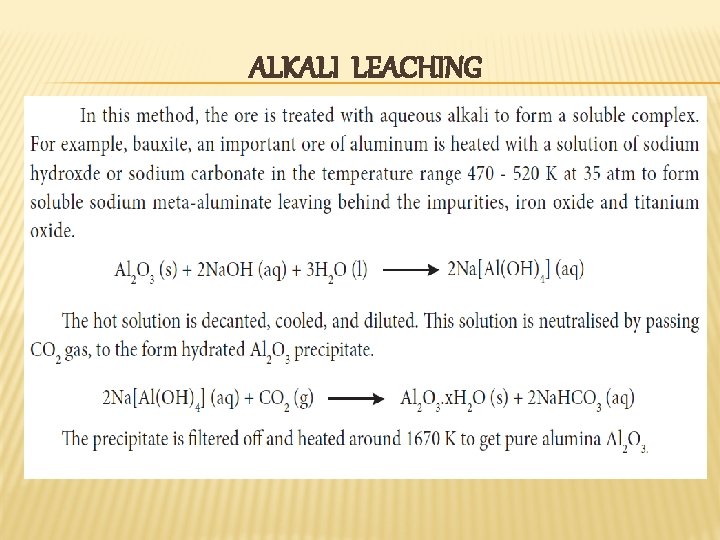
ALKALI LEACHING
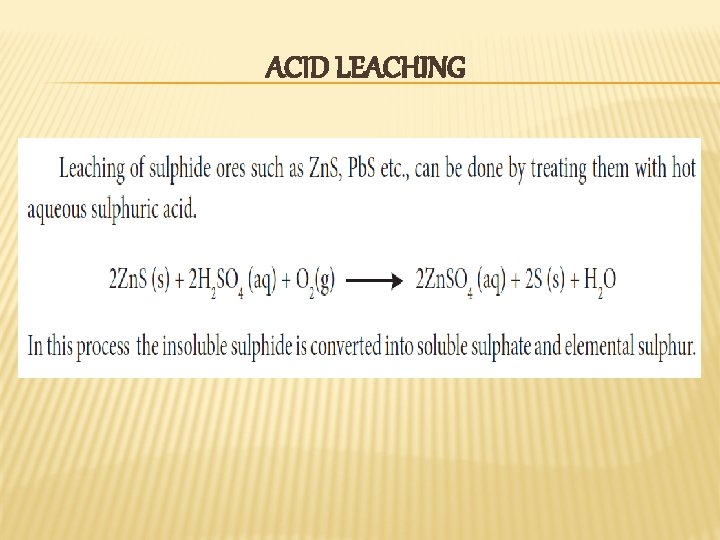
ACID LEACHING
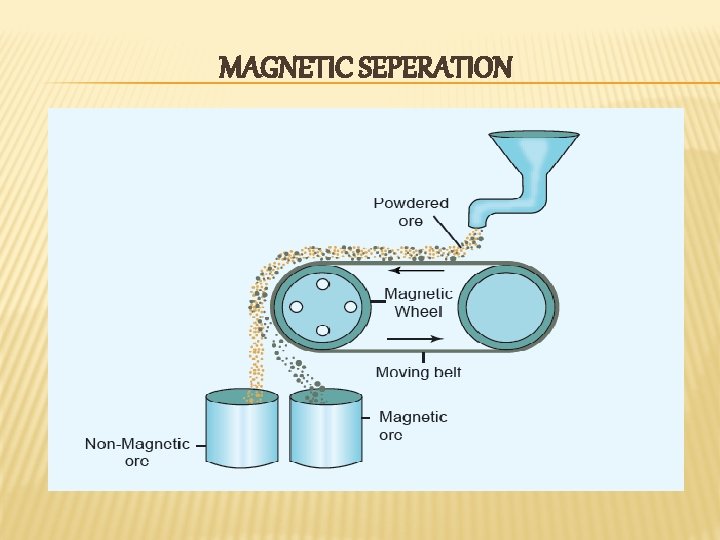
MAGNETIC SEPERATION
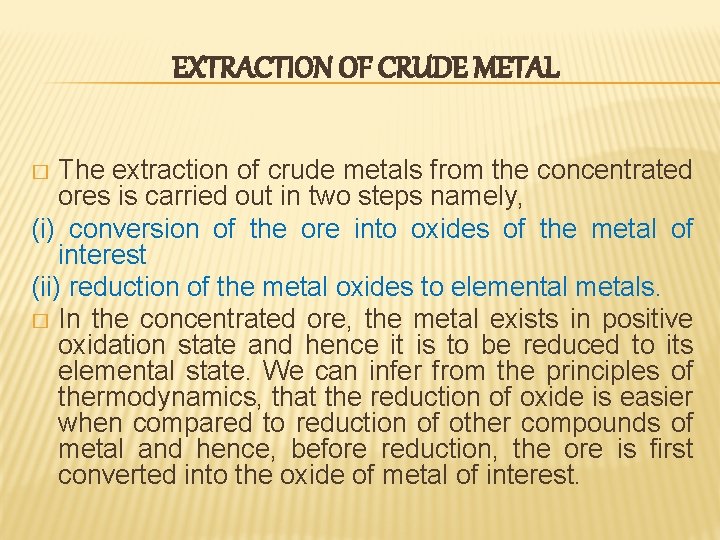
EXTRACTION OF CRUDE METAL The extraction of crude metals from the concentrated ores is carried out in two steps namely, (i) conversion of the ore into oxides of the metal of interest (ii) reduction of the metal oxides to elemental metals. � In the concentrated ore, the metal exists in positive oxidation state and hence it is to be reduced to its elemental state. We can infer from the principles of thermodynamics, that the reduction of oxide is easier when compared to reduction of other compounds of metal and hence, before reduction, the ore is first converted into the oxide of metal of interest. �
CONVERSION OF ORES INTO OXIDES � It involves in two methods namely Roasting Calcination
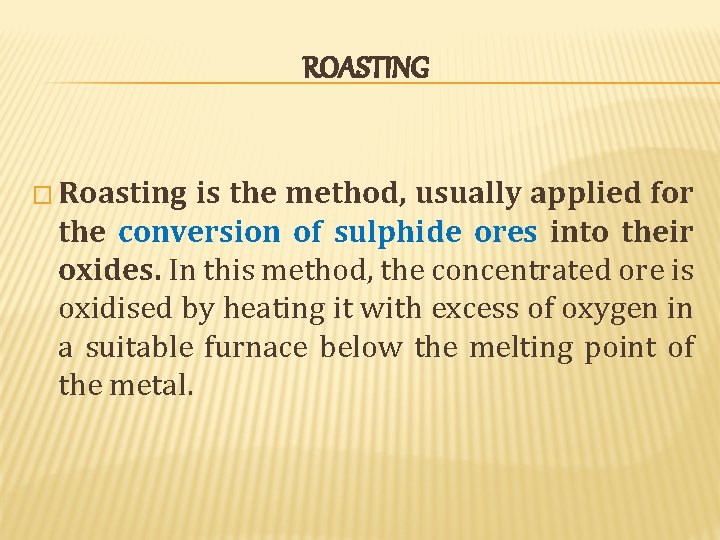
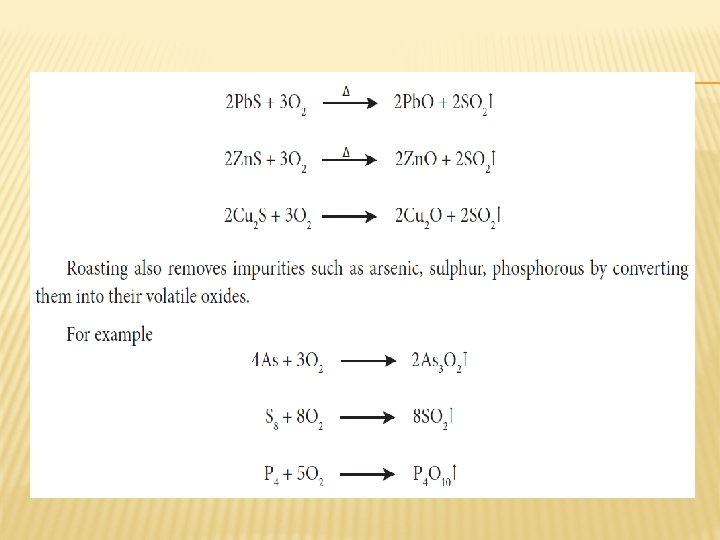
ROASTING � Roasting is the method, usually applied for the conversion of sulphide ores into their oxides. In this method, the concentrated ore is oxidised by heating it with excess of oxygen in a suitable furnace below the melting point of the metal.
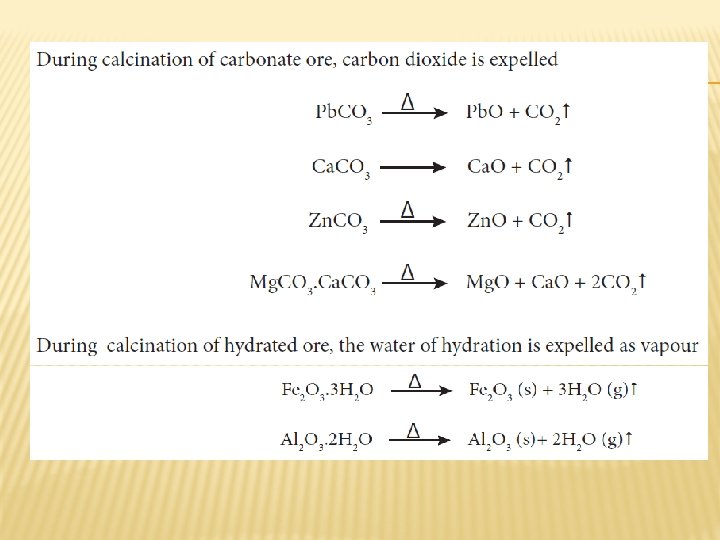
CALCINATION � Calcination is the process in which the concentrated ore is strongly heated in the absence of air. During this process, the water of crystallisation present in the hydrated oxide escapes as moisture. Any organic matter (if present) also get expelled leaving behind a porous ore. This method can also be carried out with a limited supply of air.
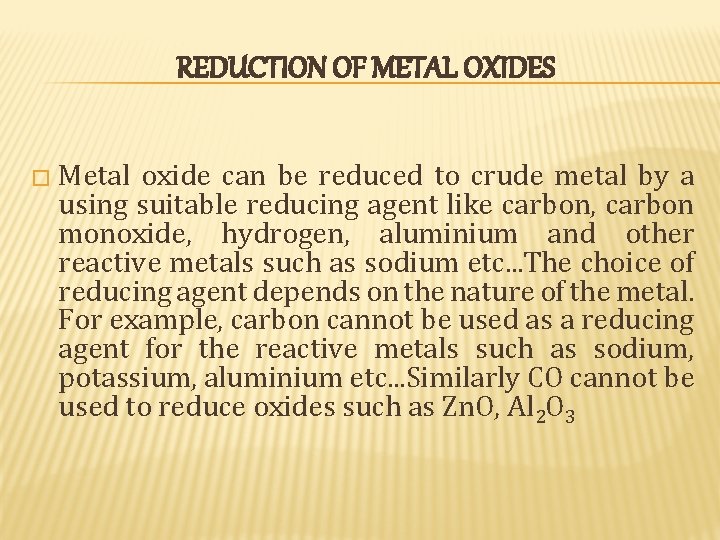
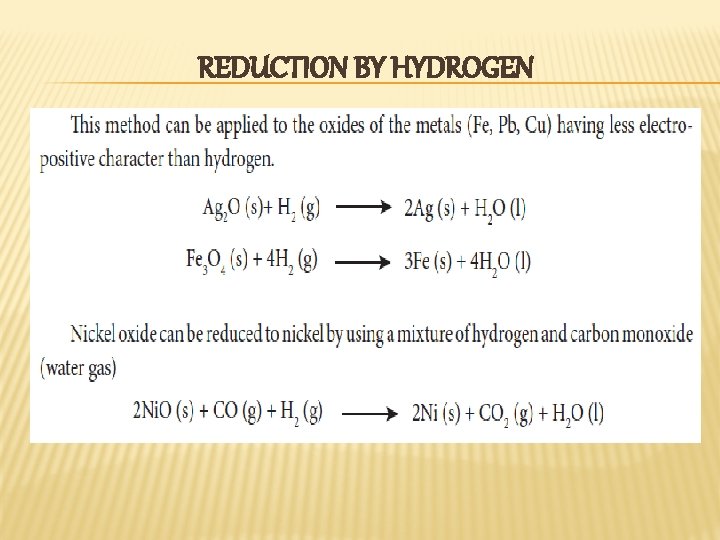
REDUCTION OF METAL OXIDES � Metal oxide can be reduced to crude metal by a using suitable reducing agent like carbon, carbon monoxide, hydrogen, aluminium and other reactive metals such as sodium etc. . . The choice of reducing agent depends on the nature of the metal. For example, carbon cannot be used as a reducing agent for the reactive metals such as sodium, potassium, aluminium etc. . . Similarly CO cannot be used to reduce oxides such as Zn. O, Al 2 O 3
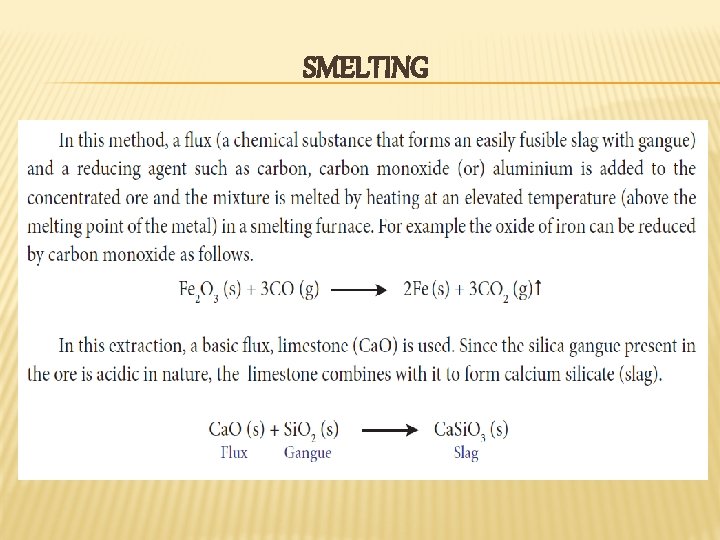
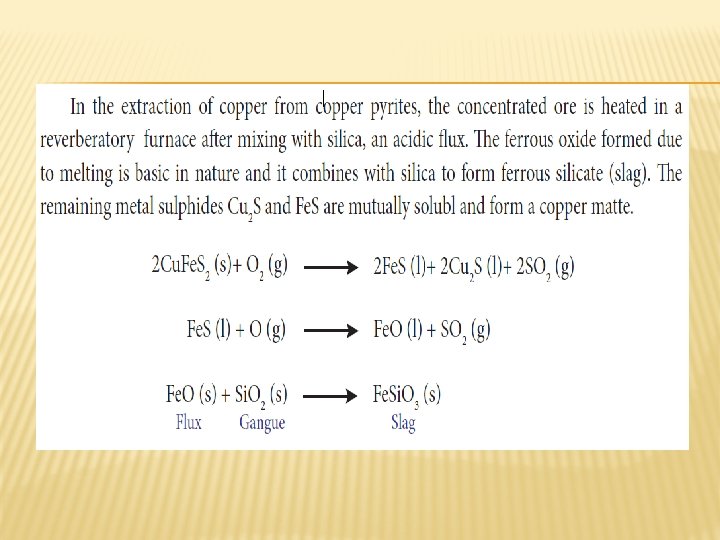
SMELTING
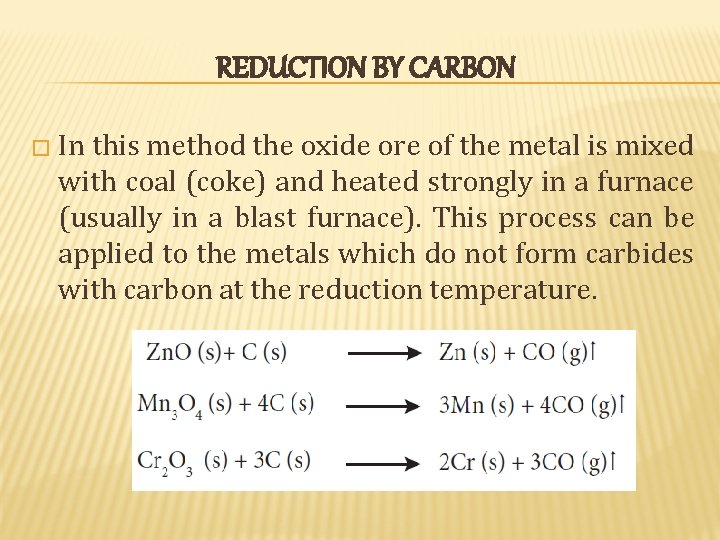
REDUCTION BY CARBON � In this method the oxide ore of the metal is mixed with coal (coke) and heated strongly in a furnace (usually in a blast furnace). This process can be applied to the metals which do not form carbides with carbon at the reduction temperature.
REDUCTION BY HYDROGEN
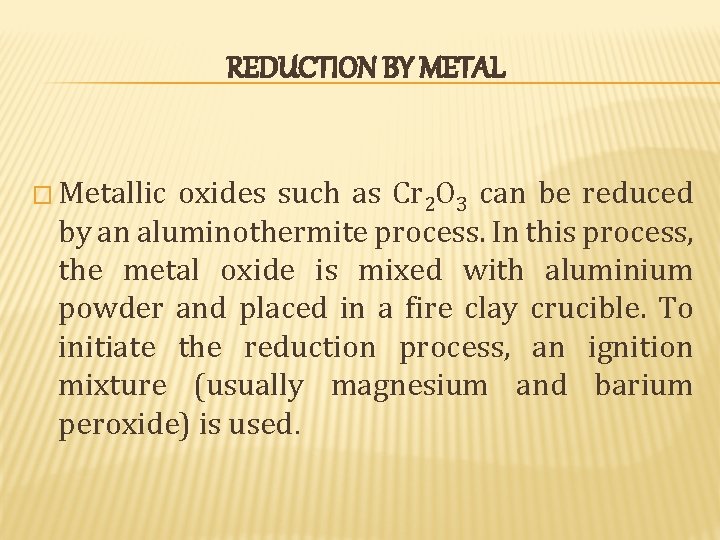
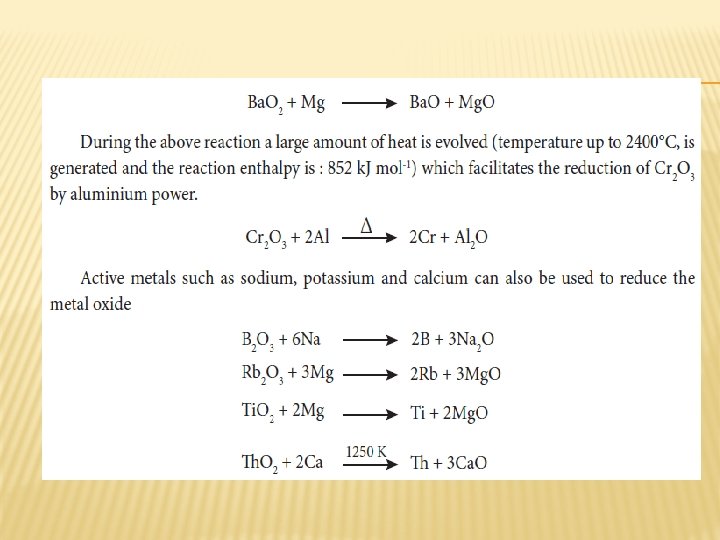
REDUCTION BY METAL � Metallic oxides such as Cr 2 O 3 can be reduced by an aluminothermite process. In this process, the metal oxide is mixed with aluminium powder and placed in a fire clay crucible. To initiate the reduction process, an ignition mixture (usually magnesium and barium peroxide) is used.
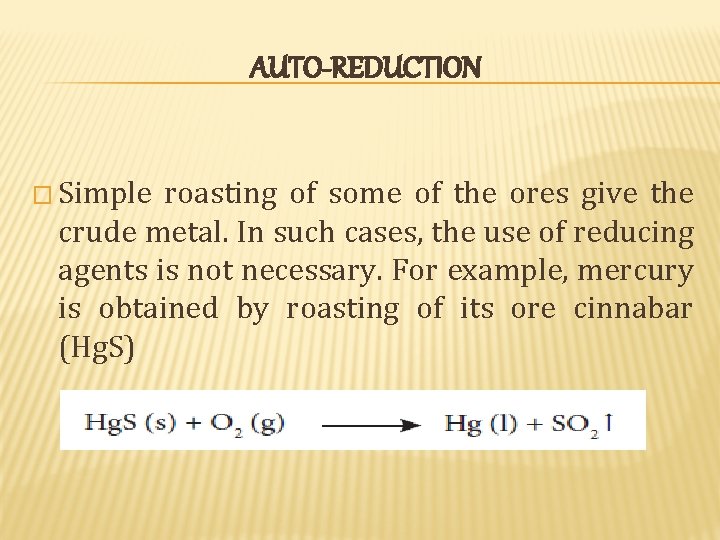
AUTO-REDUCTION � Simple roasting of some of the ores give the crude metal. In such cases, the use of reducing agents is not necessary. For example, mercury is obtained by roasting of its ore cinnabar (Hg. S)
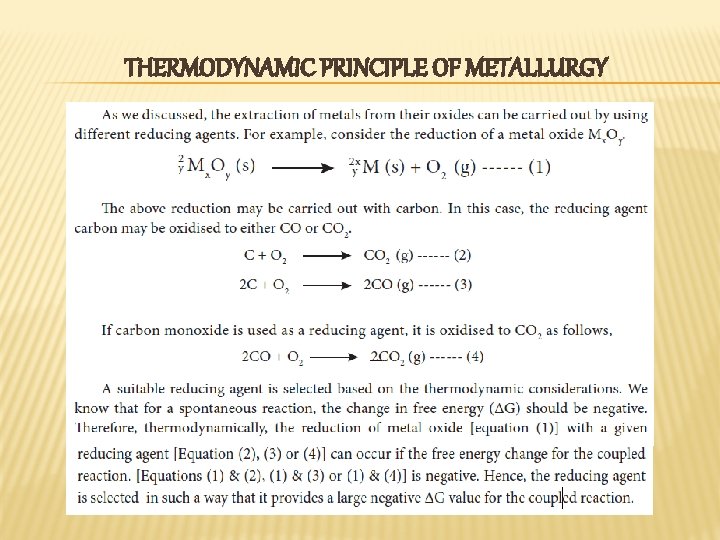
THERMODYNAMIC PRINCIPLE OF METALLURGY
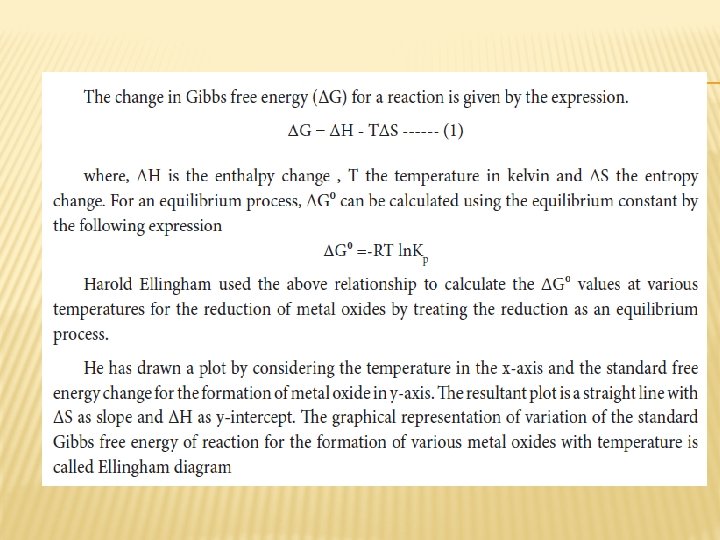
ELLINGHAM DIAGRAM
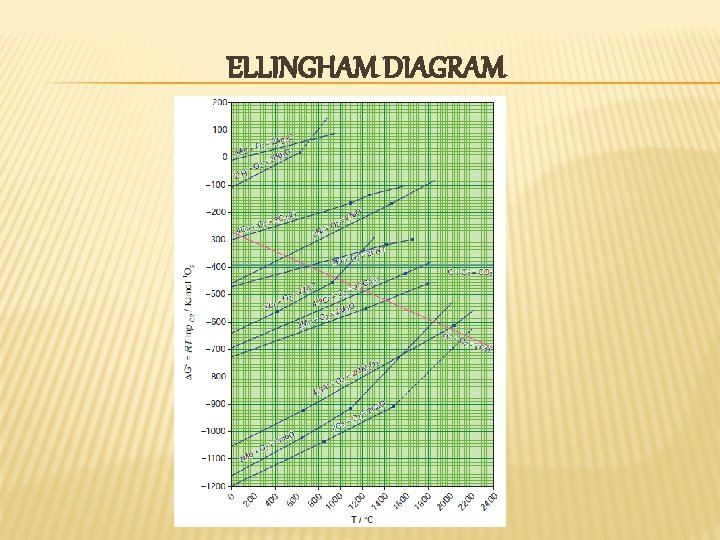
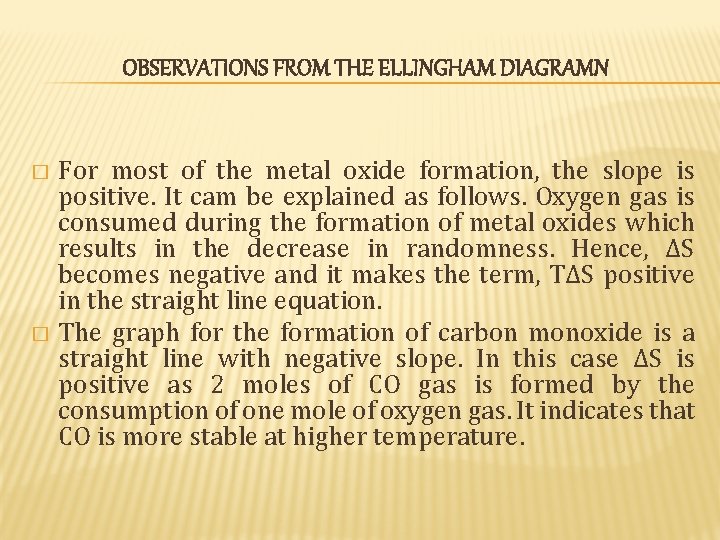
OBSERVATIONS FROM THE ELLINGHAM DIAGRAMN For most of the metal oxide formation, the slope is positive. It cam be explained as follows. Oxygen gas is consumed during the formation of metal oxides which results in the decrease in randomness. Hence, ΔS becomes negative and it makes the term, TΔS positive in the straight line equation. � The graph for the formation of carbon monoxide is a straight line with negative slope. In this case ΔS is positive as 2 moles of CO gas is formed by the consumption of one mole of oxygen gas. It indicates that CO is more stable at higher temperature. �
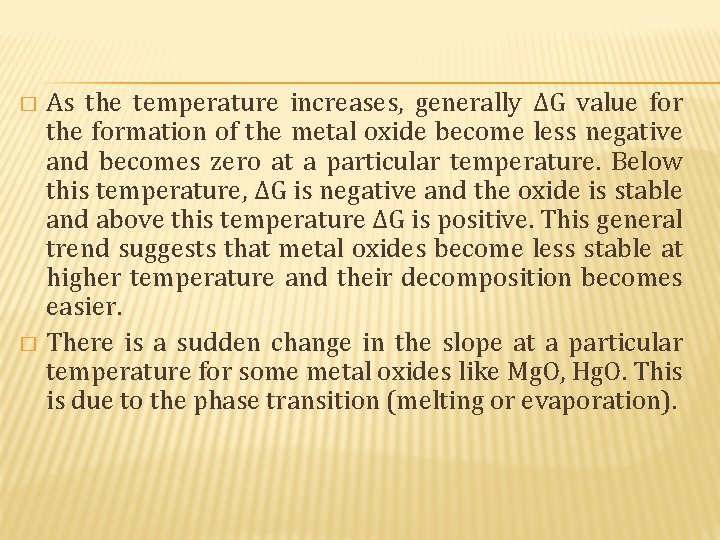
As the temperature increases, generally ΔG value for the formation of the metal oxide become less negative and becomes zero at a particular temperature. Below this temperature, ΔG is negative and the oxide is stable and above this temperature ΔG is positive. This general trend suggests that metal oxides become less stable at higher temperature and their decomposition becomes easier. � There is a sudden change in the slope at a particular temperature for some metal oxides like Mg. O, Hg. O. This is due to the phase transition (melting or evaporation). �
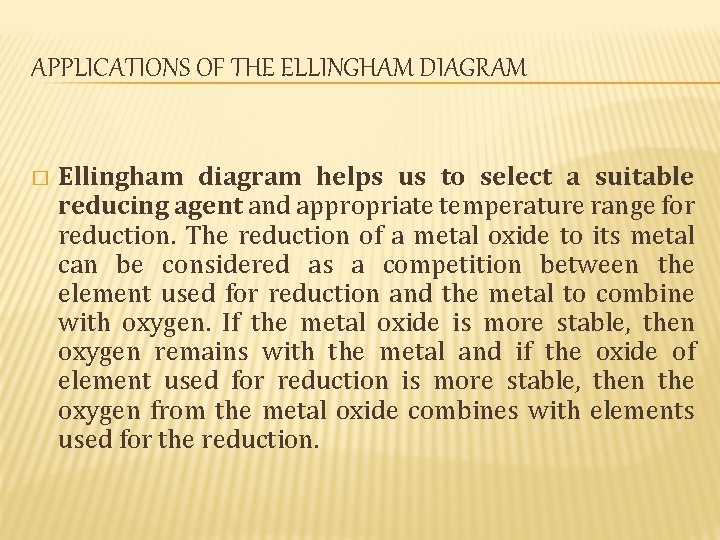
APPLICATIONS OF THE ELLINGHAM DIAGRAM � Ellingham diagram helps us to select a suitable reducing agent and appropriate temperature range for reduction. The reduction of a metal oxide to its metal can be considered as a competition between the element used for reduction and the metal to combine with oxygen. If the metal oxide is more stable, then oxygen remains with the metal and if the oxide of element used for reduction is more stable, then the oxygen from the metal oxide combines with elements used for the reduction.
LIMITATIONS OF ELLINGHAM DIAGRAM � Ellingham diagram is constructed based only on thermodynamic considerations. It gives information about thermodynamic feasibility of a reaction. It does not tell anything about the rate of the reaction. More over, it does not give any idea about the possibility of other reactions that might be taking place. � The interpretation of ΔG is based on the assumption that the reactants are in equilibrium with the product which is not always true.
ELECTROCHEMICAL PRINCIPLE OF METALLURGY
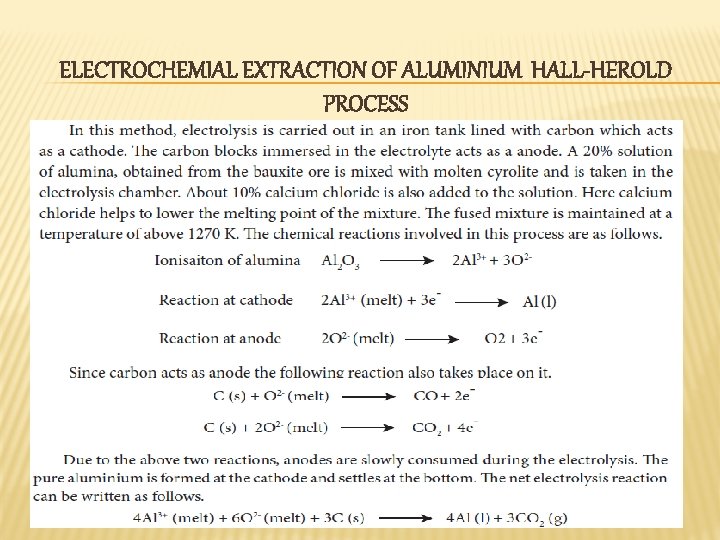
ELECTROCHEMIAL EXTRACTION OF ALUMINIUM HALL-HEROLD PROCESS
REFINING PROCESS � Generally the metal extracted from its ore contains some impurities such as unreacted oxide ore, other metals, nonmetals etc. . . Removal of such impurities associated with the isolated crude metal is called refining process
DISTILLATION � This method is employed for low boiling volatile metals like zinc (boiling point 1180 K) and mercury (630 K). In this method, the impure metal is heated to evaporate and the vapours are condensed to get pure metal.
LIQUATION � This method, is employed to remove the impurities with high melting points from metals having relatively low melting points such as tin (Sb; mp= 904 K), lead (Pb; mp=600 K), mercury (Hg; mp=234 K), and bismuth (Bi; mp=545 K). In this process, the crude metal is heated to form fusible liquid and allowed to flow on a sloping surface. The impure metal is placed on sloping hearth of a reverberatory furnace and it is heated just above the melting point of the metal in the absence of air, the molten pure metal flows down and the impurities are left behind. The molten metal is collected and solidified.
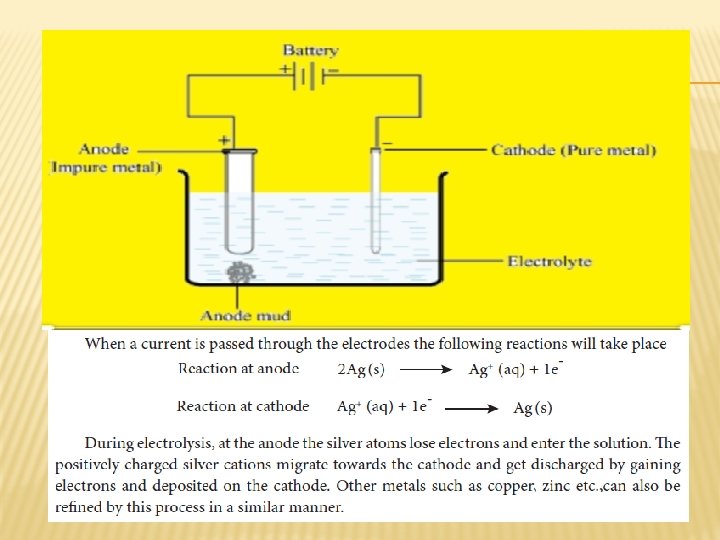
ELECTROLYTIC REFINING The crude metal is refined by electrolysis. It is carried out in an electrolytic cell containing aqueous solution of the salts of the metal of interest. During electrolysis, the less electropositive impurities in the anode, settle down at the bottom and are removed as anode mud. � Cathode : Pure silver � Anode : Impure silver rods � Electrolyte : Acidified aqueous solution of silver nitrate. �
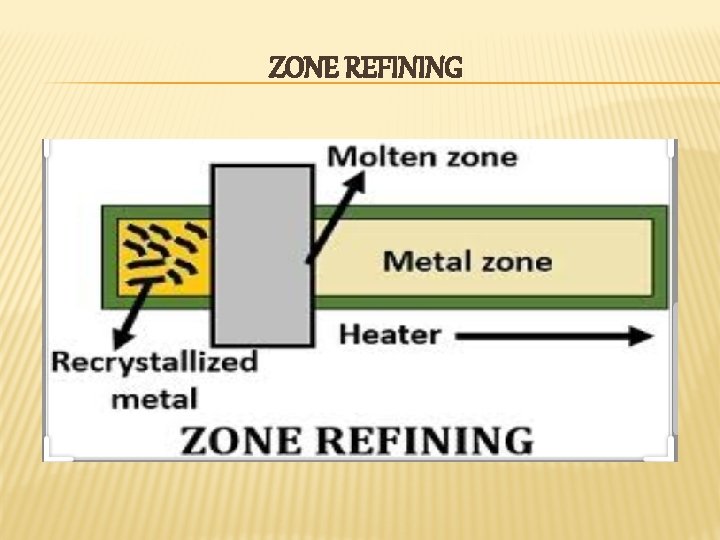
ZONE REFINING
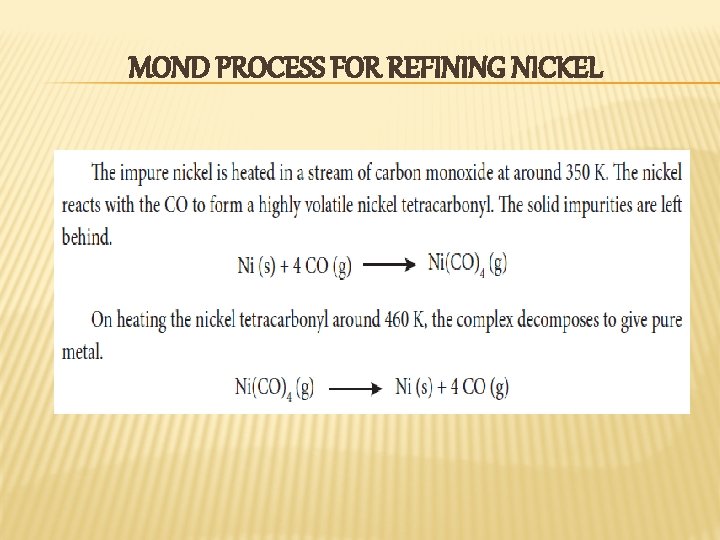
MOND PROCESS FOR REFINING NICKEL
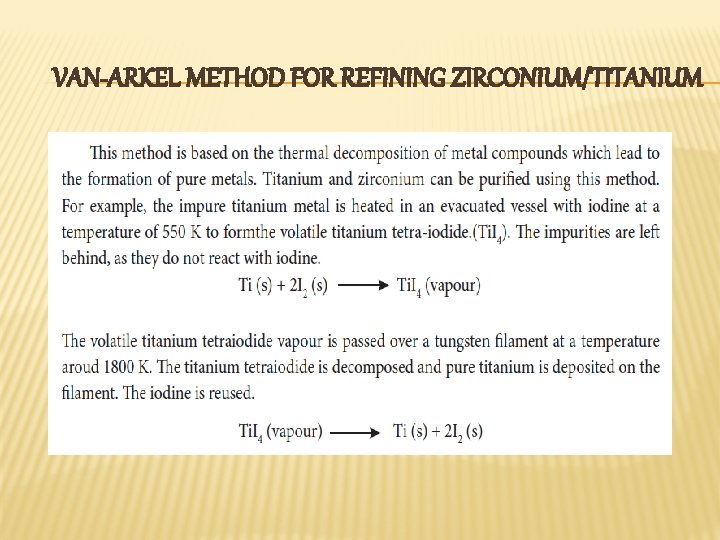
VAN-ARKEL METHOD FOR REFINING ZIRCONIUM/TITANIUM
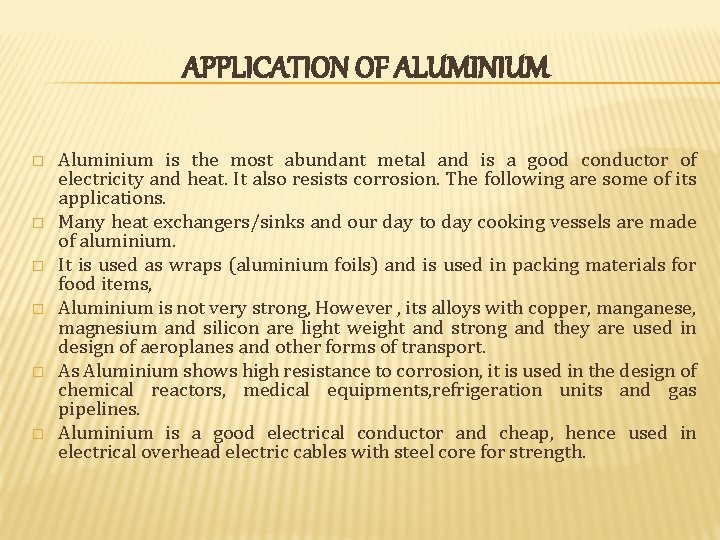
APPLICATION OF ALUMINIUM � � � Aluminium is the most abundant metal and is a good conductor of electricity and heat. It also resists corrosion. The following are some of its applications. Many heat exchangers/sinks and our day to day cooking vessels are made of aluminium. It is used as wraps (aluminium foils) and is used in packing materials for food items, Aluminium is not very strong, However , its alloys with copper, manganese, magnesium and silicon are light weight and strong and they are used in design of aeroplanes and other forms of transport. As Aluminium shows high resistance to corrosion, it is used in the design of chemical reactors, medical equipments, refrigeration units and gas pipelines. Aluminium is a good electrical conductor and cheap, hence used in electrical overhead electric cables with steel core for strength.
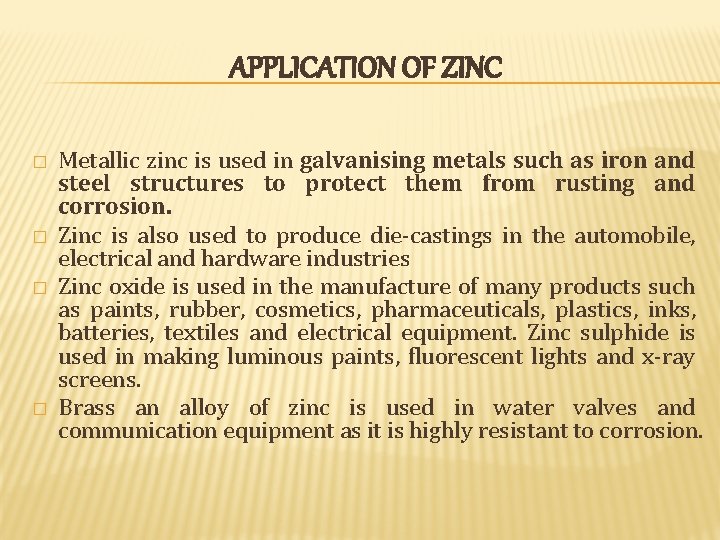
APPLICATION OF ZINC � � Metallic zinc is used in galvanising metals such as iron and steel structures to protect them from rusting and corrosion. Zinc is also used to produce die-castings in the automobile, electrical and hardware industries Zinc oxide is used in the manufacture of many products such as paints, rubber, cosmetics, pharmaceuticals, plastics, inks, batteries, textiles and electrical equipment. Zinc sulphide is used in making luminous paints, fluorescent lights and x-ray screens. Brass an alloy of zinc is used in water valves and communication equipment as it is highly resistant to corrosion.
APPLICATION OF IRON � � Iron is one of the most useful metals and its alloys are used everywhere including bridges, electricity pylons, bicycle chains, cutting tools and rifle barrels. Cast iron is used to make pipes, valves and pumps stoves etc. . . Magnets can be made of iron and its alloys and compounds. An important alloy of iron is stainless steel, and it is very resistant to corrosion. It is used in architecture, bearings, cutlery, surgical instruments and jewellery. Nickel steel is used for making cables, automobiles and aeroplane parts. Chrome steels are used foor maufacturing cutting tools and curshing machines
APPLICATION OF COPPER � Copper is the first metal used by the humans and extended use of its alloy bronze resulted in a new era, 'Bronze age' � Copper is used for making coins and ornaments along with gold and other metals. � Copper and its alloys are used for making wires, water pipes and other electrical parts
APPLICATION OF GOLD � Gold, one of the expensive and precious metals. It is used for coinage, and has been used as standard for monetary systems in some countries. � It is used extensively in jewellery in its alloy form with copper. It is also used in electroplating to cover other metals with a thin layer of gold which are used in watches, artificial limb joints, cheap jewellery, dental fillings and electrical connectors. � Gold nanoparticles are also used for increasing the efficiency of solar cells and also used an catalysts.
THANK YOU