
XII CHEMISTRY 2 P Block elements Foreword to
XII CHEMISTRY 2. P Block elements
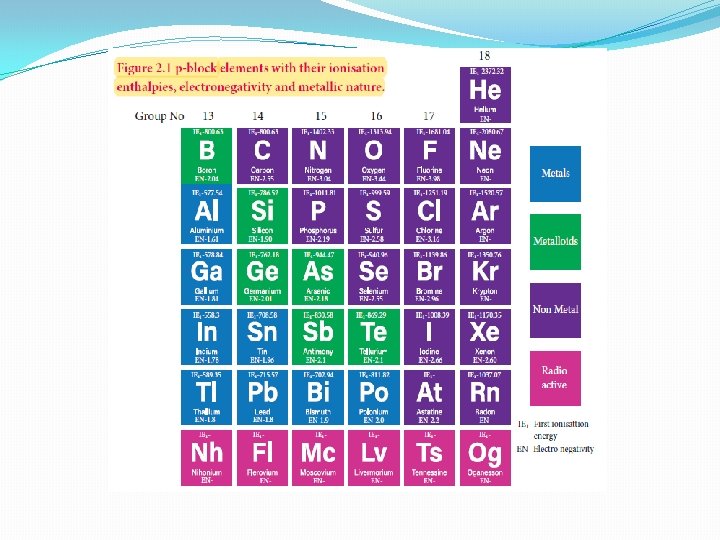
Foreword to p block elements �The elements in which their last electron enters the 'p' orbital, constitute the p-block elements. �The p-block elements have a general electronic configuration of ns 2, np 1 -6 �They are placed in 13 th to 18 th groups of the modern periodic table �This block contains nonmetals, metals and metalloids �The elements of this block and their compounds play an important role in our day to day life ( Eg: oxygen ) �The semi conducting nature of elements such as silicon and germanium made a revolutionary change in the field of modern electronics. �In this unit we discuss the properties of boron, carbon and nitrogen family
General trends in properties of p-block elements �We already learnt that the properties of elements largely depends on their electronic configuration, size, ionisation enthalpy, electronegativity etc. . . Let us discuss the general trend in such properties of various p-block elements
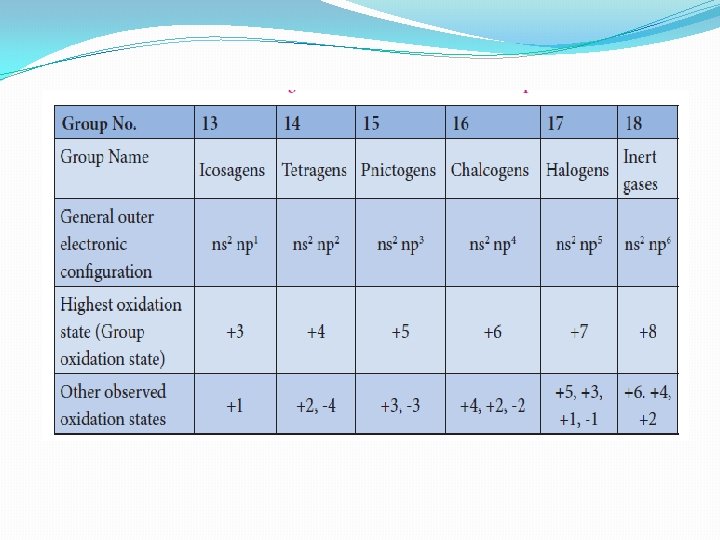
Electronic configuration and oxidation state �The p-block elements have a general electronic configuration of ns 2, np 1 -6 �The elements of each group have similar outer shell electronic configuration and differ only in the value of n (principal quantum number) �The elements of group 18 (inert gases) have completely filled p orbitals, hence they are more stable and have least reactivity. �The elements of this block show variable oxidation state and their highest oxidation state (group oxidation state) is equal to the total number of valance electrons present in them �Unlike s-block elements which show only positive oxidation state, some of the p-block elements show negative oxidation states also
Metallic nature �The tendency of an element to form a cation by loosing electrons is known as electropositive or metallic character. �This character depends on the ionisation energy. Generally on descending a group the ionisation energy decreases and hence the metallic character increases. �Elements of group 13 have metallic character except the first element boron which is a metalloid, having properties intermediate between the metal and nonmetals. The atomic radius of boron is very small and it has relatively high nuclear charge and these properties are responsible for its nonmetallic character.
�In the subsequent groups the non-metallic character increases. � In group 14 elements, carbon is a nonmetal while silicon and germanium are metalloids. �In group 15, nitrogen and phosphorus are non metals and arsenic & antimony are metalloids. �In group 16, oxygen, sulphur and selenium are non metals and tellurium is a metalloid. �All the elements of group 17 and 18 are non metals.
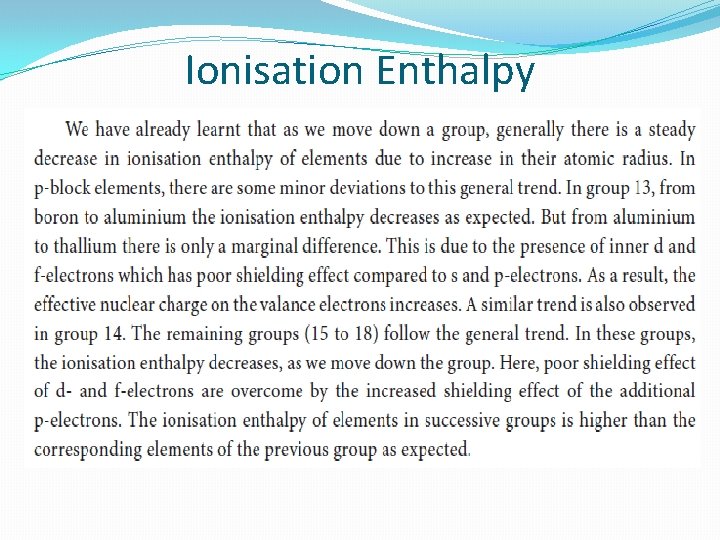
Ionisation Enthalpy
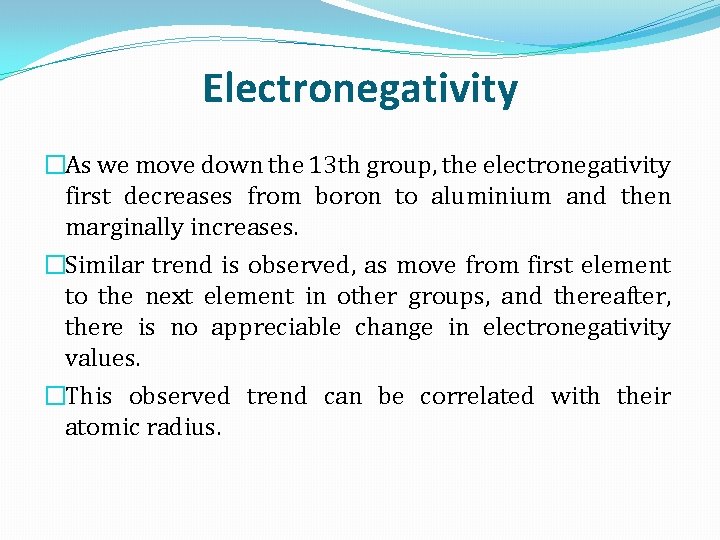
Electronegativity �As we move down the 13 th group, the electronegativity first decreases from boron to aluminium and then marginally increases. �Similar trend is observed, as move from first element to the next element in other groups, and thereafter, there is no appreciable change in electronegativity values. �This observed trend can be correlated with their atomic radius.
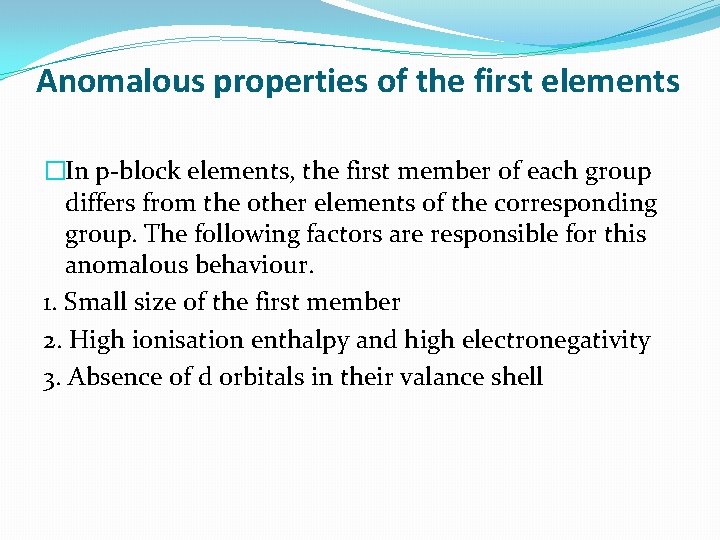
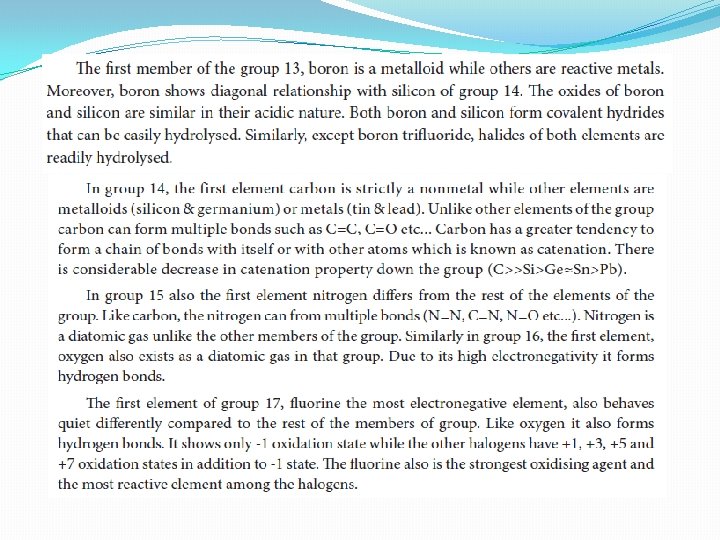
Anomalous properties of the first elements �In p-block elements, the first member of each group differs from the other elements of the corresponding group. The following factors are responsible for this anomalous behaviour. 1. Small size of the first member 2. High ionisation enthalpy and high electronegativity 3. Absence of d orbitals in their valance shell
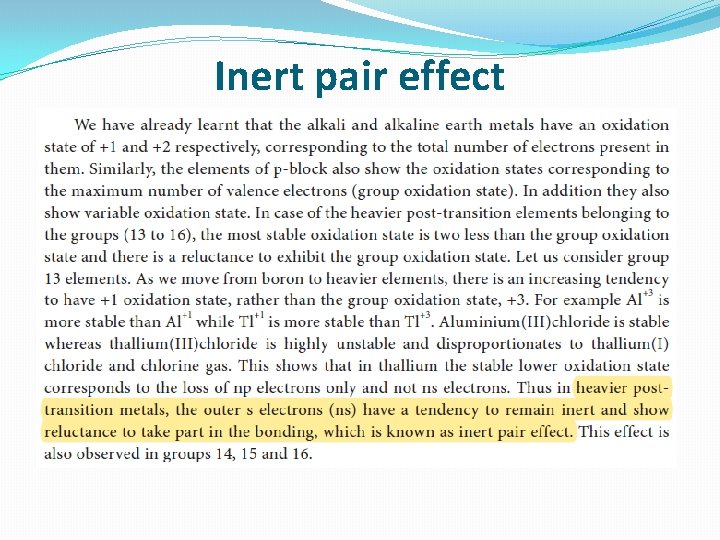
Inert pair effect
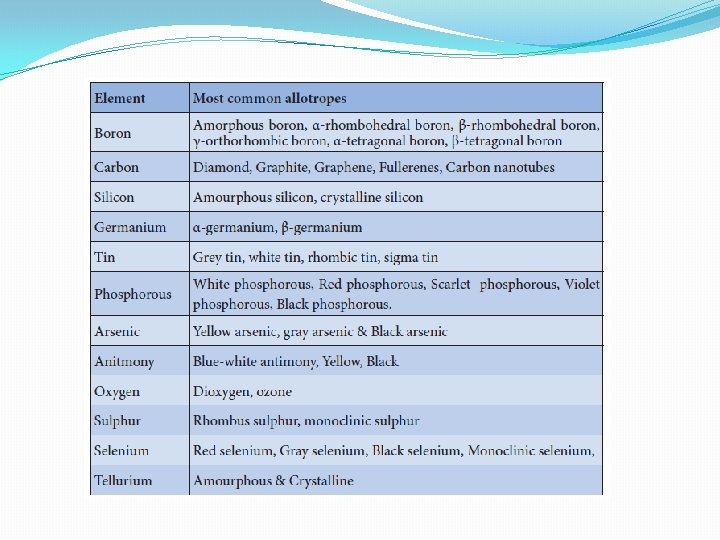
Allotropism in p-block elements: �Some elements exist in more than one crystalline or molecular forms in the same physical state. For example, carbon exists as diamond and graphite. This phenomenon is called allotropism (in greek 'allos' means another and 'trope' means change) and the different forms of an element are called allotropes. Many p-block elements show allotropism and some of the common allotropes are listed in the table.
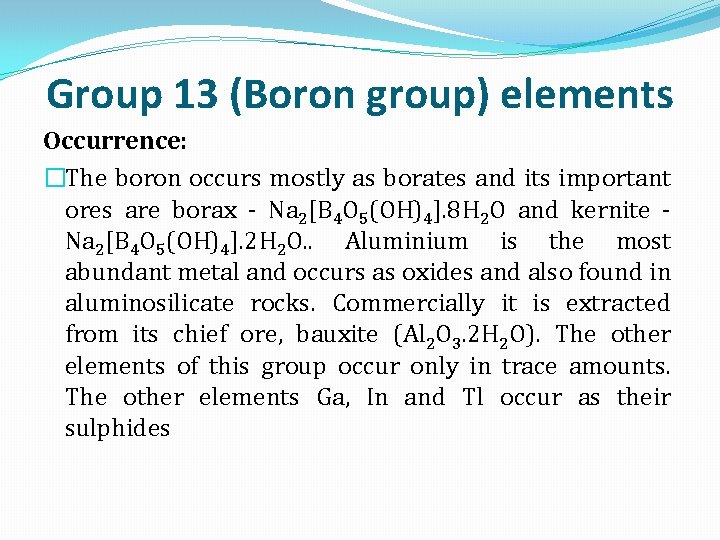
Group 13 (Boron group) elements Occurrence: �The boron occurs mostly as borates and its important ores are borax - Na 2[B 4 O 5(OH)4]. 8 H 2 O and kernite Na 2[B 4 O 5(OH)4]. 2 H 2 O. . Aluminium is the most abundant metal and occurs as oxides and also found in aluminosilicate rocks. Commercially it is extracted from its chief ore, bauxite (Al 2 O 3. 2 H 2 O). The other elements of this group occur only in trace amounts. The other elements Ga, In and Tl occur as their sulphides
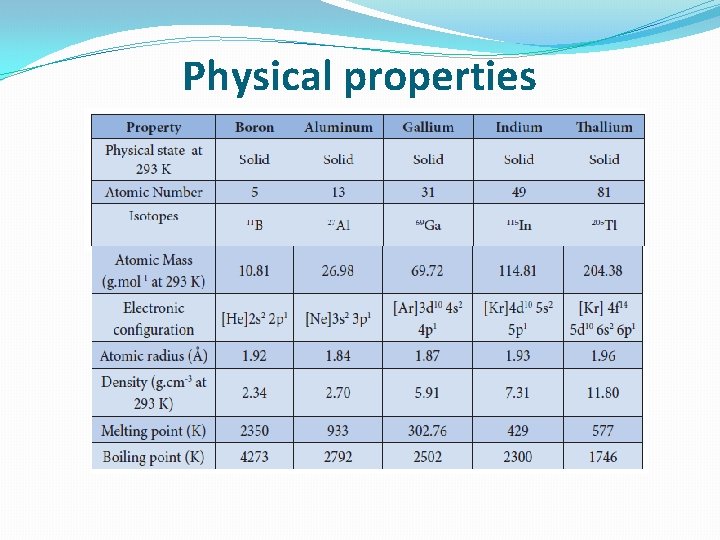
Physical properties
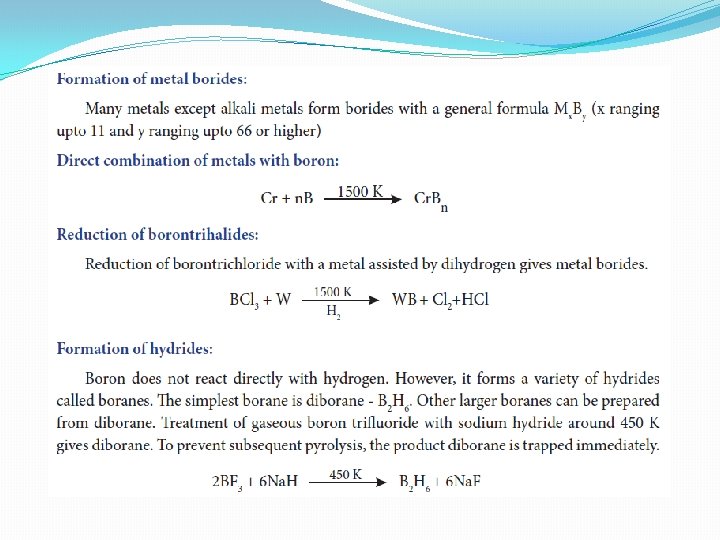
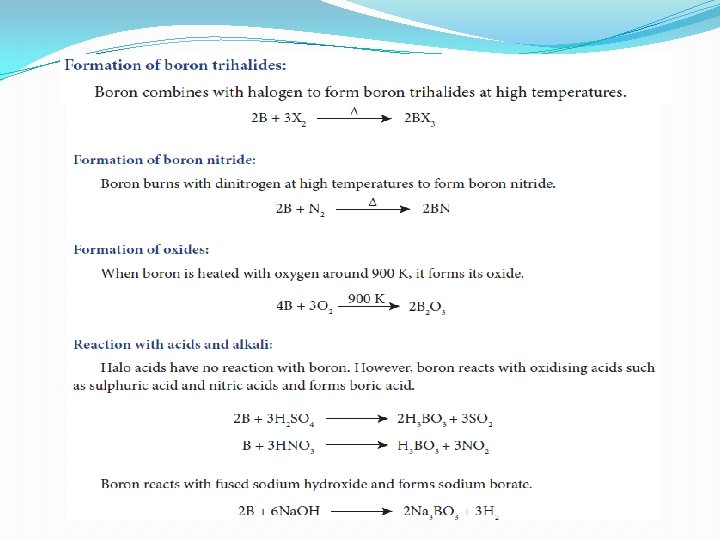
Chemical properties of Boron �Boron is the only nonmetal in this group and is less reactive. However, it shows reactivity at higher temperatures. Many of its compounds are electron deficient and has unusual type of covalent bonding which is due to its small size, high ionisation energy and similarity in electronegativity with carbon and hydrogen.
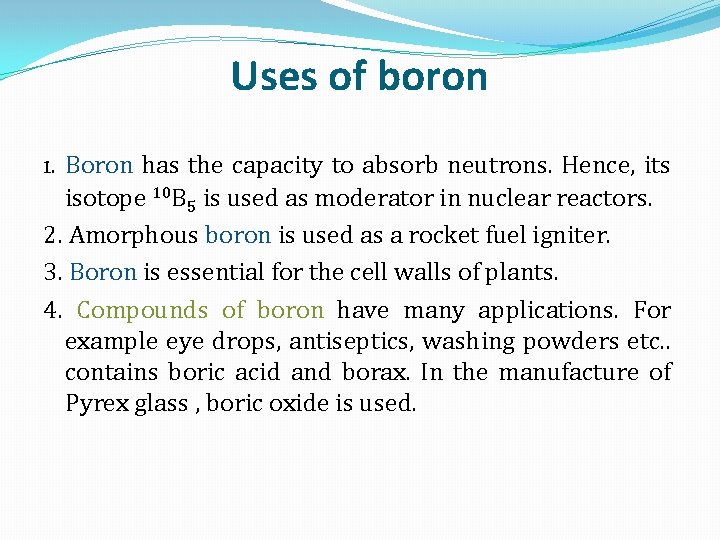
Uses of boron 1. Boron has the capacity to absorb neutrons. Hence, its isotope 10 B 5 is used as moderator in nuclear reactors. 2. Amorphous boron is used as a rocket fuel igniter. 3. Boron is essential for the cell walls of plants. 4. Compounds of boron have many applications. For example eye drops, antiseptics, washing powders etc. . contains boric acid and borax. In the manufacture of Pyrex glass , boric oxide is used.
![Borax [Na 2 B 4 O 7. 10 H 2 O] Preparation: �Borax is](http://slidetodoc.com/presentation_image_h2/cded2331afe039532aee4864da2be053/image-22.jpg "Borax [Na 2 B 4 O 7. 10 H 2 O] Preparation: �Borax is")
Borax [Na 2 B 4 O 7. 10 H 2 O] Preparation: �Borax is a sodium salt of tetraboric acid. It is obtained from colemanite ore by boiling its solution with sodium carbonate. �Borax is normally formulated as Na 2 B 4 O 7. 10 H 2 O. But it contains, tetranuclear units [B 4 O 5. (OH)4]2 -. This form is known as prismatic form. Borax also exists two other forms namely, jeweller or octahderal borax (Na 2 B 4 O 7. 5 H 2 O) and borax glass (Na 2 B 4 O 7).
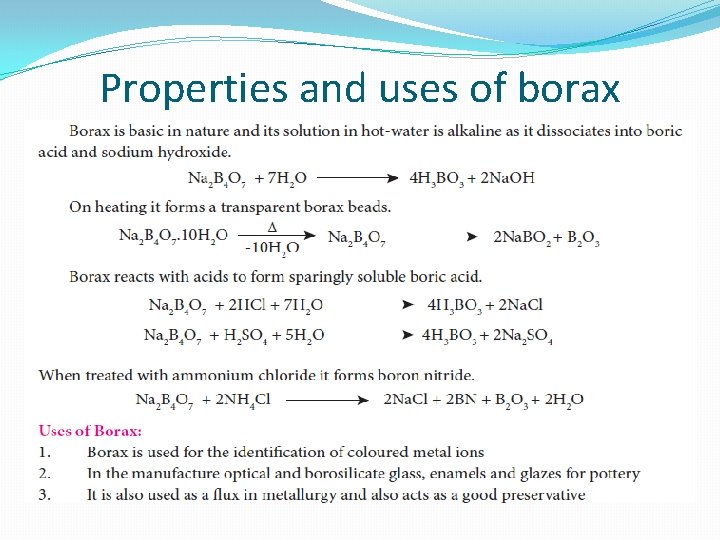
Properties and uses of borax
![Boric acid [H 3 BO 3 or B(OH)3]](http://slidetodoc.com/presentation_image_h2/cded2331afe039532aee4864da2be053/image-24.jpg "Boric acid [H 3 BO 3 or B(OH)3]")
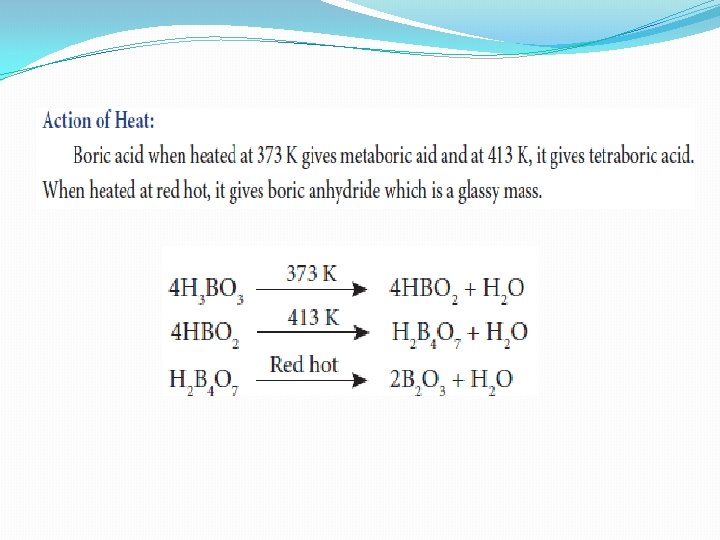
Boric acid [H 3 BO 3 or B(OH)3]
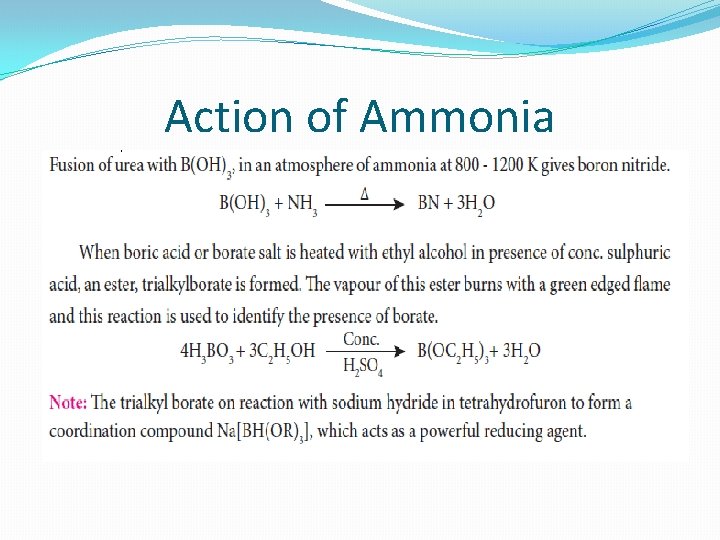
Action of Ammonia
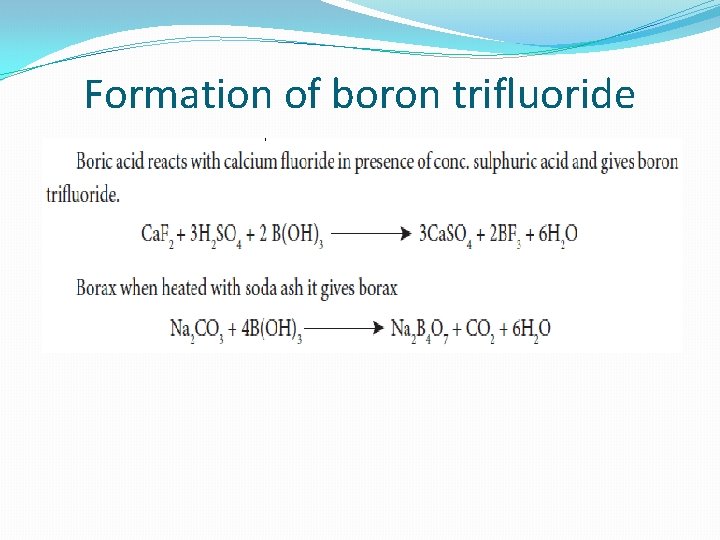
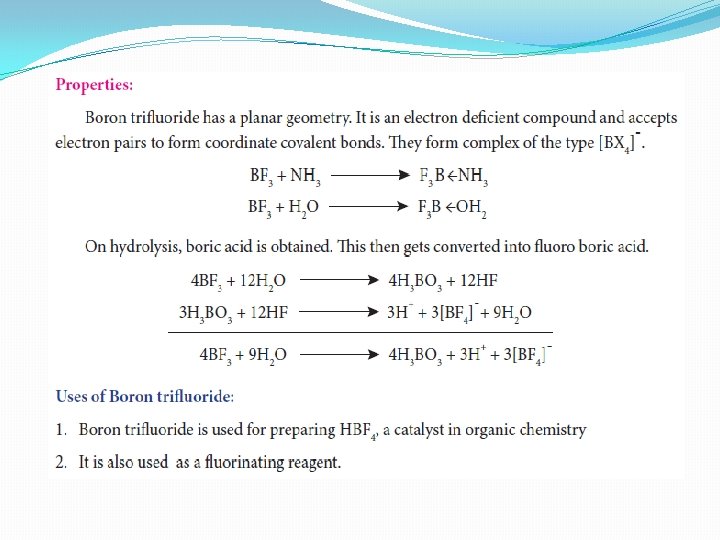
Formation of boron trifluoride
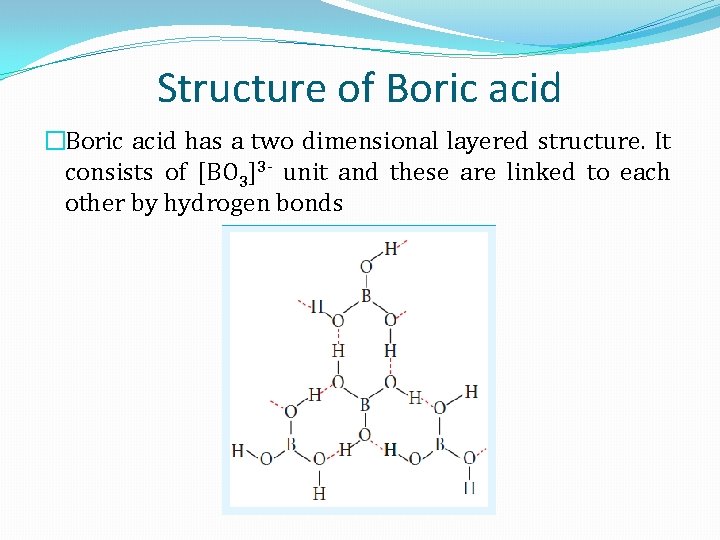
Structure of Boric acid �Boric acid has a two dimensional layered structure. It consists of [BO 3]3 - unit and these are linked to each other by hydrogen bonds
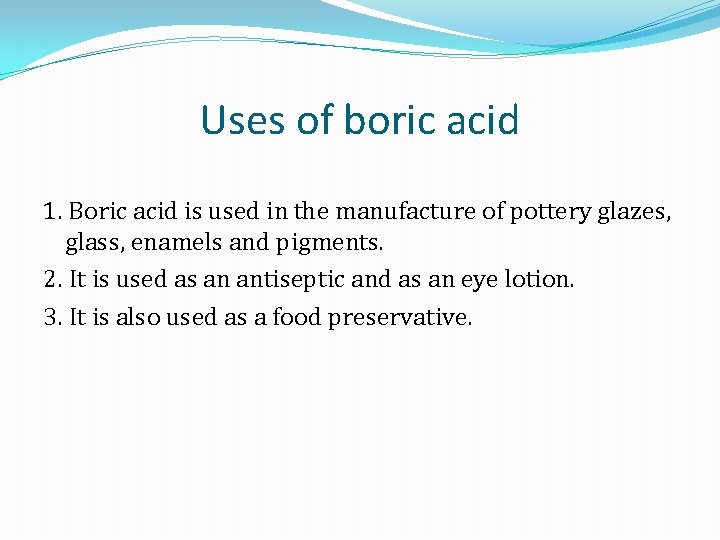
Uses of boric acid 1. Boric acid is used in the manufacture of pottery glazes, glass, enamels and pigments. 2. It is used as an antiseptic and as an eye lotion. 3. It is also used as a food preservative.
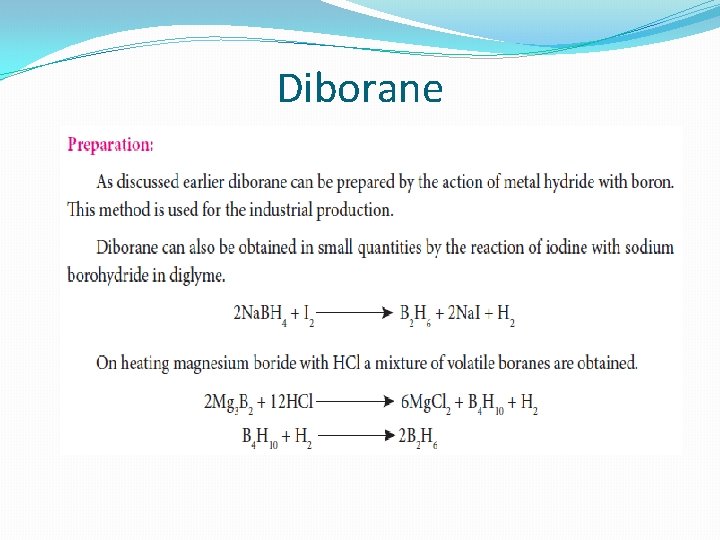
Diborane
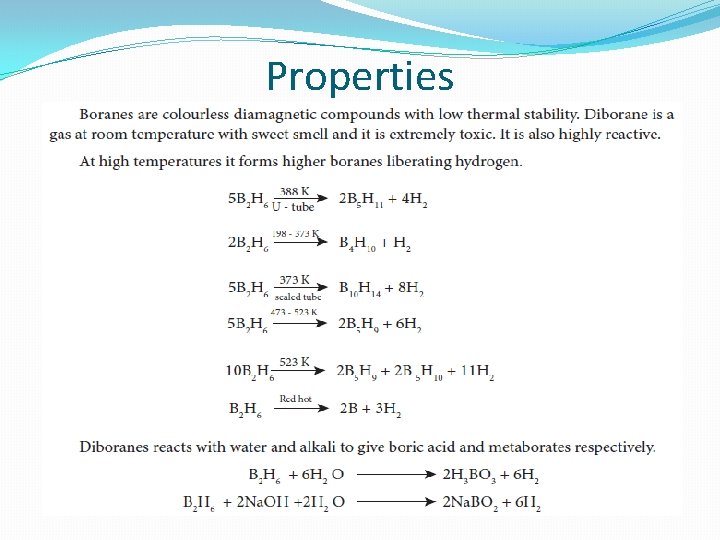
Properties
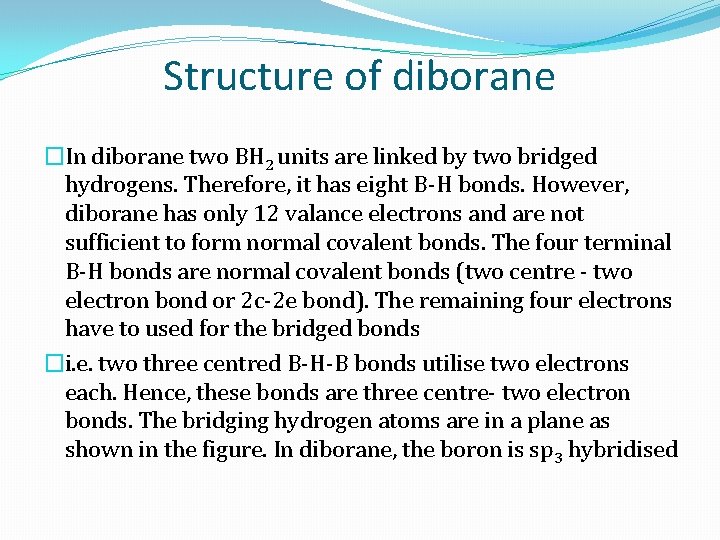
Structure of diborane �In diborane two BH 2 units are linked by two bridged hydrogens. Therefore, it has eight B-H bonds. However, diborane has only 12 valance electrons and are not sufficient to form normal covalent bonds. The four terminal B-H bonds are normal covalent bonds (two centre - two electron bond or 2 c-2 e bond). The remaining four electrons have to used for the bridged bonds �i. e. two three centred B-H-B bonds utilise two electrons each. Hence, these bonds are three centre- two electron bonds. The bridging hydrogen atoms are in a plane as shown in the figure. In diborane, the boron is sp 3 hybridised
�Three of the four sp 3 hybridised orbitals contains single electron and the fourth orbital is empty. Two of the half filled hybridised orbitals of each boron overlap with the two hydrogens to form four terminal 2 c-2 e bonds, leaving one empty and one half filled hybridised orbitals on each boron. The Three centre - two electron bonds), B-H-B bond formation involves overlapping the half filled hybridised orbital of one boron, the empty hybridised orbital of the other boron and the half filled 1 s orbital of hydrogen.
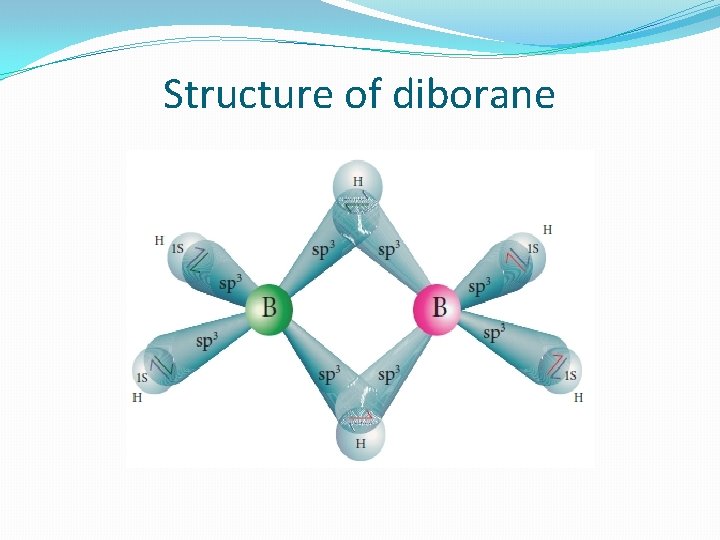
Structure of diborane
Uses of diborane 1. Diborane is used as a high energy fuel for propellant 2. It is used as a reducing agent in organic chemistry 3. It is used in welding torches
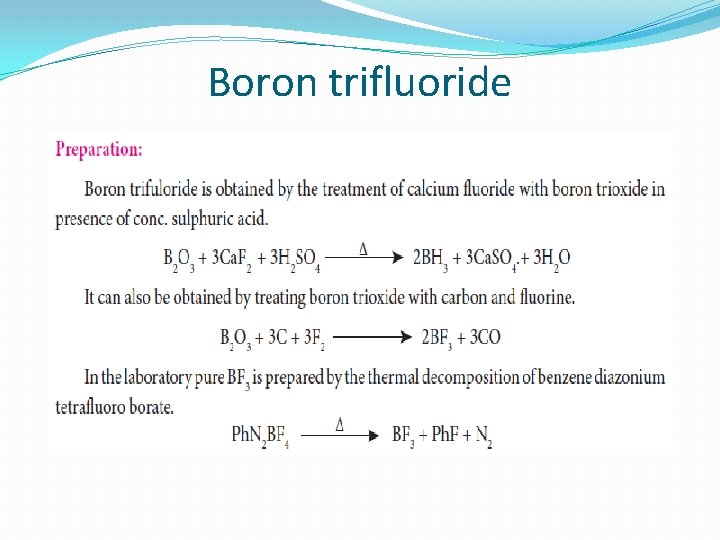
Boron trifluoride
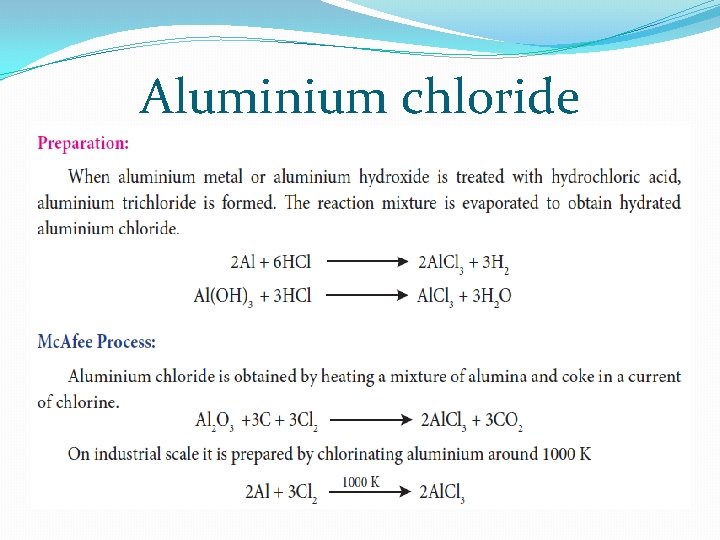
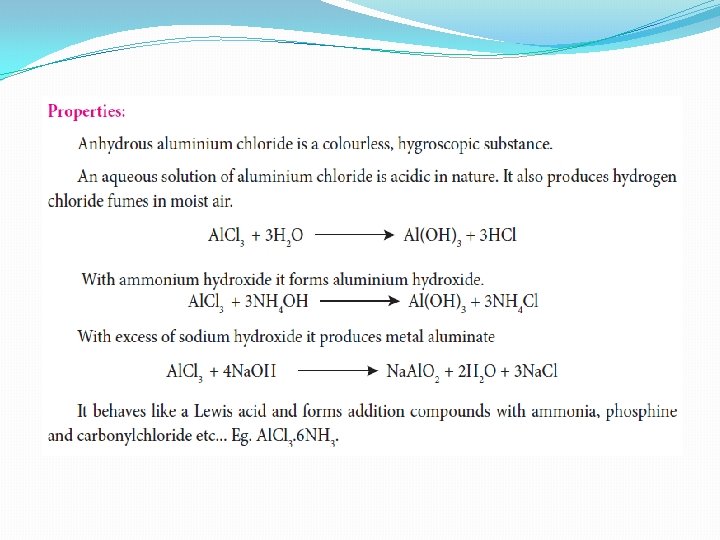
Aluminium chloride
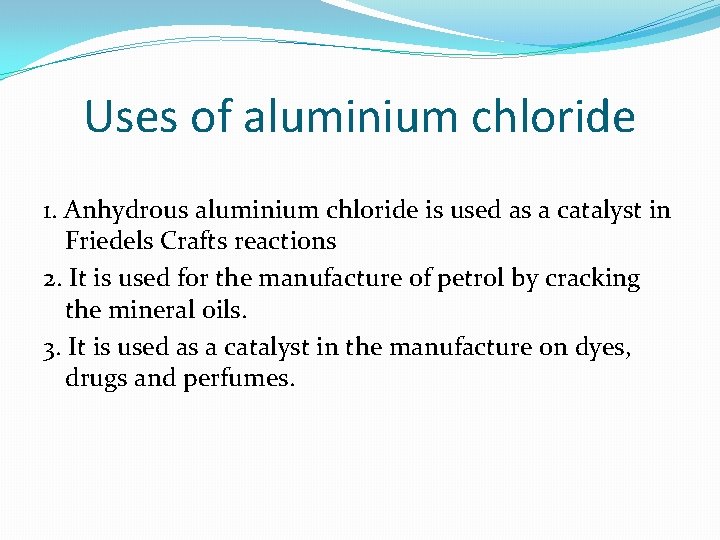
Uses of aluminium chloride 1. Anhydrous aluminium chloride is used as a catalyst in Friedels Crafts reactions 2. It is used for the manufacture of petrol by cracking the mineral oils. 3. It is used as a catalyst in the manufacture on dyes, drugs and perfumes.
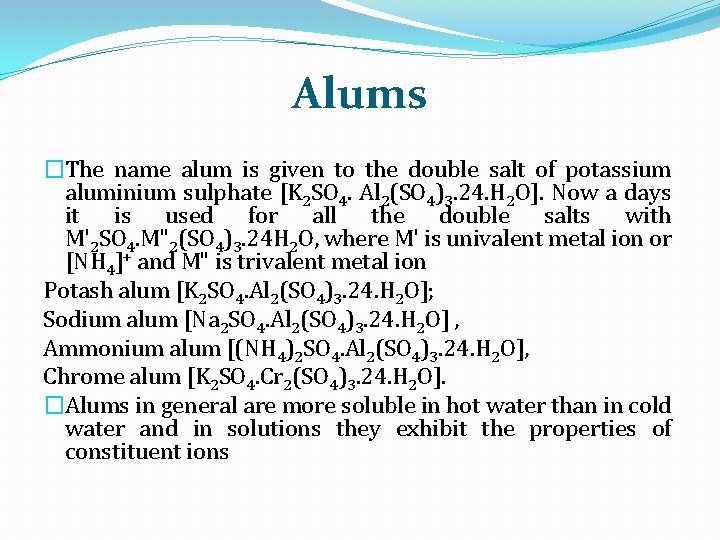
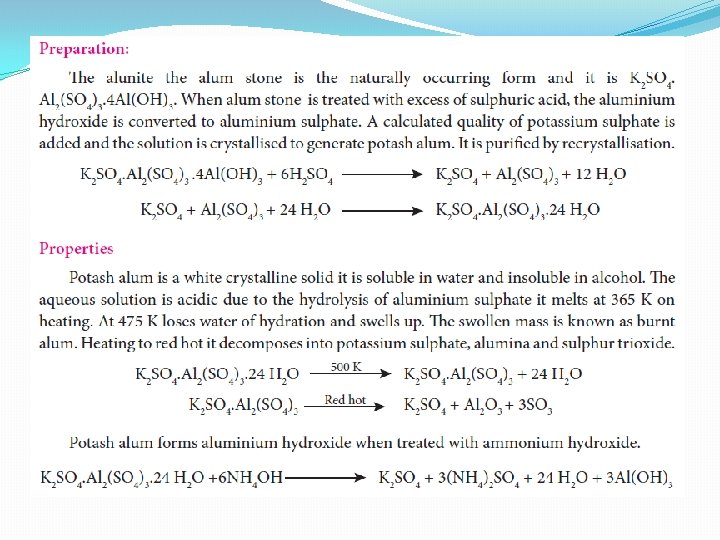
Alums �The name alum is given to the double salt of potassium aluminium sulphate [K 2 SO 4. Al 2(SO 4)3. 24. H 2 O]. Now a days it is used for all the double salts with M'2 SO 4. M"2(SO 4)3. 24 H 2 O, where M' is univalent metal ion or [NH 4]+ and M" is trivalent metal ion Potash alum [K 2 SO 4. Al 2(SO 4)3. 24. H 2 O]; Sodium alum [Na 2 SO 4. Al 2(SO 4)3. 24. H 2 O] , Ammonium alum [(NH 4)2 SO 4. Al 2(SO 4)3. 24. H 2 O], Chrome alum [K 2 SO 4. Cr 2(SO 4)3. 24. H 2 O]. �Alums in general are more soluble in hot water than in cold water and in solutions they exhibit the properties of constituent ions
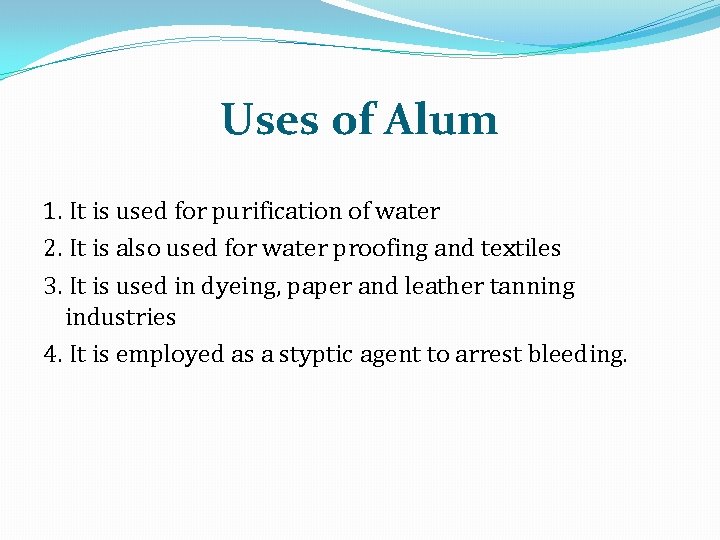
Uses of Alum 1. It is used for purification of water 2. It is also used for water proofing and textiles 3. It is used in dyeing, paper and leather tanning industries 4. It is employed as a styptic agent to arrest bleeding.
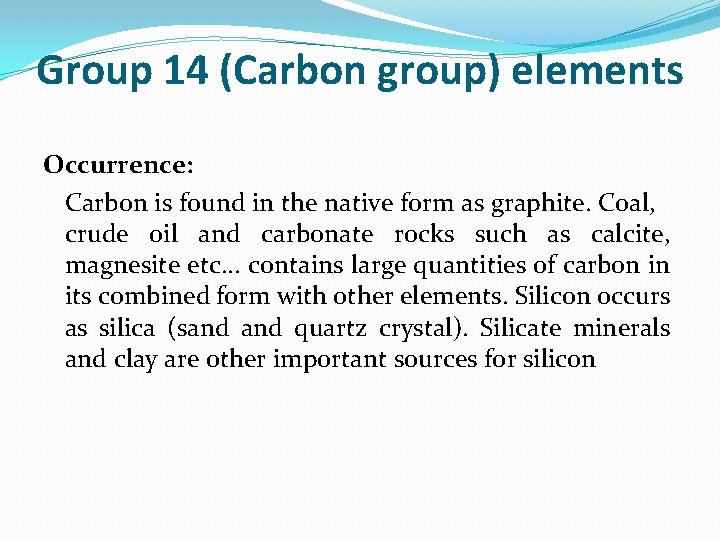
Group 14 (Carbon group) elements Occurrence: Carbon is found in the native form as graphite. Coal, crude oil and carbonate rocks such as calcite, magnesite etc. . . contains large quantities of carbon in its combined form with other elements. Silicon occurs as silica (sand quartz crystal). Silicate minerals and clay are other important sources for silicon
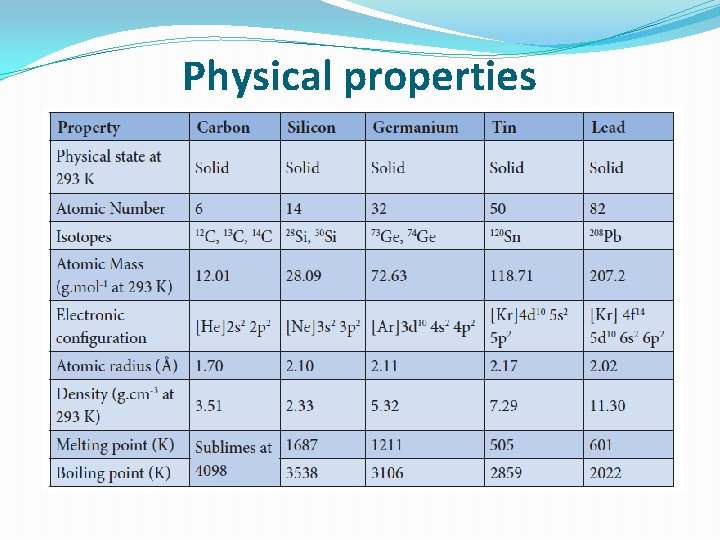
Physical properties
Tendency for catenation Catenation is an ability of an element to form chain of atoms. The following conditions are necessary for catenation. (i) the valency of element is greater than or equal to two (ii) element should have an ability to bond with itself (iii) the self bond must be as strong as its bond with other elements (iv) kinetic inertness of catenated compound towards other molecules. Carbon possesses all the above properties and forms a wide range of compounds with itself and with other elements such as H, O, N, S and halogens.
Allotropes of carbon �Carbon exists in many allotropic forms. Graphite and diamond are the most common allotropes. Other important allotropes are graphene, fullerenes and carbon nanotubes.
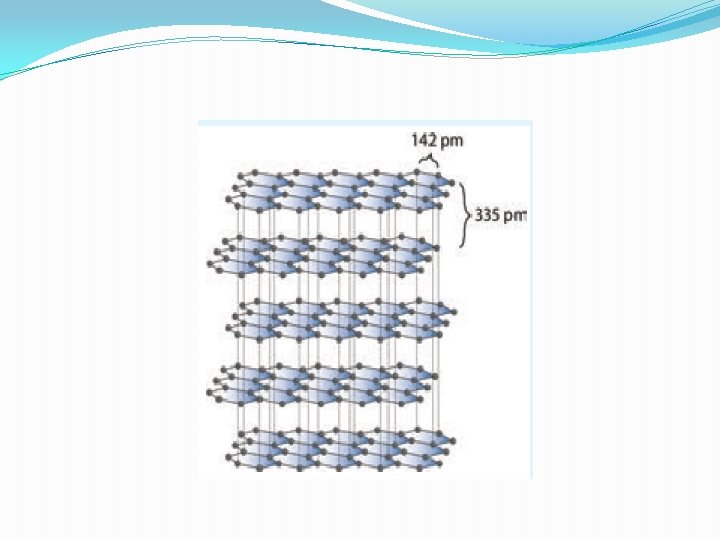
Graphite �Graphite is the most stable allotropic form of carbon at normal temperature and pressure. It is soft and conducts electricity. It is composed of flat two dimensional sheets of carbon atoms. Each sheet is a hexagonal net of sp 2 hybridised carbon atoms with a C-C bond length of 1. 41 Å which is close to the C-C bond distance in benzene (1. 40 Å). Each carbon atom forms three σ bonds with three neighbouring carbon atoms using three of its valence electrons and the fourth electron present in the unhybridised p orbital forms a π-bond. These π electrons are delocalised over the entire sheet which is responsible for its electrical conductivity. The successive carbon sheets are held together by weak van der Waals forces. The distance between successive sheet is 3. 40 Å. It is used as a lubricant either on its own or as a graphited oil
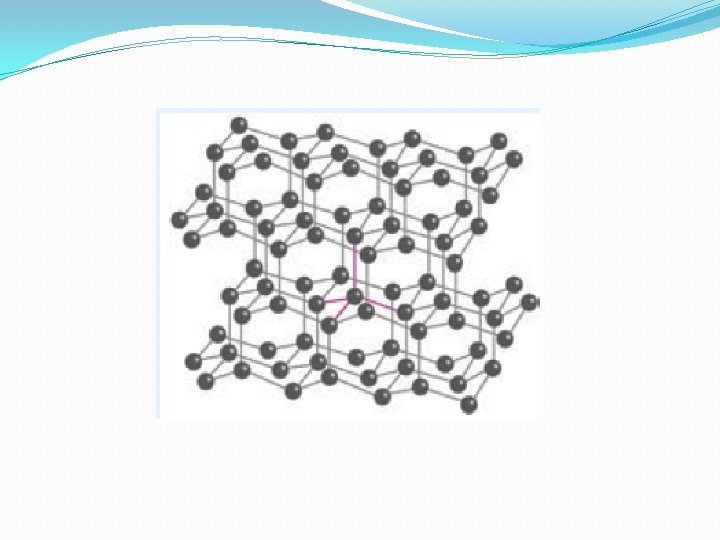
Diamond �Unlike graphite te other allotrope diamond is very hard. The carbon atoms in diamond are sp 3 hybridised and bonded to four neighbouring carbon atoms by σ bonds with a C-C bond length of 1. 54 Å. This results in a tetrahedral arrangement around each carbon atom that extends to the entire lattice as shown in figure 2. 5. Since all four valance electrons of carbon are involved in bonding there is no free electrons for conductivity. Being the hardest element, it used for sharpening hard tools, cutting glasses, making bores and rock drilling
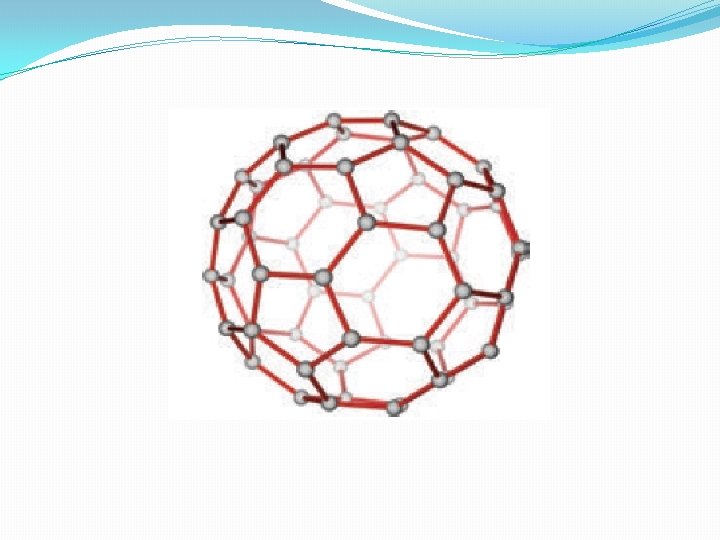
Fullerene �Fullerenes are newly synthesised allotropes of carbon. Unlike graphite and diamond, these allotropes are discrete molecules such as C 32, C 50, C 60, C 76 etc. . These molecules have cage like structures as shown in the figure. The C 60 molecules have a soccer ball like structure and is called buckminster fullerene or buckyballs. It has a fused ring structure consists of 20 six membered rings and 12 five membered rings. Each carbon atom is sp 2 hybridised and forms thee σ bonds & a delocalised π bond giving aromatic character to these molecules. The C-C bond distance is 1. 44 Å and C=C distance 1. 38 Å.
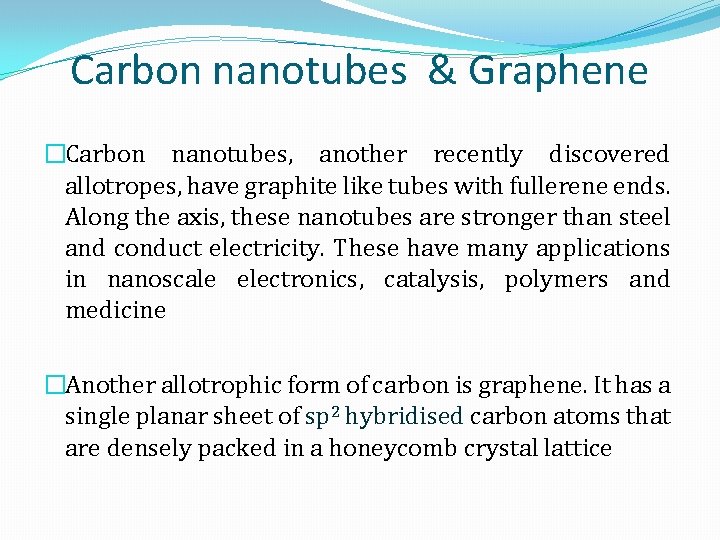
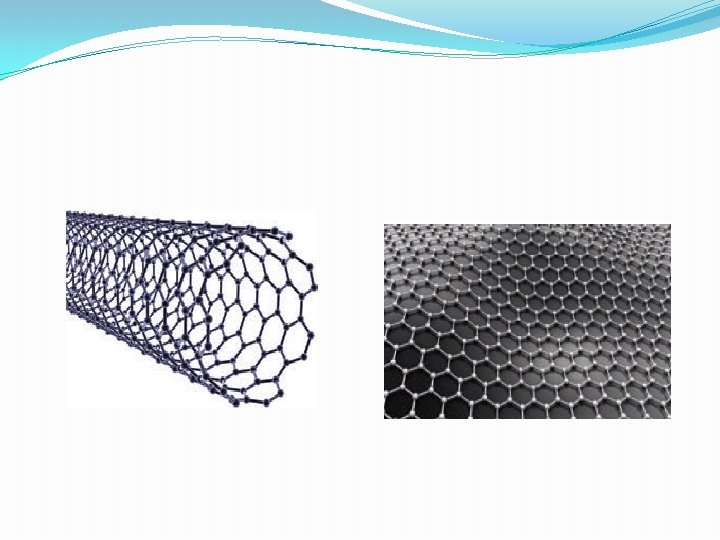
Carbon nanotubes & Graphene �Carbon nanotubes, another recently discovered allotropes, have graphite like tubes with fullerene ends. Along the axis, these nanotubes are stronger than steel and conduct electricity. These have many applications in nanoscale electronics, catalysis, polymers and medicine �Another allotrophic form of carbon is graphene. It has a single planar sheet of sp 2 hybridised carbon atoms that are densely packed in a honeycomb crystal lattice
![Carbon monoxide [CO] �Preparation: Carbon monoxide can be prepared by the reaction of carbon](http://slidetodoc.com/presentation_image_h2/cded2331afe039532aee4864da2be053/image-58.jpg "Carbon monoxide [CO] �Preparation: Carbon monoxide can be prepared by the reaction of carbon")
Carbon monoxide [CO] �Preparation: Carbon monoxide can be prepared by the reaction of carbon with limited amount of oxygen. �
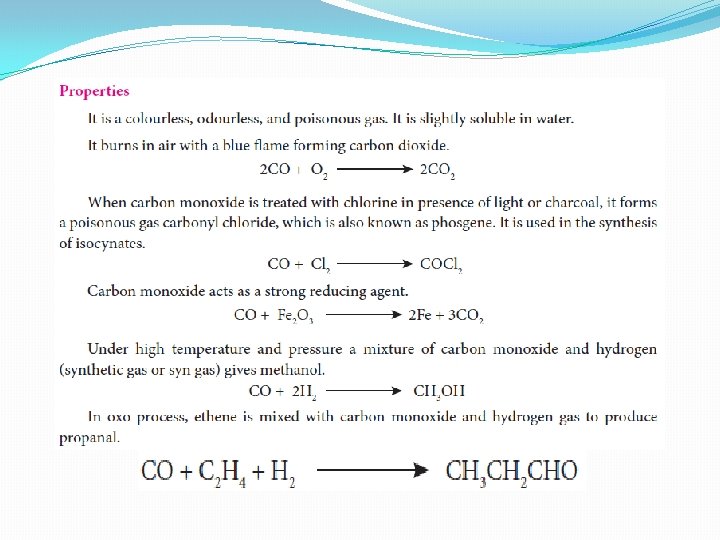
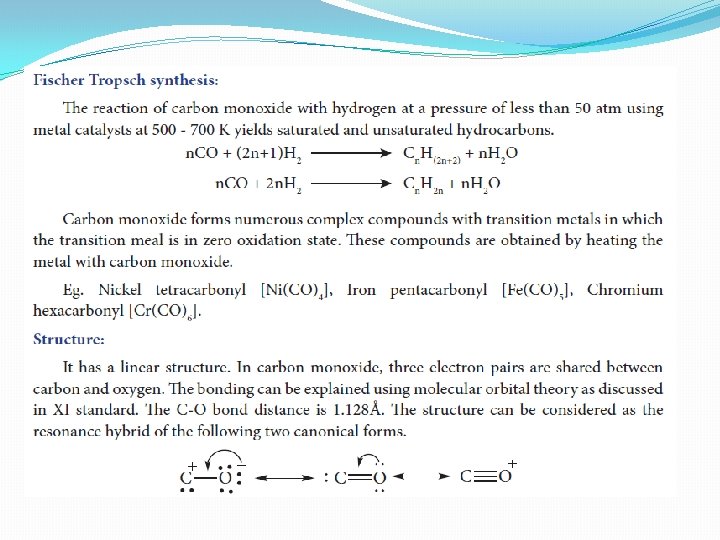
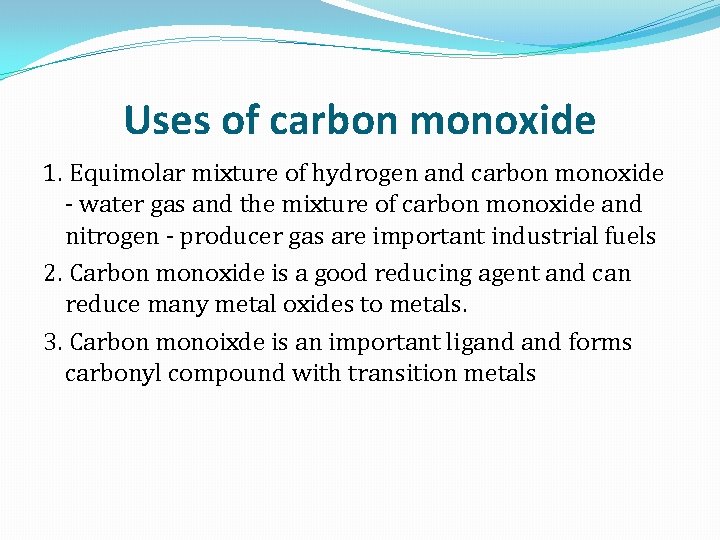
Uses of carbon monoxide 1. Equimolar mixture of hydrogen and carbon monoxide - water gas and the mixture of carbon monoxide and nitrogen - producer gas are important industrial fuels 2. Carbon monoxide is a good reducing agent and can reduce many metal oxides to metals. 3. Carbon monoixde is an important ligand forms carbonyl compound with transition metals
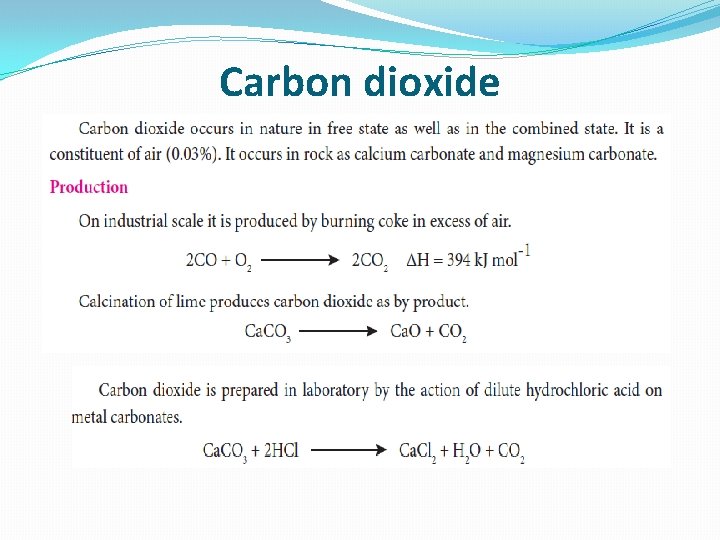
Carbon dioxide
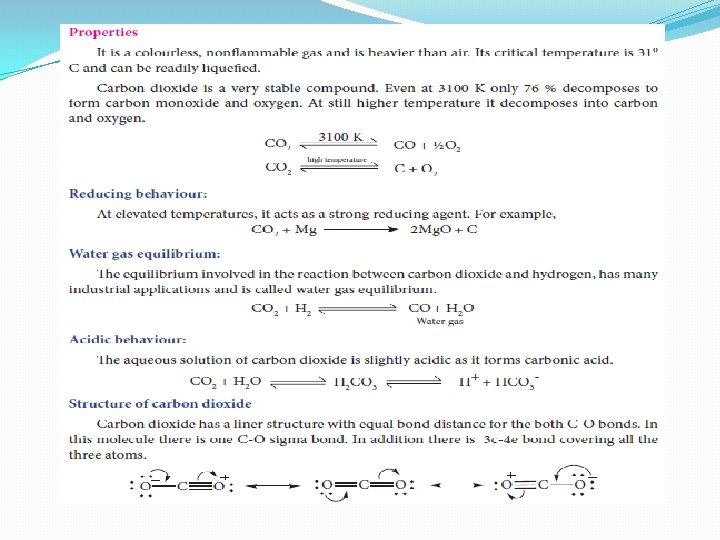
Uses of carbon dioxide 1. Carbon dioxide is used to produce an inert atomosphere for chemical processing. 2. Biologically, it is important for photosynthesis. 3. It is also used as fire extinguisher and as a propellent gas. 4. It is used in the production of carbonated beverages and in the production of foam.
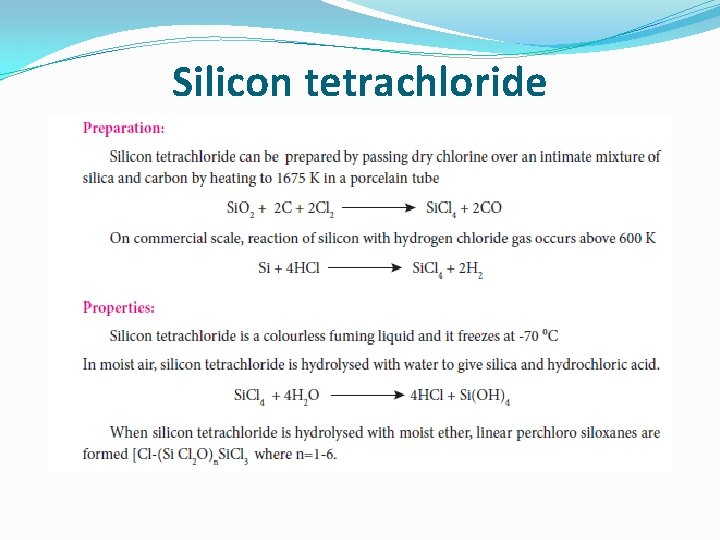
Silicon tetrachloride
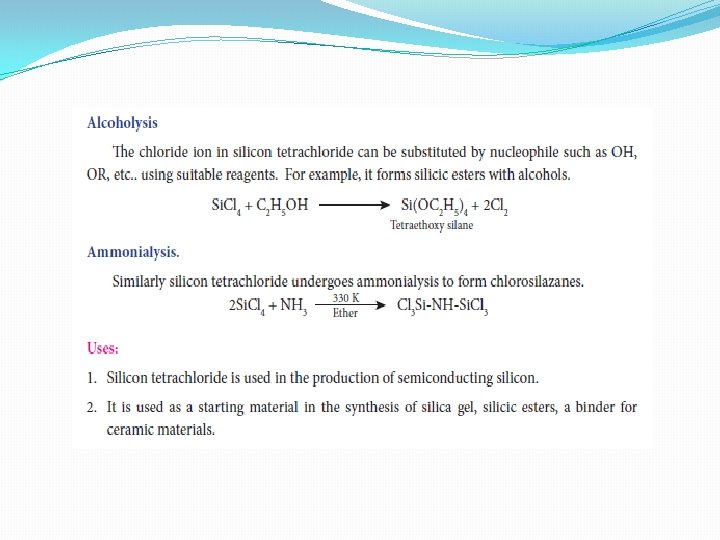
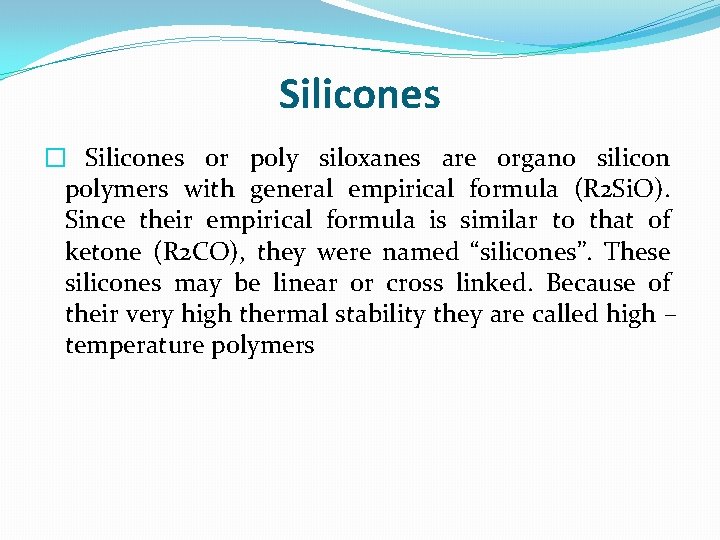
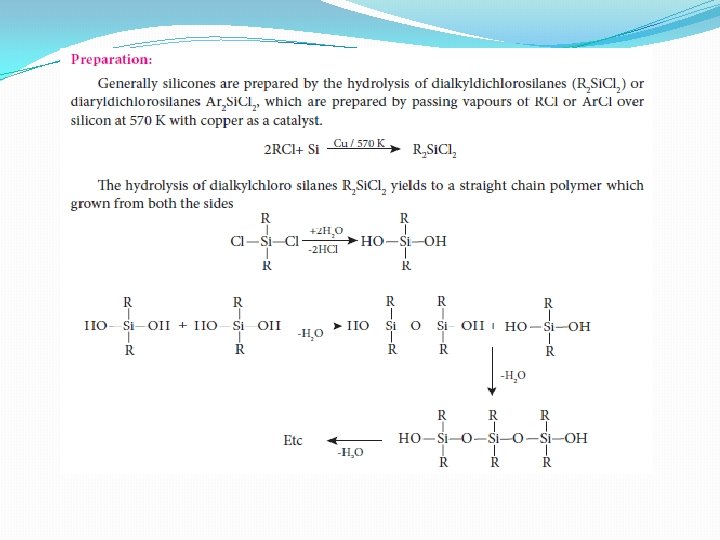
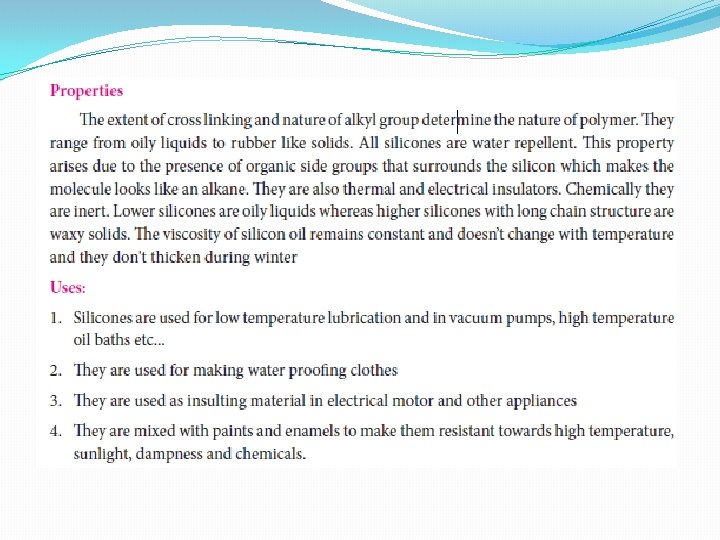
Silicones � Silicones or poly siloxanes are organo silicon polymers with general empirical formula (R 2 Si. O). Since their empirical formula is similar to that of ketone (R 2 CO), they were named “silicones”. These silicones may be linear or cross linked. Because of their very high thermal stability they are called high – temperature polymers
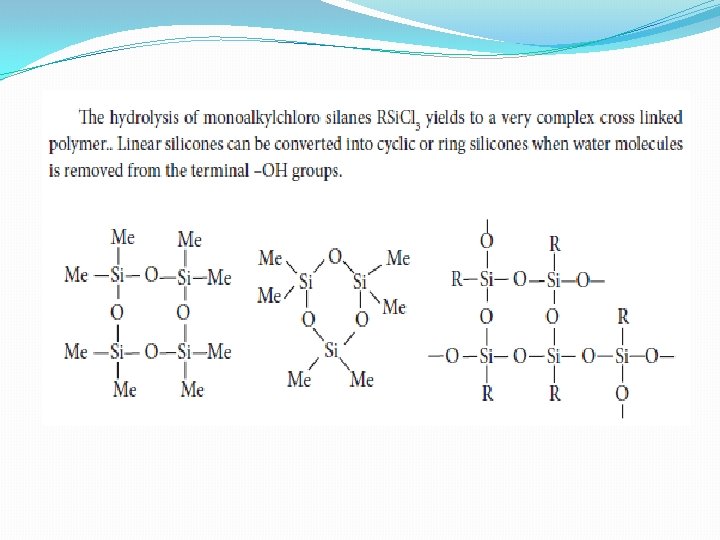
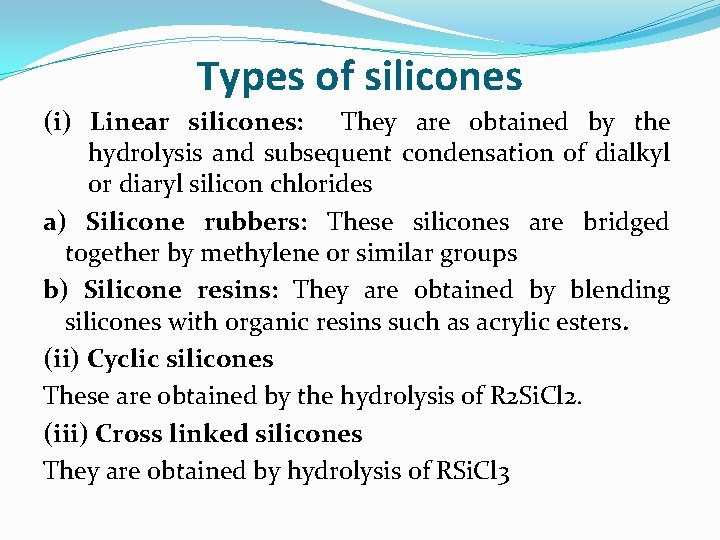
Types of silicones (i) Linear silicones: They are obtained by the hydrolysis and subsequent condensation of dialkyl or diaryl silicon chlorides a) Silicone rubbers: These silicones are bridged together by methylene or similar groups b) Silicone resins: They are obtained by blending silicones with organic resins such as acrylic esters. (ii) Cyclic silicones These are obtained by the hydrolysis of R 2 Si. Cl 2. (iii) Cross linked silicones They are obtained by hydrolysis of RSi. Cl 3
![Silicates �The mineral which contains silicon and oxygen in tetrahedral [Si. O 4]4 -](http://slidetodoc.com/presentation_image_h2/cded2331afe039532aee4864da2be053/image-72.jpg "Silicates �The mineral which contains silicon and oxygen in tetrahedral [Si. O 4]4 -")
Silicates �The mineral which contains silicon and oxygen in tetrahedral [Si. O 4]4 - units linked together in different patterns are called silicates. Nearly 95 % of the earth crust is composed of silicate minerals and silica. The glass and ceramic industries are based on the chemistry silicates.
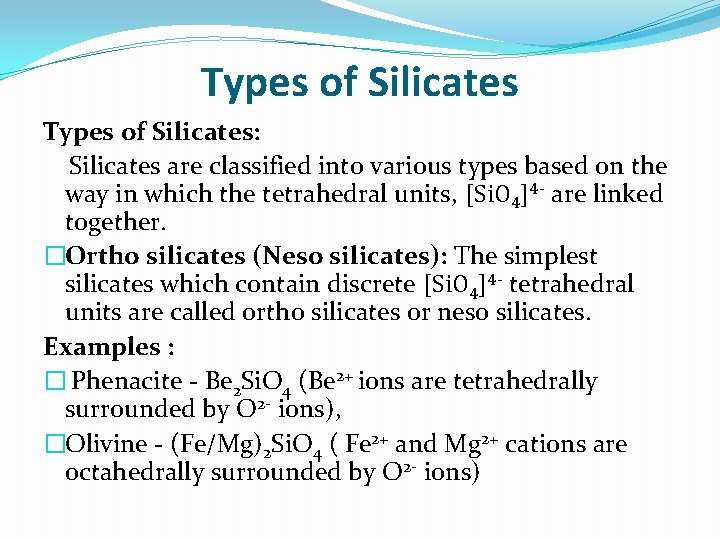
Types of Silicates: Silicates are classified into various types based on the way in which the tetrahedral units, [Si. O 4]4 - are linked together. �Ortho silicates (Neso silicates): The simplest silicates which contain discrete [Si. O 4]4 - tetrahedral units are called ortho silicates or neso silicates. Examples : � Phenacite - Be 2 Si. O 4 (Be 2+ ions are tetrahedrally surrounded by O 2 - ions), �Olivine - (Fe/Mg)2 Si. O 4 ( Fe 2+ and Mg 2+ cations are octahedrally surrounded by O 2 - ions)
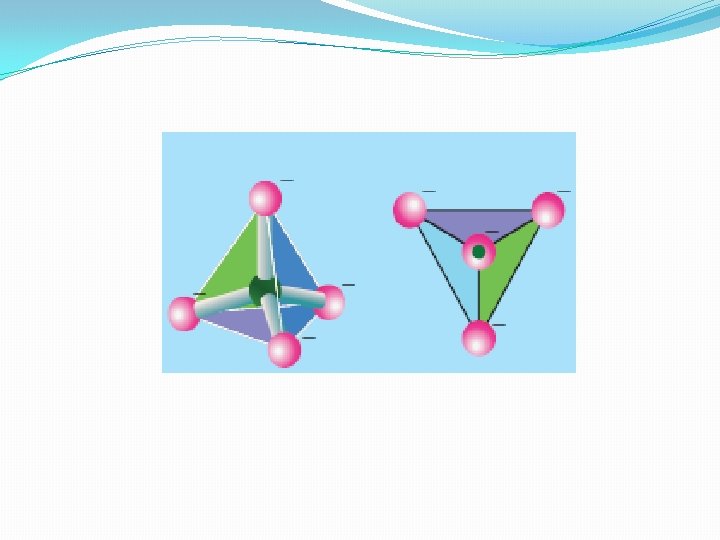
![Pyro silicate (or) Soro silicates �Silicates which contain [Si 2 O 7]6 - ions](http://slidetodoc.com/presentation_image_h2/cded2331afe039532aee4864da2be053/image-75.jpg "Pyro silicate (or) Soro silicates �Silicates which contain [Si 2 O 7]6 - ions")
Pyro silicate (or) Soro silicates �Silicates which contain [Si 2 O 7]6 - ions are called pyro silicates (or) Soro silicates. They are formed by joining two [Si. O 4]4 - tetrahedral units by sharing one oxygen atom at one corner. (one oxygen is removed while joining). �Example : Thortveitite - Sc 2 Si 2 O 7
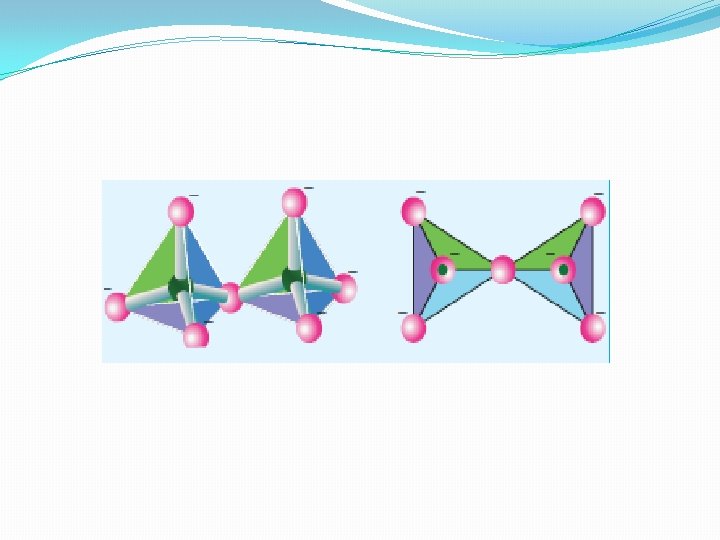
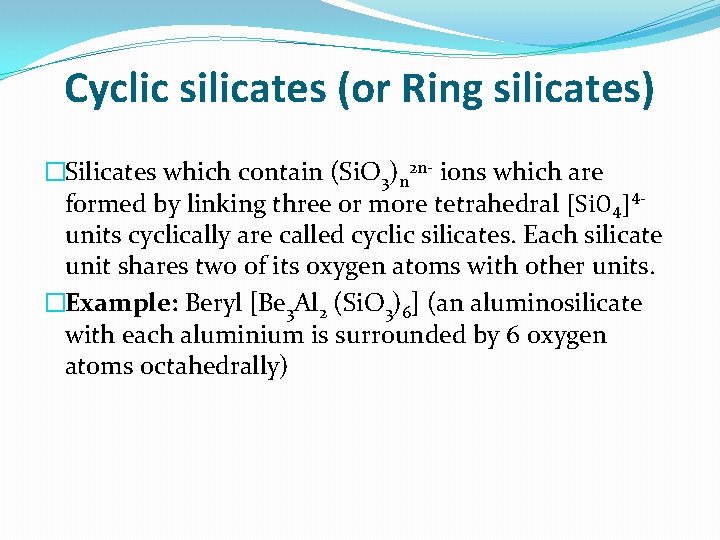
Cyclic silicates (or Ring silicates) �Silicates which contain (Si. O 3)n 2 n- ions which are formed by linking three or more tetrahedral [Si. O 4]4 units cyclically are called cyclic silicates. Each silicate unit shares two of its oxygen atoms with other units. �Example: Beryl [Be 3 Al 2 (Si. O 3)6] (an aluminosilicate with each aluminium is surrounded by 6 oxygen atoms octahedrally)
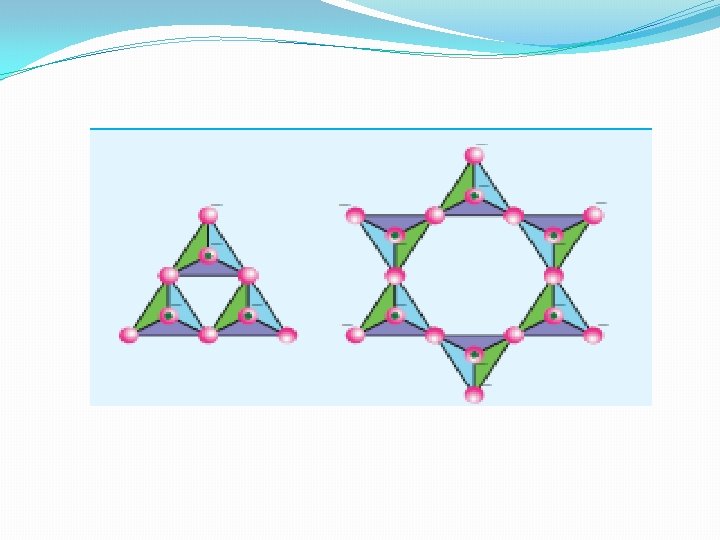
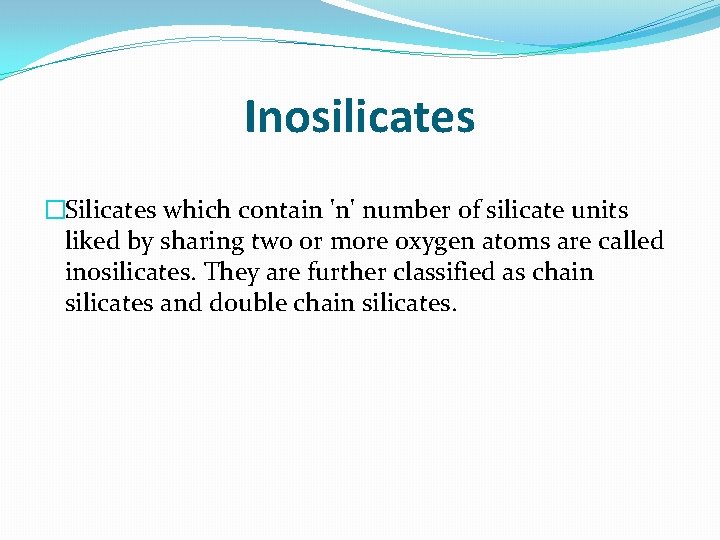
Inosilicates �Silicates which contain 'n' number of silicate units liked by sharing two or more oxygen atoms are called inosilicates. They are further classified as chain silicates and double chain silicates.
![Chain silicates (or pyroxenes) �These silicates contain [(Si. O 3) n]2 n- ions formed](http://slidetodoc.com/presentation_image_h2/cded2331afe039532aee4864da2be053/image-80.jpg "Chain silicates (or pyroxenes) �These silicates contain [(Si. O 3) n]2 n- ions formed")
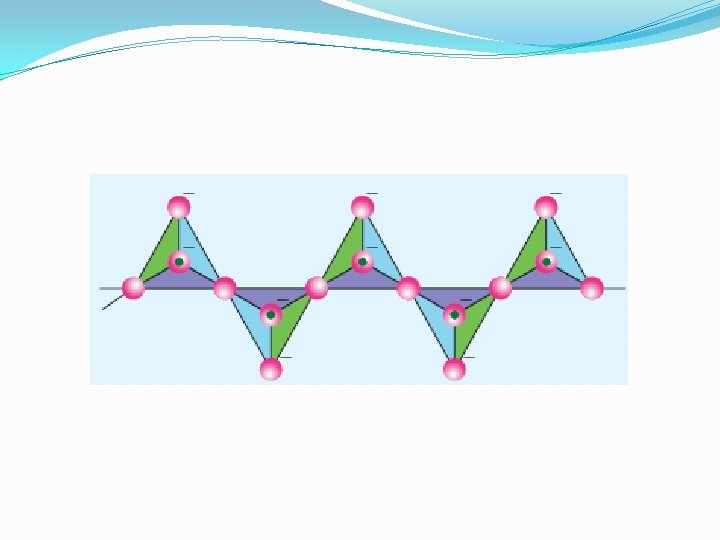
Chain silicates (or pyroxenes) �These silicates contain [(Si. O 3) n]2 n- ions formed by linking ‘n’ number of tetrahedral [Si. O 4]4 -units linearly. Each silicate unit shares two of its oxygen atoms with other units. �Example: Spodumene - Li. Al(Si. O 3)2.
![Double chain silicates (amphiboles) �These silicates contains [Si 4 O 11]n 6 n- ions.](http://slidetodoc.com/presentation_image_h2/cded2331afe039532aee4864da2be053/image-82.jpg "Double chain silicates (amphiboles) �These silicates contains [Si 4 O 11]n 6 n- ions.")
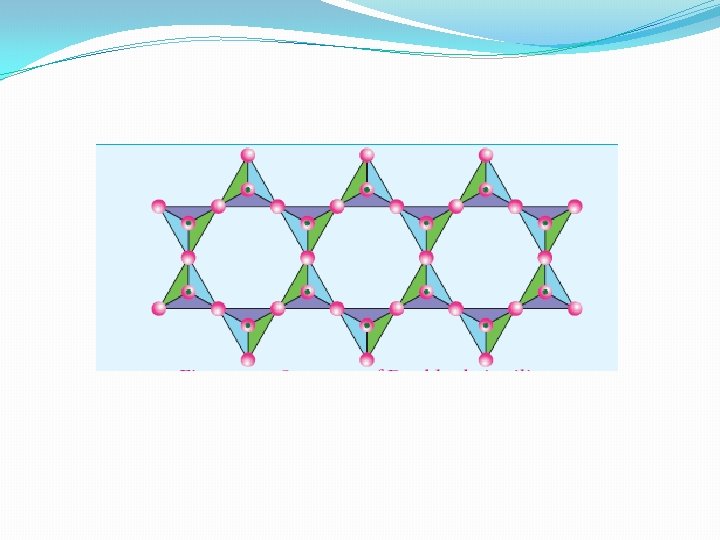
Double chain silicates (amphiboles) �These silicates contains [Si 4 O 11]n 6 n- ions. In these silicates there are two different types of tetrahedral �(i) Those sharing 3 vertices �(ii) those sharing only 2 vertices. Examples: � Asbestos : These are fibrous and non-combustible silicates. Therefore they are used for thermal insulation material, brake linings, construction material and filters. Asbestos being carcinogenic silicates, their applications are restricted.
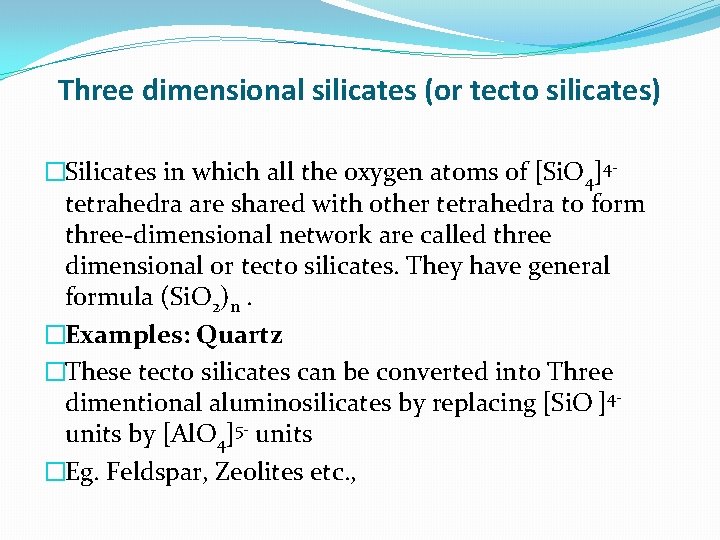
Sheet or phyllo silicates �Silicates which contain (Si 2 O 5)n 2 n- are called sheet or phyllo silicates. In these, Each [ Si. O 4 ] 4 - tetrahedron unit shares three oxygen atoms with others and thus by forming two-dimensional sheets. These sheets silicates form layered structures in which silicate sheets are stacked over each other. The attractive forces between these layers are very week, hence they can be cleaved easily just like graphite. �Example: Talc, Mica etc. . .
Three dimensional silicates (or tecto silicates) �Silicates in which all the oxygen atoms of [Si. O 4]4 tetrahedra are shared with other tetrahedra to form three-dimensional network are called three dimensional or tecto silicates. They have general formula (Si. O 2)n. �Examples: Quartz �These tecto silicates can be converted into Three dimentional aluminosilicates by replacing [Si. O ]4 units by [Al. O 4]5 - units �Eg. Feldspar, Zeolites etc. ,
Zeolites �Zeolites are three-dimensional crystalline solids containing aluminium, silicon, and oxygen in their regular three dimensional framework. They are hydrated sodium alumino silicates with general formula Na. O. (Al 2 O 3). x(Si. O 2). y. H 2 O (x=2 to 10; y=2 to 6). �Zeolites have porous structure in which the monovalent sodium ions and water molecules are loosely held. The Si and Al atoms are tetrahedrally coordinated with each other through shared oxygen atoms. Zeolites are similar to clay minerals but they differ in their crystalline structure. �Zeolites have a three dimensional crystalline structure looks like a honeycomb consisting of a network of interconnected tunnels and cages. Water molecules moves freely in and out of these pores but the zeolite framework remains rigid. Another special aspect of this structure is that the pore/channel sizes are nearly uniform, allowing the crystal to act as a molecular sieve. We have already discussed in XI standard, the removal of permanent hardness of water using zeolites.
- Slides: 87