
XGC Gyrokinetic Particle Simulation of Edge Plasma Presented
- Slides: 12
XGC: Gyrokinetic Particle Simulation of Edge Plasma Presented by CPES Team Physics and Applied Math Computational Science
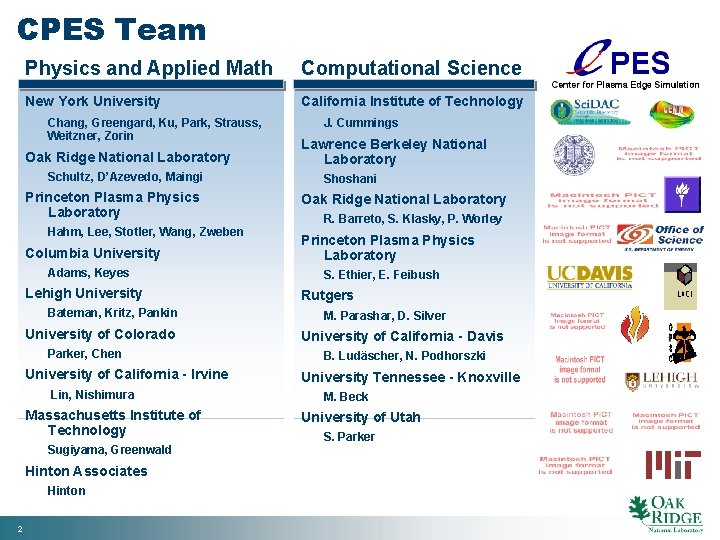
CPES Team Physics and Applied Math Computational Science New York University California Institute of Technology Chang, Greengard, Ku, Park, Strauss, Weitzner, Zorin Oak Ridge National Laboratory Schultz, D’Azevedo, Maingi Princeton Plasma Physics Laboratory Hahm, Lee, Stotler, Wang, Zweben Columbia University Adams, Keyes Lehigh University Bateman, Kritz, Pankin University of Colorado Parker, Chen University of California - Irvine Lin, Nishimura Massachusetts Institute of Technology Sugiyama, Greenwald Hinton Associates Hinton 2 J. Cummings Lawrence Berkeley National Laboratory Shoshani Oak Ridge National Laboratory R. Barreto, S. Klasky, P. Worley Princeton Plasma Physics Laboratory S. Ethier, E. Feibush Rutgers M. Parashar, D. Silver University of California - Davis B. Ludäscher, N. Podhorszki University Tennessee - Knoxville M. Beck University of Utah S. Parker
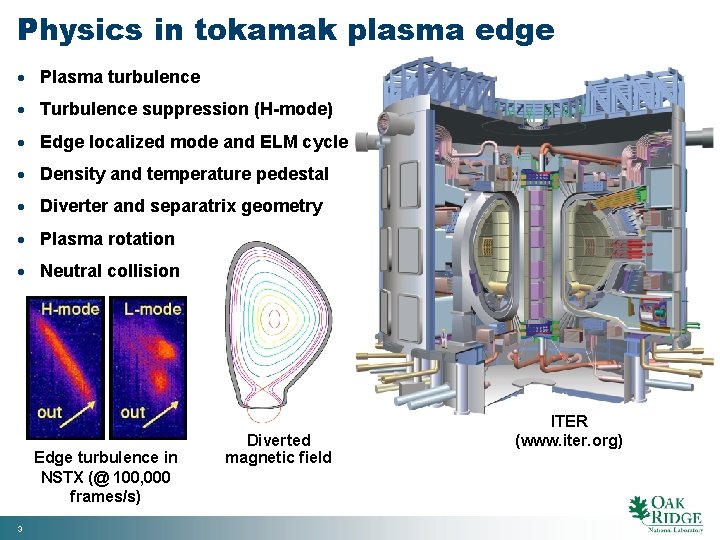
Physics in tokamak plasma edge · Plasma turbulence · Turbulence suppression (H-mode) · Edge localized mode and ELM cycle · Density and temperature pedestal · Diverter and separatrix geometry · Plasma rotation · Neutral collision Edge turbulence in NSTX (@ 100, 000 frames/s) 3 Diverted magnetic field ITER (www. iter. org)
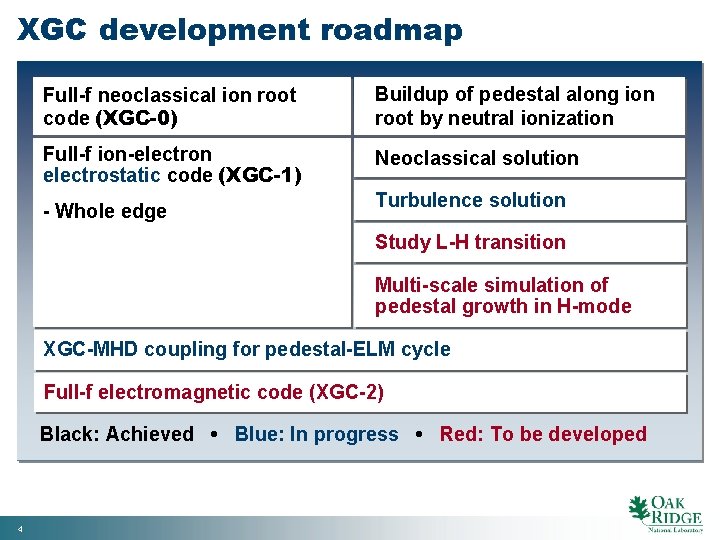
XGC development roadmap Full-f neoclassical ion root code (XGC-0) Buildup of pedestal along ion root by neutral ionization Full-f ion-electron electrostatic code (XGC-1) Neoclassical solution - Whole edge Turbulence solution Study L-H transition Multi-scale simulation of pedestal growth in H-mode XGC-MHD coupling for pedestal-ELM cycle Full-f electromagnetic code (XGC-2) Black: Achieved • Blue: In progress • Red: To be developed 4
XGC 1 code · Particle-in-cell code · 5 -dimensional (3 -D real space + 2 -D velocity space) · Conserving plasma collisions (Monte Carlo) · Full-f ions, electrons, and neutrals · Gyrokinetic Poisson equation for neoclassical and turbulent electric field · PETSc library for Poisson solver · MPI for parallelization · Realistic magnetic geometry containing X-point · Particle source from neutral ionization 5
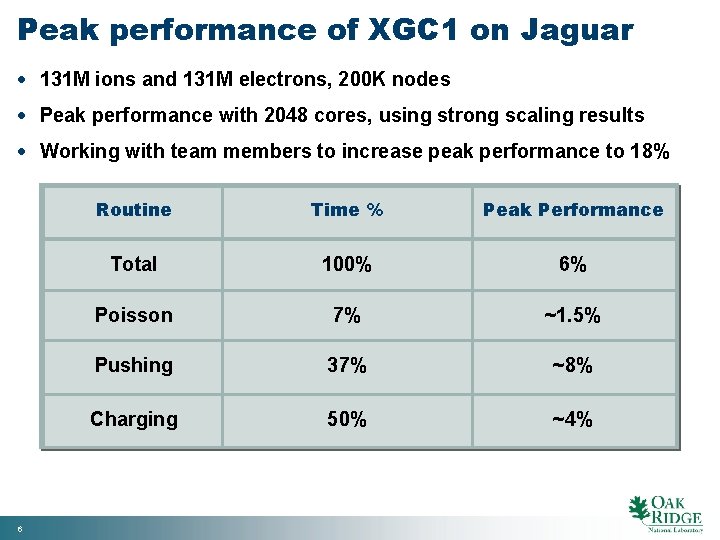
Peak performance of XGC 1 on Jaguar · 131 M ions and 131 M electrons, 200 K nodes · Peak performance with 2048 cores, using strong scaling results · Working with team members to increase peak performance to 18% 6 Routine Time % Peak Performance Total 100% 6% Poisson 7% ~1. 5% Pushing 37% ~8% Charging 50% ~4%
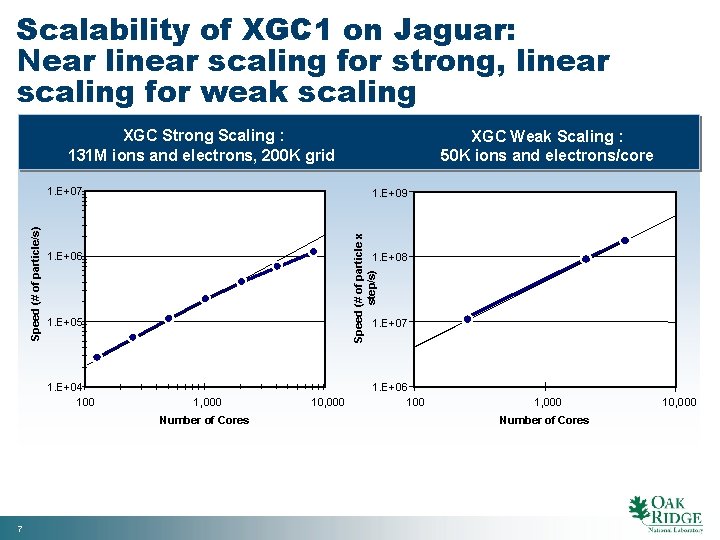
Scalability of XGC 1 on Jaguar: Near linear scaling for strong, linear scaling for weak scaling XGC Strong Scaling : 131 M ions and electrons, 200 K grid 1. E+09 Speed (# of particle x step/s) Speed (# of particle/s) 1. E+07 1. E+06 1. E+08 1. E+05 1. E+04 100 1. E+07 1, 000 Number of Cores 7 XGC Weak Scaling : 50 K ions and electrons/core 10, 000 1. E+06 100 1, 000 Number of Cores 10, 000
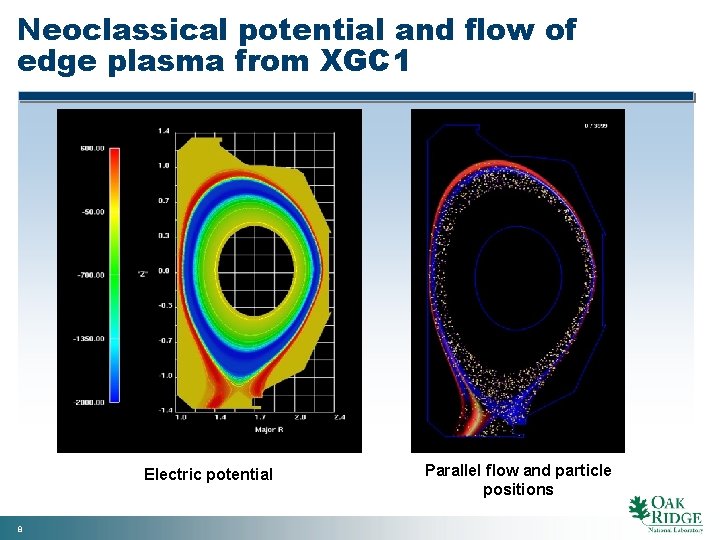
Neoclassical potential and flow of edge plasma from XGC 1 Electric potential 8 Parallel flow and particle positions
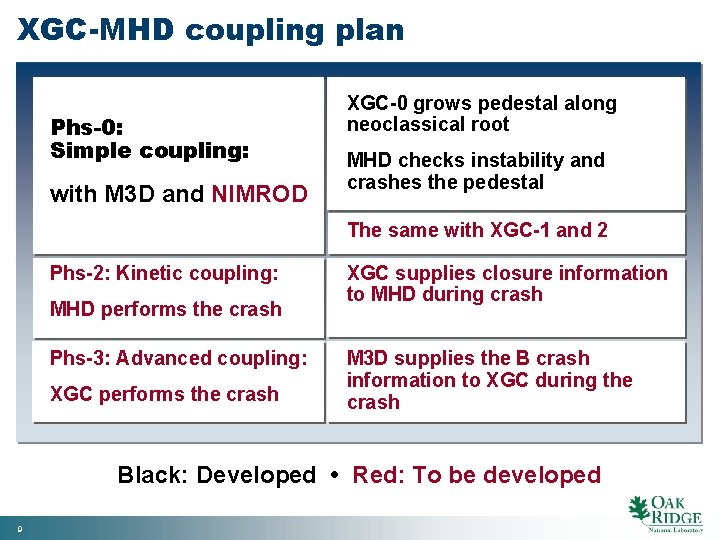
XGC-MHD coupling plan Phs-0: Simple coupling: with M 3 D and NIMROD XGC-0 grows pedestal along neoclassical root MHD checks instability and crashes the pedestal The same with XGC-1 and 2 Phs-2: Kinetic coupling: MHD performs the crash Phs-3: Advanced coupling: XGC performs the crash XGC supplies closure information to MHD during crash M 3 D supplies the B crash information to XGC during the crash Black: Developed • Red: To be developed 9
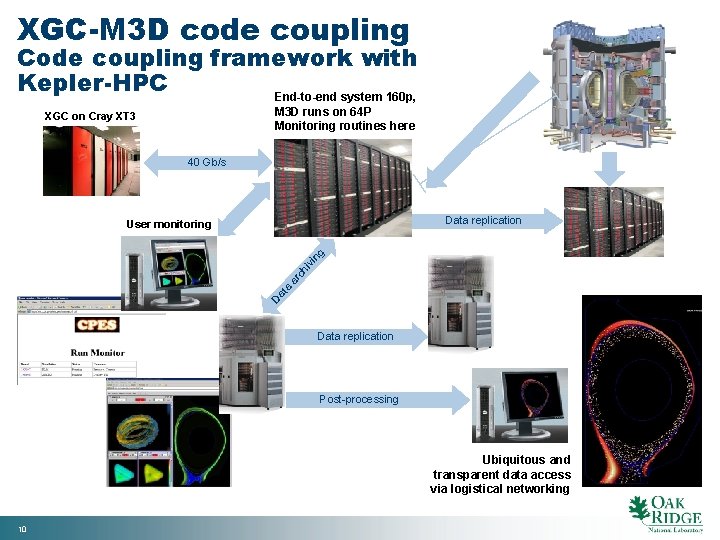
XGC-M 3 D code coupling Code coupling framework with Kepler-HPC End-to-end system 160 p, M 3 D runs on 64 P Monitoring routines here XGC on Cray XT 3 40 Gb/s Data replication Da ta ar ch ivi ng User monitoring Data replication Post-processing Ubiquitous and transparent data access via logistical networking 10
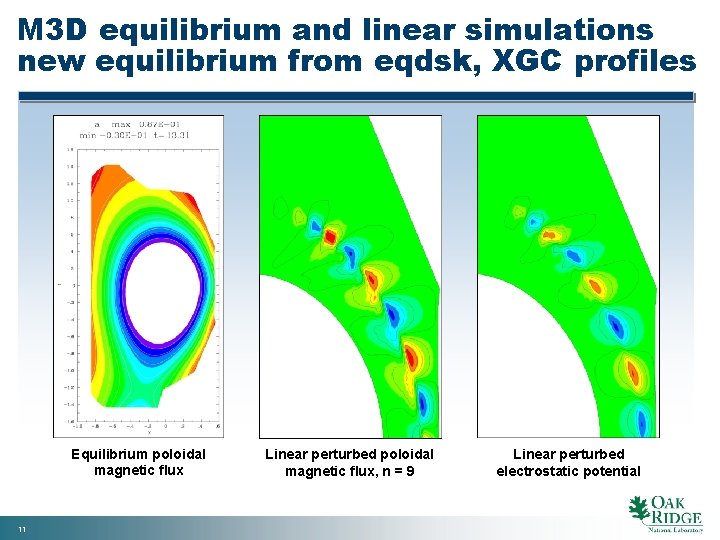
M 3 D equilibrium and linear simulations new equilibrium from eqdsk, XGC profiles Equilibrium poloidal magnetic flux 11 Linear perturbed poloidal magnetic flux, n = 9 Linear perturbed electrostatic potential
Contact Scott A. Klasky Lead, End-to-End Solutions Center for Computational Sciences (865) 241 -9980 klasky@ornl. gov 12 12 Klasky_XGC_0611