
Xerographic Setup and Control ROS Power and Photoreceptor



- Slides: 19
Xerographic Setup and Control, ROS Power, and Photoreceptor Sensitivity Considerations for Delphinus Plus Mark Jackson XIG / XRCW /Operations ME&IL Review / MP&CI Page For Internal Use Only
Acknowledgements Helpful discussions, critiques, data pointers, etc. from • Brad Willard (PSG/PDU) on Delphinus setup • Pat Donaldson (PSG/PDU) on Delphinus setup • Bob Kleckner (PSG/PDU) on VCSEL ROS • Ed Grabowski (CD&MG/PDA) on photoreceptors but the remaining judgment calls and outright errors are mine. . 2 For Internal Use Only
Overview Of a Work In Progress General parameters Xerographic setup and process controls • image-on-image essentials • i. Gen 3 • Delphinus Plus and beyond ROS and imaging system • i. Gen 3 • VCSEL Photoreceptor • sensitivity • CTL transit time Current outlook and checkpoints 3 For Internal Use Only
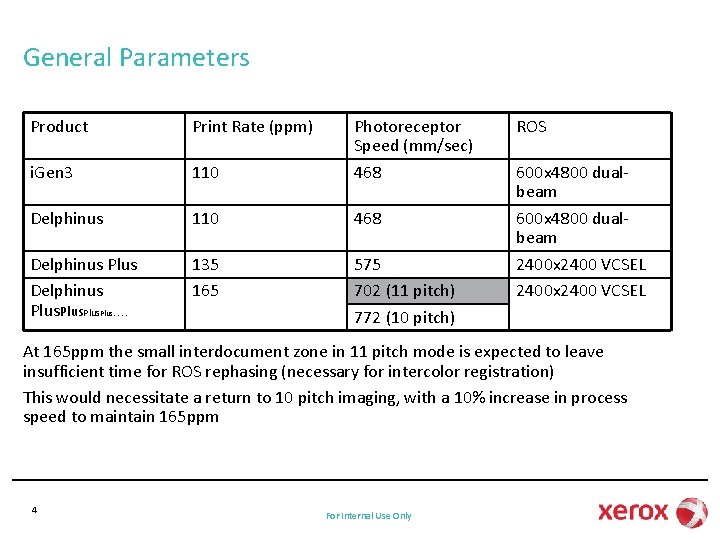
General Parameters Product Print Rate (ppm) i. Gen 3 110 Photoreceptor Speed (mm/sec) 468 Delphinus 110 468 Delphinus Plus. . 135 165 575 702 (11 pitch) 772 (10 pitch) ROS 600 x 4800 dualbeam 2400 x 2400 VCSEL At 165 ppm the small interdocument zone in 11 pitch mode is expected to leave insufficient time for ROS rephasing (necessary for intercolor registration) This would necessitate a return to 10 pitch imaging, with a 10% increase in process speed to maintain 165 ppm 4 For Internal Use Only
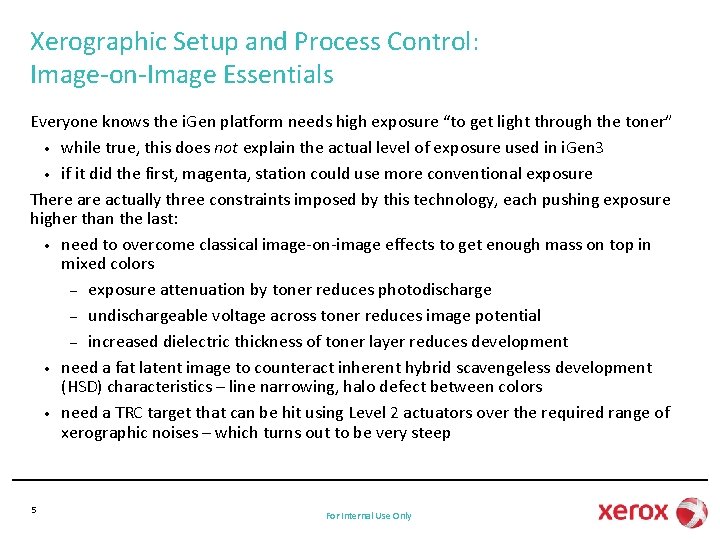
Xerographic Setup and Process Control: Image-on-Image Essentials Everyone knows the i. Gen platform needs high exposure “to get light through the toner” • while true, this does not explain the actual level of exposure used in i. Gen 3 • if it did the first, magenta, station could use more conventional exposure There actually three constraints imposed by this technology, each pushing exposure higher than the last: • need to overcome classical image-on-image effects to get enough mass on top in mixed colors – exposure attenuation by toner reduces photodischarge – undischargeable voltage across toner reduces image potential – increased dielectric thickness of toner layer reduces development • need a fat latent image to counteract inherent hybrid scavengeless development (HSD) characteristics – line narrowing, halo defect between colors • need a TRC target that can be hit using Level 2 actuators over the required range of xerographic noises – which turns out to be very steep 5 For Internal Use Only
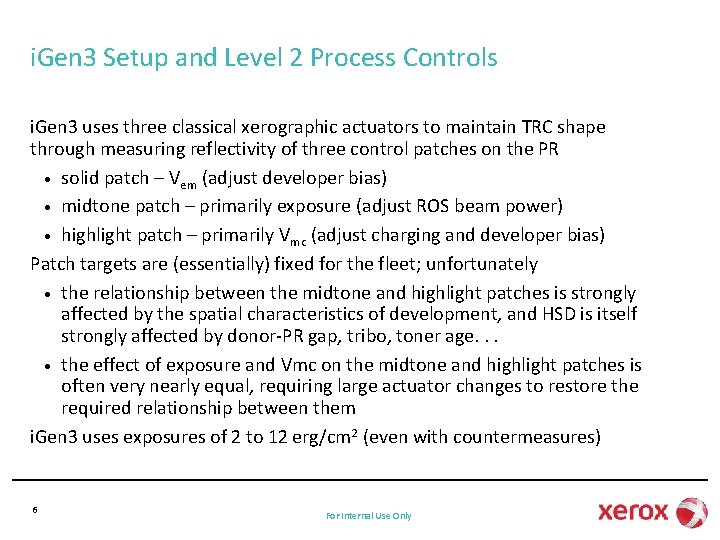
i. Gen 3 Setup and Level 2 Process Controls i. Gen 3 uses three classical xerographic actuators to maintain TRC shape through measuring reflectivity of three control patches on the PR • solid patch – Vem (adjust developer bias) • midtone patch – primarily exposure (adjust ROS beam power) • highlight patch – primarily Vmc (adjust charging and developer bias) Patch targets are (essentially) fixed for the fleet; unfortunately • the relationship between the midtone and highlight patches is strongly affected by the spatial characteristics of development, and HSD is itself strongly affected by donor-PR gap, tribo, toner age. . . • the effect of exposure and Vmc on the midtone and highlight patches is often very nearly equal, requiring large actuator changes to restore the required relationship between them i. Gen 3 uses exposures of 2 to 12 erg/cm 2 (even with countermeasures) 6 For Internal Use Only
Consequences of High Exposure Steep, saturated native engine TRCs • undesirably extreme mapping of halftone levels • increased color sensitivity to within-page and temporal xerographic noises Sensitivity to details of the ROS spot that are difficult and expensive to control precisely • image edge behavior controlled by beam shape below half-maximum • background voltage near images modulated by the sinc 2 tail of the beam • polygon facet-to-facet variation leads to banding • variation in the mirror-lens system as the beam sweeps across the process leads to streaks 7 For Internal Use Only
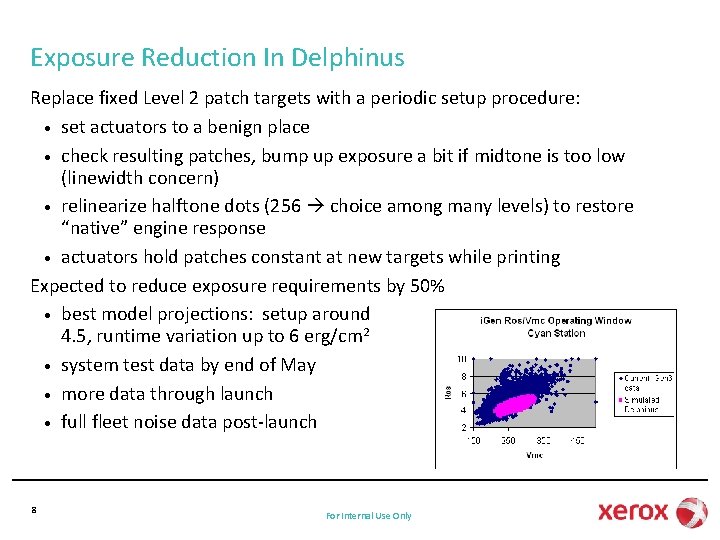
Exposure Reduction In Delphinus Replace fixed Level 2 patch targets with a periodic setup procedure: • set actuators to a benign place • check resulting patches, bump up exposure a bit if midtone is too low (linewidth concern) • relinearize halftone dots (256 choice among many levels) to restore “native” engine response • actuators hold patches constant at new targets while printing Expected to reduce exposure requirements by 50% • best model projections: setup around 4. 5, runtime variation up to 6 erg/cm 2 • system test data by end of May • more data through launch • full fleet noise data post-launch 8 For Internal Use Only
Prospects For Delphinus Plus and Beyond To first order, Delphinus setup at 468 mm/sec should hold for Delphinus Plus at 575 mm/sec • development parameters may need rebalancing between resolving power and scavenging due to shorter image residence time in nip • effects should be small; sign unclear • as process speed increases (to 772 mm/sec) confidence shrinks Dot relinearization during run – modified Level 3 control – would allow actuators to remain near nominal aim, reducing maximum required Delphinus scheme accepts increased linewidth variation and is bounded by line shrinkage limit; digital linewidth adjustment would address both 9 For Internal Use Only
i. Gen 3 ROS and Imaging System The i. Gen 3 dual-diode ROS has no power to spare at i. Gen’s process speed and setup • however if the polygon can be spun fast enough it could provide up to 9. 7 erg/cm 2 at 575 mm/sec and 7. 2 erg/cm 2 at 772 mm/sec • adequate for 165 ppm if Delphinus setup outlook holds Replacing the existing unit is strongly desired • 600 scan lines/in is hardly adequate for high quality color, even with 4800/in fast-scan addressability – difficult halftone design – compromised halftone dots more sensitive to noise – compromised halftone dots give nonuniform, variable TRC • isotropic, higher addressability an enabler for better registration • “true 2400 x 2400” has more marketing cachet 10 For Internal Use Only
VCSEL ROS and Imaging System Plan is to adapt, with maximum reuse, the Fuji Xerox Vertical Cavity Surface Emitting Laser (VCSEL) system to Delphinus Plus • 32 emitters, 2 m. W each, in a 4 x 8 parallellogram • scans at 2400 x 2400 /in • Venezia configuration would provide only 5. 6 erg/cm 2 at 575 mm/sec and 4. 2 erg/cm 2 at 772 mm/sec – insufficient exposure Architecture options include 2 orientations, overwrite / no overwrite, interlace schemes • each choice requires a specific optical magnification to match array spacing to 2400/in scan lines • holding beam diameter to nominal 32 μm at the photoreceptor requires changes to aperture as magnification changes • this discards a varying amount of light – hence exposure available depends on architecture choice 11 For Internal Use Only
VCSEL ROS and Imaging System 2 Rotated array, interlace 2, no overwrite provides lots of exposure • 16. 9 erg/cm 2 at 575 mm/sec and 12. 6 erg/cm 2 at 772 mm/sec • prototypes exhibited unacceptable banding – design sensitive to assorted sources of beam-to-beam variation – wide swath written by 32 -beam array moves resulting defects into the visible range Extensive model studies identified acceptable architecture • rotated array, overwrite, no interlace (“interlace 1”) • 9. 0 erg/cm 2 at 575 mm/sec and 6. 7 erg/cm 2 at 772 mm/sec • banding sensitivity near-identical to FX design – prototype ROSes showed no visible banding @ TCD (April 07) – small increase in sensitivity to array rotation error for one defect – outlook is that rotation can be held with sufficient precision 12 For Internal Use Only
VCSEL ROS and Imaging System 3 Overwrite is critical to acceptable banding performance • averaging effect of writing every scan line with 2 different beams (on different facets) reduces expected variability of image Architectures with overwrite push some parts of the (heavily reused) system toward boundaries • FX “March” ASIC bandwidth: can switch anywhere at 2400/in, but must wait 2 pixels before switching again • insufficient time for automatic power adjustment of all 32 beams between scans – will need revised ASIC board, at least @ 772 mm/sec • MPA speed (45, 603 @ 772 mm/sec) difficult but doable 50% increase in exposure available in principle • push array to 3 m. W/emitter (some loss of spot quality due to higherorder emission modes) • requires new board to accommodate thermoelectric cooling (TEC) 13 For Internal Use Only
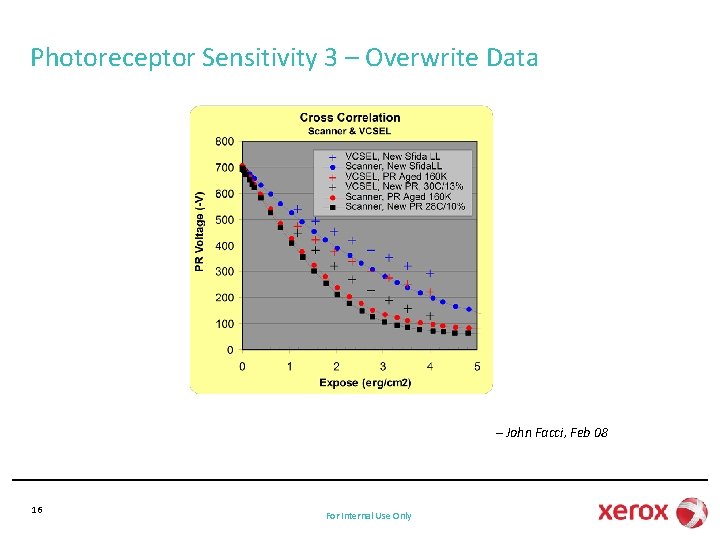
Photoreceptor Sensitivity The setup and control analysis yielding 6 erg/cm 2 assumes the current PIDC distribution Use of the chosen VCSEL architecture will change the effective PIDC • quantum efficiency depends on the electric field at the generator layer – higher field, higher efficiency • currently almost all photogeneration takes place as the ROS scans over the pixel in question (some due to “tail” spillover from lines scanned earlier or later) • with overwrite the first half of the exposure is separated by one facet rotation from the second half – minimum of 220 μsec (772 mm/sec) • this is plenty of time for the photogenerated carriers to exit the thin generator layer, significantly reducing the local field • the second half of the exposure takes place at the lower field, hence lower quantum efficiency 14 For Internal Use Only
Photoreceptor Sensitivity 2 Overwriting will reduce photoreceptor sensitivity, but the effect is complex • depends on the native PIDC shape, the initial charge level, and the exposure applied • preliminary data on Sfida and Venezia photoreceptors show some levels of discharge require up to 50% more exposure • effects are much smaller on initial (near-linear) discharge region, and when discharge is nearly complete • direct comparison of overwrite / nonoverwrite in i. Gen 3 configuration (Jan 08 test in PT 100 by Joe Sheflin) showed a 33% increase in exposure required to achieve setup • this will be further explored in March (see next topic) 15 For Internal Use Only
Photoreceptor Sensitivity 3 – Overwrite Data – John Facci, Feb 08 16 For Internal Use Only
Photoreceptor CTL Transit Time It takes time for charge to move across the CTL from the generator to the photoreceptor surface; the i. Gen 3 architecture is considered marginal at 468 mm/sec • any nonuniformity in charges not fully swept out under the charging device(s) will appear as a voltage nonuniformity post-charging • even more time than nominal under charge is required to eliminate certain ghosting signatures • nonuniformity in the completeness of discharge between exposure and development will modulate the latent image • transit time is a function of temperature, which may not be uniform The impact on image uniformity of going to Delphinus Plus @ 575 mm/sec has not yet been quantified • charging effects are worst at first (magenta) station and might be mitigated by restoring the DC device (or similar use of the waterfront) Effects at 772 mm/sec (165 ppm) will be worse 17 For Internal Use Only
Photoreceptor Prospects A surrogate tool is being set up to investigate overwrite and transport effects – first data in March Prototype belts with more sensitive pigments (Ti. OPc) are available – but scaleup to manufacture is considered an ETA risk Alternative transport molecules to reduce CTL transit time (and temperature sensitivity) are available but scaleup to manufacture is considered an ETA risk Mapping of temporal and spatial uniformity with various belt combinations is planned for March on PT 100 18 For Internal Use Only
Current Outlook and Checkpoints Centerline outlook is that Delphinus Plus should be OK with current photoreceptor pigment – 6 ergs/cm 2 x (< 150%) versus 9 ergs/cm 2 • better assessment of overwrite sensitivity penalty – March-April • system test data on Delphinus setup – May • Delphinus-like setup testing with VCSEL ROS – when? At 575 mm/sec? Centerline estimate is that Delphinus Plus would have some increase in specific nonuniformity causals with current photoreceptor CTL chemistry – but significance is unclear (could be trivial) • systematic uniformity mapping in PT 100 – March • model-based mapping to print defects – when? Experimental confirmation? Centerline estimate is that a more sensitive photoreceptor, with faster charge transport across the CTL, is quite likely to be needed for 165 ppm (772 mm/sec) 19 For Internal Use Only