
Xbox 360 512 MB system memory IBM 3
Xbox 360 512 MB system memory IBM 3 -way symmetric core processor ATI GPU with embedded EDRAM 12 x DVD Optional Hard disk
The Xbox 360 GPU Custom silicon designed by ATi Technologies Inc. 500 MHz, 338 million transistors, 90 nm process Supports vertex and pixel shader version 3. 0+ Includes some Xbox 360 extensions
The Xbox 360 GPU 10 MB embedded DRAM (EDRAM) for extremely high-bandwidth render targets Alpha blending, Z testing, multisample antialiasing are all free (even when combined) Hierarchical Z logic and dedicated memory for early Z/stencil rejection GPU is also the memory hub for the whole system 22. 4 GB/sec to/from system memory
More About the Xbox 360 GPU 48 shader ALUs shared between pixel and vertex shading (unified shaders) Each ALU can co-issue one float 4 op and one scalar op each cycle Non-traditional architecture 16 texture samplers Dedicated Branch instruction execution
More About the Xbox 360 GPU 2 x and 4 x hardware multi-sample antialiasing (MSAA) Hardware tessellator N-patches, triangular patches, and rectangular patches Can render to 4 render targets and a depth/stencil buffer simultaneously
GPU: Work Flow Consumes instructions and data from a command buffer Ring buffer in system memory Managed by Direct 3 D, user configurable size (default 2 MB) Supports indirection for vertex data, index data, shaders, textures, render state, and command buffers Up to 8 simultaneous contexts in-flight at once Changing shaders or render state is inexpensive, since a new context can be started up easily
GPU: Work Flow Threads work on units of 64 vertices or pixels at once Dedicated triangle setup, clipping, etc. Pixels processed in 2 x 2 quads Back buffers/render targets stored in EDRAM Alpha, Z, stencil test, and MSAA expansion done in EDRAM module EDRAM contents copied to system memory by “resolve” hardware
GPU: Operations Per Clock Write 8 pixels or 16 Z-only pixels to EDRAM With MSAA, up to 32 samples or 64 Z-only samples Reject up to 64 pixels that fail Hierarchical Z testing Vertex fetch sixteen 32 -bit words from up to two different vertex streams
GPU: Operations Per Clock 16 bilinear texture fetches 48 vector and scalar ALU operations Interpolate 16 float 4 shader interpolants 32 control flow operations Process one vertex, one triangle Resolve 8 pixels to system memory from EDRAM
GPU: Hierarchical Z Rough, low-resolution representation of Z/stencil buffer contents Provides early Z/stencil rejection for pixel quads 11 bits of Z and 1 bit of stencil per block
GPU: Hierarchical Z NOT tied to compression EDRAM BW advantage Separate memory buffer on GPU Enough memory for 1280 x 720 2 x MSAA Provides a big performance boost when drawing complex scenes Draw opaque objects front to back

GPU: Textures 16 bilinear texture samples per clock 64 bpp runs at half rate, 128 bpp at quarter rate Trilinear at half rate Unlimited dependent texture fetching DXT decompression has 32 bit precision Better than Xbox (16 -bit precision)

GPU: Resolve Copies surface data from EDRAM to a texture in system memory Required for render-to-texture and presentation to the screen Can perform MSAA sample averaging or resolve individual samples Can performat conversions and biasing

Direct 3 D 9+ on Xbox 360 Similar API to PC Direct 3 D 9. 0 Optimized for Xbox 360 hardware No abstraction layers or drivers—it’s direct to the metal Exposes all Xbox 360 custom hardware features New state enums New APIs for finer-grained control and completely new features
Direct 3 D 9+ on Xbox 360 Communicates with GPU via a command buffer Ring buffer in system memory Direct Command Buffer Playback support
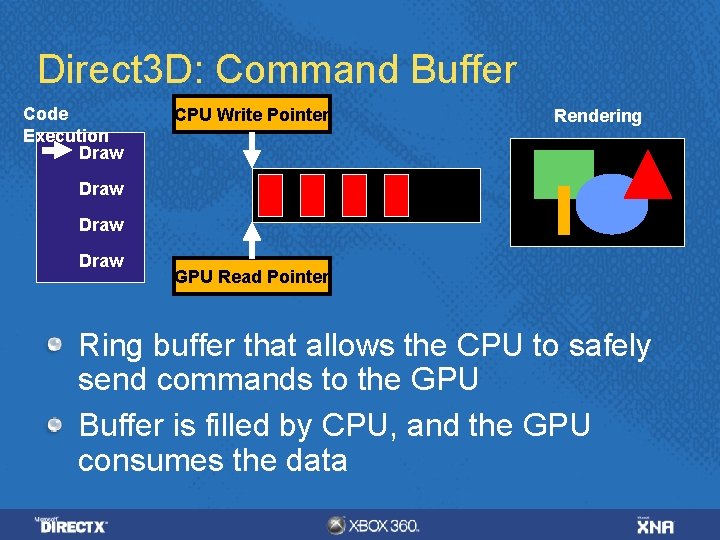
Direct 3 D: Command Buffer Code Execution Draw CPU Write Pointer Rendering Draw GPU Read Pointer Ring buffer that allows the CPU to safely send commands to the GPU Buffer is filled by CPU, and the GPU consumes the data
Shaders Two options for writing shaders HLSL (with Xbox 360 extensions) GPU microcode (specific to the Xbox 360 GPU, similar to assembly but direct to hardware) Recommendation: Use HLSL Easy to write and maintain Replace individual shaders with microcode if performance analysis warrants it
- Slides: 17