
Xband Test Accelerator New Initiatives GARD Review SLAC
X-band Test Accelerator & New Initiatives GARD Review @ SLAC Cecile Limborg, Chris Adolphsen, Tor Raubenheimer March 11, 2013

X-Band Test Accelerator (XTA) Generation of high brightness beams is a key accelerator technology Goals for the XTA: • High brightness injector (beams accelerated to 100 Me. V) - Study an approach to very high brightness beams • Compact X-band linac - Study operational issues (timing, alignment, …) • Use facility to support new initiatives Construct XTA leveraging existing infrastructure • Installed in NLCTA enclosure, uses control room and rf sources • Based on LCLS design; uses LCLS high-level controls & applications Based on 20 years of X-band rf development 2013 General Accelerator R&D Review 2

NLCTA Facility 50 meter shielded enclosure containing NLCTA and XTA. Facility has 4 X-band rf sources, 1 S-band rf gun, 1 X-band rf gun, 3 laser systems and supports a variety of acceleration and beam physics R&D activities ~50 meters 2013 General Accelerator R&D Review 3
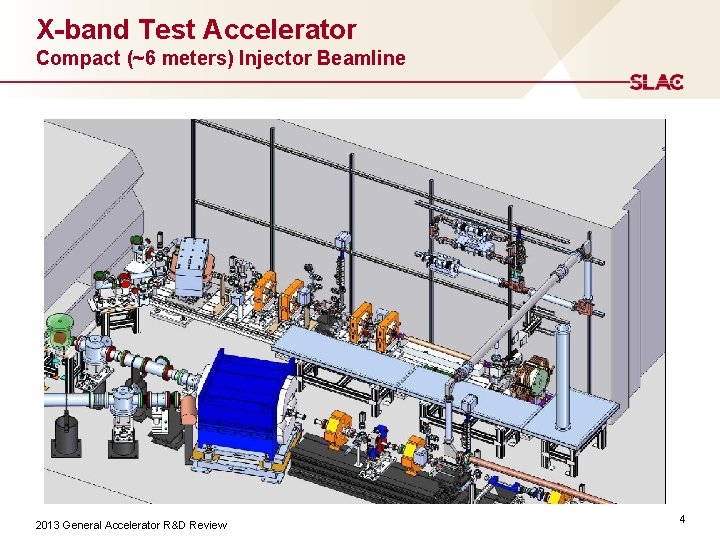
X-band Test Accelerator Compact (~6 meters) Injector Beamline 2013 General Accelerator R&D Review 4

High Brightness Electron Sources State-of-the-art Groups around the world are pushing on e- source brightness • Peak and average brightness • Focus on peak brightness largely driven by next generation radiation sources: Swiss. FEL, PALFEL, MARIE, MEGA-ray, … Two separate issues: transverse and longitudinal phase space • LCLS S-band gun • From Aug, 2008 ICFA BD Newsletter pushes both Cathodes will likely yield further improvements but gun is still limitation Recently, strong focus on lower charge bunches Q << 1 n. C • Naturally matched to higher frequency rf guns 2013 General Accelerator R&D Review 5
High Brightness Electron Guns What are the next Steps? LCLS S-band rf injector performs extremely well How to improve peak brightness? • Many incremental improvements (better field comp, load lock, …) • No concrete ideas for factor of 2 much less a factor of 10 What about different approaches? • DC photo-injector (reduced space charge and emittance from gun) • Low rf frequency gun (reduced field tolerances and peak current) • High gradient rf gun (reduced space charge and bunch length) X-band rf gun offers factor of ~8 improvement in brightness (in simulation) but will be challenging to implement • Broad synergies with other programs across SLAC 2013 General Accelerator R&D Review 6
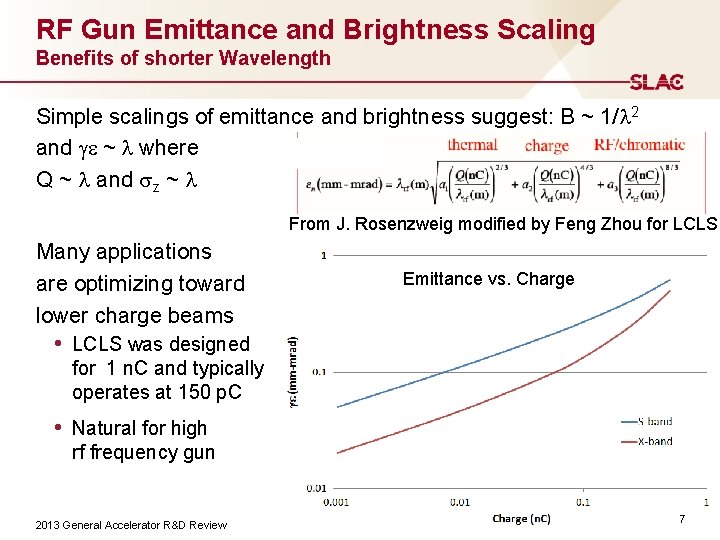
RF Gun Emittance and Brightness Scaling Benefits of shorter Wavelength Simple scalings of emittance and brightness suggest: B ~ 1/l 2 and ge ~ l where Q ~ l and sz ~ l From J. Rosenzweig modified by Feng Zhou for LCLS Many applications are optimizing toward lower charge beams Emittance vs. Charge • LCLS was designed for 1 n. C and typically operates at 150 p. C • Natural for high rf frequency gun 2013 General Accelerator R&D Review 7

Mark-1 X-band RF Gun Joint SLAC-LLNL Collaboration First X-band gun design was built and tested at SLAC in mid-2000’s Mark-1 incorporates lessons from LCLS • Racetrack coupler; increased mode separation; elliptical iris shape 2013 General Accelerator R&D Review 8
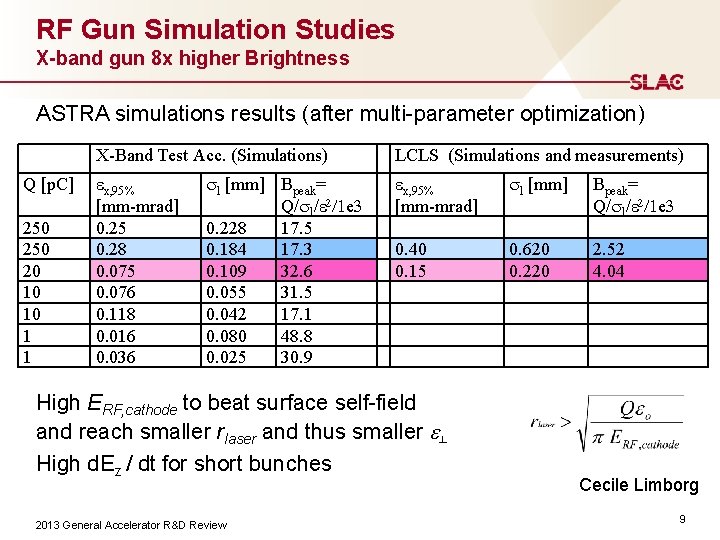
RF Gun Simulation Studies X-band gun 8 x higher Brightness ASTRA simulations results (after multi-parameter optimization) Q [p. C] 250 20 10 10 1 1 X-Band Test Acc. (Simulations) LCLS (Simulations and measurements) ex, 95% [mm-mrad] 0. 25 0. 28 0. 075 0. 076 0. 118 0. 016 0. 036 ex, 95% [mm-mrad] sl [mm] Bpeak= Q/sl/e 2/1 e 3 0. 40 0. 15 0. 620 0. 220 2. 52 4. 04 sl [mm] Bpeak= Q/sl/e 2/1 e 3 0. 228 17. 5 0. 184 17. 3 0. 109 32. 6 0. 055 31. 5 0. 042 17. 1 0. 080 48. 8 0. 025 30. 9 High ERF, cathode to beat surface self-field and reach smaller rlaser and thus smaller e┴ High d. Ez / dt for short bunches 2013 General Accelerator R&D Review Cecile Limborg 9
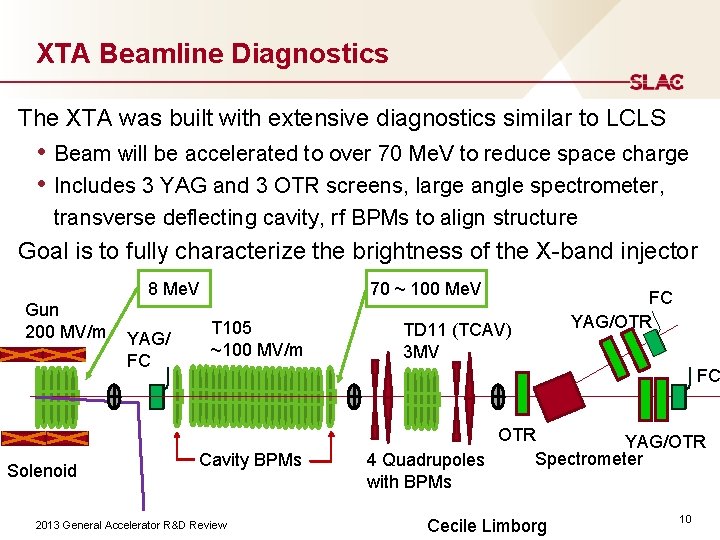
XTA Beamline Diagnostics The XTA was built with extensive diagnostics similar to LCLS • Beam will be accelerated to over 70 Me. V to reduce space charge • Includes 3 YAG and 3 OTR screens, large angle spectrometer, transverse deflecting cavity, rf BPMs to align structure Goal is to fully characterize the brightness of the X-band injector 8 Me. V Gun 200 MV/m Solenoid YAG/ FC 70 ~ 100 Me. V T 105 ~100 MV/m TD 11 (TCAV) 3 MV FC YAG/OTR FC Cavity BPMs 2013 General Accelerator R&D Review OTR YAG/OTR Spectrometer 4 Quadrupoles with BPMs Cecile Limborg 10
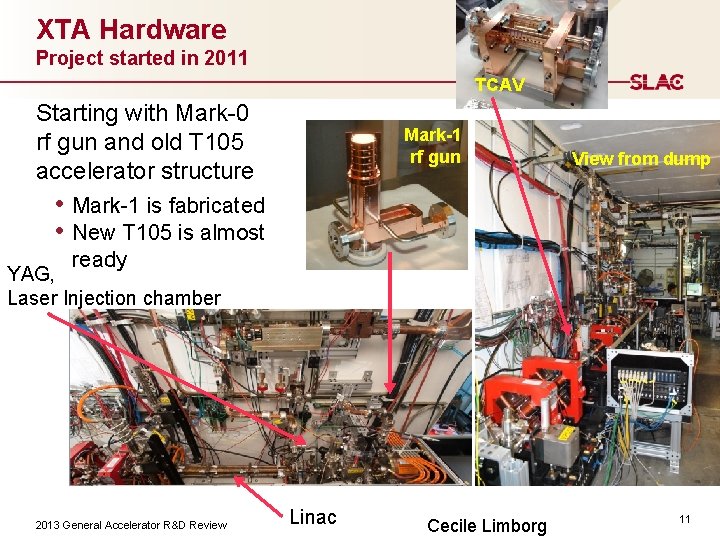
XTA Hardware Project started in 2011 TCAV Starting with Mark-0 rf gun and old T 105 accelerator structure Mark-1 rf gun View from dump • Mark-1 is fabricated • New T 105 is almost ready YAG, Laser Injection chamber 2013 General Accelerator R&D Review Linac Cecile Limborg 11
XTA Commissioning Results As of end of February, 2013 XTA routinely operated with charges up to 30 -40 p. C Energy at ~8 Me. V from gun and ~70 Me. V out of linac Transverse deflector installed and commissioned Bunch lengths measured to be 250 fs rms for ~20 p. C, in agreement with simulations Tuning to small emittances is sensitive to strong jitter and low OTR light level • Laser noise reduced from 350 -500 fs rms down to 70 fs rms • Contribution modulator HVPS measured ~175 ppm rms (ie d. F~ 0. 6 deg rms, • d. V/V ~3 e-4); Contribution from LLRF still under investigation OTR replaced by combined dual YAG/OTR Low charge studies • QE relatively low; increased by lengthening laser pulse • Plans to measure thermal emittance and maybe laser cleaning 2013 General Accelerator R&D Review Cecile Limborg 12
Future XTA Commissioning Timeline Complete commissioning in FY 2013 Goal: demonstrate injector performance by end of 2013 Continue with Mark-0 rf gun through August, 2013 • Measure cathode properties: QE and thermal emittance; try • • laser cleaning Work on improving jitter sources: LLRF and modulators Optimize slice emittance and bunch length Install Mark-1 rf gun and new T 105 in August down • Measure cathode properties: QE and thermal emittance • Optimize slice emittance and bunch length Program is interlaced with other NLCTA efforts • Operate a shift per day roughly 50% of time 2013 General Accelerator R&D Review 13
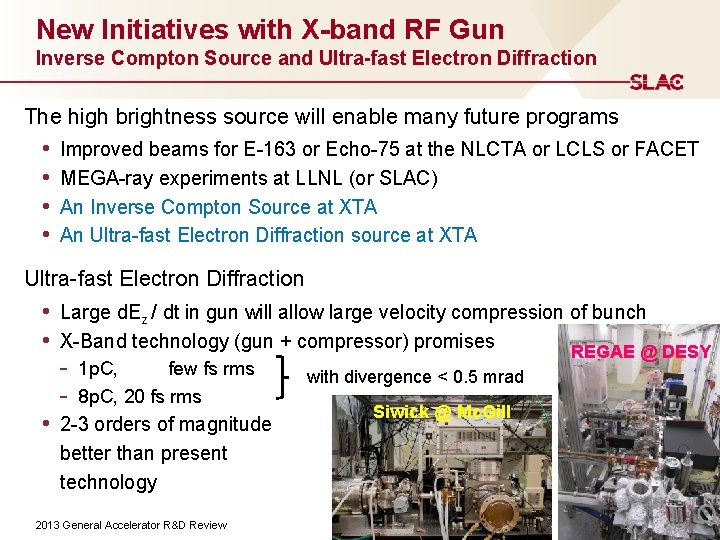
New Initiatives with X-band RF Gun Inverse Compton Source and Ultra-fast Electron Diffraction The high brightness source will enable many future programs • • Improved beams for E-163 or Echo-75 at the NLCTA or LCLS or FACET MEGA-ray experiments at LLNL (or SLAC) An Inverse Compton Source at XTA An Ultra-fast Electron Diffraction source at XTA Ultra-fast Electron Diffraction • Large d. Ez / dt in gun will allow large velocity compression of bunch • X-Band technology (gun + compressor) promises REGAE @ DESY - 1 p. C, few fs rms with divergence < 0. 5 mrad - 8 p. C, 20 fs rms Siwick @ Mc. Gill • 2 -3 orders of magnitude better than present technology 2013 General Accelerator R&D Review 14
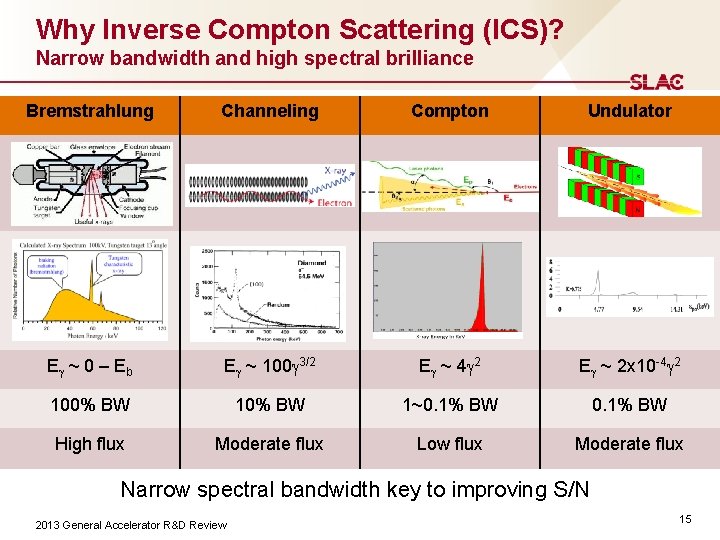
Why Inverse Compton Scattering (ICS)? Narrow bandwidth and high spectral brilliance Bremstrahlung Channeling Compton Undulator Eg ~ 0 – E b Eg ~ 100 g 3/2 Eg ~ 4 g 2 Eg ~ 2 x 10 -4 g 2 100% BW 1~0. 1% BW High flux Moderate flux Low flux Moderate flux Narrow spectral bandwidth key to improving S/N 2013 General Accelerator R&D Review 15
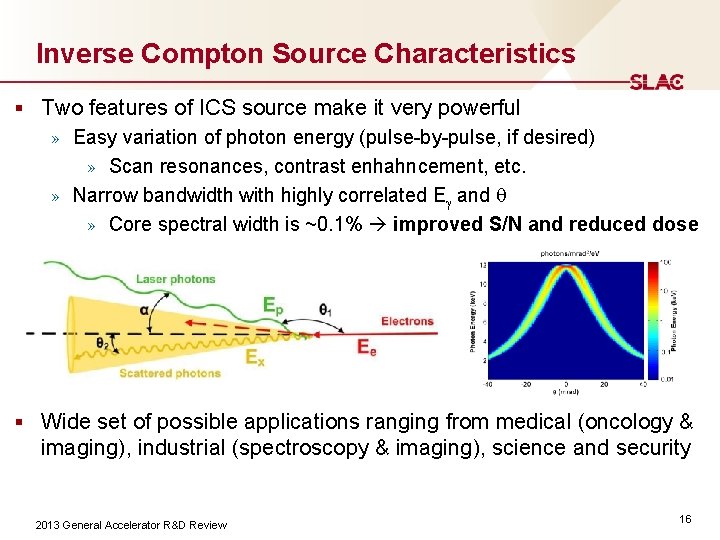
Inverse Compton Source Characteristics § Two features of ICS source make it very powerful » Easy variation of photon energy (pulse-by-pulse, if desired) » Scan resonances, contrast enhahncement, etc. » Narrow bandwidth with highly correlated Eg and q » Core spectral width is ~0. 1% improved S/N and reduced dose § Wide set of possible applications ranging from medical (oncology & imaging), industrial (spectroscopy & imaging), science and security 2013 General Accelerator R&D Review 16
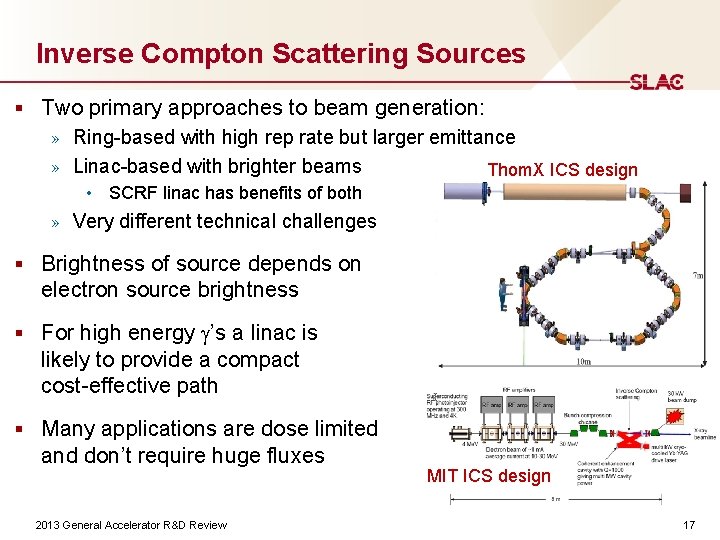
Inverse Compton Scattering Sources § Two primary approaches to beam generation: » Ring-based with high rep rate but larger emittance » Linac-based with brighter beams • SCRF linac has benefits of both Thom. X ICS design » Very different technical challenges § Brightness of source depends on electron source brightness § For high energy g’s a linac is likely to provide a compact cost-effective path § Many applications are dose limited and don’t require huge fluxes 2013 General Accelerator R&D Review MIT ICS design 17
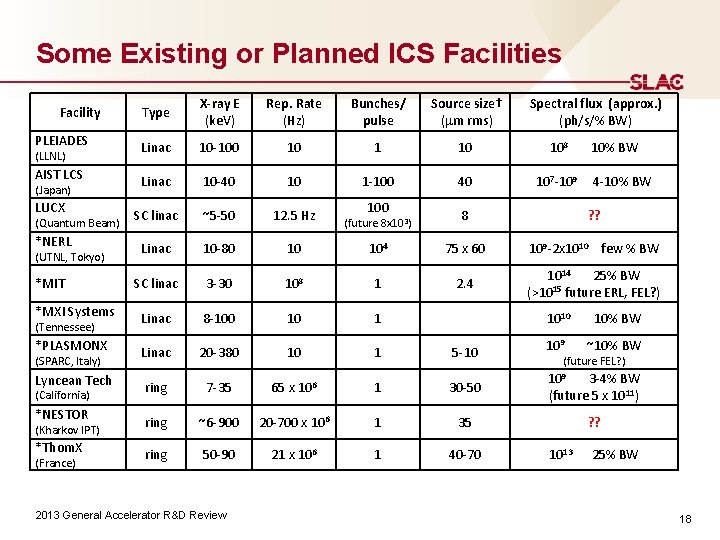
Some Existing or Planned ICS Facilities Facility PLEIADES (LLNL) AIST LCS (Japan) LUCX (Quantum Beam) *NERL (UTNL, Tokyo) *MIT *MXI Systems (Tennessee) *PLASMONX (SPARC, Italy) Lyncean Tech (California) *NESTOR (Kharkov IPT) *Thom. X (France) Type X-ray E (ke. V) Rep. Rate (Hz) Bunches/ pulse Source size† (mm rms) Linac 10 -100 10 108 Linac 10 -40 10 1 -100 40 107 -109 SC linac ~5 -50 12. 5 Hz Linac 10 -80 10 SC linac 3 -30 108 1 Linac 8 -100 10 1 Linac 20 -380 10 1 100 (future 8 x 10³) 104 10% BW 4 -10% BW 8 ? ? 75 x 60 109 -2 x 10¹⁰ few % BW 2. 4 1014 25% BW (>1015 future ERL, FEL? ) 5 -10 ring 7 -35 65 x 106 1 30 -50 ring ~6 -900 20 -700 x 106 1 35 ring 50 -90 21 x 106 1 40 -70 2013 General Accelerator R&D Review Spectral flux (approx. ) (ph/s/% BW) 1010 10% BW 109 ~10% BW (future FEL? ) 109 3 -4% BW (future 5 x 10¹¹) ? ? 1013 25% BW 18
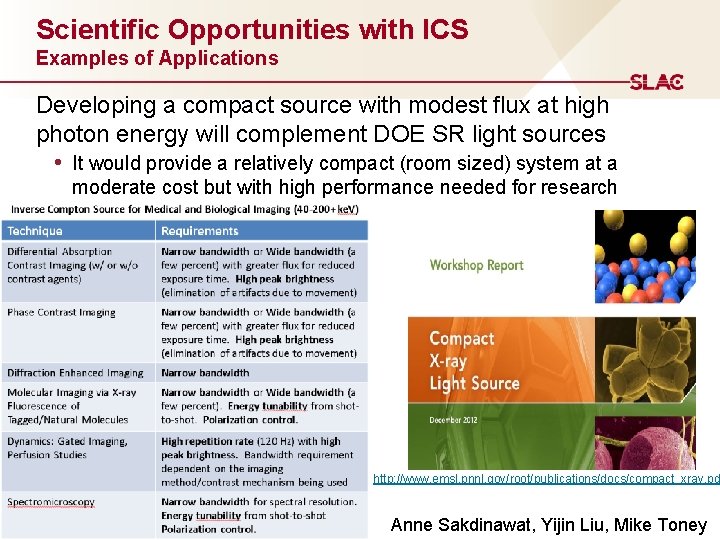
Scientific Opportunities with ICS Examples of Applications Developing a compact source with modest flux at high photon energy will complement DOE SR light sources • It would provide a relatively compact (room sized) system at a moderate cost but with high performance needed for research http: //www. emsl. pnnl. gov/root/publications/docs/compact_xray. pd 2013 General Accelerator R&D Review Anne Sakdinawat, Yijin Liu, Mike Toney
Impact (Beyond Office of Science) Example: Understanding lifecycle of rare earth elements New Critical Materials Hub recently created at DOE EERE • “… challenges in critical materials, including mineral processing, manufacture, substitution, efficient use, and end-of-life recycling; …” Rare earth K-shell binding energies range from 4 to 65 ke. V • A moderate energy ICS would penetrate typical core samples An ICS-based microscopy system could be instrumental as an experimental tool in the analysis of the morphology and composition of rare earth materials throughout their life cycle. 2013 General Accelerator R&D Review Anne Sakdinawat, Yijin Liu, Mike Toney 20
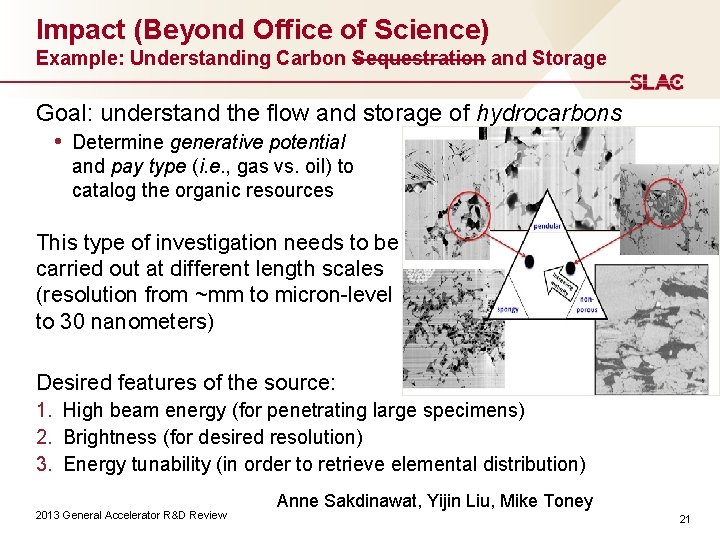
Impact (Beyond Office of Science) Example: Understanding Carbon Sequestration and Storage Goal: understand the flow and storage of hydrocarbons • Determine generative potential and pay type (i. e. , gas vs. oil) to catalog the organic resources This type of investigation needs to be carried out at different length scales (resolution from ~mm to micron-level to 30 nanometers) Desired features of the source: 1. High beam energy (for penetrating large specimens) 2. Brightness (for desired resolution) 3. Energy tunability (in order to retrieve elemental distribution) 2013 General Accelerator R&D Review Anne Sakdinawat, Yijin Liu, Mike Toney 21
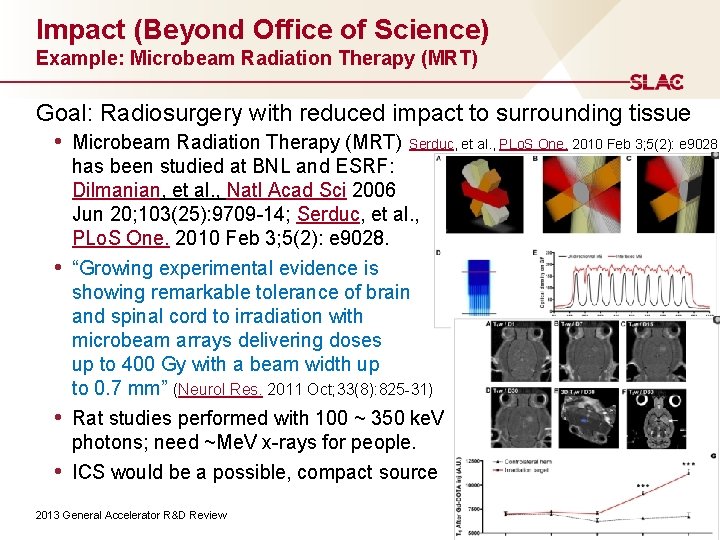
Impact (Beyond Office of Science) Example: Microbeam Radiation Therapy (MRT) Goal: Radiosurgery with reduced impact to surrounding tissue • Microbeam Radiation Therapy (MRT) Serduc, et al. , PLo. S One. 2010 Feb 3; 5(2): e 9028 • • • has been studied at BNL and ESRF: Dilmanian, et al. , Natl Acad Sci 2006 Jun 20; 103(25): 9709 -14; Serduc, et al. , PLo. S One. 2010 Feb 3; 5(2): e 9028. “Growing experimental evidence is showing remarkable tolerance of brain and spinal cord to irradiation with microbeam arrays delivering doses up to 400 Gy with a beam width up to 0. 7 mm” (Neurol Res. 2011 Oct; 33(8): 825 -31) Rat studies performed with 100 ~ 350 ke. V photons; need ~Me. V x-rays for people. ICS would be a possible, compact source 2013 General Accelerator R&D Review 22
Inverse Compton Experiment at X-band (ICE-X) Goal: high brightness gamma beam for precision experiments • Optimizing the system with photon science/medical school experts Flux of >107 g/s of 0. 1 ~ 2 Me. V photons with B >109 (g/s/mm 2/mrad 2/0. 1%) • Narrow bandwidth achieved with high brightness beam and long-pulse laser interaction reasonable beam and laser parameters - Commercially available 10 Hz, 3 J, 3 ns, YAG pump laser with 30 um laser waist - (I 0 ~ 1 x 10¹⁴ W/cm 2) 5 cm e- beta, 250 p. C, ge < 0. 4 mm-mrad • Stable beam and laser simpler operating conditions Upgrades to increase flux & brightness by >1000 • Upgrade laser to 120 Hz • Operate with multibunch train (30 bunches / rf pulse) 2013 General Accelerator R&D Review 23
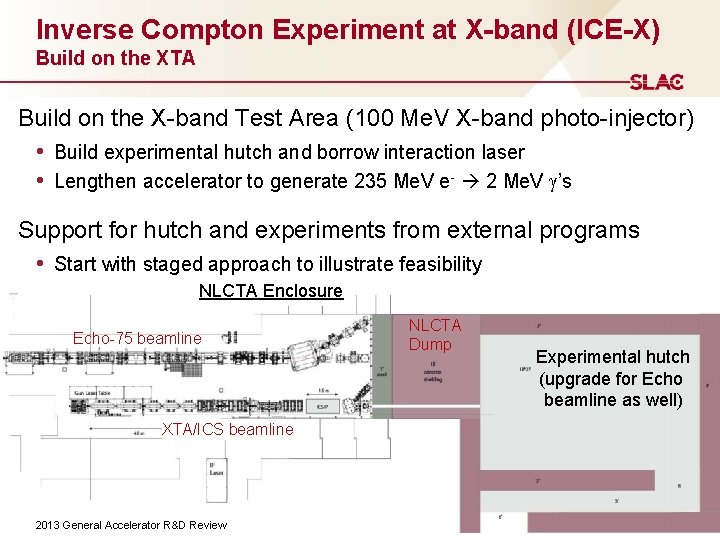
Inverse Compton Experiment at X-band (ICE-X) Build on the XTA Build on the X-band Test Area (100 Me. V X-band photo-injector) • Build experimental hutch and borrow interaction laser • Lengthen accelerator to generate 235 Me. V e- 2 Me. V g’s Support for hutch and experiments from external programs • Start with staged approach to illustrate feasibility NLCTA Enclosure Echo-75 beamline XTA/ICS beamline 2013 General Accelerator R&D Review NLCTA Dump Experimental hutch (upgrade for Echo beamline as well)
Staged Construction of ICE-X ICE-Lite (FY 2014 – FY 2015) Start from 100 Me. V XTA configuration • • • Complete XTA injector demonstration – October, 2013 Borrow YAG pump laser system (3 J, 3 ns, 10 Hz at 1 um) Add IR and laser to generate g’s – March, 2014 Start construction of g-hutch – July, 2014 Operate ICS at 50 to 200 ke. V – Sept, 2014 Upgrade with multibunch and laser rep. rate for 1000 x flux and brightness – FY 2015 Upgrade linac to 235 Me. V ICE-X • Install old T 105 and two additional T 55 structures • Double klystrons in Station 2 2013 General Accelerator R&D Review 25
Summary Quality and impact of research over the last four years: • Working on new e- source with order-of-magnitude improvement in brightness • XTA has gone from concept to beamline in <2 years and commissioning has begun Expected deliverables over the next 5 -10 years: • Demonstration of a new high brightness electron source - Key accelerator technology • Utilization of electron source to demonstrate an optimized high energy, high brightness ICS - Broad potential impact in medicine, industry, security as well as science Benefits of additional investments: • Need 1. 5 M$/yr in FY 14 and FY 15 to complete modification to ICS Impacts of reduced investment: • Loss of opportunity to demonstrate HEP contribution to accelerator technology Why at SLAC? • Unique environment with required accelerator, laser and photon science expertise 2013 General Accelerator R&D Review 26
- Slides: 26