
XANESNEXAFS with ADF Expert Mauro Stener stenerunits it
- Slides: 5
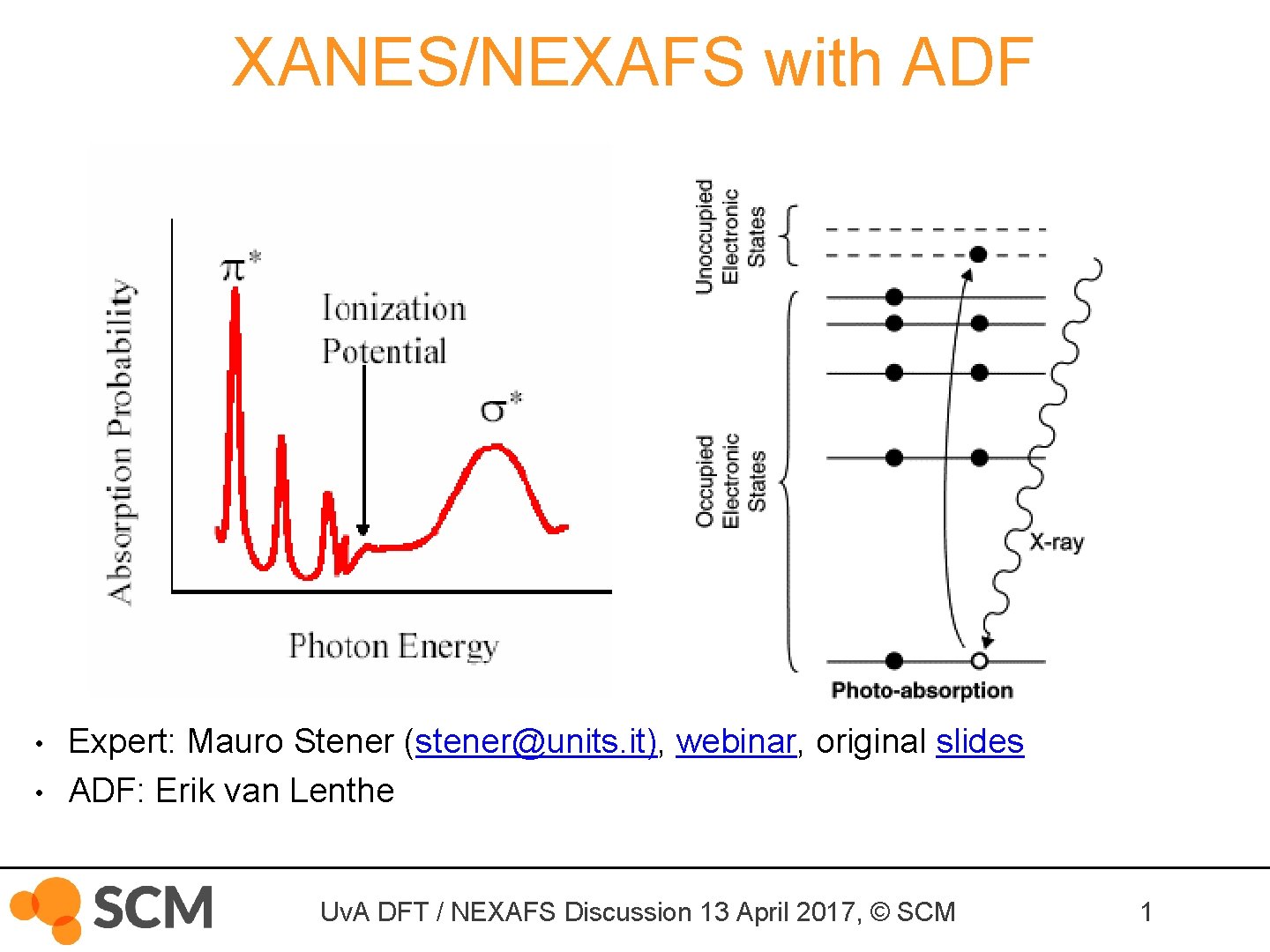
XANES/NEXAFS with ADF • • Expert: Mauro Stener (stener@units. it), webinar, original slides ADF: Erik van Lenthe Uv. A DFT / NEXAFS Discussion 13 April 2017, © SCM 1
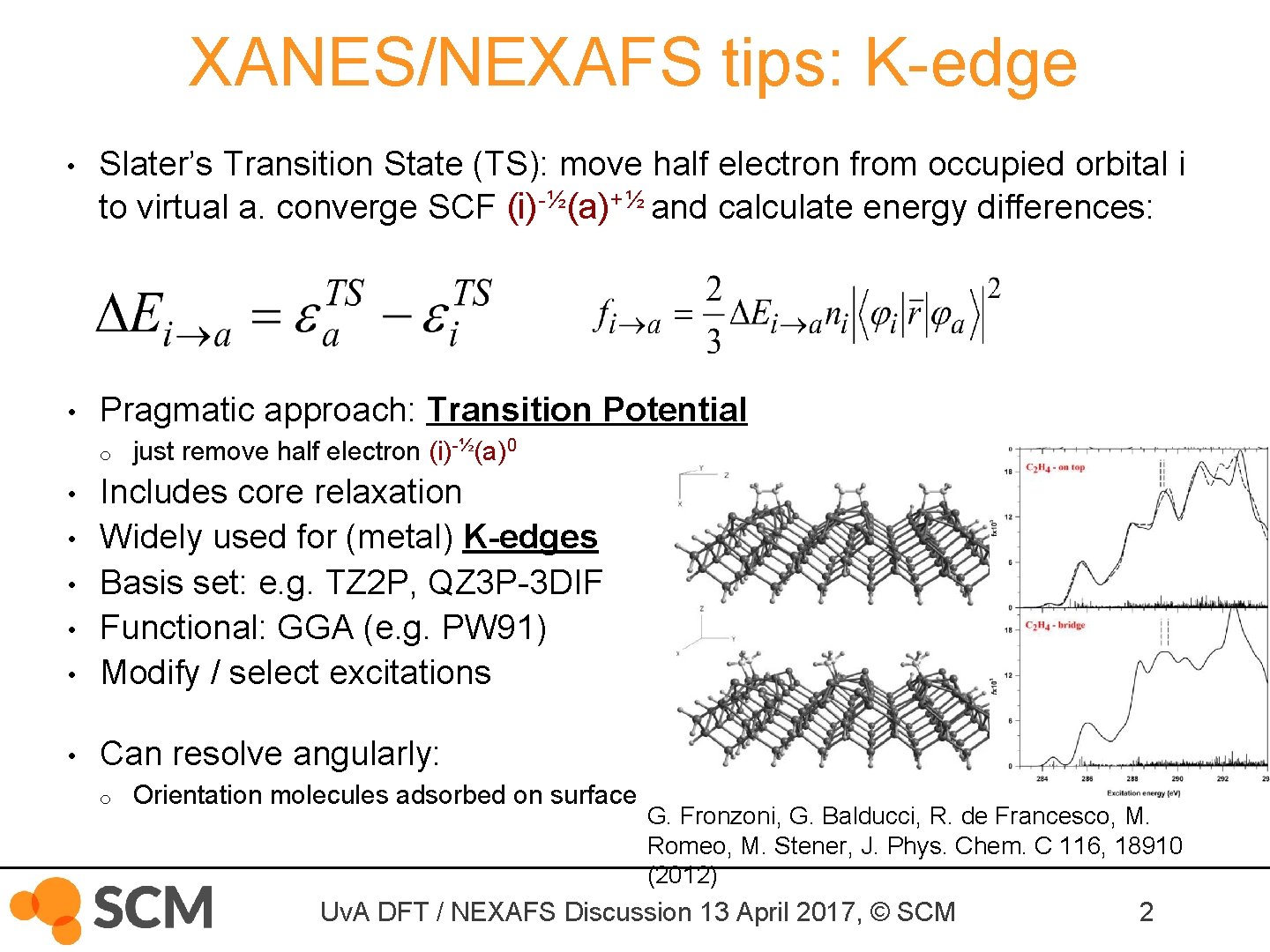
XANES/NEXAFS tips: K-edge • Slater’s Transition State (TS): move half electron from occupied orbital i to virtual a. converge SCF (i)-½(a)+½ and calculate energy differences: • Pragmatic approach: Transition Potential o just remove half electron (i)-½(a)0 • Includes core relaxation Widely used for (metal) K-edges Basis set: e. g. TZ 2 P, QZ 3 P-3 DIF Functional: GGA (e. g. PW 91) Modify / select excitations • Can resolve angularly: • • o Orientation molecules adsorbed on surface G. Fronzoni, G. Balducci, R. de Francesco, M. Romeo, M. Stener, J. Phys. Chem. C 116, 18910 (2012) Uv. A DFT / NEXAFS Discussion 13 April 2017, © SCM 2
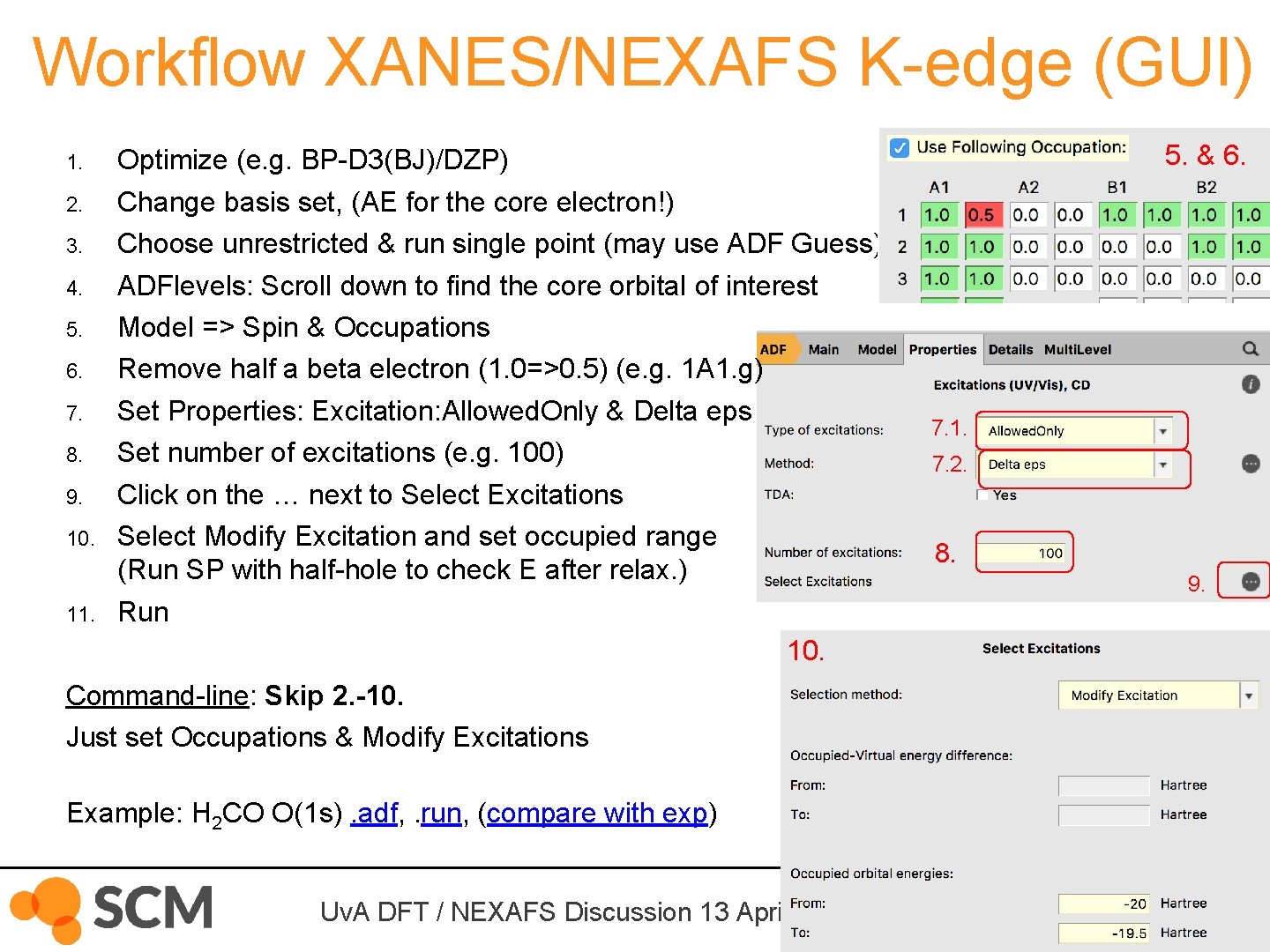
Workflow XANES/NEXAFS K-edge (GUI) 1. 2. 3. 4. 5. 6. 7. 8. 9. 10. 11. Optimize (e. g. BP-D 3(BJ)/DZP) Change basis set, (AE for the core electron!) Choose unrestricted & run single point (may use ADF Guess) ADFlevels: Scroll down to find the core orbital of interest Model => Spin & Occupations Remove half a beta electron (1. 0=>0. 5) (e. g. 1 A 1. g) Set Properties: Excitation: Allowed. Only & Delta eps Set number of excitations (e. g. 100) Click on the … next to Select Excitations Select Modify Excitation and set occupied range (Run SP with half-hole to check E after relax. ) Run 10. 5. & 6. 7. 1. 7. 2. 8. Command-line: Skip 2. -10. Just set Occupations & Modify Excitations Example: H 2 CO O(1 s). adf, . run, (compare with exp) Uv. A DFT / NEXAFS Discussion 13 April 2017, © SCM 3 9.
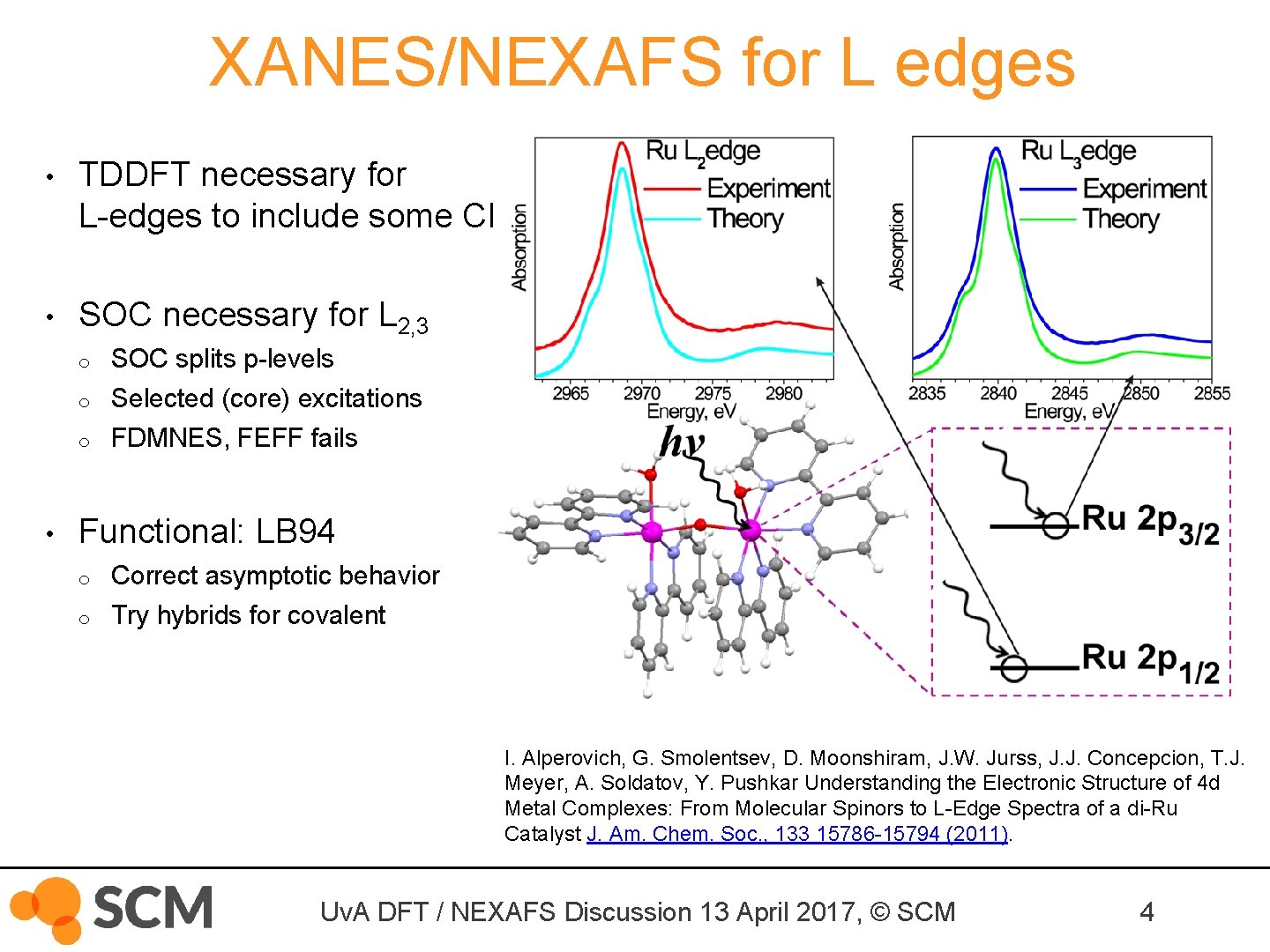
XANES/NEXAFS for L edges • TDDFT necessary for L-edges to include some CI • SOC necessary for L 2, 3 o o o • SOC splits p-levels Selected (core) excitations FDMNES, FEFF fails Functional: LB 94 o Correct asymptotic behavior o Try hybrids for covalent I. Alperovich, G. Smolentsev, D. Moonshiram, J. W. Jurss, J. J. Concepcion, T. J. Meyer, A. Soldatov, Y. Pushkar Understanding the Electronic Structure of 4 d Metal Complexes: From Molecular Spinors to L-Edge Spectra of a di-Ru Catalyst J. Am. Chem. Soc. , 133 15786 -15794 (2011). Uv. A DFT / NEXAFS Discussion 13 April 2017, © SCM 4
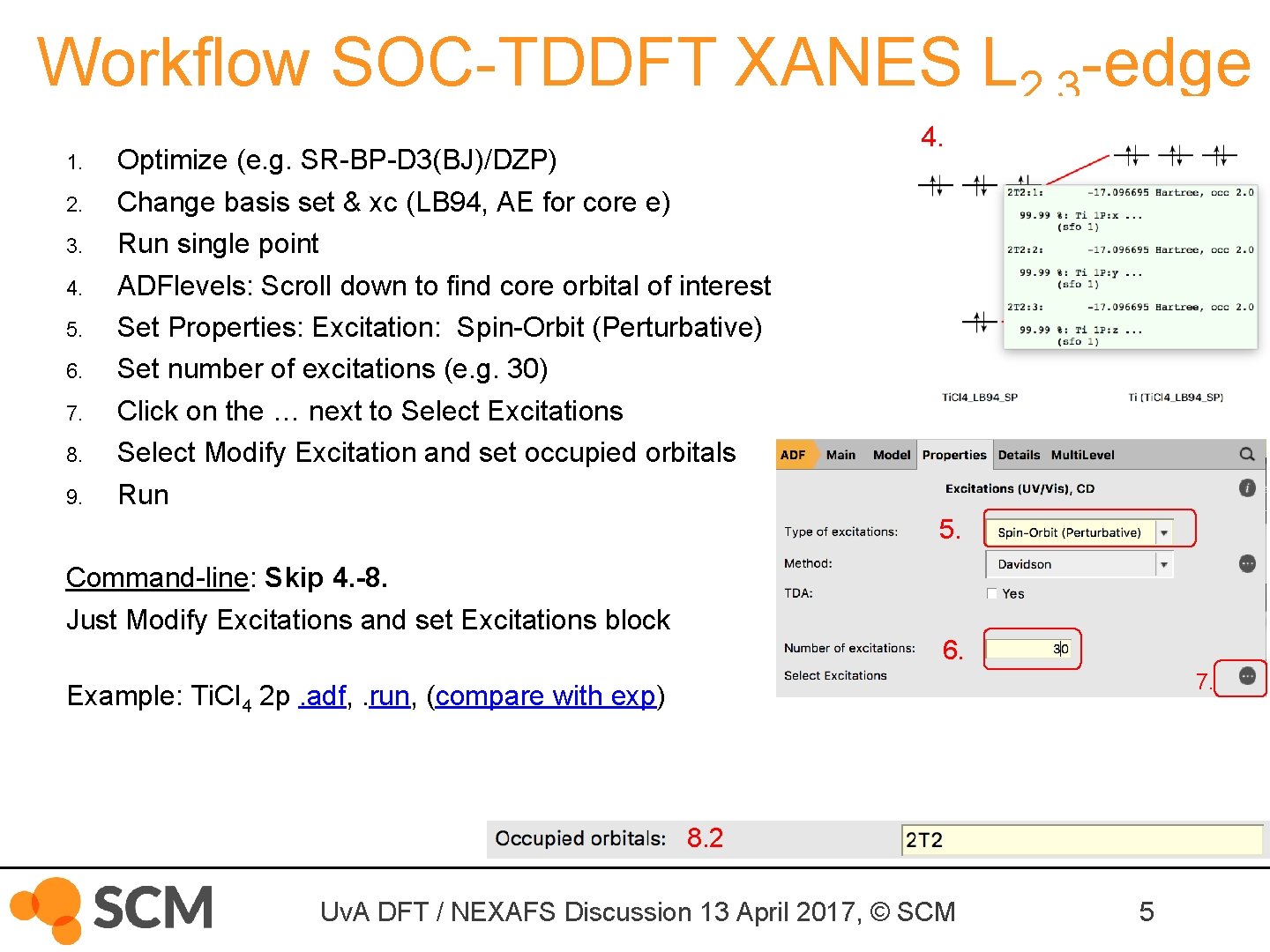
Workflow SOC-TDDFT XANES L 2, 3 -edge 1. 2. 3. 4. 5. 6. 7. 8. 9. Optimize (e. g. SR-BP-D 3(BJ)/DZP) Change basis set & xc (LB 94, AE for core e) Run single point ADFlevels: Scroll down to find core orbital of interest Set Properties: Excitation: Spin-Orbit (Perturbative) Set number of excitations (e. g. 30) Click on the … next to Select Excitations Select Modify Excitation and set occupied orbitals Run 4. 5. Command-line: Skip 4. -8. Just Modify Excitations and set Excitations block 6. 7. Example: Ti. Cl 4 2 p. adf, . run, (compare with exp) 8. 2 Uv. A DFT / NEXAFS Discussion 13 April 2017, © SCM 5