
Xander Chin Braiden Brousseau Bill Teng HARDWARE ACCELERATION
Xander Chin Braiden Brousseau Bill Teng HARDWARE ACCELERATION OF A BOOLEAN SATISFIABILITY SOLVER 1
Motivation � SAT Solvers are computational engine for major applications �EDA: testing and verification, logic synthesis, technology mapping, … �AI: knowledge base deduction, automatic theorem proving, … Software SAT Solvers has improved a lot in the last ten years, but performance is saturating � Further speed it up through hardware acceleration! � 2
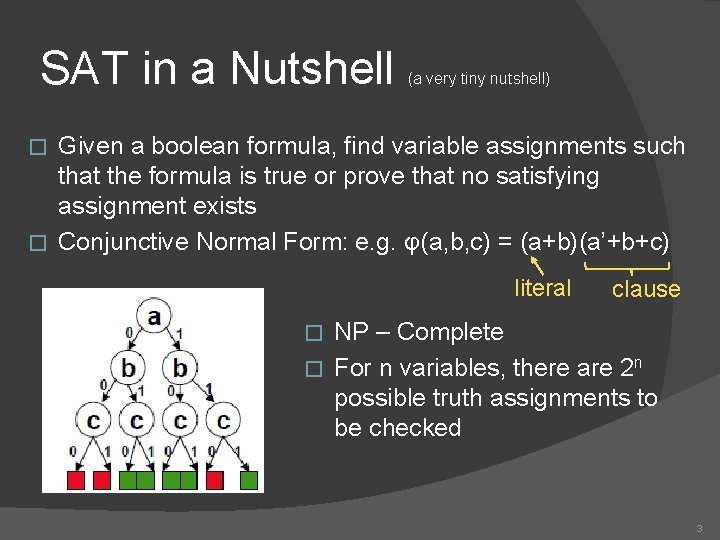
SAT in a Nutshell (a very tiny nutshell) Given a boolean formula, find variable assignments such that the formula is true or prove that no satisfying assignment exists � Conjunctive Normal Form: e. g. φ(a, b, c) = (a+b)(a’+b+c) � literal clause NP – Complete � For n variables, there are 2 n possible truth assignments to be checked � 3
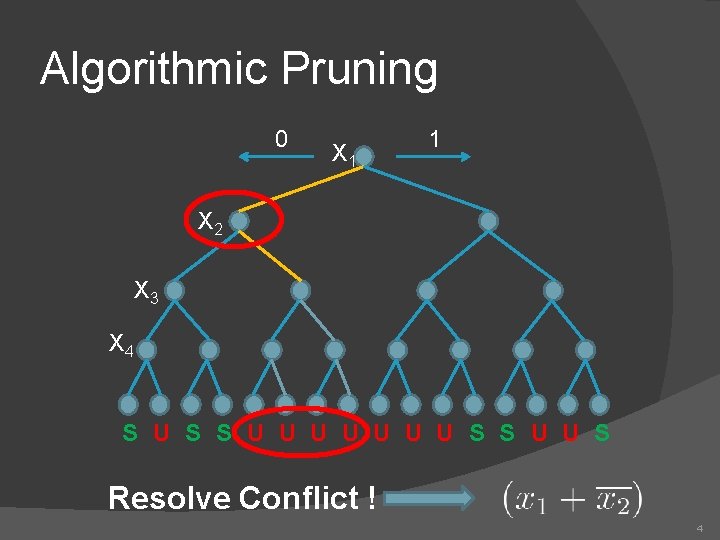
Algorithmic Pruning 0 X 1 1 X 2 X 3 X 4 S U S S U U U U S S U U S Resolve Conflict ! 4
Some Solver Techniques � Propagation �Literal watches – literal to clause mapping �Decision heuristics – which variable should be assigned next? � Pruning �Conflict analysis – which assignments will never work? � Non-chronological backtracking – undoing failed decisions quickly 5
Flexibility of Software � Software can easily implement complex pruning techniques that would be extremely difficult in hardware � New pruning techniques are demonstrating only incremental gains � Some of the complex techniques must be omitted in hardware � We must still implement the core techniques 6
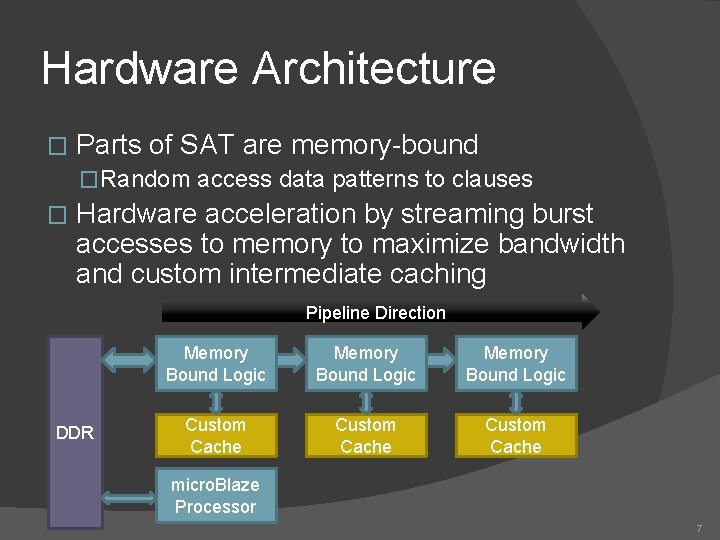
Hardware Architecture � Parts of SAT are memory-bound �Random access data patterns to clauses � Hardware acceleration by streaming burst accesses to memory to maximize bandwidth and custom intermediate caching Pipeline Direction DDR Memory Bound Logic Custom Cache micro. Blaze Processor 7
Conclusions � Trade-off between �High-level complex algorithms in software �Low-level algorithms in hardware � Critical to performance! � Novel new software algorithms could potentially outperform our hardware system �System flexibility with soft-processor �Core techniques not likely going away any time soon 8
- Slides: 8