
X Workshop on Resistive Plate Chambers and Related
X Workshop on Resistive Plate Chambers and Related Detectors Design and Performance of the Atlas RPC Detector Control System A. Polini (on behalf of the ATLAS Muon Collaboration) Outline: § Detector Requirements § System Description § Status and Performance § Future and Outlook A. Polini RPC 2010, February 9 -12 2010, Darmstadt (D)
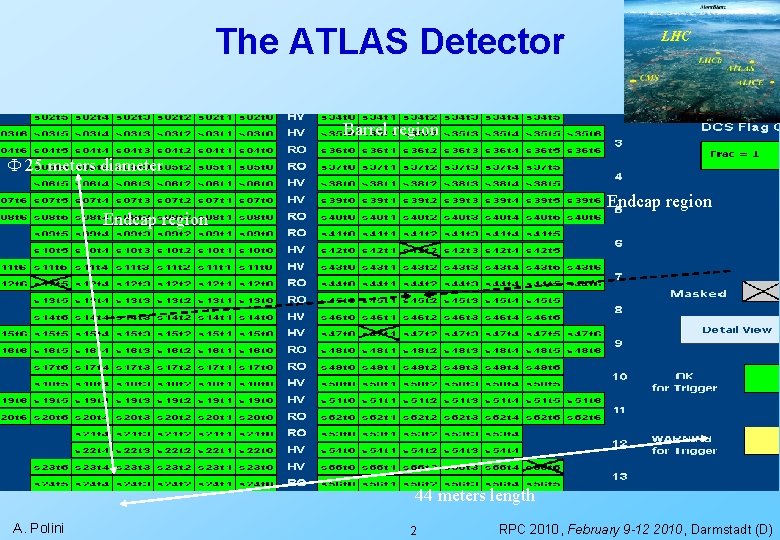
The ATLAS Detector LHC Barrel region F 25 meters diameter Endcap region 44 meters length A. Polini 2 RPC 2010, February 9 -12 2010, Darmstadt (D)
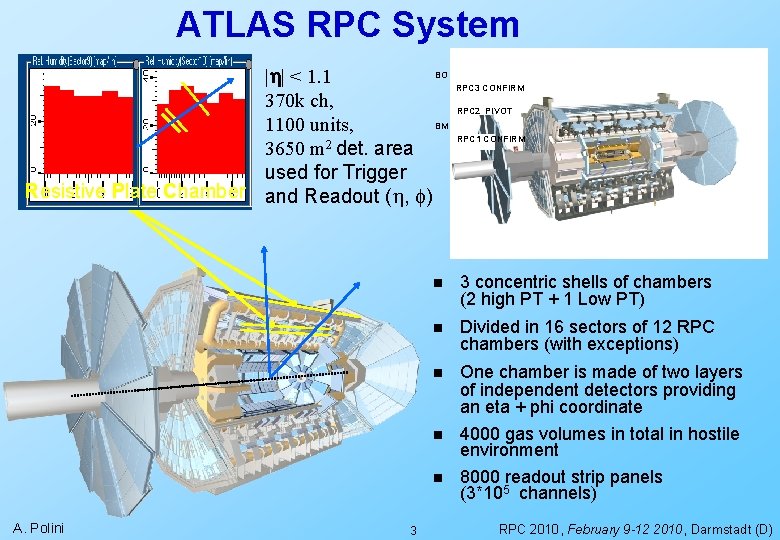
ATLAS RPC System BO |h| < 1. 1 370 k ch, BM 1100 units, 3650 m 2 det. area used for Trigger Resistive Plate Chamber and Readout ( , ) A. Polini 3 RPC 3 CONFIRM RPC 2 PIVOT RPC 1 CONFIRM n 3 concentric shells of chambers (2 high PT + 1 Low PT) n Divided in 16 sectors of 12 RPC chambers (with exceptions) n One chamber is made of two layers of independent detectors providing an eta + phi coordinate n 4000 gas volumes in total in hostile environment n 8000 readout strip panels (3*105 channels) RPC 2010, February 9 -12 2010, Darmstadt (D)
DCS Design Requirements n n Reliable system to control and operate safely the detector Expandable, scalable system, Simple and Expert interfaces FSM operation, alarm handling standardized data archiving, DB (Oracle) interface Specific RPC Requirements: n Detailed monitoring of the detector conditions n Precise measurements of the current of each Gas Gap n Precise and granular monitoring of LV draw n Highly segmented fine tuning of trigger/readout threshold n Large use of local sensors for monitoring of environment conditions (Atm. Pressure, Temperature, R. Humidity, Gas Flow). n System required to be Radiation and Magnetic Field tolerant n Advanced in-built problem tracing and analysis tools A. Polini RPC 2010, February 9 -12 2010, Darmstadt (D)
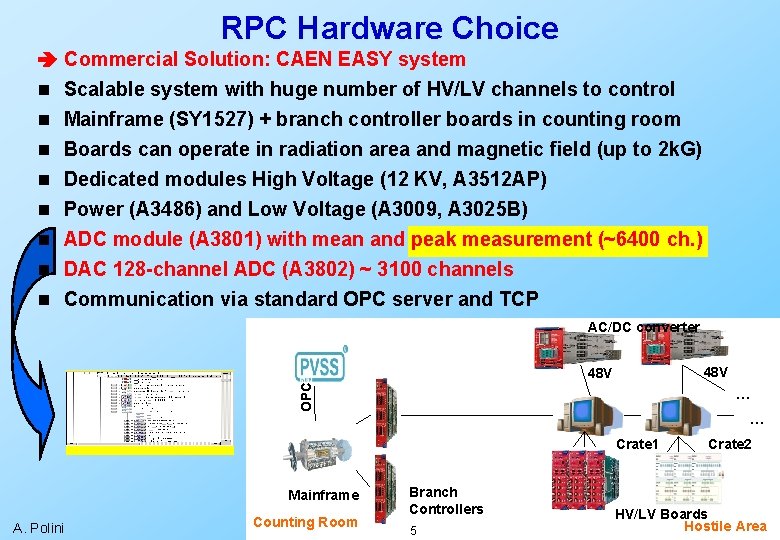
RPC Hardware Choice Commercial Solution: CAEN EASY system n Scalable system with huge number of HV/LV channels to control n Mainframe (SY 1527) + branch controller boards in counting room n Boards can operate in radiation area and magnetic field (up to 2 k. G) n Dedicated modules High Voltage (12 KV, A 3512 AP) n Power (A 3486) and Low Voltage (A 3009, A 3025 B) n ADC module (A 3801) with mean and peak measurement (~6400 ch. ) n DAC 128 -channel ADC (A 3802) ~ 3100 channels n Communication via standard OPC server and TCP AC/DC converter 48 V OPC 48 V … … Crate 1 Mainframe A. Polini Counting Room Branch Controllers 5 Crate 2 HV/LV Boards Area RPC 2010, February 9 -12 2010, Hostile Darmstadt (D)
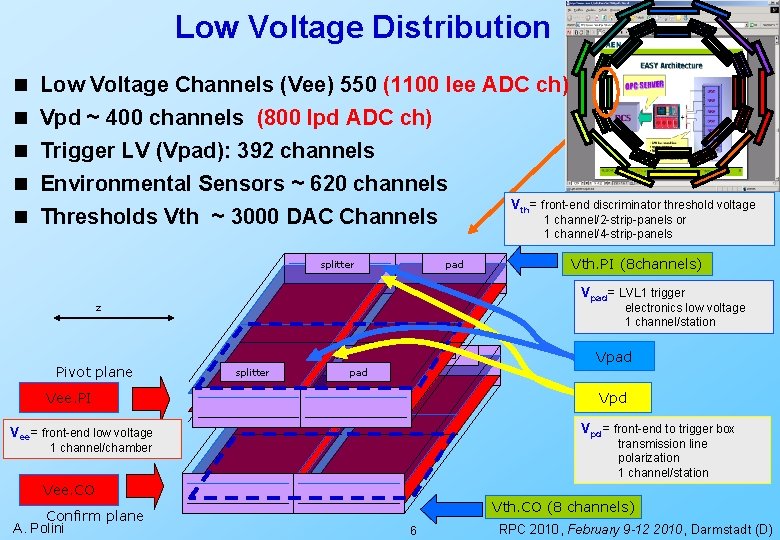
Low Voltage Distribution n Low Voltage Channels (Vee) 550 (1100 Iee ADC ch) n Vpd ~ 400 channels (800 Ipd ADC ch) n Trigger LV (Vpad): 392 channels n Environmental Sensors ~ 620 channels n Thresholds Vth ~ 3000 DAC Channels splitter pad Vth. PI (8 channels) electronics low voltage 1 channel/station splitter pad Vpad Vee. PI Vpd= front-end to trigger box Vee= front-end low voltage transmission line polarization 1 channel/station 1 channel/chamber Vee. CO Confirm plane A. Polini 1 channel/2 -strip-panels or 1 channel/4 -strip-panels Vpad= LVL 1 trigger z Pivot plane Vth= front-end discriminator threshold voltage Vth. CO (8 channels) 6 RPC 2010, February 9 -12 2010, Darmstadt (D)
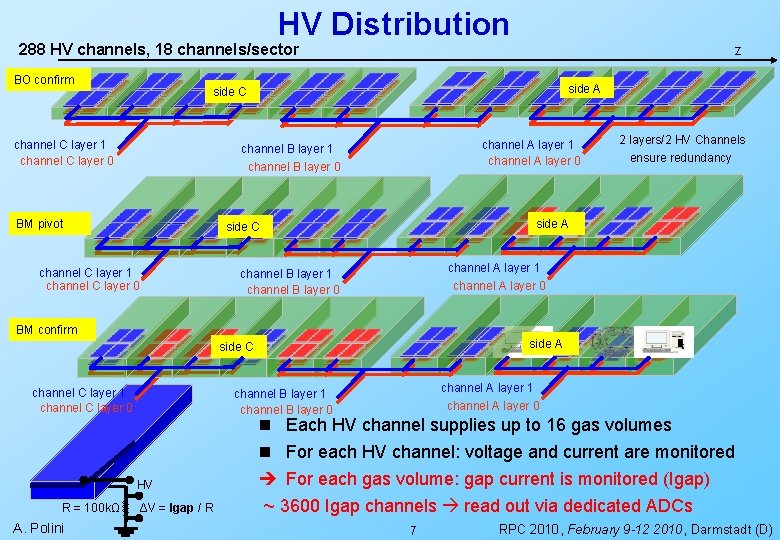
HV Distribution 288 HV channels, 18 channels/sector BO confirm z side A side C channel C layer 1 channel C layer 0 channel A layer 1 channel A layer 0 channel B layer 1 channel B layer 0 BM pivot side A side C channel C layer 1 channel C layer 0 2 layers/2 HV Channels ensure redundancy channel A layer 1 channel B layer 0 channel A layer 0 BM confirm side A side C channel C layer 1 channel C layer 0 channel A layer 1 channel B layer 0 channel A layer 0 n Each HV channel supplies up to 16 gas volumes n For each HV channel: voltage and current are monitored HV > < R = 100 kΩ < > ΔV = Igap / R A. Polini For each gas volume: gap current is monitored (Igap) ~ 3600 Igap channels read out via dedicated ADCs 7 RPC 2010, February 9 -12 2010, Darmstadt (D)
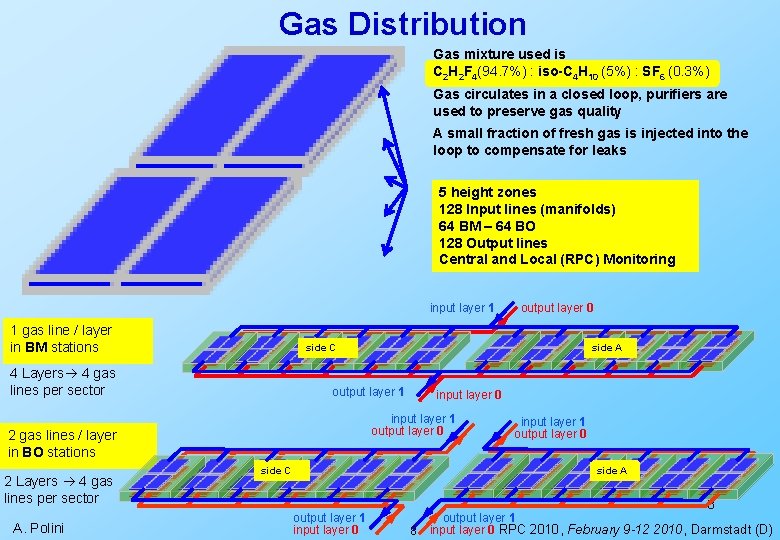
Gas Distribution Gas mixture used is C 2 H 2 F 4(94. 7%) : iso-C 4 H 10 (5%) : SF 6 (0. 3%) Gas circulates in a closed loop, purifiers are used to preserve gas quality A small fraction of fresh gas is injected into the loop to compensate for leaks 5 height zones 128 Input lines (manifolds) 64 BM – 64 BO 128 Output lines Central and Local (RPC) Monitoring input layer 1 1 gas line / layer in BM stations side C 4 Layers 4 gas lines per sector A. Polini side A output layer 1 input layer 0 input layer 1 output layer 0 2 gas lines / layer in BO stations 2 Layers 4 gas lines per sector output layer 0 side C input layer 1 output layer 0 side A output layer 1 input layer 0 8 8 output layer 1 input layer 0 RPC 2010, February 9 -12 2010, Darmstadt (D)
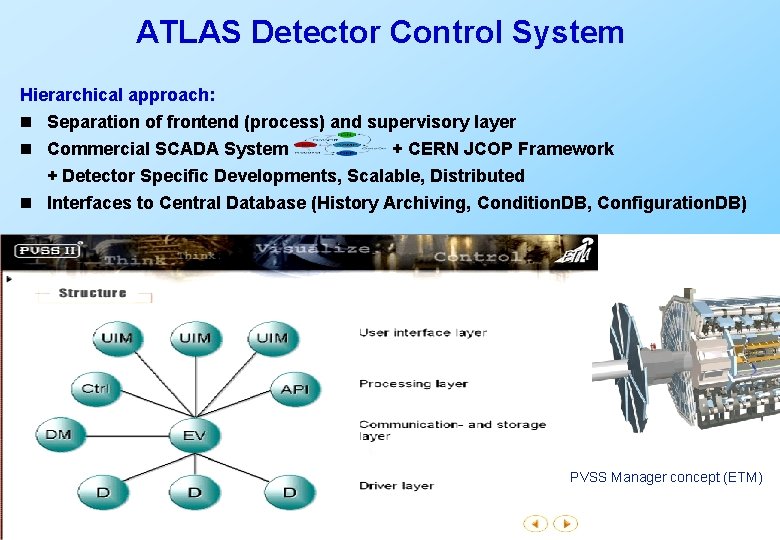
ATLAS Detector Control System Hierarchical approach: n Separation of frontend (process) and supervisory layer n Commercial SCADA System + CERN JCOP Framework + Detector Specific Developments, Scalable, Distributed n Interfaces to Central Database (History Archiving, Condition. DB, Configuration. DB) PVSS Manager concept (ETM) A. Polini RPC 2010, February 9 -12 2010, Darmstadt (D)
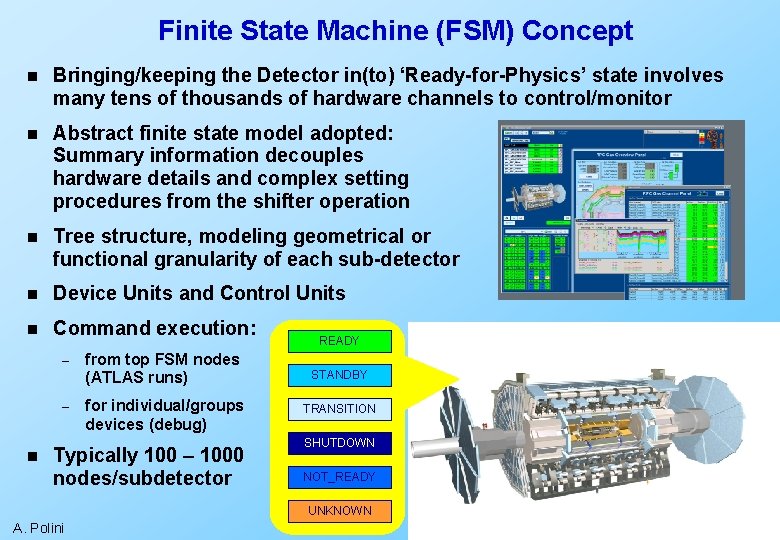
Finite State Machine (FSM) Concept n Bringing/keeping the Detector in(to) ‘Ready-for-Physics’ state involves many tens of thousands of hardware channels to control/monitor n Abstract finite state model adopted: Summary information decouples hardware details and complex setting procedures from the shifter operation n Tree structure, modeling geometrical or functional granularity of each sub-detector n Device Units and Control Units n Command execution: n READY – from top FSM nodes STANDBY (ATLAS runs) – for individual/groups TRANSITION devices (debug) SHUTDOWN Typically 100 – 1000 NOT_READY nodes/subdetector UNKNOWN A. Polini RPC 2010, February 9 -12 2010, Darmstadt (D)
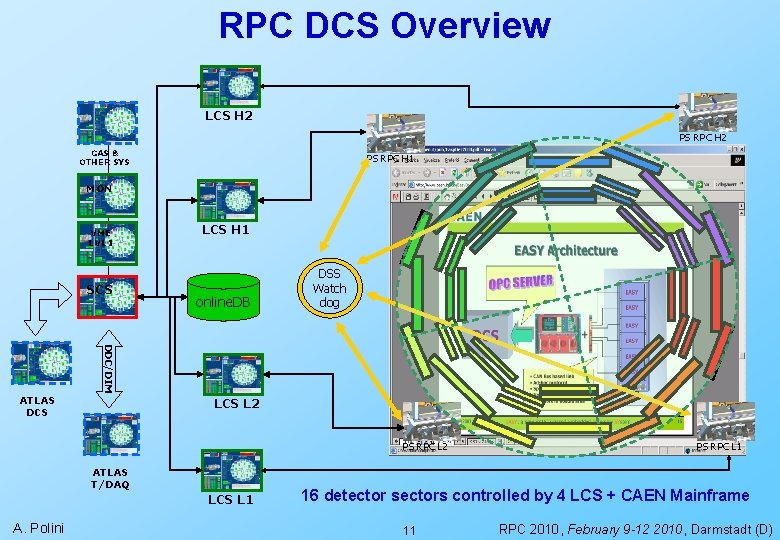
RPC DCS Overview LCS H 2 PS RPC H 2 GAS & OTHER SYS PS RPC H 1 MON VME LVL 1 SCS online. DB DSS Watch dog DDC/DIM ATLAS DCS LCS H 1 LCS L 2 PS RPC L 2 ATLAS T/DAQ LCS L 1 A. Polini PS RPC L 1 16 detector sectors controlled by 4 LCS + CAEN Mainframe 11 RPC 2010, February 9 -12 2010, Darmstadt (D)
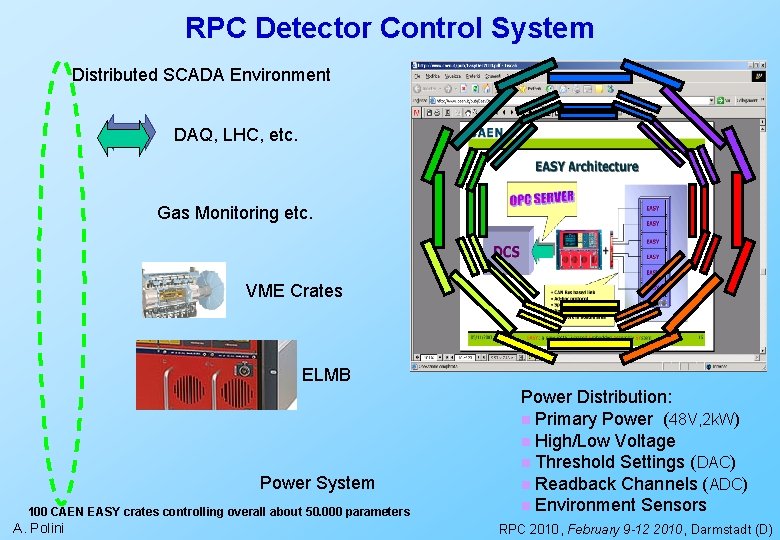
RPC Detector Control System Distributed SCADA Environment DAQ, LHC, etc. Gas Monitoring etc. VME Crates ELMB Power System 100 CAEN EASY crates controlling overall about 50. 000 parameters A. Polini Power Distribution: n Primary Power (48 V, 2 k. W) n High/Low Voltage n Threshold Settings (DAC) n Readback Channels (ADC) n Environment Sensors RPC 2010, February 9 -12 2010, Darmstadt (D)
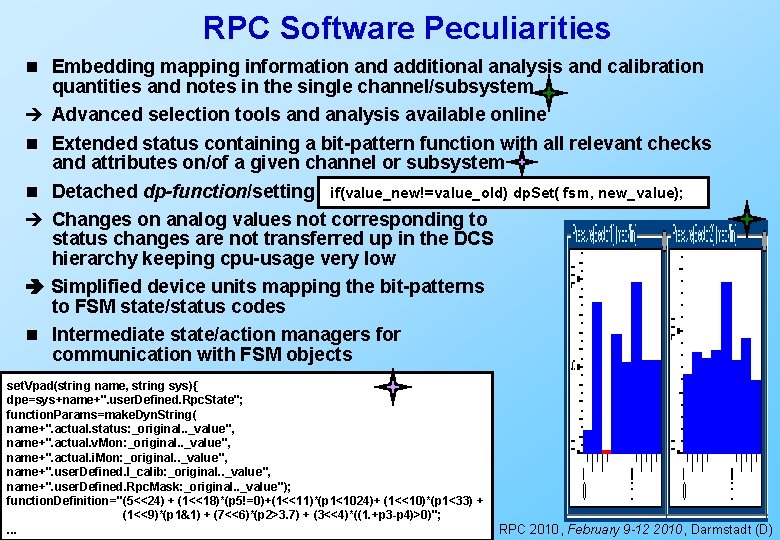
RPC Software Peculiarities n Embedding mapping information and additional analysis and calibration quantities and notes in the single channel/subsystem Advanced selection tools and analysis available online n Extended status containing a bit-pattern function with all relevant checks and attributes on/of a given channel or subsystem n Detached dp-function/setting if(value_new!=value_old) dp. Set( fsm, new_value); Changes on analog values not corresponding to status changes are not transferred up in the DCS hierarchy keeping cpu-usage very low Simplified device units mapping the bit-patterns to FSM state/status codes n Intermediate state/action managers for communication with FSM objects set. Vpad(string name, string sys){ dpe=sys+name+". user. Defined. Rpc. State"; function. Params=make. Dyn. String( name+". actual. status: _original. . _value", name+". actual. v. Mon: _original. . _value", name+". actual. i. Mon: _original. . _value", name+". user. Defined. I_calib: _original. . _value", name+". user. Defined. Rpc. Mask: _original. . _value"); function. Definition="(5<<24) + (1<<18)*(p 5!=0)+(1<<11)*(p 1<1024)+ (1<<10)*(p 1<33) + (1<<9)*(p 1&1) + (7<<6)*(p 2>3. 7) + (3<<4)*((1. +p 3 -p 4)>0)"; . . . A. Polini RPC 2010, February 9 -12 2010, Darmstadt (D)
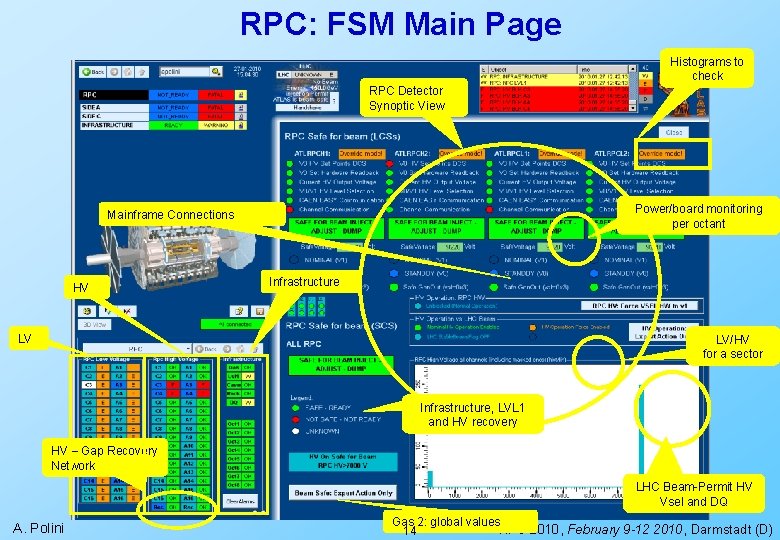
RPC: FSM Main Page Histograms to check RPC Detector Synoptic View Power/board monitoring per octant Mainframe Connections HV Infrastructure LV LV/HV for a sector Infrastructure, LVL 1 and HV recovery HV – Gap Recovery Network LHC Beam-Permit HV Vsel and 14 DQ A. Polini Gas 2: global values RPC 2010, February 9 -12 2010, Darmstadt (D) 14
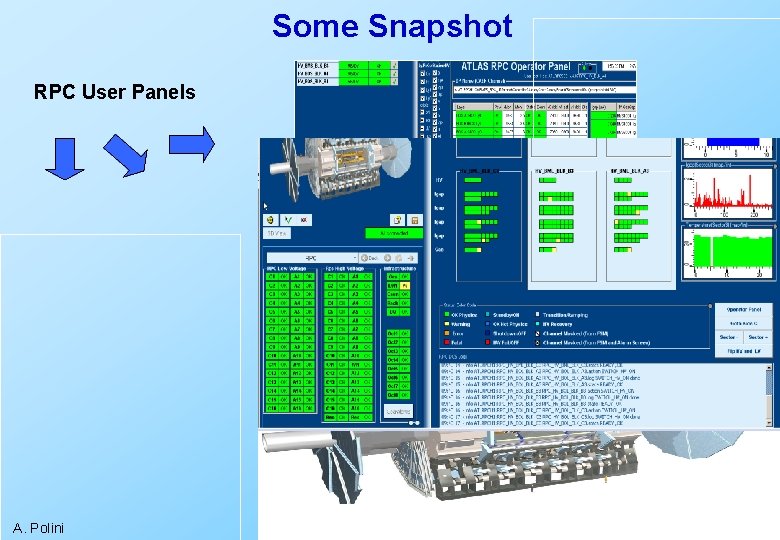
Some Snapshot RPC User Panels A. Polini RPC 2010, February 9 -12 2010, Darmstadt (D)
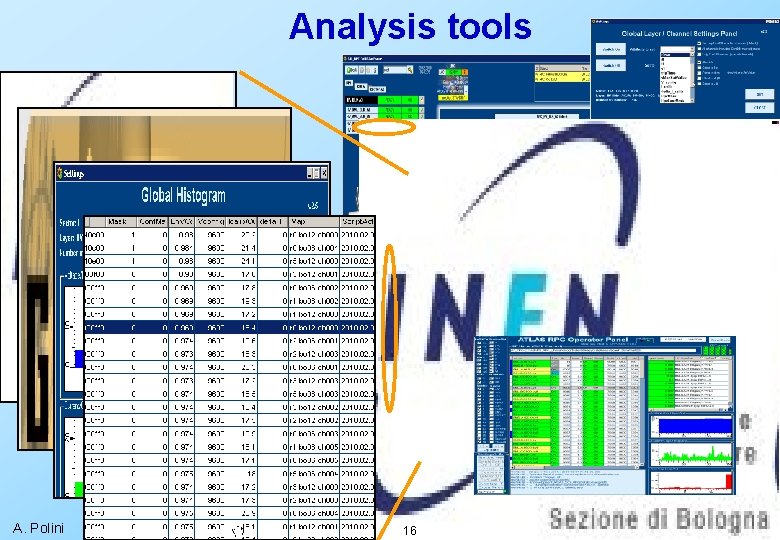
Analysis tools A. Polini 16 RPC 2010, February 9 -12 2010, Darmstadt (D)
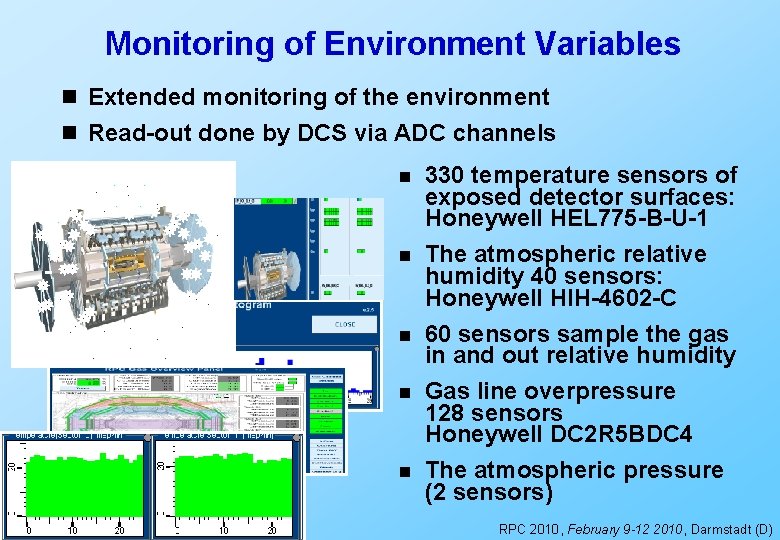
Monitoring of Environment Variables n Extended monitoring of the environment n Read-out done by DCS via ADC channels n 330 temperature sensors of exposed detector surfaces: Honeywell HEL 775 -B-U-1 n The atmospheric relative humidity 40 sensors: Honeywell HIH-4602 -C 60 sensors sample the gas in and out relative humidity Gas line overpressure 128 sensors Honeywell DC 2 R 5 BDC 4 The atmospheric pressure (2 sensors) n n n A. Polini RPC 2010, February 9 -12 2010, Darmstadt (D)
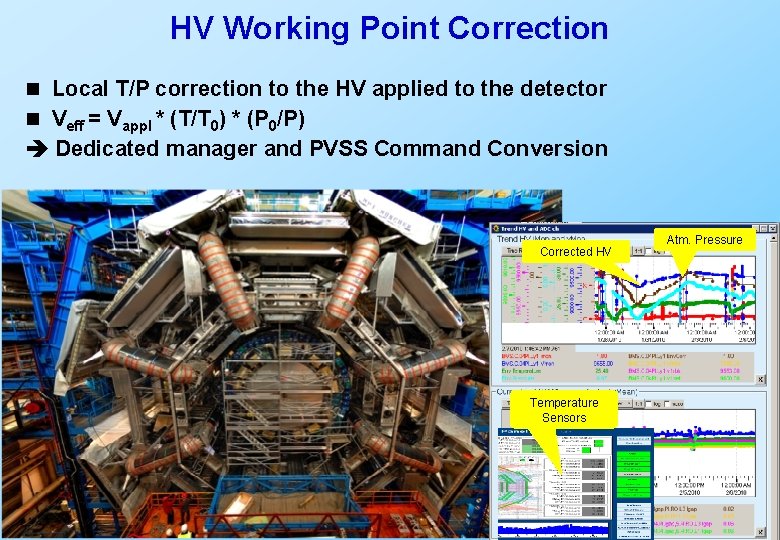
HV Working Point Correction n Local T/P correction to the HV applied to the detector n Veff = Vappl * (T/T 0) * (P 0/P) Dedicated manager and PVSS Command Conversion Corrected HV Atm. Pressure Temperature Sensors A. Polini RPC 2010, February 9 -12 2010, Darmstadt (D)
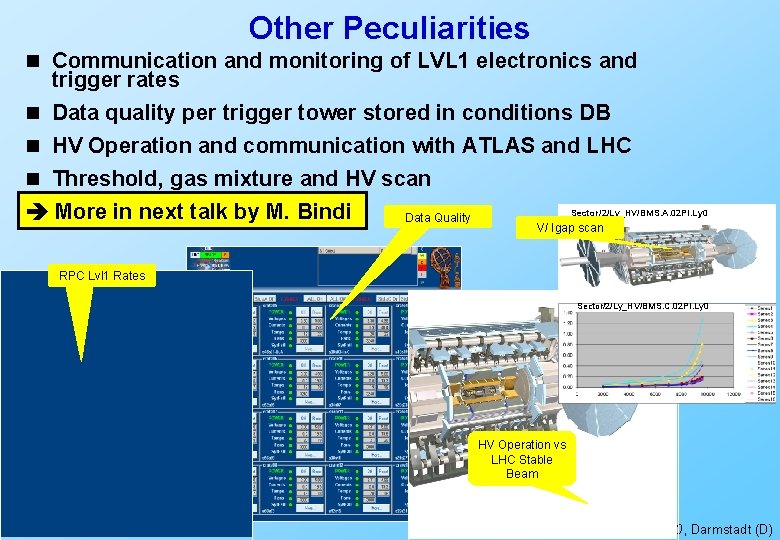
Other Peculiarities n Communication and monitoring of LVL 1 electronics and trigger rates n Data quality per trigger tower stored in conditions DB n HV Operation and communication with ATLAS and LHC n Threshold, gas mixture and HV scan Sector/2/Ly_HV/BMS. A. 02 PI. Ly 0 More in next talk by M. Bindi Data Quality V/ Igap scan RPC Lvl 1 Rates Sector/2/Ly_HV/BMS. C. 02 PI. Ly 0 HV Operation vs LHC Stable Beam A. Polini RPC 2010, February 9 -12 2010, Darmstadt (D)
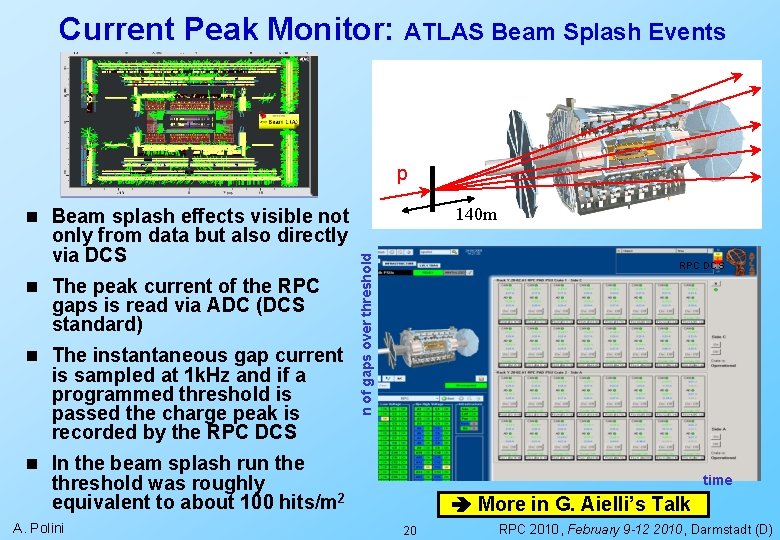
Current Peak Monitor: ATLAS Beam Splash Events p 140 m only from data but also directly via DCS n The peak current of the RPC gaps is read via ADC (DCS standard) n The instantaneous gap current is sampled at 1 k. Hz and if a programmed threshold is passed the charge peak is recorded by the RPC DCS n of gaps over threshold n Beam splash effects visible not RPC DCS n In the beam splash run the threshold was roughly equivalent to about 100 hits/m 2 A. Polini time More in G. Aielli’s Talk 20 RPC 2010, February 9 -12 2010, Darmstadt (D)
Conclusions n The ATLAS RPC DCS offers a complete solution for operating and controlling large LHC detectors n In the design an effort has been put to be able to control and monitor in great detail the detector performance n The system is fully operative and has shown to be extremely flexible and powerful allowing shifter (FSM) as well as expert operation and analysis n The very large number of detector elements that are monitored trough the DCS, will provide a statistical study of the RPC behavior and represent an uncommon tool for a deeper understanding on RPC detector physics n The ATLAS RPC DCS provides a template system for present test and future experimental facilities A. Polini RPC 2010, February 9 -12 2010, Darmstadt (D)
- Slides: 21