
x include stdio h 1 2 a float
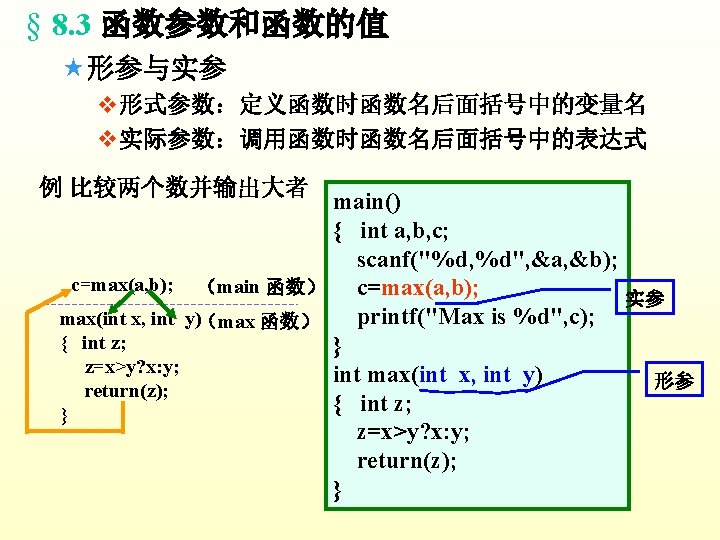
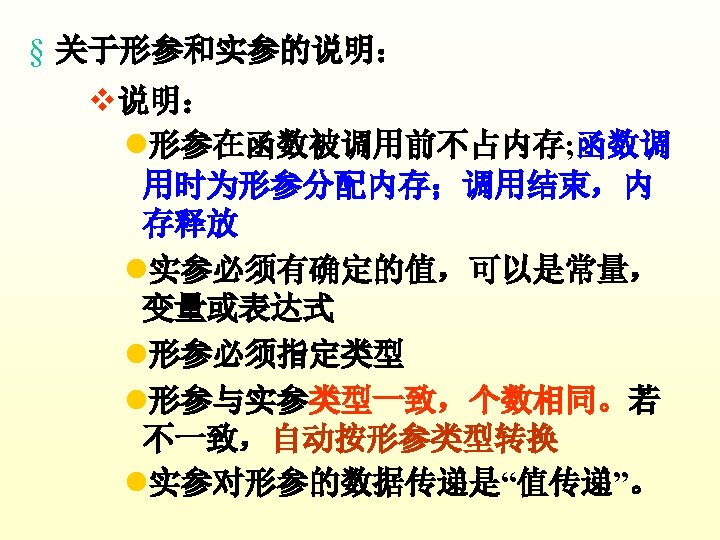

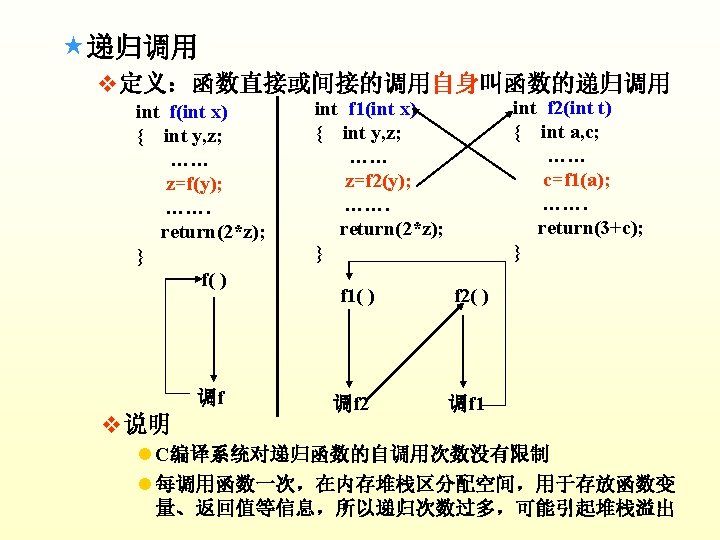
- Slides: 24
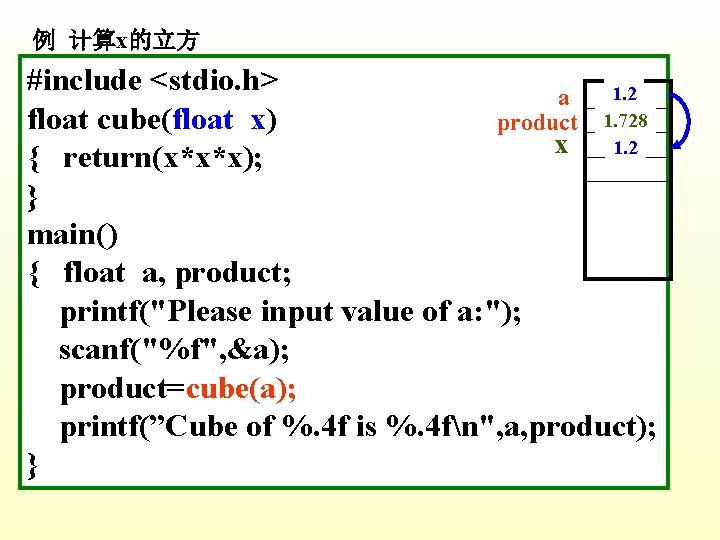
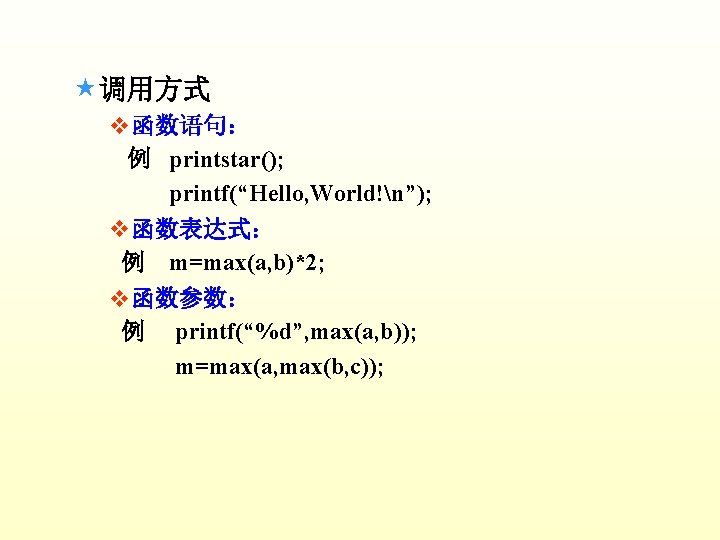
例 计算x的立方 #include <stdio. h> 1. 2 ×× a float cube(float x) ×× product 1. 728 x 1. 2 { return(x*x*x); } main() { float a, product; printf("Please input value of a: "); scanf("%f", &a); product=cube(a); printf(”Cube of %. 4 f is %. 4 fn", a, product); }
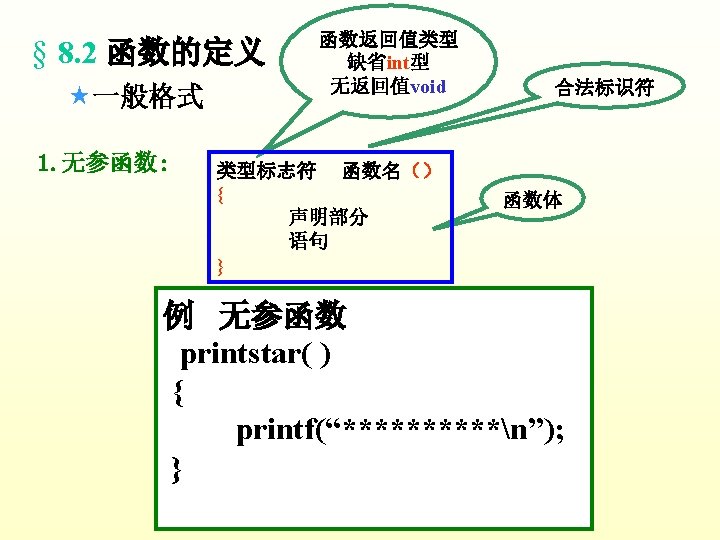
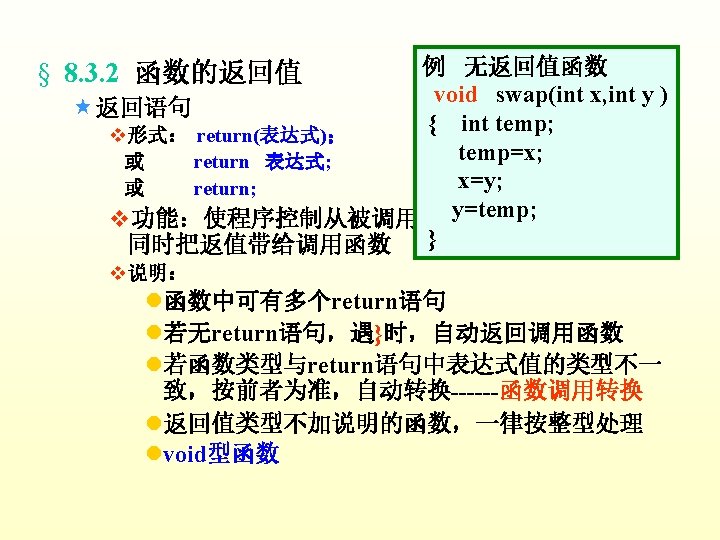
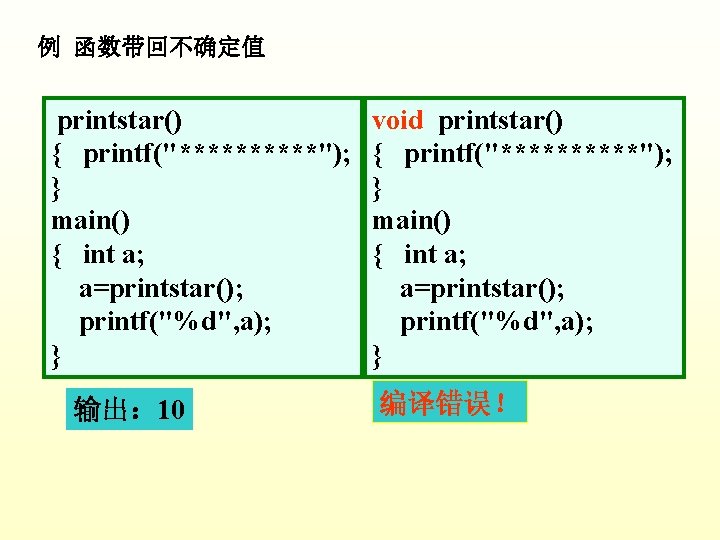
例 函数带回不确定值 printstar() { printf("*****"); } main() { int a; a=printstar(); printf("%d", a); } 输出: 10 void printstar() { printf("*****"); } main() { int a; a=printstar(); printf("%d", a); } 编译错误!
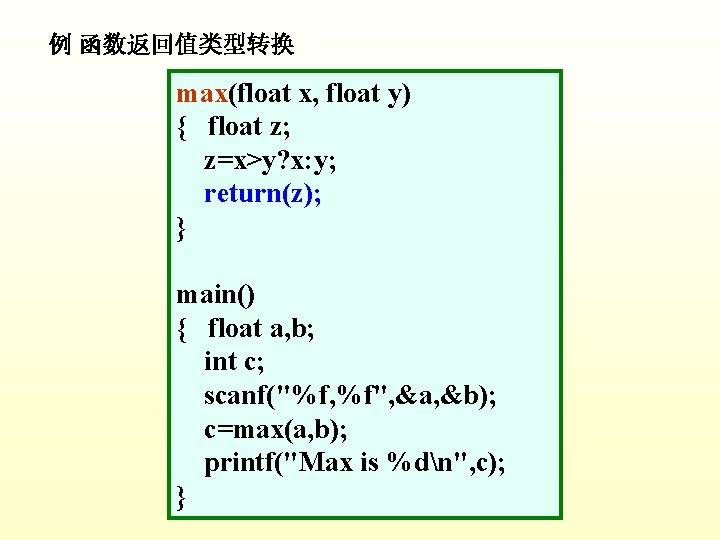
例 函数返回值类型转换 max(float x, float y) { float z; z=x>y? x: y; return(z); } main() { float a, b; int c; scanf("%f, %f", &a, &b); c=max(a, b); printf("Max is %dn", c); }
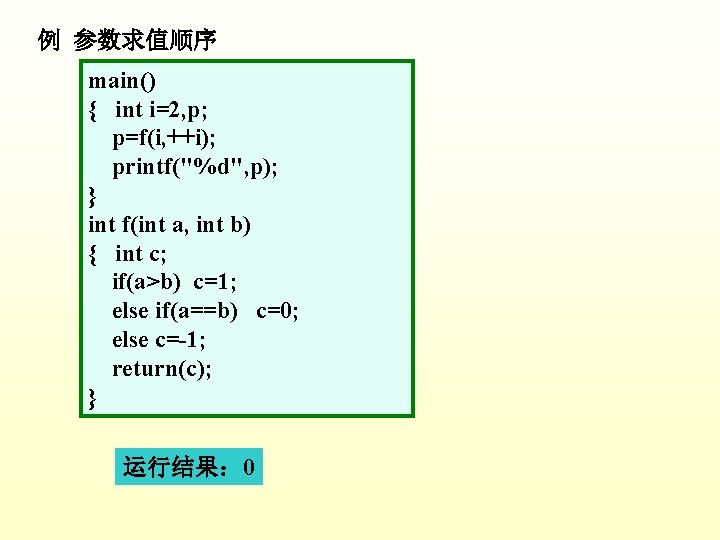
例 参数求值顺序 main() { int i=2, p; p=f(i, ++i); printf("%d", p); } int f(int a, int b) { int c; if(a>b) c=1; else if(a==b) c=0; else c=-1; return(c); } 运行结果: 0
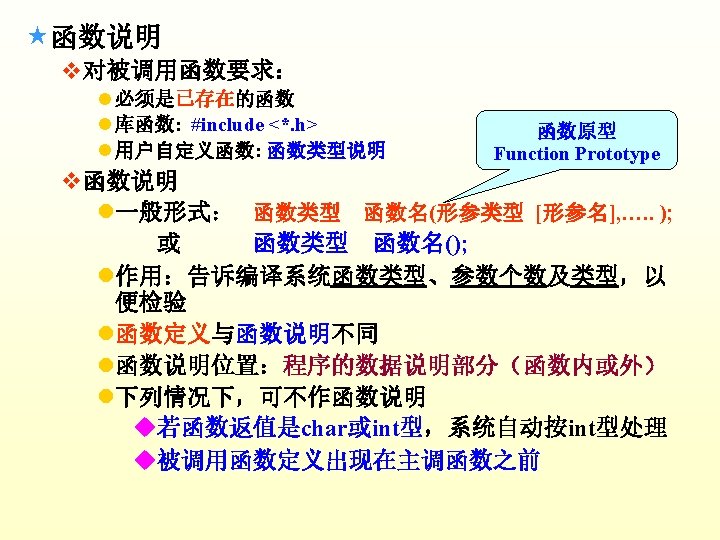
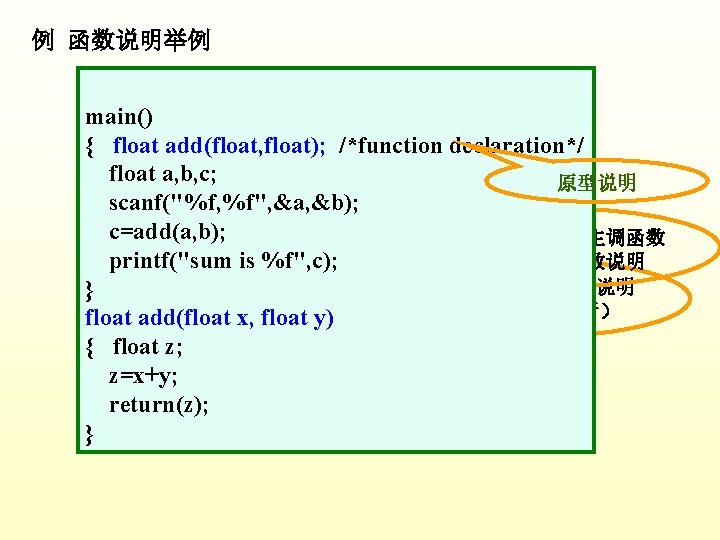
例 函数说明举例 main() { add(float a, b; x, float y) float { float add(float, float); /*function declaration*/ intz; c; { float a, b, c; 原型说明 scanf("%f, %f", &a, &b); z=x+y; scanf("%f, %f", &a, &b); c=max(a, b); return(z); c=add(a, b); printf("Max is %dn", c); 被调函数出现在主调函数 } printf("sum is %f", c); 之前,不必函数说明 } main() int型函数可不作函数说明 } max(float { float a, b, c; x, float y) (Borland C++不行) float add(float x, float y) { float z; scanf("%f, %f", &a, &b); { float z; z=x>y? x: y; c=add(a, b); z=x+y; return(z); is %f", c); printf("sum return(z); } } }
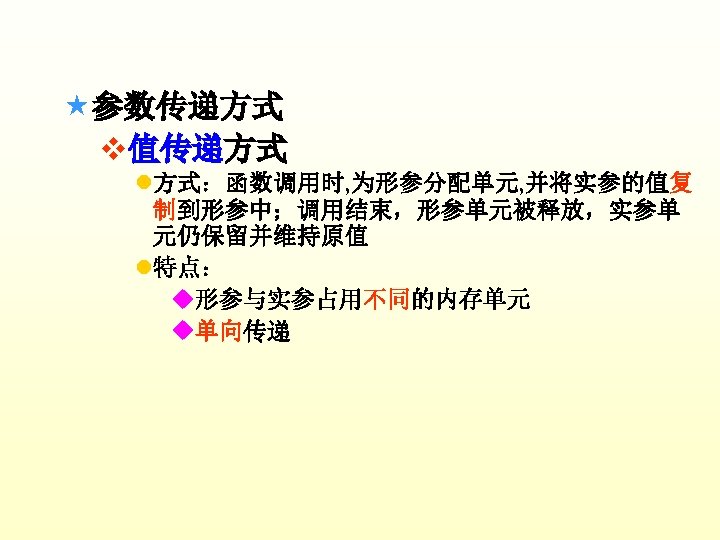
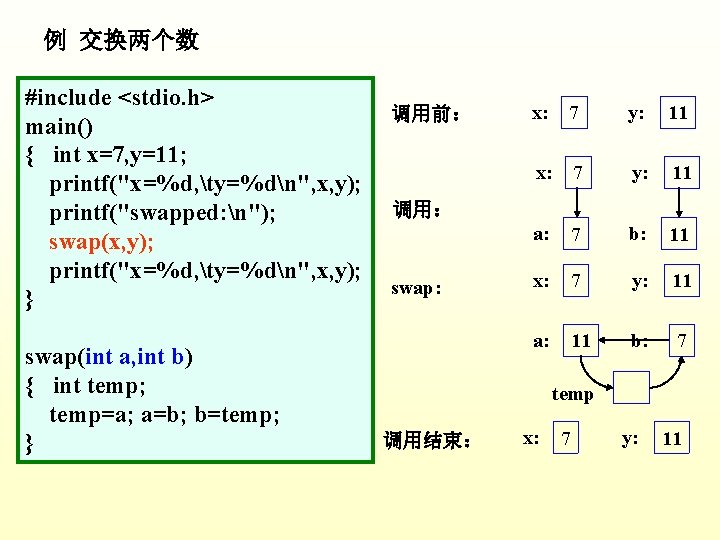
例 交换两个数 #include <stdio. h> main() { int x=7, y=11; printf("x=%d, ty=%dn", x, y); printf("swapped: n"); swap(x, y); printf("x=%d, ty=%dn", x, y); } swap(int a, int b) { int temp; temp=a; a=b; b=temp; } 调用前: x: 7 y: 11 a: 7 b: 11 x: 7 y: 11 a: 11 b: 7 调用: swap: temp 调用结束: x: 7 y: 11
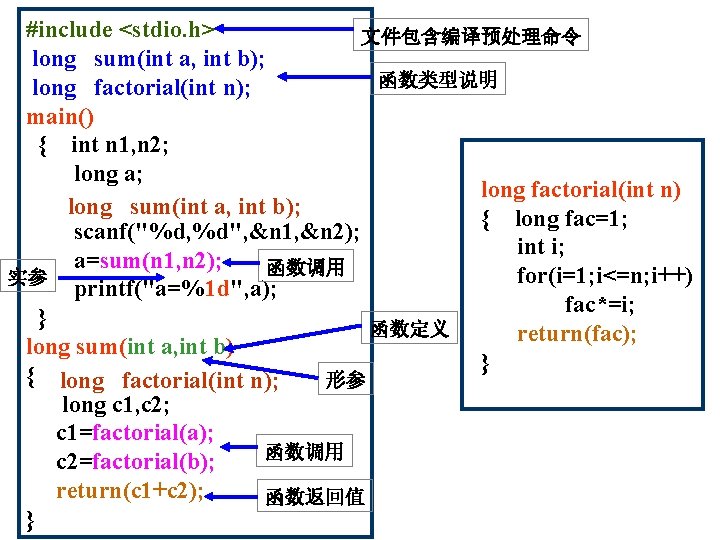
#include <stdio. h> 文件包含编译预处理命令 long sum(int a, int b); 函数类型说明 long factorial(int n); main() { int n 1, n 2; long a; long factorial(int n) long sum(int a, int b); { long fac=1; scanf("%d, %d", &n 1, &n 2); int i; a=sum(n 1, n 2); 函数调用 for(i=1; i<=n; i++) 实参 printf("a=%1 d", a); fac*=i; } 函数定义 return(fac); long sum(int a, int b) } { long factorial(int n); 形参 long c 1, c 2; c 1=factorial(a); 函数调用 c 2=factorial(b); return(c 1+c 2); 函数返回值 }
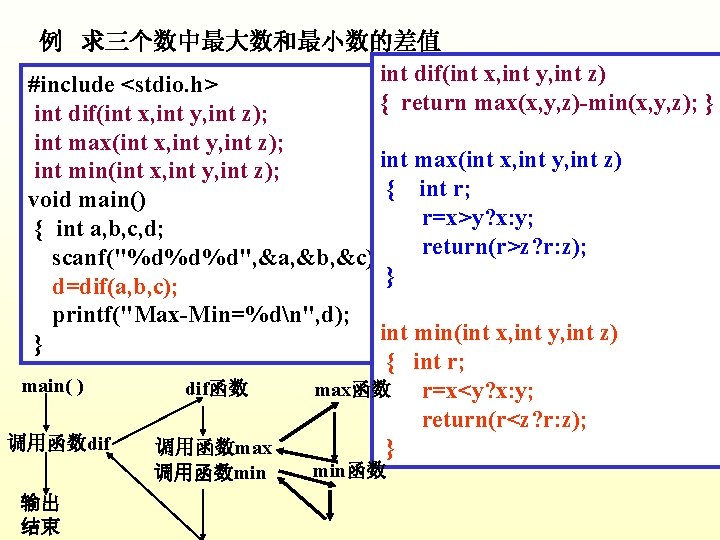
例 求三个数中最大数和最小数的差值 int dif(int x, int y, int z) #include <stdio. h> { return max(x, y, z)-min(x, y, z); } int dif(int x, int y, int z); int max(int x, int y, int z) int min(int x, int y, int z); { int r; void main() r=x>y? x: y; { int a, b, c, d; return(r>z? r: z); scanf("%d%d%d", &a, &b, &c); } d=dif(a, b, c); printf("Max-Min=%dn", d); int min(int x, int y, int z) } { int r; main( ) dif函数 max函数 r=x<y? x: y; return(r<z? r: z); 调用函数dif 调用函数max } 调用函数min 输出 结束 min函数
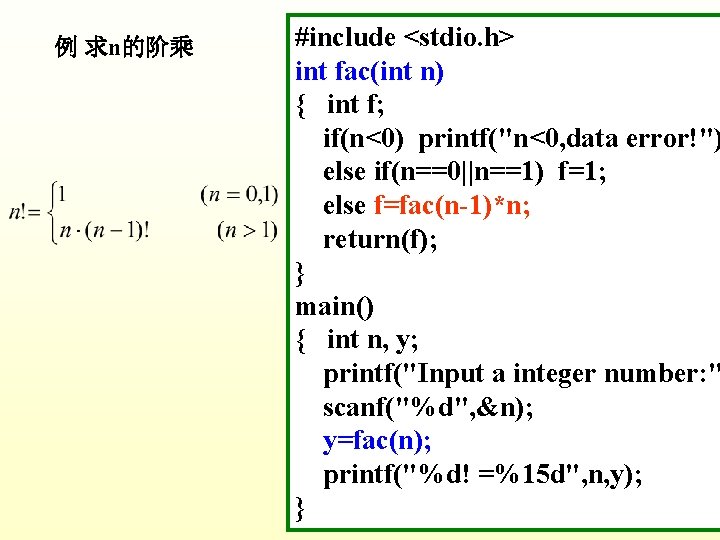
例 求n的阶乘 #include <stdio. h> int fac(int n) { int f; if(n<0) printf("n<0, data error!") else if(n==0||n==1) f=1; else f=fac(n-1)*n; return(f); } main() { int n, y; printf("Input a integer number: " scanf("%d", &n); y=fac(n); printf("%d! =%15 d", n, y); }
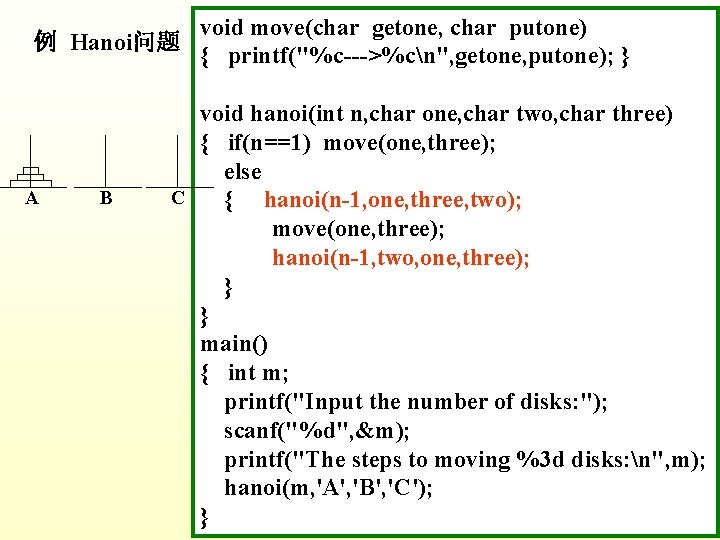
void move(char getone, char putone) 例 Hanoi问题 { printf("%c--->%cn", getone, putone); } A B void hanoi(int n, char one, char two, char three) { if(n==1) move(one, three); else C { hanoi(n-1, one, three, two); move(one, three); hanoi(n-1, two, one, three); } } main() { int m; printf("Input the number of disks: "); scanf("%d", &m); printf("The steps to moving %3 d disks: n", m); hanoi(m, 'A', 'B', 'C'); }