
X Inactivation in Female Mammals During fetal development
- Slides: 16
X Inactivation in Female Mammals • During fetal development, one female X chromosome become inactive and lies along the inside of the nuclear membrane • Which X chromosome inactivates is random and varies from cell to cell, however during mitotic division the same X chromosome remains inactive • The inactive X chromosome is called a Barr body • Females consist of a mosaic of two types of cells; those with active and those with inactive X chromosomes
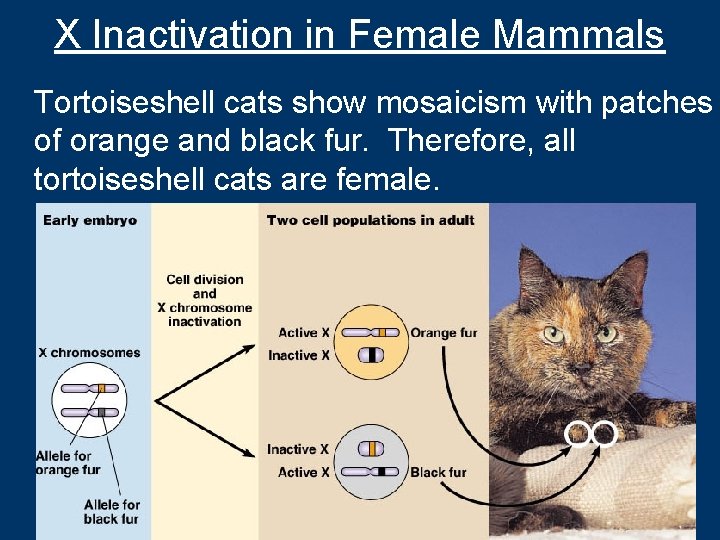
X Inactivation in Female Mammals Tortoiseshell cats show mosaicism with patches of orange and black fur. Therefore, all tortoiseshell cats are female.
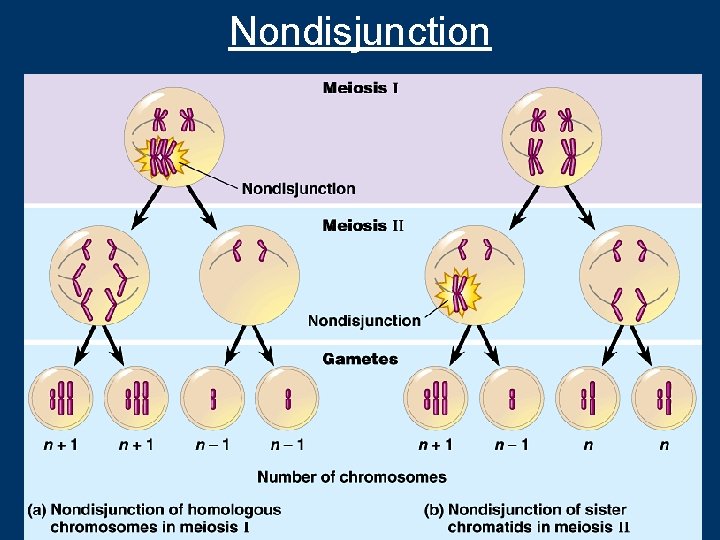
Alterations of Chromosome Number • Nondisjunction – members of a pair of homologous chromosomes fail to move apart properly during meiosis I or sister chromosomes do not separate during meiosis II. • One gamete receives two of the same type of chromosome and the other receives no copy.
Nondisjunction
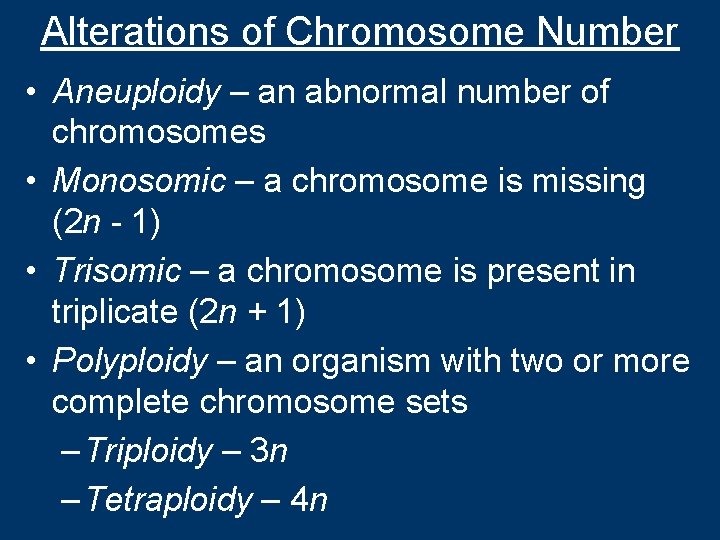
Alterations of Chromosome Number • Aneuploidy – an abnormal number of chromosomes • Monosomic – a chromosome is missing (2 n - 1) • Trisomic – a chromosome is present in triplicate (2 n + 1) • Polyploidy – an organism with two or more complete chromosome sets – Triploidy – 3 n – Tetraploidy – 4 n
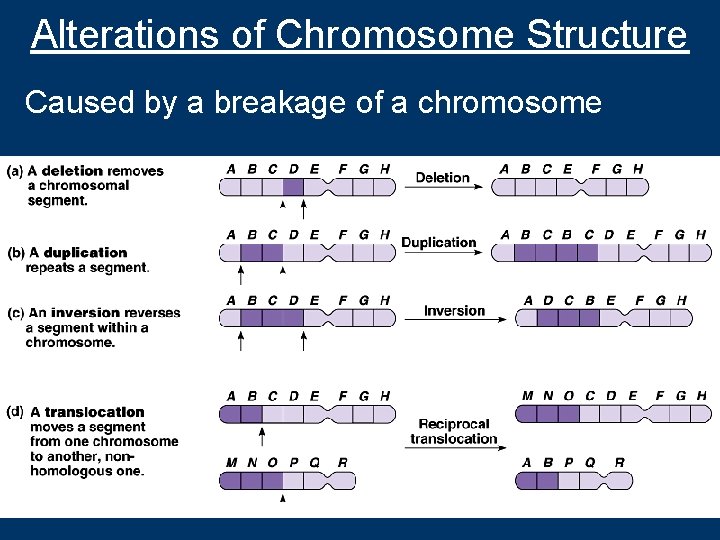
Alterations of Chromosome Structure Caused by a breakage of a chromosome
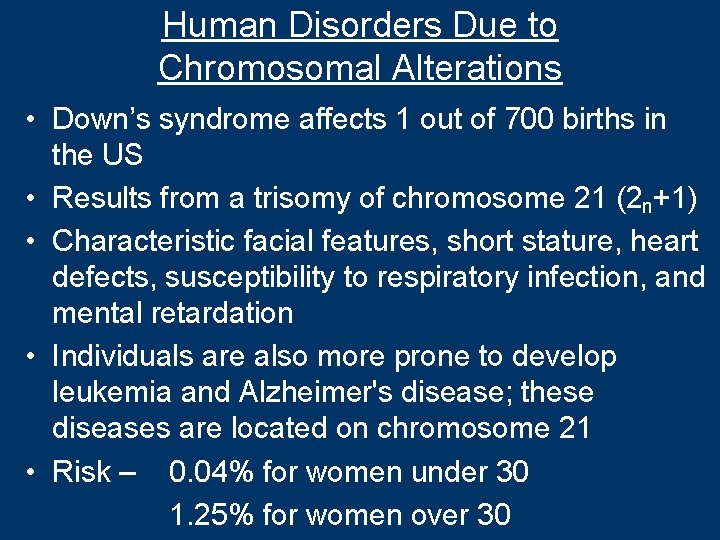
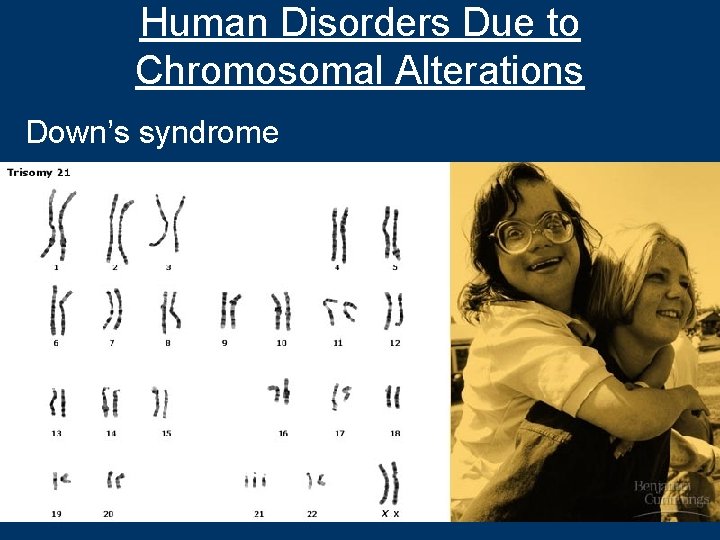
Human Disorders Due to Chromosomal Alterations • Down’s syndrome affects 1 out of 700 births in the US • Results from a trisomy of chromosome 21 (2 n+1) • Characteristic facial features, short stature, heart defects, susceptibility to respiratory infection, and mental retardation • Individuals are also more prone to develop leukemia and Alzheimer's disease; these diseases are located on chromosome 21 • Risk – 0. 04% for women under 30 1. 25% for women over 30
Human Disorders Due to Chromosomal Alterations Down’s syndrome
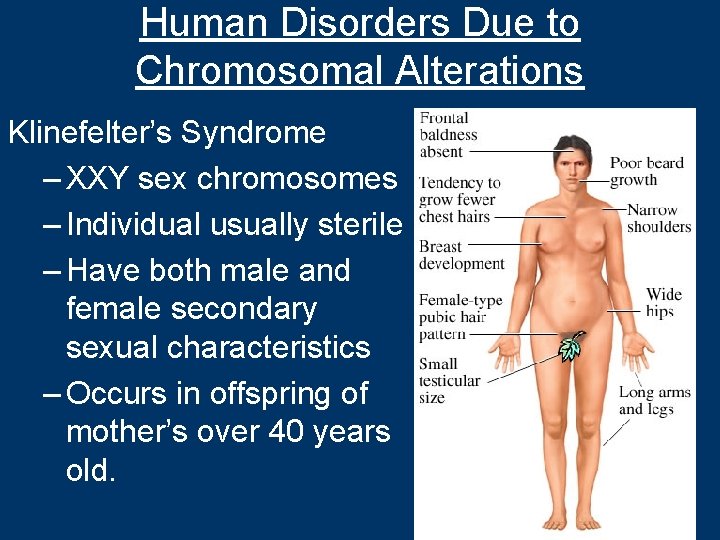
Human Disorders Due to Chromosomal Alterations Klinefelter’s Syndrome – XXY sex chromosomes – Individual usually sterile – Have both male and female secondary sexual characteristics – Occurs in offspring of mother’s over 40 years old.
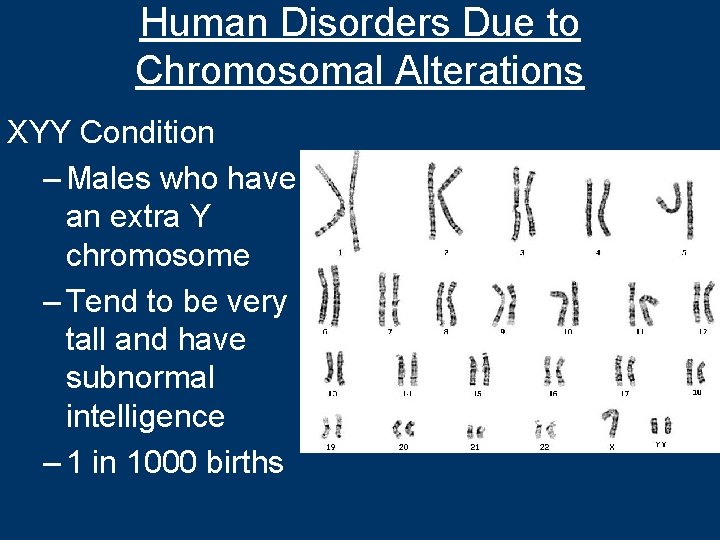
Human Disorders Due to Chromosomal Alterations XYY Condition – Males who have an extra Y chromosome – Tend to be very tall and have subnormal intelligence – 1 in 1000 births
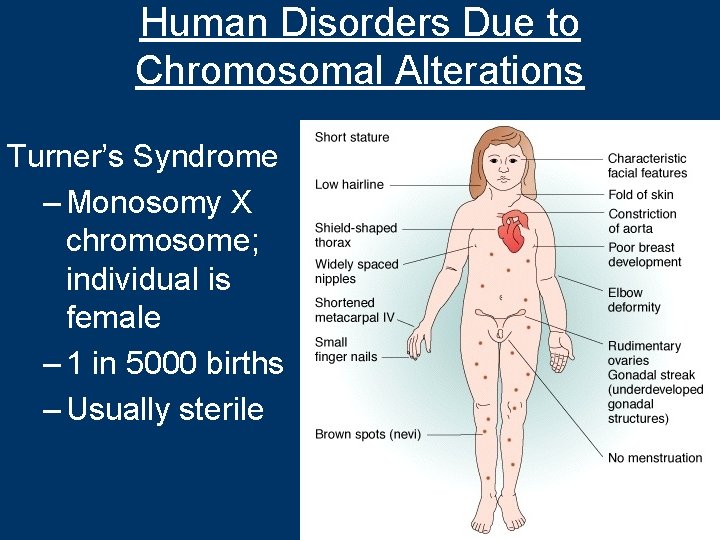
Human Disorders Due to Chromosomal Alterations Turner’s Syndrome – Monosomy X chromosome; individual is female – 1 in 5000 births – Usually sterile
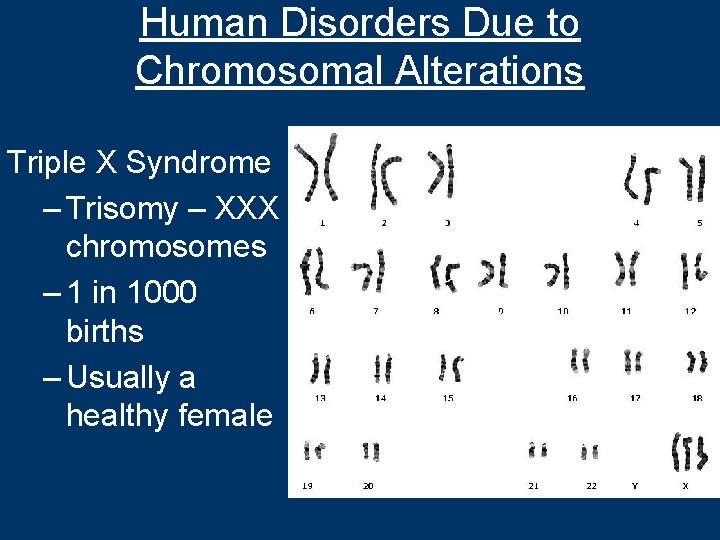
Human Disorders Due to Chromosomal Alterations Triple X Syndrome – Trisomy – XXX chromosomes – 1 in 1000 births – Usually a healthy female
Human Disorders Due to Chromosomal Alterations • Trisomy chromosome 8 – Mental retardation, skeletal deformities, internal organs malformed – 1 in 3, 000 births • Patau Syndrome – Trisomy 13 – Malformations of major organs – Usually die within 1 year – 1 in 7, 500 – 10, 000 births – 88% maternal; 12% paternal
Human Disorders Due to Chromosomal Alterations • Edward Syndrome – Trisomy 18 – Thin, frail children with short eyelids, low set ears, webbed fingers & toes, and skin folds. – In males, the testes do not descend – 20 -30% die in the first month – 90% die by the age of 1 – 1 in 5, 000 births – Affects girls more than boys
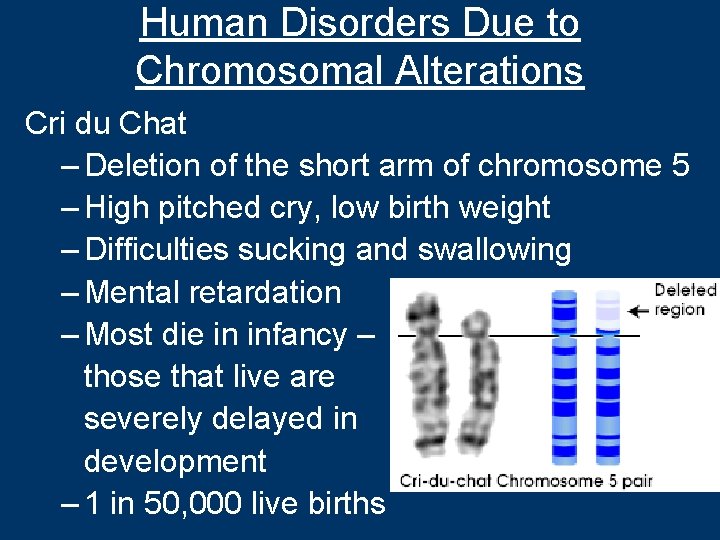
Human Disorders Due to Chromosomal Alterations Cri du Chat – Deletion of the short arm of chromosome 5 – High pitched cry, low birth weight – Difficulties sucking and swallowing – Mental retardation – Most die in infancy – those that live are severely delayed in development – 1 in 50, 000 live births