
x DSL 1 Network reference model Access provider
- Slides: 47
x. DSL 1
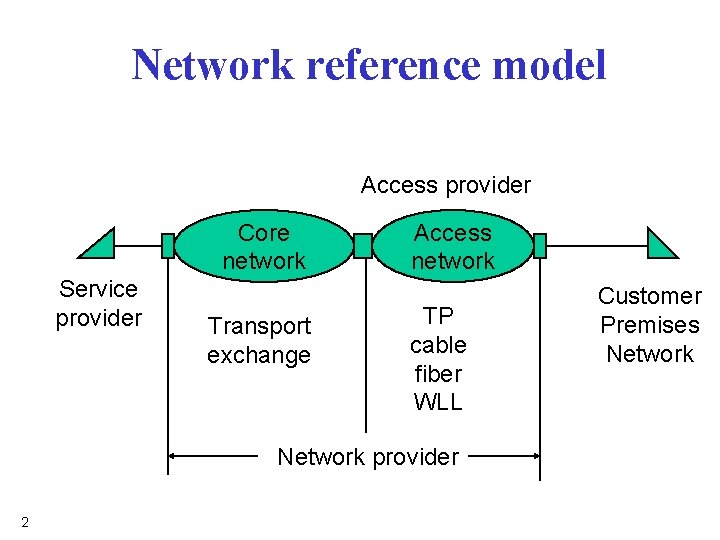
Network reference model Access provider Core network Service provider Transport exchange Access network TP cable fiber WLL Network provider 2 Customer Premises Network
Evolution of Access Network n n n 3 Evolution based on Twisted Pairs(TP) Evolution based on optical fiber Evolution based on wireless network
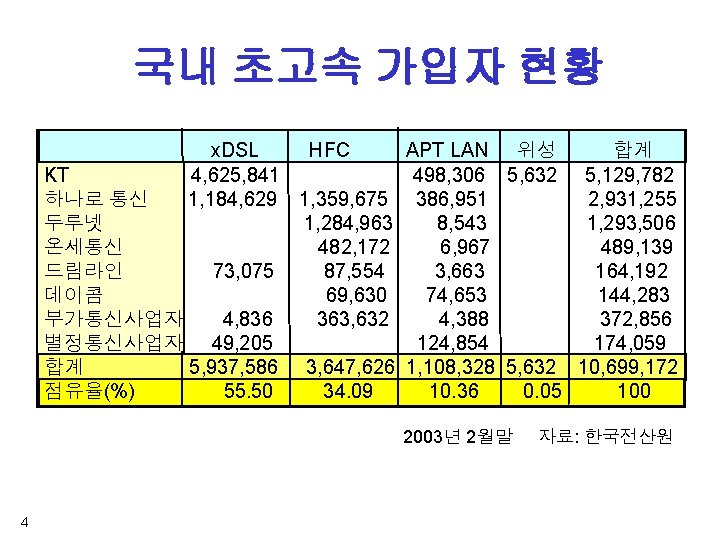
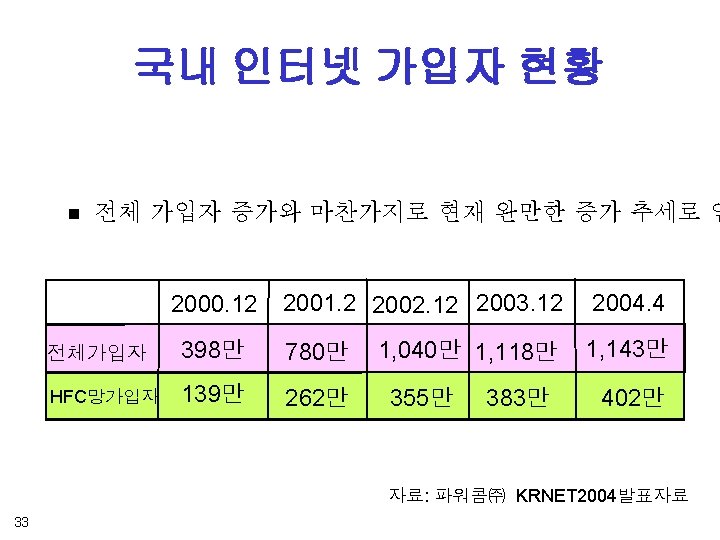
국내 초고속 가입자 현황 x. DSL HFC APT LAN 위성 합계 KT 4, 625, 841 498, 306 5, 632 5, 129, 782 하나로 통신 1, 184, 629 1, 359, 675 386, 951 2, 931, 255 두루넷 1, 284, 963 8, 543 1, 293, 506 온세통신 482, 172 6, 967 489, 139 드림라인 73, 075 87, 554 3, 663 164, 192 데이콤 69, 630 74, 653 144, 283 부가통신사업자 4, 836 363, 632 4, 388 372, 856 별정통신사업자 49, 205 124, 854 174, 059 합계 5, 937, 586 3, 647, 626 1, 108, 328 5, 632 10, 699, 172 점유율(%) 55. 50 34. 09 10. 36 0. 05 100 2003년 2월말 4 자료: 한국전산원
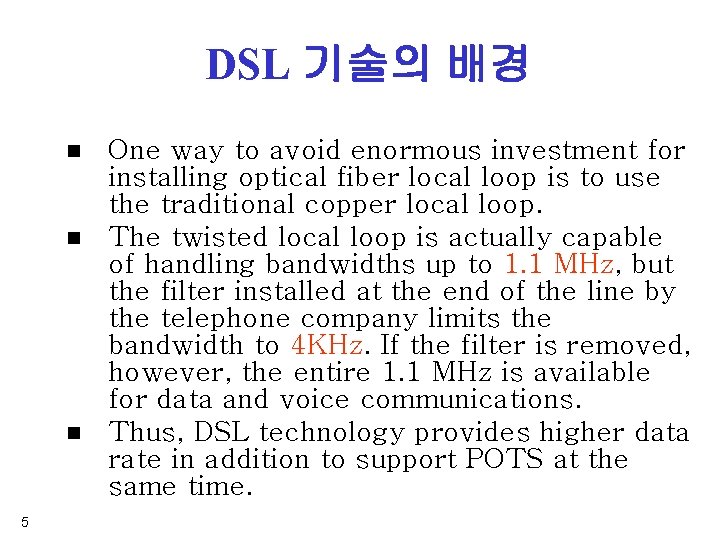
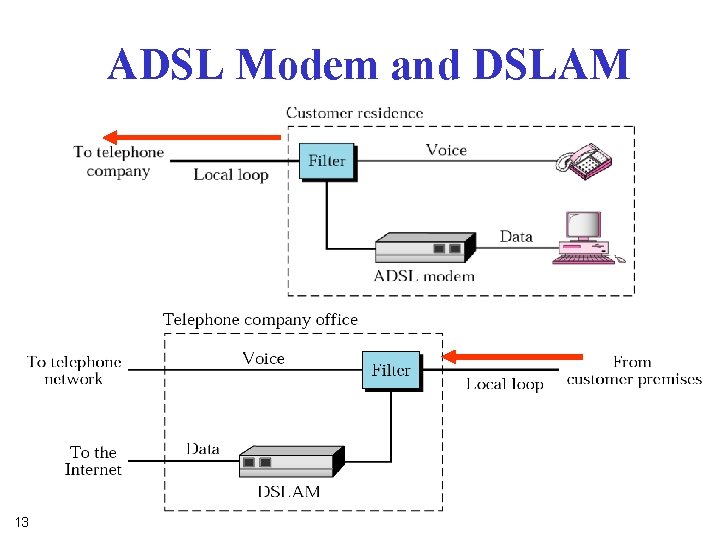
DSL 기술의 배경 n n n 5 One way to avoid enormous investment for installing optical fiber local loop is to use the traditional copper local loop. The twisted local loop is actually capable of handling bandwidths up to 1. 1 MHz, but the filter installed at the end of the line by the telephone company limits the bandwidth to 4 KHz. If the filter is removed, however, the entire 1. 1 MHz is available for data and voice communications. Thus, DSL technology provides higher data rate in addition to support POTS at the same time.
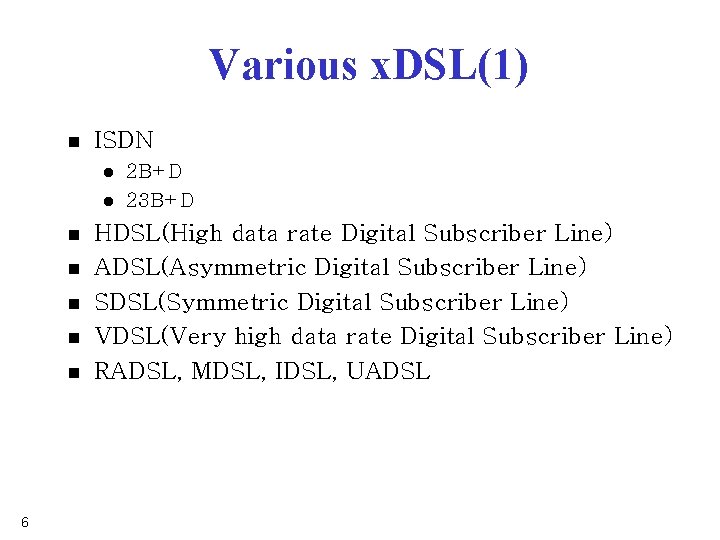
Various x. DSL(1) n ISDN l l n n n 6 2 B+D 23 B+D HDSL(High data rate Digital Subscriber Line) ADSL(Asymmetric Digital Subscriber Line) SDSL(Symmetric Digital Subscriber Line) VDSL(Very high data rate Digital Subscriber Line) RADSL, MDSL, IDSL, UADSL
Various x. DSL(2) n n n 7 ADSL 2+ VDSL 2
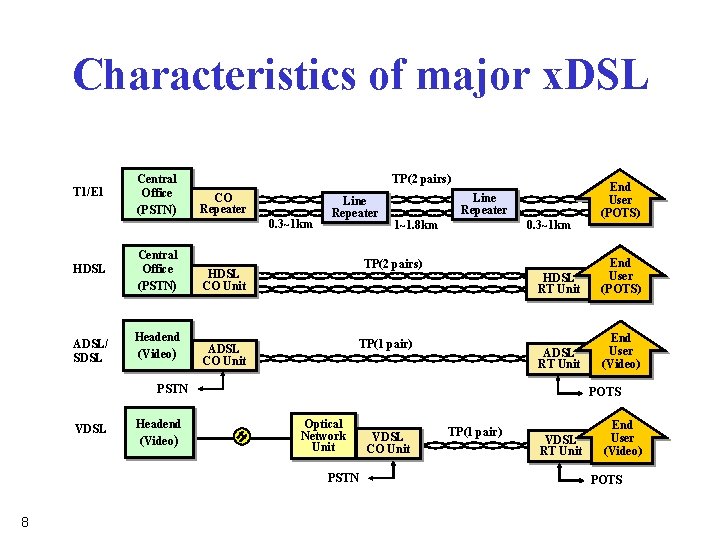
Characteristics of major x. DSL T 1/E 1 Central Office (PSTN) TP(2 pairs) CO Repeater 0. 3~1 km HDSL Central Office (PSTN) ADSL/ SDSL Headend (Video) Line Repeater 1~1. 8 km 0. 3~1 km HDSL RT Unit End User (POTS) ADSL RT Unit End User (Video) TP(2 pairs) HDSL CO Unit TP(1 pair) ADSL CO Unit PSTN VDSL Headend (Video) POTS Optical Network Unit PSTN 8 End User (POTS) VDSL CO Unit TP(1 pair) VDSL RT Unit End User (Video) POTS
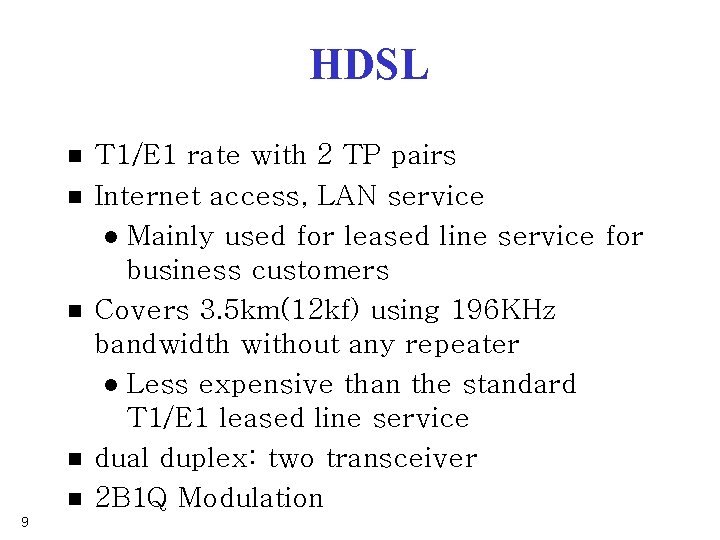
HDSL n n n 9 T 1/E 1 rate with 2 TP pairs Internet access, LAN service l Mainly used for leased line service for business customers Covers 3. 5 km(12 kf) using 196 KHz bandwidth without any repeater l Less expensive than the standard T 1/E 1 leased line service dual duplex: two transceiver 2 B 1 Q Modulation
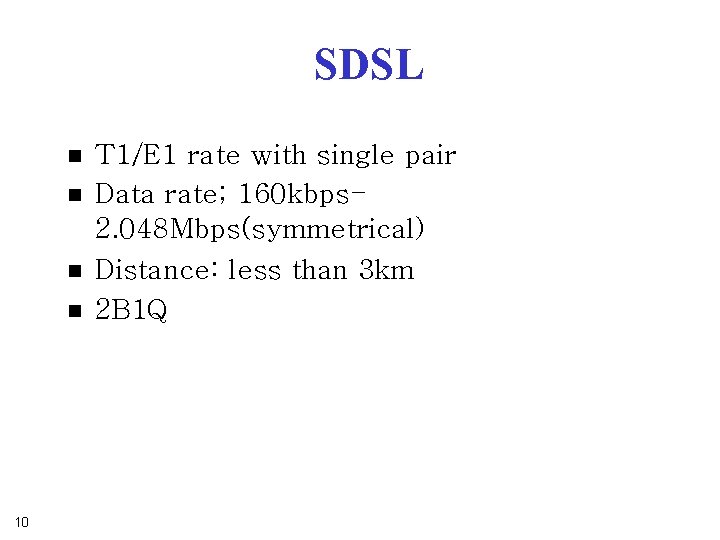
SDSL n n 10 T 1/E 1 rate with single pair Data rate; 160 kbps 2. 048 Mbps(symmetrical) Distance: less than 3 km 2 B 1 Q
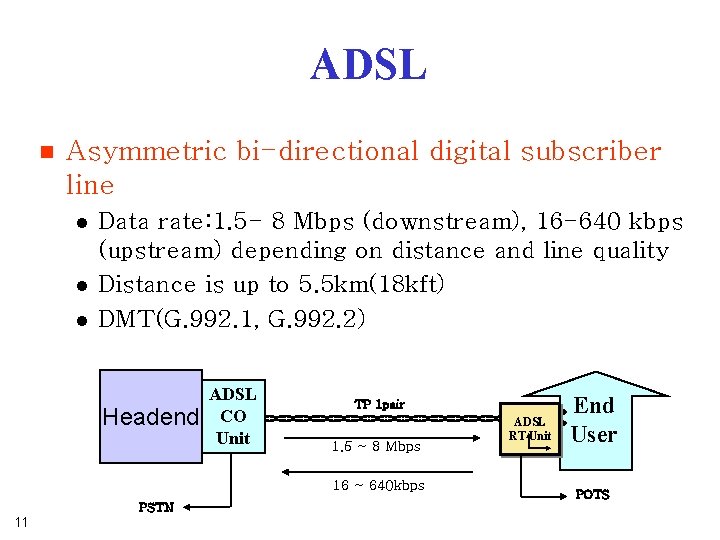
ADSL n Asymmetric bi-directional digital subscriber line l l l Data rate: 1. 5 - 8 Mbps (downstream), 16 -640 kbps (upstream) depending on distance and line quality Distance is up to 5. 5 km(18 kft) DMT(G. 992. 1, G. 992. 2) Headend ADSL CO Unit TP 1 pair 1. 5 ~ 8 Mbps 16 ~ 640 kbps PSTN 11 ADSL RT Unit End User POTS
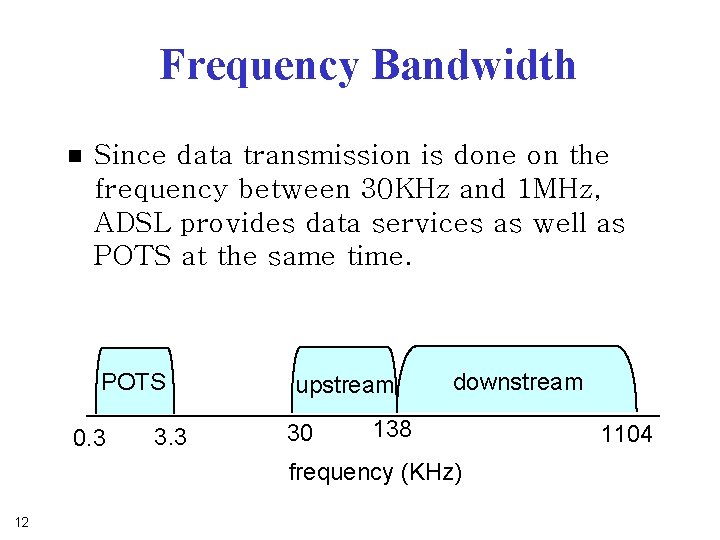
Frequency Bandwidth n Since data transmission is done on the frequency between 30 KHz and 1 MHz, ADSL provides data services as well as POTS at the same time. POTS 0. 3 3. 3 upstream 30 downstream 138 frequency (KHz) 12 1104
ADSL Modem and DSLAM 13
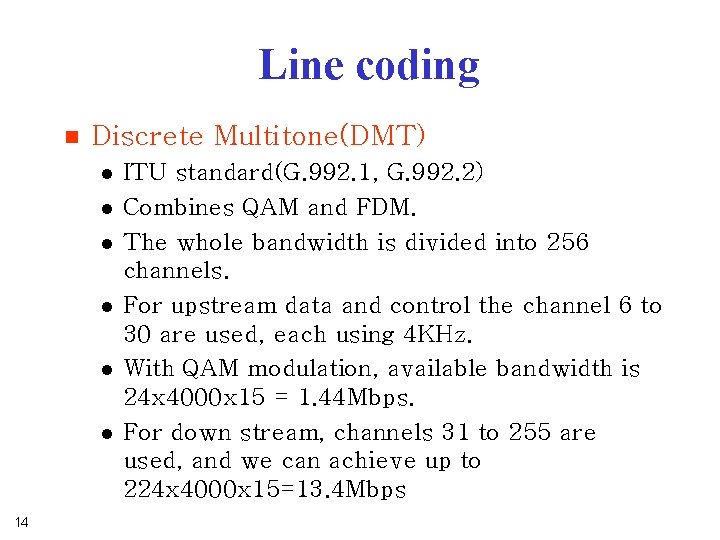
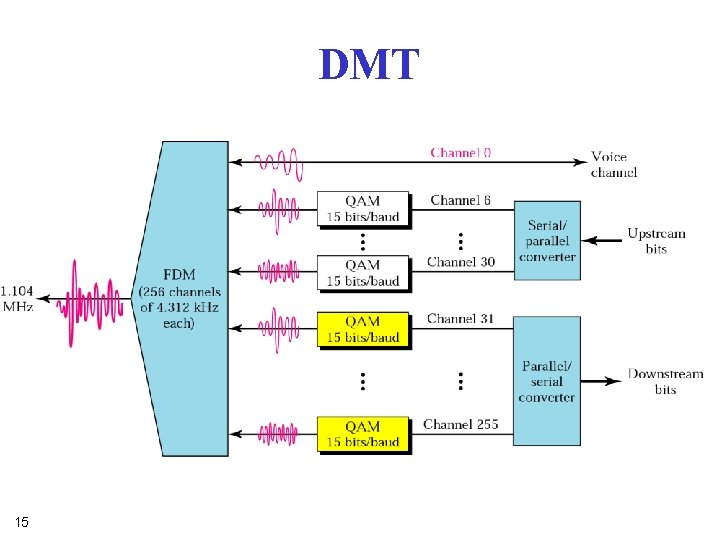
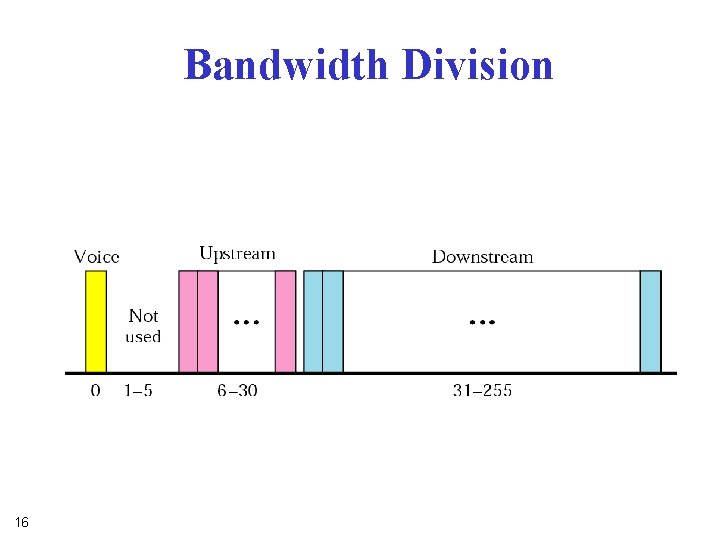
Line coding n Discrete Multitone(DMT) l l l 14 ITU standard(G. 992. 1, G. 992. 2) Combines QAM and FDM. The whole bandwidth is divided into 256 channels. For upstream data and control the channel 6 to 30 are used, each using 4 KHz. With QAM modulation, available bandwidth is 24 x 4000 x 15 = 1. 44 Mbps. For down stream, channels 31 to 255 are used, and we can achieve up to 224 x 4000 x 15=13. 4 Mbps
DMT 15
Bandwidth Division 16
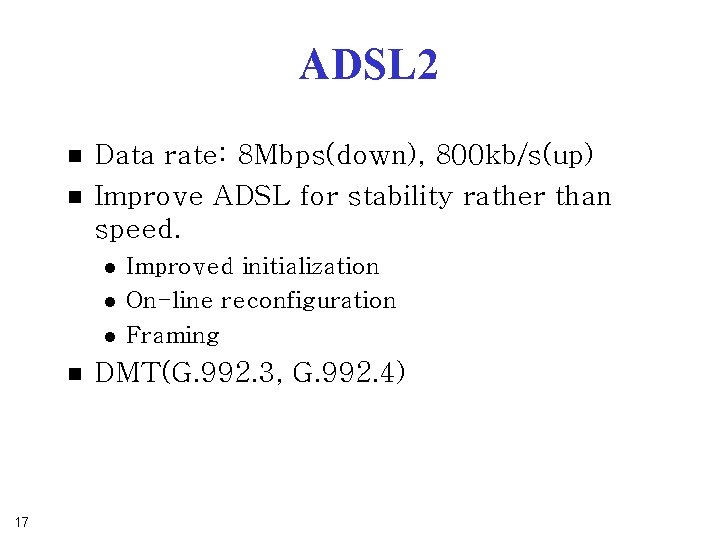
ADSL 2 n n Data rate: 8 Mbps(down), 800 kb/s(up) Improve ADSL for stability rather than speed. l l l n 17 Improved initialization On-line reconfiguration Framing DMT(G. 992. 3, G. 992. 4)
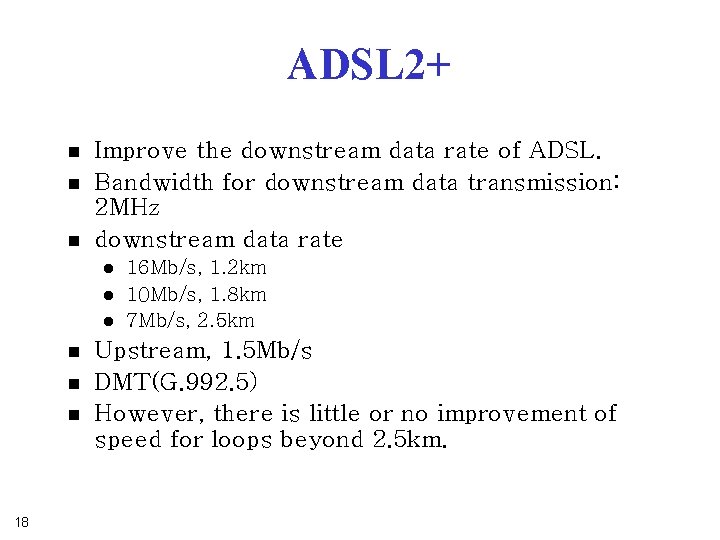
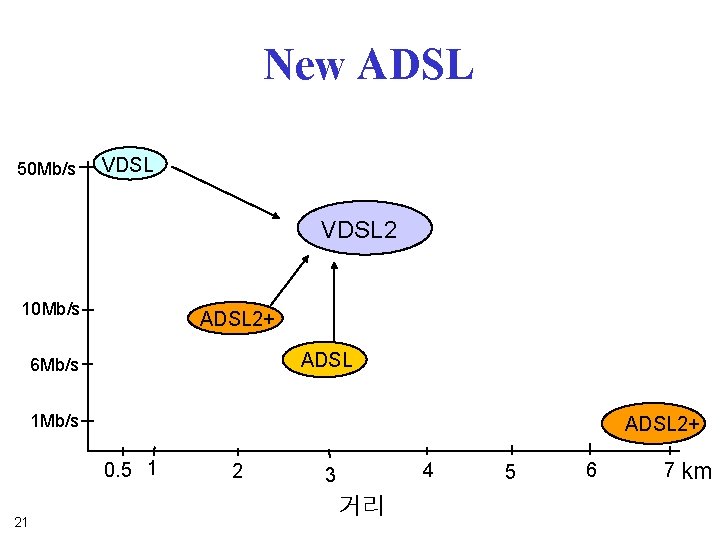
ADSL 2+ n n n Improve the downstream data rate of ADSL. Bandwidth for downstream data transmission: 2 MHz downstream data rate l l l n n n 18 16 Mb/s, 1. 2 km 10 Mb/s, 1. 8 km 7 Mb/s, 2. 5 km Upstream, 1. 5 Mb/s DMT(G. 992. 5) However, there is little or no improvement of speed for loops beyond 2. 5 km.
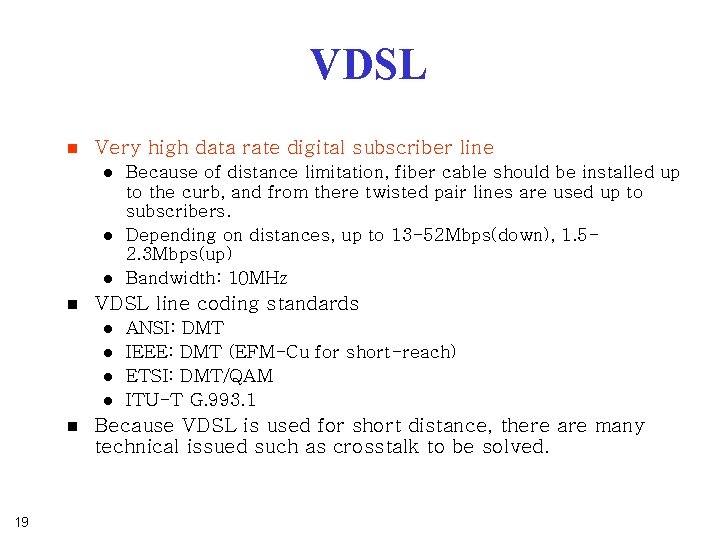
VDSL n Very high data rate digital subscriber line l l l n VDSL line coding standards l l n 19 Because of distance limitation, fiber cable should be installed up to the curb, and from there twisted pair lines are used up to subscribers. Depending on distances, up to 13 -52 Mbps(down), 1. 52. 3 Mbps(up) Bandwidth: 10 MHz ANSI: DMT IEEE: DMT (EFM-Cu for short-reach) ETSI: DMT/QAM ITU-T G. 993. 1 Because VDSL is used for short distance, there are many technical issued such as crosstalk to be solved.
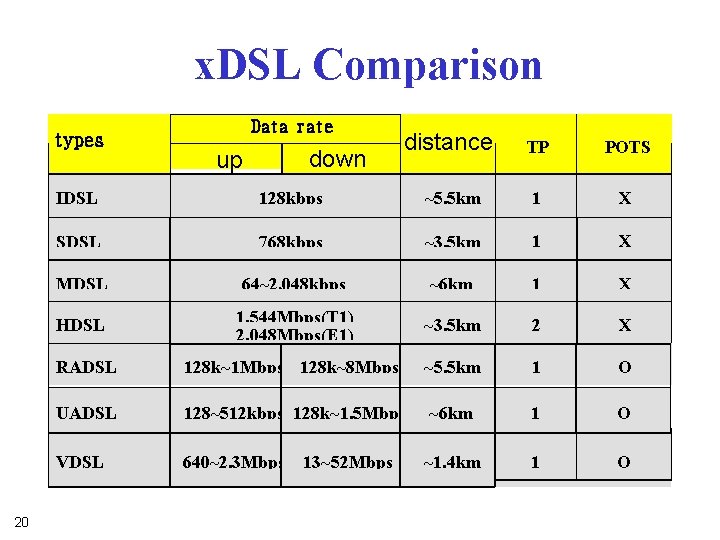
x. DSL Comparison types 20 Data rate up down distance TP POTS IDSL 128 kbps ~5. 5 km 1 X SDSL 768 kbps ~3. 5 km 1 X MDSL 64~2, 048 kbps ~6 km 1 X HDSL 1. 544 Mbps(T 1) 2. 048 Mbps(E 1) ~3. 5 km 2 X RADSL 128 k~1 Mbps 128 k~8 Mbps ~5. 5 km 1 O UADSL 128~512 kbps 128 k~1. 5 Mbps ~6 km 1 O VDSL 640~2. 3 Mbps 13~52 Mbps ~1. 4 km 1 O
New ADSL 50 Mb/s VDSL 2 10 Mb/s ADSL 2+ ADSL 6 Mb/s 1 Mb/s ADSL 2+ 0. 5 1 21 2 4 3 거리 5 6 7 km
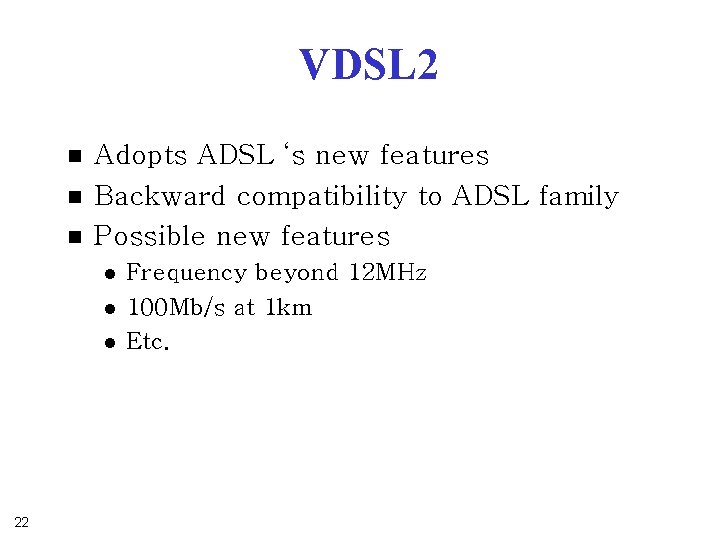
VDSL 2 n n n Adopts ADSL ‘s new features Backward compatibility to ADSL family Possible new features l l l 22 Frequency beyond 12 MHz 100 Mb/s at 1 km Etc.
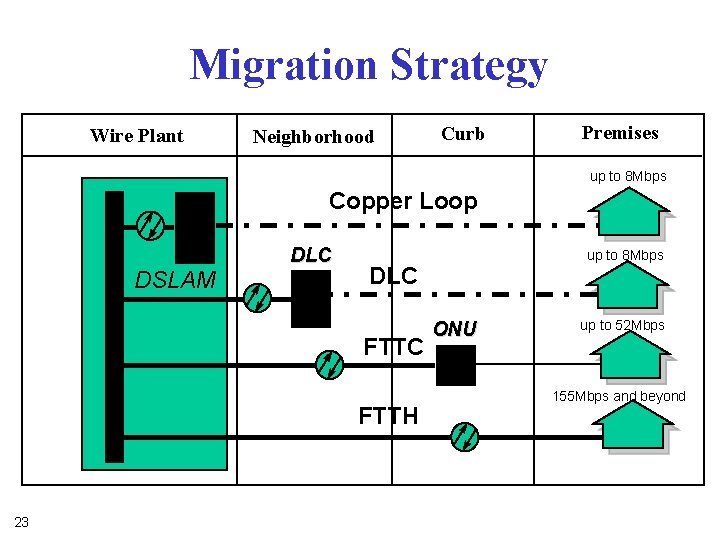
Migration Strategy Wire Plant Neighborhood Curb Premises up to 8 Mbps Copper Loop DSLAM DLC FTTC FTTH 23 up to 8 Mbps ONU up to 52 Mbps 155 Mbps and beyond
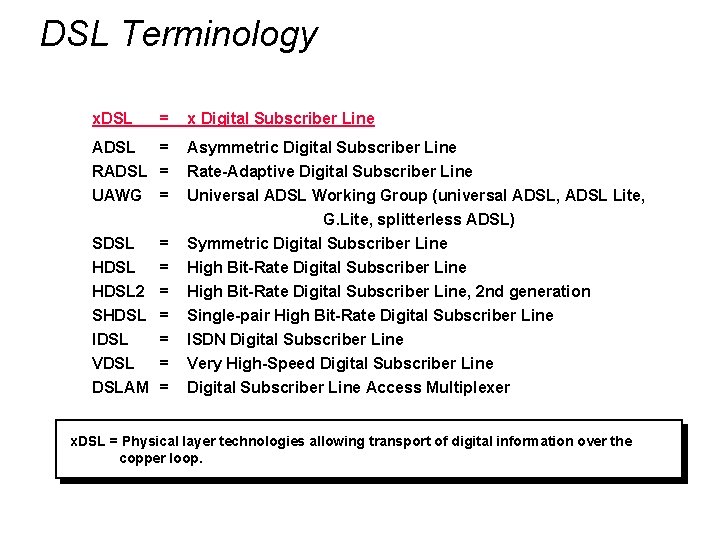
DSL Terminology x. DSL = x Digital Subscriber Line ADSL = Asymmetric Digital Subscriber Line RADSL = Rate-Adaptive Digital Subscriber Line UAWG Universal ADSL Working Group (universal ADSL, ADSL Lite, = G. Lite, splitterless ADSL) SDSL HDSL 2 SHDSL IDSL VDSL DSLAM = = = = Symmetric Digital Subscriber Line High Bit-Rate Digital Subscriber Line, 2 nd generation Single-pair High Bit-Rate Digital Subscriber Line ISDN Digital Subscriber Line Very High-Speed Digital Subscriber Line Access Multiplexer x. DSL = Physical layer technologies allowing transport of digital information over the copper loop.
HFC(Hybrid fiber-coaxial) 25
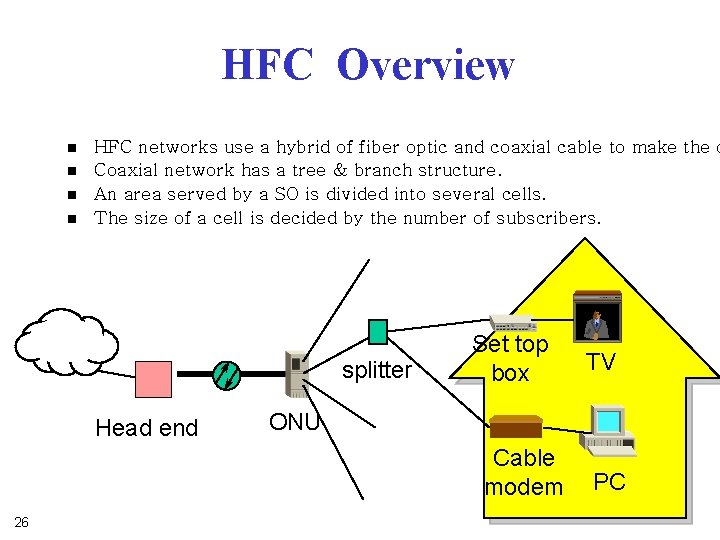
HFC Overview n n HFC networks use a hybrid of fiber optic and coaxial cable to make the c Coaxial network has a tree & branch structure. An area served by a SO is divided into several cells. The size of a cell is decided by the number of subscribers. splitter Head end Set top box ONU Cable modem 26 TV PC
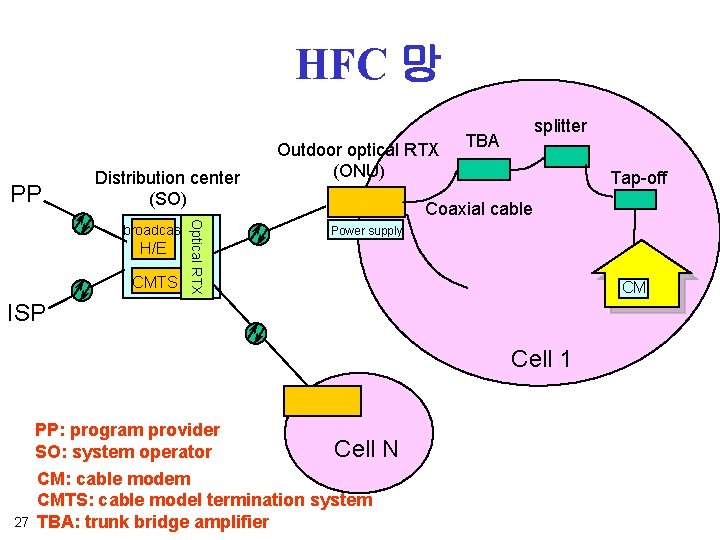
HFC 망 PP Distribution center (SO) H/E CMTS Optical RTX broadcast Outdoor optical RTX (ONU) splitter TBA Tap-off Coaxial cable Power supply CM ISP Cell 1 27 PP: program provider Cell SO: system operator CM: cable modem CMTS: cable model termination system TBA: trunk bridge amplifier N
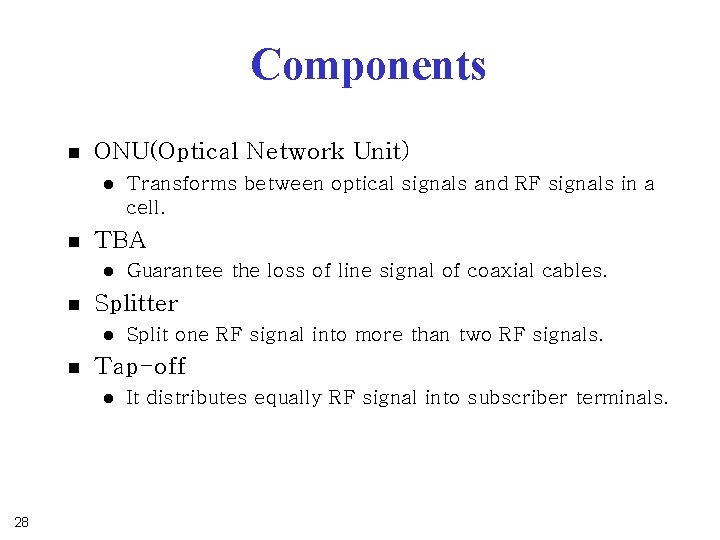
Components n ONU(Optical Network Unit) l n TBA l n Split one RF signal into more than two RF signals. Tap-off l 28 Guarantee the loss of line signal of coaxial cables. Splitter l n Transforms between optical signals and RF signals in a cell. It distributes equally RF signal into subscriber terminals.
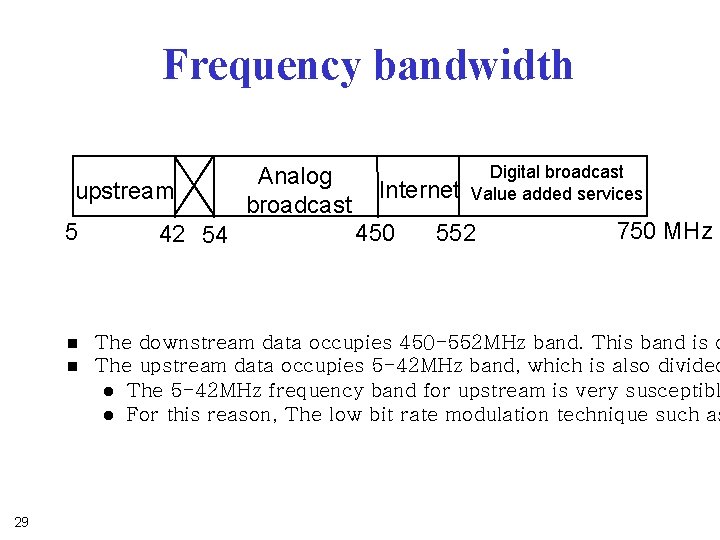
Frequency bandwidth upstream 5 n n 29 42 54 Analog broadcast Internet 450 Digital broadcast Value added services 552 750 MHz The downstream data occupies 450 -552 MHz band. This band is d The upstream data occupies 5 -42 MHz band, which is also divided l The 5 -42 MHz frequency band for upstream is very susceptibl l For this reason, The low bit rate modulation technique such as
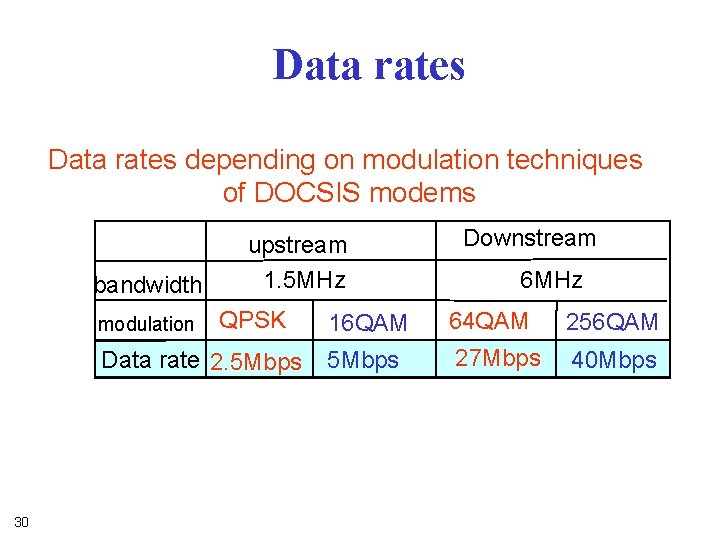
Data rates depending on modulation techniques of DOCSIS modems bandwidth modulation upstream 1. 5 MHz QPSK Data rate 2. 5 Mbps 30 Downstream 6 MHz 16 QAM 64 QAM 256 QAM 5 Mbps 27 Mbps 40 Mbps
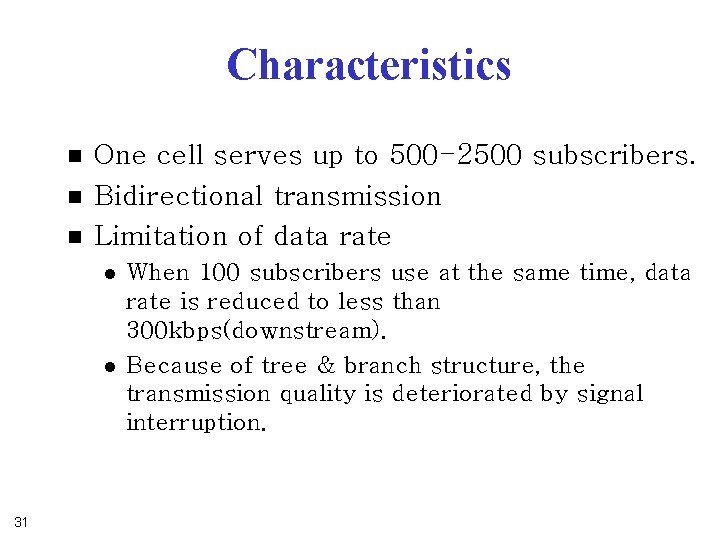
Characteristics n n n One cell serves up to 500 -2500 subscribers. Bidirectional transmission Limitation of data rate l l 31 When 100 subscribers use at the same time, data rate is reduced to less than 300 kbps(downstream). Because of tree & branch structure, the transmission quality is deteriorated by signal interruption.
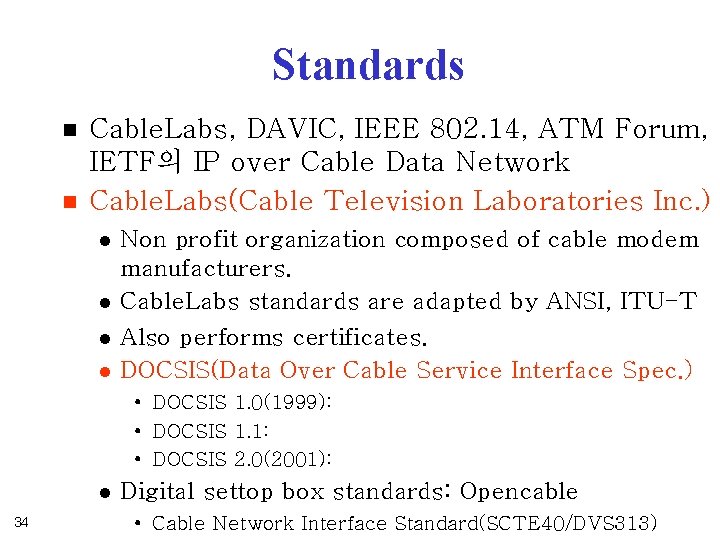
Standards n n Cable. Labs, DAVIC, IEEE 802. 14, ATM Forum, IETF의 IP over Cable Data Network Cable. Labs(Cable Television Laboratories Inc. ) l l Non profit organization composed of cable modem manufacturers. Cable. Labs standards are adapted by ANSI, ITU-T Also performs certificates. DOCSIS(Data Over Cable Service Interface Spec. ) • DOCSIS 1. 0(1999): • DOCSIS 1. 1: • DOCSIS 2. 0(2001): l 34 Digital settop box standards: Opencable • Cable Network Interface Standard(SCTE 40/DVS 313)
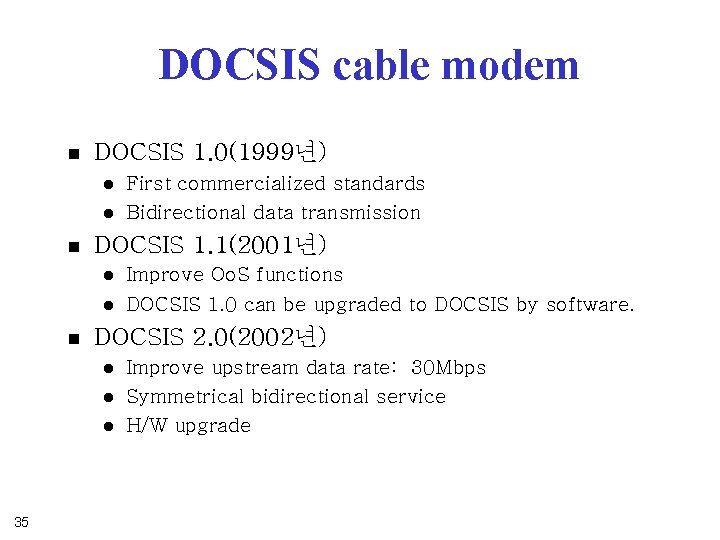
DOCSIS cable modem n DOCSIS 1. 0(1999년) l l n DOCSIS 1. 1(2001년) l l n Improve Oo. S functions DOCSIS 1. 0 can be upgraded to DOCSIS by software. DOCSIS 2. 0(2002년) l l l 35 First commercialized standards Bidirectional data transmission Improve upstream data rate: 30 Mbps Symmetrical bidirectional service H/W upgrade
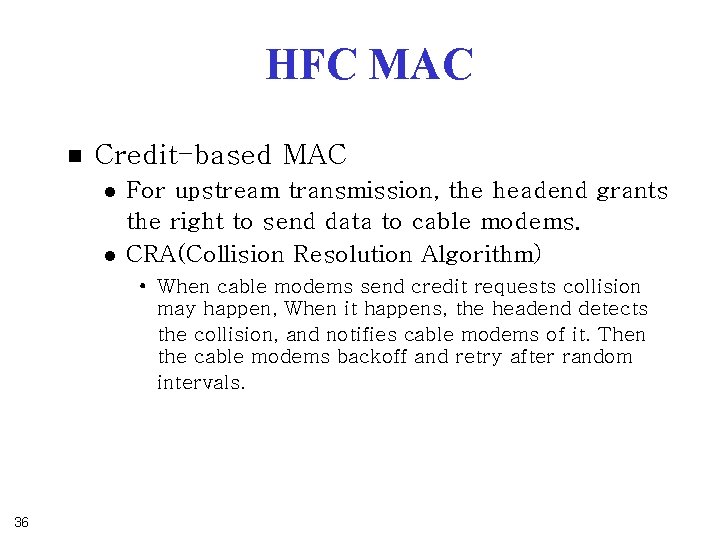
HFC MAC n Credit-based MAC l l For upstream transmission, the headend grants the right to send data to cable modems. CRA(Collision Resolution Algorithm) • When cable modems send credit requests collision may happen, When it happens, the headend detects the collision, and notifies cable modems of it. Then the cable modems backoff and retry after random intervals. 36
Future n Speed improvement l n Downsizing of cells l n 37 Frequency bandwidth can be expanded upto 1. 5 Gbps, the speed can be increased upto 100 Mb/s. The current distance from ONU to subscribers which is about 1 km will be decreased to less than 500 m. Improve network monitoring system.
SDH (SONET) 38
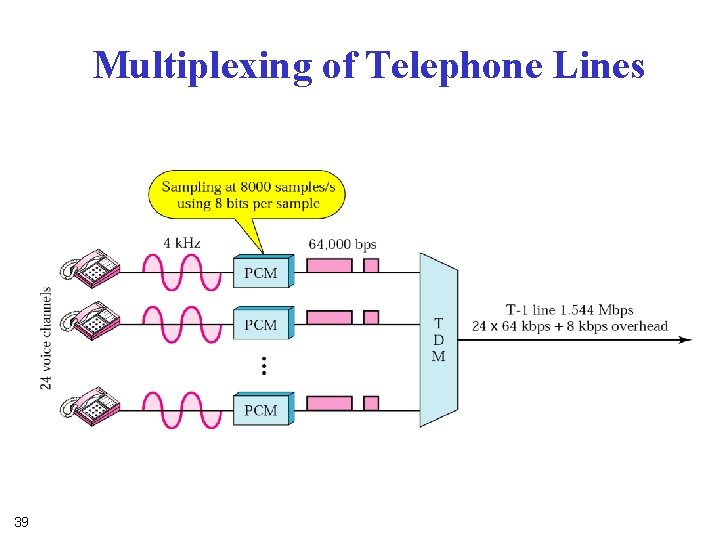
Multiplexing of Telephone Lines 39
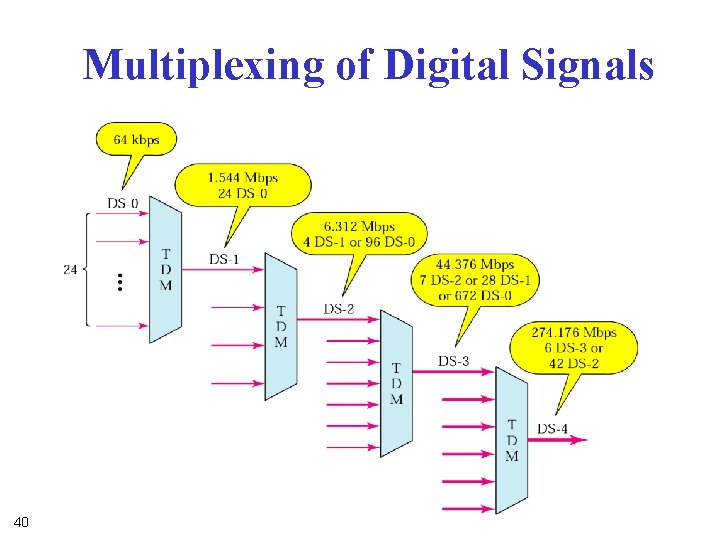
Multiplexing of Digital Signals 40
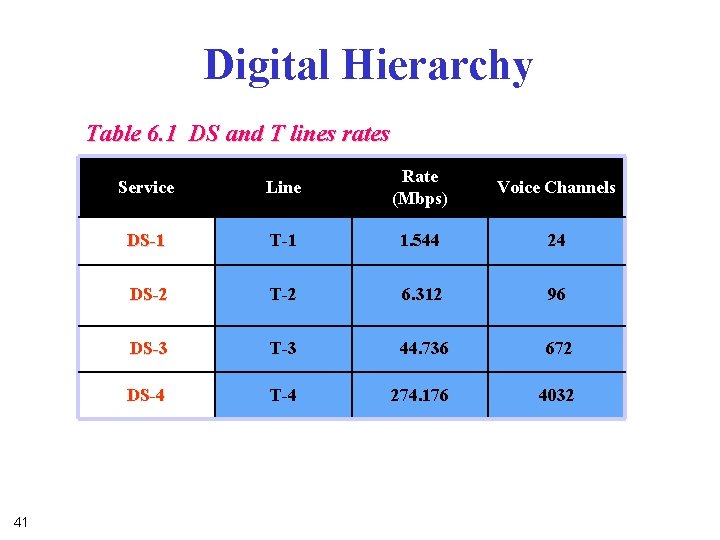
Digital Hierarchy Table 6. 1 DS and T lines rates 41 Service Line Rate (Mbps) Voice Channels DS-1 T-1 1. 544 24 DS-2 T-2 6. 312 96 DS-3 T-3 44. 736 672 DS-4 T-4 274. 176 4032
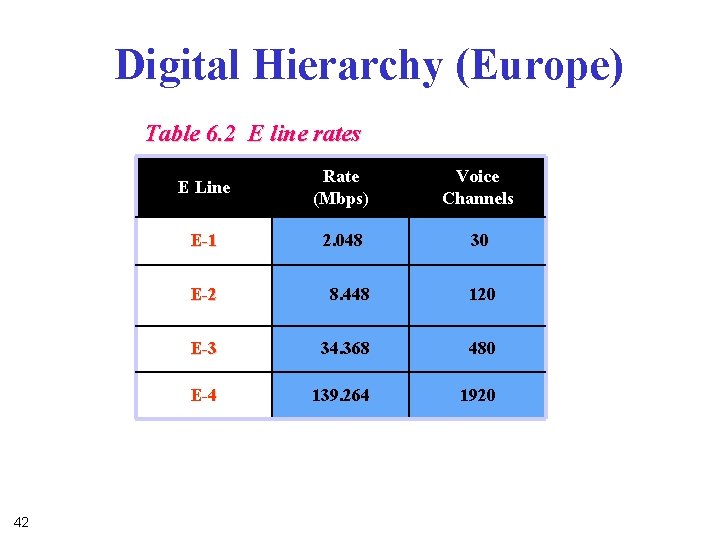
Digital Hierarchy (Europe) Table 6. 2 E line rates 42 E Line Rate (Mbps) Voice Channels E-1 2. 048 30 E-2 8. 448 120 E-3 34. 368 480 E-4 139. 264 1920
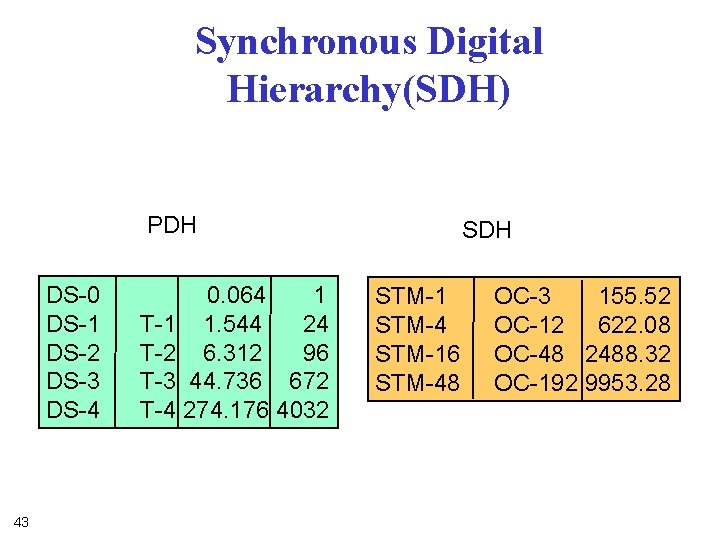
Synchronous Digital Hierarchy(SDH) PDH DS-0 DS-1 DS-2 DS-3 DS-4 43 0. 064 1 T-1 1. 544 24 T-2 6. 312 96 T-3 44. 736 672 T-4 274. 176 4032 SDH STM-1 STM-4 STM-16 STM-48 OC-3 155. 52 OC-12 622. 08 OC-48 2488. 32 OC-192 9953. 28
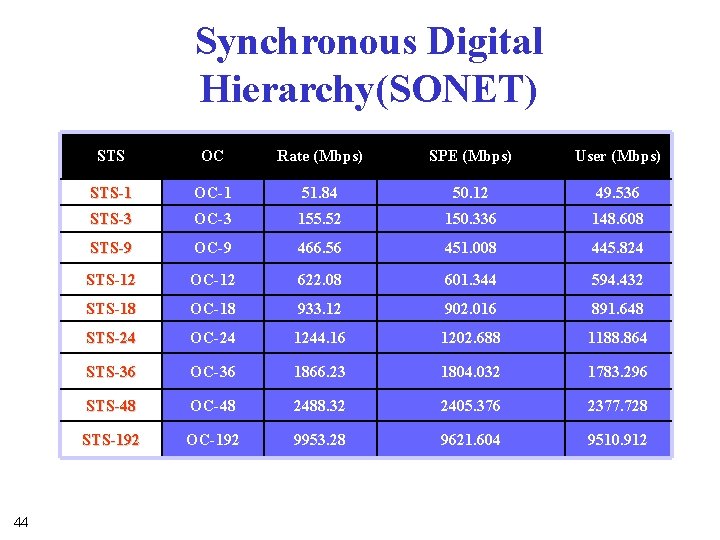
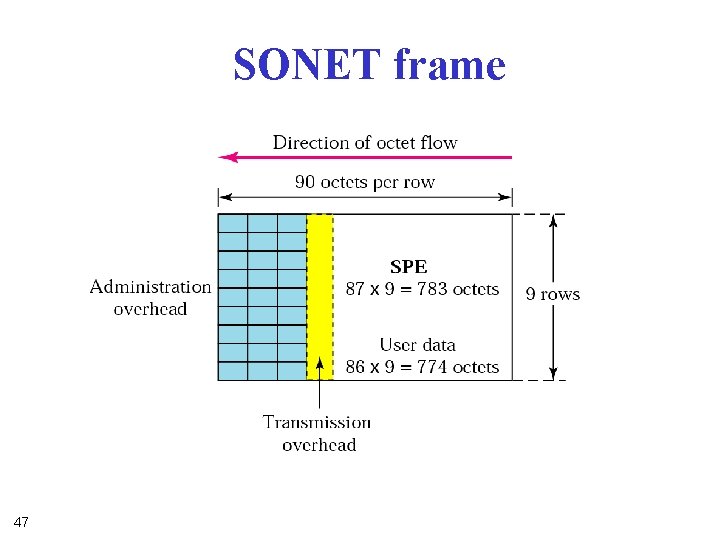
Synchronous Digital Hierarchy(SONET) 44 STS OC Rate (Mbps) SPE (Mbps) User (Mbps) STS-1 OC-1 51. 84 50. 12 49. 536 STS-3 OC-3 155. 52 150. 336 148. 608 STS-9 OC-9 466. 56 451. 008 445. 824 STS-12 OC-12 622. 08 601. 344 594. 432 STS-18 OC-18 933. 12 902. 016 891. 648 STS-24 OC-24 1244. 16 1202. 688 1188. 864 STS-36 OC-36 1866. 23 1804. 032 1783. 296 STS-48 OC-48 2488. 32 2405. 376 2377. 728 STS-192 OC-192 9953. 28 9621. 604 9510. 912
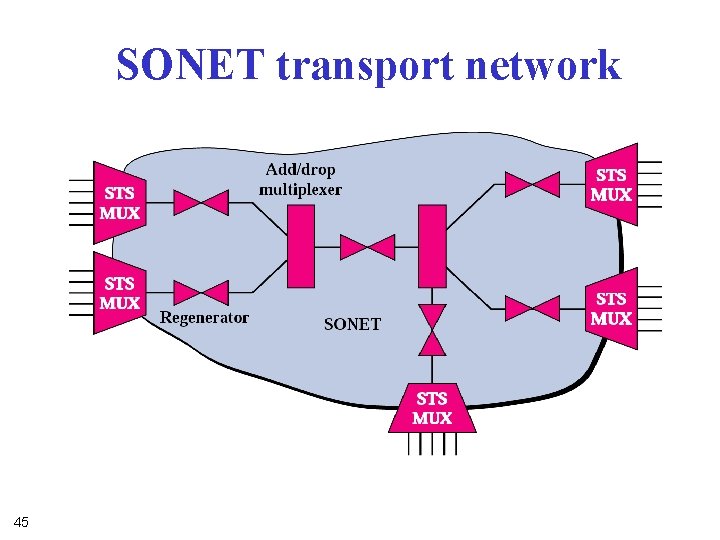
SONET transport network 45
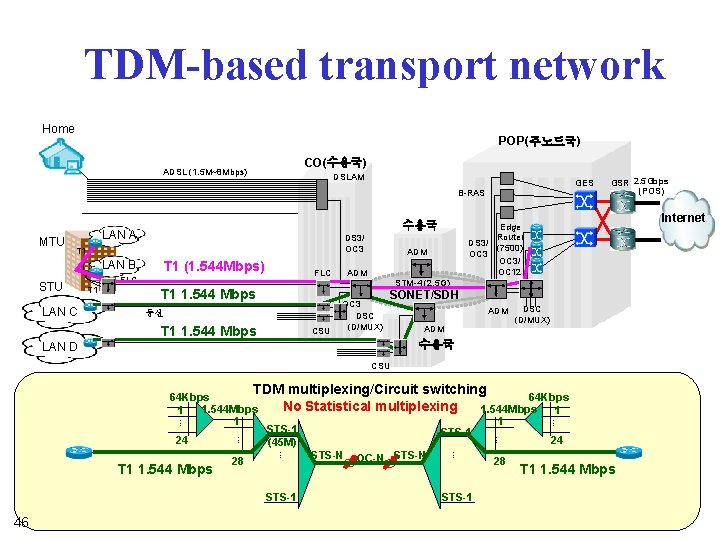
TDM-based transport network Home POP(주노드국) CO(수용국) ADSL (1. 5 M~8 Mbps) DSLAM GES B-RAS MTU 수용국 LAN A DS 3/ OC 3 T 1 (1. 544 Mbps) LAN B STU LAN C FLC T 1 1. 544 Mbps 동선 T 1 1. 544 Mbps CSU Internet Edge Router DS 3/ (7500) OC 3/ OC 12 ADM GSR 2. 5 Gbps (POS) STM-4 (2. 5 G) OC 3 DSC (D/MUX) SONET/SDH ADM DSC (D/MUX) 수용국 LAN D CSU … STS-1 46 STS-N OC-N STS-N … 28 … T 1 1. 544 Mbps STS-1 1 … … 24 STS-1 (45 M) … TDM multiplexing/Circuit switching 64 Kbps No Statistical multiplexing 1. 544 Mbps 1 64 Kbps 1. 544 Mbps 1 1 24 28 T 1 1. 544 Mbps
SONET frame 47