
x 86 Assembly Review General Purpose Registers EAX
x 86 Assembly Review
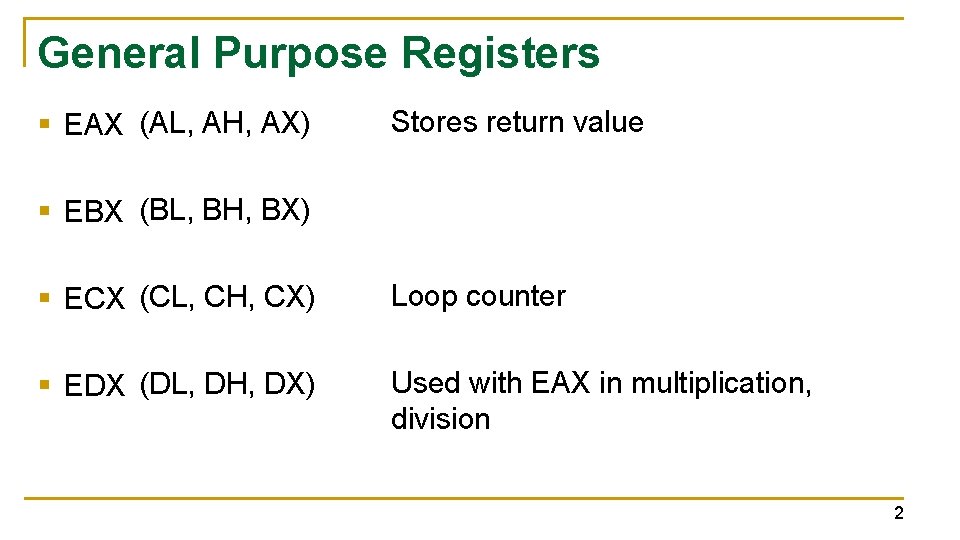
General Purpose Registers § EAX (AL, AH, AX) Stores return value § EBX (BL, BH, BX) § ECX (CL, CH, CX) Loop counter § EDX (DL, DH, DX) Used with EAX in multiplication, division 2
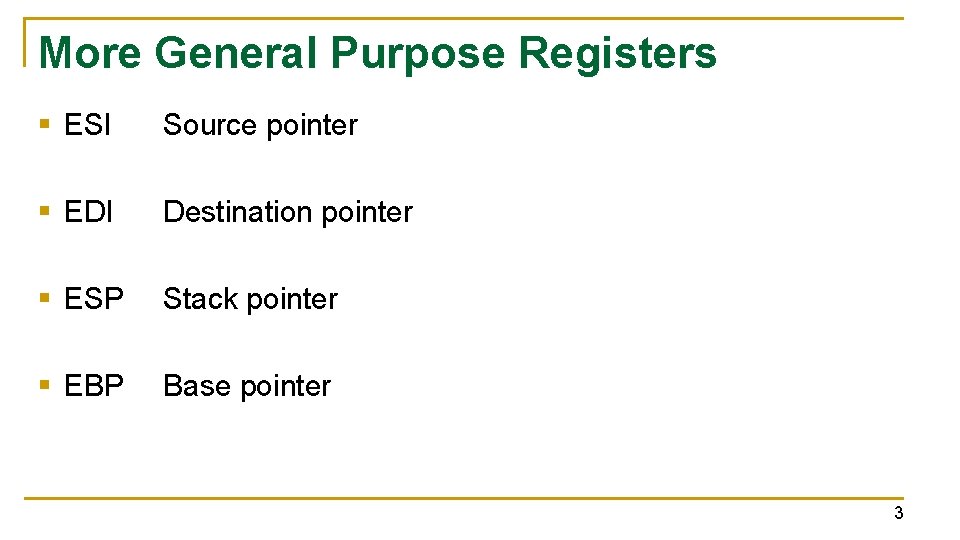
More General Purpose Registers § ESI Source pointer § EDI Destination pointer § ESP Stack pointer § EBP Base pointer 3
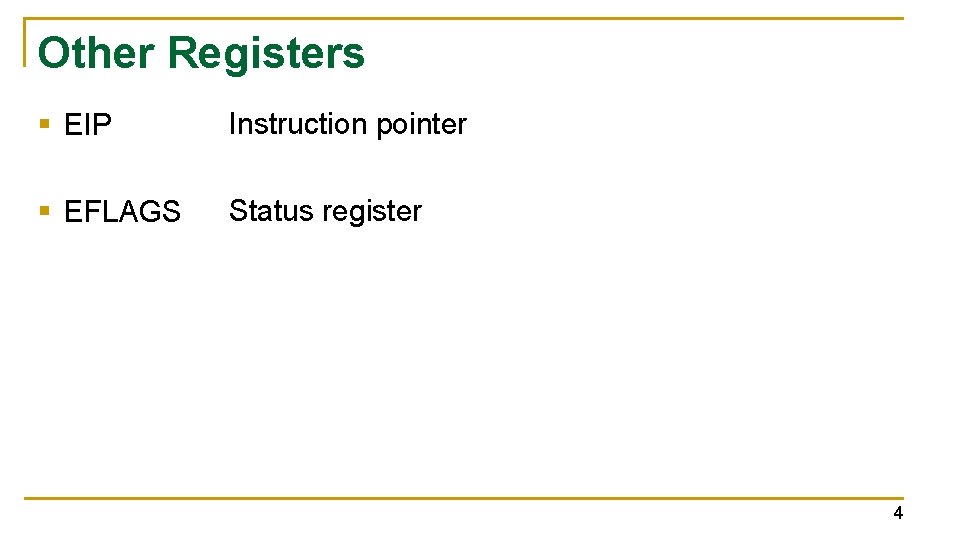
Other Registers § EIP Instruction pointer § EFLAGS Status register 4
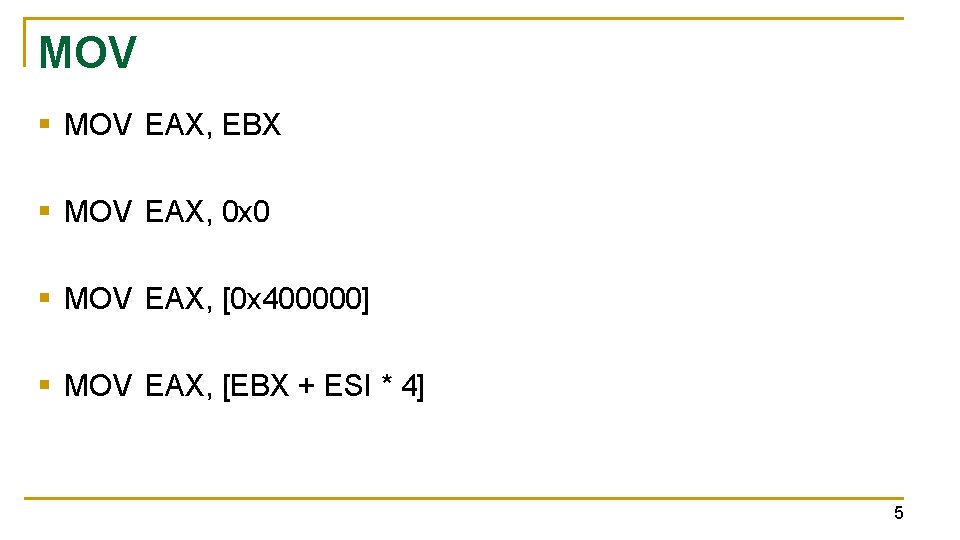
MOV § MOV EAX, EBX § MOV EAX, 0 x 0 § MOV EAX, [0 x 400000] § MOV EAX, [EBX + ESI * 4] 5
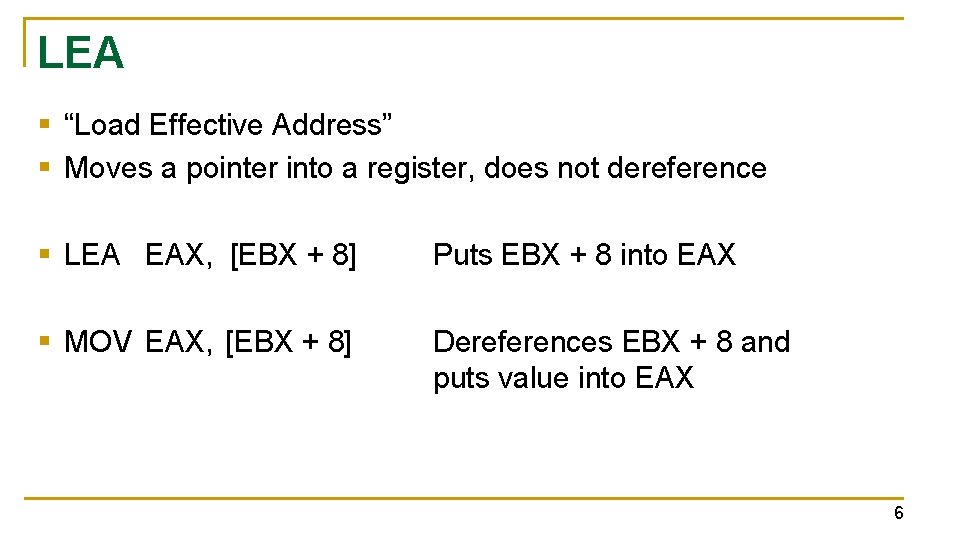
LEA § “Load Effective Address” § Moves a pointer into a register, does not dereference § LEA EAX, [EBX + 8] Puts EBX + 8 into EAX § MOV EAX, [EBX + 8] Dereferences EBX + 8 and puts value into EAX 6
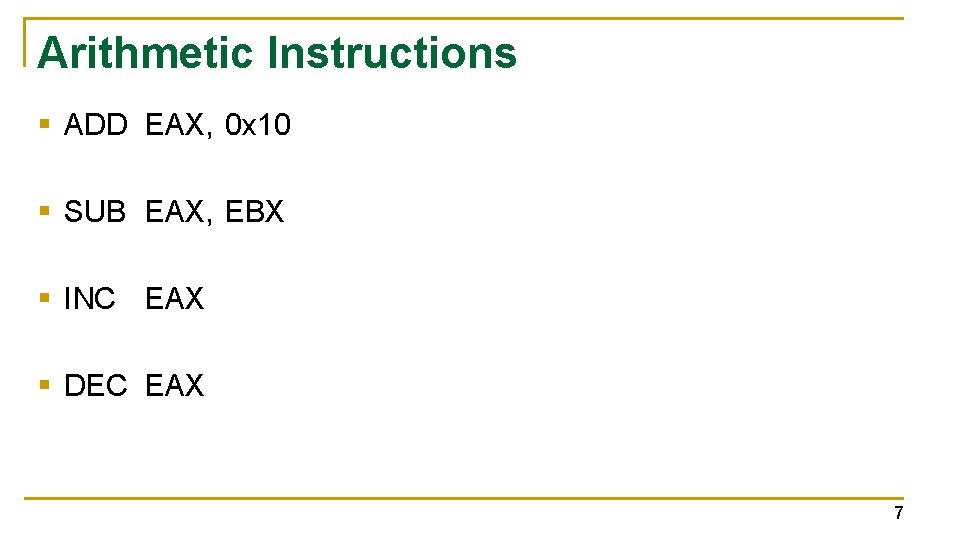
Arithmetic Instructions § ADD EAX, 0 x 10 § SUB EAX, EBX § INC EAX § DEC EAX 7
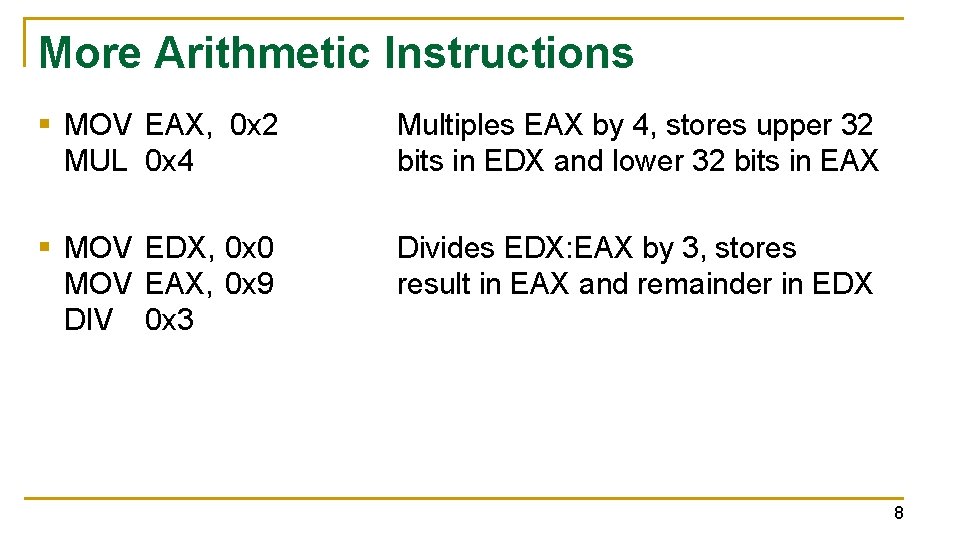
More Arithmetic Instructions § MOV EAX, 0 x 2 MUL 0 x 4 Multiples EAX by 4, stores upper 32 bits in EDX and lower 32 bits in EAX § MOV EDX, 0 x 0 MOV EAX, 0 x 9 DIV 0 x 3 Divides EDX: EAX by 3, stores result in EAX and remainder in EDX 8
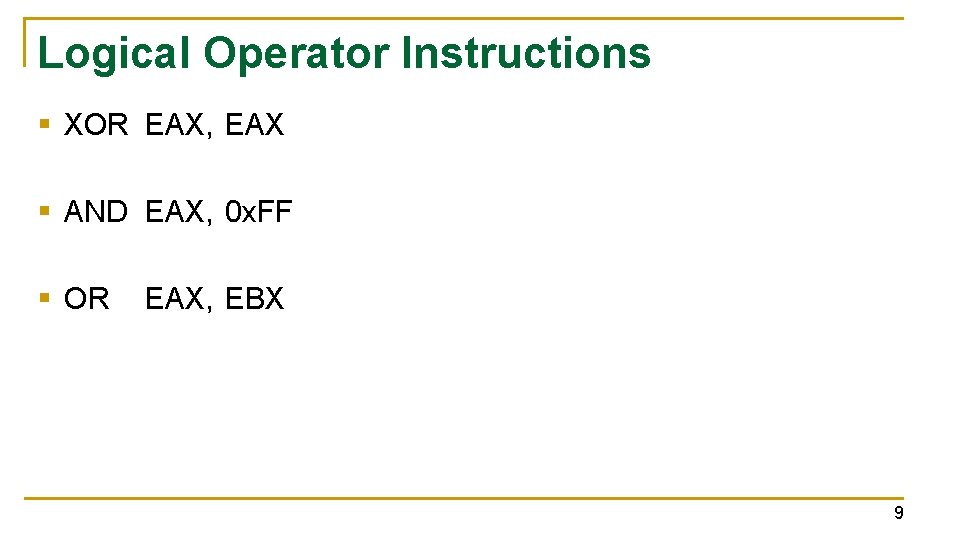
Logical Operator Instructions § XOR EAX, EAX § AND EAX, 0 x. FF § OR EAX, EBX 9
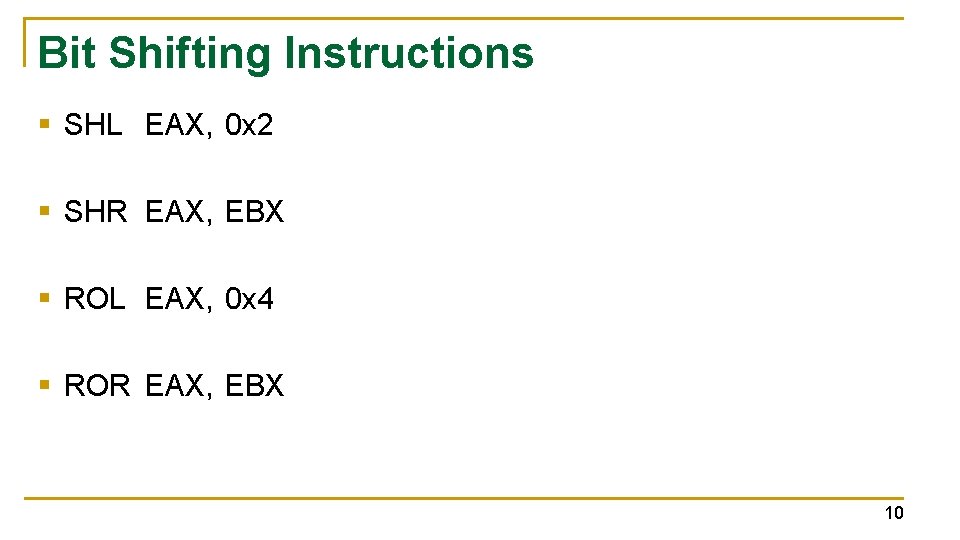
Bit Shifting Instructions § SHL EAX, 0 x 2 § SHR EAX, EBX § ROL EAX, 0 x 4 § ROR EAX, EBX 10
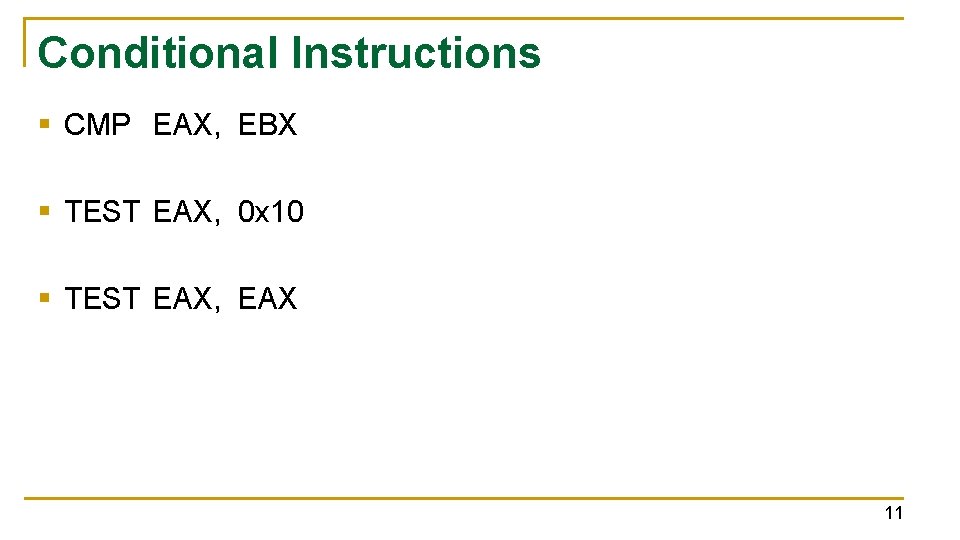
Conditional Instructions § CMP EAX, EBX § TEST EAX, 0 x 10 § TEST EAX, EAX 11
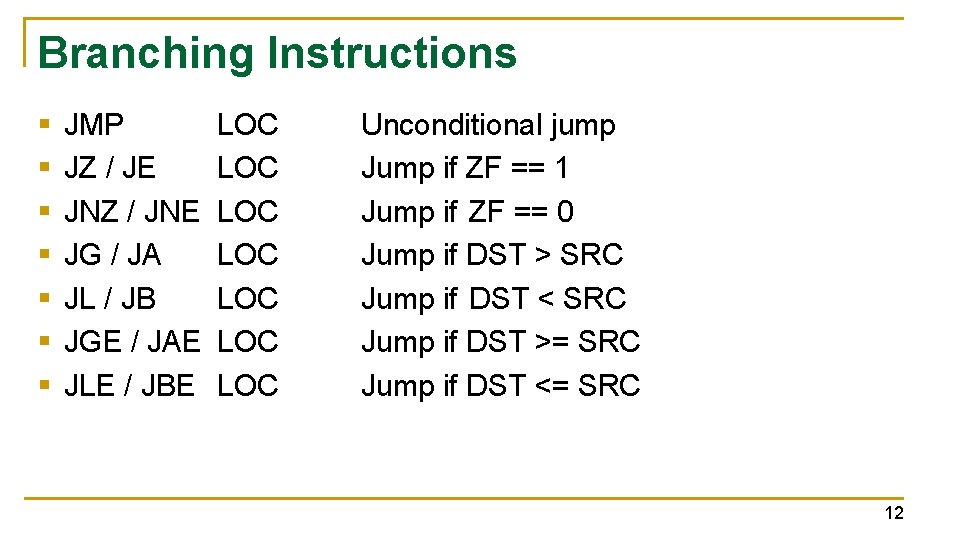
Branching Instructions § § § § JMP JZ / JE JNZ / JNE JG / JA JL / JB JGE / JAE JLE / JBE LOC LOC Unconditional jump Jump if ZF == 1 Jump if ZF == 0 Jump if DST > SRC Jump if DST < SRC Jump if DST >= SRC Jump if DST <= SRC 12
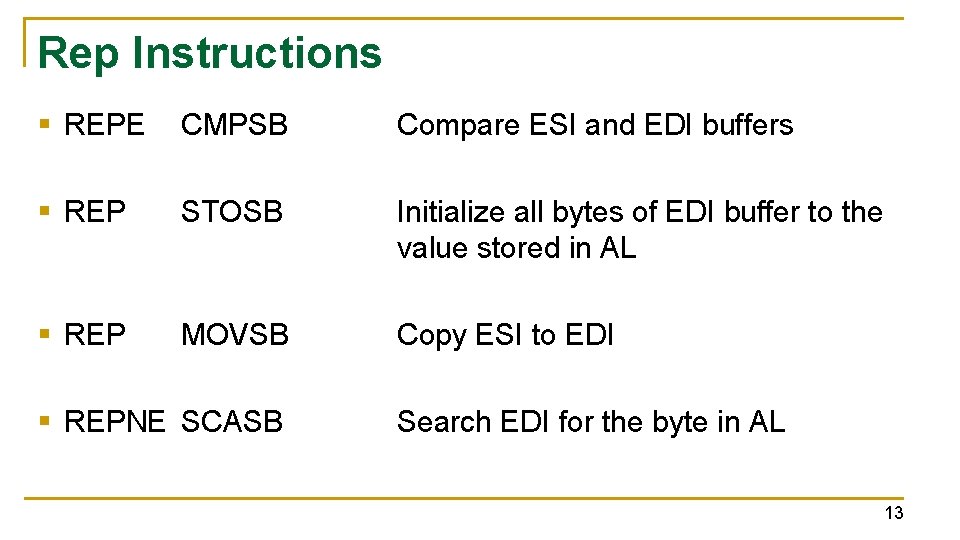
Rep Instructions § REPE CMPSB Compare ESI and EDI buffers § REP STOSB Initialize all bytes of EDI buffer to the value stored in AL § REP MOVSB Copy ESI to EDI § REPNE SCASB Search EDI for the byte in AL 13
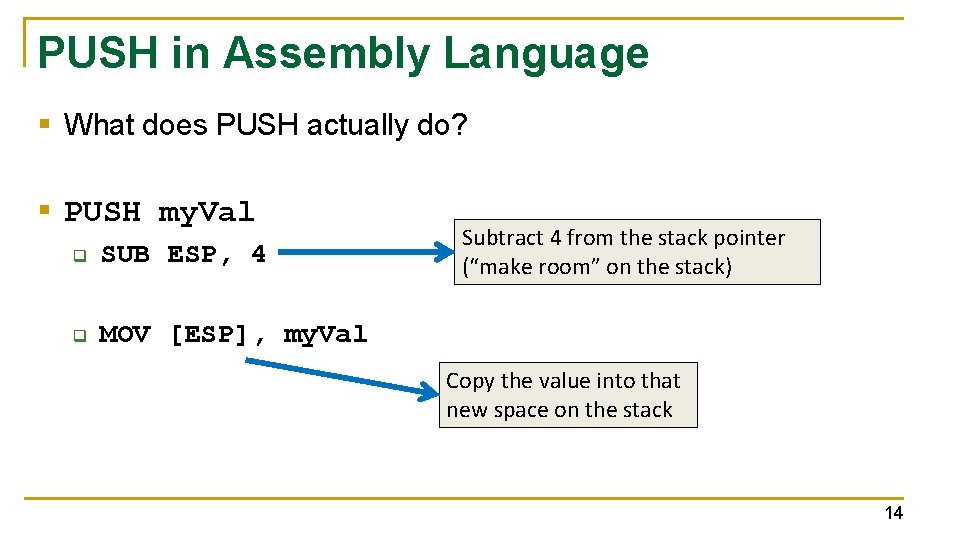
PUSH in Assembly Language § What does PUSH actually do? § PUSH my. Val q SUB ESP, 4 q MOV [ESP], my. Val Subtract 4 from the stack pointer (“make room” on the stack) Copy the value into that new space on the stack 14
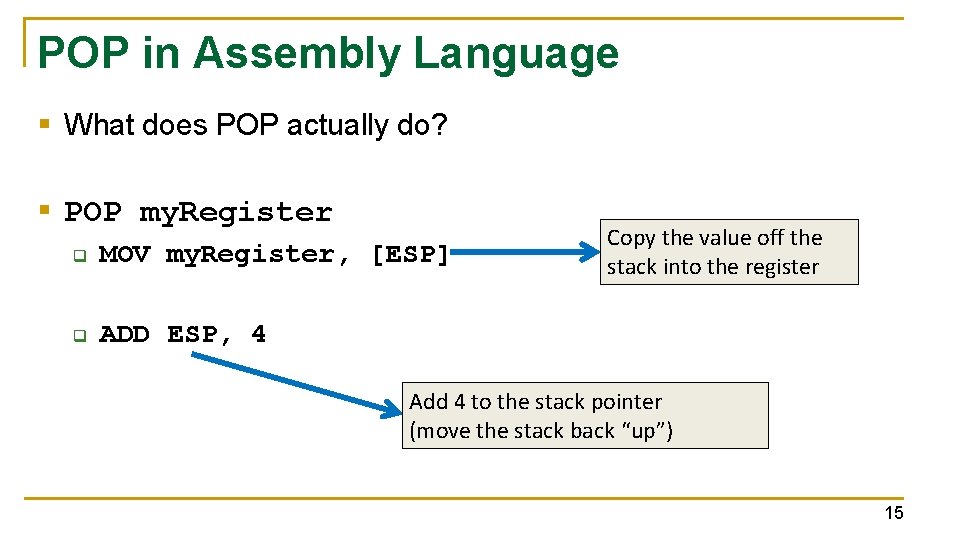
POP in Assembly Language § What does POP actually do? § POP my. Register q MOV my. Register, [ESP] q ADD ESP, 4 Copy the value off the stack into the register Add 4 to the stack pointer (move the stack back “up”) 15
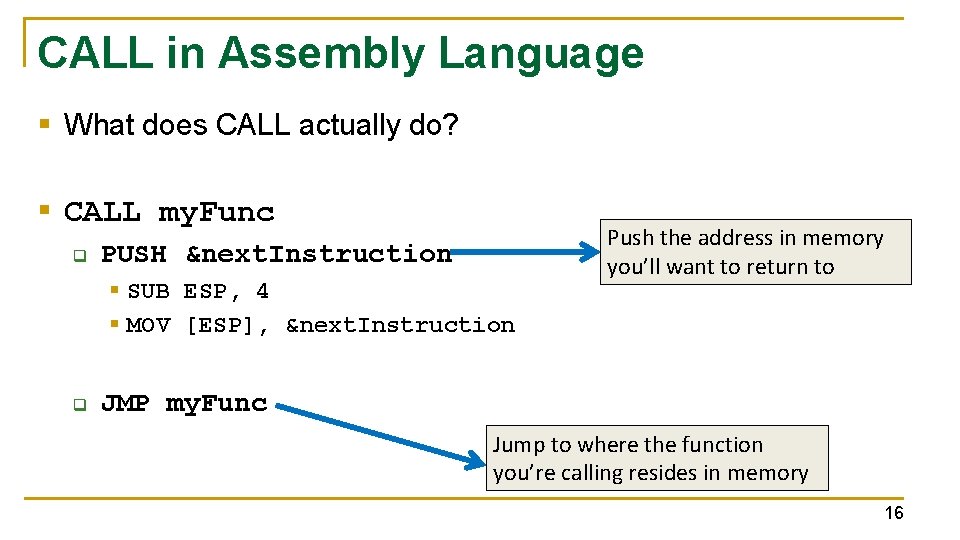
CALL in Assembly Language § What does CALL actually do? § CALL my. Func q PUSH &next. Instruction § SUB ESP, 4 § MOV [ESP], &next. Instruction q Push the address in memory you’ll want to return to JMP my. Func Jump to where the function you’re calling resides in memory 16
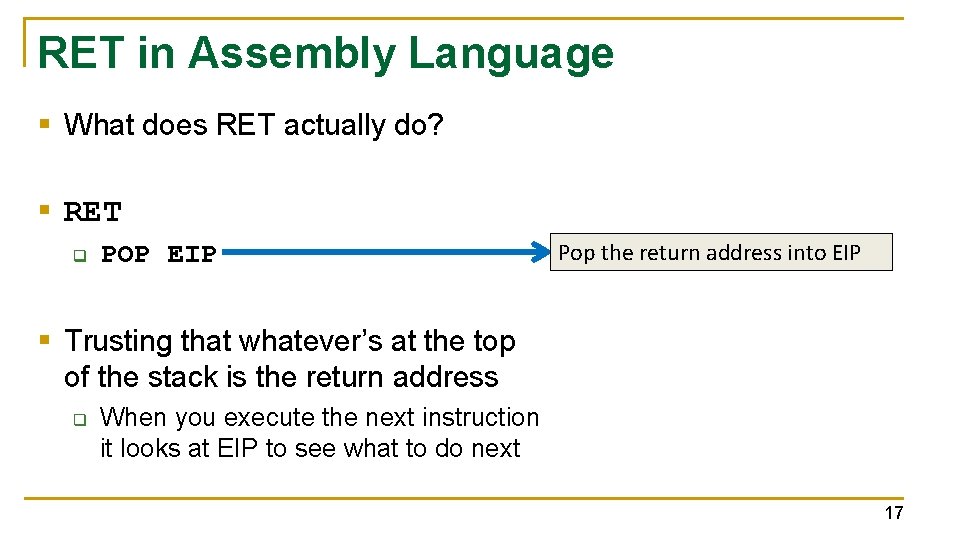
RET in Assembly Language § What does RET actually do? § RET q POP EIP Pop the return address into EIP § Trusting that whatever’s at the top of the stack is the return address q When you execute the next instruction it looks at EIP to see what to do next 17
What is Cdecl? § The calling convention for the C programming language § Calling conventions determine q q q Order in which parameters are placed onto the stack Which registers are used/preserved for the caller How the stack in general is handled 18
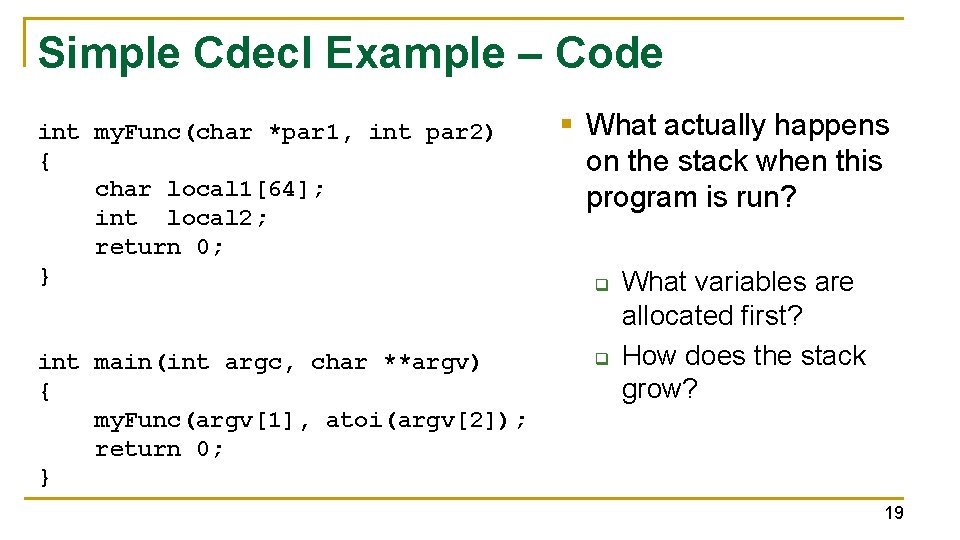
Simple Cdecl Example – Code int my. Func(char *par 1, int par 2) { char local 1[64]; int local 2; return 0; } int main(int argc, char **argv) { my. Func(argv[1], atoi(argv[2]); return 0; } § What actually happens on the stack when this program is run? q q What variables are allocated first? How does the stack grow? 19
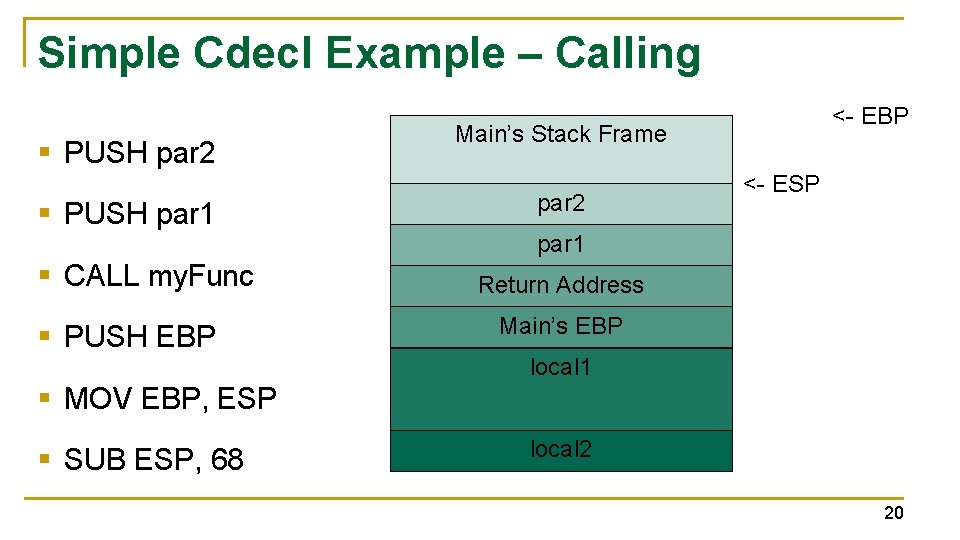
Simple Cdecl Example – Calling § PUSH par 2 § PUSH par 1 § CALL my. Func § PUSH EBP <- EBP Main’s Stack Frame par 2 <- ESP par 1 Return Address Main’s EBP local 1 § MOV EBP, ESP § SUB ESP, 68 local 2 20
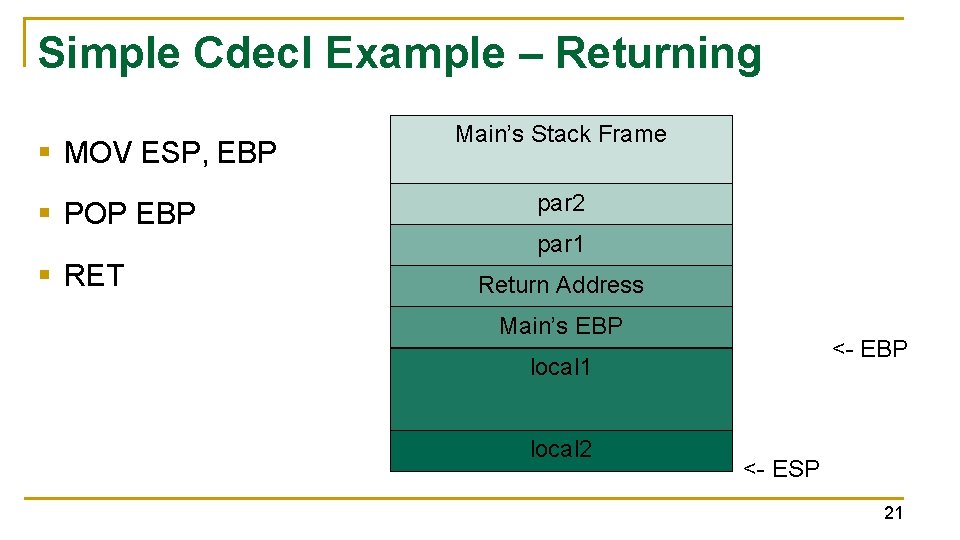
Simple Cdecl Example – Returning § MOV ESP, EBP § POP EBP § RET Main’s Stack Frame par 2 par 1 Return Address Main’s EBP <- EBP local 1 local 2 <- ESP 21
- Slides: 21