
X 20 3 Technical Volume Slide Deck Template

- Slides: 19
X 20. 3 Technical Volume Slide Deck Template (applicable to AF 21. 1 CSO 1 and AF 21. 1 -DCSO 1) Notional/Example - For reference only Please send questions to usaf. team@afsbirsttr. us Notional example - For reference only 1
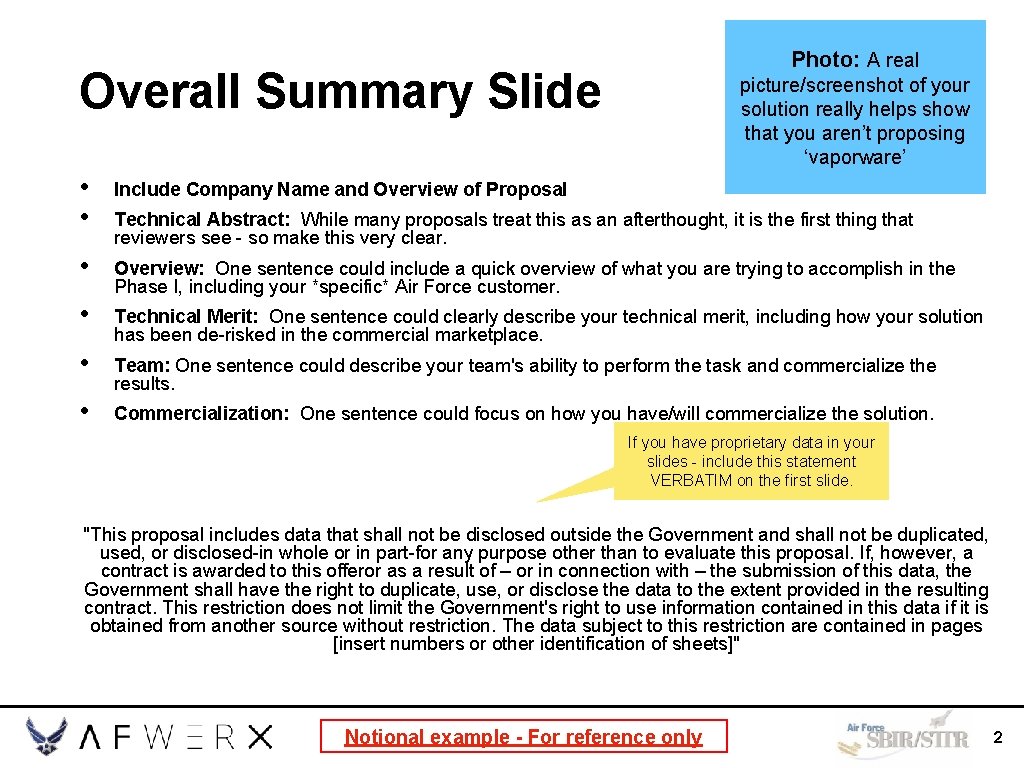
Photo: A real Overall Summary Slide picture/screenshot of your solution really helps show that you aren’t proposing ‘vaporware’ • • Include Company Name and Overview of Proposal • Overview: One sentence could include a quick overview of what you are trying to accomplish in the Phase I, including your *specific* Air Force customer. • Technical Merit: One sentence could clearly describe your technical merit, including how your solution has been de-risked in the commercial marketplace. • Team: One sentence could describe your team's ability to perform the task and commercialize the results. • Commercialization: One sentence could focus on how you have/will commercialize the solution. Technical Abstract: While many proposals treat this as an afterthought, it is the first thing that reviewers see - so make this very clear. If you have proprietary data in your slides - include this statement VERBATIM on the first slide. "This proposal includes data that shall not be disclosed outside the Government and shall not be duplicated, used, or disclosed-in whole or in part-for any purpose other than to evaluate this proposal. If, however, a contract is awarded to this offeror as a result of – or in connection with – the submission of this data, the Government shall have the right to duplicate, use, or disclose the data to the extent provided in the resulting contract. This restriction does not limit the Government's right to use information contained in this data if it is obtained from another source without restriction. The data subject to this restriction are contained in pages [insert numbers or other identification of sheets]" Notional example - For reference only 2
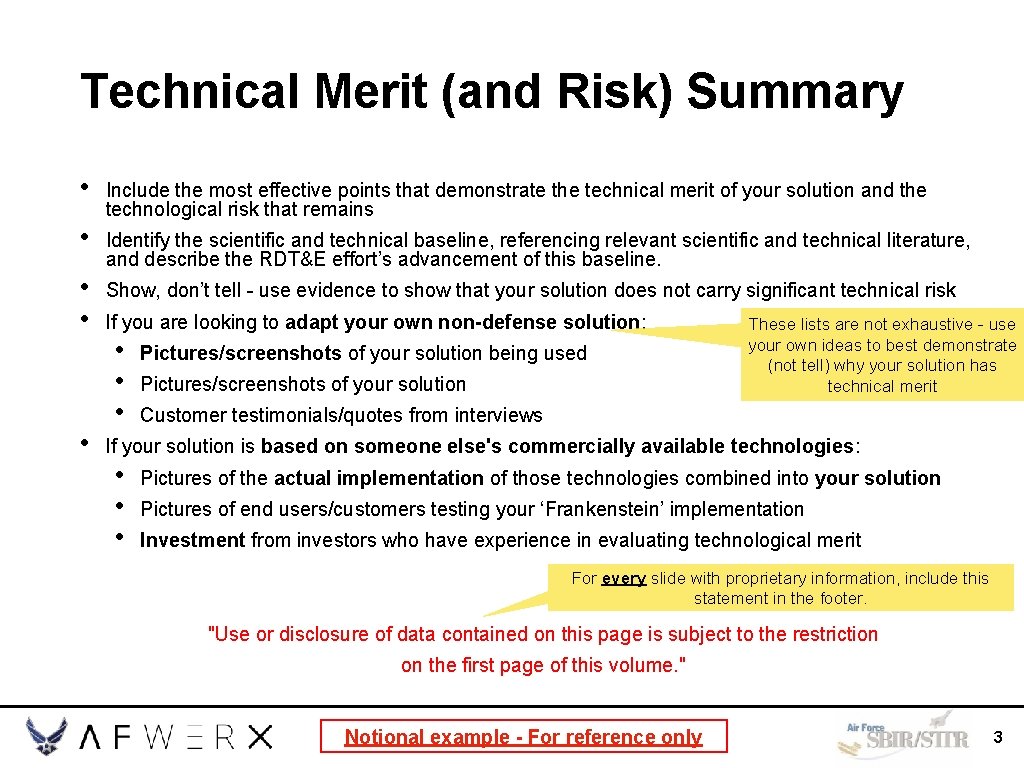
Technical Merit (and Risk) Summary • Include the most effective points that demonstrate the technical merit of your solution and the technological risk that remains • Identify the scientific and technical baseline, referencing relevant scientific and technical literature, and describe the RDT&E effort’s advancement of this baseline. • • Show, don’t tell - use evidence to show that your solution does not carry significant technical risk • If you are looking to adapt your own non-defense solution: • • • Pictures/screenshots of your solution being used Pictures/screenshots of your solution These lists are not exhaustive - use your own ideas to best demonstrate (not tell) why your solution has technical merit Customer testimonials/quotes from interviews If your solution is based on someone else's commercially available technologies: • • • Pictures of the actual implementation of those technologies combined into your solution Pictures of end users/customers testing your ‘Frankenstein’ implementation Investment from investors who have experience in evaluating technological merit For every slide with proprietary information, include this statement in the footer. "Use or disclosure of data contained on this page is subject to the restriction on the first page of this volume. " Notional example - For reference only 3
Significance of Problem/Opportunity • Define the specific technical problem or opportunity addressed. • Communicate how and if the private sector variant of the proposed solution is different from the Do. D-variant. • Define the specific problem’s strategic and/or operational importance. • This is not the time to show off your technical depth, but rather to explain your technology/value proposition and why people should care. “You do not really understand something until you can explain it to your grandmother. " Notional example - For reference only 4
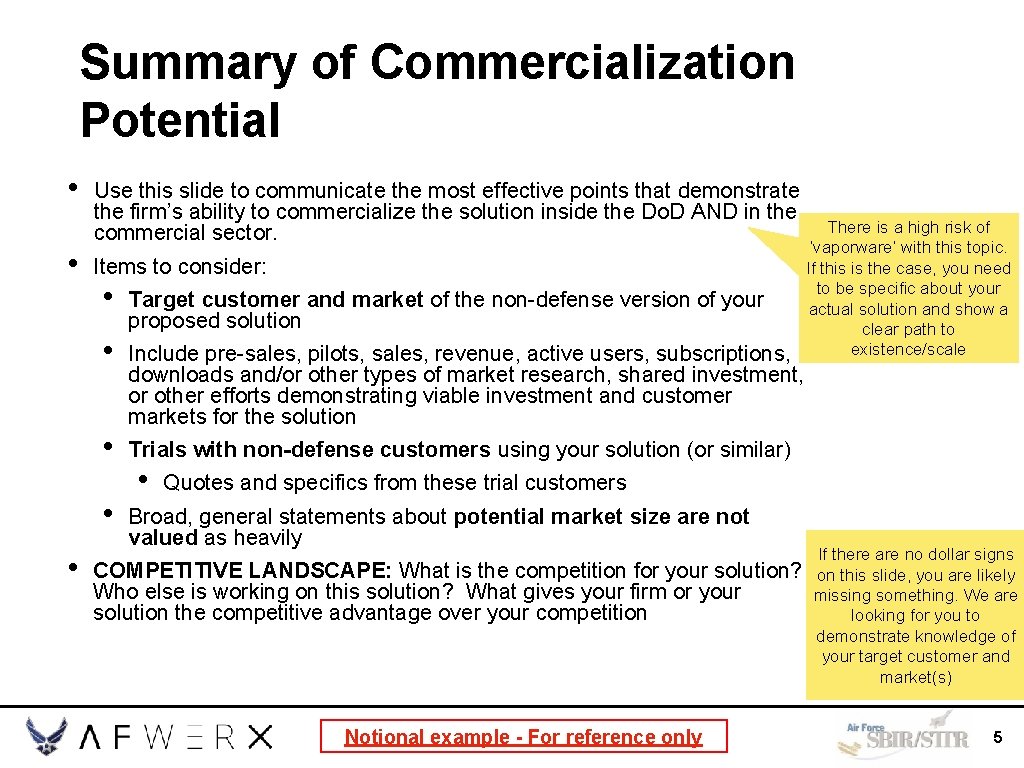
Summary of Commercialization Potential • • Use this slide to communicate the most effective points that demonstrate the firm’s ability to commercialize the solution inside the Do. D AND in the commercial sector. Items to consider: • • • Target customer and market of the non-defense version of your proposed solution There is a high risk of ‘vaporware’ with this topic. If this is the case, you need to be specific about your actual solution and show a clear path to existence/scale Include pre-sales, pilots, sales, revenue, active users, subscriptions, downloads and/or other types of market research, shared investment, or other efforts demonstrating viable investment and customer markets for the solution Trials with non-defense customers using your solution (or similar) • Quotes and specifics from these trial customers Broad, general statements about potential market size are not valued as heavily If there are no dollar signs COMPETITIVE LANDSCAPE: What is the competition for your solution? on this slide, you are likely Who else is working on this solution? What gives your firm or your missing something. We are solution the competitive advantage over your competition looking for you to demonstrate knowledge of your target customer and market(s) Notional example - For reference only 5
Team’s Ability to Perform and Commercialize the Proposed Solution • Use this slide to demonstrate the most effective points for demonstrating the team can continue technical development AND commercialize the results for Air Force customers. • The ability to execute a successful SBIR and commercialization inside the government will largely be based on people - as they are the ones who will help you determine product/market fit The question is not only can you do it, but can you do it in our compressed timelines? H 4 D is a good resource for Do. D customer discovery: http: //hacking 4 defens e. stanford. edu/ • Identify the team, including all partnerships, and The AF is just like any other B 2 B organization - you need to be entrepreneurial to find your way into the sales cycle. Notional example - For reference only 6 highlight relevant education, experience, and/or capabilities demonstrating the ability to develop the solution AND adapt it to prospective AF customer needs.
Defense Need • • Demonstrate knowledge of prospective AF End-User(s)/Customer(s) and their most reasonable use-case for your solution. Highlight previous Do. D funding for the solution or underlying technology (AFOSR research grants, etc. ) DISCUSS HOW YOUR SOLUTION COMPARES TO THE USER’S CURRENT ALTERNATIVE. For Phase I - Show who you plan on talking to inside the government to start your customer discovery process. Don’t just say ‘the Air Force’ is your customer • • • Give specific units or specific people with whom you will start your customer discovery Give any lessons learned from Do. D user testing or customer discovery The closer you are to the user, the better - don’t just get feedback from scientists and engineers, go talk to the actual users Large Do. D contractors are helpful - but are NOT a replacement for AF users/stakeholders For Phase II – you must already have found your customer and end-user (identify them and describe their validated defense need) If applicable, reference a Strategic Capability area, as described in Section 2. 1. Notional example - For reference only 7
(Phase I) Objectives • Enumerate the specific Phase I objectives, including the R/R&D methods to determine the proposed approach’s feasibility. Describe how success will be measured in helping the prospective users and the plan to identify stakeholders other than end-users (e. g. safety, test or certification authorities, cybersecurity, acquisition specialists supporting prospective end-users, etc. ) • List at least one working-level organization or community in the Air Force who may be able to benefit from your solution. This is VERY important - who is the first AF Stakeholder you will contact once you start your Phase I? If you have trouble with this, try looking through news reports or networking through Linkedin. Notional example - For reference only 8
(Phase II) Objectives • Enumerate the specific Phase II objectives, including the R/R&D adaptations or changes to the non-Defense commercial solution. This should include all required to meet the AF end-user’s/customer’s needs and/or T&E to be performed on the solution. Describe how success/failure will be measured during the solution’s trial. Notional example - For reference only 9
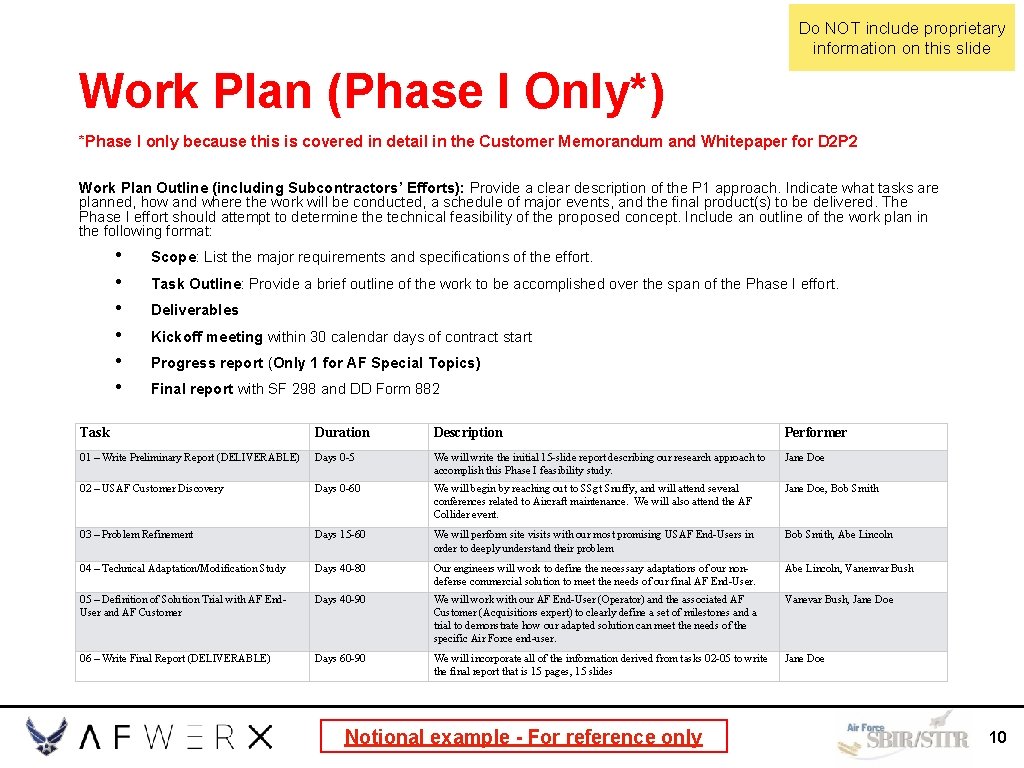
Do NOT include proprietary information on this slide Work Plan (Phase I Only*) *Phase I only because this is covered in detail in the Customer Memorandum and Whitepaper for D 2 P 2 Work Plan Outline (including Subcontractors’ Efforts): Provide a clear description of the P 1 approach. Indicate what tasks are planned, how and where the work will be conducted, a schedule of major events, and the final product(s) to be delivered. The Phase I effort should attempt to determine the technical feasibility of the proposed concept. Include an outline of the work plan in the following format: • • • Scope: List the major requirements and specifications of the effort. Task Outline: Provide a brief outline of the work to be accomplished over the span of the Phase I effort. Deliverables Kickoff meeting within 30 calendar days of contract start Progress report (Only 1 for AF Special Topics) Final report with SF 298 and DD Form 882 Task Duration Description Performer 01 – Write Preliminary Report (DELIVERABLE) Days 0 -5 We will write the initial 15 -slide report describing our research approach to accomplish this Phase I feasibility study. Jane Doe 02 – USAF Customer Discovery Days 0 -60 We will begin by reaching out to SSgt Snuffy, and will attend several conferences related to Aircraft maintenance. We will also attend the AF Collider event. Jane Doe, Bob Smith 03 – Problem Refinement Days 15 -60 We will perform site visits with our most promising USAF End-Users in order to deeply understand their problem Bob Smith, Abe Lincoln 04 – Technical Adaptation/Modification Study Days 40 -80 Our engineers will work to define the necessary adaptations of our nondefense commercial solution to meet the needs of our final AF End-User. Abe Lincoln, Vanenvar Bush 05 – Definition of Solution Trial with AF End. User and AF Customer Days 40 -90 We will work with our AF End-User (Operator) and the associated AF Customer (Acquisitions expert) to clearly define a set of milestones and a trial to demonstrate how our adapted solution can meet the needs of the specific Air Force end-user. Vanevar Bush, Jane Doe 06 – Write Final Report (DELIVERABLE) Days 60 -90 We will incorporate all of the information derived from tasks 02 -05 to write the final report that is 15 pages, 15 slides Jane Doe Notional example - For reference only 10
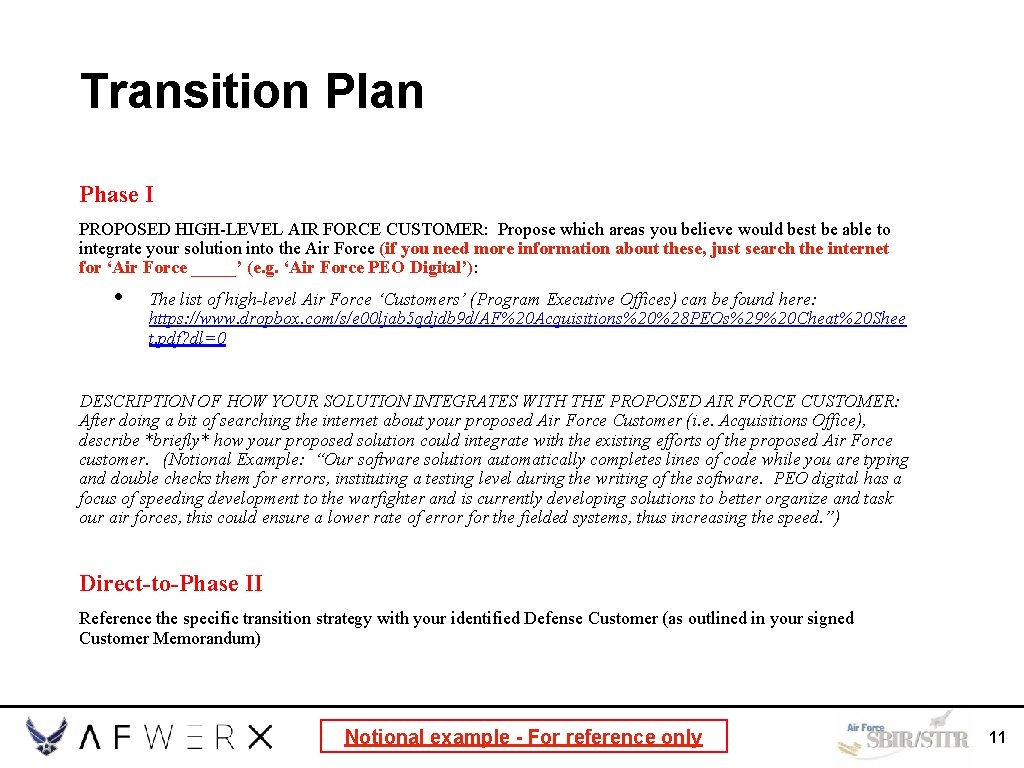
Transition Plan Phase I PROPOSED HIGH-LEVEL AIR FORCE CUSTOMER: Propose which areas you believe would best be able to integrate your solution into the Air Force (if you need more information about these, just search the internet for ‘Air Force _____’ (e. g. ‘Air Force PEO Digital’): • The list of high-level Air Force ‘Customers’ (Program Executive Offices) can be found here: https: //www. dropbox. com/s/e 00 ljab 5 qdjdb 9 d/AF%20 Acquisitions%20%28 PEOs%29%20 Cheat%20 Shee t. pdf? dl=0 DESCRIPTION OF HOW YOUR SOLUTION INTEGRATES WITH THE PROPOSED AIR FORCE CUSTOMER: After doing a bit of searching the internet about your proposed Air Force Customer (i. e. Acquisitions Office), describe *briefly* how your proposed solution could integrate with the existing efforts of the proposed Air Force customer. (Notional Example: “Our software solution automatically completes lines of code while you are typing and double checks them for errors, instituting a testing level during the writing of the software. PEO digital has a focus of speeding development to the warfighter and is currently developing solutions to better organize and task our air forces, this could ensure a lower rate of error for the fielded systems, thus increasing the speed. ”) Direct-to-Phase II Reference the specific transition strategy with your identified Defense Customer (as outlined in your signed Customer Memorandum) Notional example - For reference only 11
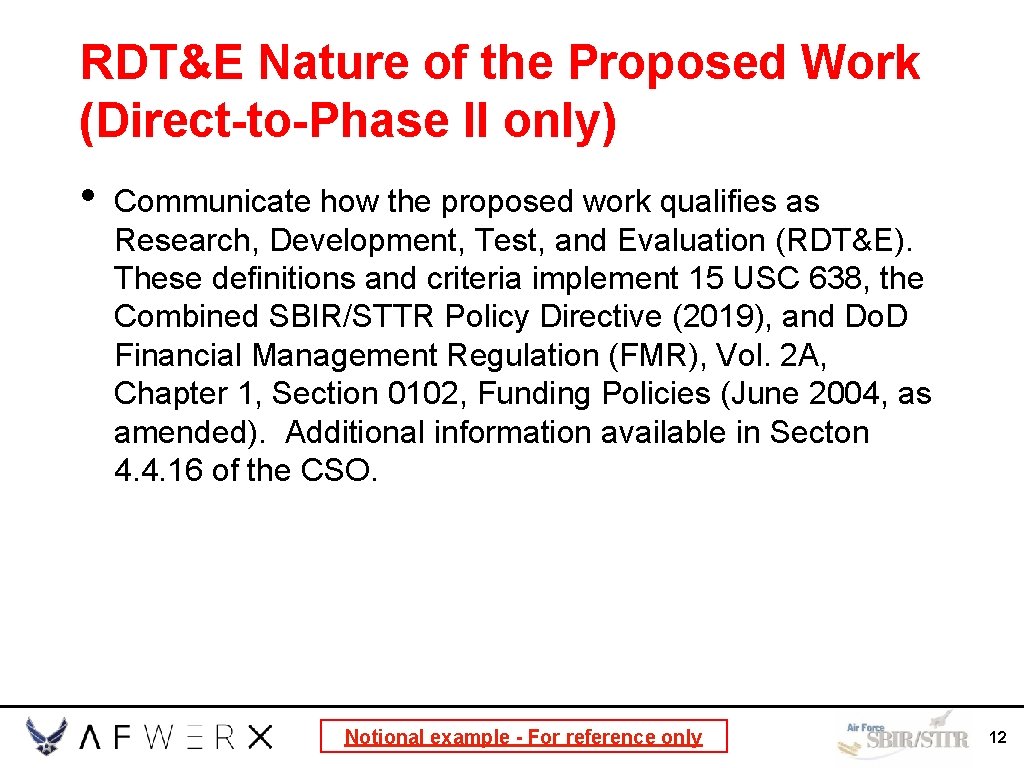
RDT&E Nature of the Proposed Work (Direct-to-Phase II only) • Communicate how the proposed work qualifies as Research, Development, Test, and Evaluation (RDT&E). These definitions and criteria implement 15 USC 638, the Combined SBIR/STTR Policy Directive (2019), and Do. D Financial Management Regulation (FMR), Vol. 2 A, Chapter 1, Section 0102, Funding Policies (June 2004, as amended). Additional information available in Secton 4. 4. 16 of the CSO. Notional example - For reference only 12
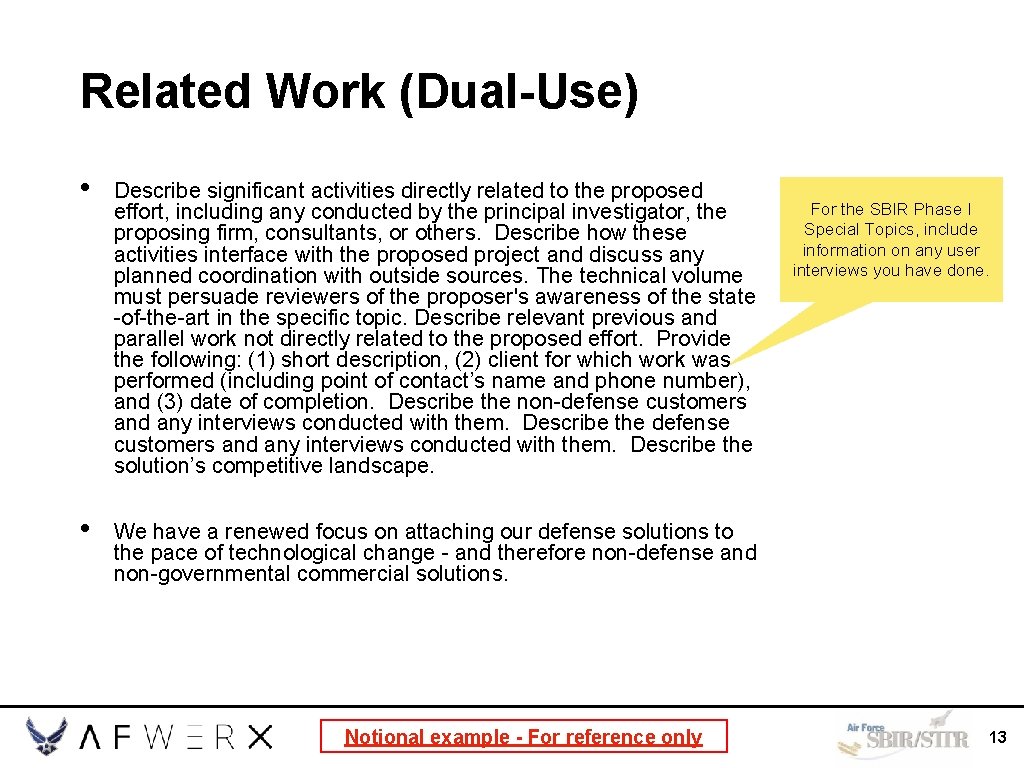
Related Work (Dual-Use) • Describe significant activities directly related to the proposed effort, including any conducted by the principal investigator, the proposing firm, consultants, or others. Describe how these activities interface with the proposed project and discuss any planned coordination with outside sources. The technical volume must persuade reviewers of the proposer's awareness of the state -of-the-art in the specific topic. Describe relevant previous and parallel work not directly related to the proposed effort. Provide the following: (1) short description, (2) client for which work was performed (including point of contact’s name and phone number), and (3) date of completion. Describe the non-defense customers and any interviews conducted with them. Describe the solution’s competitive landscape. • We have a renewed focus on attaching our defense solutions to the pace of technological change - and therefore non-defense and non-governmental commercial solutions. Notional example - For reference only For the SBIR Phase I Special Topics, include information on any user interviews you have done. 13
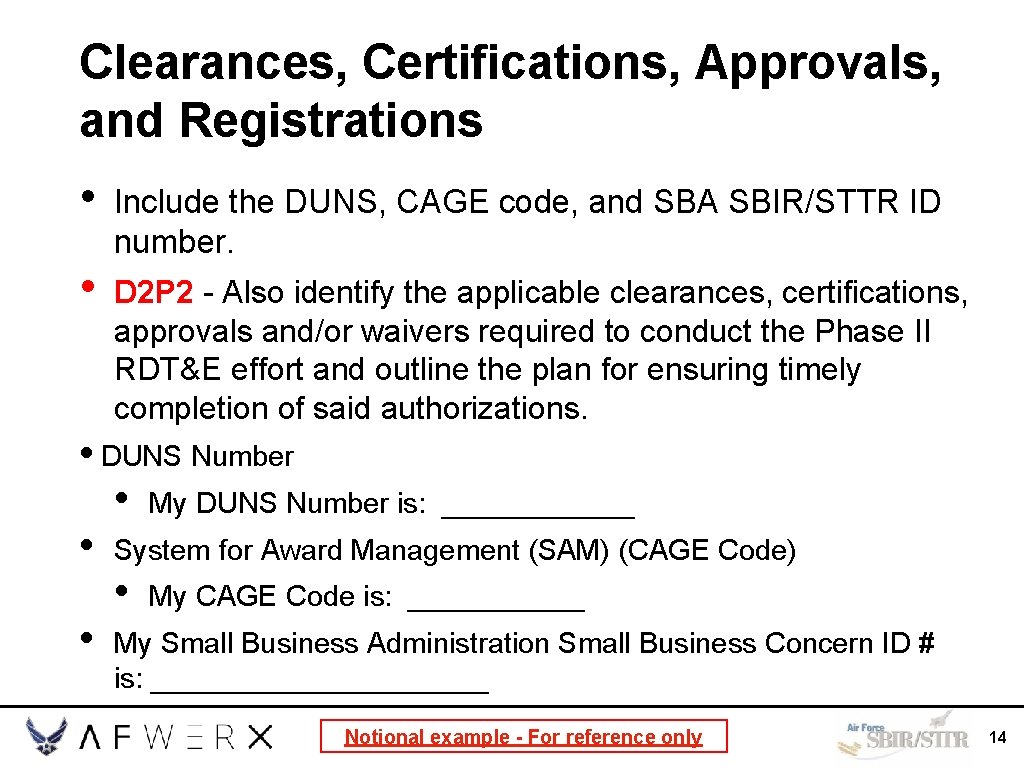
Clearances, Certifications, Approvals, and Registrations • Include the DUNS, CAGE code, and SBA SBIR/STTR ID number. • D 2 P 2 - Also identify the applicable clearances, certifications, approvals and/or waivers required to conduct the Phase II RDT&E effort and outline the plan for ensuring timely completion of said authorizations. • DUNS Number • My DUNS Number is: ______ • System for Award Management (SAM) (CAGE Code) • My CAGE Code is: ______ • My Small Business Administration Small Business Concern ID # is: ___________ Notional example - For reference only 14
The following slides are required AS APPLICABLE Notional example - For reference only
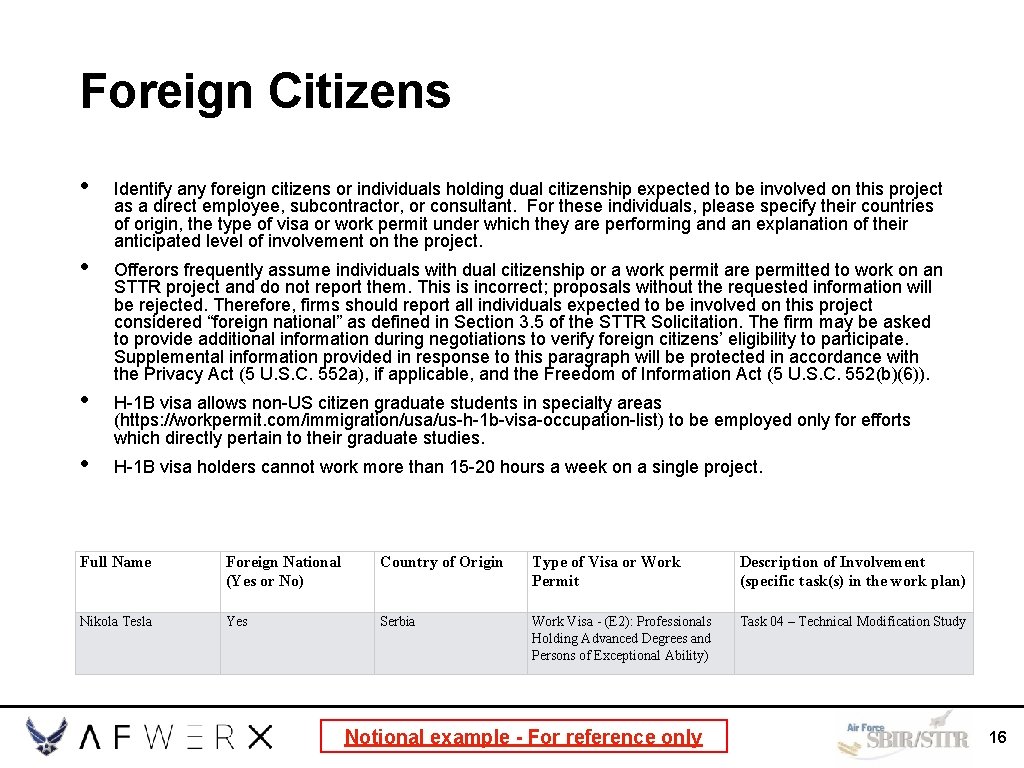
Foreign Citizens • Identify any foreign citizens or individuals holding dual citizenship expected to be involved on this project as a direct employee, subcontractor, or consultant. For these individuals, please specify their countries of origin, the type of visa or work permit under which they are performing and an explanation of their anticipated level of involvement on the project. • Offerors frequently assume individuals with dual citizenship or a work permit are permitted to work on an STTR project and do not report them. This is incorrect; proposals without the requested information will be rejected. Therefore, firms should report all individuals expected to be involved on this project considered “foreign national” as defined in Section 3. 5 of the STTR Solicitation. The firm may be asked to provide additional information during negotiations to verify foreign citizens’ eligibility to participate. Supplemental information provided in response to this paragraph will be protected in accordance with the Privacy Act (5 U. S. C. 552 a), if applicable, and the Freedom of Information Act (5 U. S. C. 552(b)(6)). • H-1 B visa allows non-US citizen graduate students in specialty areas (https: //workpermit. com/immigration/usa/us-h-1 b-visa-occupation-list) to be employed only for efforts which directly pertain to their graduate studies. • H-1 B visa holders cannot work more than 15 -20 hours a week on a single project. Full Name Foreign National (Yes or No) Country of Origin Type of Visa or Work Permit Description of Involvement (specific task(s) in the work plan) Nikola Tesla Yes Serbia Work Visa - (E 2): Professionals Holding Advanced Degrees and Persons of Exceptional Ability) Task 04 – Technical Modification Study Notional example - For reference only 16
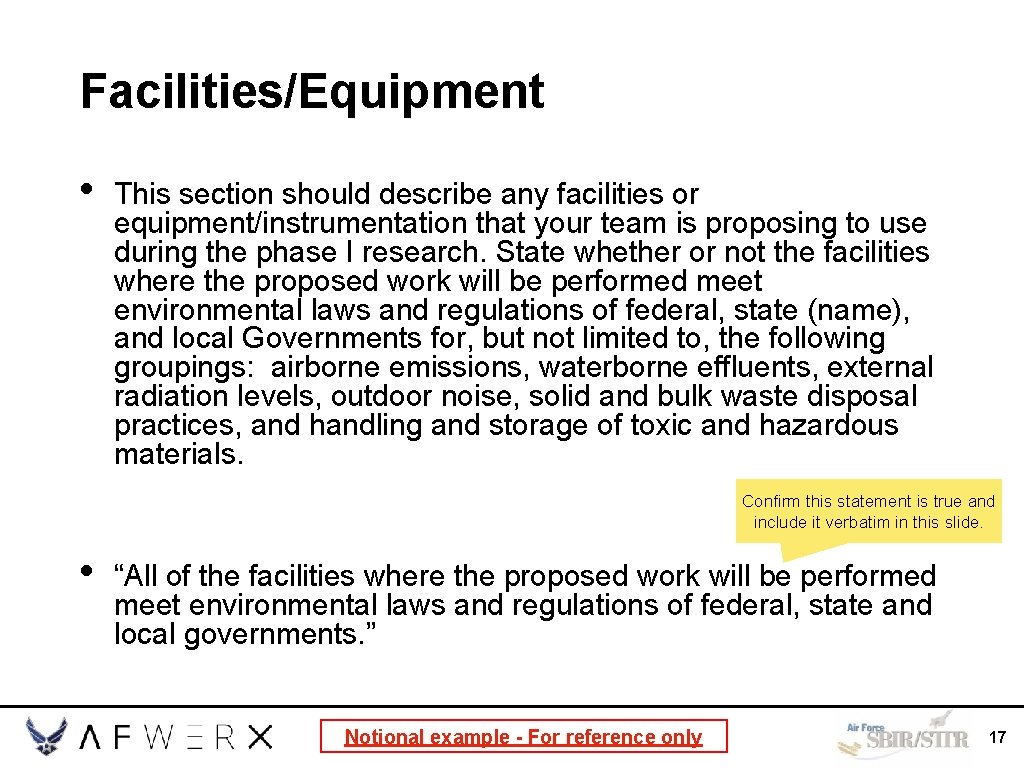
Facilities/Equipment • This section should describe any facilities or equipment/instrumentation that your team is proposing to use during the phase I research. State whether or not the facilities where the proposed work will be performed meet environmental laws and regulations of federal, state (name), and local Governments for, but not limited to, the following groupings: airborne emissions, waterborne effluents, external radiation levels, outdoor noise, solid and bulk waste disposal practices, and handling and storage of toxic and hazardous materials. Confirm this statement is true and include it verbatim in this slide. • “All of the facilities where the proposed work will be performed meet environmental laws and regulations of federal, state and local governments. ” Notional example - For reference only 17
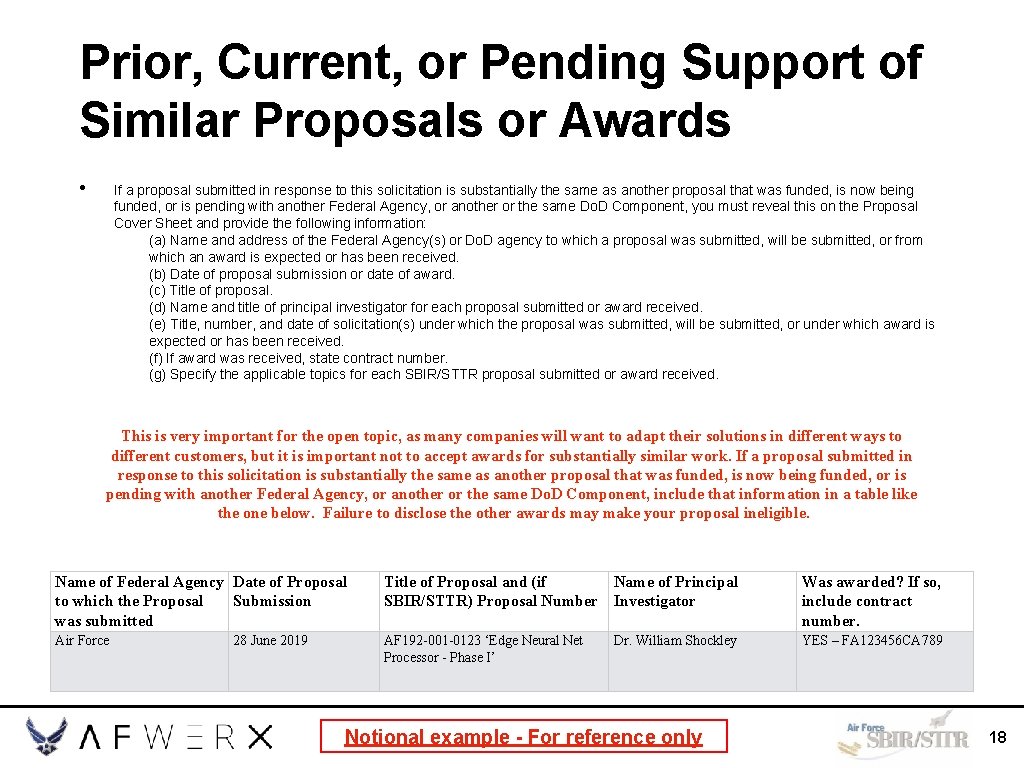
Prior, Current, or Pending Support of Similar Proposals or Awards • If a proposal submitted in response to this solicitation is substantially the same as another proposal that was funded, is now being funded, or is pending with another Federal Agency, or another or the same Do. D Component, you must reveal this on the Proposal Cover Sheet and provide the following information: (a) Name and address of the Federal Agency(s) or Do. D agency to which a proposal was submitted, will be submitted, or from which an award is expected or has been received. (b) Date of proposal submission or date of award. (c) Title of proposal. (d) Name and title of principal investigator for each proposal submitted or award received. (e) Title, number, and date of solicitation(s) under which the proposal was submitted, will be submitted, or under which award is expected or has been received. (f) If award was received, state contract number. (g) Specify the applicable topics for each SBIR/STTR proposal submitted or award received. This is very important for the open topic, as many companies will want to adapt their solutions in different ways to different customers, but it is important not to accept awards for substantially similar work. If a proposal submitted in response to this solicitation is substantially the same as another proposal that was funded, is now being funded, or is pending with another Federal Agency, or another or the same Do. D Component, include that information in a table like the one below. Failure to disclose the other awards may make your proposal ineligible. Name of Federal Agency Date of Proposal to which the Proposal Submission was submitted Title of Proposal and (if Name of Principal SBIR/STTR) Proposal Number Investigator Was awarded? If so, include contract number. Air Force AF 192 -001 -0123 ‘Edge Neural Net Processor - Phase I’ YES – FA 123456 CA 789 28 June 2019 Dr. William Shockley Notional example - For reference only 18
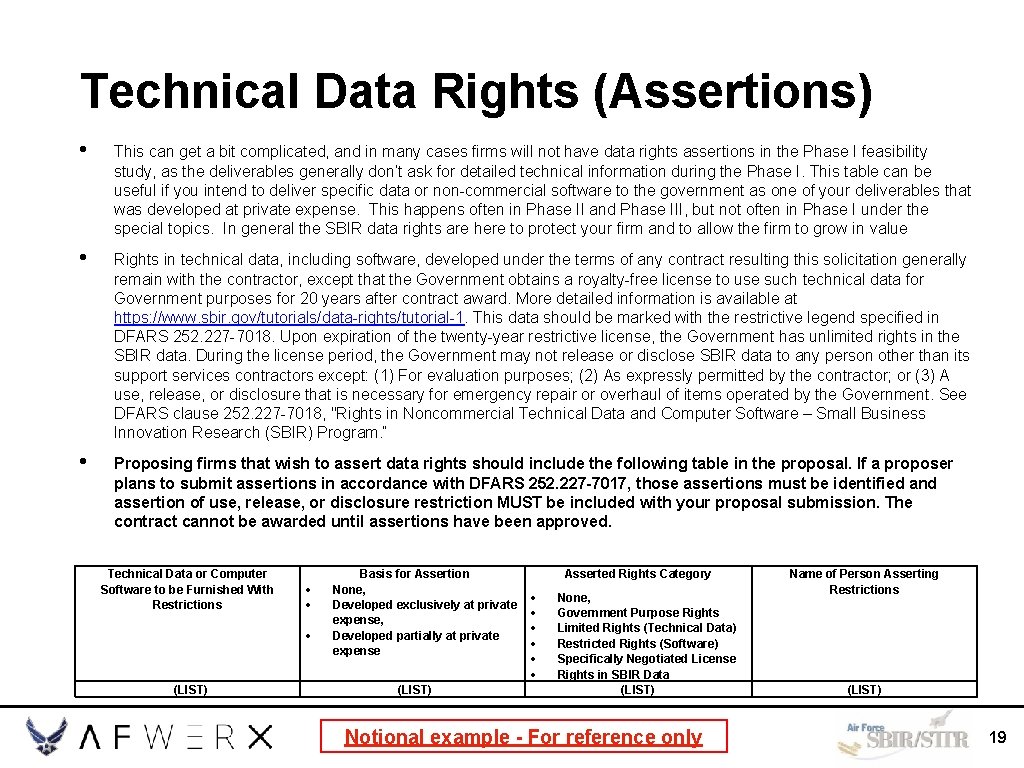
Technical Data Rights (Assertions) • This can get a bit complicated, and in many cases firms will not have data rights assertions in the Phase I feasibility study, as the deliverables generally don’t ask for detailed technical information during the Phase I. This table can be useful if you intend to deliver specific data or non-commercial software to the government as one of your deliverables that was developed at private expense. This happens often in Phase II and Phase III, but not often in Phase I under the special topics. In general the SBIR data rights are here to protect your firm and to allow the firm to grow in value • Rights in technical data, including software, developed under the terms of any contract resulting this solicitation generally remain with the contractor, except that the Government obtains a royalty-free license to use such technical data for Government purposes for 20 years after contract award. More detailed information is available at https: //www. sbir. gov/tutorials/data-rights/tutorial-1. This data should be marked with the restrictive legend specified in DFARS 252. 227 -7018. Upon expiration of the twenty-year restrictive license, the Government has unlimited rights in the SBIR data. During the license period, the Government may not release or disclose SBIR data to any person other than its support services contractors except: (1) For evaluation purposes; (2) As expressly permitted by the contractor; or (3) A use, release, or disclosure that is necessary for emergency repair or overhaul of items operated by the Government. See DFARS clause 252. 227 -7018, "Rights in Noncommercial Technical Data and Computer Software – Small Business Innovation Research (SBIR) Program. “ • Proposing firms that wish to assert data rights should include the following table in the proposal. If a proposer plans to submit assertions in accordance with DFARS 252. 227 -7017, those assertions must be identified and assertion of use, release, or disclosure restriction MUST be included with your proposal submission. The contract cannot be awarded until assertions have been approved. Technical Data or Computer Software to be Furnished With Restrictions (LIST) Basis for Assertion None, Developed exclusively at private expense, Developed partially at private expense (LIST) Asserted Rights Category None, Government Purpose Rights Limited Rights (Technical Data) Restricted Rights (Software) Specifically Negotiated License Rights in SBIR Data (LIST) Notional example - For reference only Name of Person Asserting Restrictions (LIST) 19