
www schoolcounselor org THE ASCA NATIONAL MODEL Unpacking
- Slides: 30
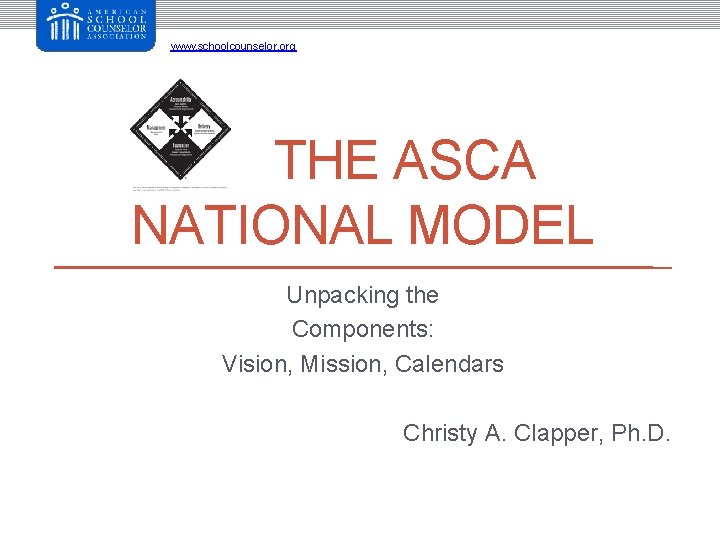
www. schoolcounselor. org THE ASCA NATIONAL MODEL Unpacking the Components: Vision, Mission, Calendars Christy A. Clapper, Ph. D.
www. schoolcounselor. org Learner Outcomes • Participants will: • Examine three components of the national model: Vision, Mission, and Calendars. • Understand the purpose and power of these three components in the development and implementation of a model program. • Apply the use of suggested processes, tools, and resources for developing a school counseling vision, mission, and calendars.
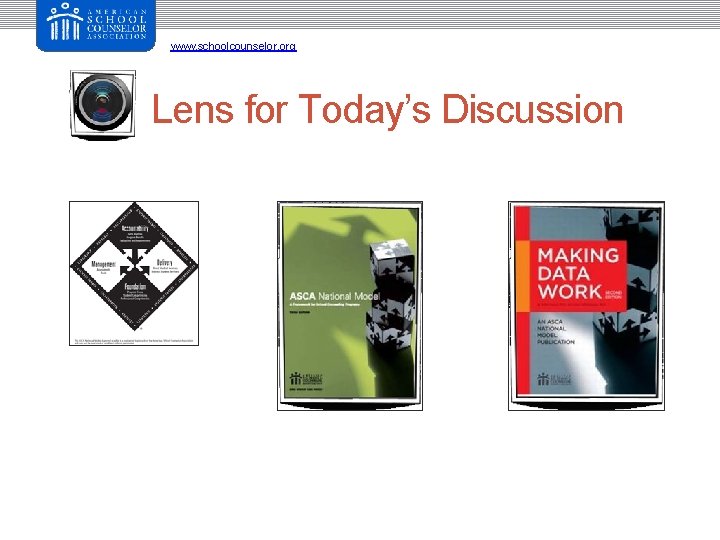
www. schoolcounselor. org Lens for Today’s Discussion
www. schoolcounselor. org Difference between Guidance and Counseling Guidance • “Umbrella” term that includes a constellation of services aimed at personal and career development, and school adjustment • Describes the overall school program and implies personal assistance to students, teachers, parents and administrators • Guidance, guidance program, guidance services, guidance lesson, guidance personnel, guidance counselor, etc Counseling • Has been perceived as a process through which someone who has a problem receives personal assistance, usually through private discussion • Term not used exclusively by school counselors or other professional counselors.
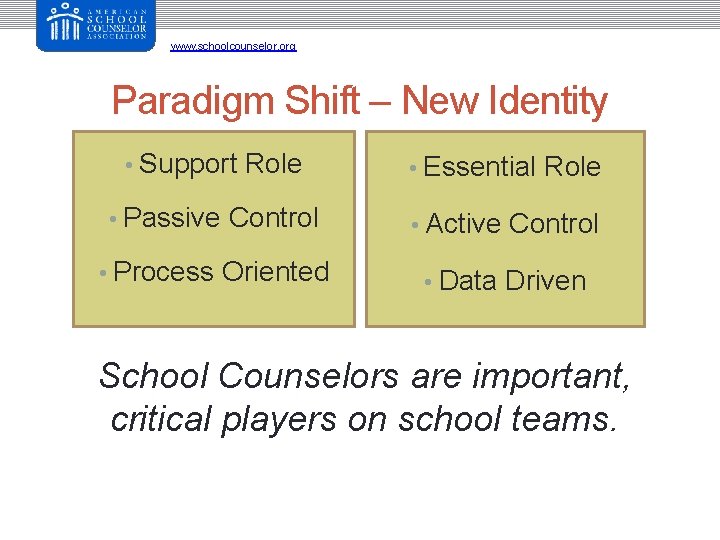
www. schoolcounselor. org Paradigm Shift – New Identity • Support Role • Essential Role • Passive Control • Active Control • Process Oriented • Data Driven School Counselors are important, critical players on school teams.
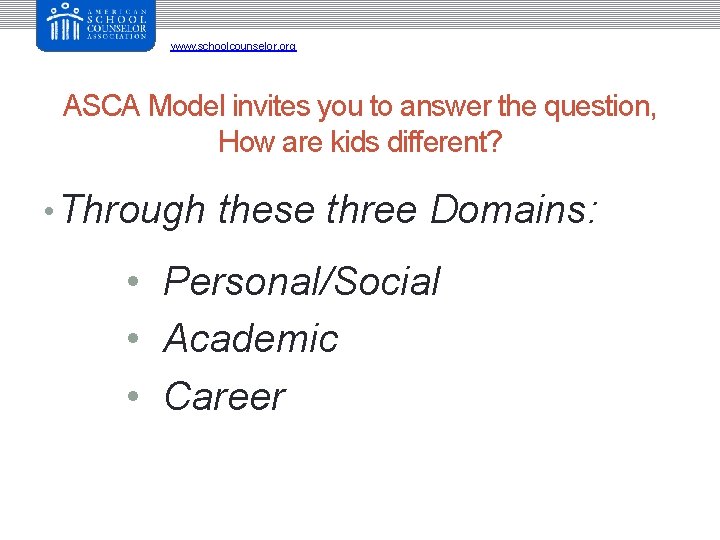
www. schoolcounselor. org ASCA Model invites you to answer the question, How are kids different? • Through these three Domains: • Personal/Social • Academic • Career
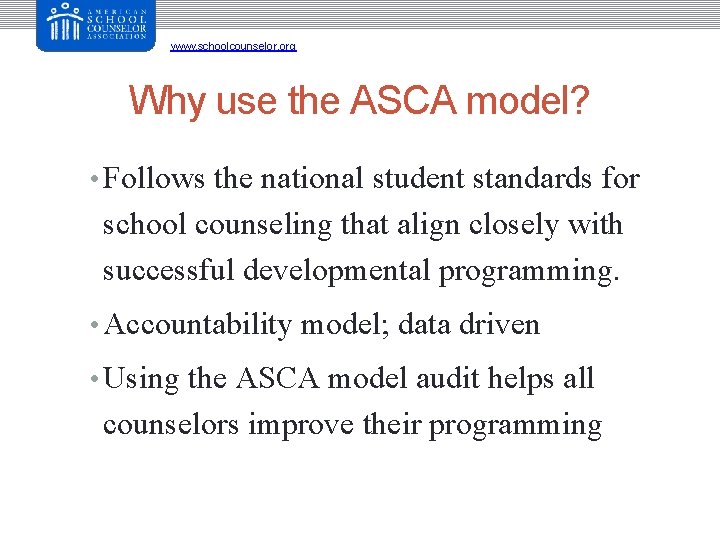
www. schoolcounselor. org Why use the ASCA model? • Follows the national student standards for school counseling that align closely with successful developmental programming. • Accountability model; data driven • Using the ASCA model audit helps all counselors improve their programming
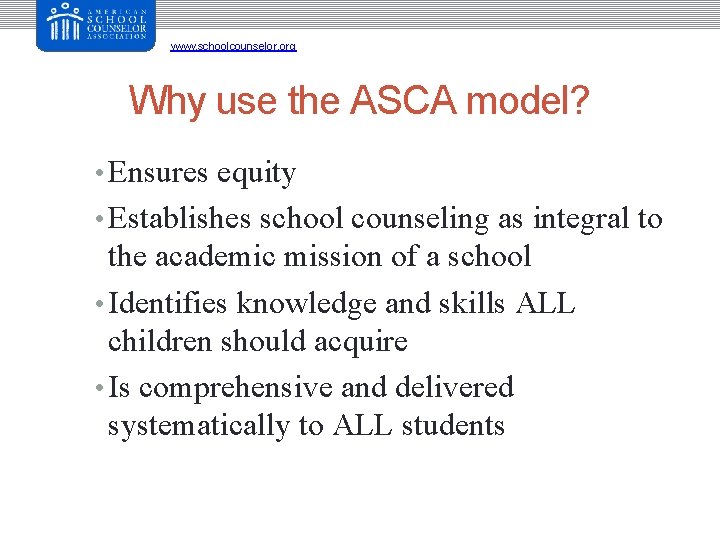
www. schoolcounselor. org Why use the ASCA model? • Ensures equity • Establishes school counseling as integral to the academic mission of a school • Identifies knowledge and skills ALL children should acquire • Is comprehensive and delivered systematically to ALL students
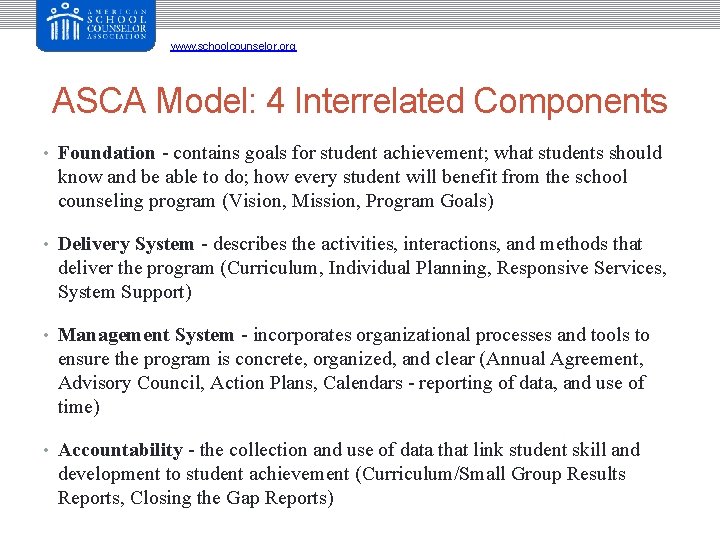
www. schoolcounselor. org ASCA Model: 4 Interrelated Components • Foundation - contains goals for student achievement; what students should know and be able to do; how every student will benefit from the school counseling program (Vision, Mission, Program Goals) • Delivery System - describes the activities, interactions, and methods that deliver the program (Curriculum, Individual Planning, Responsive Services, System Support) • Management System - incorporates organizational processes and tools to ensure the program is concrete, organized, and clear (Annual Agreement, Advisory Council, Action Plans, Calendars - reporting of data, and use of time) • Accountability - the collection and use of data that link student skill and development to student achievement (Curriculum/Small Group Results Reports, Closing the Gap Reports)
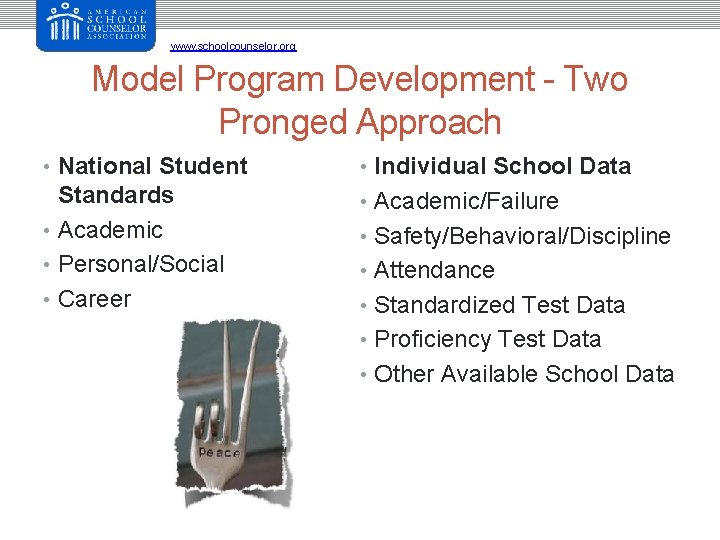
www. schoolcounselor. org Model Program Development - Two Pronged Approach • National Student • Individual School Data Standards • Academic • Personal/Social • Career • Academic/Failure • Safety/Behavioral/Discipline • Attendance • Standardized Test Data • Proficiency Test Data • Other Available School Data
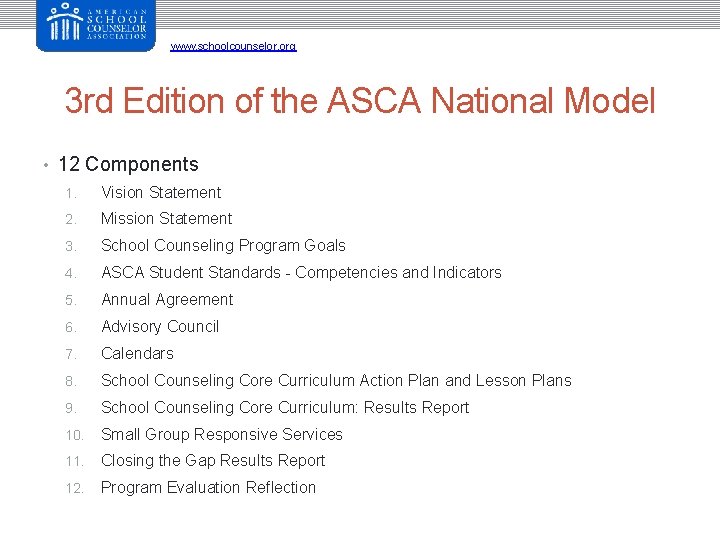
www. schoolcounselor. org 3 rd Edition of the ASCA National Model • 12 Components 1. Vision Statement 2. Mission Statement 3. School Counseling Program Goals 4. ASCA Student Standards - Competencies and Indicators 5. Annual Agreement 6. Advisory Council 7. Calendars 8. School Counseling Core Curriculum Action Plan and Lesson Plans 9. School Counseling Core Curriculum: Results Report 10. Small Group Responsive Services 11. Closing the Gap Results Report 12. Program Evaluation Reflection
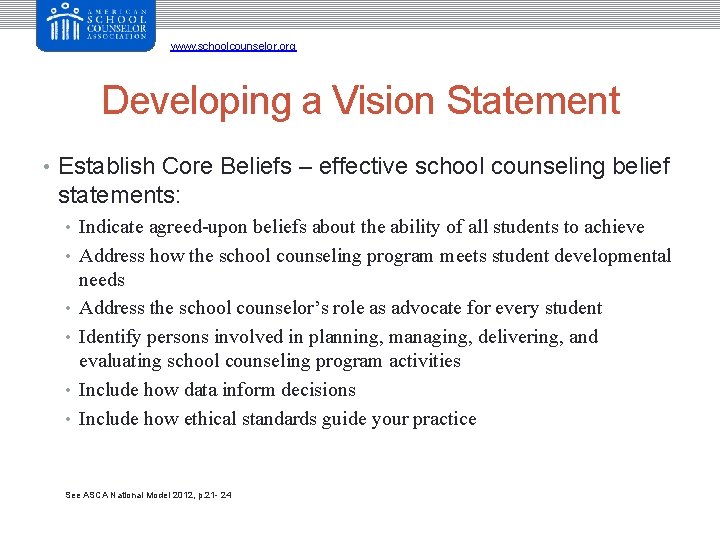
www. schoolcounselor. org Developing a Vision Statement • Establish Core Beliefs – effective school counseling belief statements: • Indicate agreed-upon beliefs about the ability of all students to achieve • Address how the school counseling program meets student developmental • • needs Address the school counselor’s role as advocate for every student Identify persons involved in planning, managing, delivering, and evaluating school counseling program activities Include how data inform decisions Include how ethical standards guide your practice See ASCA National Model 2012, p. 21 - 24
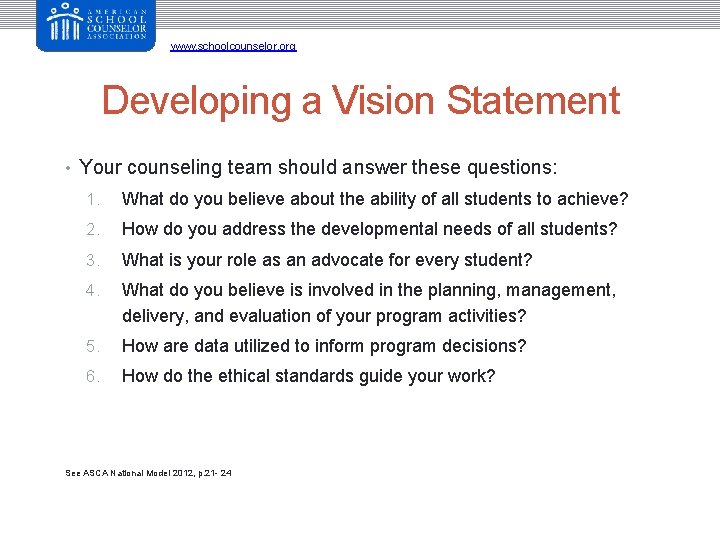
www. schoolcounselor. org Developing a Vision Statement • Your counseling team should answer these questions: 1. What do you believe about the ability of all students to achieve? 2. How do you address the developmental needs of all students? 3. What is your role as an advocate for every student? 4. What do you believe is involved in the planning, management, delivery, and evaluation of your program activities? 5. How are data utilized to inform program decisions? 6. How do the ethical standards guide your work? See ASCA National Model 2012, p. 21 - 24
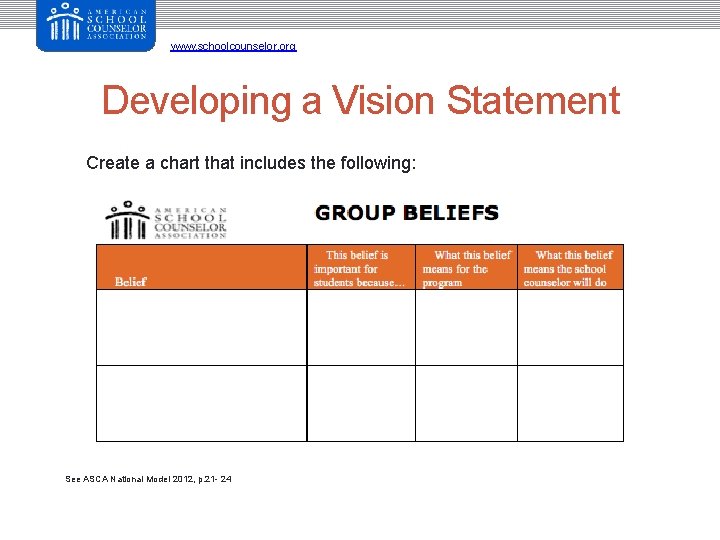
www. schoolcounselor. org Developing a Vision Statement Create a chart that includes the following: See ASCA National Model 2012, p. 21 - 24
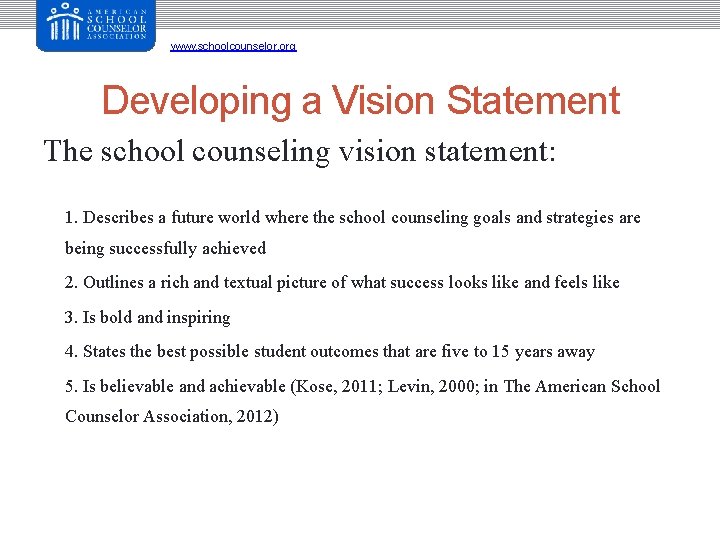
www. schoolcounselor. org Developing a Vision Statement The school counseling vision statement: 1. Describes a future world where the school counseling goals and strategies are being successfully achieved 2. Outlines a rich and textual picture of what success looks like and feels like 3. Is bold and inspiring 4. States the best possible student outcomes that are five to 15 years away 5. Is believable and achievable (Kose, 2011; Levin, 2000; in The American School Counselor Association, 2012)
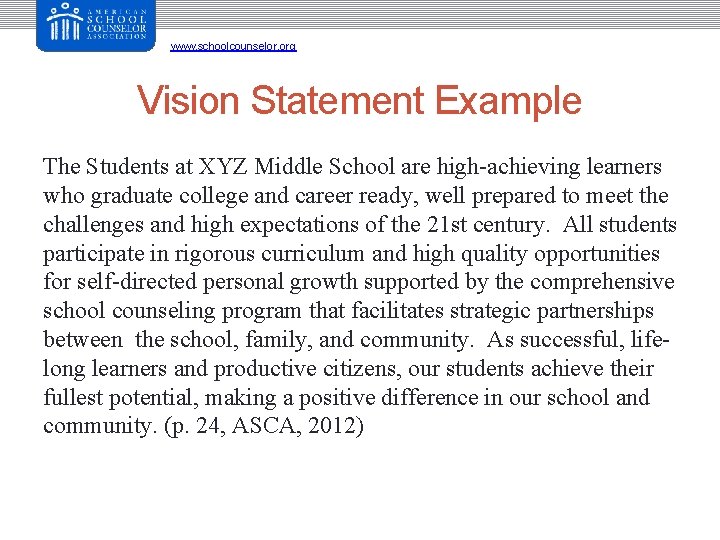
www. schoolcounselor. org Vision Statement Example The Students at XYZ Middle School are high-achieving learners who graduate college and career ready, well prepared to meet the challenges and high expectations of the 21 st century. All students participate in rigorous curriculum and high quality opportunities for self-directed personal growth supported by the comprehensive school counseling program that facilitates strategic partnerships between the school, family, and community. As successful, lifelong learners and productive citizens, our students achieve their fullest potential, making a positive difference in our school and community. (p. 24, ASCA, 2012)
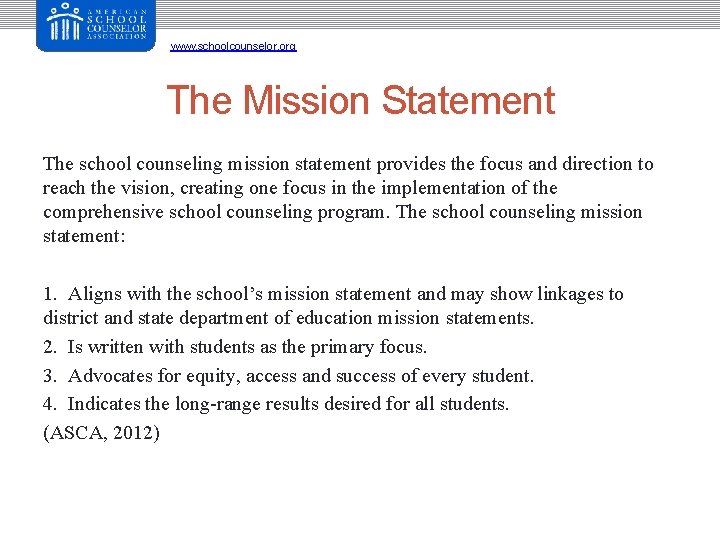
www. schoolcounselor. org The Mission Statement The school counseling mission statement provides the focus and direction to reach the vision, creating one focus in the implementation of the comprehensive school counseling program. The school counseling mission statement: 1. Aligns with the school’s mission statement and may show linkages to district and state department of education mission statements. 2. Is written with students as the primary focus. 3. Advocates for equity, access and success of every student. 4. Indicates the long-range results desired for all students. (ASCA, 2012)
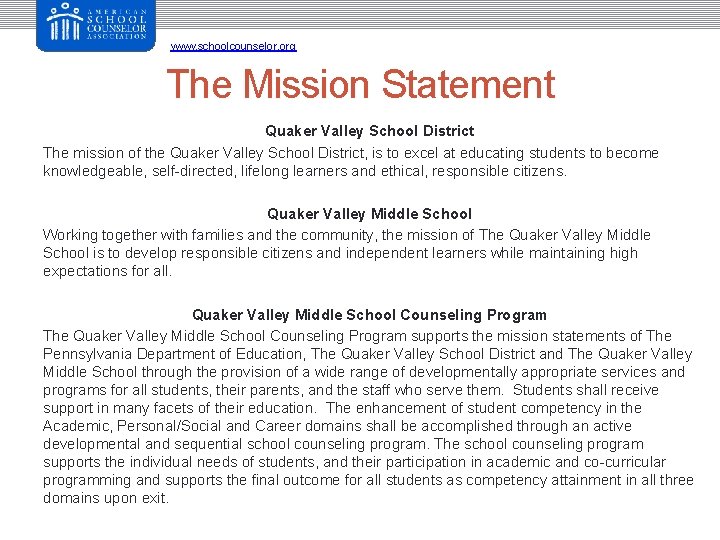
www. schoolcounselor. org The Mission Statement Quaker Valley School District The mission of the Quaker Valley School District, is to excel at educating students to become knowledgeable, self-directed, lifelong learners and ethical, responsible citizens. Quaker Valley Middle School Working together with families and the community, the mission of The Quaker Valley Middle School is to develop responsible citizens and independent learners while maintaining high expectations for all. Quaker Valley Middle School Counseling Program The Quaker Valley Middle School Counseling Program supports the mission statements of The Pennsylvania Department of Education, The Quaker Valley School District and The Quaker Valley Middle School through the provision of a wide range of developmentally appropriate services and programs for all students, their parents, and the staff who serve them. Students shall receive support in many facets of their education. The enhancement of student competency in the Academic, Personal/Social and Career domains shall be accomplished through an active developmental and sequential school counseling program. The school counseling program supports the individual needs of students, and their participation in academic and co-curricular programming and supports the final outcome for all students as competency attainment in all three domains upon exit.
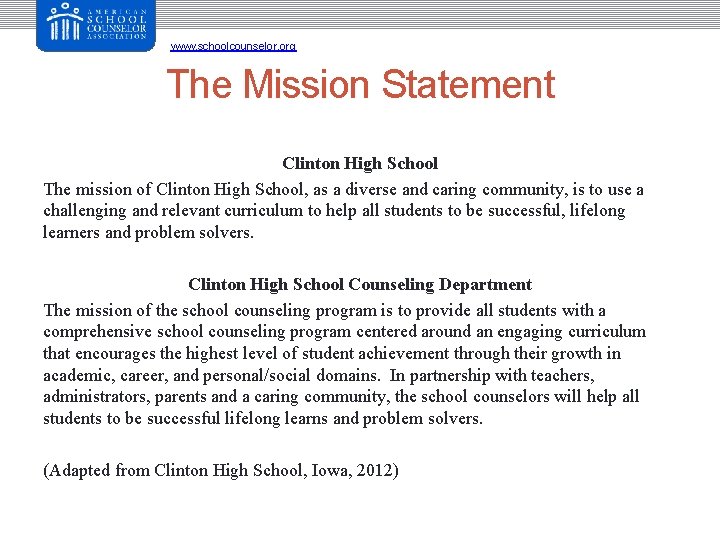
www. schoolcounselor. org The Mission Statement Clinton High School The mission of Clinton High School, as a diverse and caring community, is to use a challenging and relevant curriculum to help all students to be successful, lifelong learners and problem solvers. Clinton High School Counseling Department The mission of the school counseling program is to provide all students with a comprehensive school counseling program centered around an engaging curriculum that encourages the highest level of student achievement through their growth in academic, career, and personal/social domains. In partnership with teachers, administrators, parents and a caring community, the school counselors will help all students to be successful lifelong learns and problem solvers. (Adapted from Clinton High School, Iowa, 2012)
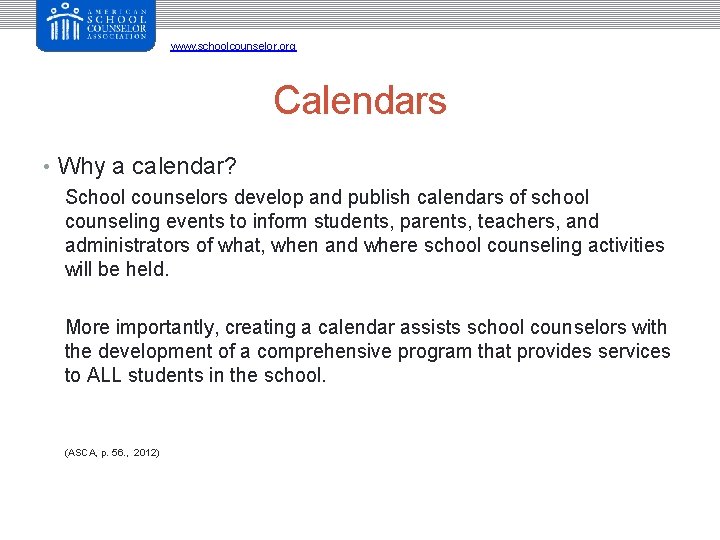
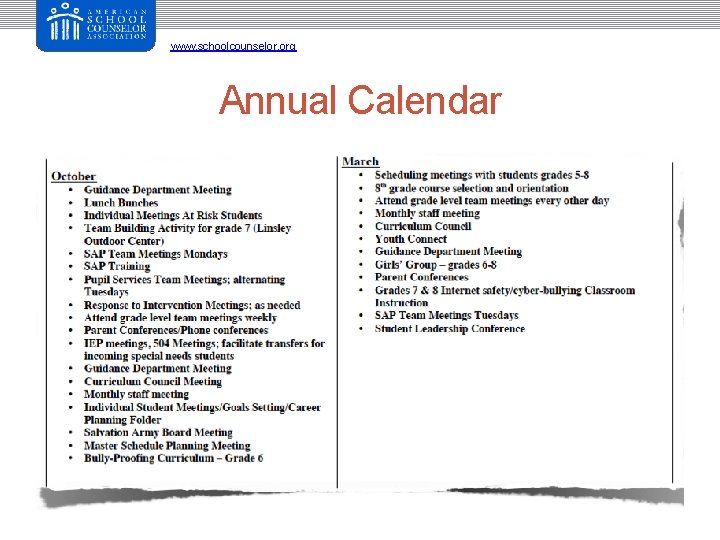
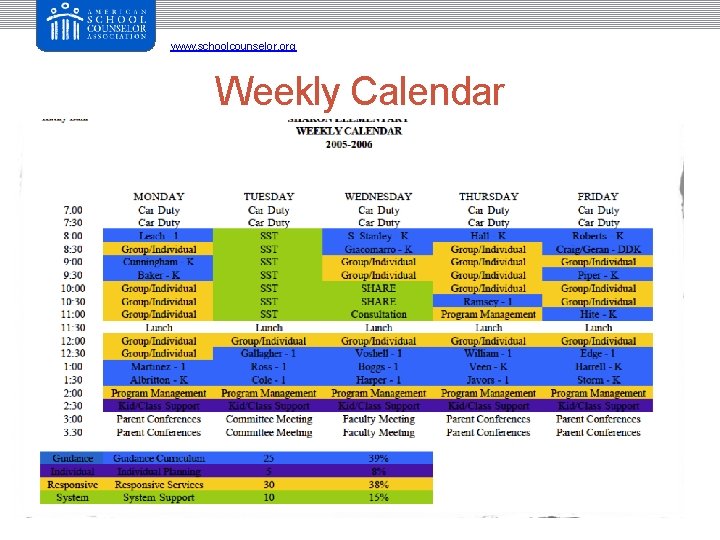
www. schoolcounselor. org Calendars • Why a calendar? School counselors develop and publish calendars of school counseling events to inform students, parents, teachers, and administrators of what, when and where school counseling activities will be held. More importantly, creating a calendar assists school counselors with the development of a comprehensive program that provides services to ALL students in the school. (ASCA, p. 56. , 2012)
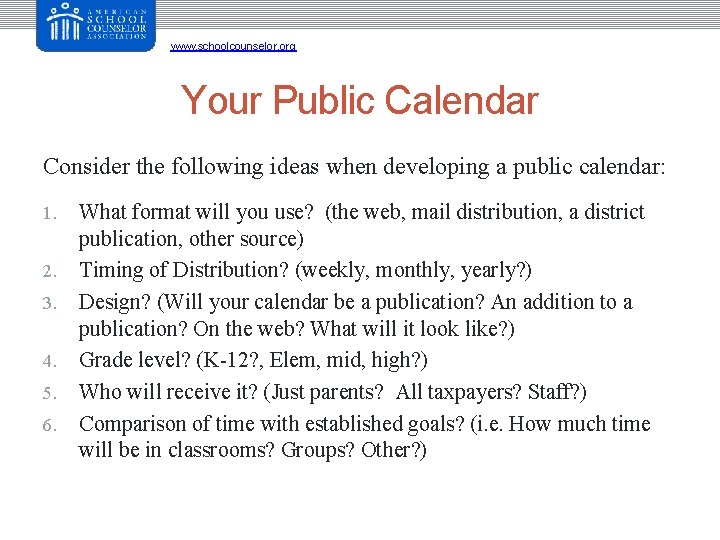
www. schoolcounselor. org Your Public Calendar Consider the following ideas when developing a public calendar: 1. 2. 3. 4. 5. 6. What format will you use? (the web, mail distribution, a district publication, other source) Timing of Distribution? (weekly, monthly, yearly? ) Design? (Will your calendar be a publication? An addition to a publication? On the web? What will it look like? ) Grade level? (K-12? , Elem, mid, high? ) Who will receive it? (Just parents? All taxpayers? Staff? ) Comparison of time with established goals? (i. e. How much time will be in classrooms? Groups? Other? )
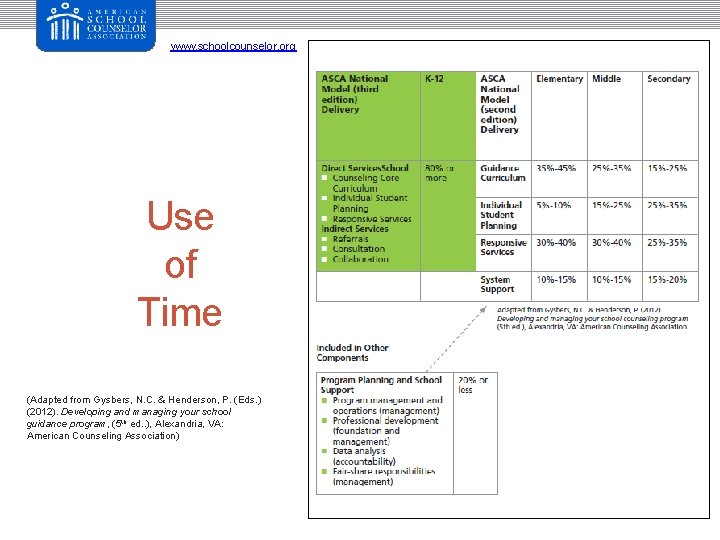
www. schoolcounselor. org Use of Time (Adapted from Gysbers, N. C. & Henderson, P. (Eds. ) (2012). Developing and managing your school guidance program, (5 th ed. . ), Alexandria, VA: American Counseling Association)
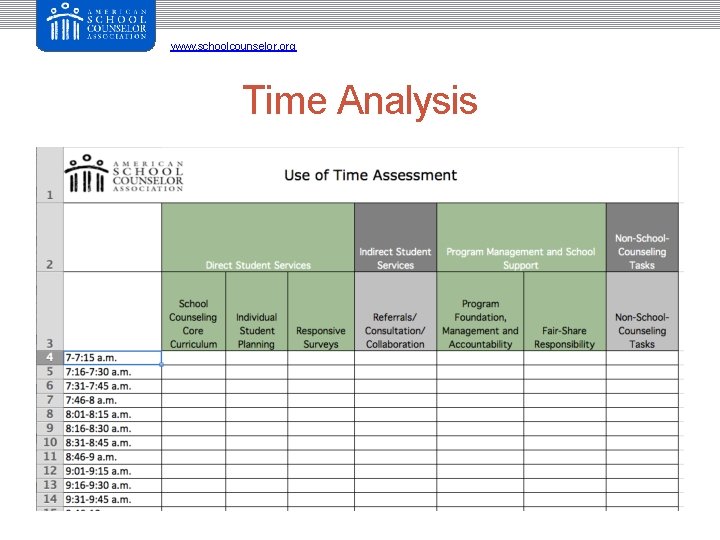
www. schoolcounselor. org Time Analysis
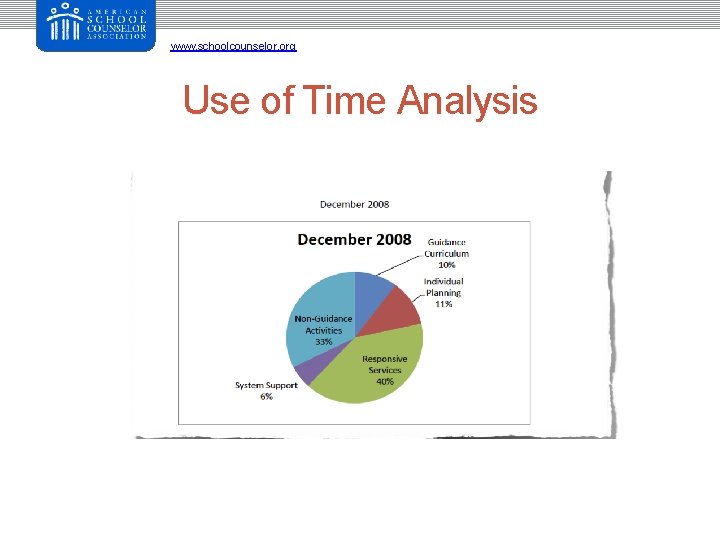
www. schoolcounselor. org Use of Time Analysis
www. schoolcounselor. org Annual Calendar
www. schoolcounselor. org Weekly Calendar
www. schoolcounselor. org Weekly Calendar
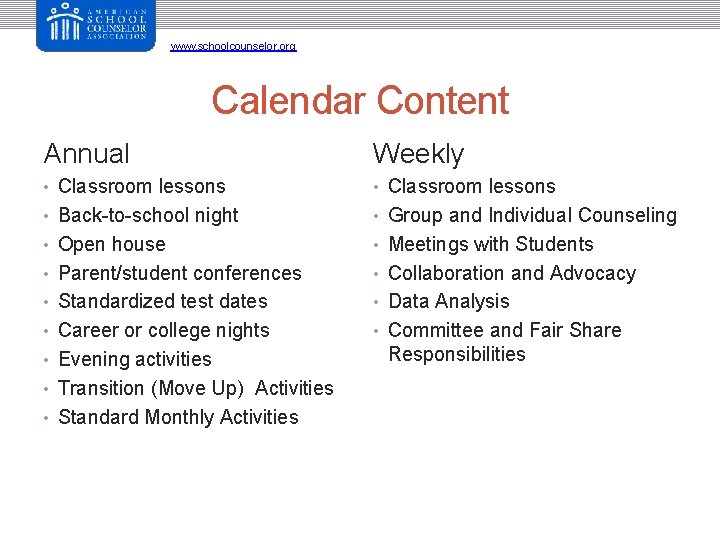
www. schoolcounselor. org Calendar Content Annual Weekly • Classroom lessons • Back-to-school night • Group and Individual Counseling • Open house • Meetings with Students • Parent/student conferences • Collaboration and Advocacy • Standardized test dates • Data Analysis • Career or college nights • Committee and Fair Share • Evening activities • Transition (Move Up) Activities • Standard Monthly Activities Responsibilities
www. schoolcounselor. org Final Thoughts… • Developing a model program takes time…with proper support and a stable staff, 3 -5 years. Be patient and steady. • Seek advice. If you know of a school who is currently implementing a model program, talk with the school counselors there. Invite them to share their journey with you. Don’t be afraid to ask. • Acquire and utilize the ASCA resources. For minimal cost, you can have all the resources you need right at your fingertips. It’s great professional development too. • TELL YOUR STORY to anyone who will listen! Be open to any opportunity to talk about your program and the difference it makes in kids. Share the data and the joy. • Best wishes on your RAMP journey!
www. schoolcounselor. org Thank you for being here! Questions?