
www pwc com Something to Be Called Tax
www. pwc. com Something to Be Called Tax Reform Cometh June 1, 2017 Pam Olson US Deputy Tax Leader & Washington National Tax Services Leader 202 414 1401 | pam. olson@pwc. com
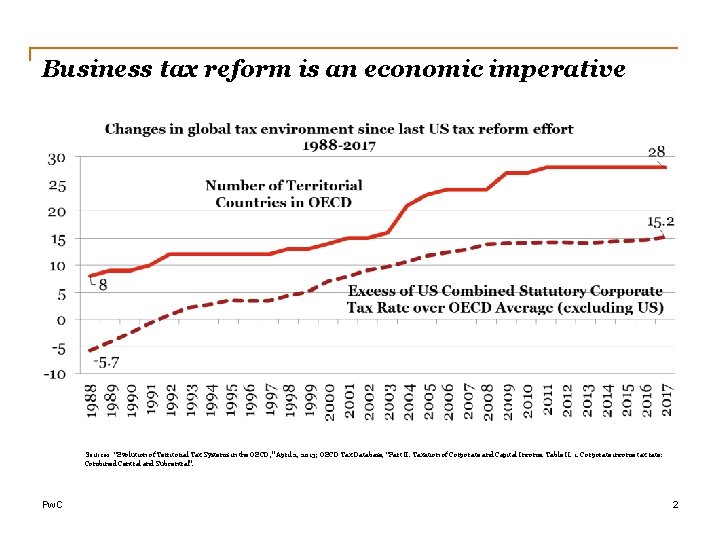
Business tax reform is an economic imperative Sources: “Evolution of Territorial Tax Systems in the OECD, ” April 2, 2013; OECD Tax Database, “Part II. Taxation of Corporate and Capital Income. Table II. 1. Corporate income tax rate: Combined Central and Subcentral”. Pw. C 2
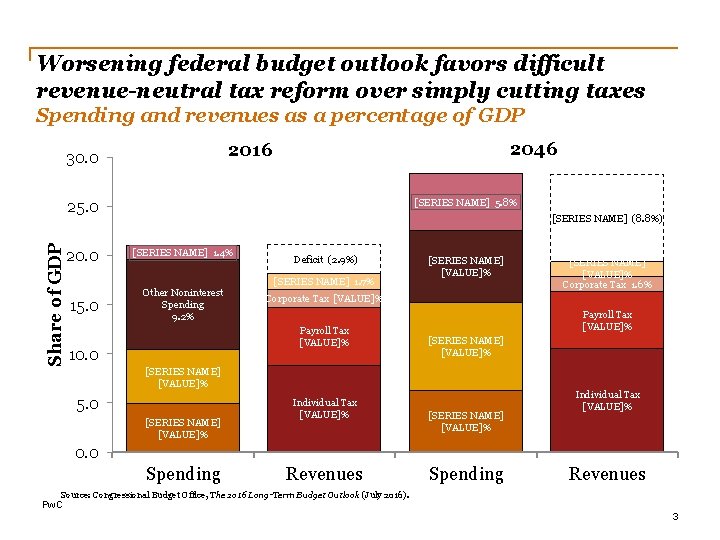
Worsening federal budget outlook favors difficult revenue-neutral tax reform over simply cutting taxes Spending and revenues as a percentage of GDP 2046 2016 30. 0 [SERIES NAME] 5. 8% Share of GDP 25. 0 [SERIES NAME] (8. 8%) 20. 0 [SERIES NAME] 1. 4% 15. 0 Other Noninterest Spending 9. 2% Deficit (2. 9%) [SERIES NAME] 1. 7% [SERIES NAME] [VALUE]% Corporate Tax 1. 6% Corporate Tax [VALUE]% Payroll Tax [VALUE]% 10. 0 [SERIES NAME] [VALUE]% Payroll Tax [VALUE]% [SERIES NAME] [VALUE]% 5. 0 [SERIES NAME] [VALUE]% Individual Tax [VALUE]% 0. 0 Spending Revenues Source: Congressional Budget Office, The 2016 Long-Term Budget Outlook (July 2016). Pw. C 3
Looking back to past reform efforts Tax Reform Act of 1986 (H. R. 3838) § Treasury I - November 1984 § Treasury II – May 1985 § Ways and Means hearings – 30 days of hearings between February and July 1985 § Ways and Means markup – 26 days of markup sessions between September and December 1985 § House passage of H. R. 3838 on December 17, 1985 § Finance Committee hearings – 36 days of hearings between May 1985 and April 1986 § Finance Committee markup – 17 days of markup sessions between March and May 1986 • Senate passage of H. R. 3838, as amended – on June 24, 1986, after 12 days of floor action • House/Senate Conference Committee – 4 days of formal conference committee meetings between July and August 1986 • House final passage of H. R. 3838 on September 25, 1986 • Senate final passage of H. R. 3838 on September 25, 1986 • President Reagan signs H. R. 3838 into law – October 22, 1986 Pw. C 4
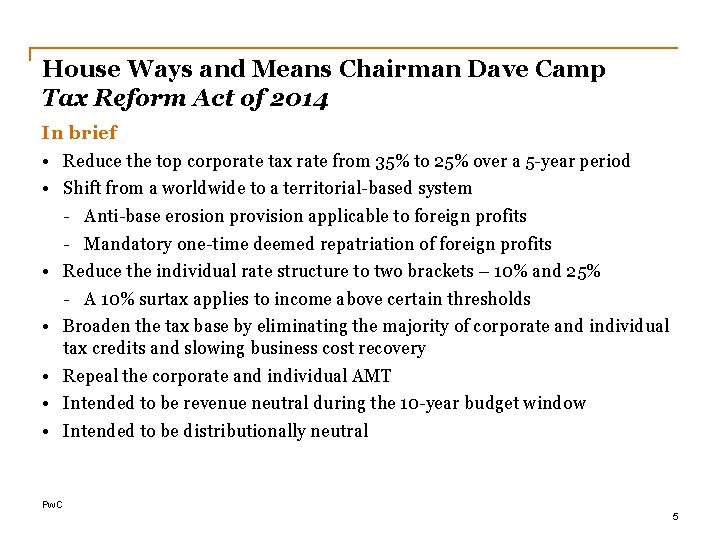
House Ways and Means Chairman Dave Camp Tax Reform Act of 2014 In brief • Reduce the top corporate tax rate from 35% to 25% over a 5 -year period • Shift from a worldwide to a territorial-based system - Anti-base erosion provision applicable to foreign profits - Mandatory one-time deemed repatriation of foreign profits • Reduce the individual rate structure to two brackets – 10% and 25% - A 10% surtax applies to income above certain thresholds • Broaden the tax base by eliminating the majority of corporate and individual tax credits and slowing business cost recovery • Repeal the corporate and individual AMT • Intended to be revenue neutral during the 10 -year budget window • Intended to be distributionally neutral Pw. C 5
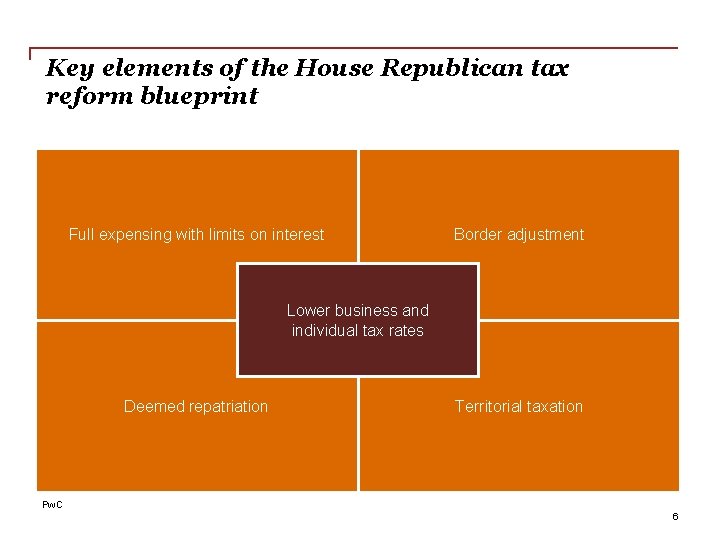
Key elements of the House Republican tax reform blueprint Full expensing with limits on interest Border adjustment Lower business and individual tax rates Deemed repatriation Territorial taxation Pw. C 6
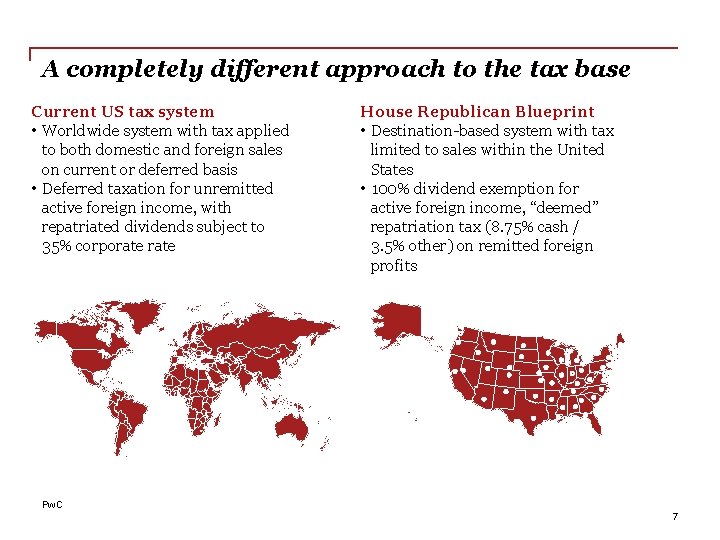
A completely different approach to the tax base Current US tax system • Worldwide system with tax applied to both domestic and foreign sales on current or deferred basis • Deferred taxation for unremitted active foreign income, with repatriated dividends subject to 35% corporate House Republican Blueprint • Destination-based system with tax limited to sales within the United States • 100% dividend exemption for active foreign income, “deemed” repatriation tax (8. 75% cash / 3. 5% other) on remitted foreign profits Pw. C 7
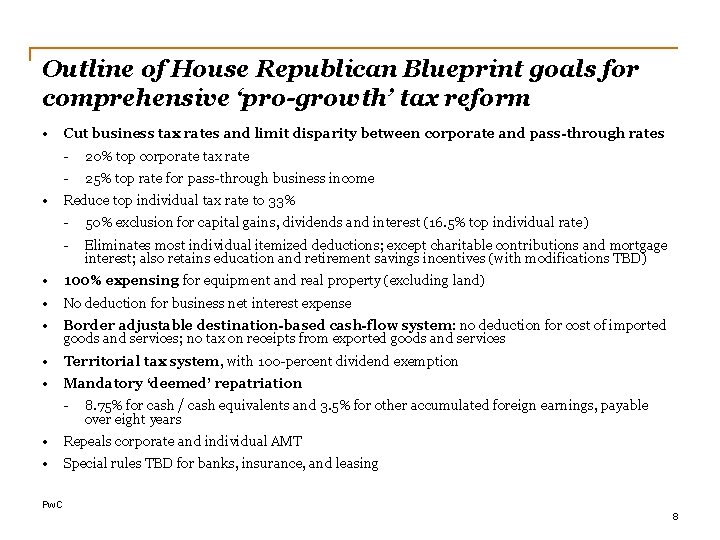
Outline of House Republican Blueprint goals for comprehensive ‘pro-growth’ tax reform • • Cut business tax rates and limit disparity between corporate and pass-through rates - 20% top corporate tax rate - 25% top rate for pass-through business income Reduce top individual tax rate to 33% - 50% exclusion for capital gains, dividends and interest (16. 5% top individual rate) - Eliminates most individual itemized deductions; except charitable contributions and mortgage interest; also retains education and retirement savings incentives (with modifications TBD) • 100% expensing for equipment and real property (excluding land) • No deduction for business net interest expense • Border adjustable destination-based cash-flow system: no deduction for cost of imported goods and services; no tax on receipts from exported goods and services • Territorial tax system, with 100 -percent dividend exemption • Mandatory ‘deemed’ repatriation - 8. 75% for cash / cash equivalents and 3. 5% for other accumulated foreign earnings, payable over eight years • Repeals corporate and individual AMT • Special rules TBD for banks, insurance, and leasing Pw. C 8
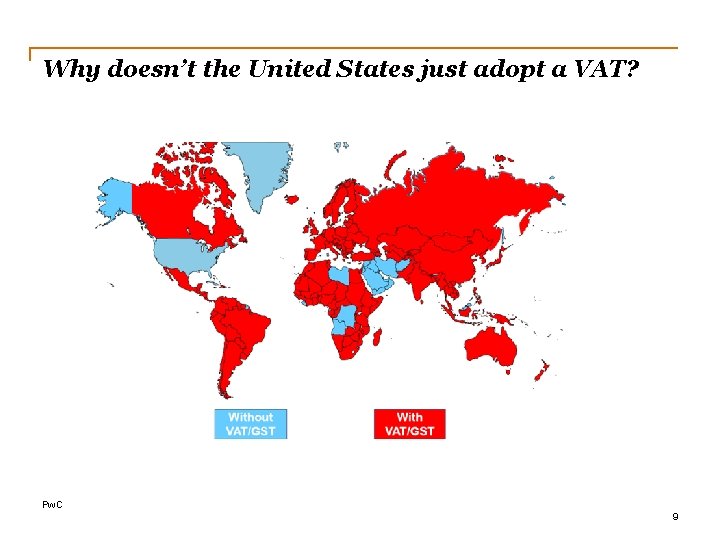
Why doesn’t the United States just adopt a VAT? Pw. C 9
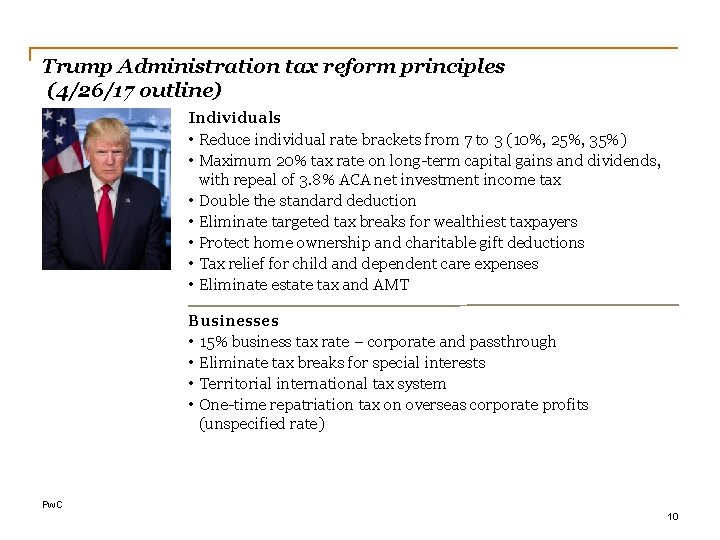
Trump Administration tax reform principles (4/26/17 outline) Individuals • Reduce individual rate brackets from 7 to 3 (10%, 25%, 35%) • Maximum 20% tax rate on long-term capital gains and dividends, with repeal of 3. 8% ACA net investment income tax • Double the standard deduction • Eliminate targeted tax breaks for wealthiest taxpayers • Protect home ownership and charitable gift deductions • Tax relief for child and dependent care expenses • Eliminate estate tax and AMT Businesses • 15% business tax rate – corporate and passthrough • Eliminate tax breaks for special interests • Territorial international tax system • One-time repatriation tax on overseas corporate profits (unspecified rate) Pw. C 10
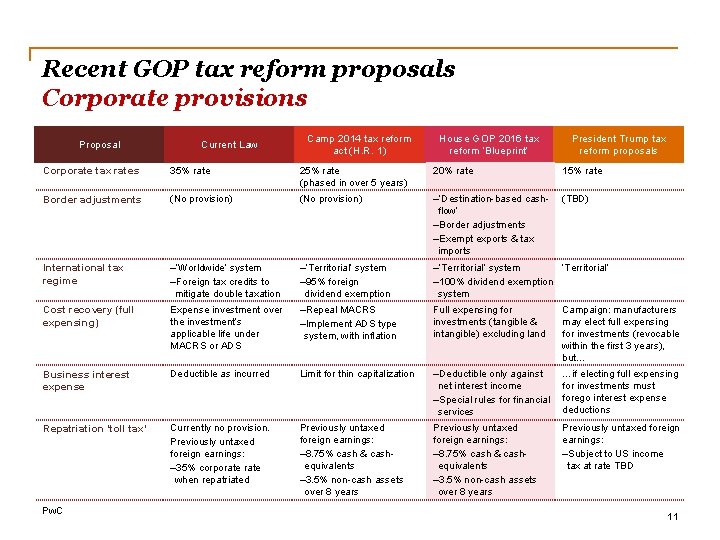
Recent GOP tax reform proposals Corporate provisions Proposal Current Law Camp 2014 tax reform act (H. R. 1) House GOP 2016 tax reform ‘Blueprint’ President Trump tax reform proposals Corporate tax rates 35% rate 25% rate (phased in over 5 years) 20% rate 15% rate Border adjustments (No provision) –‘Destination-based cashflow’ –Border adjustments –Exempt exports & tax imports (TBD) International tax regime –‘Worldwide’ system –Foreign tax credits to mitigate double taxation –‘Territorial’ system – 95% foreign dividend exemption –‘Territorial’ system ‘Territorial’ – 100% dividend exemption system Cost recovery (full expensing) Expense investment over the investment’s applicable life under MACRS or ADS –Repeal MACRS –Implement ADS type system, with inflation Full expensing for investments (tangible & intangible) excluding land Campaign: manufacturers may elect full expensing for investments (revocable within the first 3 years), but… Business interest expense Deductible as incurred Limit for thin capitalization –Deductible only against net interest income –Special rules for financial services …if electing full expensing for investments must forego interest expense deductions Repatriation ‘toll tax’ Currently no provision. Previously untaxed foreign earnings: – 35% corporate when repatriated Previously untaxed foreign earnings: – 8. 75% cash & cashequivalents – 3. 5% non-cash assets over 8 years Previously untaxed foreign earnings: –Subject to US income tax at rate TBD Pw. C 11
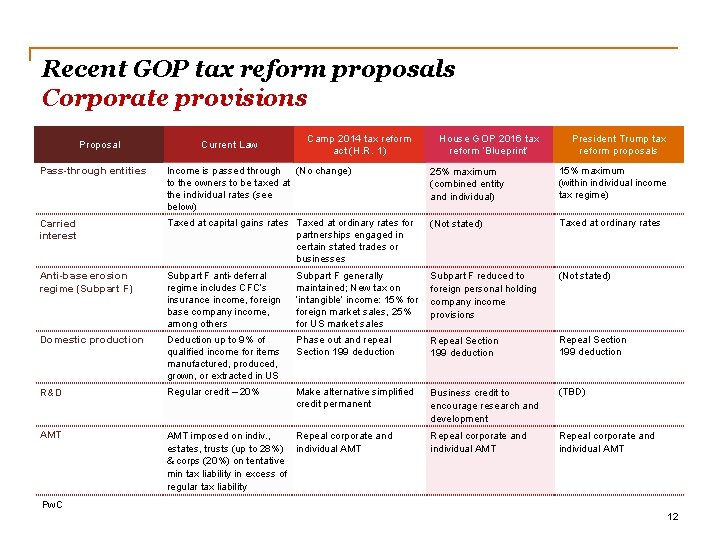
Recent GOP tax reform proposals Corporate provisions Proposal Current Law Camp 2014 tax reform act (H. R. 1) House GOP 2016 tax reform ‘Blueprint’ President Trump tax reform proposals Pass-through entities Income is passed through (No change) to the owners to be taxed at the individual rates (see below) 25% maximum (combined entity and individual) 15% maximum (within individual income tax regime) Carried interest Taxed at capital gains rates Taxed at ordinary rates for partnerships engaged in certain stated trades or businesses (Not stated) Taxed at ordinary rates Anti-base erosion regime (Subpart F) Subpart F anti-deferral regime includes CFC’s insurance income, foreign base company income, among others Subpart F generally maintained; New tax on ‘intangible’ income: 15% foreign market sales, 25% for US market sales Subpart F reduced to foreign personal holding company income provisions (Not stated) Domestic production Deduction up to 9% of qualified income for items manufactured, produced, grown, or extracted in US Phase out and repeal Section 199 deduction Repeal Section 199 deduction R&D Regular credit – 20% Make alternative simplified credit permanent Business credit to encourage research and development (TBD) AMT imposed on indiv. , Repeal corporate and estates, trusts (up to 28%) individual AMT & corps (20%) on tentative min tax liability in excess of regular tax liability Repeal corporate and individual AMT Pw. C 12
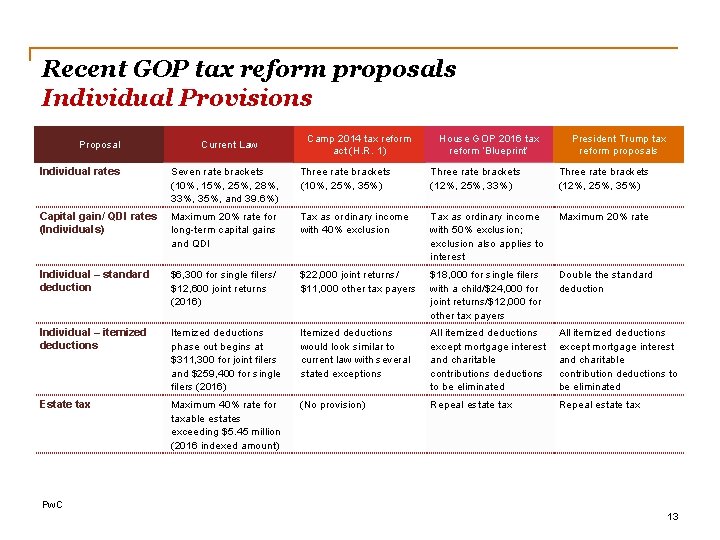
Recent GOP tax reform proposals Individual Provisions Proposal Current Law Camp 2014 tax reform act (H. R. 1) House GOP 2016 tax reform ‘Blueprint’ President Trump tax reform proposals Individual rates Seven rate brackets (10%, 15%, 28%, 33%, 35%, and 39. 6%) Three rate brackets (10%, 25%, 35%) Three rate brackets (12%, 25%, 33%) Three rate brackets (12%, 25%, 35%) Capital gain/ QDI rates (Individuals) Maximum 20% rate for long-term capital gains and QDI Tax as ordinary income with 40% exclusion Tax as ordinary income with 50% exclusion; exclusion also applies to interest Maximum 20% rate Individual – standard deduction $6, 300 for single filers/ $12, 600 joint returns (2016) $22, 000 joint returns/ $11, 000 other tax payers $18, 000 for single filers with a child/$24, 000 for joint returns/$12, 000 for other tax payers Double the standard deduction Individual – itemized deductions Itemized deductions phase out begins at $311, 300 for joint filers and $259, 400 for single filers (2016) Itemized deductions would look similar to current law with several stated exceptions All itemized deductions except mortgage interest and charitable contributions deductions to be eliminated All itemized deductions except mortgage interest and charitable contribution deductions to be eliminated Estate tax Maximum 40% rate for taxable estates exceeding $5. 45 million (2016 indexed amount) (No provision) Repeal estate tax Pw. C 13
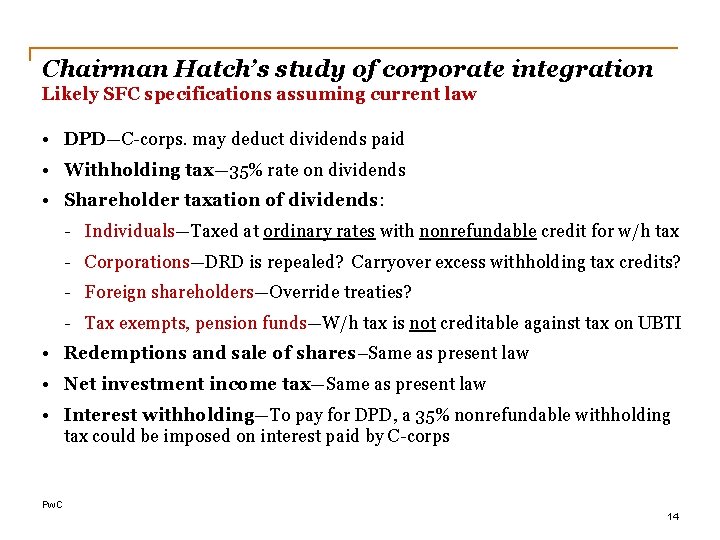
Chairman Hatch’s study of corporate integration Likely SFC specifications assuming current law • DPD—C-corps. may deduct dividends paid • Withholding tax— 35% rate on dividends • Shareholder taxation of dividends: - Individuals—Taxed at ordinary rates with nonrefundable credit for w/h tax - Corporations—DRD is repealed? Carryover excess withholding tax credits? - Foreign shareholders—Override treaties? - Tax exempts, pension funds—W/h tax is not creditable against tax on UBTI • Redemptions and sale of shares–Same as present law • Net investment income tax—Same as present law • Interest withholding—To pay for DPD, a 35% nonrefundable withholding tax could be imposed on interest paid by C-corps Pw. C 14
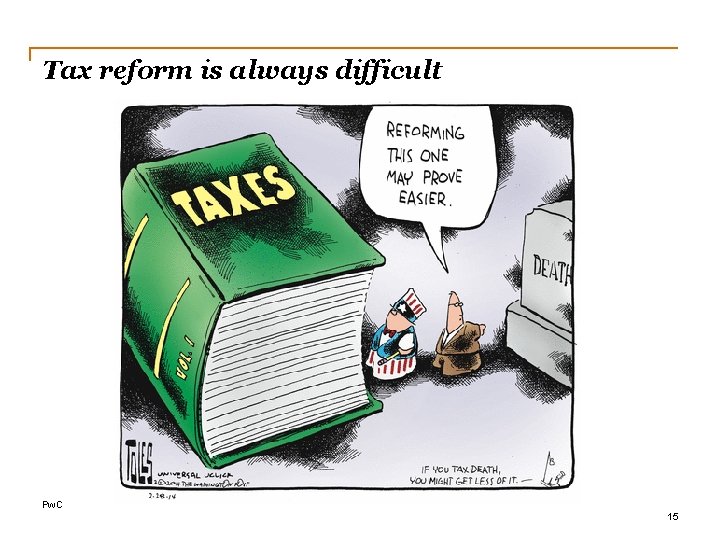
Tax reform is always difficult Pw. C 15
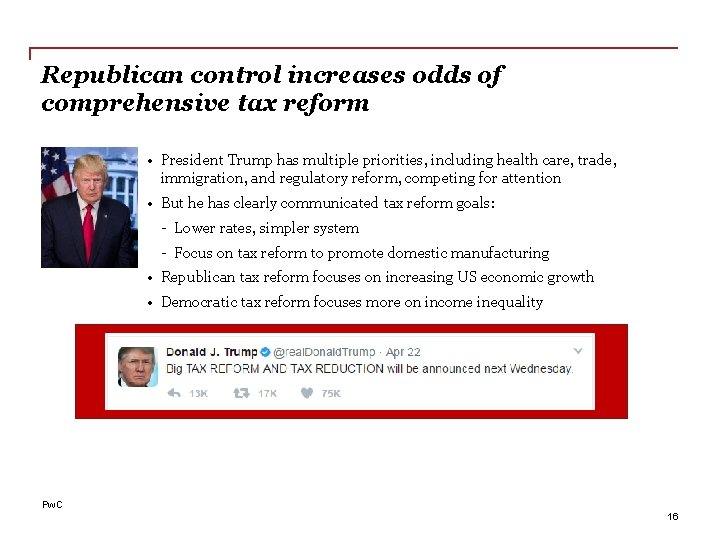
Republican control increases odds of comprehensive tax reform • President Trump has multiple priorities, including health care, trade, immigration, and regulatory reform, competing for attention • But he has clearly communicated tax reform goals: - Lower rates, simpler system - Focus on tax reform to promote domestic manufacturing • Republican tax reform focuses on increasing US economic growth • Democratic tax reform focuses more on income inequality Pw. C 16
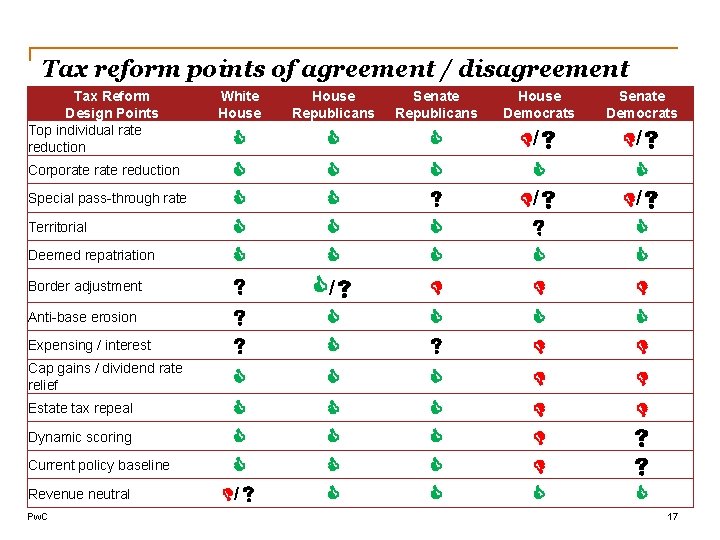
Tax reform points of agreement / disagreement Tax Reform Design Points Top individual rate reduction White House Republicans Senate Republicans House Democrats Senate Democrats C C C D/s Deemed repatriation C C Border adjustment s Anti-base erosion s Expensing / interest C C s C C D/s C C C/s D D D C s C D Cap gains / dividend rate relief C C C D D Estate tax repeal C C C D D D C D s s C Corporate reduction Special pass-through rate Territorial Dynamic scoring Current policy baseline Revenue neutral Pw. C D/s s 17
This document is provided by Pricewaterhouse. Coopers LLP for general guidance only, and does not constitute the provision of legal advice, accounting services, investment advice, written tax advice under Circular 230 or professional advice of any kind. The information provided herein should not be used as a substitute for consultation with professional tax, accounting, legal or other competent advisors. Before making any decision or taking any action, you should consult with a professional adviser who has been provided with all pertinent facts relevant to your particular situation. The information is provided ‘as is’ with no assurance or guarantee of completeness, accuracy or timeliness of the information, and without warranty of any kind, express or implied, including but not limited to warranties or performance, merchantability, and fitness for a particular purpose.
- Slides: 18