
www pwc com Mergers acquisitions Federal and state


- Slides: 29
www. pwc. com Mergers & acquisitions – Federal and state Sean Kelly, M&A Director
Agenda • Tax due diligence basics • Tax structuring and modelling basics • M&A tax technical update/developments Pw. C | Mergers & acquisitions – Federal and state 2
Section 0. 0. 1 Tax due diligence basics Pw. C | Mergers & acquisitions – Federal and state 3
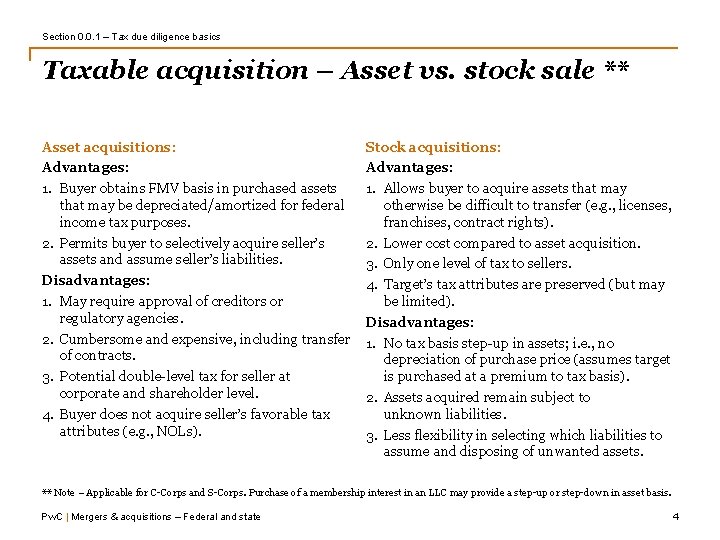
Section 0. 0. 1 – Tax due diligence basics Taxable acquisition – Asset vs. stock sale ** Asset acquisitions: Advantages: 1. Buyer obtains FMV basis in purchased assets that may be depreciated/amortized for federal income tax purposes. 2. Permits buyer to selectively acquire seller’s assets and assume seller’s liabilities. Disadvantages: 1. May require approval of creditors or regulatory agencies. 2. Cumbersome and expensive, including transfer of contracts. 3. Potential double-level tax for seller at corporate and shareholder level. 4. Buyer does not acquire seller’s favorable tax attributes (e. g. , NOLs). Stock acquisitions: Advantages: 1. Allows buyer to acquire assets that may otherwise be difficult to transfer (e. g. , licenses, franchises, contract rights). 2. Lower cost compared to asset acquisition. 3. Only one level of tax to sellers. 4. Target’s tax attributes are preserved (but may be limited). Disadvantages: 1. No tax basis step-up in assets; i. e. , no depreciation of purchase price (assumes target is purchased at a premium to tax basis). 2. Assets acquired remain subject to unknown liabilities. 3. Less flexibility in selecting which liabilities to assume and disposing of unwanted assets. ** Note – Applicable for C-Corps and S-Corps. Purchase of a membership interest in an LLC may provide a step-up or step-down in asset basis. Pw. C | Mergers & acquisitions – Federal and state 4
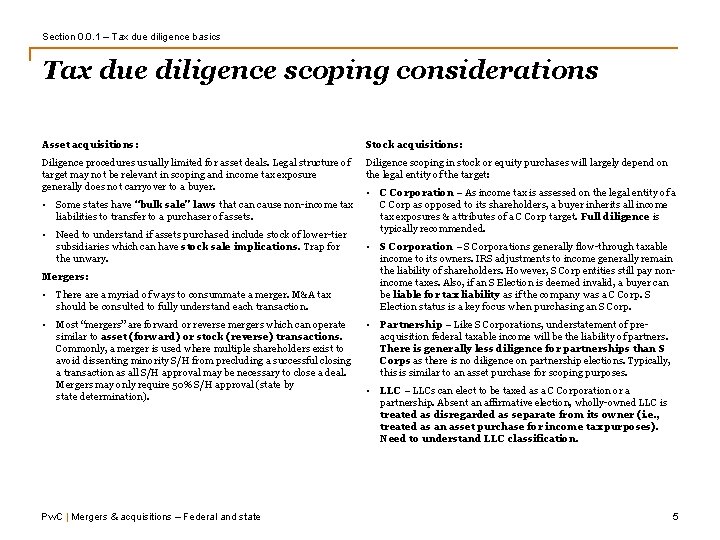
Section 0. 0. 1 – Tax due diligence basics Tax due diligence scoping considerations Asset acquisitions: Stock acquisitions: Diligence procedures usually limited for asset deals. Legal structure of target may not be relevant in scoping and income tax exposure generally does not carryover to a buyer. Diligence scoping in stock or equity purchases will largely depend on the legal entity of the target: • Some states have “bulk sale” laws that can cause non-income tax liabilities to transfer to a purchaser of assets. • Need to understand if assets purchased include stock of lower-tier subsidiaries which can have stock sale implications. Trap for the unwary. • C Corporation – As income tax is assessed on the legal entity of a C Corp as opposed to its shareholders, a buyer inherits all income tax exposures & attributes of a C Corp target. Full diligence is typically recommended. • S Corporation – S Corporations generally flow-through taxable income to its owners. IRS adjustments to income generally remain the liability of shareholders. However, S Corp entities still pay nonincome taxes. Also, if an S Election is deemed invalid, a buyer can be liable for tax liability as if the company was a C Corp. S Election status is a key focus when purchasing an S Corp. • Partnership – Like S Corporations, understatement of preacquisition federal taxable income will be the liability of partners. There is generally less diligence for partnerships than S Corps as there is no diligence on partnership elections. Typically, this is similar to an asset purchase for scoping purposes. • LLC – LLCs can elect to be taxed as a C Corporation or a partnership. Absent an affirmative election, wholly-owned LLC is treated as disregarded as separate from its owner (i. e. , treated as an asset purchase for income tax purposes). Need to understand LLC classification. Mergers: • There a myriad of ways to consummate a merger. M&A tax should be consulted to fully understand each transaction. • Most “mergers” are forward or reverse mergers which can operate similar to asset (forward) or stock (reverse) transactions. Commonly, a merger is used where multiple shareholders exist to avoid dissenting minority S/H from precluding a successful closing a transaction as all S/H approval may be necessary to close a deal. Mergers may only require 50% S/H approval (state by state determination). Pw. C | Mergers & acquisitions – Federal and state 5
Diligence procedures – Valuing tax attributes Objective – A Buyer and Seller should fully inventory and understand all tax attributes that can carryover in stock purchase or that can exist within a transaction. Tax Attributes can include: • Net operating losses (“NOLs”) • Credit Carryforwards (e. g. , R&D credits, foreign tax credits, state incentives) • Deductibility of Transactions Expenses (both buyers and sellers). Examples include: - Stock options - Capitalized loan costs - Transaction bonuses • Ability of a seller to offer a step-up in basis (i. e. , Section 338(h)(10) election as described later) To fully realize their benefits, identification and quantification of tax attributes should be addressed in a purchase agreement. For example, a buyer may have to consider language in a sales agreement allowing a buyer to make certain elections to be made in tax returns from prior years. Sellers should assess and compute value and develop strategy to sell/market their tax attributes to potential buyers in sell-side engagements. Pw. C | Mergers & acquisitions – Federal and state 6
Section 0. 0. 1 – Tax due diligence basics State/International tax diligence considerations State nexus Key international diligence considerations • Nexus, for state tax purposes, is the minimum threshold level of activity a taxpayer must have within a specific state to subject the taxpayer to a state’s various corporate taxes. • • Public Law No. 86 -272 prohibits states from taxing the income of a corporation whose only business activity within the state consists of solicitation of orders for sales of tangible personal property. Overall structure – International structures can provide significant shareholder value if structured in a tax efficient way. A buyer needs to understand a target’s international profile to understand post-integration savings that could result from a structure. • Permanent establishment – Similar to the nexus concept for states, in an international context, a company can trigger a filing requirement by conducting business in other countries. This is known as permanent establishment (frequently called “PE”). Tracking PE can be difficult for multi-national companies. • Transfer pricing – Intercompany transactions occurring crossborder need to be priced according to arm’s length standards. The U. S. and other taxing authorities have complex rules around transfer pricing. This is an area of high visibility for taxing authorities and thus needs to be reviewed in the course of due diligence. • Typically, to the extent that the Company has property in a state or performs services beyond mere solicitation, it has generally created nexus and will be subject to that state’s taxes. Identifying state nexus exposure • A company with significant business conducted in states (measured as sales, property and payroll) in which they are not filing are potential nexus exposure candidates. Sales/use tax • Sales tax is required to be collected by companies when their sales do not qualify for sales tax exemptions. Due to the subjectivity and varying rules in each state, many companies incorrectly apply sales tax exemptions giving rise to a tax exposure. • Additionally, sales tax nexus is said to be triggered if you “sneeze” on a state. • As sales/use is a non-income tax, diligence procedures need to be considered in asset and stock transactions. Pw. C | Mergers & acquisitions – Federal and state 7
Section 0. 0. 2 Tax structuring & modeling basics Pw. C | Mergers & acquisitions – Federal and state 8
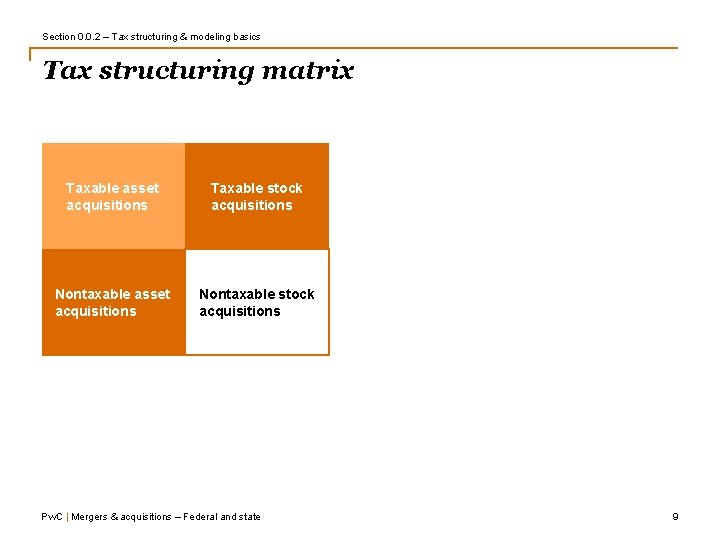
Section 0. 0. 2 – Tax structuring & modeling basics Tax structuring matrix Taxable asset acquisitions Taxable stock acquisitions Nontaxable asset acquisitions Nontaxable stock acquisitions Pw. C | Mergers & acquisitions – Federal and state 9
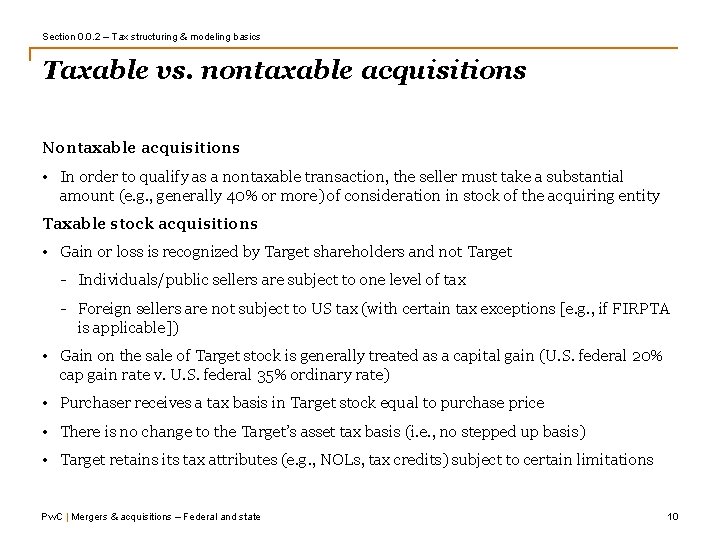
Section 0. 0. 2 – Tax structuring & modeling basics Taxable vs. nontaxable acquisitions Nontaxable acquisitions • In order to qualify as a nontaxable transaction, the seller must take a substantial amount (e. g. , generally 40% or more) of consideration in stock of the acquiring entity Taxable stock acquisitions • Gain or loss is recognized by Target shareholders and not Target - Individuals/public sellers are subject to one level of tax - Foreign sellers are not subject to US tax (with certain tax exceptions [e. g. , if FIRPTA is applicable]) • Gain on the sale of Target stock is generally treated as a capital gain (U. S. federal 20% cap gain rate v. U. S. federal 35% ordinary rate) • Purchaser receives a tax basis in Target stock equal to purchase price • There is no change to the Target’s asset tax basis (i. e. , no stepped up basis) • Target retains its tax attributes (e. g. , NOLs, tax credits) subject to certain limitations Pw. C | Mergers & acquisitions – Federal and state 10
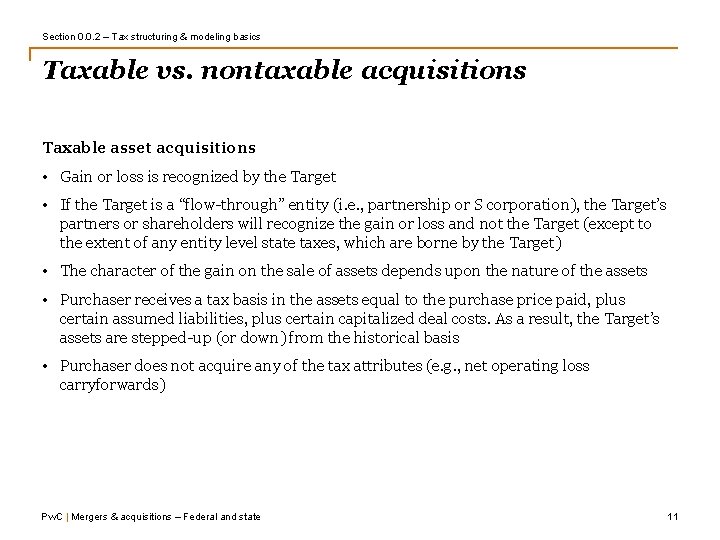
Section 0. 0. 2 – Tax structuring & modeling basics Taxable vs. nontaxable acquisitions Taxable asset acquisitions • Gain or loss is recognized by the Target • If the Target is a “flow-through” entity (i. e. , partnership or S corporation), the Target’s partners or shareholders will recognize the gain or loss and not the Target (except to the extent of any entity level state taxes, which are borne by the Target) • The character of the gain on the sale of assets depends upon the nature of the assets • Purchaser receives a tax basis in the assets equal to the purchase price paid, plus certain assumed liabilities, plus certain capitalized deal costs. As a result, the Target’s assets are stepped-up (or down) from the historical basis • Purchaser does not acquire any of the tax attributes (e. g. , net operating loss carryforwards) Pw. C | Mergers & acquisitions – Federal and state 11
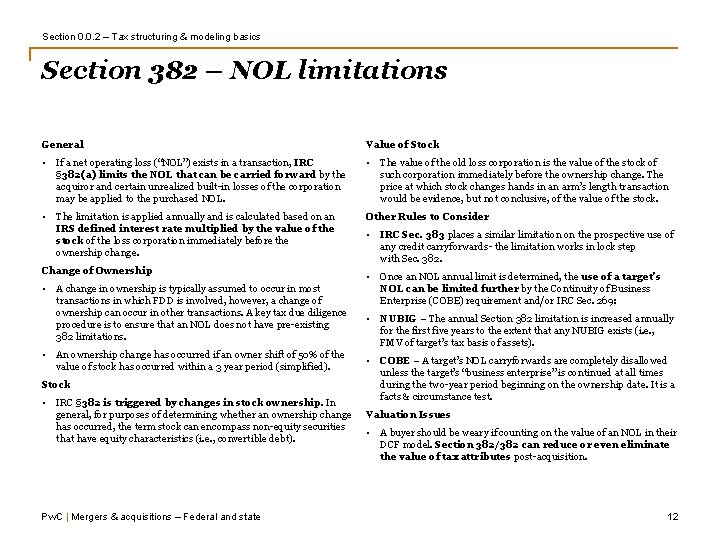
Section 0. 0. 2 – Tax structuring & modeling basics Section 382 – NOL limitations General Value of Stock • If a net operating loss (“NOL”) exists in a transaction, IRC § 382(a) limits the NOL that can be carried forward by the acquiror and certain unrealized built-in losses of the corporation may be applied to the purchased NOL. • • The limitation is applied annually and is calculated based on an IRS defined interest rate multiplied by the value of the stock of the loss corporation immediately before the ownership change. Other Rules to Consider Change of Ownership • • A change in ownership is typically assumed to occur in most transactions in which FDD is involved, however, a change of ownership can occur in other transactions. A key tax due diligence procedure is to ensure that an NOL does not have pre-existing 382 limitations. An ownership change has occurred if an owner shift of 50% of the value of stock has occurred within a 3 year period (simplified). • IRC Sec. 383 places a similar limitation on the prospective use of any credit carryforwards- the limitation works in lock step with Sec. 382. • Once an NOL annual limit is determined, the use of a target’s NOL can be limited further by the Continuity of Business Enterprise (COBE) requirement and/or IRC Sec. 269: • NUBIG – The annual Section 382 limitation is increased annually for the first five years to the extent that any NUBIG exists (i. e. , FMV of target’s tax basis of assets). • COBE – A target’s NOL carryforwards are completely disallowed unless the target’s “business enterprise” is continued at all times during the two-year period beginning on the ownership date. It is a facts & circumstance test. Stock • IRC § 382 is triggered by changes in stock ownership. In general, for purposes of determining whether an ownership change has occurred, the term stock can encompass non-equity securities that have equity characteristics (i. e. , convertible debt). Pw. C | Mergers & acquisitions – Federal and state The value of the old loss corporation is the value of the stock of such corporation immediately before the ownership change. The price at which stock changes hands in an arm’s length transaction would be evidence, but not conclusive, of the value of the stock. Valuation Issues • A buyer should be weary if counting on the value of an NOL in their DCF model. Section 382/382 can reduce or even eliminate the value of tax attributes post-acquisition. 12
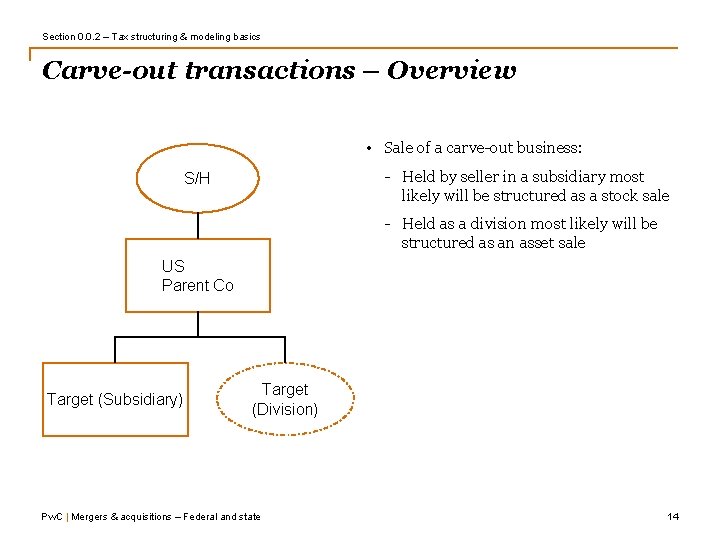
Section 0. 0. 2 – Tax structuring & modeling basics Carve-out transactions – Overview • There is generally greater flexibility for tax structuring in carve-out transactions with respect to: - Step-up in tax basis - Debt placement • Carve-out transactions may be structured as a stock purchase or asset purchase (or a combination of both) depending on how the seller’s structure is organized Pw. C | Mergers & acquisitions – Federal and state 13
Section 0. 0. 2 – Tax structuring & modeling basics Carve-out transactions – Overview • Sale of a carve-out business: - Held by seller in a subsidiary most likely will be structured as a stock sale S/H - Held as a division most likely will be structured as an asset sale US Parent Co Target (Subsidiary) Target (Division) Pw. C | Mergers & acquisitions – Federal and state 14
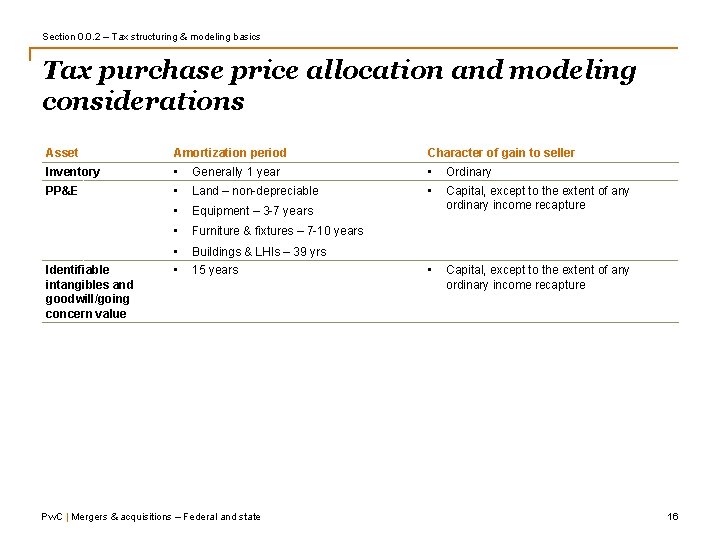
Section 0. 0. 2 – Tax structuring & modeling basics Tax purchase price allocation • Purchase price allocation in an asset purchase will impact: - Purchaser’s basis in individual assets, future depreciation and amortization - Target’s character of asset sale gain • The allocation of purchase price for tax purposes is similar to GAAP – purchase price is allocated from most liquid to least liquid Pw. C | Mergers & acquisitions – Federal and state 15
Section 0. 0. 2 – Tax structuring & modeling basics Tax purchase price allocation and modeling considerations Asset Amortization period Character of gain to seller Inventory • • Generally 1 year • • Ordinary • Equipment – 3 -7 years • Furniture & fixtures – 7 -10 years • • Buildings & LHIs – 39 yrs • Capital, except to the extent of any ordinary income recapture PP&E Identifiable intangibles and goodwill/going concern value Land – non-depreciable 15 years Pw. C | Mergers & acquisitions – Federal and state Capital, except to the extent of any ordinary income recapture 16
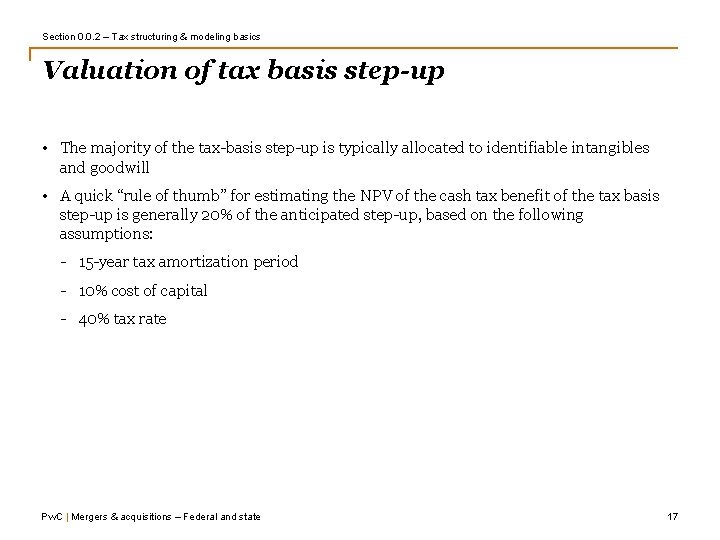
Section 0. 0. 2 – Tax structuring & modeling basics Valuation of tax basis step-up • The majority of the tax-basis step-up is typically allocated to identifiable intangibles and goodwill • A quick “rule of thumb” for estimating the NPV of the cash tax benefit of the tax basis step-up is generally 20% of the anticipated step-up, based on the following assumptions: - 15 -year tax amortization period - 10% cost of capital - 40% tax rate Pw. C | Mergers & acquisitions – Federal and state 17
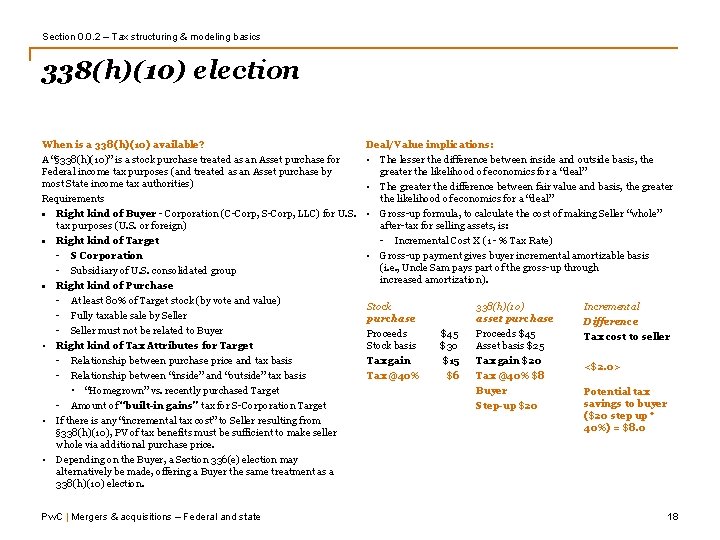
Section 0. 0. 2 – Tax structuring & modeling basics 338(h)(10) election When is a 338(h)(10) available? A “§ 338(h)(10)” is a stock purchase treated as an Asset purchase for Federal income tax purposes (and treated as an Asset purchase by most State income tax authorities) Requirements • Right kind of Buyer - Corporation (C-Corp, S-Corp, LLC) for U. S. tax purposes (U. S. or foreign) • Right kind of Target - S Corporation - Subsidiary of U. S. consolidated group • Right kind of Purchase - At least 80% of Target stock (by vote and value) - Fully taxable sale by Seller - Seller must not be related to Buyer • Right kind of Tax Attributes for Target - Relationship between purchase price and tax basis - Relationship between “inside” and “outside” tax basis ◦ “Homegrown” vs. recently purchased Target • • - Amount of “built-in gains” tax for S-Corporation Target If there is any “incremental tax cost” to Seller resulting from § 338(h)(10), PV of tax benefits must be sufficient to make seller whole via additional purchase price. Depending on the Buyer, a Section 336(e) election may alternatively be made, offering a Buyer the same treatment as a 338(h)(10) election. Pw. C | Mergers & acquisitions – Federal and state Deal/Value implications: • The lesser the difference between inside and outside basis, the greater the likelihood of economics for a “deal” • The greater the difference between fair value and basis, the greater the likelihood of economics for a “deal” • Gross-up formula, to calculate the cost of making Seller “whole” after-tax for selling assets, is: - Incremental Cost X (1 - % Tax Rate) • Gross-up payment gives buyer incremental amortizable basis (i. e. , Uncle Sam pays part of the gross-up through increased amortization). Stock purchase Proceeds Stock basis Tax gain Tax @40% $45 $30 $15 $6 338(h)(10) asset purchase Proceeds $45 Asset basis $25 Tax gain $20 Tax @40% $8 Buyer Step-up $20 Incremental Difference Tax cost to seller <$2. 0> Potential tax savings to buyer ($20 step up * 40%) = $8. 0 18
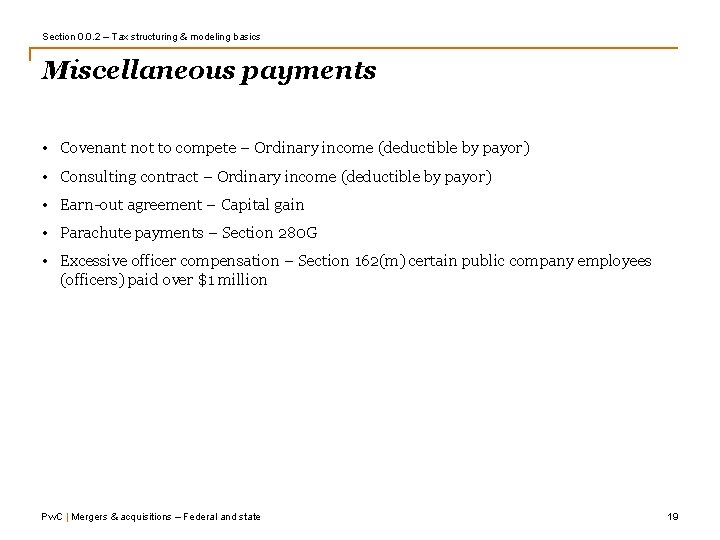
Section 0. 0. 2 – Tax structuring & modeling basics Miscellaneous payments • Covenant not to compete – Ordinary income (deductible by payor) • Consulting contract – Ordinary income (deductible by payor) • Earn-out agreement – Capital gain • Parachute payments – Section 280 G • Excessive officer compensation – Section 162(m) certain public company employees (officers) paid over $1 million Pw. C | Mergers & acquisitions – Federal and state 19
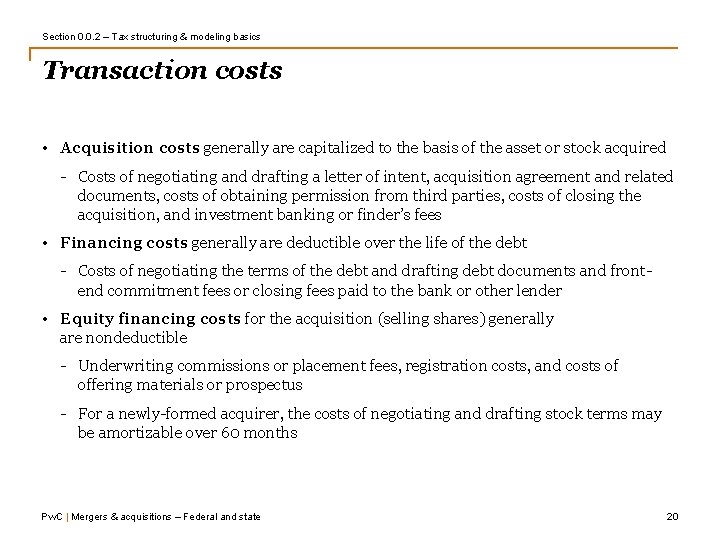
Section 0. 0. 2 – Tax structuring & modeling basics Transaction costs • Acquisition costs generally are capitalized to the basis of the asset or stock acquired - Costs of negotiating and drafting a letter of intent, acquisition agreement and related documents, costs of obtaining permission from third parties, costs of closing the acquisition, and investment banking or finder’s fees • Financing costs generally are deductible over the life of the debt - Costs of negotiating the terms of the debt and drafting debt documents and frontend commitment fees or closing fees paid to the bank or other lender • Equity financing costs for the acquisition (selling shares) generally are nondeductible - Underwriting commissions or placement fees, registration costs, and costs of offering materials or prospectus - For a newly-formed acquirer, the costs of negotiating and drafting stock terms may be amortizable over 60 months Pw. C | Mergers & acquisitions – Federal and state 20
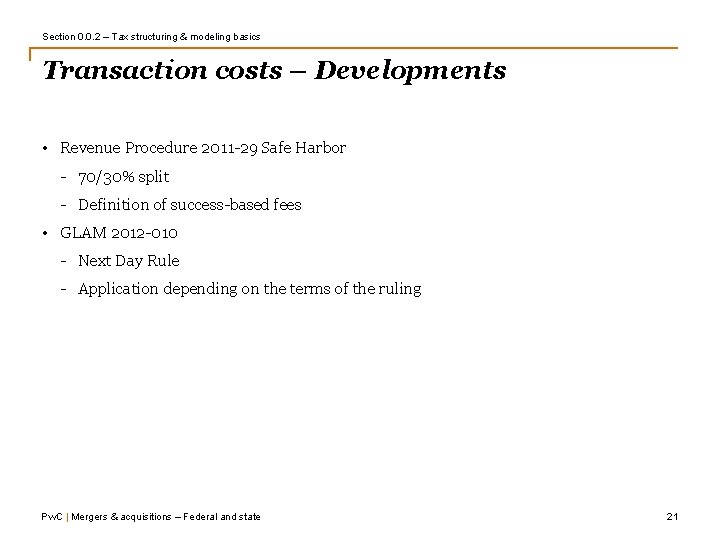
Section 0. 0. 2 – Tax structuring & modeling basics Transaction costs – Developments • Revenue Procedure 2011 -29 Safe Harbor - 70/30% split - Definition of success-based fees • GLAM 2012 -010 - Next Day Rule - Application depending on the terms of the ruling Pw. C | Mergers & acquisitions – Federal and state 21
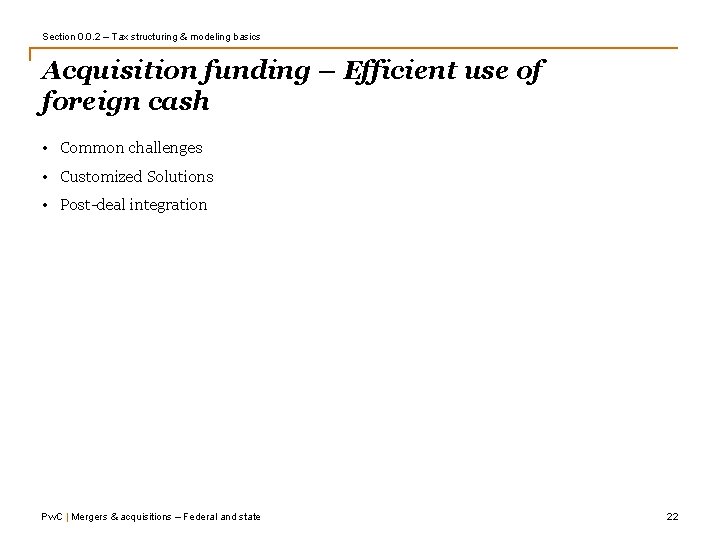
Section 0. 0. 2 – Tax structuring & modeling basics Acquisition funding – Efficient use of foreign cash • Common challenges • Customized Solutions • Post-deal integration Pw. C | Mergers & acquisitions – Federal and state 22
Section 0. 0. 3 M&A tax developments Pw. C | Mergers & acquisitions – Federal and state 23
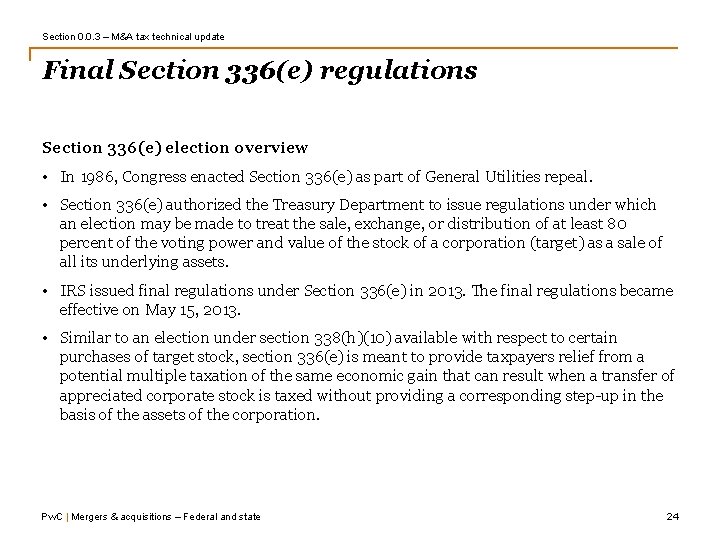
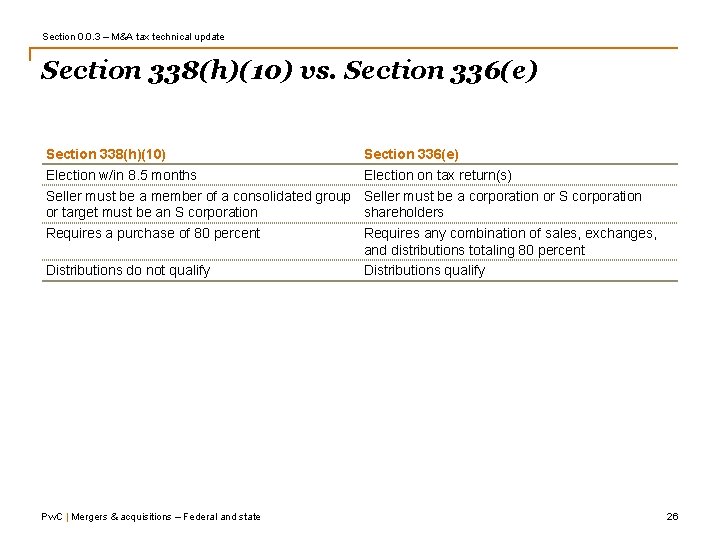
Section 0. 0. 3 – M&A tax technical update Final Section 336(e) regulations Section 336(e) election overview • In 1986, Congress enacted Section 336(e) as part of General Utilities repeal. • Section 336(e) authorized the Treasury Department to issue regulations under which an election may be made to treat the sale, exchange, or distribution of at least 80 percent of the voting power and value of the stock of a corporation (target) as a sale of all its underlying assets. • IRS issued final regulations under Section 336(e) in 2013. The final regulations became effective on May 15, 2013. • Similar to an election under section 338(h)(10) available with respect to certain purchases of target stock, section 336(e) is meant to provide taxpayers relief from a potential multiple taxation of the same economic gain that can result when a transfer of appreciated corporate stock is taxed without providing a corresponding step-up in the basis of the assets of the corporation. Pw. C | Mergers & acquisitions – Federal and state 24
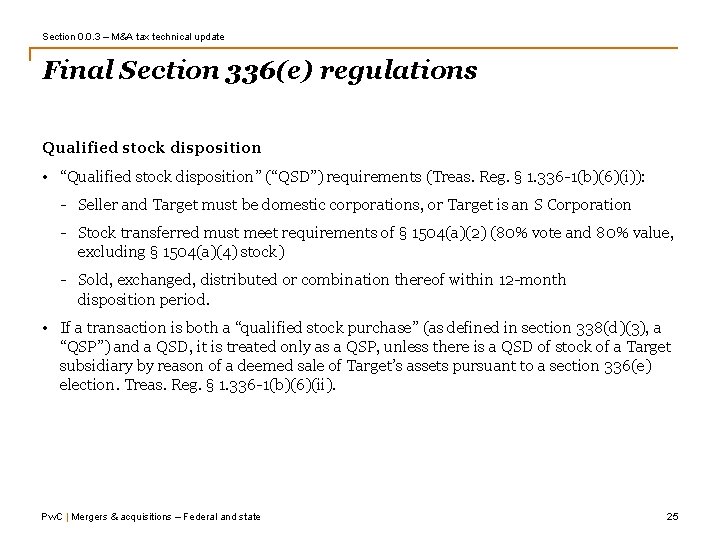
Section 0. 0. 3 – M&A tax technical update Final Section 336(e) regulations Qualified stock disposition • “Qualified stock disposition” (“QSD”) requirements (Treas. Reg. § 1. 336 -1(b)(6)(i)): - Seller and Target must be domestic corporations, or Target is an S Corporation - Stock transferred must meet requirements of § 1504(a)(2) (80% vote and 80% value, excluding § 1504(a)(4) stock) - Sold, exchanged, distributed or combination thereof within 12 -month disposition period. • If a transaction is both a “qualified stock purchase” (as defined in section 338(d)(3), a “QSP”) and a QSD, it is treated only as a QSP, unless there is a QSD of stock of a Target subsidiary by reason of a deemed sale of Target’s assets pursuant to a section 336(e) election. Treas. Reg. § 1. 336 -1(b)(6)(ii). Pw. C | Mergers & acquisitions – Federal and state 25
Section 0. 0. 3 – M&A tax technical update Section 338(h)(10) vs. Section 336(e) Section 338(h)(10) Election w/in 8. 5 months Seller must be a member of a consolidated group or target must be an S corporation Requires a purchase of 80 percent Distributions do not qualify Pw. C | Mergers & acquisitions – Federal and state Section 336(e) Election on tax return(s) Seller must be a corporation or S corporation shareholders Requires any combination of sales, exchanges, and distributions totaling 80 percent Distributions qualify 26
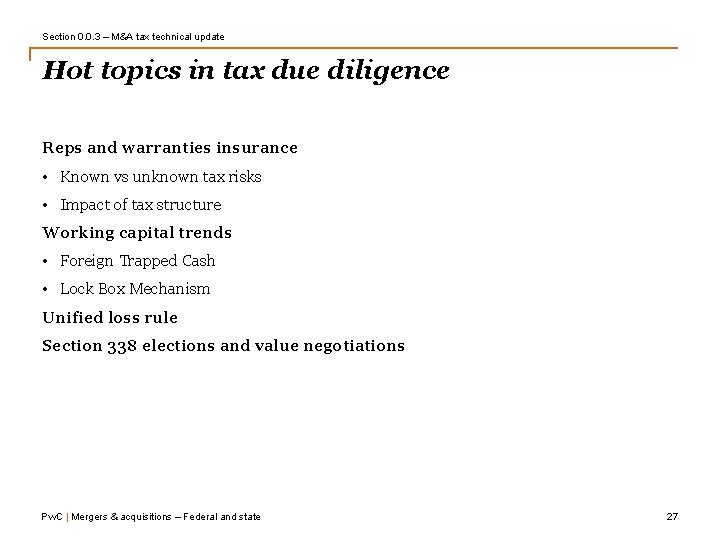
Section 0. 0. 3 – M&A tax technical update Hot topics in tax due diligence Reps and warranties insurance • Known vs unknown tax risks • Impact of tax structure Working capital trends • Foreign Trapped Cash • Lock Box Mechanism Unified loss rule Section 338 elections and value negotiations Pw. C | Mergers & acquisitions – Federal and state 27
© 2016 Pw. C. All rights reserved. Pw. C refers to the US member firm or one of its subsidiaries or affiliates, and may sometimes refer to the Pw. C network. Each member firm is a separate legal entity. Please see www. pwc. com/structure for further details.
Thank you Sean Kelly, M&A Director Cleveland, Ohio (216) 875 -3551 sean. p. kelly@pwc. com This document is for general information purposes only, and should not be used as a substitute for consultation with professional advisors. This document was not intended or written to be used, and it cannot be used, for the purpose of avoiding US federal, state or local tax penalties. © 2016 Pw. C. All rights reserved. In this document, "Pw. C" refers to Pricewaterhouse. Coopers LLP, a Delaware limited liability partnership, which is a member firm of Pricewaterhouse. Coopers International Limited, each member firm of which is a separate legal entity.