
www pwc com IFRS 13 Fair Value Measurement



- Slides: 22
www. pwc. com IFRS 13 Fair Value Measurement
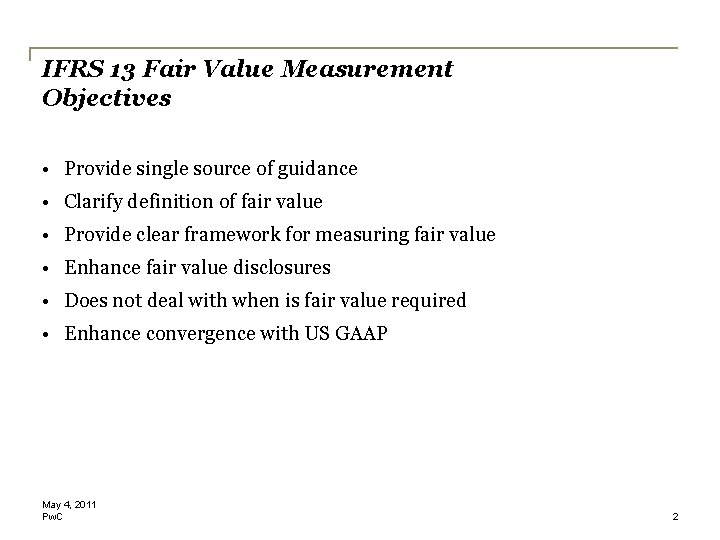
IFRS 13 Fair Value Measurement Objectives • Provide single source of guidance • Clarify definition of fair value • Provide clear framework for measuring fair value • Enhance fair value disclosures • Does not deal with when is fair value required • Enhance convergence with US GAAP May 4, 2011 Pw. C 2
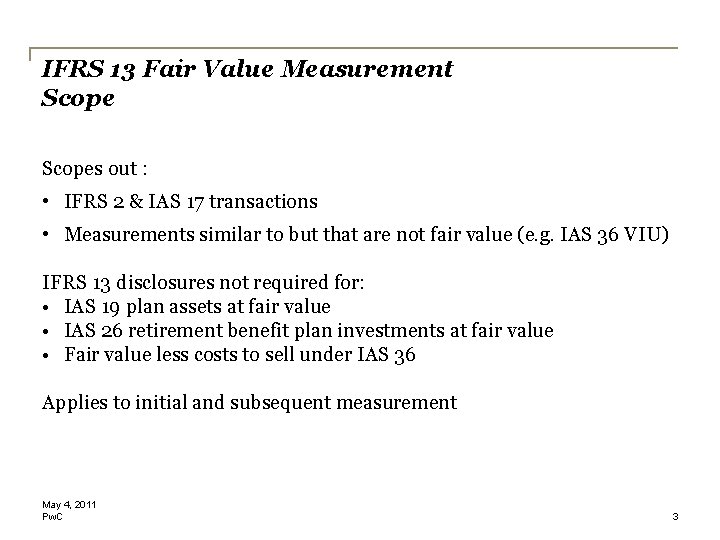
IFRS 13 Fair Value Measurement Scopes out : • IFRS 2 & IAS 17 transactions • Measurements similar to but that are not fair value (e. g. IAS 36 VIU) IFRS 13 disclosures not required for: • IAS 19 plan assets at fair value • IAS 26 retirement benefit plan investments at fair value • Fair value less costs to sell under IAS 36 Applies to initial and subsequent measurement May 4, 2011 Pw. C 3
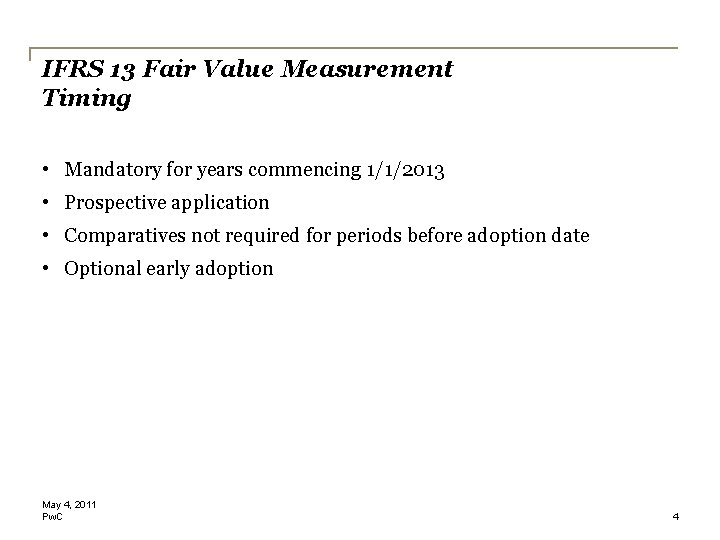
IFRS 13 Fair Value Measurement Timing • Mandatory for years commencing 1/1/2013 • Prospective application • Comparatives not required for periods before adoption date • Optional early adoption May 4, 2011 Pw. C 4
IFRS 13 Fair Value Measurement Definition of fair value The price that would be received to sell an asset or paid to transfer a liability in an orderly transaction between market participants at the measurement date. - Exit price concept - Consider characteristics of asset/liability: ◦ Condition ◦ Location ◦ Restrictions on sale/use - Liability fair value reflects own non-performance risk - Excludes transaction costs - Includes transport costs May 4, 2011 Pw. C 5
IFRS 13 Fair Value Measurement What must be done? Determine: • Asset/liability being measured • Principal/ most advantageous market • Non-financial assets: - What is highest and best use (HABU) - Whether HABU is on stand-alone basis or with other assets • Quoted price / valuation technique to measure fair value May 4, 2011 Pw. C 6
IFRS 13 Fair Value Measurement Identifying the market • Use principal market if available The market with the greatest volume and level of activity for the asset or liability. • Otherwise, use most advantageous market The market that maximises the amount that would be received to sell the asset or minimises the amount that would be paid to transfer the liability, after taking into account transaction costs and transport costs. May 4, 2011 Pw. C 7
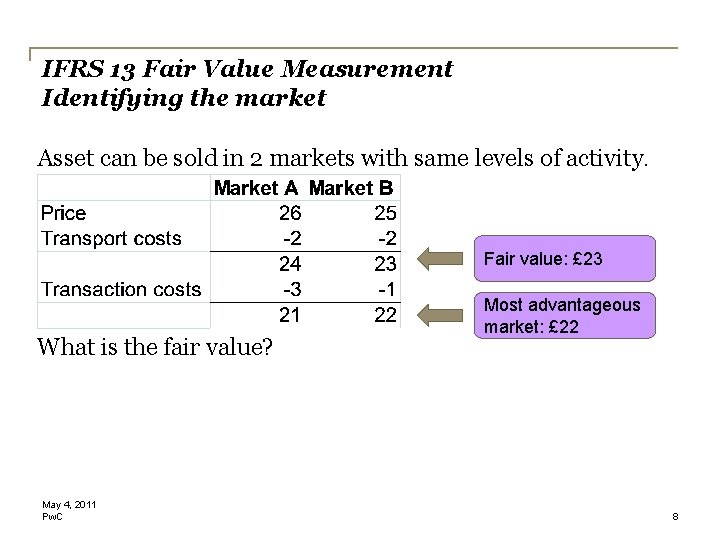
IFRS 13 Fair Value Measurement Identifying the market Asset can be sold in 2 markets with same levels of activity. Fair value: £ 23 What is the fair value? May 4, 2011 Pw. C Most advantageous market: £ 22 8
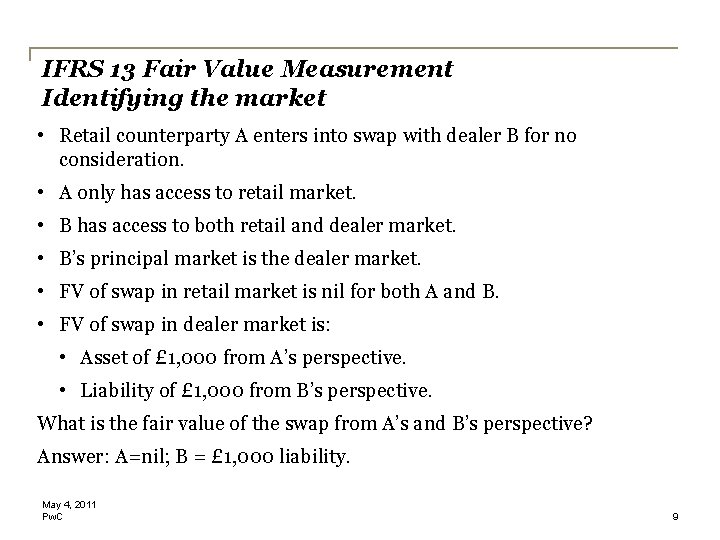
IFRS 13 Fair Value Measurement Identifying the market • Retail counterparty A enters into swap with dealer B for no consideration. • A only has access to retail market. • B has access to both retail and dealer market. • B’s principal market is the dealer market. • FV of swap in retail market is nil for both A and B. • FV of swap in dealer market is: • Asset of £ 1, 000 from A’s perspective. • Liability of £ 1, 000 from B’s perspective. What is the fair value of the swap from A’s and B’s perspective? Answer: A=nil; B = £ 1, 000 liability. May 4, 2011 Pw. C 9
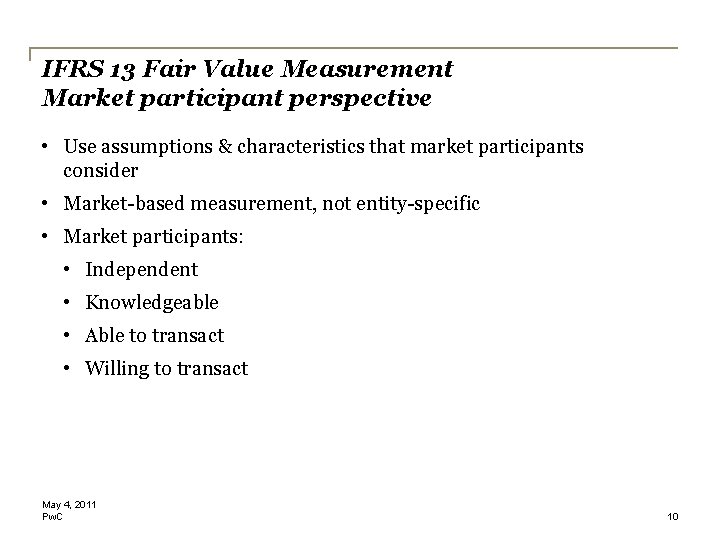
IFRS 13 Fair Value Measurement Market participant perspective • Use assumptions & characteristics that market participants consider • Market-based measurement, not entity-specific • Market participants: • Independent • Knowledgeable • Able to transact • Willing to transact May 4, 2011 Pw. C 10
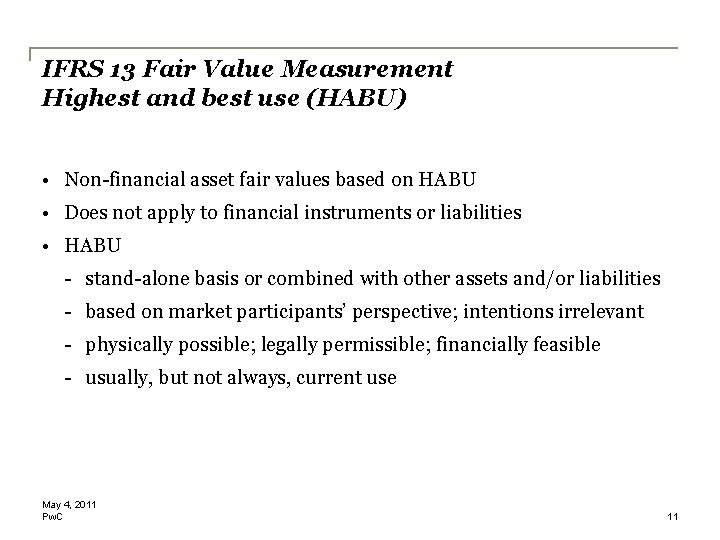
IFRS 13 Fair Value Measurement Highest and best use (HABU) • Non-financial asset fair values based on HABU • Does not apply to financial instruments or liabilities • HABU - stand-alone basis or combined with other assets and/or liabilities - based on market participants’ perspective; intentions irrelevant - physically possible; legally permissible; financially feasible - usually, but not always, current use May 4, 2011 Pw. C 11
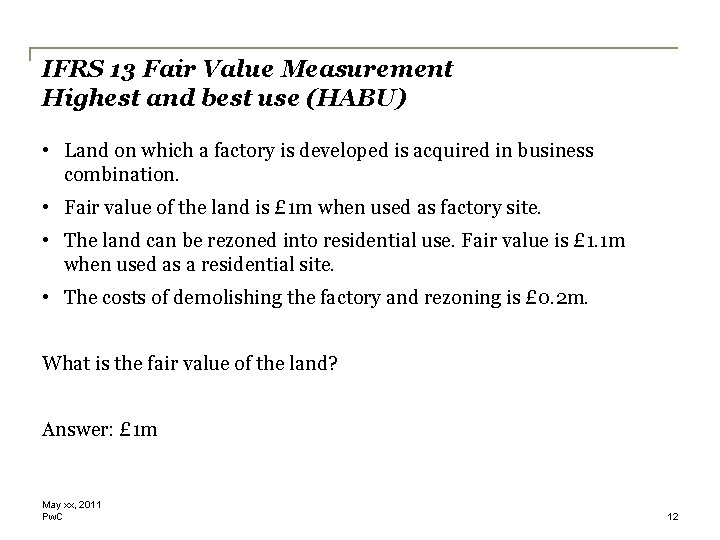
IFRS 13 Fair Value Measurement Highest and best use (HABU) • Land on which a factory is developed is acquired in business combination. • Fair value of the land is £ 1 m when used as factory site. • The land can be rezoned into residential use. Fair value is £ 1. 1 m when used as a residential site. • The costs of demolishing the factory and rezoning is £ 0. 2 m. What is the fair value of the land? Answer: £ 1 m May xx, 2011 Pw. C 12
IFRS 13 Fair Value Measurement Financial assets and financial liabilities with offsetting positions Group of financial assets and liabilities can be fair valued based on net exposure to a market/credit risk if reporter: • manages group based on net exposure to that risk • documents this in risk management policy/ investment strategy • provides information on this basis to key management (IAS 24) • measures those assets and liabilities at fair value May 4, 2011 Pw. C 13
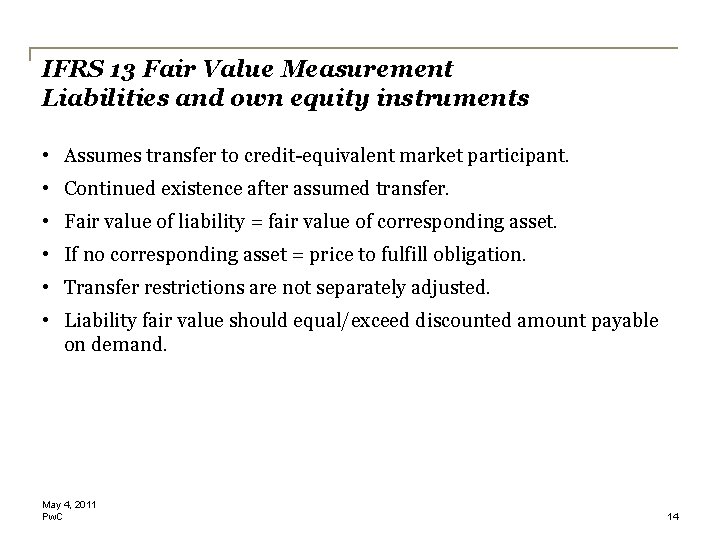
IFRS 13 Fair Value Measurement Liabilities and own equity instruments • Assumes transfer to credit-equivalent market participant. • Continued existence after assumed transfer. • Fair value of liability = fair value of corresponding asset. • If no corresponding asset = price to fulfill obligation. • Transfer restrictions are not separately adjusted. • Liability fair value should equal/exceed discounted amount payable on demand. May 4, 2011 Pw. C 14
IFRS 13 Fair Value Measurement Valuation techniques • Market, income or cost approach • Assess appropriateness based on circumstances • Maximise observable inputs • Change in technique acceptable if equally or more representative of fair value May 4, 2011 Pw. C 15
IFRS 13 Fair Value Measurement Valuation techniques Entity acquires software that is developed internally using proprietary technologies which are not available to market participants. Which of the following is the most appropriate valuation technique? a) Income approach using present value of licence fees = £ 15 m b) Cost approach based on cost to build substitute asset, taking into account obsolescence = £ 10 m May xx, 2011 Pw. C 16
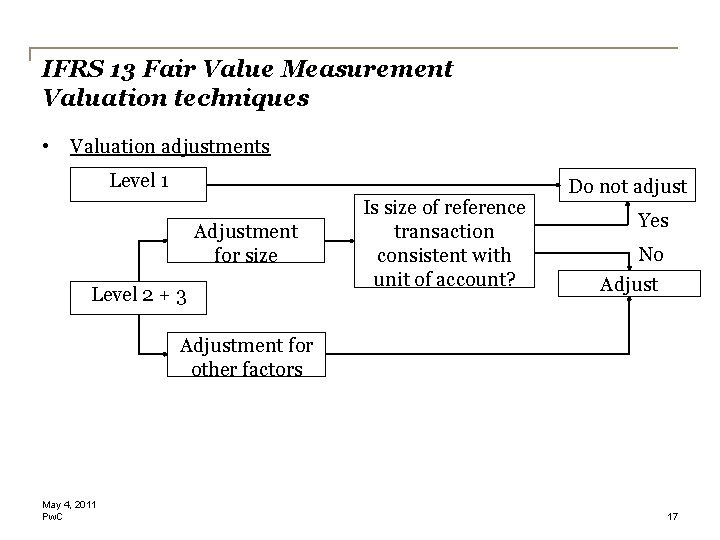
IFRS 13 Fair Value Measurement Valuation techniques • Valuation adjustments Level 1 Adjustment for size Level 2 + 3 Is size of reference transaction consistent with unit of account? Do not adjust Yes No Adjustment for other factors May 4, 2011 Pw. C 17
IFRS 13 Fair Value Measurement Bid and ask prices • Does not mandate bid price for assets and ask price for liabilities • Does not preclude mid-market or other pricing conventions May 4, 2011 Pw. C 18
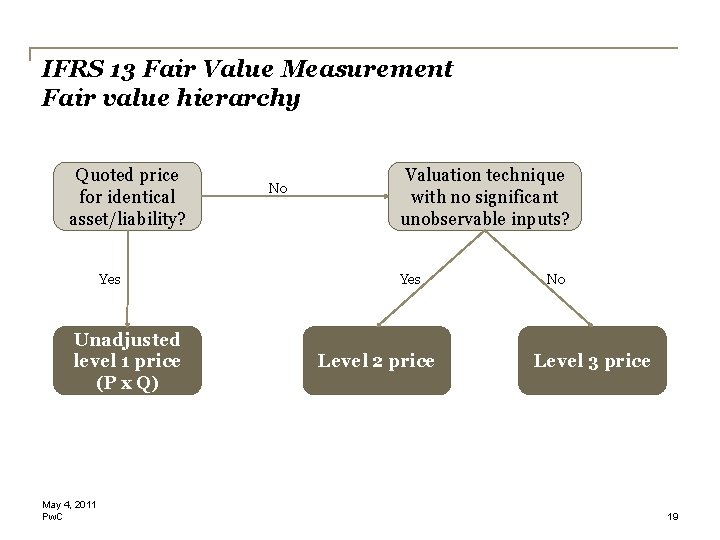
IFRS 13 Fair Value Measurement Fair value hierarchy Quoted price for identical asset/liability? Yes Unadjusted level 1 price (P x Q) May 4, 2011 Pw. C No Valuation technique with no significant unobservable inputs? Yes Level 2 price No Level 3 price 19
IFRS 13 Fair Value Measurement Disclosures • Similar to IFRS 7, but apply to all assets and liabilities • Specific requirements to meet the objectives of: • disclosing FV techniques and inputs • disclosing effect of significant unobservable inputs on P&L/OCI May 4, 2011 Pw. C 20
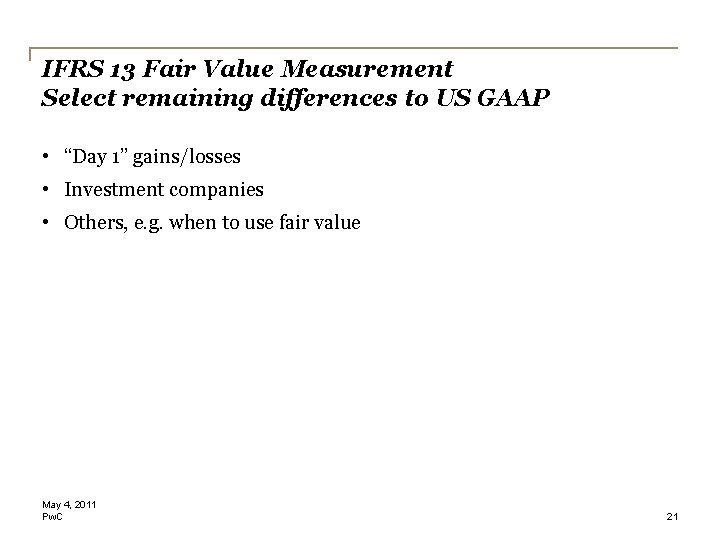
IFRS 13 Fair Value Measurement Select remaining differences to US GAAP • “Day 1” gains/losses • Investment companies • Others, e. g. when to use fair value May 4, 2011 Pw. C 21
Questions? This publication has been prepared for general guidance on matters of interest only, and does not constitute professional advice. You should not act upon the information contained in this publication without obtaining specific professional advice. No representation or warranty (express or implied) is given as to the accuracy or completeness of the information contained in this publication, and, to the extent permitted by law, Pricewaterhouse. Coopers International Limited, its members, employees and agents do not accept or assume any liability, responsibility or duty of care for any consequences of you or anyone else acting, or refraining to act, in reliance on the information contained in this publication or for any decision based on it. © 2011 Pricewaterhouse. Coopers International Limited. All rights reserved. In this document, “Pw. C” refers to Pricewaterhouse. Coopers International Limited which is a member firm of Pricewaterhouse. Coopers International Limited, each member firm of which is a separate legal entity.