
www pwc com Breakout Session 2 A Revenue

www. pwc. com Break-out Session 2 A: Revenue recognition Ann Kruse, Partner, St. Louis Latina Fauconier, Advisory Director, Detroit Mark Wilmot, Director, Detroit
Agenda • Overview of the New Standard • Revenue Recognition Activities and Implementation Issues • Common Findings • Tax Considerations Pw. C | Break-out Session 2 A – Revenue recognition 2
Overview of the new standard 1 Pw. C | Break-out Session 2 A – Revenue recognition 3
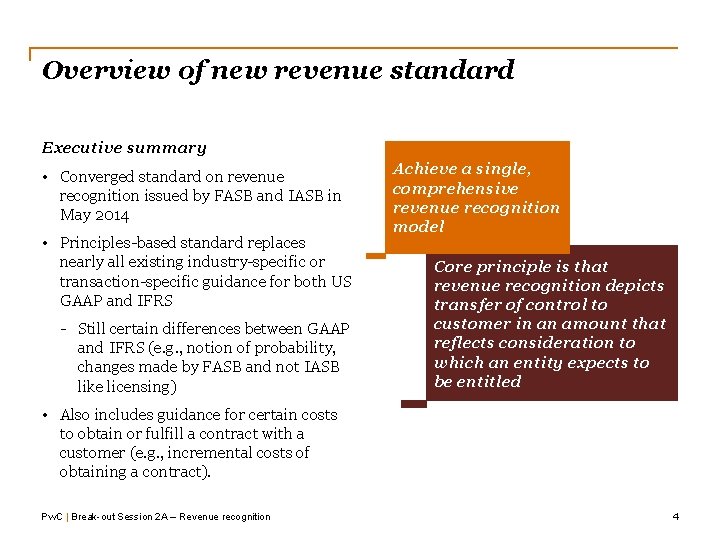
Overview of new revenue standard Executive summary • Converged standard on revenue recognition issued by FASB and IASB in May 2014 • Principles-based standard replaces nearly all existing industry-specific or transaction-specific guidance for both US GAAP and IFRS - Still certain differences between GAAP and IFRS (e. g. , notion of probability, changes made by FASB and not IASB like licensing) Achieve a single, comprehensive revenue recognition model Core principle is that revenue recognition depicts transfer of control to customer in an amount that reflects consideration to which an entity expects to be entitled • Also includes guidance for certain costs to obtain or fulfill a contract with a customer (e. g. , incremental costs of obtaining a contract). Pw. C | Break-out Session 2 A – Revenue recognition 4
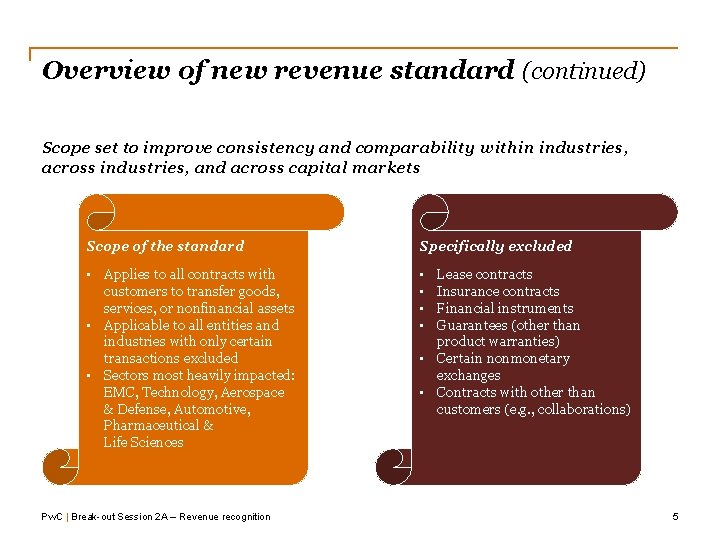
Overview of new revenue standard (continued) Scope set to improve consistency and comparability within industries, across industries, and across capital markets Scope of the standard Specifically excluded • Applies to all contracts with customers to transfer goods, services, or nonfinancial assets • Applicable to all entities and industries with only certain transactions excluded • Sectors most heavily impacted: EMC, Technology, Aerospace & Defense, Automotive, Pharmaceutical & Life Sciences • • Pw. C | Break-out Session 2 A – Revenue recognition Lease contracts Insurance contracts Financial instruments Guarantees (other than product warranties) • Certain nonmonetary exchanges • Contracts with other than customers (e. g. , collaborations) 5
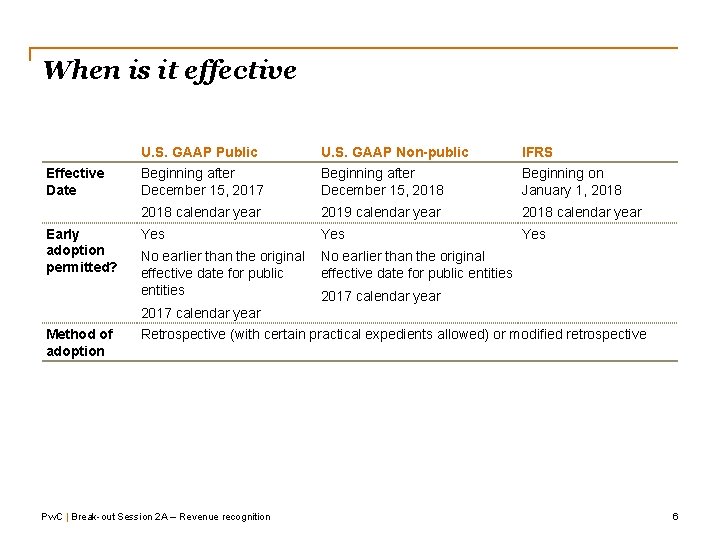
When is it effective U. S. GAAP Public U. S. GAAP Non-public IFRS Beginning after December 15, 2017 Beginning after December 15, 2018 Beginning on January 1, 2018 calendar year 2019 calendar year 2018 calendar year Early adoption permitted? Yes Yes Method of adoption Retrospective (with certain practical expedients allowed) or modified retrospective Effective Date No earlier than the original effective date for public entities 2017 calendar year Pw. C | Break-out Session 2 A – Revenue recognition 6
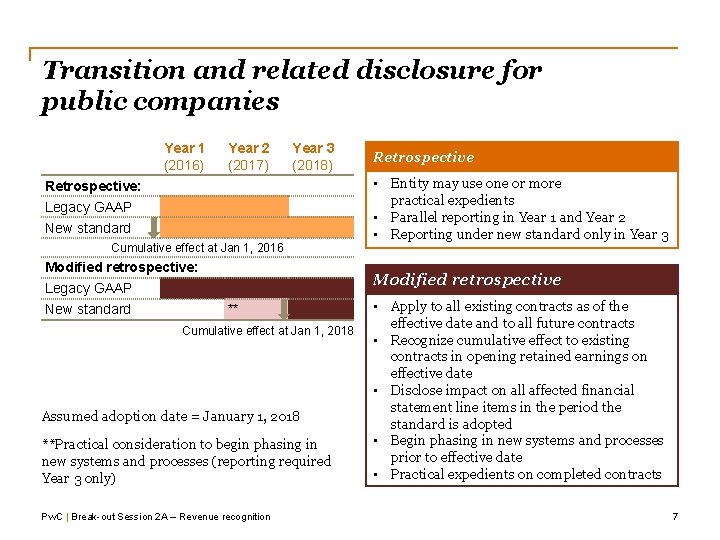
Transition and related disclosure for public companies Year 1 (2016) Year 2 (2017) Year 3 (2018) Retrospective: Legacy GAAP New standard Cumulative effect at Jan 1, 2016 Modified retrospective: Legacy GAAP New standard Retrospective • Entity may use one or more practical expedients • Parallel reporting in Year 1 and Year 2 • Reporting under new standard only in Year 3 Modified retrospective ** Cumulative effect at Jan 1, 2018 Assumed adoption date = January 1, 2018 **Practical consideration to begin phasing in new systems and processes (reporting required Year 3 only) Pw. C | Break-out Session 2 A – Revenue recognition • Apply to all existing contracts as of the effective date and to all future contracts • Recognize cumulative effect to existing contracts in opening retained earnings on effective date • Disclose impact on all affected financial statement line items in the period the standard is adopted • Begin phasing in new systems and processes prior to effective date • Practical expedients on completed contracts 7
Revenue recognition activities and implementation issues 2 Pw. C | Break-out Session 2 A – Revenue recognition 8

Revenue recognition activities Transition resource group SEC Preparers and audit firms New Revenue Standard AICPA task forces FASB and IASB Other industry working groups and committees Pw. C | Break-out Session 2 A – Revenue recognition 9
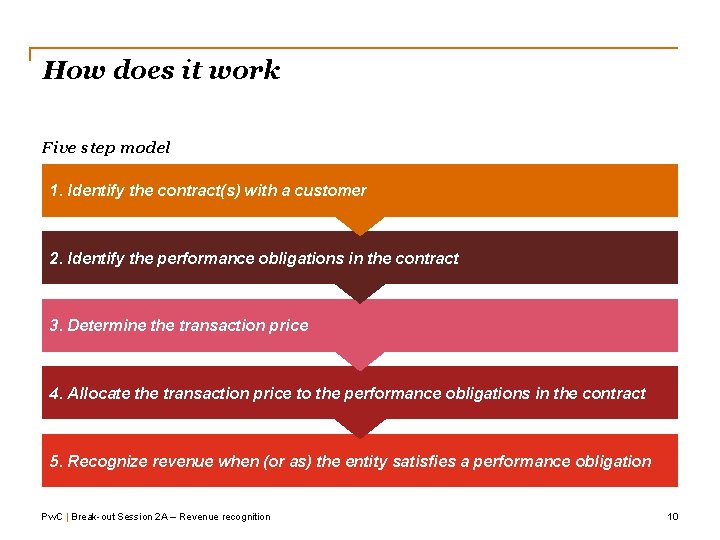
How does it work Five step model 1. Identify the contract(s) with a customer 2. Identify the performance obligations in the contract 3. Determine the transaction price 4. Allocate the transaction price to the performance obligations in the contract 5. Recognize revenue when (or as) the entity satisfies a performance obligation Pw. C | Break-out Session 2 A – Revenue recognition 10
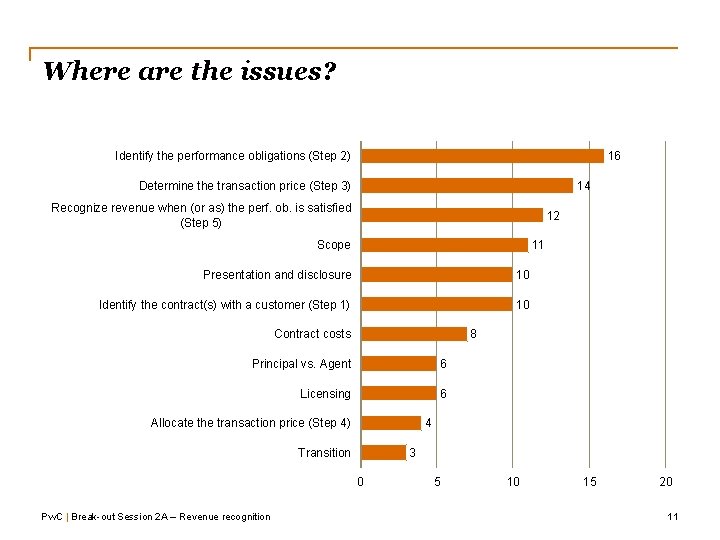
Where are the issues? 16 Identify the performance obligations (Step 2) Determine the transaction price (Step 3) 14 Recognize revenue when (or as) the perf. ob. is satisfied (Step 5) 12 11 Scope Presentation and disclosure 10 Identify the contract(s) with a customer (Step 1) 10 Contract costs 8 Principal vs. Agent 6 Licensing 6 Allocate the transaction price (Step 4) 4 Transition 3 0 Pw. C | Break-out Session 2 A – Revenue recognition 5 10 15 20 11
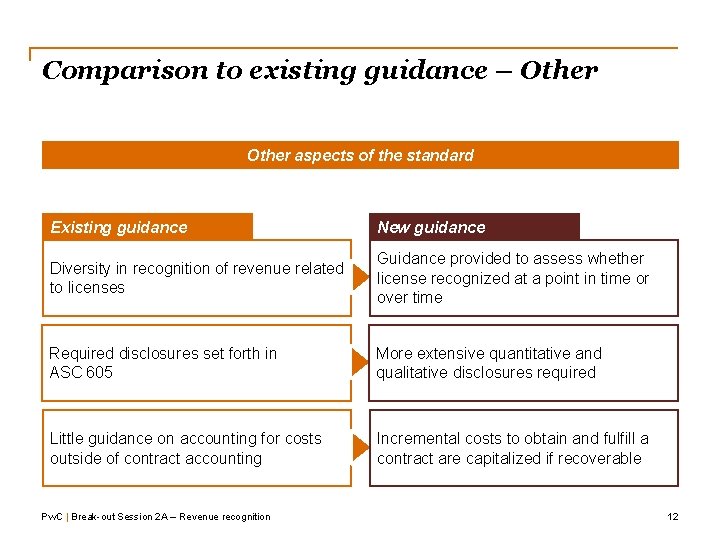
Comparison to existing guidance – Other aspects of the standard Existing guidance New guidance Diversity in recognition of revenue related to licenses Guidance provided to assess whether license recognized at a point in time or over time Required disclosures set forth in ASC 605 More extensive quantitative and qualitative disclosures required Little guidance on accounting for costs outside of contract accounting Incremental costs to obtain and fulfill a contract are capitalized if recoverable Pw. C | Break-out Session 2 A – Revenue recognition 12
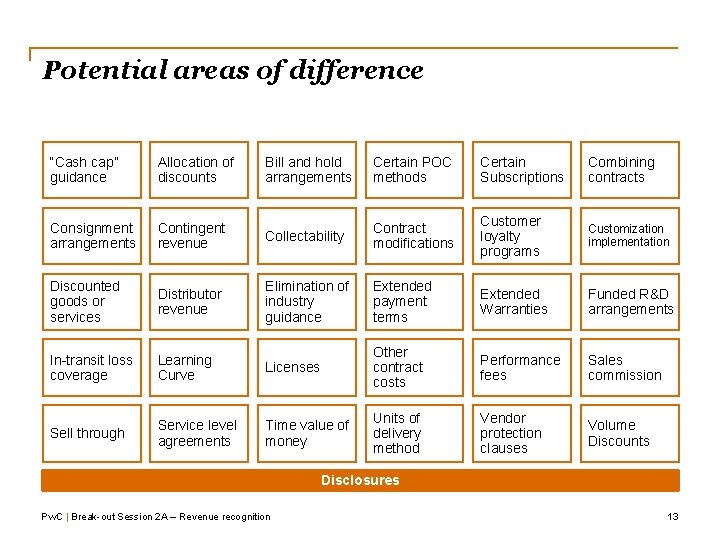
Potential areas of difference “Cash cap” guidance Allocation of discounts Bill and hold arrangements Certain POC methods Certain Subscriptions Combining contracts Consignment arrangements Contingent revenue Collectability Contract modifications Customer loyalty programs Customization implementation Discounted goods or services Distributor revenue Elimination of industry guidance Extended payment terms Extended Warranties Funded R&D arrangements In-transit loss coverage Learning Curve Licenses Other contract costs Performance fees Sales commission Sell through Service level agreements Time value of money Units of delivery method Vendor protection clauses Volume Discounts Disclosures Pw. C | Break-out Session 2 A – Revenue recognition 13
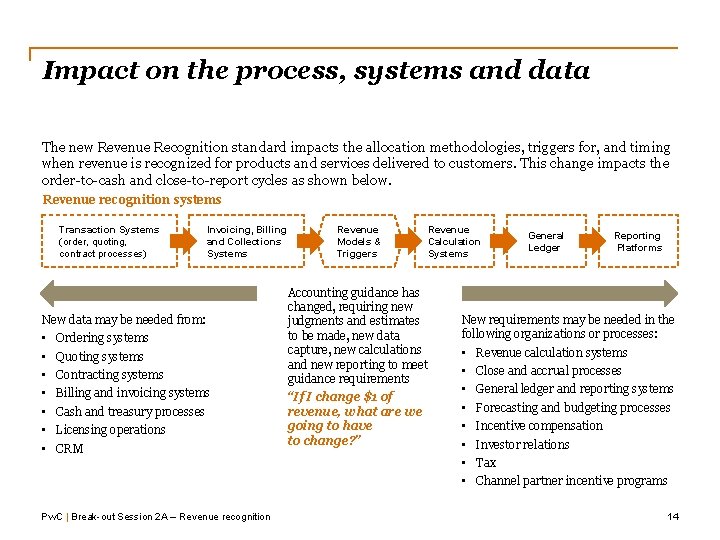
Impact on the process, systems and data The new Revenue Recognition standard impacts the allocation methodologies, triggers for, and timing when revenue is recognized for products and services delivered to customers. This change impacts the order-to-cash and close-to-report cycles as shown below. Revenue recognition systems Transaction Systems (order, quoting, contract processes) Invoicing, Billing and Collections Systems New data may be needed from: • • Ordering systems Quoting systems Contracting systems Billing and invoicing systems Cash and treasury processes Licensing operations CRM Pw. C | Break-out Session 2 A – Revenue recognition Revenue Models & Triggers Revenue Calculation Systems Accounting guidance has changed, requiring new judgments and estimates to be made, new data capture, new calculations and new reporting to meet guidance requirements “If I change $1 of revenue, what are we going to have to change? ” General Ledger Reporting Platforms New requirements may be needed in the following organizations or processes: • • Revenue calculation systems Close and accrual processes General ledger and reporting systems Forecasting and budgeting processes Incentive compensation Investor relations Tax Channel partner incentive programs 14
Common findings 3 Pw. C | Break-out Session 2 A – Revenue recognition 15
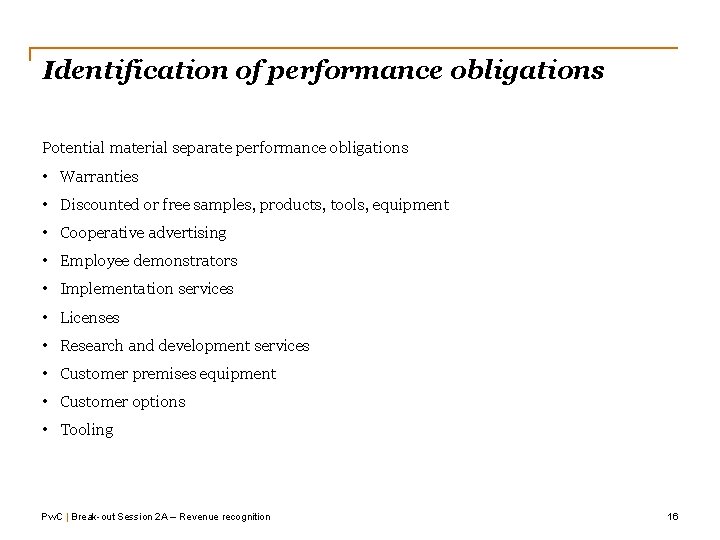
Identification of performance obligations Potential material separate performance obligations • Warranties • Discounted or free samples, products, tools, equipment • Cooperative advertising • Employee demonstrators • Implementation services • Licenses • Research and development services • Customer premises equipment • Customer options • Tooling Pw. C | Break-out Session 2 A – Revenue recognition 16
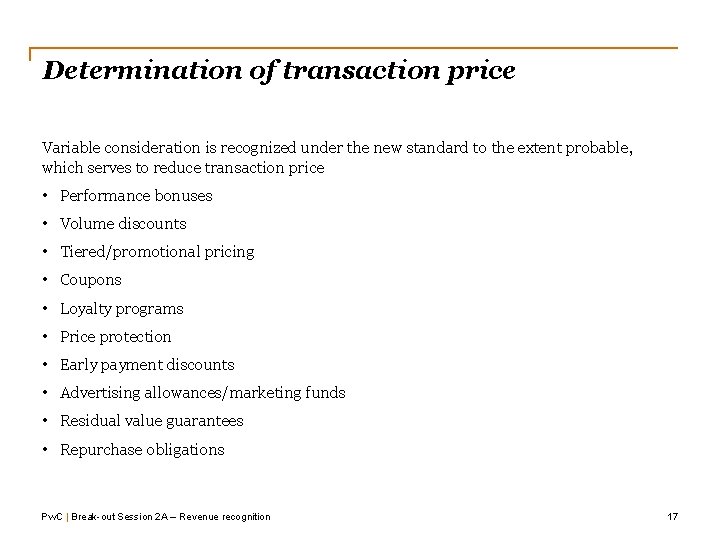
Determination of transaction price Variable consideration is recognized under the new standard to the extent probable, which serves to reduce transaction price • Performance bonuses • Volume discounts • Tiered/promotional pricing • Coupons • Loyalty programs • Price protection • Early payment discounts • Advertising allowances/marketing funds • Residual value guarantees • Repurchase obligations Pw. C | Break-out Session 2 A – Revenue recognition 17
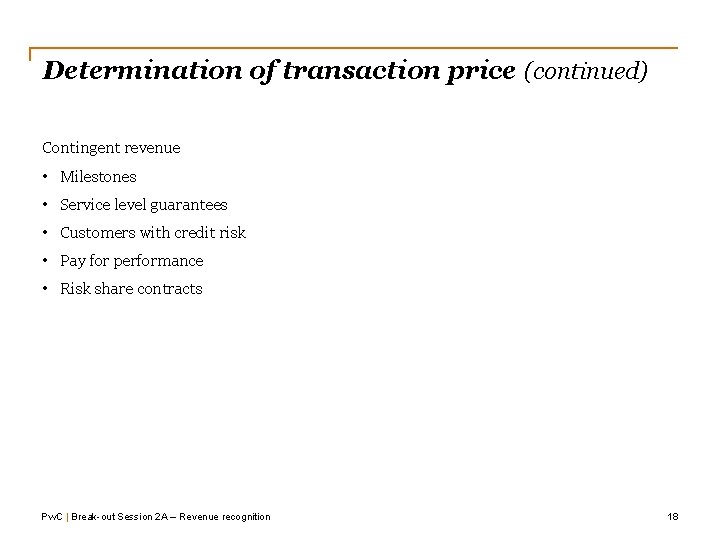
Determination of transaction price (continued) Contingent revenue • Milestones • Service level guarantees • Customers with credit risk • Pay for performance • Risk share contracts Pw. C | Break-out Session 2 A – Revenue recognition 18
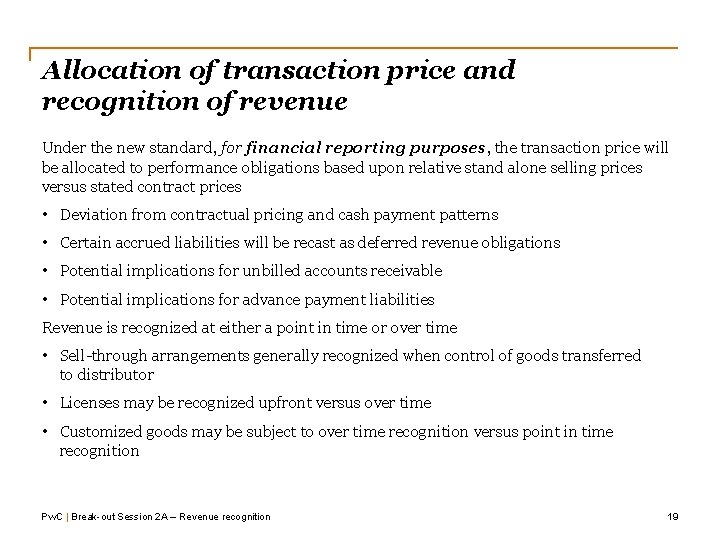
Allocation of transaction price and recognition of revenue Under the new standard, for financial reporting purposes, the transaction price will be allocated to performance obligations based upon relative stand alone selling prices versus stated contract prices • Deviation from contractual pricing and cash payment patterns • Certain accrued liabilities will be recast as deferred revenue obligations • Potential implications for unbilled accounts receivable • Potential implications for advance payment liabilities Revenue is recognized at either a point in time or over time • Sell-through arrangements generally recognized when control of goods transferred to distributor • Licenses may be recognized upfront versus over time • Customized goods may be subject to over time recognition versus point in time recognition Pw. C | Break-out Session 2 A – Revenue recognition 19
Tax considerations 4 Pw. C | Break-out Session 2 A – Revenue recognition 20
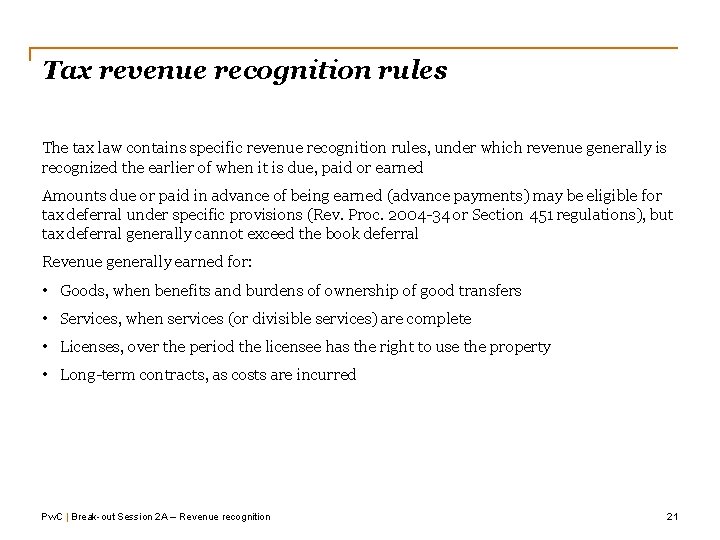
Tax revenue recognition rules The tax law contains specific revenue recognition rules, under which revenue generally is recognized the earlier of when it is due, paid or earned Amounts due or paid in advance of being earned (advance payments) may be eligible for tax deferral under specific provisions (Rev. Proc. 2004 -34 or Section 451 regulations), but tax deferral generally cannot exceed the book deferral Revenue generally earned for: • Goods, when benefits and burdens of ownership of good transfers • Services, when services (or divisible services) are complete • Licenses, over the period the licensee has the right to use the property • Long-term contracts, as costs are incurred Pw. C | Break-out Session 2 A – Revenue recognition 21
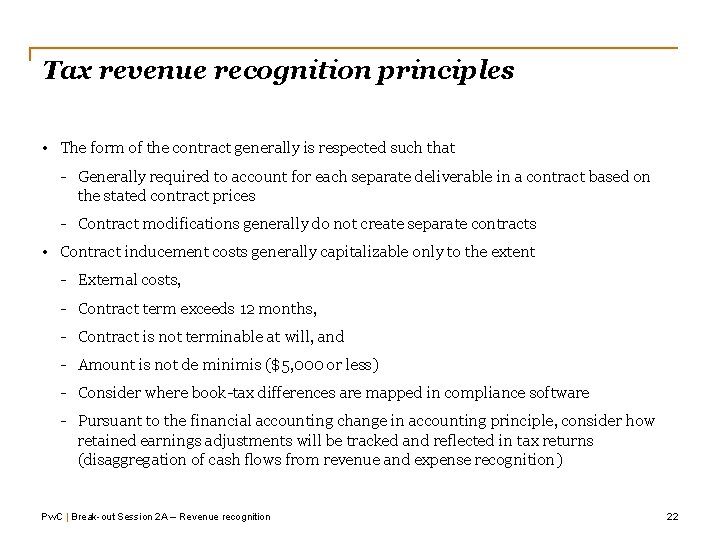
Tax revenue recognition principles • The form of the contract generally is respected such that - Generally required to account for each separate deliverable in a contract based on the stated contract prices - Contract modifications generally do not create separate contracts • Contract inducement costs generally capitalizable only to the extent - External costs, - Contract term exceeds 12 months, - Contract is not terminable at will, and - Amount is not de minimis ($5, 000 or less) - Consider where book-tax differences are mapped in compliance software - Pursuant to the financial accounting change in accounting principle, consider how retained earnings adjustments will be tracked and reflected in tax returns (disaggregation of cash flows from revenue and expense recognition) Pw. C | Break-out Session 2 A – Revenue recognition 22
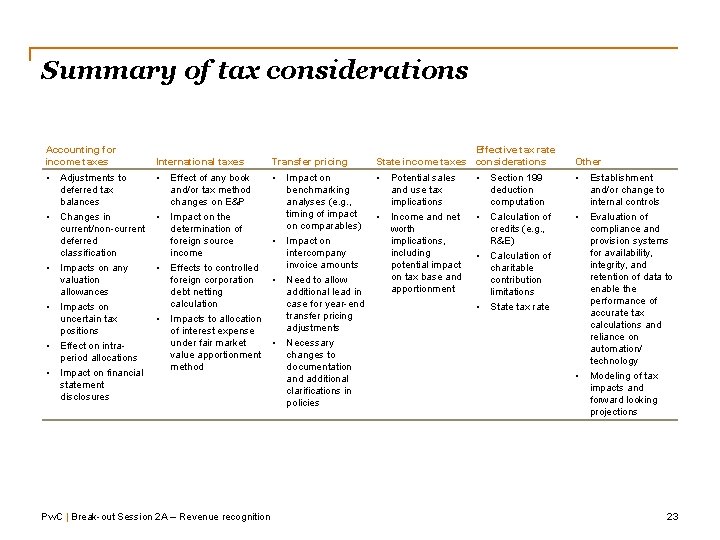
Summary of tax considerations Accounting for income taxes International taxes Transfer pricing • • Adjustments to deferred tax balances Changes in current/non-current deferred classification Impacts on any valuation allowances Impacts on uncertain tax positions Effect on intraperiod allocations Impact on financial statement disclosures • • • Effect of any book and/or tax method changes on E&P Impact on the determination of foreign source income Effects to controlled foreign corporation debt netting calculation Impacts to allocation of interest expense under fair market value apportionment method Pw. C | Break-out Session 2 A – Revenue recognition • • • Effective tax rate State income taxes considerations Impact on • benchmarking analyses (e. g. , timing of impact • on comparables) Impact on intercompany invoice amounts Need to allow additional lead in case for year-end transfer pricing adjustments Necessary changes to documentation and additional clarifications in policies Potential sales and use tax implications Income and net worth implications, including potential impact on tax base and apportionment • • Section 199 deduction computation Calculation of credits (e. g. , R&E) Calculation of charitable contribution limitations State tax rate Other • • • Establishment and/or change to internal controls Evaluation of compliance and provision systems for availability, integrity, and retention of data to enable the performance of accurate tax calculations and reliance on automation/ technology Modeling of tax impacts and forward looking projections 23
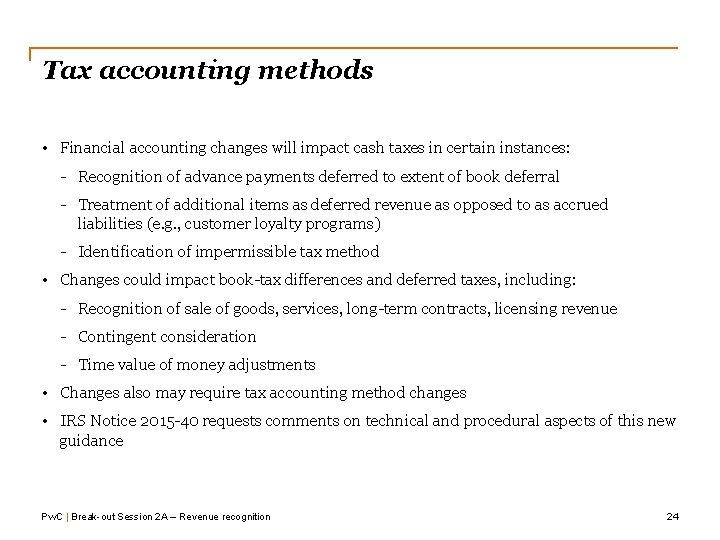
Tax accounting methods • Financial accounting changes will impact cash taxes in certain instances: - Recognition of advance payments deferred to extent of book deferral - Treatment of additional items as deferred revenue as opposed to as accrued liabilities (e. g. , customer loyalty programs) - Identification of impermissible tax method • Changes could impact book-tax differences and deferred taxes, including: - Recognition of sale of goods, services, long-term contracts, licensing revenue - Contingent consideration - Time value of money adjustments • Changes also may require tax accounting method changes • IRS Notice 2015 -40 requests comments on technical and procedural aspects of this new guidance Pw. C | Break-out Session 2 A – Revenue recognition 24
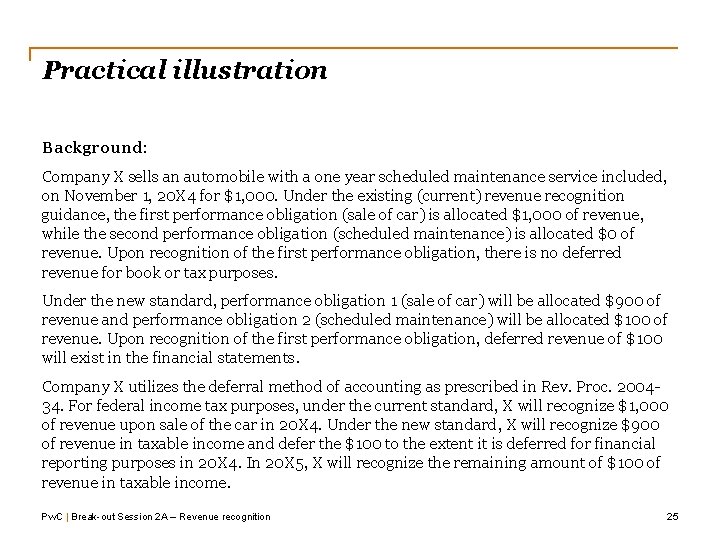
Practical illustration Background: Company X sells an automobile with a one year scheduled maintenance service included, on November 1, 20 X 4 for $1, 000. Under the existing (current) revenue recognition guidance, the first performance obligation (sale of car) is allocated $1, 000 of revenue, while the second performance obligation (scheduled maintenance) is allocated $0 of revenue. Upon recognition of the first performance obligation, there is no deferred revenue for book or tax purposes. Under the new standard, performance obligation 1 (sale of car) will be allocated $900 of revenue and performance obligation 2 (scheduled maintenance) will be allocated $100 of revenue. Upon recognition of the first performance obligation, deferred revenue of $100 will exist in the financial statements. Company X utilizes the deferral method of accounting as prescribed in Rev. Proc. 200434. For federal income tax purposes, under the current standard, X will recognize $1, 000 of revenue upon sale of the car in 20 X 4. Under the new standard, X will recognize $900 of revenue in taxable income and defer the $100 to the extent it is deferred for financial reporting purposes in 20 X 4. In 20 X 5, X will recognize the remaining amount of $100 of revenue in taxable income. Pw. C | Break-out Session 2 A – Revenue recognition 25
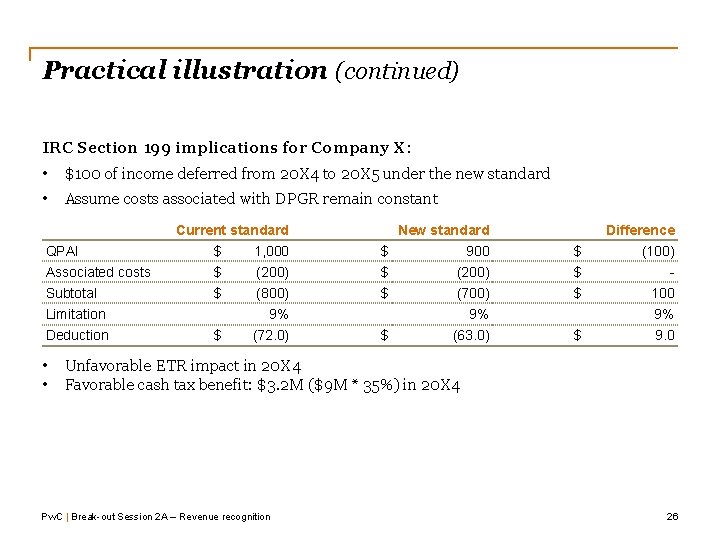
Practical illustration (continued) IRC Section 199 implications for Company X: • $100 of income deferred from 20 X 4 to 20 X 5 under the new standard • Assume costs associated with DPGR remain constant Current standard New standard Difference QPAI $ 1, 000 $ 900 $ (100) Associated costs $ (200) $ - Subtotal $ (800) $ (700) $ 100 Limitation Deduction • • 9% $ (72. 0) 9% $ (63. 0) 9% $ 9. 0 Unfavorable ETR impact in 20 X 4 Favorable cash tax benefit: $3. 2 M ($9 M * 35%) in 20 X 4 Pw. C | Break-out Session 2 A – Revenue recognition 26
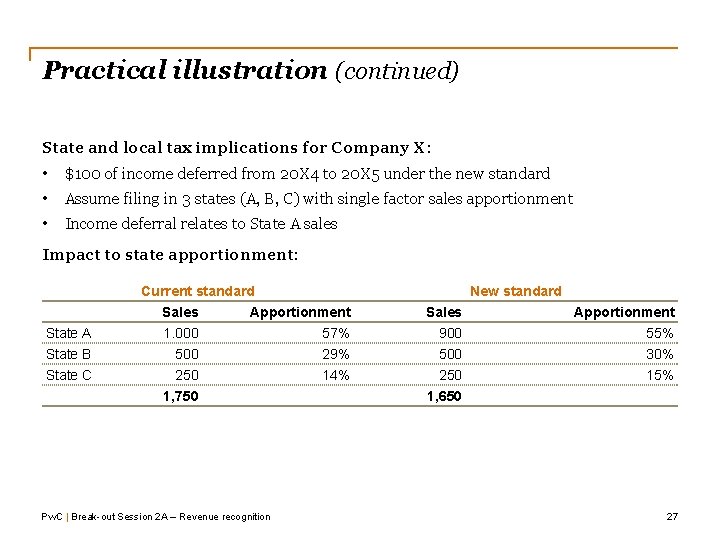
Practical illustration (continued) State and local tax implications for Company X: • $100 of income deferred from 20 X 4 to 20 X 5 under the new standard • Assume filing in 3 states (A, B, C) with single factor sales apportionment • Income deferral relates to State A sales Impact to state apportionment: Current standard New standard Sales Apportionment State A 1. 000 57% 900 55% State B 500 29% 500 30% State C 250 14% 250 15% 1, 750 Pw. C | Break-out Session 2 A – Revenue recognition 1, 650 27
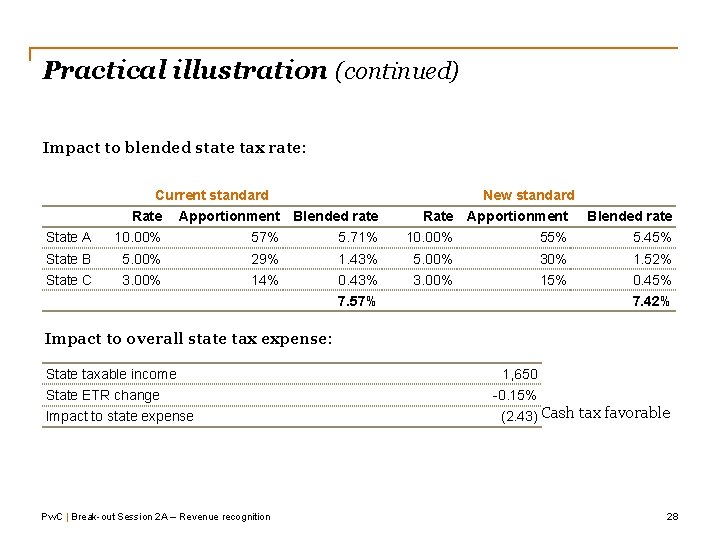
Practical illustration (continued) Impact to blended state tax rate: Current standard New standard Rate Apportionment Blended rate State A 10. 00% 57% 5. 71% 10. 00% 55% 5. 45% State B 5. 00% 29% 1. 43% 5. 00% 30% 1. 52% State C 3. 00% 14% 0. 43% 3. 00% 15% 0. 45% 7. 57% 7. 42% Impact to overall state tax expense: State taxable income State ETR change Impact to state expense Pw. C | Break-out Session 2 A – Revenue recognition 1, 650 -0. 15% (2. 43) Cash tax favorable 28

Thank you Ann Kruse, Federal Partner St. Louis, MO (314) 206 -8154 ann. l. kruse@pwc. com Latina Fauconier, Advisory Director Detroit, Michigan (313) 394 -6249 latina. s. fauconier@pwc. com Mark Wilmot, Federal Director Detroit, Michigan (313) 394 -6685 mark. j. wilmot@pwc. com This document is for general information purposes only, and should not be used as a substitute for consultation with professional advisors. This document was not intended or written to be used, and it cannot be used, for the purpose of avoiding US federal, state or local tax penalties. © 2016 Pw. C. All rights reserved. In this document, "Pw. C" refers to Pricewaterhouse. Coopers LLP, a Delaware limited liability partnership, which is a member firm of Pricewaterhouse. Coopers International Limited, each member firm of which is a separate legal entity.
- Slides: 29