
www itcilo org International Training Centre of the

- Slides: 21
www. itcilo. org International Training Centre of the ILO 1 © International Training Centre of the ILO 2007 Introduction to Research Methodology & Role of Trade Union Researchers
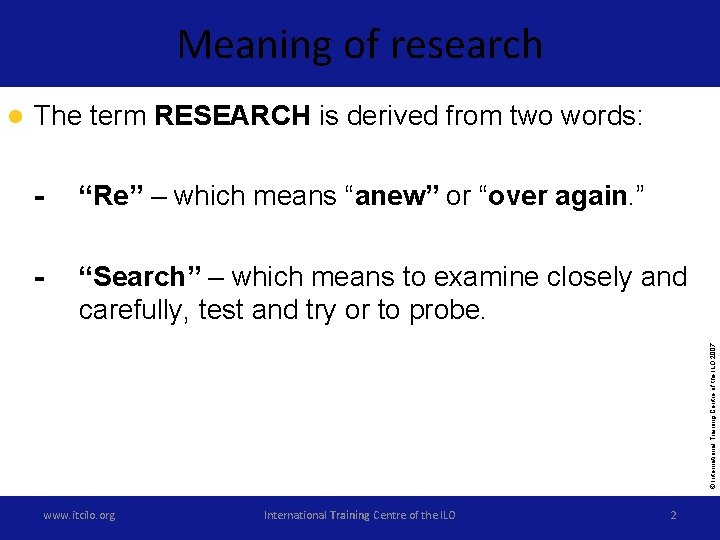
Meaning of research The term RESEARCH is derived from two words: - “Re” – which means “anew” or “over again. ” - “Search” – which means to examine closely and carefully, test and try or to probe. © International Training Centre of the ILO 2007 l www. itcilo. org International Training Centre of the ILO 2
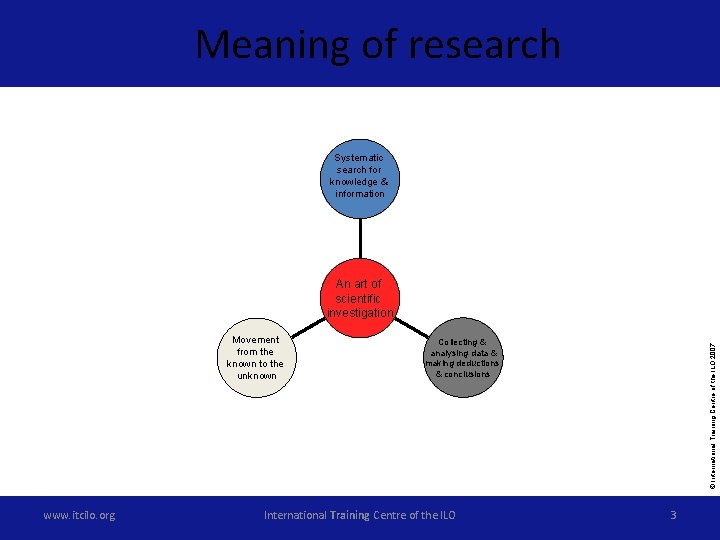
Meaning of research Systematic search for knowledge & information An art of scientific investigation www. itcilo. org Collecting & analysing data & making deductions & conclusions International Training Centre of the ILO © International Training Centre of the ILO 2007 Movement from the known to the unknown 3
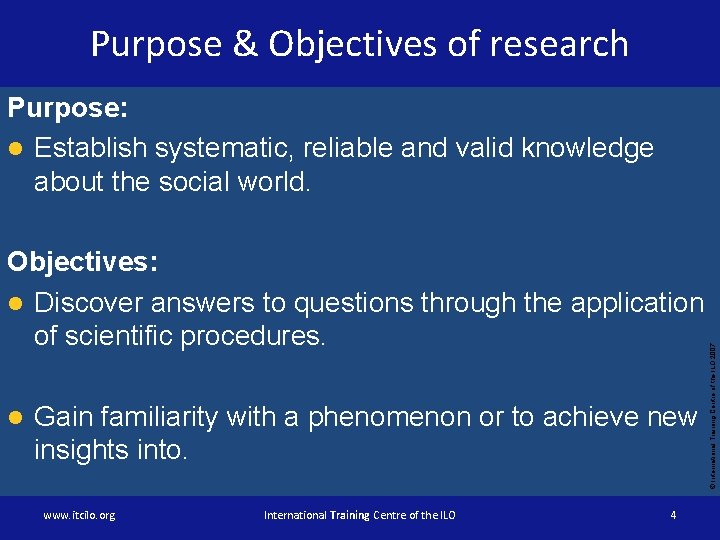
Purpose & Objectives of research Objectives: l Discover answers to questions through the application of scientific procedures. l Gain familiarity with a phenomenon or to achieve new insights into. www. itcilo. org International Training Centre of the ILO 4 © International Training Centre of the ILO 2007 Purpose: l Establish systematic, reliable and valid knowledge about the social world.
Purpose & Objective of research • Portray accurately the characteristics of a particular individual, situation or group. • Determine the frequency with which something occurs or with which it is associated with something else. www. itcilo. org International Training Centre of the ILO © International Training Centre of the ILO 2007 • Test a hypothesis of a relationship between variables. 5
Characteristics of Research • Controlled – it is extremely difficult to ensure control given that research studies are carried out on issues relating to human beings living in society where such controls are impossible – however, quantifying the impact of variables is a possible way. © International Training Centre of the ILO 2007 • Rigorous – to ensure that the procedures followed to find answers to questions are relevant, appropriate and justified. • Systematic – procedures adopted to undertake an investigation must follow a certain logical sequence. www. itcilo. org International Training Centre of the ILO 6
Characteristics of Research • Valid and verifiable – conclusions based on findings must be accurate and verifiable. • Critical – scrutiny of the procedures used and methods employed is crucial to research inquiry i. e. the research process must be foolproof and free from any drawbacks as well as the capability to withstand critical scrutiny. www. itcilo. org International Training Centre of the ILO 7 © International Training Centre of the ILO 2007 • Empirical – conclusions drawn must be based on hard evidence.
Motivation in research • Desire to: - get a research degree along with its consequent benefits. - get intellectual joy of doing some collective work. - be of service to society. www. itcilo. org International Training Centre of the ILO © International Training Centre of the ILO 2007 - face the challenge in solving the unsolved problems, i. e. concern over practical problems initiates research. 8
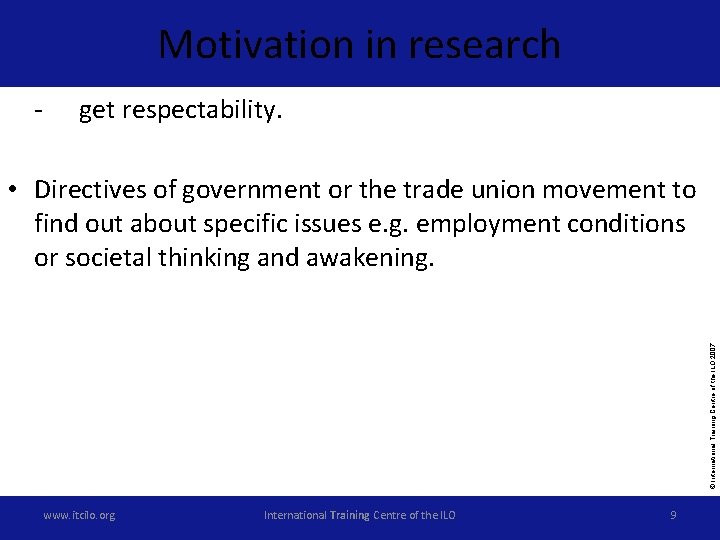
Motivation in research - get respectability. © International Training Centre of the ILO 2007 • Directives of government or the trade union movement to find out about specific issues e. g. employment conditions or societal thinking and awakening. www. itcilo. org International Training Centre of the ILO 9
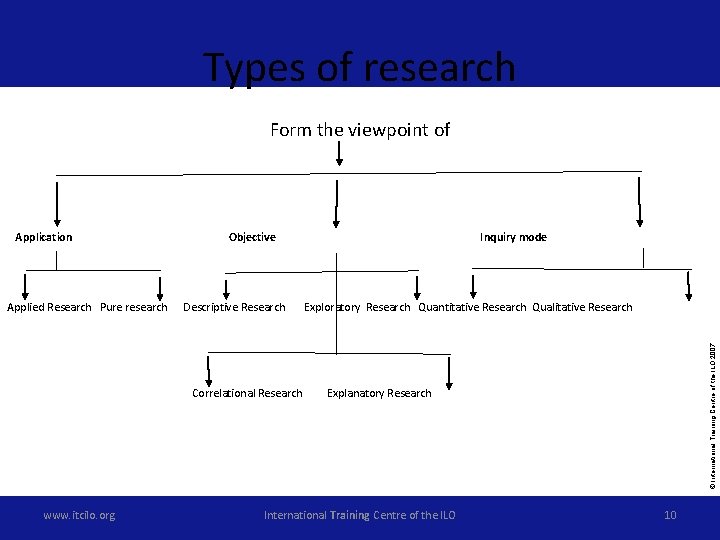
Types of research Form the viewpoint of Applied Research Pure research Objective Descriptive Research Correlational Research www. itcilo. org Inquiry mode Exploratory Research Quantitative Research Qualitative Research © International Training Centre of the ILO 2007 Application Explanatory Research International Training Centre of the ILO 10
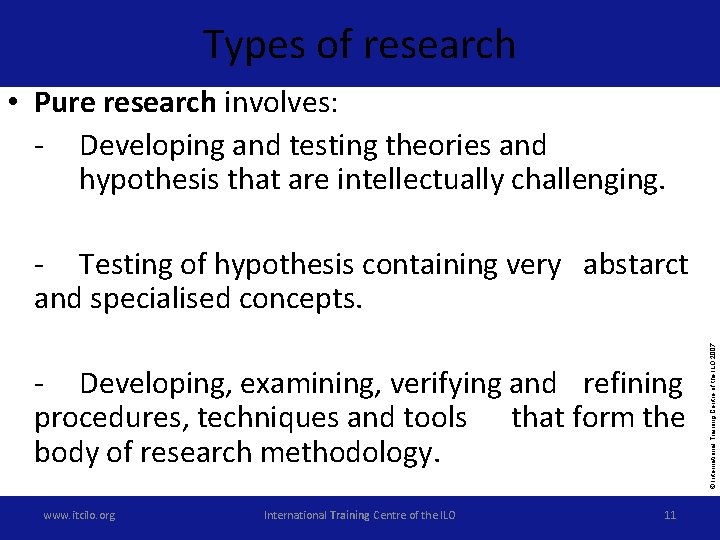
Types of research • Pure research involves: - Developing and testing theories and hypothesis that are intellectually challenging. - Developing, examining, verifying and refining procedures, techniques and tools that form the body of research methodology. www. itcilo. org International Training Centre of the ILO 11 © International Training Centre of the ILO 2007 - Testing of hypothesis containing very abstarct and specialised concepts.
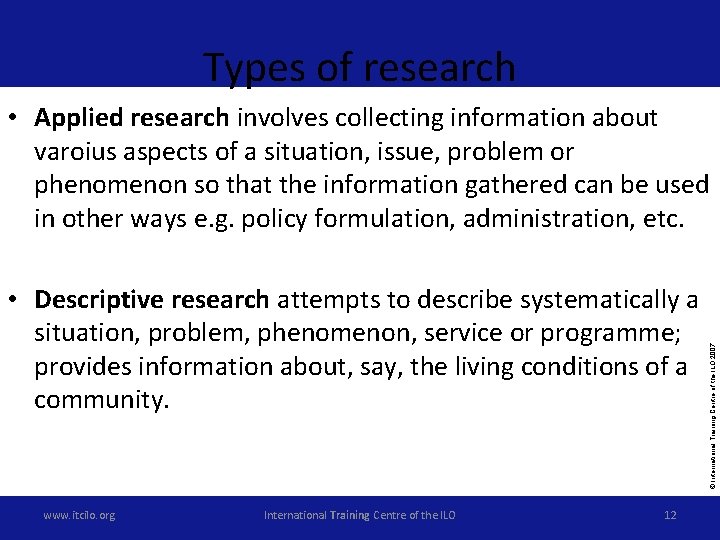
Types of research • Descriptive research attempts to describe systematically a situation, problem, phenomenon, service or programme; provides information about, say, the living conditions of a community. www. itcilo. org International Training Centre of the ILO 12 © International Training Centre of the ILO 2007 • Applied research involves collecting information about varoius aspects of a situation, issue, problem or phenomenon so that the information gathered can be used in other ways e. g. policy formulation, administration, etc.
Types of research • Exploratory research is a study undertaken with the objective either to explore an area where little is known or to investigate the possibilities of undertaking a particular research study. Exploratory research is also called feasibility study or pilot study. - © International Training Centre of the ILO 2007 • Correlative research entails discovering and establishing the existence of a relationship/association or interdependence between two or more aspects of a situation e. g. Technology and unemployment Stressful working conditions and the incidence of heart attack. www. itcilo. org International Training Centre of the ILO 13
Types of research © International Training Centre of the ILO 2007 • Explanatory research attempts to clarify why and how there is a relationship between two aspects of a situation or phenomenon e. g. why stressful working condition result in heart attacks or how the home environment affects children’s level of academic achievement. www. itcilo. org International Training Centre of the ILO 14
Types of research www. itcilo. org International Training Centre of the ILO © International Training Centre of the ILO 2007 • Qualitative research determines the extent of a problem, issue, phenomenon, problem or event using information gathered through the use of variables measured on nominal or ordinal scales (qualitative measurement scales) and analysed to establish the variation in the situation, or problem without quantifying it. 15
Types of research www. itcilo. org International Training Centre of the ILO © International Training Centre of the ILO 2007 • Quantitative Research entails quantifying the variation in a phenomenon, problem or issue using quantitative variables and analysed to ascertain the magnitude of the variation e. g. how many people have a particular problem? How many people hold a particular attitude? 16
Steps in planning a research www. itcilo. org International Training Centre of the ILO © International Training Centre of the ILO 2007 • Step 1: formulating a research problem • Step 2: conceptualising a research design • Step 3: constructing an instrument for data collection • Step 4: selecting a sample • Step 5: writing a research proposal • Step 6: collecting data • Step 7: processing data • Sept 8: writing a research report. 17
Role of Trade Union Researchers • Undertake research on employment and social issues that are of relevance to trade unions. © International Training Centre of the ILO 2007 • Generate sound, up-to-date and credible labour statistics on unemployment, non-standard employment, CL, FL, TIPs, LM, women’s participation in the labour force, safety and health at work, social security, CB, organising and a broader range of other topics associated with the measurement of decent work. • Scrutinise public policies and prepare union responses, comments and submissions. www. itcilo. org International Training Centre of the ILO 18
Role of Trade Union Researchers • Collect, analyse and interpret information on wages, conditions of employment, company productivity and profits, companies’ balance sheets, economic trends in the industry and country as a whole, job grading, cost of living, pension/provident funds, etc. • Make regular contacts with union branches and shop stewards to assess progress and impact on CBAs. www. itcilo. org International Training Centre of the ILO 19 © International Training Centre of the ILO 2007 • Provide statistics which trade union leaders can use to effectively communicate cogent arguments during policymaking and policy review exercises.
Role of Trade Union Researchers • Collect, analyse and interpret data on key challenges facing the trade union movement e. g. membership decline, fragmentation and proliferation, gender inequality, organising informal economy workers, etc. © International Training Centre of the ILO 2007 • Coordinate statistical activities across the affiliates of the national trade union centre and monitor their qualities. • Create reliable statistical database for trade unions. www. itcilo. org International Training Centre of the ILO 20
THE END © International Training Centre of the ILO 2007 THANK YOU! www. itcilo. org International Training Centre of the ILO 21