
www iaecho in Systolic anterior motion of mitral
- Slides: 12
www. iaecho. in Systolic anterior motion of mitral apparatus
What is SAM? www. iaecho. in • SAM of the mitral valve describes the paradoxical, anterior motion of AML towards the septum (and occasionally with the posterior mitral leaflet PML), during systole. • Can involve only chordae (chordal SAM) or leaflets or both. • It results in left ventricular outflow tract obstruction (LVOTO) and secondary mitral regurgitation (MR)- directed posteriorly due to the mal-coaptation of the leaflets.
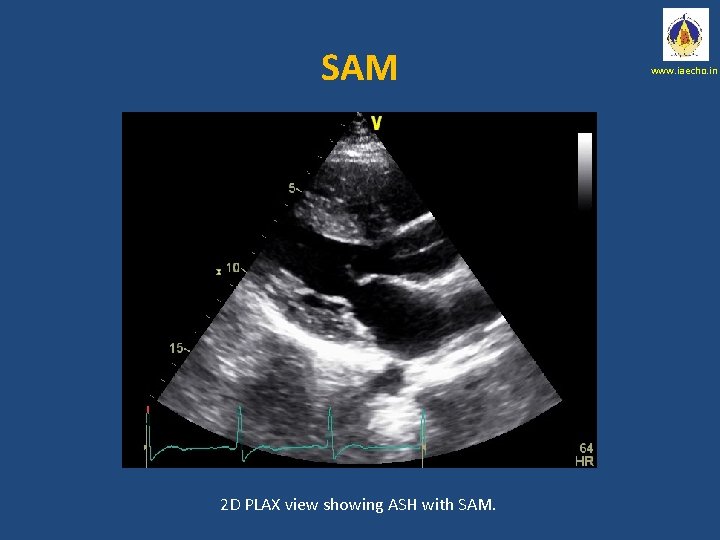
SAM 2 D PLAX view showing ASH with SAM. www. iaecho. in
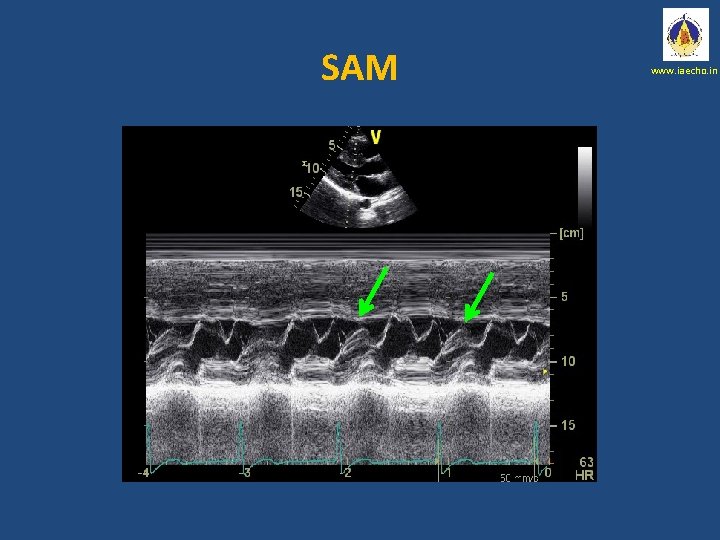
SAM www. iaecho. in
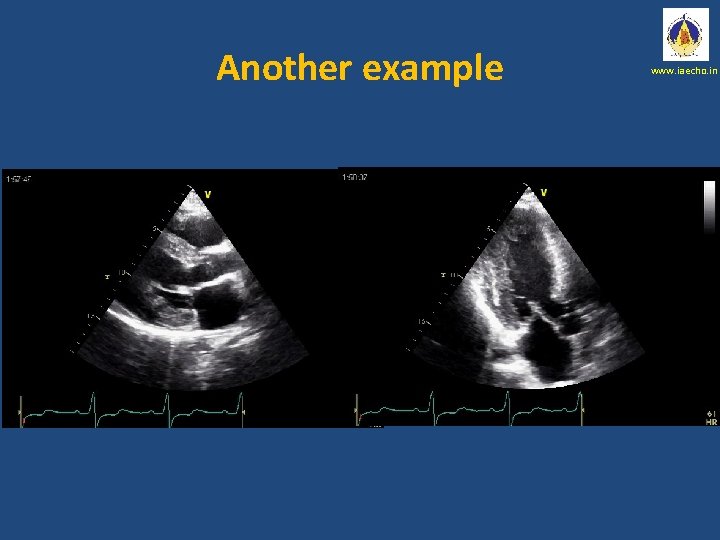
Another example www. iaecho. in
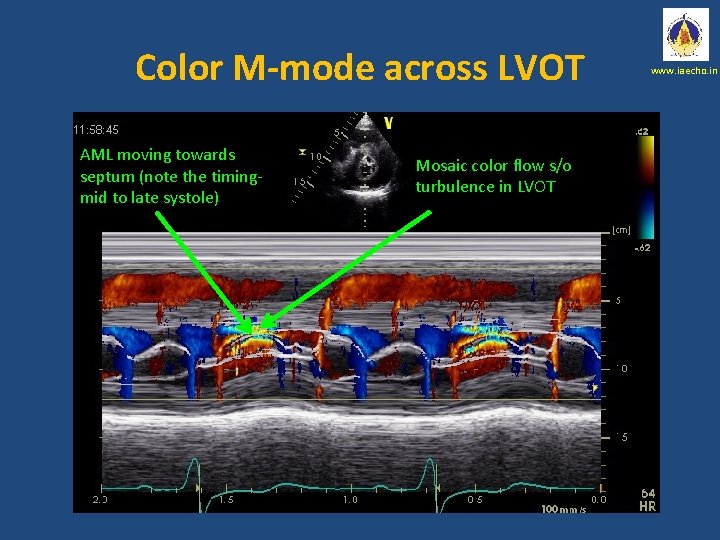
Color M-mode across LVOT AML moving towards septum (note the timingmid to late systole) Mosaic color flow s/o turbulence in LVOT www. iaecho. in
Mechanism www. iaecho. in • Primarily two theories– Venturi effect: the AML is pulled towards the septum – Anterior insertion of papillary muscles as a result of which chordal tension is altered and the leaflets are pushed towards septum in early systole. A combination both these mechanisms may in fact be operative in causation of SAM
Mechanism Substrates Provoking factors • Susceptible anatomy of LV (e. g. bulging subaortic septum) • Surgical/anatomical anterior translocation of MV • Excessive AML/PML tissue or surgical elongation of AML • Aorto-mitral angle <120° • Elongation/buckling of chordae/ surgical interventions of chordae • Anteromedial displacement of Papillary muscles • Minimum distance between septum and coaptation point (C-sept) <2. 5 cm, etc. • Reduced Preload www. iaecho. in • Reduced after load, and/or • increased Contractility
Causes www. iaecho. in • Most commonly, SAM is • Other conditions where SAM is known to be associated seen are (SAM peaks in end with asymmetrical septal systole) hypertrophy (ASH) type of – Any condition with hypovolemia and increased contractility (e. g. HCM (SAM peaks in midpost-op period, during systole). – – – dobutamine echo) Hypertension Post AVR (for AS) Post MV repair (annular undersizing) Post MI Diabetes CHDs ( D-TGA, cleft AML, subaortic stenosis)
Grading www. iaecho. in • Echocardiographic grading of SAMI. No leaflet-septum contact; min. distance between mitral leaflet/septum >1 cm II. no leaflet-septum contact; min. distance between mitral leaflet/septum <1 cm III. mitral leaflet-septum contact <30% of systolic time IV. mitral leaflet-septum contact >30% of systolic time
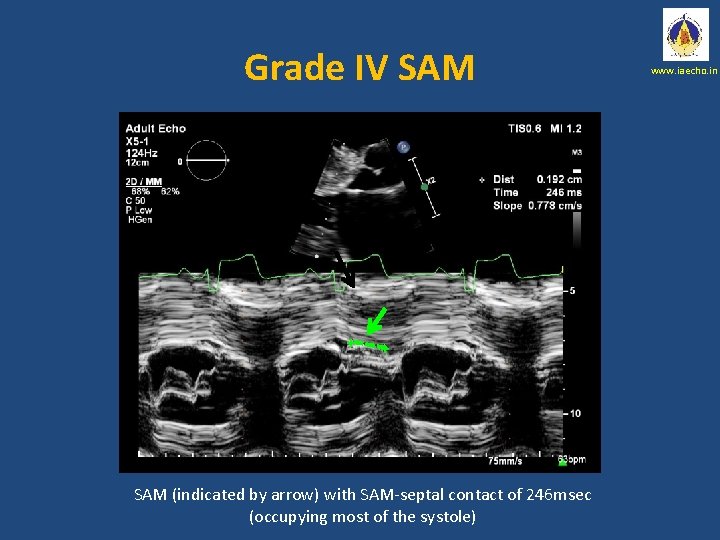
Grade IV SAM + + SAM (indicated by arrow) with SAM-septal contact of 246 msec (occupying most of the systole) www. iaecho. in
Management of SAM www. iaecho. in • Measures like hypovolemia, diuretics, vasodilators, general anesthesia may aggravate/provoke SAM and should be avoided • Mild SAM with MR controlled with volume replacement, beta-blockers, vasoconstrictors, etc. • Moderate/Severe SAM with MR may require surgical options in addition to medical measures.