
www hoddereducation co ukgeographyreview The USAs superpower status
- Slides: 12
www. hoddereducation. co. uk/geographyreview The USA’s superpower status Assessing the USA’s current and future geopolitical role Simon Oakes Hodder & Stoughton © 2017
Key terms Superpower The term global superpower was used originally to describe the ability of the USA, USSR and the British empire to project power and influence anywhere on Earth to become a dominant worldwide force. Hard power This means getting your own way by using force. Invasions, war and conflict are very blunt instruments. Economic power can be used as a Do you know what these terms mean? form of hard power: sanctions and trade barriers can cause great harm to other states. Click to reveal the definitions Soft power The political scientist Joseph Nye coined the term ‘soft power’ to mean the power of persuasion. Some countries are able to make others follow their lead by making their policies attractive. A country’s culture (arts, music, cinema) may be viewed favourably by people in other countries. International aid is another soft power strategy. Hodder & Stoughton © 2017
Key terms Americanisation The imposition and adoption of US cultural traits and values at a global scale. Media giant Disney has exported its stories of superheroes and princesses globally. Western festivals of Hallowe’en and Christmas feature prominently in its films. Global hegemony A powerful state which can influence outcomes and shape global Click to reveal the definitions norms without reverting to hard-power tactics alone, such as military force. Instead, control is exercised and reproduced using soft strategies including diplomacy, aid and the work of the media and educational institutions. The USA is regarded widely as being a global hegemon in the post-1945 era. Hodder & Stoughton © 2017 Do you know what these terms mean?
What makes the USA a superpower? • The British empire was a colonial power, alongside France, Spain, Portugal and other European states. Between approximately 1500 and 1900, these leading powers built global empires. One result was the diffusion of European languages, religions, laws, customs, arts and sports on a global scale. • In contrast to the direct rule of the British in the 1800 s, the USA has dominated world affairs since 1945 mainly by using indirect forms of influence or neocolonial strategies. Unlike every superpower before it, the USA has not built an empire by colonising other nations. Instead, it has used soft power mechanisms, such as media, aid and diplomacy, to spread its norms, culture and power. Much of American influence has been attributed to ‘Hollywood, Harvard, Microsoft and Michael Jordan’. Hodder & Stoughton © 2017
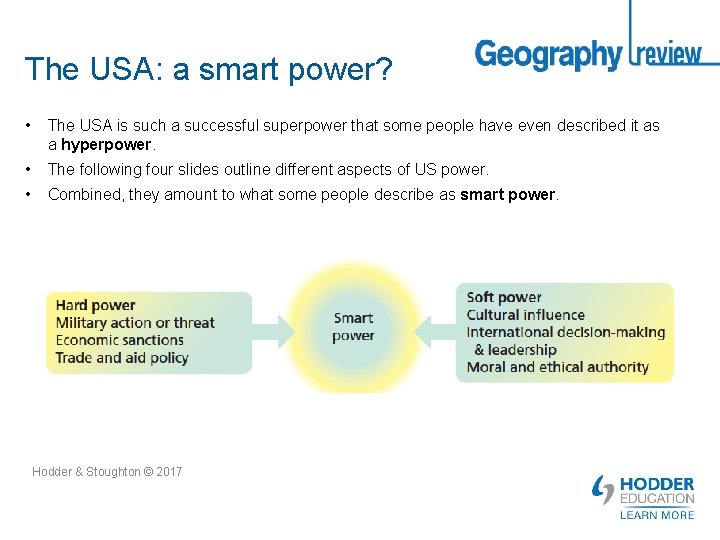
The USA: a smart power? • The USA is such a successful superpower that some people have even described it as a hyperpower. • The following four slides outline different aspects of US power. • Combined, they amount to what some people describe as smart power. Hodder & Stoughton © 2017
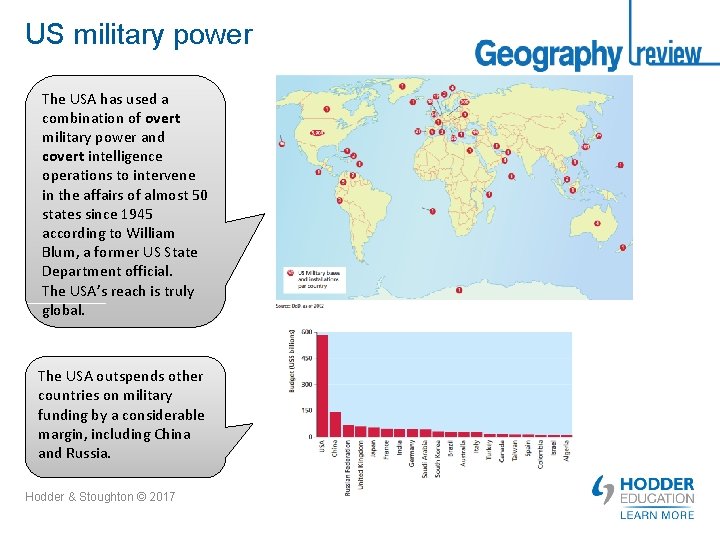
US military power The USA has used a combination of overt military power and covert intelligence operations to intervene in the affairs of almost 50 states since 1945 according to William Blum, a former US State Department official. The USA’s reach is truly global. The USA outspends other countries on military funding by a considerable margin, including China and Russia. Hodder & Stoughton © 2017
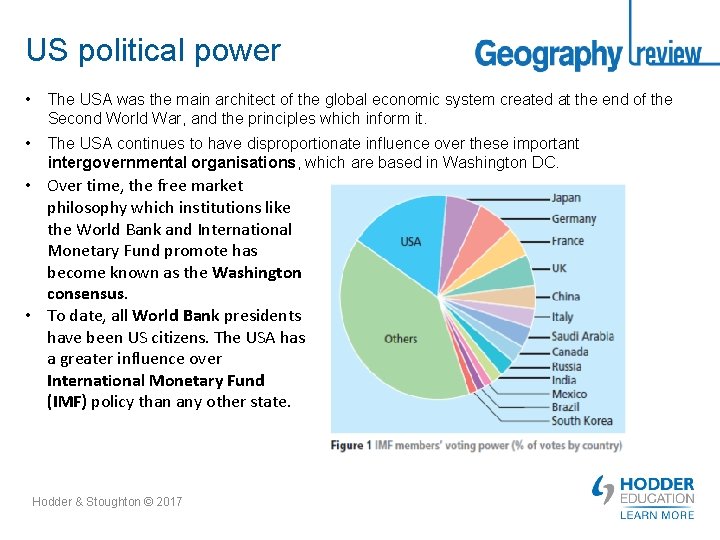
US political power • The USA was the main architect of the global economic system created at the end of the Second World War, and the principles which inform it. • The USA continues to have disproportionate influence over these important intergovernmental organisations, which are based in Washington DC. • Over time, the free market philosophy which institutions like the World Bank and International Monetary Fund promote has become known as the Washington consensus. • To date, all World Bank presidents have been US citizens. The USA has a greater influence over International Monetary Fund (IMF) policy than any other state. Hodder & Stoughton © 2017
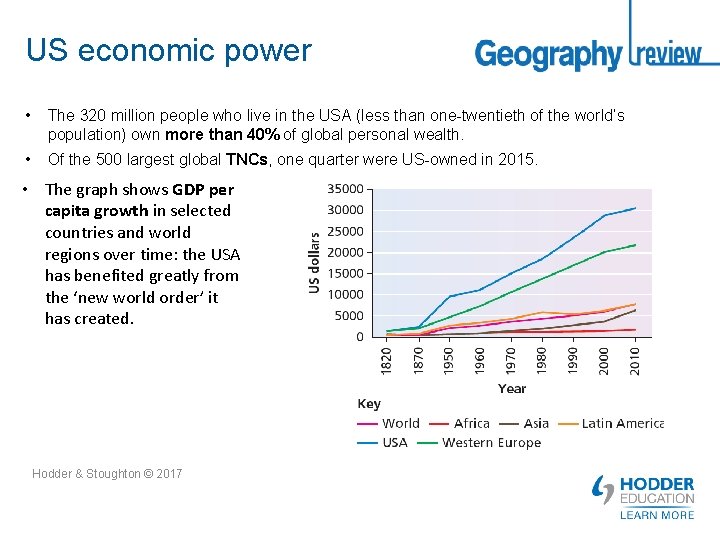
US economic power • The 320 million people who live in the USA (less than one-twentieth of the world’s population) own more than 40% of global personal wealth. • Of the 500 largest global TNCs, one quarter were US-owned in 2015. • The graph shows GDP per capita growth in selected countries and world regions over time: the USA has benefited greatly from the ‘new world order’ it has created. Hodder & Stoughton © 2017
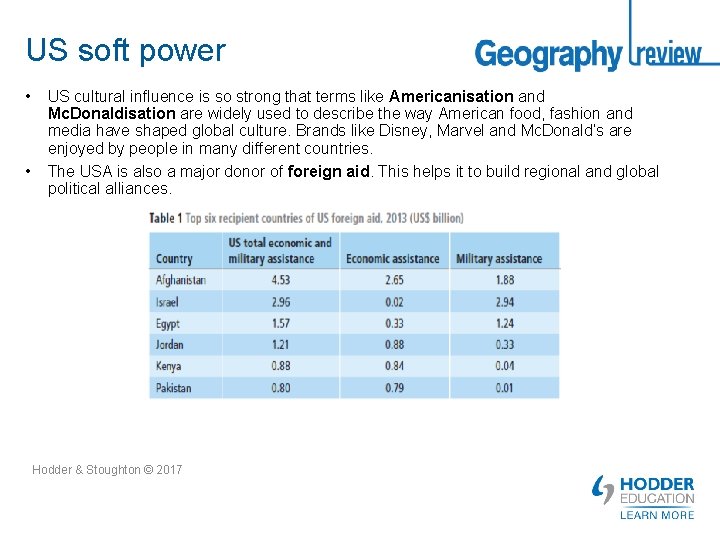
US soft power • • US cultural influence is so strong that terms like Americanisation and Mc. Donaldisation are widely used to describe the way American food, fashion and media have shaped global culture. Brands like Disney, Marvel and Mc. Donald’s are enjoyed by people in many different countries. The USA is also a major donor of foreign aid. This helps it to build regional and global political alliances. Hodder & Stoughton © 2017
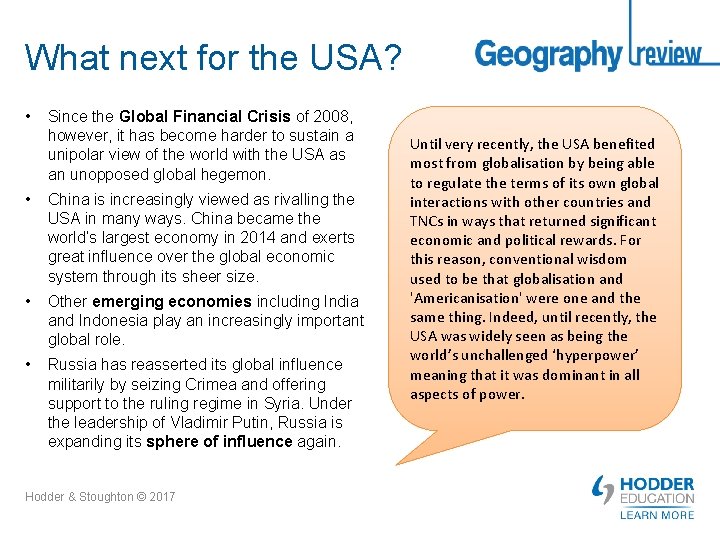
What next for the USA? • Since the Global Financial Crisis of 2008, however, it has become harder to sustain a unipolar view of the world with the USA as an unopposed global hegemon. • China is increasingly viewed as rivalling the USA in many ways. China became the world’s largest economy in 2014 and exerts great influence over the global economic system through its sheer size. • Other emerging economies including India and Indonesia play an increasingly important global role. • Russia has reasserted its global influence militarily by seizing Crimea and offering support to the ruling regime in Syria. Under the leadership of Vladimir Putin, Russia is expanding its sphere of influence again. Hodder & Stoughton © 2017 Until very recently, the USA benefited most from globalisation by being able to regulate the terms of its own global interactions with other countries and TNCs in ways that returned significant economic and political rewards. For this reason, conventional wisdom used to be that globalisation and 'Americanisation' were one and the same thing. Indeed, until recently, the USA was widely seen as being the world’s unchallenged ‘hyperpower’ meaning that it was dominant in all aspects of power.
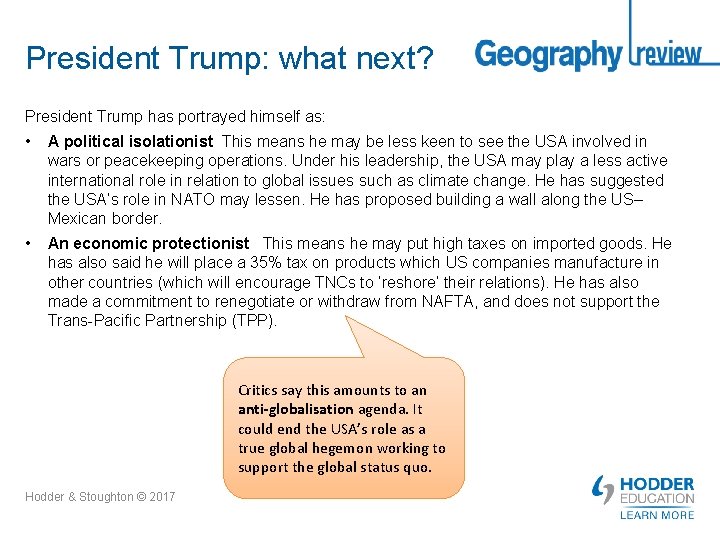
President Trump: what next? President Trump has portrayed himself as: • A political isolationist This means he may be less keen to see the USA involved in wars or peacekeeping operations. Under his leadership, the USA may play a less active international role in relation to global issues such as climate change. He has suggested the USA’s role in NATO may lessen. He has proposed building a wall along the US– Mexican border. • An economic protectionist This means he may put high taxes on imported goods. He has also said he will place a 35% tax on products which US companies manufacture in other countries (which will encourage TNCs to ‘reshore’ their relations). He has also made a commitment to renegotiate or withdraw from NAFTA, and does not support the Trans-Pacific Partnership (TPP). Critics say this amounts to an anti-globalisation agenda. It could end the USA’s role as a true global hegemon working to support the global status quo. Hodder & Stoughton © 2017
This resource is part of GEOGRAPHY REVIEW, a magazine written for A-level students by subject experts. To subscribe to the full magazine go to: http: //www. hoddereducation. co. uk/geographyreview Hodder & Stoughton © 2017