
www h 2 training eu Chapter Alternative Vehicle




- Slides: 42
www. h 2 training. eu Chapter: Alternative Vehicle Concepts The chapter gives an overview of working-principles and concepts of alternative drives and presents exemplary cars. The focus is on fuel cell vehicles.
Contents www. h 2 training. eu 1. Introduction: European and US emission-laws. 2. Internal combustion engines (ICE). Part 1 Part 2 Part 3 Part 4 Part 5 ü Diesel and gasoline engine. ü Rotary Engine (Wankel engine). 3. Hybrid-Drives. ü Mild Hybrids. ü Full Hybrids. ü Plug In Hybrids. 4. Electrical Drives. ü Batteries. ü Fuel Cells. 5. Fuel Cell Vehicles. ü Types and car concepts. ü Components. ü Efficiency.
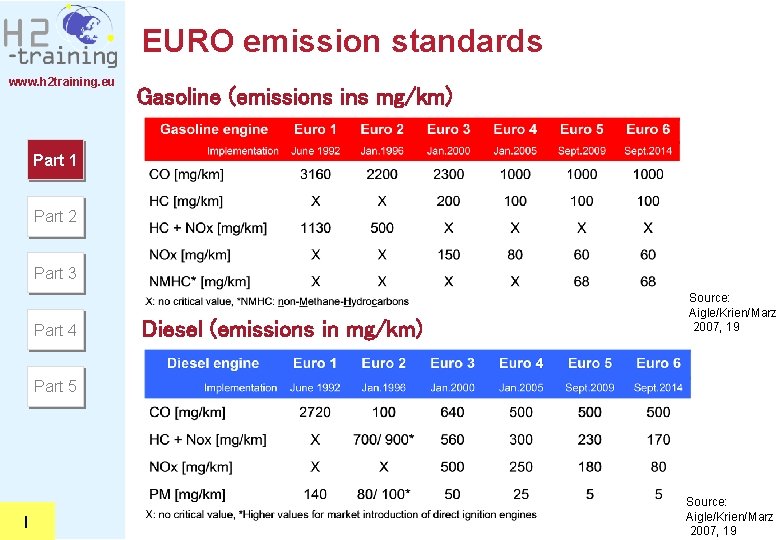
EURO emission standards www. h 2 training. eu Gasoline (emissions ins mg/km) Part 1 Part 2 Part 3 Part 4 Diesel (emissions in mg/km) Source: Aigle/Krien/Marz 2007, 19 Part 5 I Source: Aigle/Krien/Marz 2007, 19
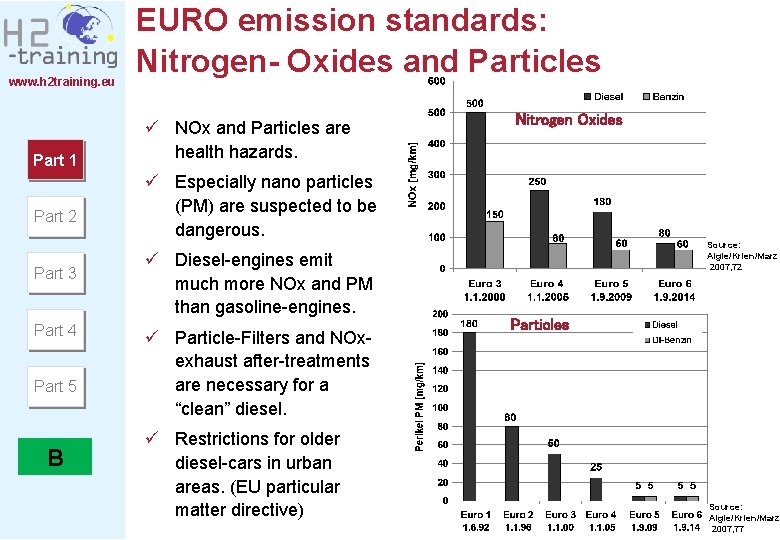
www. h 2 training. eu Part 1 Part 2 Part 3 Part 4 Part 5 B EURO emission standards: Nitrogen- Oxides and Particles ü NOx and Particles are health hazards. Nitrogen Oxides ü Especially nano particles (PM) are suspected to be dangerous. ü Diesel engines emit much more NOx and PM than gasoline engines. ü Particle Filters and NOx exhaust after treatments are necessary for a “clean” diesel. ü Restrictions for older diesel cars in urban areas. (EU particular matter directive) Source: Aigle/Krien/Marz 2007, 72 Particles Source: Aigle/Krien/Marz 2007, 77
California's Low-Emission-Act www. h 2 training. eu Part 1 ü California has the world wide strongest emission law. Part 2 ü California claims a 4% market share of Zero Emission Vehicles (ZEV). Part 3 ü Hybrids and natural gas cars can be credited. Part 4 Part 5 B ü ZEV are only Fuel Cell and Battery cars. ü Note 1: There's no limit for CO 2. ü Note 2: The production of a fuel produces emissions ! Data: Aigle/Krien/Marz 2007, 24 own Illustration LEV - Low Emission Vehicle ULEV - Ultra Low E. V SULEV - Super Ultra Low E. V. EZEV - Equivalent Zero E. V. PZEV 1 - Partial Zero E. V. ZEV - Zero Emission Vehicle
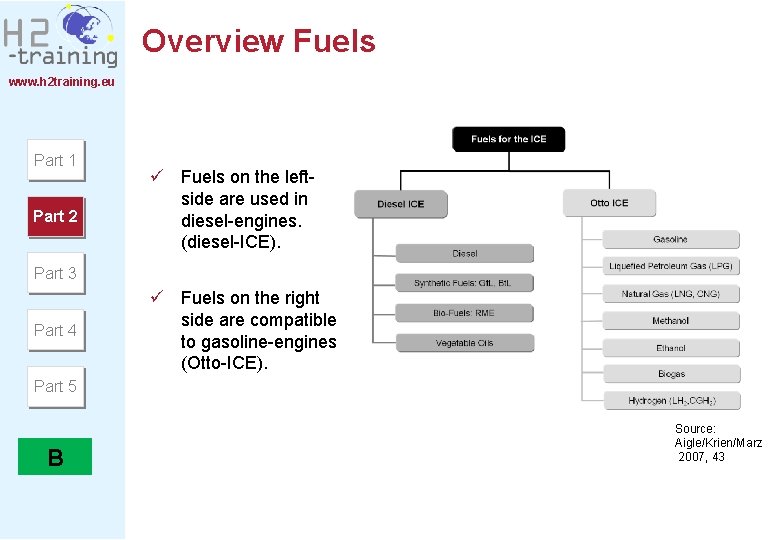
Overview Fuels www. h 2 training. eu Part 1 Part 2 ü Fuels on the left side are used in diesel engines. (diesel ICE). Part 3 Part 4 ü Fuels on the right side are compatible to gasoline engines (Otto ICE). Part 5 B Source: Aigle/Krien/Marz 2007, 43
www. h 2 training. eu Internal Combustion Engines (ICE) Principle Invention in the 1876: Part 1 Part 2 Part 3 ü First four stroke cycle engine developed by Nikolaus August Otto. First automobile in 1886: Intake valve Exhaust valve fuel air mixture Exhaust gases Sparking Plug Piston Cylinder Piston rings Connecting rod ü Developed by Gottfried Daimler and Carl Benz. Crankshaft Four stroke principle: Part 4 Rotating direction ü Intake. Source: WBZU 2007 ü Compression. Part 5 ü Ignition. ü Exhaust. B Engine Types: ü Diesel engine (self ignition). ü Otto engine. Nikolaus Otto Rudolph Diesel Source: Wikipedia 2007
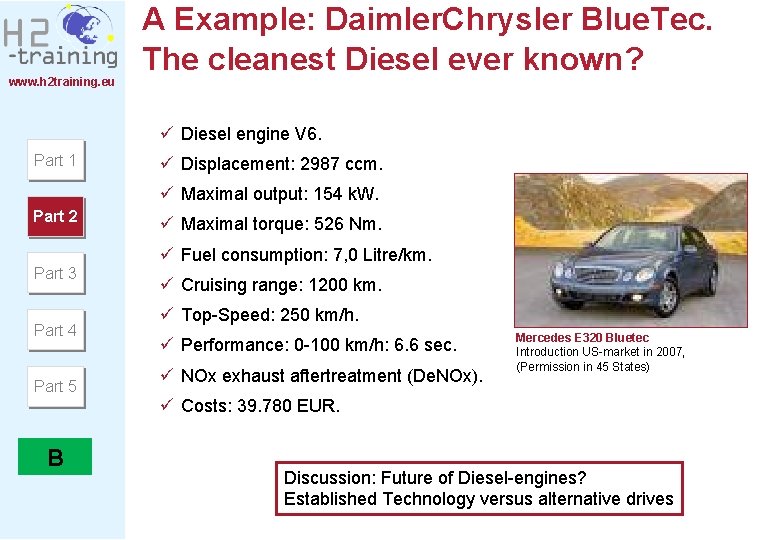
www. h 2 training. eu A Example: Daimler. Chrysler Blue. Tec. The cleanest Diesel ever known? ü Diesel engine V 6. Part 1 ü Displacement: 2987 ccm. ü Maximal output: 154 k. W. Part 2 Part 3 Part 4 Part 5 B ü Maximal torque: 526 Nm. ü Fuel consumption: 7, 0 Litre/km. ü Cruising range: 1200 km. ü Top Speed: 250 km/h. ü Performance: 0 100 km/h: 6. 6 sec. ü NOx exhaust aftertreatment (De. NOx). Mercedes E 320 Bluetec Introduction US market in 2007, (Permission in 45 States) ü Costs: 39. 780 EUR. Discussion: Future of Diesel engines? Established Technology versus alternative drives
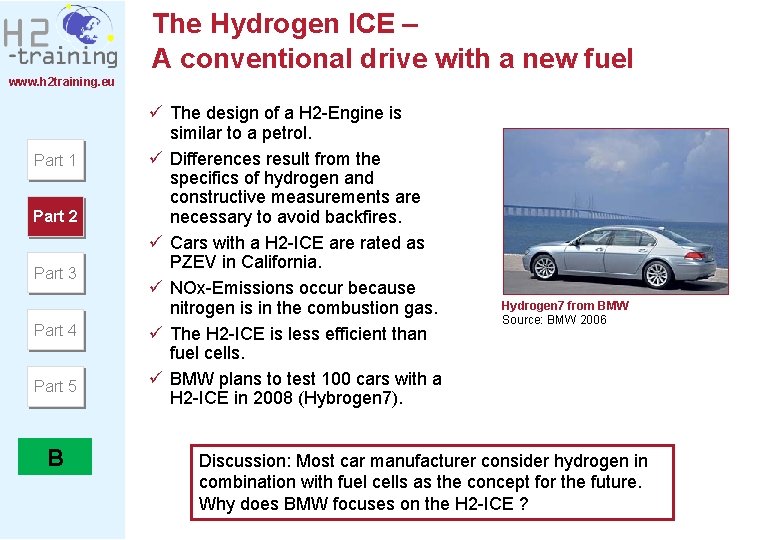
The Hydrogen ICE – A conventional drive with a new fuel www. h 2 training. eu Part 1 Part 2 Part 3 Part 4 Part 5 B ü The design of a H 2 Engine is similar to a petrol. ü Differences result from the specifics of hydrogen and constructive measurements are necessary to avoid backfires. ü Cars with a H 2 ICE are rated as PZEV in California. ü NOx Emissions occur because nitrogen is in the combustion gas. ü The H 2 ICE is less efficient than fuel cells. ü BMW plans to test 100 cars with a H 2 ICE in 2008 (Hybrogen 7). Hydrogen 7 from BMW Source: BMW 2006 Discussion: Most car manufacturer consider hydrogen in combination with fuel cells as the concept for the future. Why does BMW focuses on the H 2 ICE ?
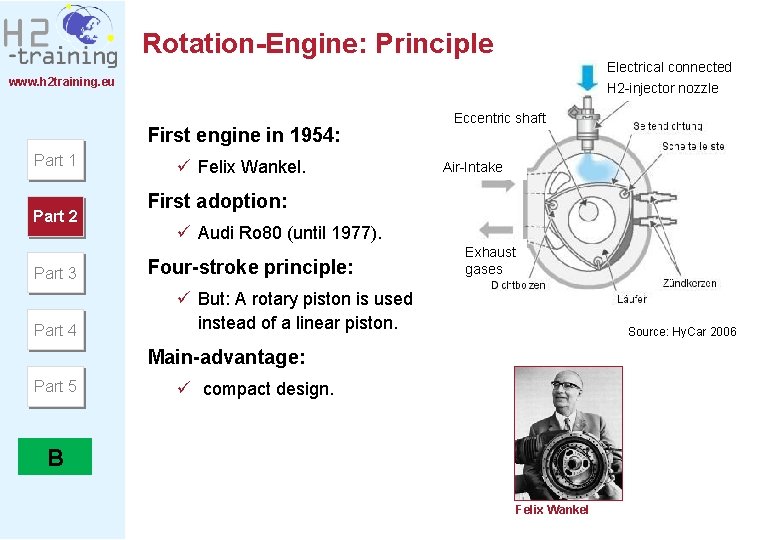
Rotation-Engine: Principle Electrical connected H 2 injector nozzle www. h 2 training. eu First engine in 1954: Part 1 Part 2 Part 3 Part 4 ü Felix Wankel. Eccentric shaft Air Intake First adoption: ü Audi Ro 80 (until 1977). Four-stroke principle: Exhaust gases ü But: A rotary piston is used instead of a linear piston. Source: Hy. Car 2006 Main-advantage: Part 5 ü compact design. B Felix Wankel
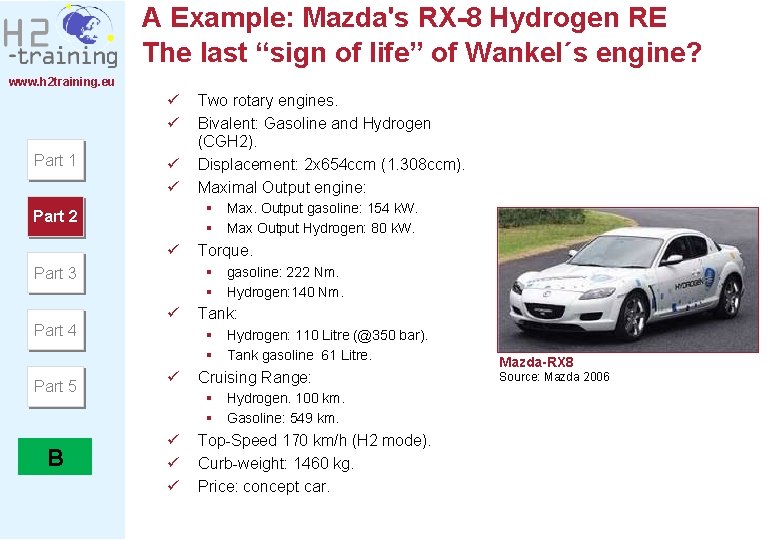
A Example: Mazda's RX-8 Hydrogen RE The last “sign of life” of Wankel´s engine? www. h 2 training. eu ü ü Part 1 ü ü § Max. Output gasoline: 154 k. W. § Max Output Hydrogen: 80 k. W. Part 2 ü Part 5 B Torque. § gasoline: 222 Nm. § Hydrogen: 140 Nm. Part 3 Part 4 Two rotary engines. Bivalent: Gasoline and Hydrogen (CGH 2). Displacement: 2 x 654 ccm (1. 308 ccm). Maximal Output engine: ü Tank: § Hydrogen: 110 Litre (@350 bar). § Tank gasoline 61 Litre. ü Cruising Range: § Hydrogen. 100 km. § Gasoline: 549 km. ü ü ü Top Speed 170 km/h (H 2 mode). Curb weight: 1460 kg. Price: concept car. Mazda-RX 8 Source: Mazda 2006
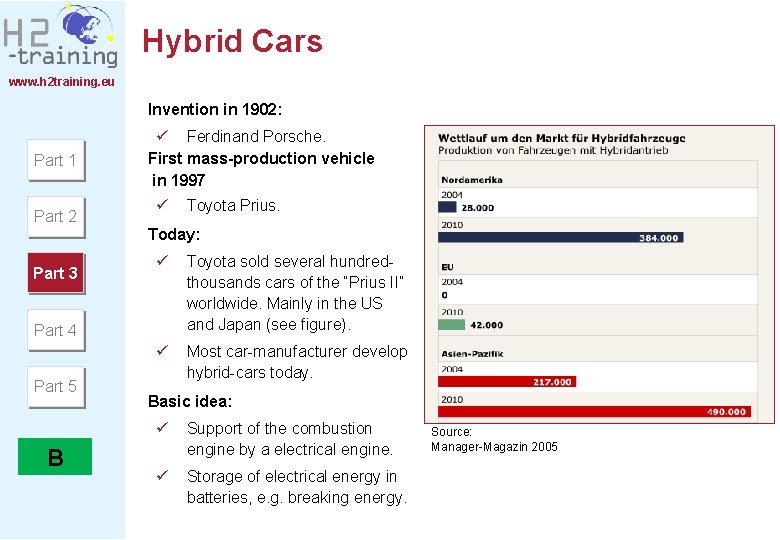
Hybrid Cars www. h 2 training. eu Invention in 1902: Part 1 Part 2 Part 3 ü Ferdinand Porsche. First mass-production vehicle in 1997 ü Today: ü Toyota sold several hundred thousands cars of the “Prius II” worldwide. Mainly in the US and Japan (see figure). ü Most car manufacturer develop hybrid cars today. Part 4 Part 5 B Toyota Prius. Basic idea: ü Support of the combustion engine by a electrical engine. ü Storage of electrical energy in batteries, e. g. breaking energy. Source: Manager Magazin 2005
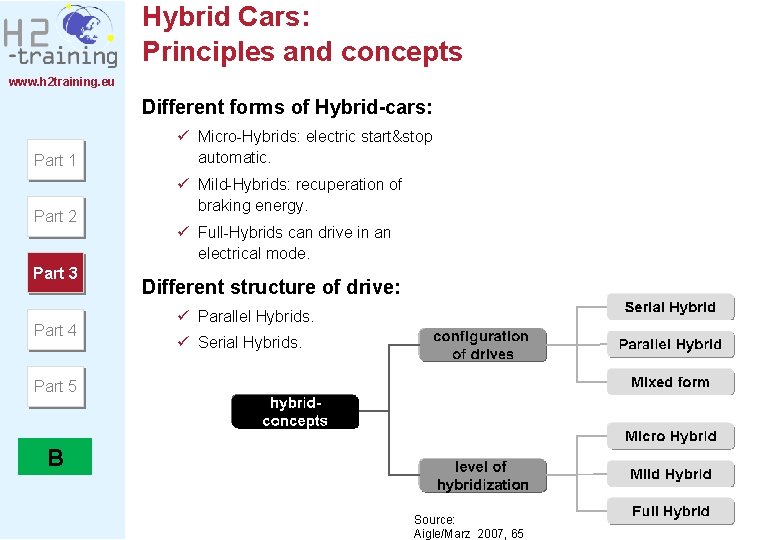
Hybrid Cars: Principles and concepts www. h 2 training. eu Different forms of Hybrid-cars: Part 1 Part 2 Part 3 Part 4 ü Micro Hybrids: electric start&stop automatic. ü Mild Hybrids: recuperation of braking energy. ü Full Hybrids can drive in an electrical mode. Different structure of drive: ü Parallel Hybrids. ü Serial Hybrids. Part 5 B Source: Aigle/Marz 2007, 65
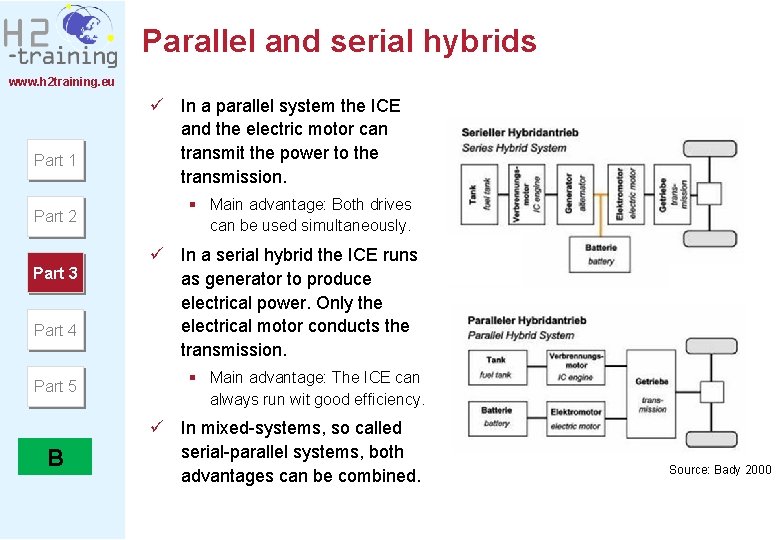
Parallel and serial hybrids www. h 2 training. eu Part 1 Part 2 Part 3 Part 4 Part 5 B ü In a parallel system the ICE and the electric motor can transmit the power to the transmission. § Main advantage: Both drives can be used simultaneously. ü In a serial hybrid the ICE runs as generator to produce electrical power. Only the electrical motor conducts the transmission. § Main advantage: The ICE can always run wit good efficiency. ü In mixed systems, so called serial parallel systems, both advantages can be combined. Source: Bady 2000
An example: Toyota Prius A success-story made in Japan www. h 2 training. eu ü Part 1 Part 2 Part 3 Part 4 Part 5 B ü ü ü ü ü Combustion engine: 4 Cylinder Otto engine: § Displacement: : 1497 ccm. § Nominal Power: 57 k. W. § Nominal Torque: 115 Nm (@ 4000 U/min). Electrical Engine: Synchron AC engine: § Nominal Power: 50 k. W. § Nominal Torque: 400 Nm (@ 1200 U/min). Battery: Ni MH. Fuel consumption: 4, 3 Litre. Cruising range: 1050 km. Tank: 45 Litre. Top speed: : 170 km/h. Performance 0 100 km/h: 10, 9 sec. Curb weight: 1400 kg. CO 2 Emissions: 104 g/km. Price: 24. 070 € Toyota Prius Source: Toyota 2006
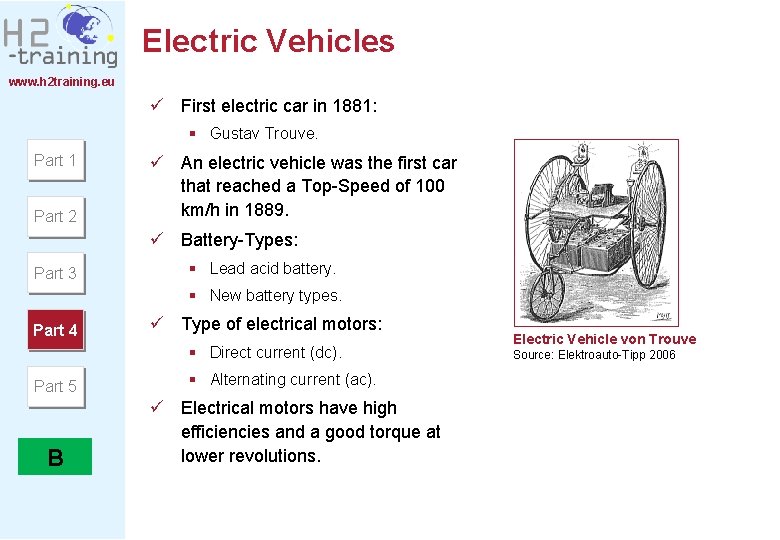
Electric Vehicles www. h 2 training. eu ü First electric car in 1881: § Gustav Trouve. Part 1 Part 2 ü An electric vehicle was the first car that reached a Top Speed of 100 km/h in 1889. ü Battery Types: Part 3 § Lead acid battery. § New battery types. Part 4 ü Type of electrical motors: § Direct current (dc). Part 5 B § Alternating current (ac). ü Electrical motors have high efficiencies and a good torque at lower revolutions. Electric Vehicle von Trouve Source: Elektroauto Tipp 2006
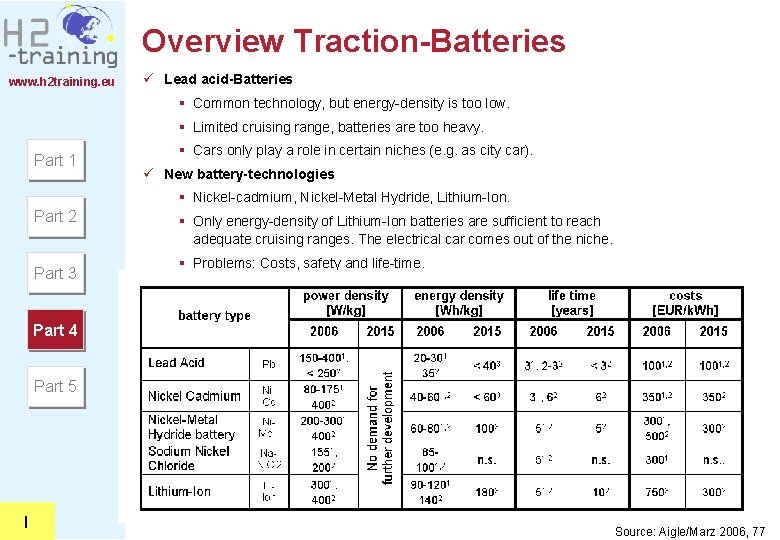
Overview Traction-Batteries www. h 2 training. eu ü Lead acid-Batteries § Common technology, but energy density is too low. § Limited cruising range, batteries are too heavy. Part 1 § Cars only play a role in certain niches (e. g. as city car). ü New battery-technologies § Nickel cadmium, Nickel Metal Hydride, Lithium Ion. Part 2 Part 3 § Only energy density of Lithium Ion batteries are sufficient to reach adequate cruising ranges. The electrical car comes out of the niche. § Problems: Costs, safety and life time. Part 4 Part 5 I Source: Aigle/Marz 2006, 77
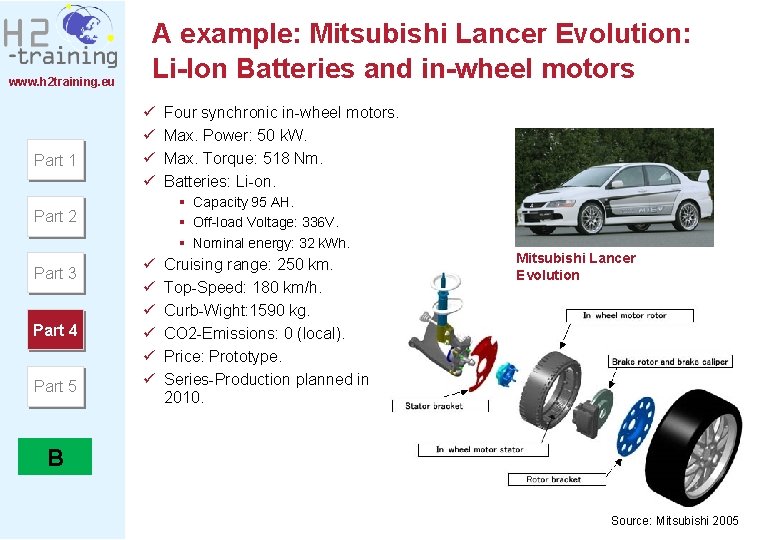
www. h 2 training. eu Part 1 A example: Mitsubishi Lancer Evolution: Li-Ion Batteries and in-wheel motors ü ü § Capacity 95 AH. § Off load Voltage: 336 V. § Nominal energy: 32 k. Wh. Part 2 Part 3 Part 4 Part 5 Four synchronic in wheel motors. Max. Power: 50 k. W. Max. Torque: 518 Nm. Batteries: Li on. ü ü ü Cruising range: 250 km. Top Speed: 180 km/h. Curb Wight: 1590 kg. CO 2 Emissions: 0 (local). Price: Prototype. Series Production planned in 2010. Mitsubishi Lancer Evolution B Source: Mitsubishi 2005
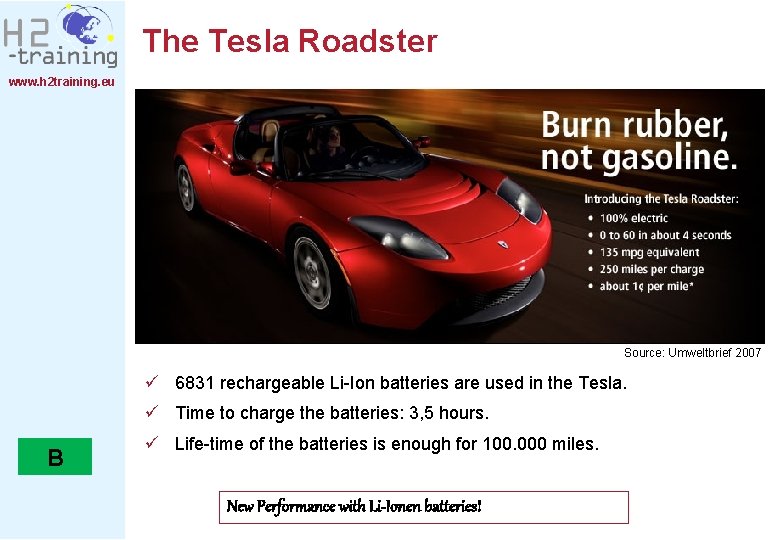
The Tesla Roadster www. h 2 training. eu Source: Umweltbrief 2007 ü 6831 rechargeable Li Ion batteries are used in the Tesla. ü Time to charge the batteries: 3, 5 hours. B ü Life time of the batteries is enough for 100. 000 miles. New Performance with Li-Ionen batteries!
www. h 2 training. eu Part 1 Part 2 Part 3 Part 4 Part 5 Fuel Cell Cars
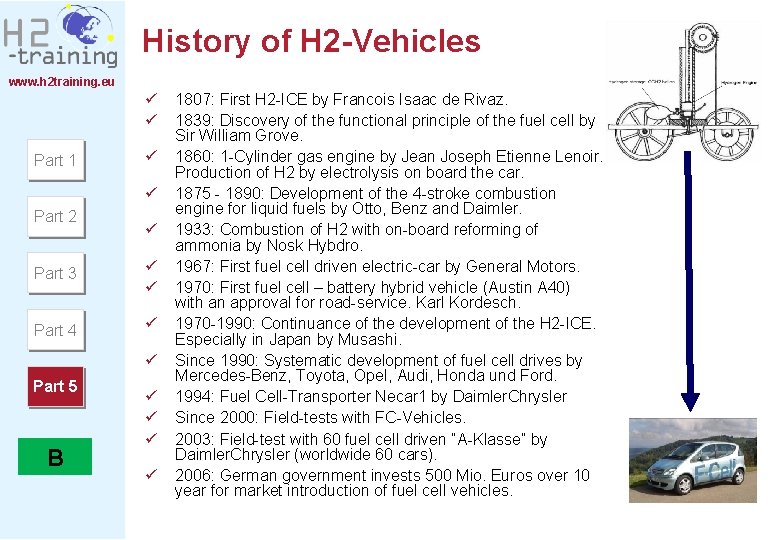
History of H 2 -Vehicles www. h 2 training. eu ü ü Part 1 ü ü Part 2 ü Part 3 ü ü Part 4 ü ü Part 5 B ü ü 1807: First H 2 ICE by Francois Isaac de Rivaz. 1839: Discovery of the functional principle of the fuel cell by Sir William Grove. 1860: 1 Cylinder gas engine by Jean Joseph Etienne Lenoir. Production of H 2 by electrolysis on board the car. 1875 1890: Development of the 4 stroke combustion engine for liquid fuels by Otto, Benz and Daimler. 1933: Combustion of H 2 with on board reforming of ammonia by Nosk Hybdro. 1967: First fuel cell driven electric car by General Motors. 1970: First fuel cell – battery hybrid vehicle (Austin A 40) with an approval for road service. Karl Kordesch. 1970 1990: Continuance of the development of the H 2 ICE. Especially in Japan by Musashi. Since 1990: Systematic development of fuel cell drives by Mercedes Benz, Toyota, Opel, Audi, Honda und Ford. 1994: Fuel Cell Transporter Necar 1 by Daimler. Chrysler Since 2000: Field tests with FC Vehicles. 2003: Field test with 60 fuel cell driven “A Klasse” by Daimler. Chrysler (worldwide 60 cars). 2006: German government invests 500 Mio. Euros over 10 year for market introduction of fuel cell vehicles.
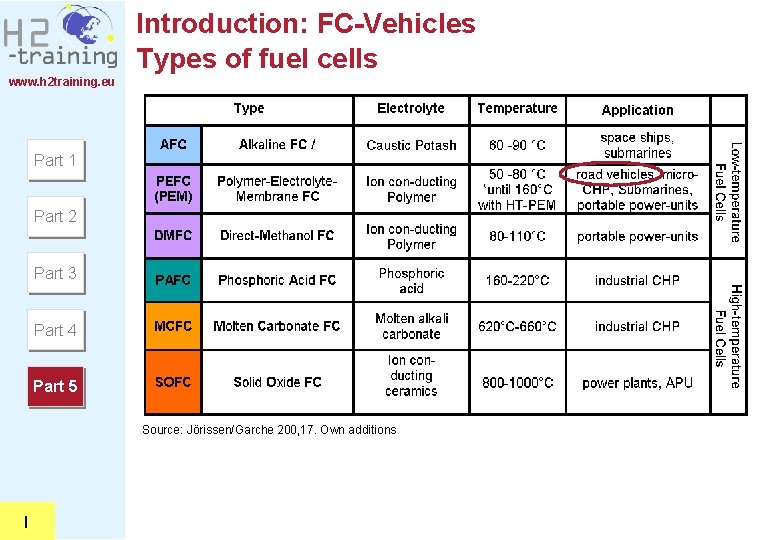
Introduction: FC-Vehicles Types of fuel cells www. h 2 training. eu Part 1 Part 2 Part 3 Part 4 Part 5 Source: Jörissen/Garche 200, 17. Own additions I
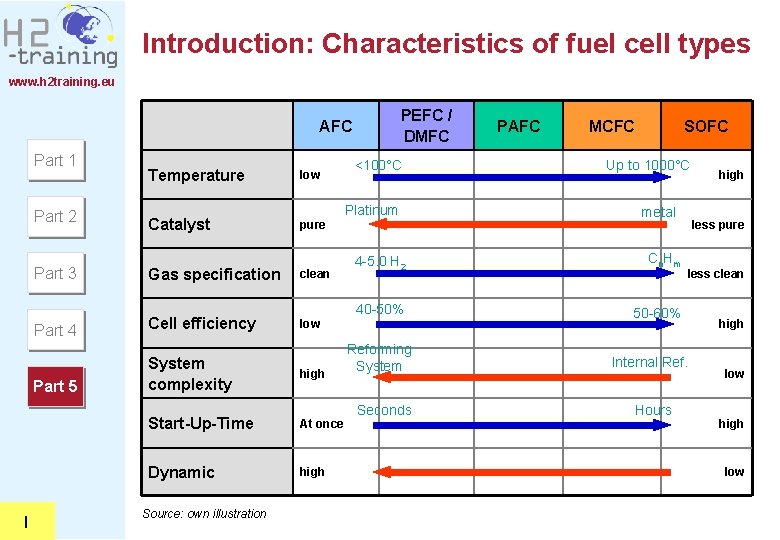
Introduction: Characteristics of fuel cell types www. h 2 training. eu PEFC / DMFC AFC Part 1 Part 2 Catalyst low pure Part 3 Gas specification clean Part 4 Cell efficiency low Part 5 I Temperature System complexity high Start-Up-Time At once Dynamic high Source: own illustration <100°C Platinum PAFC MCFC SOFC Up to 1000°C metal 4 5. 0 H 2 Cn. Hm 40 50% 50 60% Reforming System Seconds less pure less clean Internal Ref. Hours high low
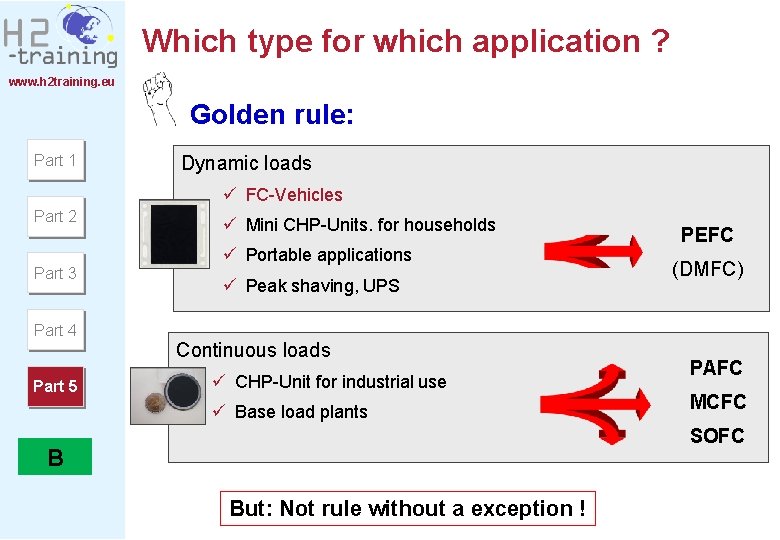
Which type for which application ? www. h 2 training. eu Golden rule: Part 1 Dynamic loads ü FC Vehicles Part 2 Part 3 ü Mini CHP Units. for households ü Portable applications ü Peak shaving, UPS PEFC (DMFC) Part 4 Continuous loads Part 5 ü CHP Unit for industrial use ü Base load plants PAFC MCFC SOFC B But: Not rule without a exception !
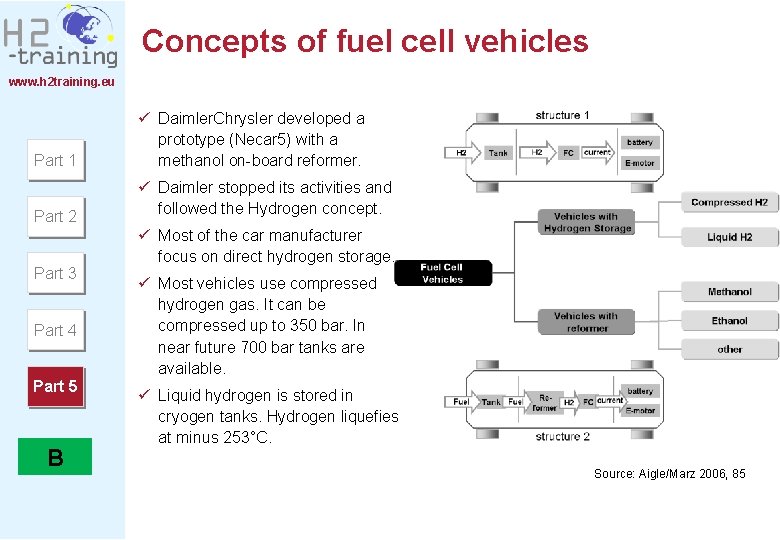
Concepts of fuel cell vehicles www. h 2 training. eu Part 1 Part 2 Part 3 Part 4 Part 5 B ü Daimler. Chrysler developed a prototype (Necar 5) with a methanol on board reformer. ü Daimler stopped its activities and followed the Hydrogen concept. ü Most of the car manufacturer focus on direct hydrogen storage. ü Most vehicles use compressed hydrogen gas. It can be compressed up to 350 bar. In near future 700 bar tanks are available. ü Liquid hydrogen is stored in cryogen tanks. Hydrogen liquefies at minus 253°C. Source: Aigle/Marz 2006, 85
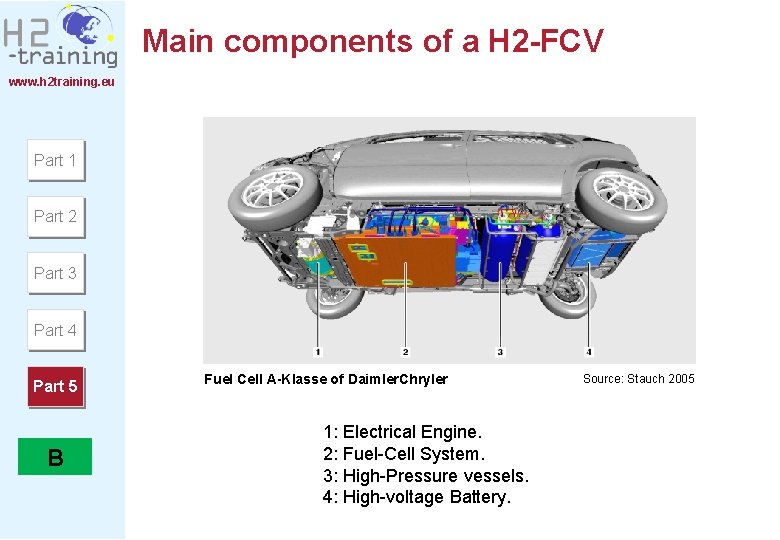
Main components of a H 2 -FCV www. h 2 training. eu Part 1 Part 2 Part 3 Part 4 Part 5 B Fuel Cell A-Klasse of Daimler. Chryler 1: Electrical Engine. 2: Fuel Cell System. 3: High Pressure vessels. 4: High voltage Battery. Source: Stauch 2005
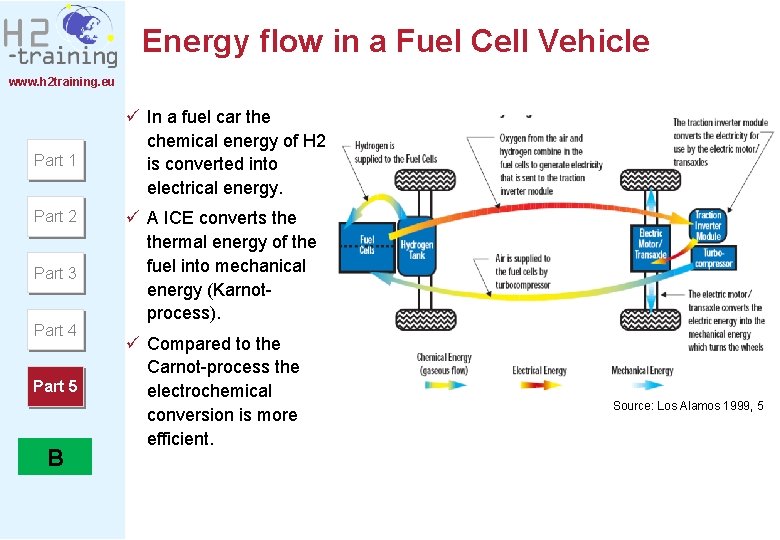
Energy flow in a Fuel Cell Vehicle www. h 2 training. eu Part 1 Part 2 Part 3 Part 4 Part 5 B ü In a fuel car the chemical energy of H 2 is converted into electrical energy. ü A ICE converts thermal energy of the fuel into mechanical energy (Karnot process). ü Compared to the Carnot process the electrochemical conversion is more efficient. Source: Los Alamos 1999, 5
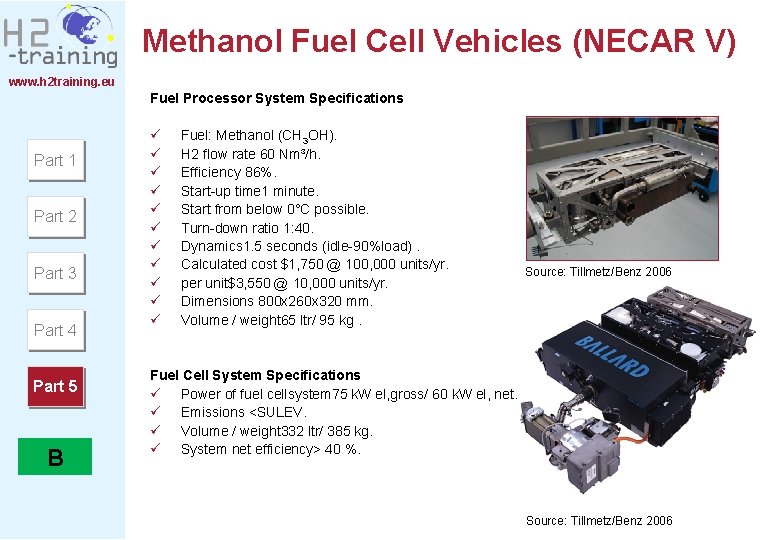
Methanol Fuel Cell Vehicles (NECAR V) www. h 2 training. eu Fuel Processor System Specifications Part 1 Part 2 Part 3 Part 4 Part 5 B ü ü ü Fuel: Methanol (CH 3 OH). H 2 flow rate 60 Nm³/h. Efficiency 86%. Start up time 1 minute. Start from below 0°C possible. Turn down ratio 1: 40. Dynamics 1. 5 seconds (idle 90%load). Calculated cost $1, 750 @ 100, 000 units/yr. per unit$3, 550 @ 10, 000 units/yr. Dimensions 800 x 260 x 320 mm. Volume / weight 65 ltr/ 95 kg. Source: Tillmetz/Benz 2006 Fuel Cell System Specifications ü Power of fuel cellsystem 75 k. W el, gross/ 60 k. W el, net. ü Emissions <SULEV. ü Volume / weight 332 ltr/ 385 kg. ü System net efficiency> 40 %. Source: Tillmetz/Benz 2006
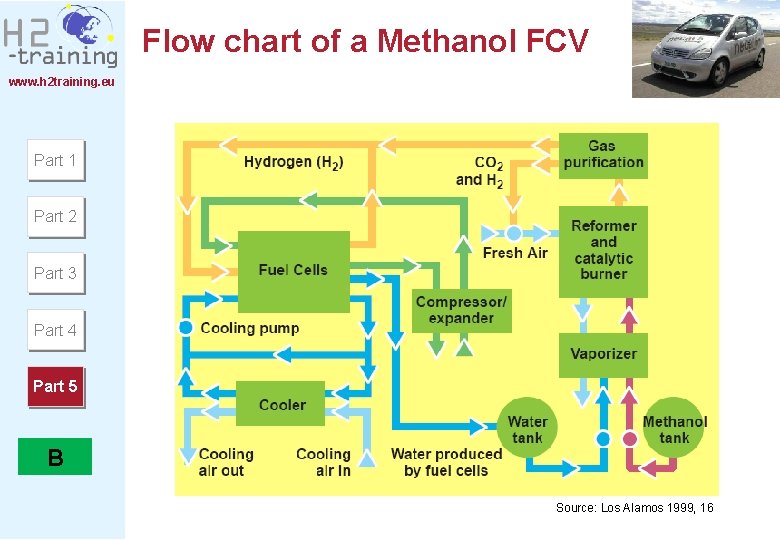
Flow chart of a Methanol FCV www. h 2 training. eu Part 1 Part 2 Part 3 Part 4 Part 5 B Source: Los Alamos 1999, 16
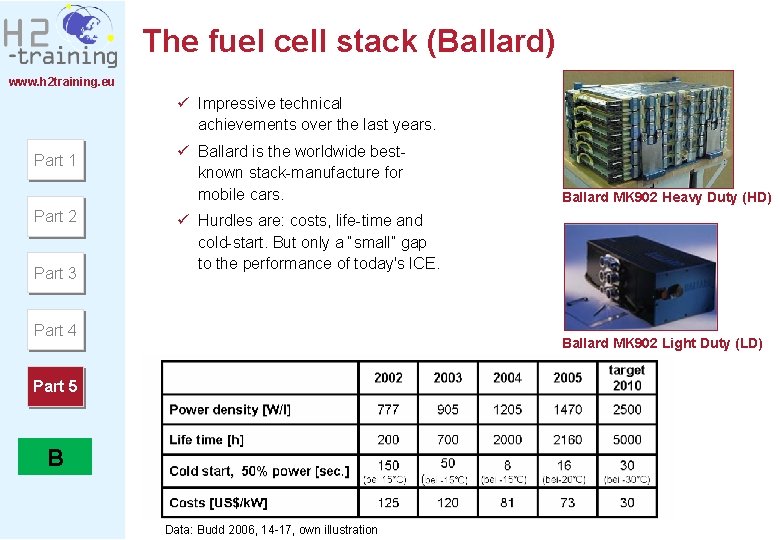
The fuel cell stack (Ballard) www. h 2 training. eu ü Impressive technical achievements over the last years. Part 1 Part 2 Part 3 ü Ballard is the worldwide best known stack manufacture for mobile cars. Ballard MK 902 Heavy Duty (HD) ü Hurdles are: costs, life time and cold start. But only a “small” gap to the performance of today's ICE. Part 4 Ballard MK 902 Light Duty (LD) Part 5 B Data: Budd 2006, 14 17, own illustration
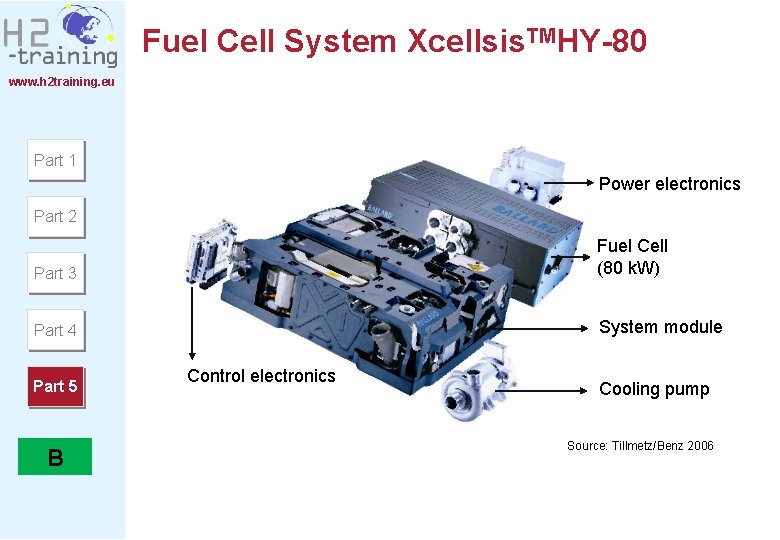
Fuel Cell System Xcellsis. TMHY-80 www. h 2 training. eu Part 1 Power electronics Part 2 Part 3 Fuel Cell (80 k. W) Part 4 System module Part 5 B Control electronics Cooling pump Source: Tillmetz/Benz 2006
Tank-System for compressed Hydrogen gas (CHG) www. h 2 training. eu ü CGH 2: compressed gaseous hydrogen, ü Pressure 35– 70 MPa and room temperature. Part 1 ü Usually 2 or 3 vessels can be placed in a car. In busses up to 8 vessels can be placed. Part 2 ü Cruising range is between 200 km (350 bar) up to 500 km (700 bar). Part 3 Part 4 Part 5 B Source: Helmolt/Eberle 2007, 837
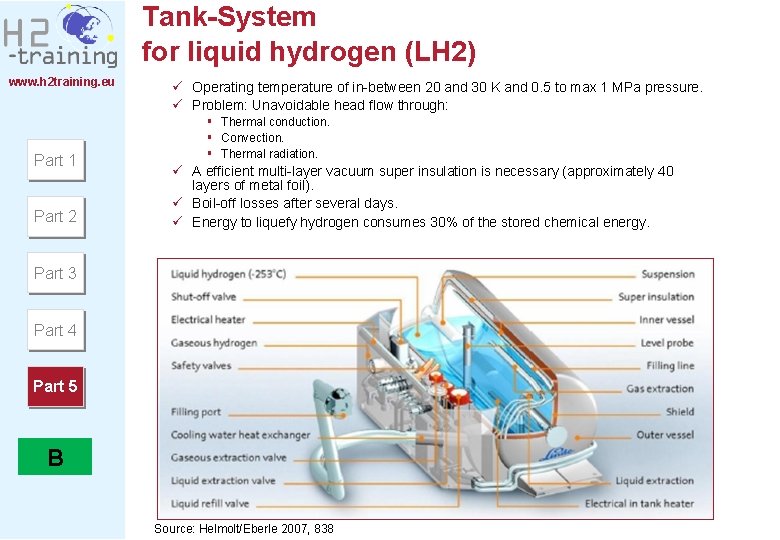
Tank-System for liquid hydrogen (LH 2) www. h 2 training. eu Part 1 Part 2 ü Operating temperature of in between 20 and 30 K and 0. 5 to max 1 MPa pressure. ü Problem: Unavoidable head flow through: § Thermal conduction. § Convection. § Thermal radiation. ü A efficient multi layer vacuum super insulation is necessary (approximately 40 layers of metal foil). ü Boil off losses after several days. ü Energy to liquefy hydrogen consumes 30% of the stored chemical energy. Part 3 Part 4 Part 5 B Source: Helmolt/Eberle 2007, 838
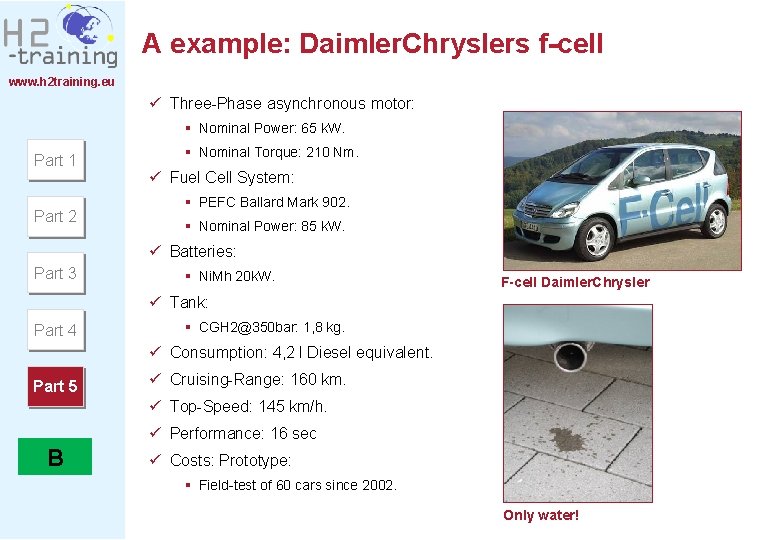
A example: Daimler. Chryslers f-cell www. h 2 training. eu ü Three Phase asynchronous motor: § Nominal Power: 65 k. W. Part 1 Part 2 § Nominal Torque: 210 Nm. ü Fuel Cell System: § PEFC Ballard Mark 902. § Nominal Power: 85 k. W. ü Batteries: Part 3 § Ni. Mh 20 k. W. F-cell Daimler. Chrysler ü Tank: Part 4 § CGH 2@350 bar: 1, 8 kg. ü Consumption: 4, 2 l Diesel equivalent. Part 5 ü Cruising Range: 160 km. ü Top Speed: 145 km/h. ü Performance: 16 sec B ü Costs: Prototype: § Field test of 60 cars since 2002. Only water!
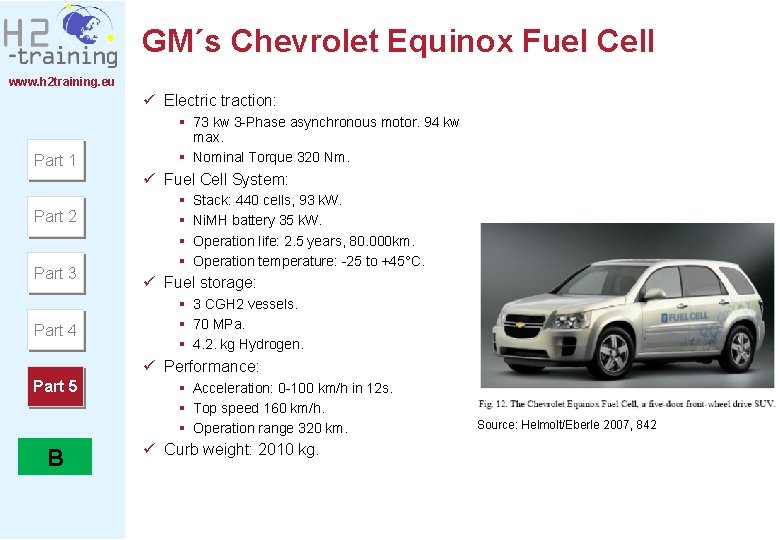
GM´s Chevrolet Equinox Fuel Cell www. h 2 training. eu ü Electric traction: Part 1 § 73 kw 3 Phase asynchronous motor. 94 kw max. § Nominal Torque 320 Nm. ü Fuel Cell System: Part 2 Part 3 Part 4 § § Stack: 440 cells, 93 k. W. Ni. MH battery 35 k. W. Operation life: 2. 5 years, 80. 000 km. Operation temperature: 25 to +45°C. ü Fuel storage: § 3 CGH 2 vessels. § 70 MPa. § 4. 2. kg Hydrogen. ü Performance: Part 5 B § Acceleration: 0 100 km/h in 12 s. § Top speed 160 km/h. § Operation range 320 km. ü Curb weight: 2010 kg. Source: Helmolt/Eberle 2007, 842
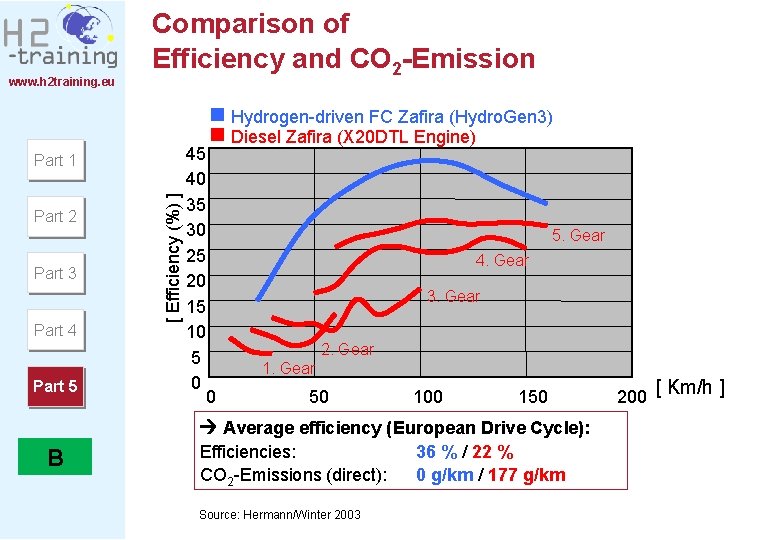
www. h 2 training. eu Comparison of Efficiency and CO 2 -Emission Part 2 Part 3 Part 4 Part 5 B [ Efficiency (%) ] Part 1 45 40 35 30 25 20 15 10 5 0 n Hydrogen driven FC Zafira (Hydro. Gen 3) n Diesel Zafira (X 20 DTL Engine) 5. Gear 4. Gear 3. Gear 2. Gear 1. Gear 0 50 100 150 Average efficiency (European Drive Cycle): Efficiencies: 36 % / 22 % CO 2 Emissions (direct): 0 g/km / 177 g/km Source: Hermann/Winter 2003 200 [ Km/h ]
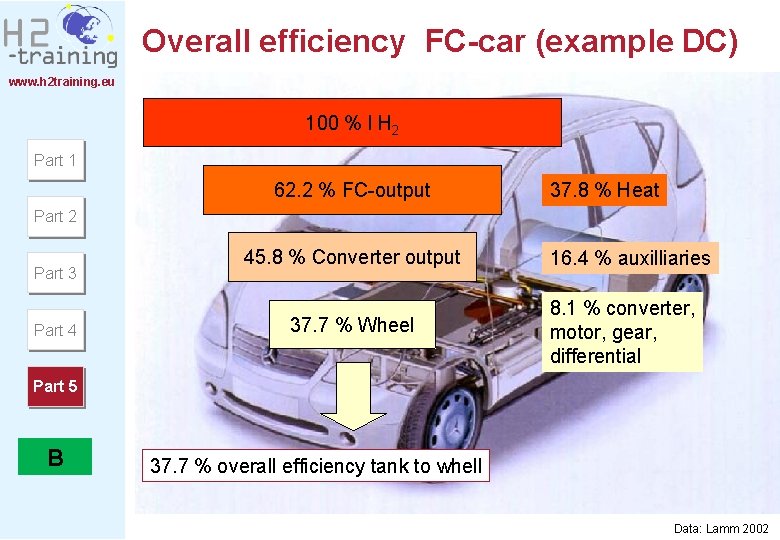
Overall efficiency FC-car (example DC) www. h 2 training. eu 100 % l H 2 Part 1 62. 2 % FC output 37. 8 % Heat Part 2 Part 3 Part 4 45. 8 % Converter output 37. 7 % Wheel 16. 4 % auxilliaries 8. 1 % converter, motor, gear, differential Part 5 B 37. 7 % overall efficiency tank to whell Data: Lamm 2002
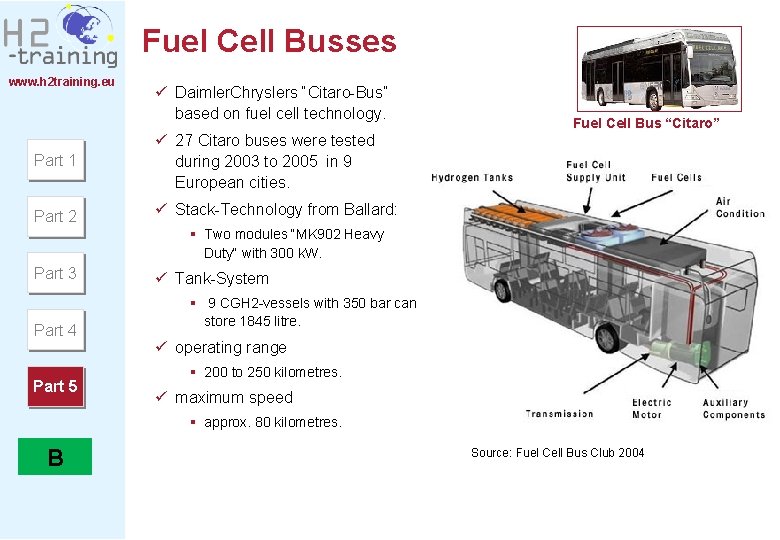
Fuel Cell Busses www. h 2 training. eu ü Daimler. Chryslers “Citaro Bus” based on fuel cell technology. Part 1 ü 27 Citaro buses were tested during 2003 to 2005 in 9 European cities. Part 2 ü Stack Technology from Ballard: Fuel Cell Bus “Citaro” § Two modules “MK 902 Heavy Duty“ with 300 k. W. Part 3 Part 4 Part 5 ü Tank System § 9 CGH 2 vessels with 350 bar can store 1845 litre. ü operating range § 200 to 250 kilometres. ü maximum speed § approx. 80 kilometres. B Source: Fuel Cell Bus Club 2004
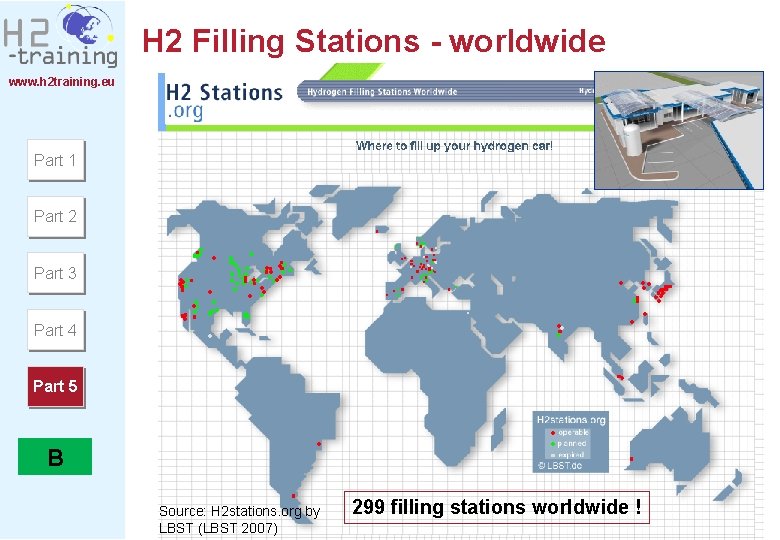
H 2 Filling Stations - worldwide www. h 2 training. eu Part 1 Part 2 Part 3 Part 4 Part 5 B Source: H 2 stations. org by LBST (LBST 2007) 299 filling stations worldwide !
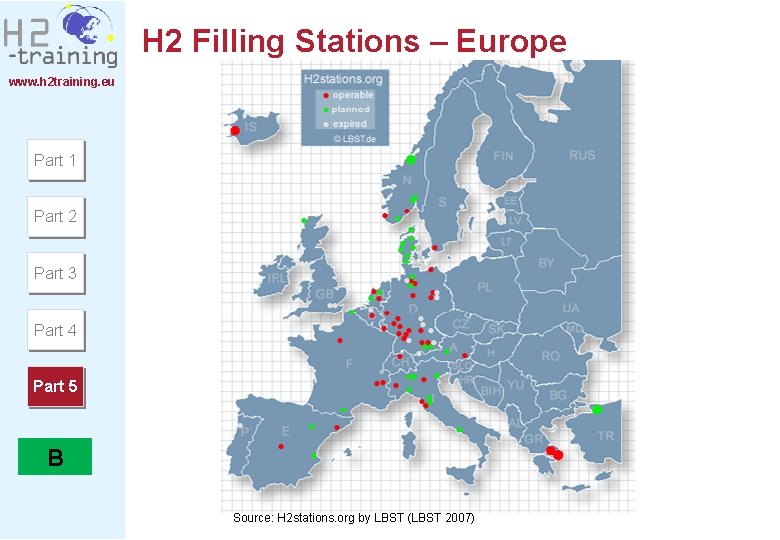
H 2 Filling Stations – Europe www. h 2 training. eu Part 1 Part 2 Part 3 Part 4 Part 5 B Source: H 2 stations. org by LBST (LBST 2007)
Sources I www. h 2 training. eu Part 1 Part 2 Part 3 Part 4 Part 5 Aigle, Thomas; Marz, Lutz (2007 a): Automobilität und Innovation. Versuch eine interdisziplinären Systematisierung. Discussion Paper SPIII 2007 102. Wissenschaftszentrum für Sozialforschung Berlin Aigle, Thomas; Krien, Philipp; Marz, Lutz (2007): Die Evaluations Matrix. Ein Tool zur Bewertung antriebs und kraftstofftechnologischer Innovationen in der Automobilindustrie. Discussion Paper SPIII 2007 105. Wissenschaftszentrum für Sozialforschung Berlin Bady, Ralf (2000): Hybrid Elektrofahrzeuge – Strukturen und Entwicklungen. Vortrag, 6. Symposium Elektrische Straßenfahrzeug. Technische Akademie Esslingen. Budd, Geoff (2006): A fuel cell bus project for Europe – Lessons learned from a fuel cell perspektive. Vortag, CUTE Abschlusskonferenz. 22. 5. 2006, Hamburg. BMW (2006 a): Der BMW Hydrogen 7 – eine neue Ära der Mobilität. Pressemitteilung, Internet: www. 7 forum. com/news/Der BMW Hydrogen 7 eine neue Aera der Mo 1285. html. Zugriff: 10. 2006 Fuel Cell Bus Club (2004) Background Information / Fuel Cell Technology / New Generation of Buses Internet: /www. fuel cell bus club. com/index. php? module=pagesetter&func=viewpub&tid=1&pid=116. zugriff: 17. 12. 2007 Helmolt von, Rittmar; Eberle, Ulrich (2007): Fuel cell vehicles: Status 2007. In: Journal of Power Sources, 165 (2007), S. 833 845 Herrmann, M. ; Winter, U. : Fuel Cells 2003, 3, No. 3, 141 ff Hy. Car (2006): Der Wasserstoff Wankelmotor. Informationsseiten über Wasserstofffahrzeuge von Jürgen Kern. Internet: www. hycar. de/wankel. htm. Zugriff: 04. 10. 06 Jörissen, Ludwig; Garche, Jürgen (2000): Brennstoffzellen für den Fahrzeugantrieb. In: Wengel, Jürgen; Schirmeister, Elna (Hg. ): Innovationsprozess vom Verbrennungsmotor zur Brennstoffzelle – Chancen und Risiken für die baden württembergische Industrie. Abschlussbericht. Karlsruhe, Februar 2000, S. 13 48.
Sources II www. h 2 training. eu Lamm, Arnold (2006): PEM BZ Systeme für den mobilen Einsatz. Vortrag, Daimler. Chrysler Forschungszentrum Ulm. Internet: www. sfb 374. uni stuttgart. de/rv_02_03/PEM_Brennstoffzelle_Lamm. pdf. Zugriff: 06. 11. 2006 Part 1 Part 2 Part 3 Part 4 Part 5 LBSt (2007): Hydrogen filling stations worldwide. Internet: www. h 2 stations. org Los Alamos (1999): Fuel Cells. The green Power. Manager Magazin (2005): Hybridautos – Der Airbag Effekt. Artikel, Internet: www. manager magazin. de/unternehmen/artikel/0, 2828, 373740, 00. html. Zugriff: 22. 10. 2006 Mitshubishi (2005): Mitsubishi Motors to drive forward development of next generation EVs Colt EV test car uses in wheel motors & lithium ion batteries. Pressemitteilung, Internet: http: //media. mitsubishi motors. com/pressrelease/e/corporate/detail 1269. html. Zugriff: 02. 11. 2006 Stauch, Thorsten (2005): Präsentation Technik F Cell. Vortrag, Praxis Seminar Wasserstoff betriebene Fahrzeuge, Weiterbildungszentrum Brennstoffzelle. 27. 1. 2005, Ulm. Tillmetz, Werner; Benz, Uwe (2006): Methanol Fuel Cell Power Train. Vortrag. European Biofuel Congress, 17. Oktober 2006, Essen Toyota (2006): Seriell paralleles Hybridsystem Fluss der Systemenergie. Schaubild, Internet: www. hybridsynergydrive. com/de/series_parallel. html. Zugriff: 22. 10. 2006 Umweltbrief (2007): Tesla ein Elektro Roadster aus USA. Internet: www. umweltbrief. de/neu/html/aktuell. html#Tesla Elektro Roadster. Zugriff: 17. 12. 2007