
www gwlearning comchilddevelopment 1 Chapter 2 New Directions

- Slides: 79
www. g-wlearning. com/childdevelopment 1
Chapter 2 New Directions in Learning www. g-wlearning. com/childdevelopment 2
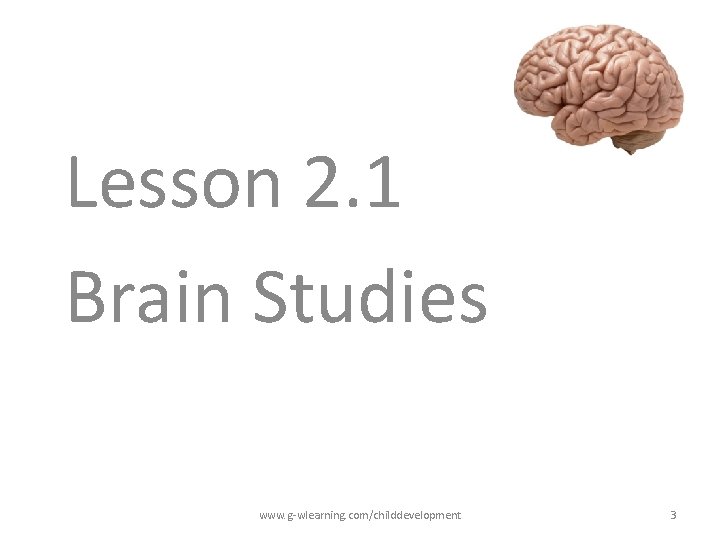
Lesson 2. 1 Brain Studies www. g-wlearning. com/childdevelopment 3
Key Terms • • • • Axons Critical periods Dendrites Firing Glial cells Myelin Neurons Plasticity Pruning Sensitive periods Synapse Window of opportunity Wiring Academic Terms Abundance Biochemistry Seldom Tentative www. g-wlearning. com/childdevelopment 4
Objectives • After studying this lesson, you will be able to: • • • Describe the two major goals of recent child development research. Compare the basic differences between the functions of neurons and glial cells. Illustrate the process by which neurons communicate with each other. Give three reasons why brain plasticity is helpful. Explain what is meant by using windows of opportunity to aid children's learning. Identify two offenders of normal brain functioning. www. g-wlearning. com/childdevelopment 5
Lesson 2. 1 Guided Notes Write the questions on your paper and answer as you take notes. 1. List the four types of glial cells and their functions. 2. Why does pruning occur? 3. Explain the concept of brain plasticity and why it is important. 4. What is the difference between critical periods and sensitive periods? Handouts: Figure 2. 4, 2. 5 and 2. 6 www. g-wlearning. com/childdevelopment 6
• The study of children has changed over the year. • The scientific study of children emerged from the field of psychology. • The new research frontier of the 21 st century is brain studies. www. g-wlearning. com/childdevelopment 7
How Do Children Learn? • Learning is any permanent change in knowledge or behavior. • All changes result from some type of experience, such as personal experiences in the environment, imitation, guided discovery, or direct instruction. • The command center of the body is the brain www. g-wlearning. com/childdevelopment 8
How the Brain Works • Biochemistry the chemistry of living organisms. • Abundance is large amounts. www. g-wlearning. com/childdevelopment 9
Knowing Brain Biology • Brain development begins shortly after conception. Before birth, about 250, 000 brain cells are formed each minute. • Full-term babies have about 100 billion brain cells. • Brain growth happens when brain chemicals are released in waves. Brain growth occurs in a predictable, biological sequence that is the same for all people. www. g-wlearning. com/childdevelopment 10
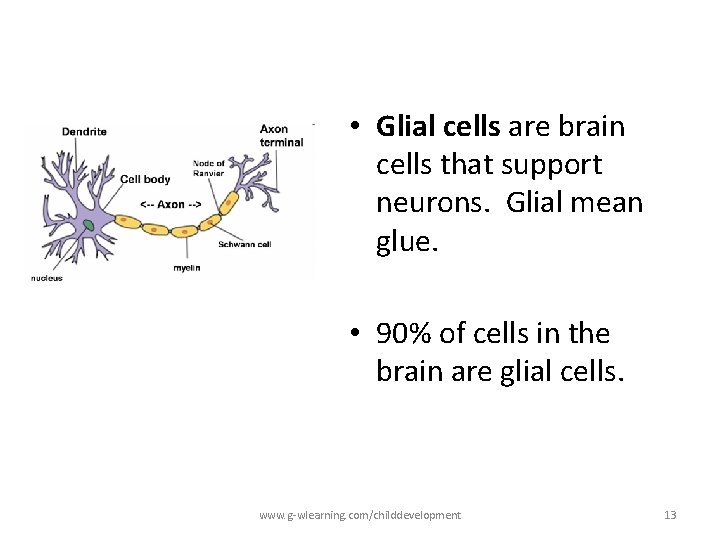
• Neurons (nerve cells) are brain cells that send and receive chemical are electrical impulses among each other to direct the various tasks of the brain. • Their overall task is to receive, process, and transport information need by the person to perform all tasks, which is called communication. www. g-wlearning. com/childdevelopment 11
• Cell body contains genetic information and proteins for cell maintenance. • Dendrites means trees, short, busy cables that allow each neuron to receive signals sent by other neuron. • Axon mean axis, long, thick cables with terminal buttons that transmit all the signals from a neuron to other neurons. www. g-wlearning. com/childdevelopment 12
• Glial cells are brain cells that support neurons. Glial mean glue. • 90% of cells in the brain are glial cells. www. g-wlearning. com/childdevelopment 13
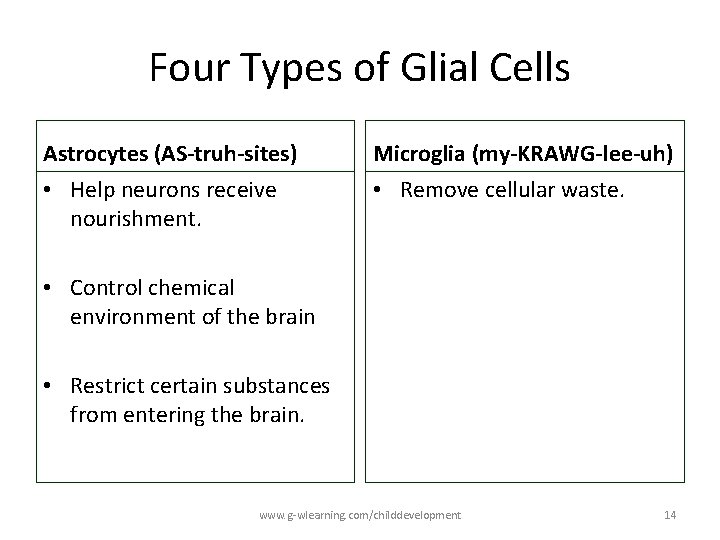
Four Types of Glial Cells Astrocytes (AS-truh-sites) Microglia (my-KRAWG-lee-uh) • Help neurons receive nourishment. • Remove cellular waste. • Control chemical environment of the brain • Restrict certain substances from entering the brain. www. g-wlearning. com/childdevelopment 14
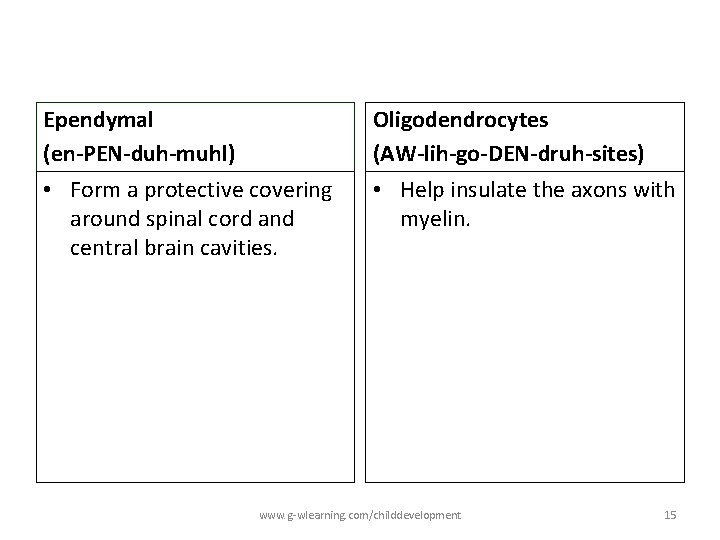
Ependymal (en-PEN-duh-muhl) Oligodendrocytes (AW-lih-go-DEN-druh-sites) • Form a protective covering around spinal cord and central brain cavities. • Help insulate the axons with myelin. www. g-wlearning. com/childdevelopment 15
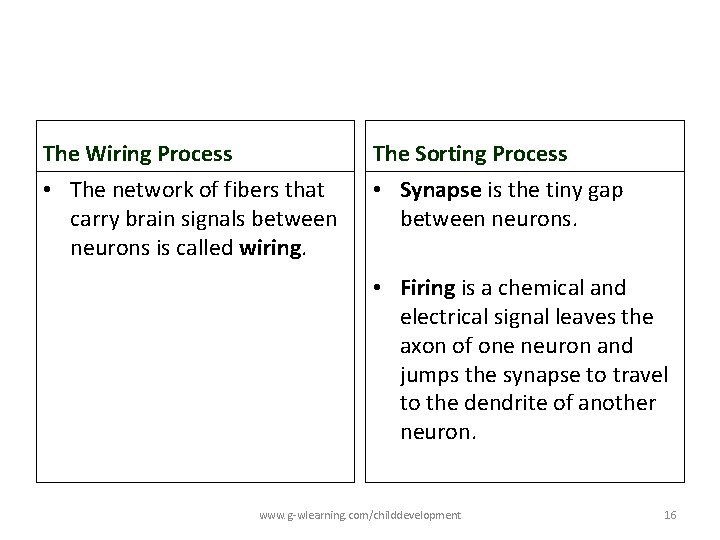
The Wiring Process The Sorting Process • The network of fibers that carry brain signals between neurons is called wiring. • Synapse is the tiny gap between neurons. • Firing is a chemical and electrical signal leaves the axon of one neuron and jumps the synapse to travel to the dendrite of another neuron. www. g-wlearning. com/childdevelopment 16
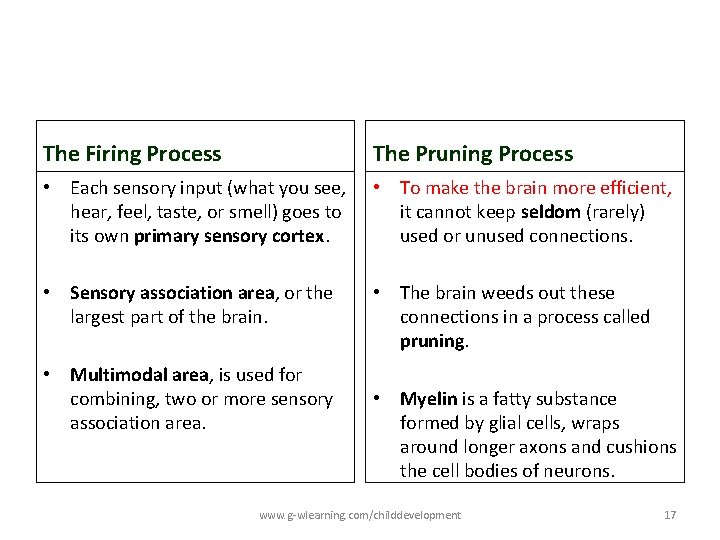
The Firing Process The Pruning Process • Each sensory input (what you see, hear, feel, taste, or smell) goes to its own primary sensory cortex. • To make the brain more efficient, it cannot keep seldom (rarely) used or unused connections. • Sensory association area, or the largest part of the brain. • The brain weeds out these connections in a process called pruning. • Multimodal area, is used for combining, two or more sensory association area. • Myelin is a fatty substance formed by glial cells, wraps around longer axons and cushions the cell bodies of neurons. www. g-wlearning. com/childdevelopment 17
Reshaping Connections: Brain Plasticity • The human brain is adaptable. • The brain has the ability to change or adapt to the environment. • Plasticity is the ability to be shaped and reshaped. www. g-wlearning. com/childdevelopment 18
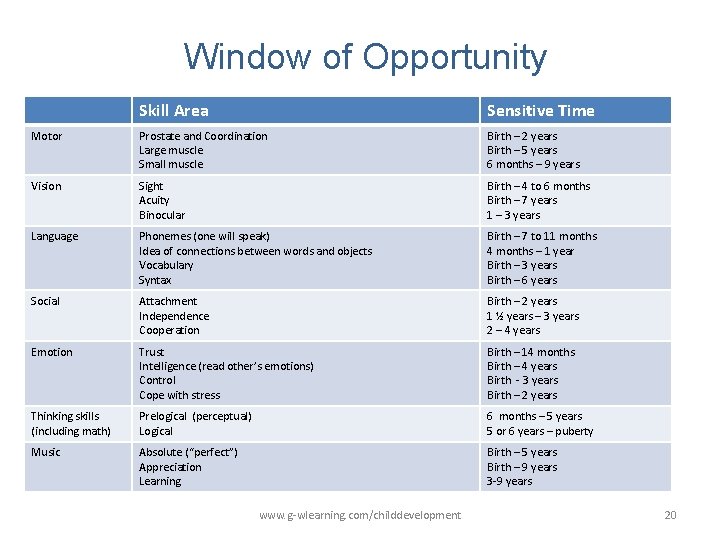
Timing of Experiences • Critical periods are times when some part of the body is very vulnerable to lack of stimulation or to negative experiences. • Sensitive periods are times when the brain is best able to wire specific skills for all children. • A window of opportunity is a prime period in a child’s life for developing a particular skill. www. g-wlearning. com/childdevelopment 19
Window of Opportunity Skill Area Sensitive Time Motor Prostate and Coordination Large muscle Small muscle Birth – 2 years Birth – 5 years 6 months – 9 years Vision Sight Acuity Binocular Birth – 4 to 6 months Birth – 7 years 1 – 3 years Language Phonemes (one will speak) Idea of connections between words and objects Vocabulary Syntax Birth – 7 to 11 months 4 months – 1 year Birth – 3 years Birth – 6 years Social Attachment Independence Cooperation Birth – 2 years 1 ½ years – 3 years 2 – 4 years Emotion Trust Intelligence (read other’s emotions) Control Cope with stress Birth – 14 months Birth – 4 years Birth - 3 years Birth – 2 years Thinking skills (including math) Prelogical (perceptual) Logical 6 months – 5 years 5 or 6 years – puberty Music Absolute (“perfect”) Appreciation Learning Birth – 5 years Birth – 9 years 3 -9 years www. g-wlearning. com/childdevelopment 20
Figure 2. 4 Drag & Drop 1. 2. 3. 4. 5. 6. 7. 8. 9. 10. Go to the website www. g-wlearning. com Click on child development Click on the first book Under the book Child Development © 2016 Click full site Under Chapter 2 New Directions in Learning, click on Lesson 2. 1 Brain Studies Under Label Art Activities Click on Figure 2. 6 Drag and Drop Complete the activity. www. g-wlearning. com/childdevelopment 21
Figure 2. 5 Drag & Drop 1. 2. 3. 4. 5. 6. 7. 8. 9. 10. Go to the website www. g-wlearning. com Click on child development Click on the first book Under the book Child Development © 2016 Click full site Under Chapter 2 New Directions in Learning, click on Lesson 2. 1 Brain Studies Under Label Art Activities Click on Figure 2. 6 Drag and Drop Complete the activity. www. g-wlearning. com/childdevelopment 22
Figure 2. 6 Drag & Drop 1. 2. 3. 4. 5. 6. 7. 8. 9. 10. Go to the website www. g-wlearning. com Click on child development Click on the first book Under the book Child Development © 2016 Click full site Under Chapter 2 New Directions in Learning, click on Lesson 2. 1 Brain Studies Under Label Art Activities Click on Figure 2. 6 Drag and Drop Complete the activity. www. g-wlearning. com/childdevelopment 23
PYPM The Brain • Use the handout and take notes as you watch the video about theorist. www. g-wlearning. com/childdevelopment 24
Your brain with a concussion by BI Science • https: //www. youtube. com/watch? v=Mboxd. G 2 EZA 0 www. g-wlearning. com/childdevelopment 25
Concussion Demonstration • Egg and Jar • {2} Football Player • {4} Driving a car www. g-wlearning. com/childdevelopment 26
Left Brain or Right Brain 1. Go to the website http: //braintest. somm er-sommer. com/en/ Directions. : Answer the questions on the following handout. 2. And do the activity to see if you are left brain or right brain. 3. Write which one you are. 27
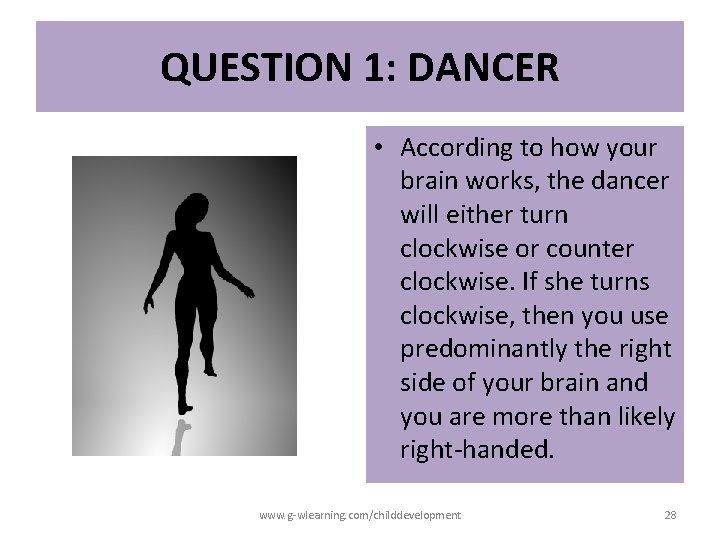
QUESTION 1: DANCER • According to how your brain works, the dancer will either turn clockwise or counter clockwise. If she turns clockwise, then you use predominantly the right side of your brain and you are more than likely right-handed. www. g-wlearning. com/childdevelopment 28
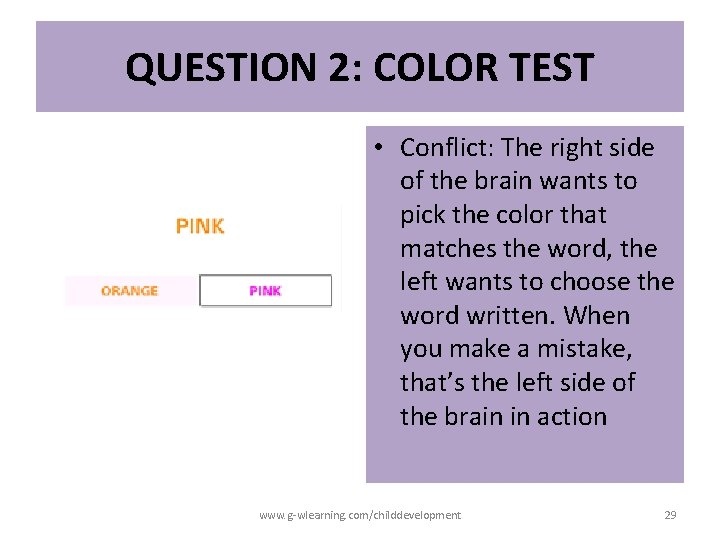
QUESTION 2: COLOR TEST • Conflict: The right side of the brain wants to pick the color that matches the word, the left wants to choose the word written. When you make a mistake, that’s the left side of the brain in action www. g-wlearning. com/childdevelopment 29
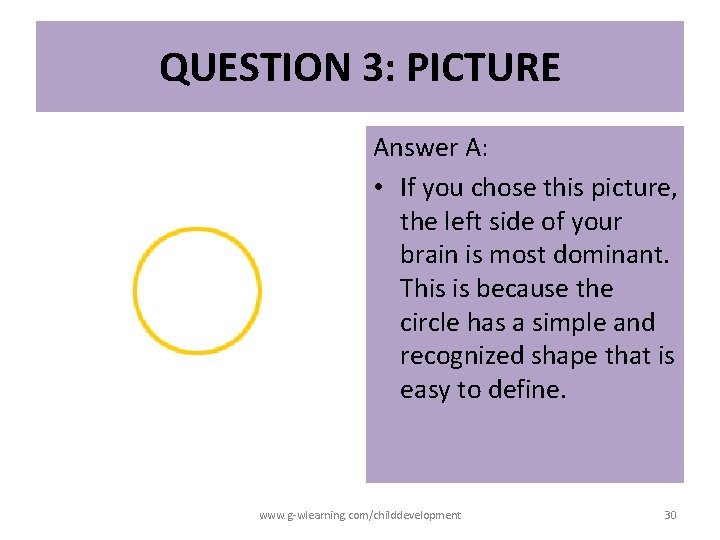
QUESTION 3: PICTURE Answer A: • If you chose this picture, the left side of your brain is most dominant. This is because the circle has a simple and recognized shape that is easy to define. www. g-wlearning. com/childdevelopment 30
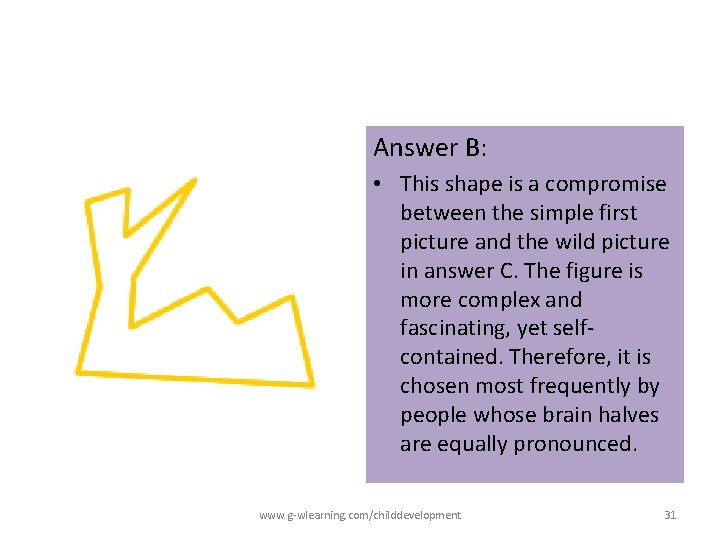
Answer B: • This shape is a compromise between the simple first picture and the wild picture in answer C. The figure is more complex and fascinating, yet selfcontained. Therefore, it is chosen most frequently by people whose brain halves are equally pronounced. www. g-wlearning. com/childdevelopment 31
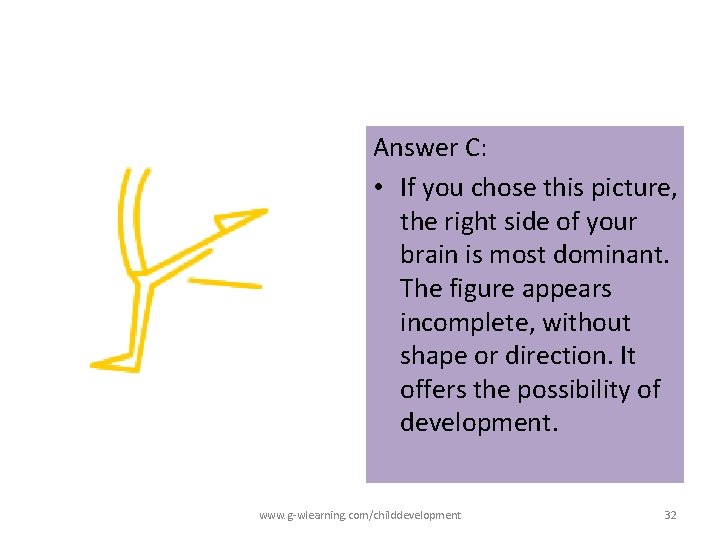
Answer C: • If you chose this picture, the right side of your brain is most dominant. The figure appears incomplete, without shape or direction. It offers the possibility of development. www. g-wlearning. com/childdevelopment 32
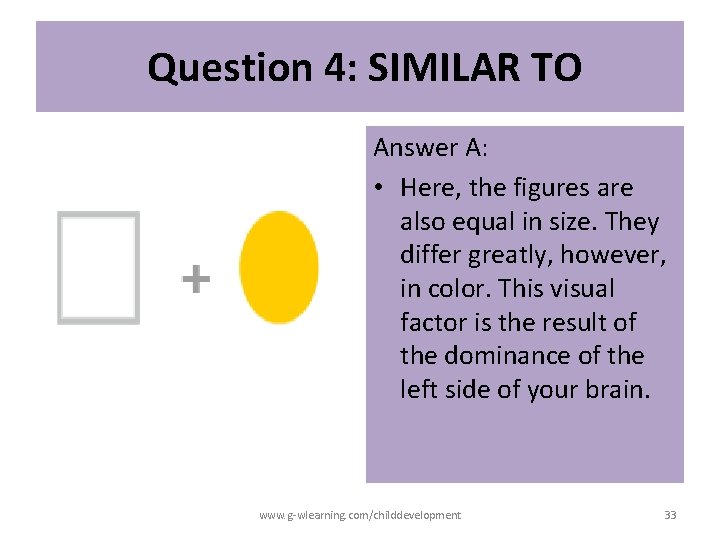
Question 4: SIMILAR TO Answer A: • Here, the figures are also equal in size. They differ greatly, however, in color. This visual factor is the result of the dominance of the left side of your brain. www. g-wlearning. com/childdevelopment 33
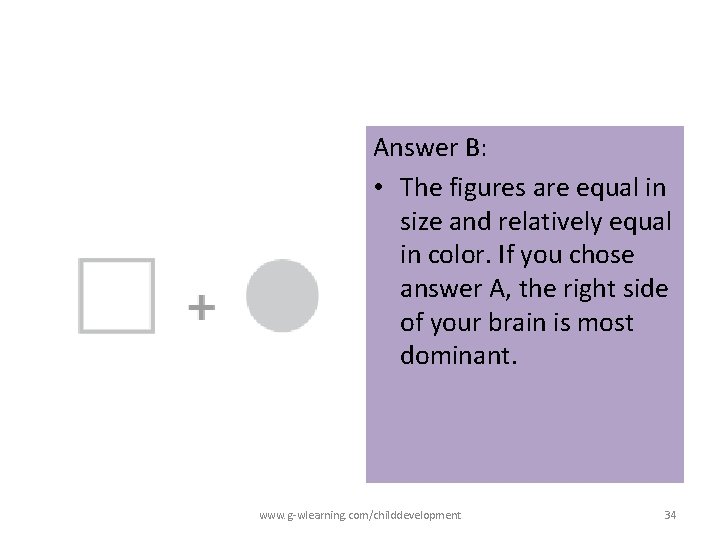
Answer B: • The figures are equal in size and relatively equal in color. If you chose answer A, the right side of your brain is most dominant. www. g-wlearning. com/childdevelopment 34
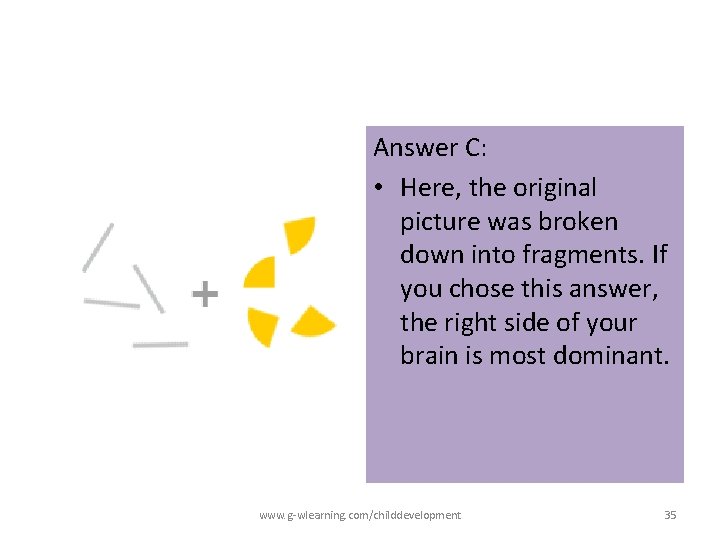
Answer C: • Here, the original picture was broken down into fragments. If you chose this answer, the right side of your brain is most dominant. www. g-wlearning. com/childdevelopment 35
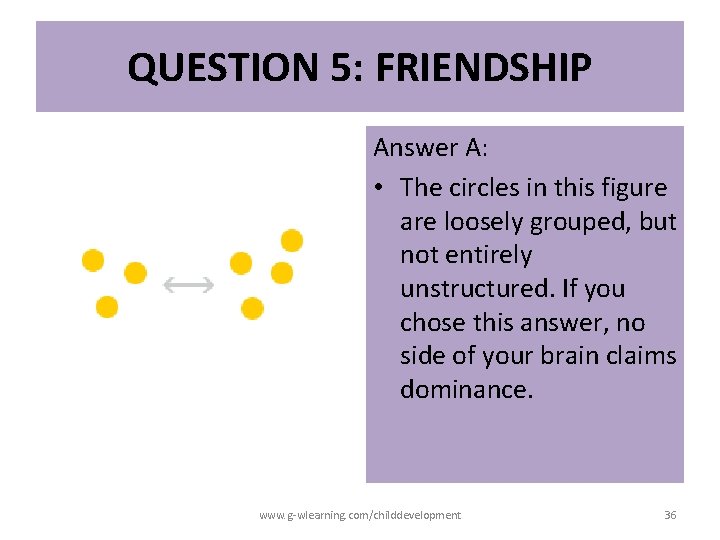
QUESTION 5: FRIENDSHIP Answer A: • The circles in this figure are loosely grouped, but not entirely unstructured. If you chose this answer, no side of your brain claims dominance. www. g-wlearning. com/childdevelopment 36
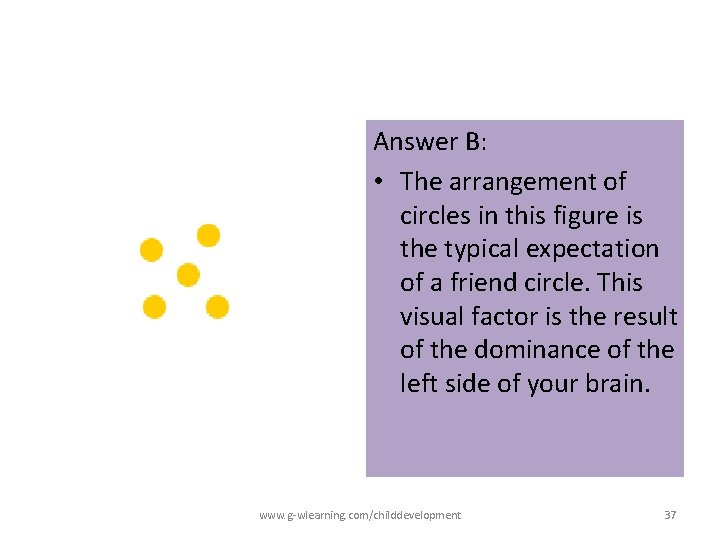
Answer B: • The arrangement of circles in this figure is the typical expectation of a friend circle. This visual factor is the result of the dominance of the left side of your brain. www. g-wlearning. com/childdevelopment 37
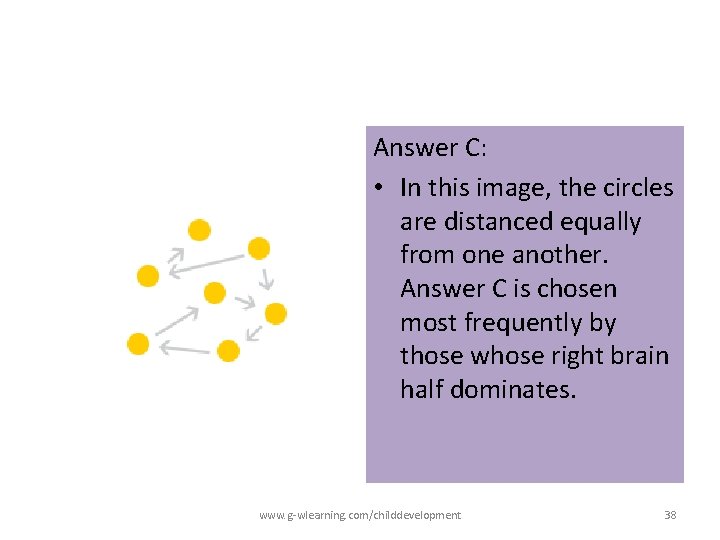
Answer C: • In this image, the circles are distanced equally from one another. Answer C is chosen most frequently by those whose right brain half dominates. www. g-wlearning. com/childdevelopment 38
QUESTION 6, 7 AND 8: • If you're in right-brain mode, you will use your left hand, left leg, or left eye. • If you're in left-brain mode, you will use your right hand, right leg, or right eye. In these cases, the right side of the body is controlled by the left side of the brain, and vice versa. www. g-wlearning. com/childdevelopment 39
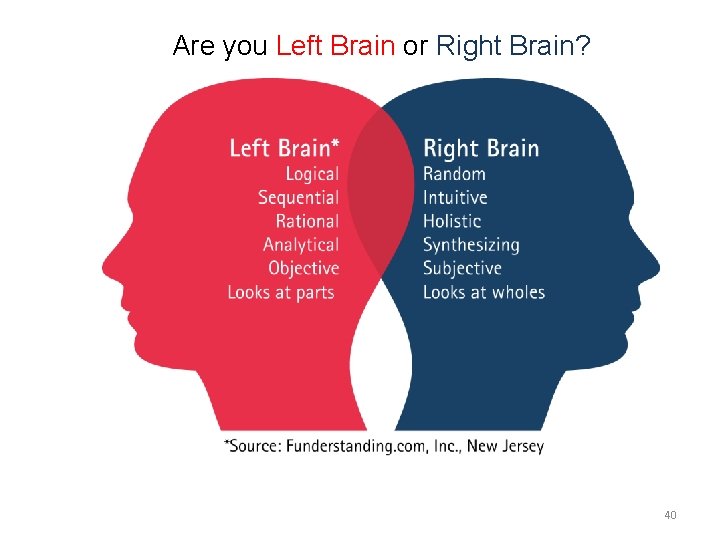
Are you Left Brain or Right Brain? 40
The Differences Between Right Brain Thinking • Right brain or creative thinkers gather information by feelings and intuition. This information is retained by using images and patterns and are able to visualize the whole idea as we gather our research. • The thought processes appear illogical and meandering because they are emotional, intuitive, abstract and laterally connected. • Analysis of this information or problem-solving often involves free association and, while the solutions may be quite innovative, the route traveled to reach this conclusion would be impossible for a more rational left brain thinker to follow. • Visual thinkers do not use a step-by-step process to gather information -- rather it is visually gathered all at once which makes organization of this information and verbalizing the accumulated data, either in written or verbal form, difficult. Right brain thinkers are best able to express themselves using art, music or dance. 41
The Differences Between Left Brain Thinking • Left Brain or Critical Thinkers collect information using logic and sense. This information is retained using words, numbers and symbols. • Unlike right brain thinkers who see the whole concept, left brain thinkers see only parts of the whole idea that guides them in their logical, step-bystep gathering of information. • Their brain processes are deductive, rational, concrete and analytically connected. • Left brain thinkers express themselves with concise words, numerical and written formulas and technological systems. 42
The Differences Between Left Brain/Right Brain Thinking • Modern scientists know that your left brain is your verbal and rational brain while your right brain is you • nonverbal and intuitive brain. We require special functions from both sides of our brains to accomplish • most tasks in our daily lives. There are some nonverbal tasks -- such as drawing, painting, dancing and • music, in which our right brain excels and you'd be best to shelve your left brain functions to prevent • interference by your rational side. • While most people can be categorized as left or right brain thinkers, there are exercises that can help you • develop and nurture your intuitive side. 43
Brain Development • Child Development Core Story, Part 1: Brain Architecture • Child Development Core Story, Part 2: Serve and Return • https: //www. youtube. c om/watch? v=Spq. Lz. Few 9 bs • https: //www. youtube. c om/watch? v=u 0_Y 7 j. SG np 8 www. g-wlearning. com/childdevelopment 44
Brain Development • Child Development Core Story, Part 3: Stress • Child Development Core Story, Part 4: Pay Now or Pay Later • https: //www. youtube. c om/watch? v=kivv 2 BJhz b. A • https: //www. youtube. c om/watch? v=20 Ddwzh MTTA www. g-wlearning. com/childdevelopment 45
Brain Games • You and a partner will work at a computer together and play at least 2 different “Brain Games. ” You must play at least 2 rounds of each game. • http: //www. neok 12. com/games. htm www. g-wlearning. com/childdevelopment 46
Wild Child: The Story of Feral Children • https: //www. youtube. com/watch? v=cym. Zq 1 Vbl. U 0 • Answer the following question as you watch the video. (1) What happens to a child that is not nurtured and protected by the people responsible for her/him? (2) Define the feral. (3) What do you have to be in order to be a human being? (4) Explain critical theory. (5) Why was Jennie unable to learn? www. g-wlearning. com/childdevelopment 47
Lesson 2. 1 Assessment 1. List the four types of glial cells and their functions. 2. Why does pruning occur? 3. Explain the concept of brain plasticity and why it is important. 4. What is the difference between critical periods and sensitive periods? http: //www. g-wlearning. com/childdevelopment/9781631260384/student/ch 02_01/review. htm www. g-wlearning. com/childdevelopment 48
Lesson 2. 2 Acquiring Knowledge www. g-wlearning. com/childdevelopment 49
Key Terms • • Academic Terms Cognitive flexibility Developmental tasks Essential life skills Executive functions Inhibition Lifelong learning Working memory Explicit Implicit Manipulating Neuroscience Reinforcement www. g-wlearning. com/childdevelopment 50
Objectives • After studying this lesson, you will be able to: • Differentiate between four types of knowledge • Explain how knowledge of child development is used in education. • Identify and describe three executive functions. • Analyze Galinsky’s seven life skills. • Assess the dangers of stress and trauma in children. www. g-wlearning. com/childdevelopment 51
Lesson 2. 2 Guided Notes 1. 2. 3. 4. 5. 6. According to professionals in child developmental health problems find their roots in the ______________ child experience during childhood. Name the four types of knowledge, and give an example of a skill or activity that requires each type. ____ are skills that should be mastered at a certain stage in life. According to Havighurst, a child’s readiness for developmental task stems from what three sources? List and define the executive functions. What are Galinsky’s Seven Essential Life Skills and explain them. http: //www. g-wlearning. com/childdevelopment/9781631260384/student/ch 02_02/review. htm www. g-wlearning. com/childdevelopment 52
• The first goal of child development research is to advance knowledge. • The other goal is to apply knowledge. • People who work with or for children, especially in education, not only use available research knowledge, but also create more knowledge. • Schools for older children are also using child development research to guide curriculum decisions. www. g-wlearning. com/childdevelopment 53
• Professionals in health and protective services also contribute to the knowledge of child development. • Try to prevent and treat mental health issues in children. • The roots of mental health problems are the stressors of childhood. • The scars my be seen physically but the real scars may be within their brain. www. g-wlearning. com/childdevelopment 54
What Should Children Learn? • Children need to know • By law children must the values and practices receive 12 or 13 years of the culture and have of education. the skills needed to thrive in their world. • Learning has to be ongoing which is lifelong learning. • Schools transmit the – Adapt to changes values of the culture – Broader knowledge and teach skills needed – Multicultural understanding. for the workforce. www. g-wlearning. com/childdevelopment 55
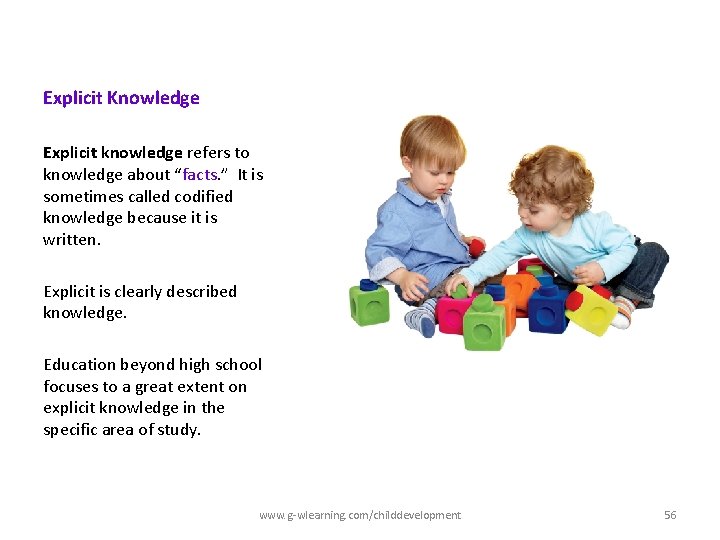
Explicit Knowledge Explicit knowledge refers to knowledge about “facts. ” It is sometimes called codified knowledge because it is written. Explicit is clearly described knowledge. Education beyond high school focuses to a great extent on explicit knowledge in the specific area of study. www. g-wlearning. com/childdevelopment 56
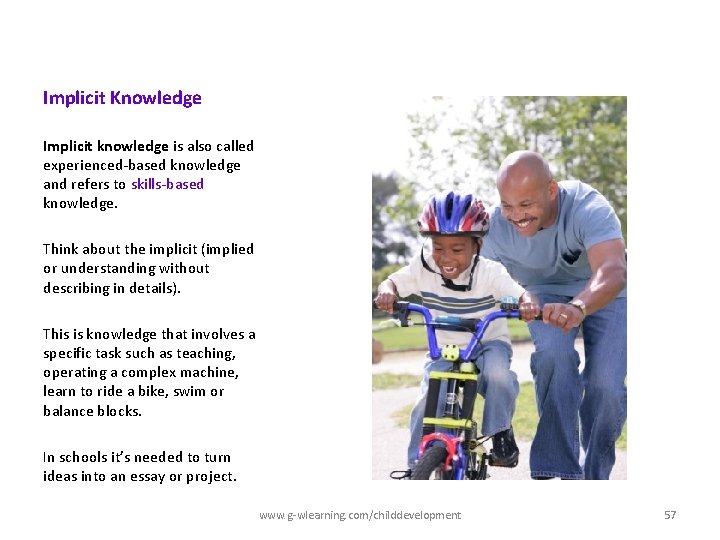
Implicit Knowledge Implicit knowledge is also called experienced-based knowledge and refers to skills-based knowledge. Think about the implicit (implied or understanding without describing in details). This is knowledge that involves a specific task such as teaching, operating a complex machine, learn to ride a bike, swim or balance blocks. In schools it’s needed to turn ideas into an essay or project. www. g-wlearning. com/childdevelopment 57
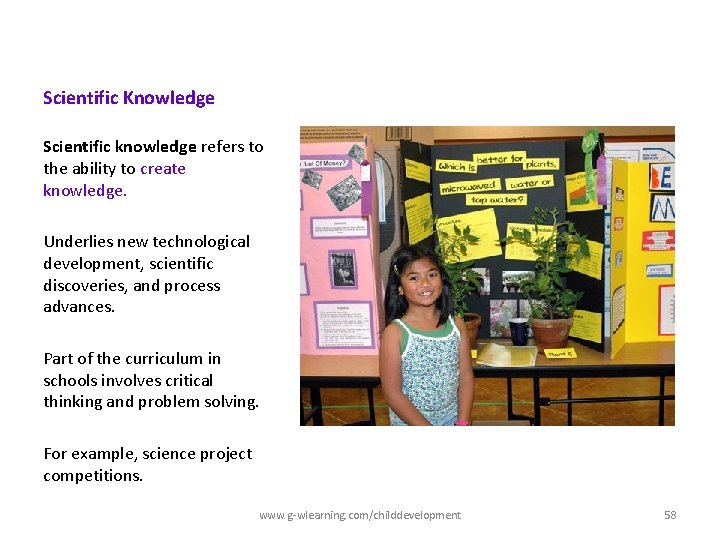
Scientific Knowledge Scientific knowledge refers to the ability to create knowledge. Underlies new technological development, scientific discoveries, and process advances. Part of the curriculum in schools involves critical thinking and problem solving. For example, science project competitions. www. g-wlearning. com/childdevelopment 58
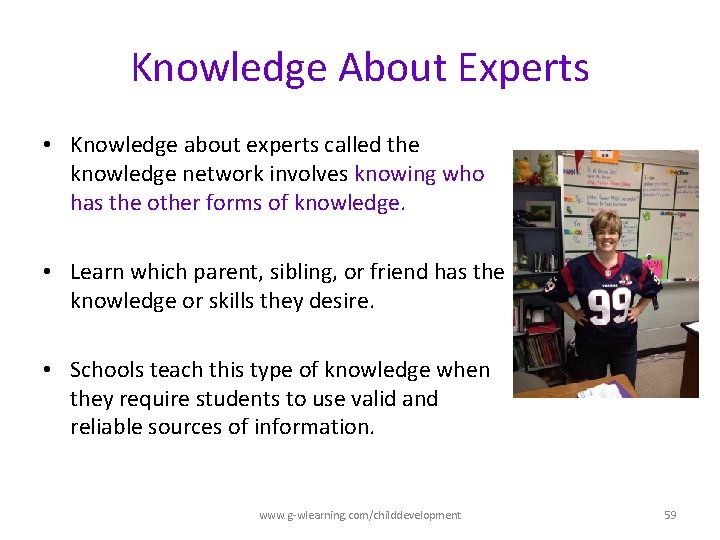
Knowledge About Experts • Knowledge about experts called the knowledge network involves knowing who has the other forms of knowledge. • Learn which parent, sibling, or friend has the knowledge or skills they desire. • Schools teach this type of knowledge when they require students to use valid and reliable sources of information. www. g-wlearning. com/childdevelopment 59
Linking Child Development Knowledge to Education • Rote memorization or memorization without full comprehension, was the way children learned many facts. • Reinforcement (rewards) for mastery of facts and skills. www. g-wlearning. com/childdevelopment 60
Types of Knowledge • You will complete a poster with this information with your partner: – – – Top of Poster has the title, “Types of Knowledge” The poster will be divided into 4 sections List the names of each of the knowledges Give a written example of each. Add a picture that represent that knowledge www. g-wlearning. com/childdevelopment 61
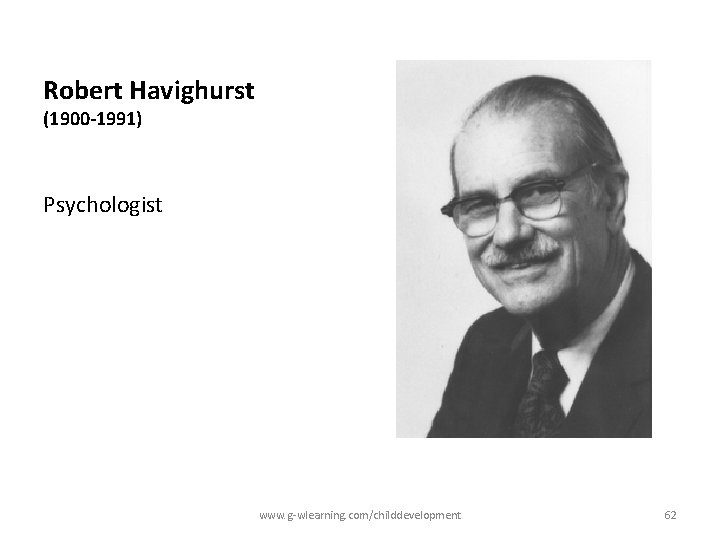
Robert Havighurst (1900 -1991) Psychologist www. g-wlearning. com/childdevelopment 62
• Developmental tasks are skills that should be mastered at a certain stage in life. Havighurst coined the term teachable moment. • Child’s readiness for a developmental task came from – Physical maturation – Social pressures – Inner pressures www. g-wlearning. com/childdevelopment 63
• Piaget and Vygotsky theories give curriculum developers guidelines for knowing the best time for learning certain knowledge and skills (implies how to sequence the curriculum). • These theories also give curriculum developers guidelines for knowing how children learn(implies how to teach or methodology). www. g-wlearning. com/childdevelopment 64
Executive Functions • Executive functions (EFs) are intellectual function people use to manage themselves and their resources (knowledge, time) to achieve goals. Also called managing functions. The lack of EFs is most often seen in children with learning and behavioral problems. • Working memory -storing, organizing, and manipulating (moving or changing) information while working on a task. • Cognitive flexibility –being able to adjust to changing demands. • Inhibition – filtering thoughts and feelings so as not to act impulsively. www. g-wlearning. com/childdevelopment 65
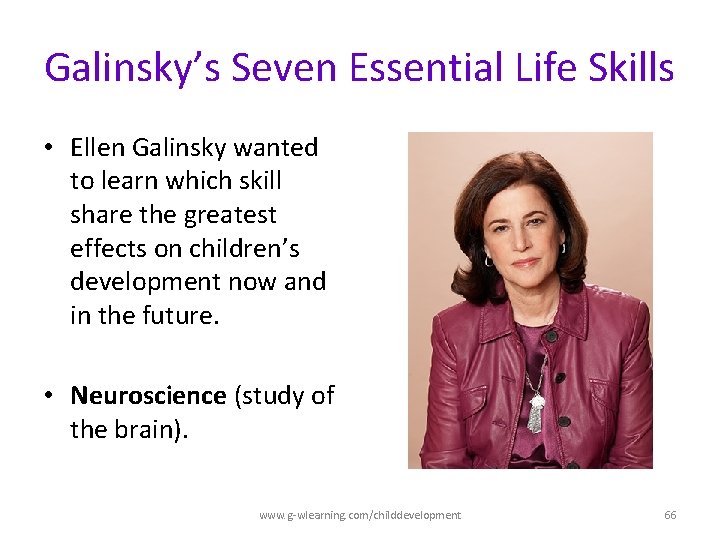
Galinsky’s Seven Essential Life Skills • Ellen Galinsky wanted to learn which skill share the greatest effects on children’s development now and in the future. • Neuroscience (study of the brain). www. g-wlearning. com/childdevelopment 66
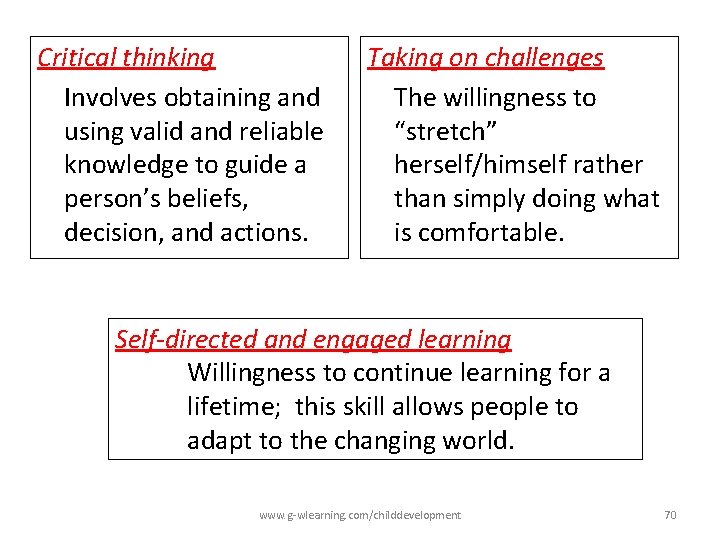
• Essential life skills as the intellectual, social, and emotional skills that prepare children for the pressures of modern life. 1. Focus and self control. 2. Perspective taking. 3. Communicating. 4. Making connections. 5. Critical thinking 6. Taking on challenges. 7. Self directed and engaged learning. www. g-wlearning. com/childdevelopment 67
Galinsky’s Seven Essential Skills Focus and self-control Perspective talking Skill involves being Perspective taking is the oriented skill of figuring out what others are thinking and toward achieving a goal feeling. by being alert and paying attention to get more out of the information. www. g-wlearning. com/childdevelopment 68
Communicating This skill involves reflecting on the message. One person must listen and understand another person's perspective and realize how his or her communication will be understood by others. Making connections This skill involves seeing how things are the same or different and determining how bits of knowledge relate to each other. www. g-wlearning. com/childdevelopment 69
Critical thinking Involves obtaining and using valid and reliable knowledge to guide a person’s beliefs, decision, and actions. Taking on challenges The willingness to “stretch” herself/himself rather than simply doing what is comfortable. Self-directed and engaged learning Willingness to continue learning for a lifetime; this skill allows people to adapt to the changing world. www. g-wlearning. com/childdevelopment 70
The Seven Essential Life Skills, With Ellen Galinsky Big Think Mentor • Watch the video about the Essential Life Skills. • https: //www. youtube. com/watch? v=Sd. Ik. Qn. Ty 6 j. A www. g-wlearning. com/childdevelopment 71
The Elevator Speech – Think of the speech you are giving to someone who is important to something you want. – What would you say to that person. – You will prepare a 1 minute speech about yourself. – You will say this speech to the class. www. g-wlearning. com/childdevelopment 72
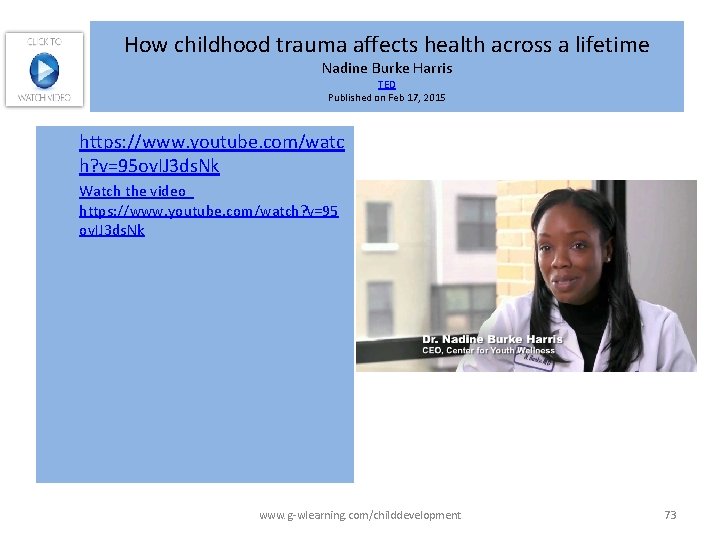
How childhood trauma affects health across a lifetime Nadine Burke Harris TED Published on Feb 17, 2015 https: //www. youtube. com/watc h? v=95 ov. IJ 3 ds. Nk Watch the video https: //www. youtube. com/watch? v=95 ov. IJ 3 ds. Nk www. g-wlearning. com/childdevelopment 73
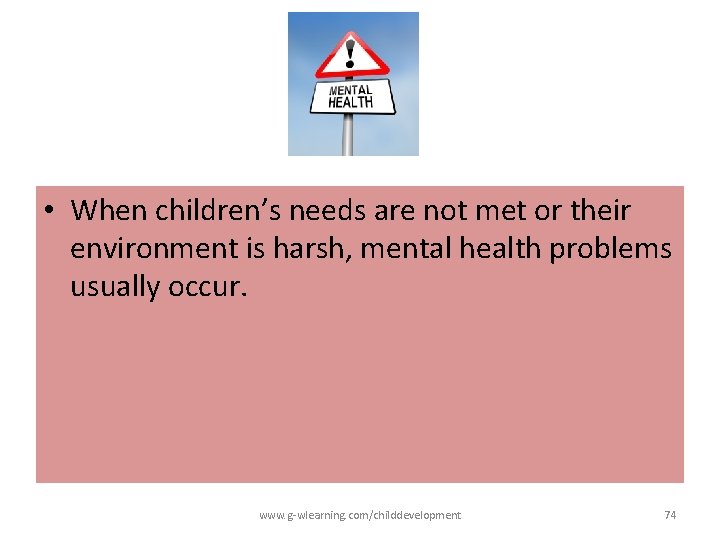
• When children’s needs are not met or their environment is harsh, mental health problems usually occur. www. g-wlearning. com/childdevelopment 74
How Can Adults Help Prevent Children’s Stress? • The road from conception to the adult years is a long one. • Children are not born with the ability to control the harm that may come to their developing bodies, including their brains. • Only as they interact with people and objects in their environment do they come to realize how their world works. www. g-wlearning. com/childdevelopment 75
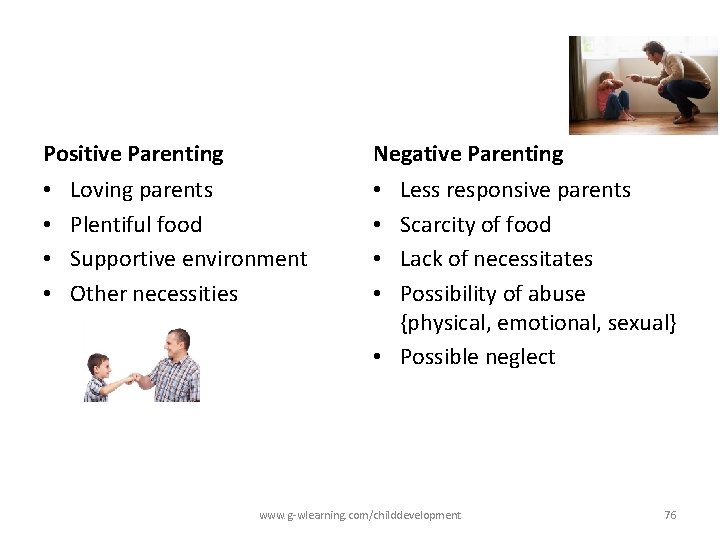
Positive Parenting • • Negative Parenting Loving parents Plentiful food Supportive environment Other necessities Less responsive parents Scarcity of food Lack of necessitates Possibility of abuse {physical, emotional, sexual} • Possible neglect • • www. g-wlearning. com/childdevelopment 76
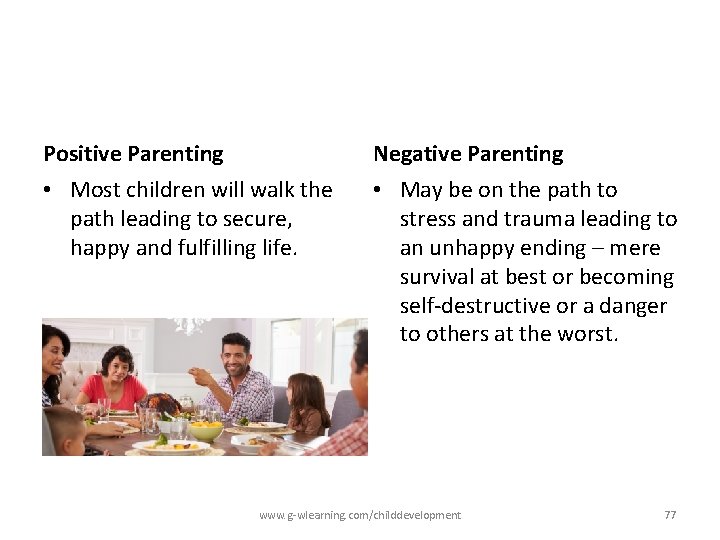
Positive Parenting Negative Parenting • Most children will walk the path leading to secure, happy and fulfilling life. • May be on the path to stress and trauma leading to an unhappy ending – mere survival at best or becoming self-destructive or a danger to others at the worst. www. g-wlearning. com/childdevelopment 77
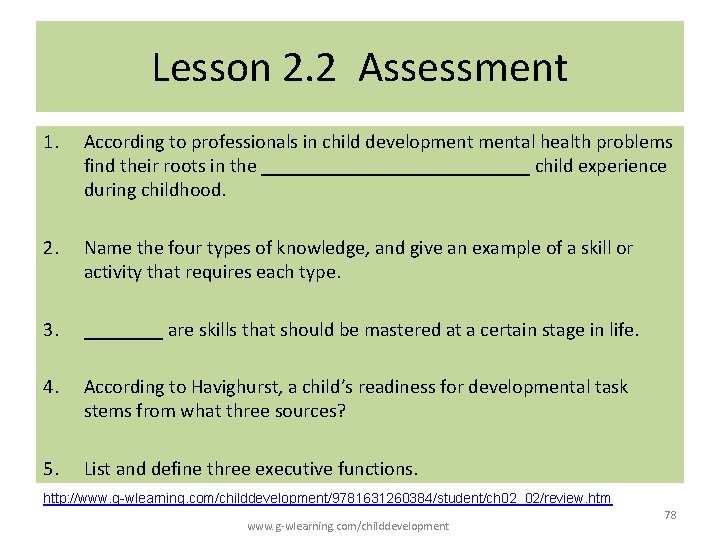
Lesson 2. 2 Assessment 1. According to professionals in child developmental health problems find their roots in the ______________ child experience during childhood. 2. Name the four types of knowledge, and give an example of a skill or activity that requires each type. 3. ____ are skills that should be mastered at a certain stage in life. 4. According to Havighurst, a child’s readiness for developmental task stems from what three sources? 5. List and define three executive functions. http: //www. g-wlearning. com/childdevelopment/9781631260384/student/ch 02_02/review. htm www. g-wlearning. com/childdevelopment 78
The End www. g-wlearning. com/childdevelopment 79