
www gigascale org Runtime Verification A Computer Architecture


- Slides: 52
www. gigascale. org Runtime Verification: A Computer Architecture Perspective Sharad Malik Princeton University Gigascale Systems Research Center (GSRC) Runtime Verification Conference San Francisco September 28, 2011 1
Talk Outline • • Motivation Micro-Architectural Case-Studies Connections with Formal Verification Summary 2
Increasing Design Complexity Moore’s Law: Growth rate of transistors/IC is exponential – Corollary 1: Growth rate of state bits/IC is exponential – Corollary 2: Growth rate of state space (proxy for complexity) is doubly exponential But… – Corollary 3: Growth rate of compute power is exponential Thus… – Growth rate of complexity is still doubly exponential relative to our ability to deal with it 3
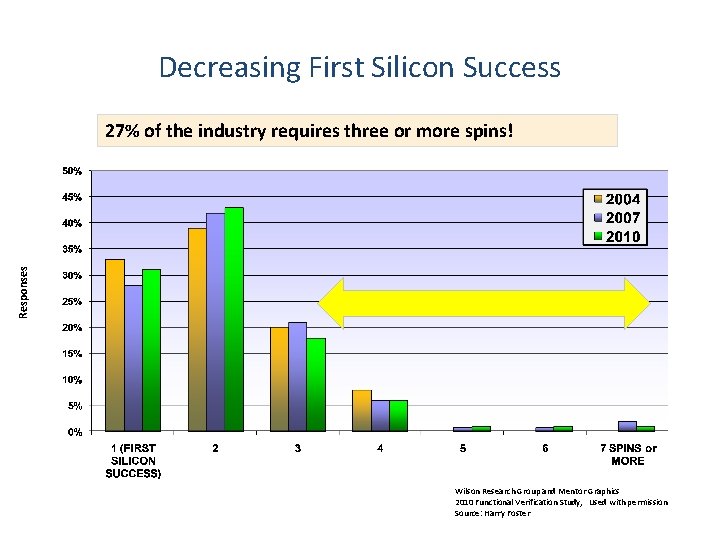
Decreasing First Silicon Success Responses 27% of the industry requires three or more spins! Wilson Research Group and Mentor Graphics 2010 Functional Verification Study, Used with permission Source: Harry Foster
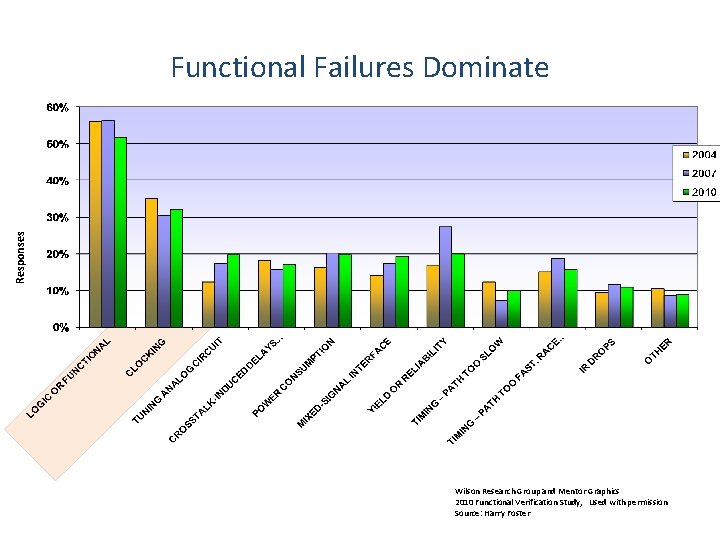
Responses Functional Failures Dominate Wilson Research Group and Mentor Graphics 2010 Functional Verification Study, Used with permission Source: Harry Foster
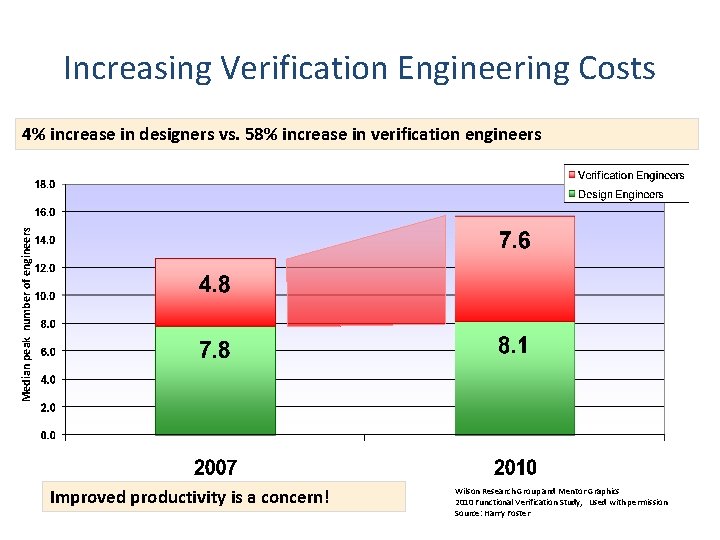
Increasing Verification Engineering Costs Median peak number of engineers 4% increase in designers vs. 58% increase in verification engineers Improved productivity is a concern! Wilson Research Group and Mentor Graphics 2010 Functional Verification Study, Used with permission Source: Harry Foster
Increased Adoption of Formal Verification Median peak number of verification engineers The adoption of formal property checking has grown by 53% Wilson Research Group and Mentor Graphics 2010 Functional Verification Study, Used with permission Source: Harry Foster
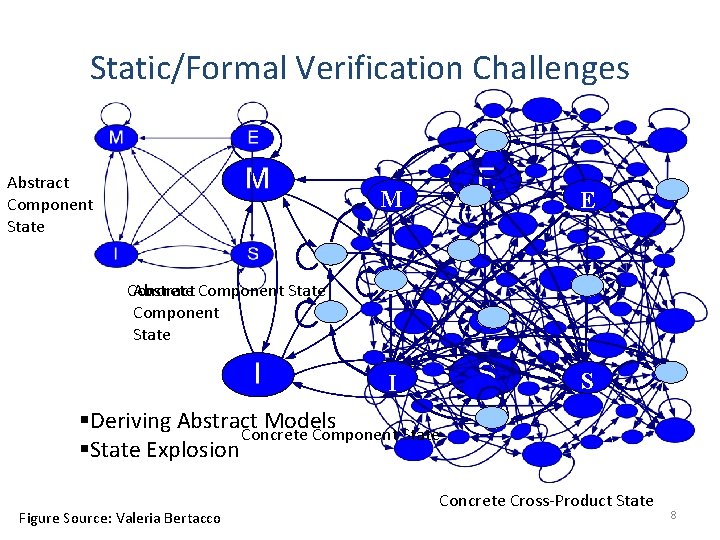
Static/Formal Verification Challenges Abstract Component State M E I S Concrete Component State Abstract Component State §Deriving Abstract Models Concrete Component State §State Explosion Figure Source: Valeria Bertacco Concrete Cross-Product State 8
Dynamic Verification Challenges • Too many traces • Poor absolute coverage • Difficult to derive useful traces • Difficult to characterize true coverage Hardware is inherently concurrent! 9
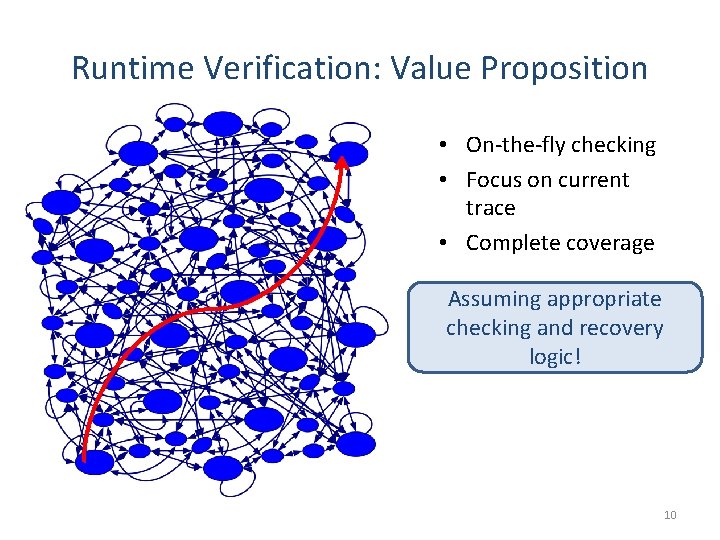
Runtime Verification: Value Proposition • On-the-fly checking • Focus on current trace • Complete coverage Assuming appropriate checking and recovery logic! 10
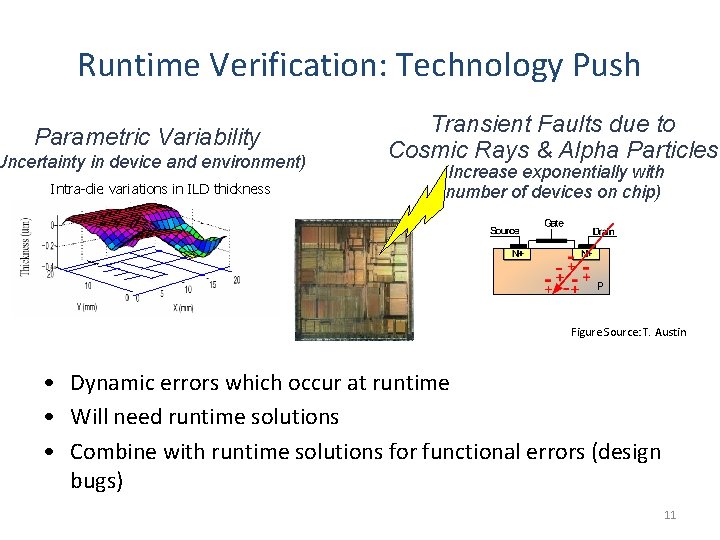
Runtime Verification: Technology Push Parametric Variability Uncertainty in device and environment) Intra-die variations in ILD thickness Transient Faults due to Cosmic Rays & Alpha Particles (Increase exponentially with number of devices on chip) Figure Source: T. Austin • Dynamic errors which occur at runtime • Will need runtime solutions • Combine with runtime solutions for functional errors (design bugs) 11
Runtime Verification: Challenges • What to check? • How to recover? • How to manage costs? Discuss the above through specific micro-architecture case-studies in the uni- and multi-processor context. 12
Talk Outline • • Motivation Micro-Architectural Case-Studies Connections with Formal Verification Summary 13
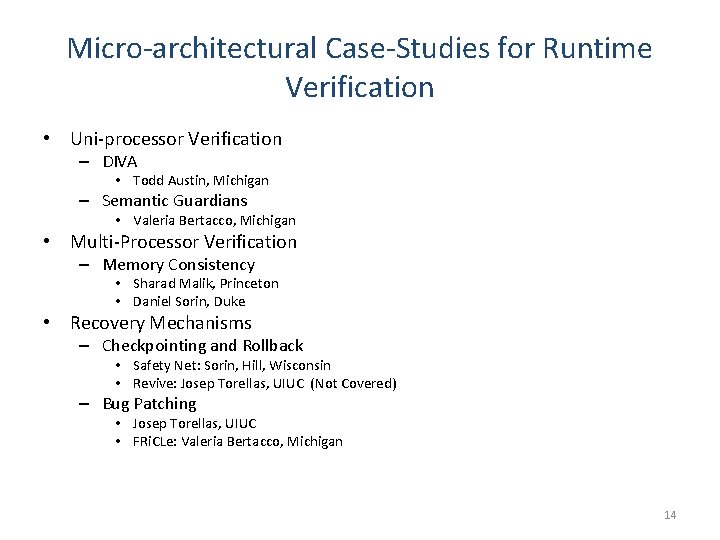
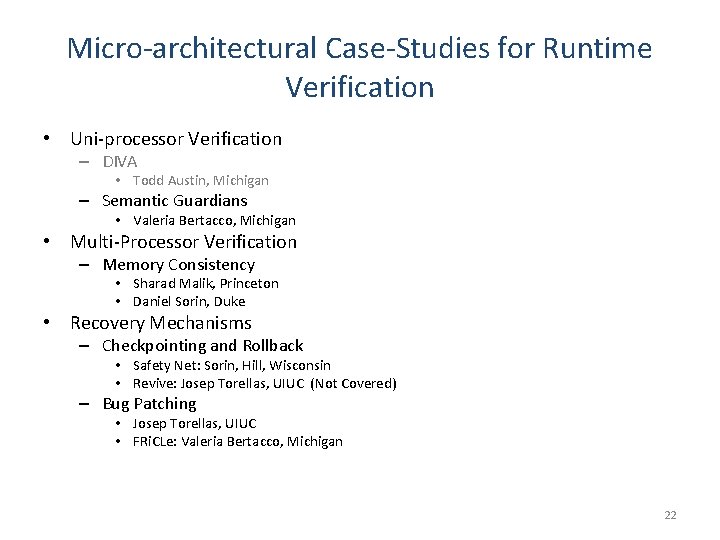
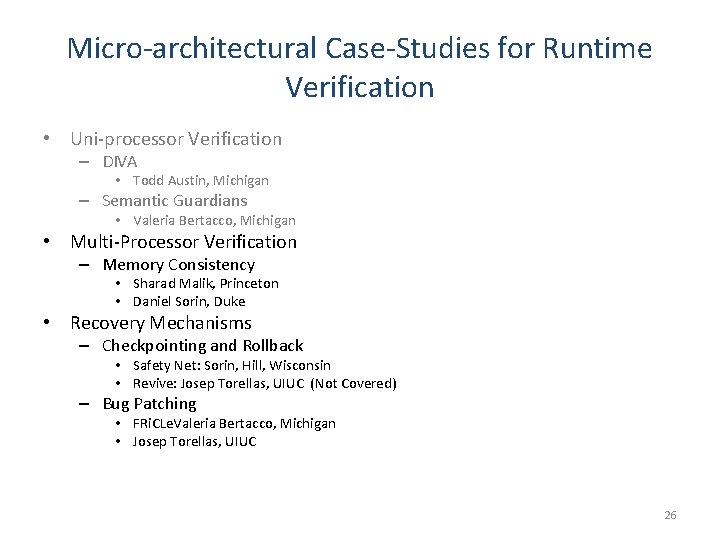
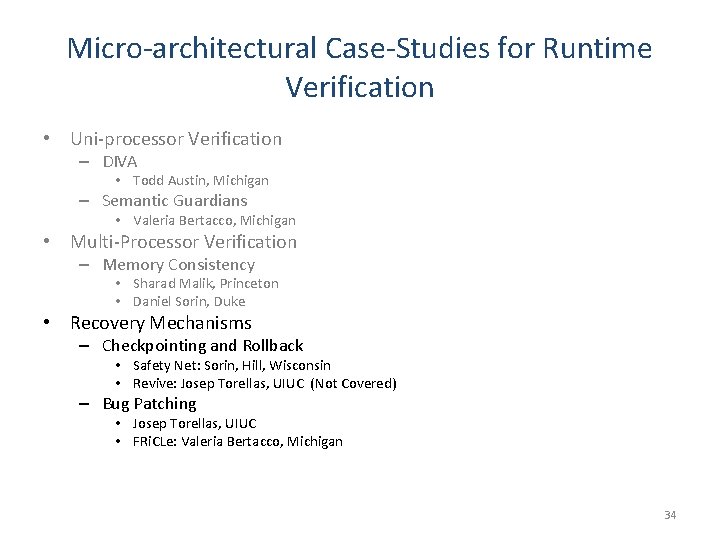
Micro-architectural Case-Studies for Runtime Verification • Uni-processor Verification – DIVA • Todd Austin, Michigan – Semantic Guardians • Valeria Bertacco, Michigan • Multi-Processor Verification – Memory Consistency • Sharad Malik, Princeton • Daniel Sorin, Duke • Recovery Mechanisms – Checkpointing and Rollback • Safety Net: Sorin, Hill, Wisconsin • Revive: Josep Torellas, UIUC (Not Covered) – Bug Patching • Josep Torellas, UIUC • FRi. CLe: Valeria Bertacco, Michigan 14
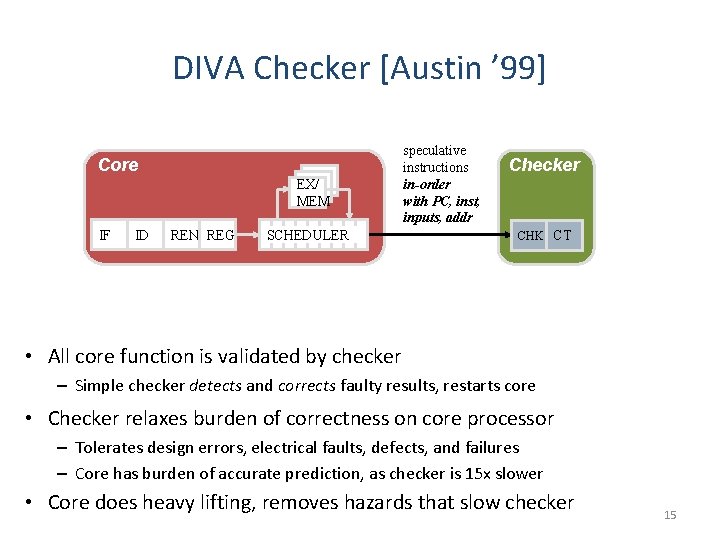
DIVA Checker [Austin ’ 99] Core EX/ MEM IF ID REN REG SCHEDULER speculative instructions in-order with PC, inst, inputs, addr Checker CHK CT • All core function is validated by checker – Simple checker detects and corrects faulty results, restarts core • Checker relaxes burden of correctness on core processor – Tolerates design errors, electrical faults, defects, and failures – Core has burden of accurate prediction, as checker is 15 x slower • Core does heavy lifting, removes hazards that slow checker 15
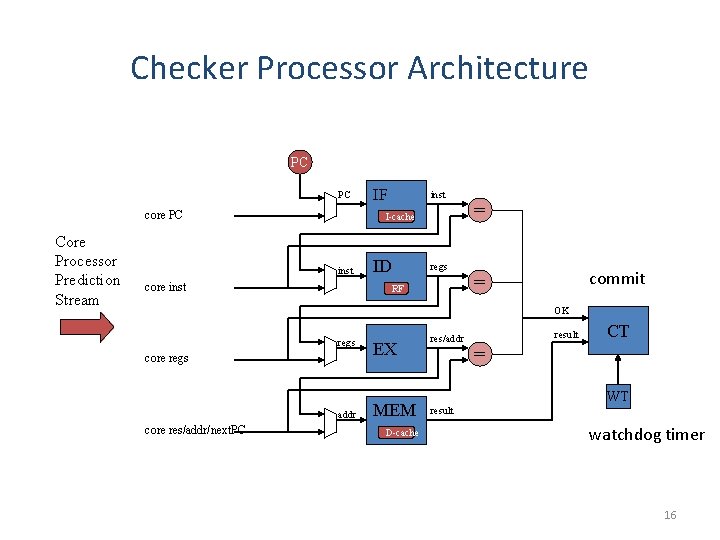
Checker Processor Architecture PC PC core PC Core Processor Prediction Stream IF inst I-cache inst core inst ID regs RF = commit = OK regs core regs addr core res/addr/next. PC EX MEM D-cache res/addr result CT = WT result watchdog timer 16
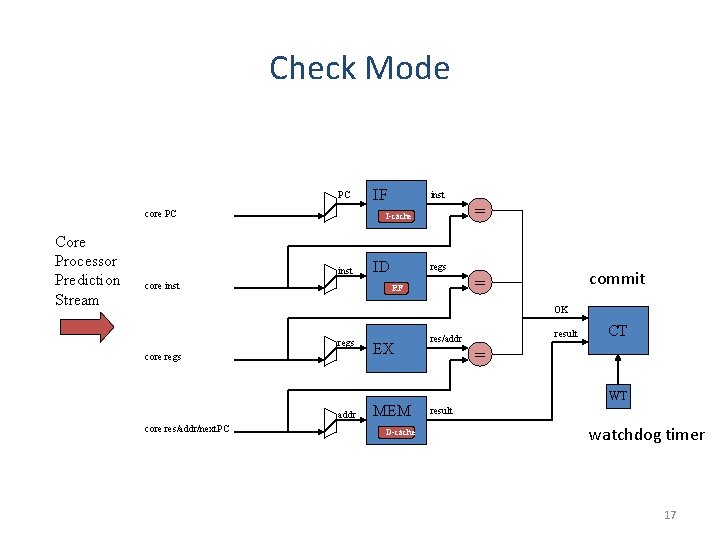
Check Mode PC core PC Core Processor Prediction Stream IF inst = I-cache inst core inst ID regs commit = RF OK regs core regs addr core res/addr/next. PC EX MEM D-cache result res/addr CT = WT result watchdog timer 17
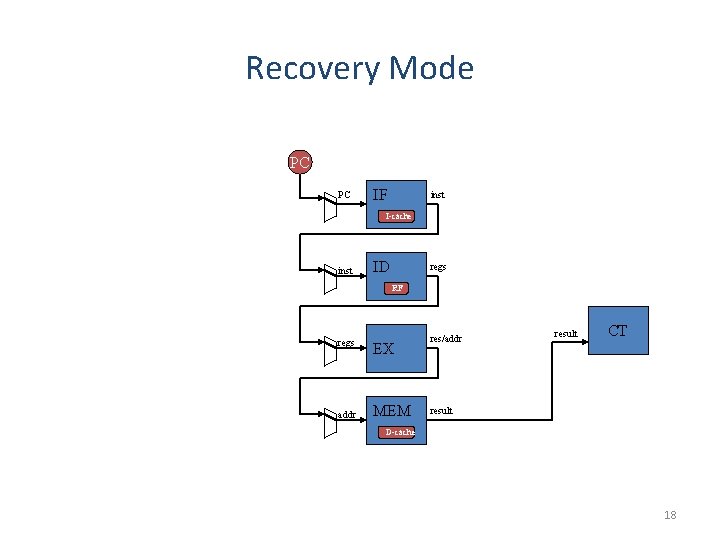
Recovery Mode PC PC IF inst I-cache inst ID regs RF regs addr EX MEM res/addr result CT result D-cache 18
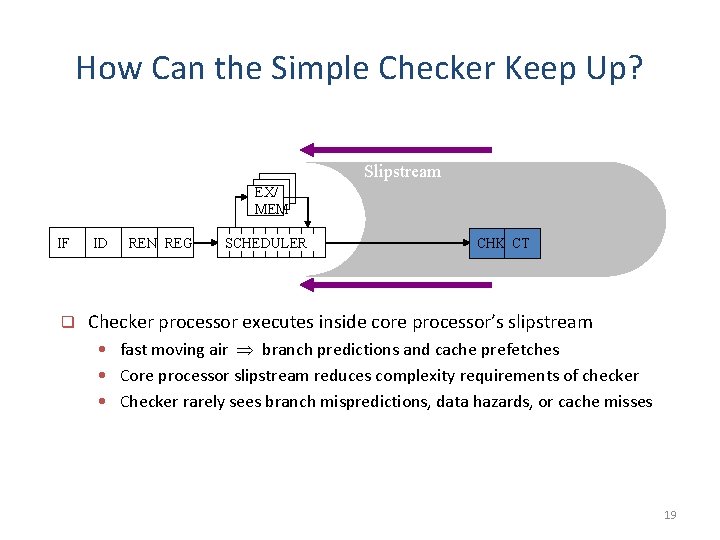
How Can the Simple Checker Keep Up? Slipstream EX/ MEM IF q ID REN REG SCHEDULER CHK CT Checker processor executes inside core processor’s slipstream • fast moving air branch predictions and cache prefetches • Core processor slipstream reduces complexity requirements of checker • Checker rarely sees branch mispredictions, data hazards, or cache misses 19
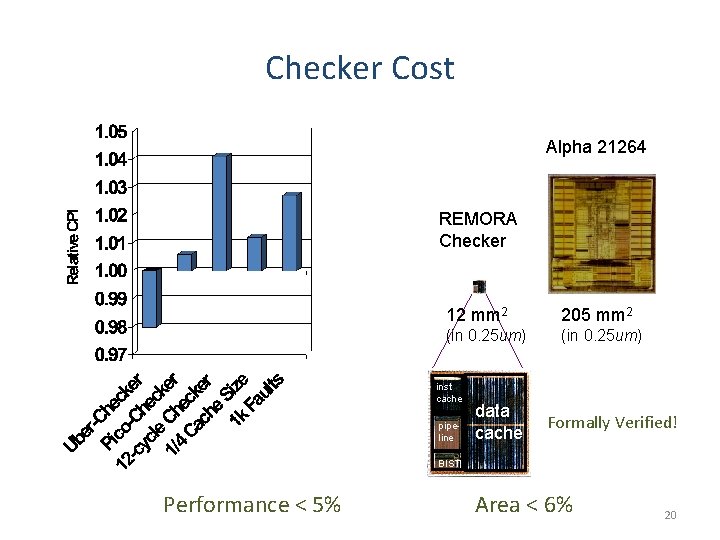
Checker Cost Alpha 21264 REMORA Checker 12 mm 2 205 mm 2 (in 0. 25 um) inst cache pipeline data cache Formally Verified! BIST Performance < 5% Area < 6% 20
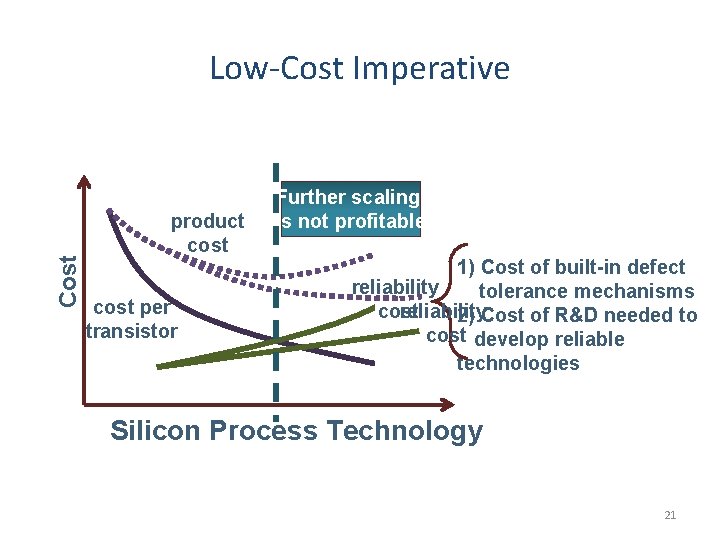
Cost Low-Cost Imperative product cost per transistor Further scaling is not profitable 1) Cost of built-in defect reliability tolerance mechanisms cost reliability 2) Cost of R&D needed to cost develop reliable technologies Silicon Process Technology 21
Micro-architectural Case-Studies for Runtime Verification • Uni-processor Verification – DIVA • Todd Austin, Michigan – Semantic Guardians • Valeria Bertacco, Michigan • Multi-Processor Verification – Memory Consistency • Sharad Malik, Princeton • Daniel Sorin, Duke • Recovery Mechanisms – Checkpointing and Rollback • Safety Net: Sorin, Hill, Wisconsin • Revive: Josep Torellas, UIUC (Not Covered) – Bug Patching • Josep Torellas, UIUC • FRi. CLe: Valeria Bertacco, Michigan 22
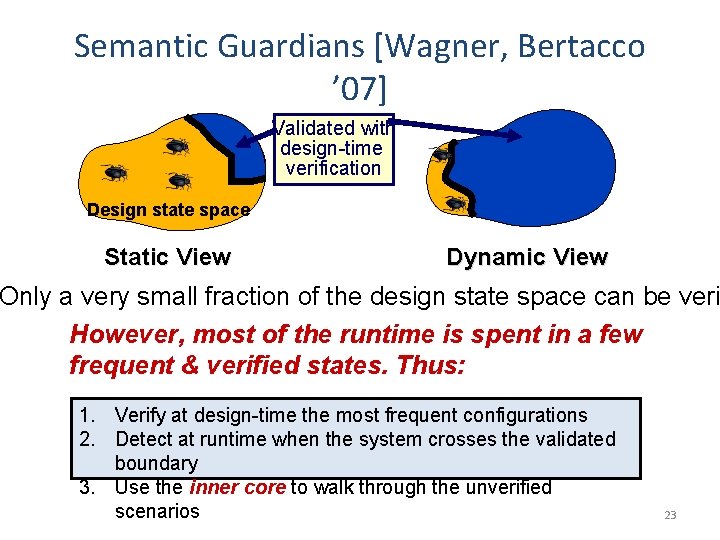
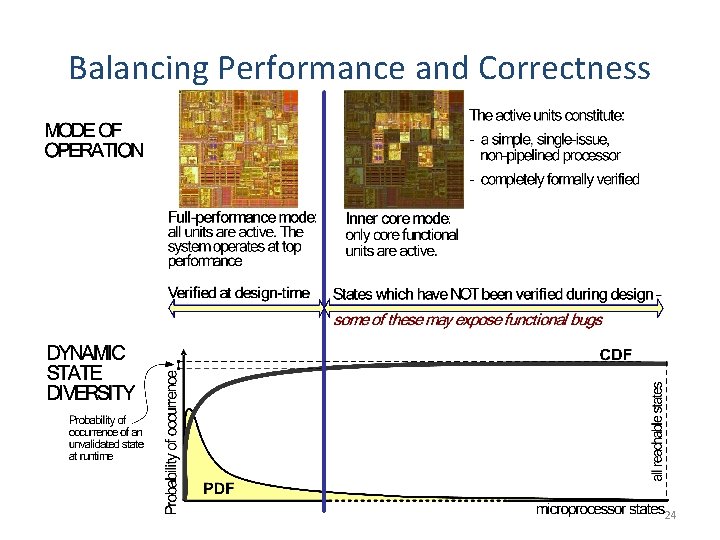
Semantic Guardians [Wagner, Bertacco ’ 07] Validated with design-time verification Design state space Static View Dynamic View Only a very small fraction of the design state space can be veri However, most of the runtime is spent in a few frequent & verified states. Thus: 1. Verify at design-time the most frequent configurations 2. Detect at runtime when the system crosses the validated boundary 3. Use the inner core to walk through the unverified scenarios 23
Balancing Performance and Correctness 24
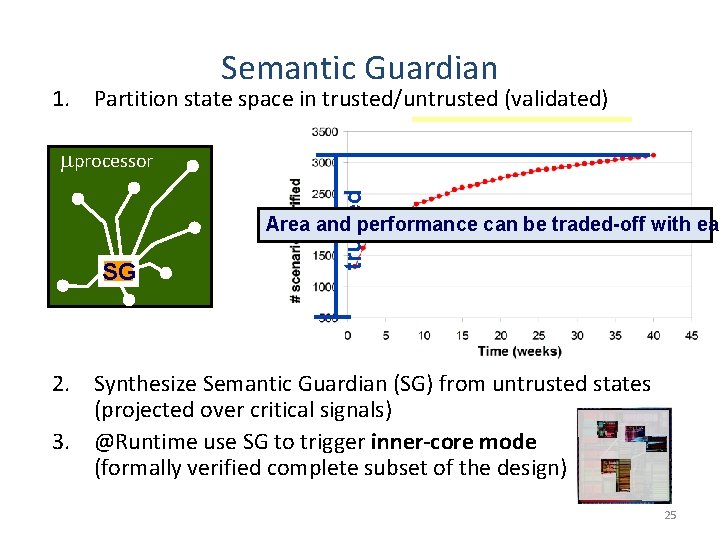
Semantic Guardian 1. Partition state space in trusted/untrusted (validated) VALIDATION EFFORT trusted mprocessor SG Tape-out Area and performance can be traded-off with eac 2. Synthesize Semantic Guardian (SG) from untrusted states (projected over critical signals) 3. @Runtime use SG to trigger inner-core mode (formally verified complete subset of the design) 25
Micro-architectural Case-Studies for Runtime Verification • Uni-processor Verification – DIVA • Todd Austin, Michigan – Semantic Guardians • Valeria Bertacco, Michigan • Multi-Processor Verification – Memory Consistency • Sharad Malik, Princeton • Daniel Sorin, Duke • Recovery Mechanisms – Checkpointing and Rollback • Safety Net: Sorin, Hill, Wisconsin • Revive: Josep Torellas, UIUC (Not Covered) – Bug Patching • FRi. CLe. Valeria Bertacco, Michigan • Josep Torellas, UIUC 26
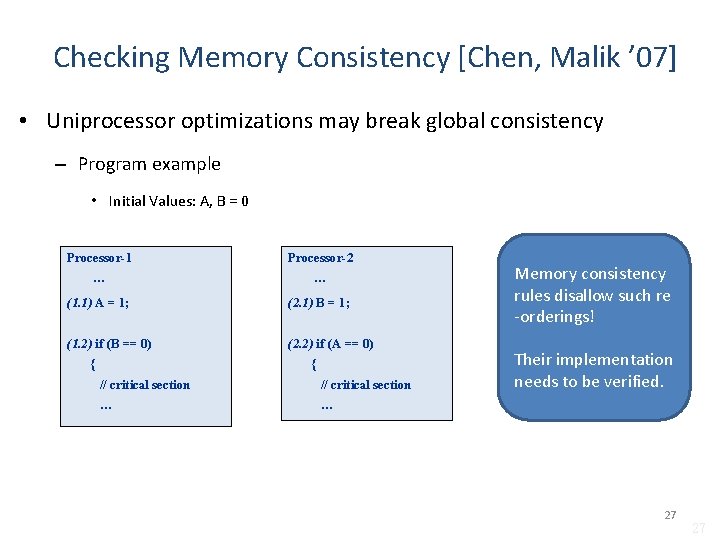
Checking Memory Consistency [Chen, Malik ’ 07] • Uniprocessor optimizations may break global consistency – Program example • Initial Values: A, B = 0 Processor-1 Processor-2 … … (1. 1) A = 1; (2. 1) B = 1; (1. 2) if (B == 0) (2. 2) if (A == 0) { { // critical section … … Memory consistency rules disallow such re -orderings! Their implementation needs to be verified. 27 27
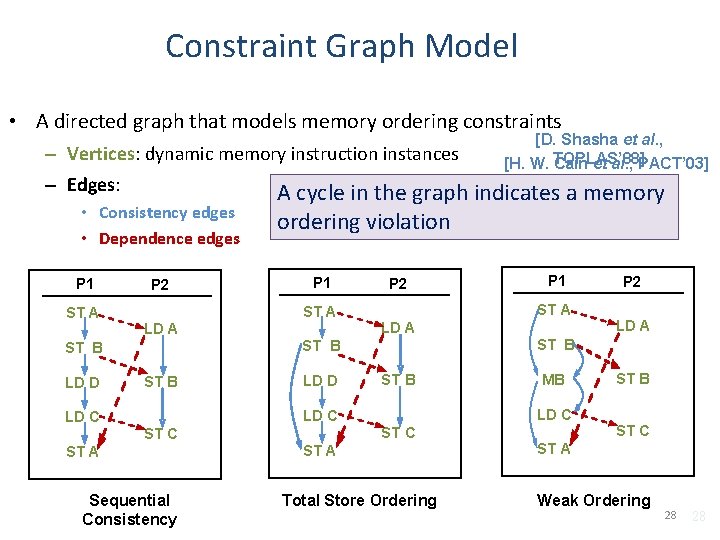
Constraint Graph Model • A directed graph that models memory ordering constraints – Vertices: dynamic memory instruction instances – Edges: • Consistency edges • Dependence edges P 1 ST A P 2 LD D B LD C ST A A cycle in the graph indicates a memory ordering violation P 1 ST A LD A P 2 ST B A LD D LD C ST C LD A Sequential Consistency ST A P 1 ST A LD A P 2 LD A ST B [D. Shasha et al. , [H. W. TOPLAS’ 88] Cain et al. , PACT’ 03] ST B A MB LD C ST C LD A Total Store Ordering ST A ST B A ST C LD A Weak Ordering 28 28
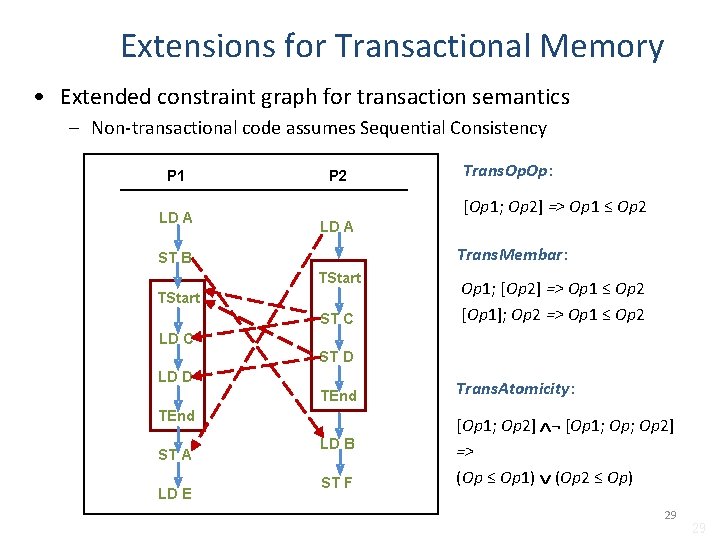
Extensions for Transactional Memory • Extended constraint graph for transaction semantics – Non-transactional code assumes Sequential Consistency P 1 LD A P 2 Trans. Op: [Op 1; Op 2] => Op 1 ≤ Op 2 LD A Trans. Membar: ST B TStart ST C Op 1; [Op 2] => Op 1 ≤ Op 2 [Op 1]; Op 2 => Op 1 ≤ Op 2 LD C ST D LD D TEnd ST A LD E LD B ST F Trans. Atomicity: [Op 1; Op 2] ¬ [Op 1; Op 2] => (Op ≤ Op 1) (Op 2 ≤ Op) 29 29
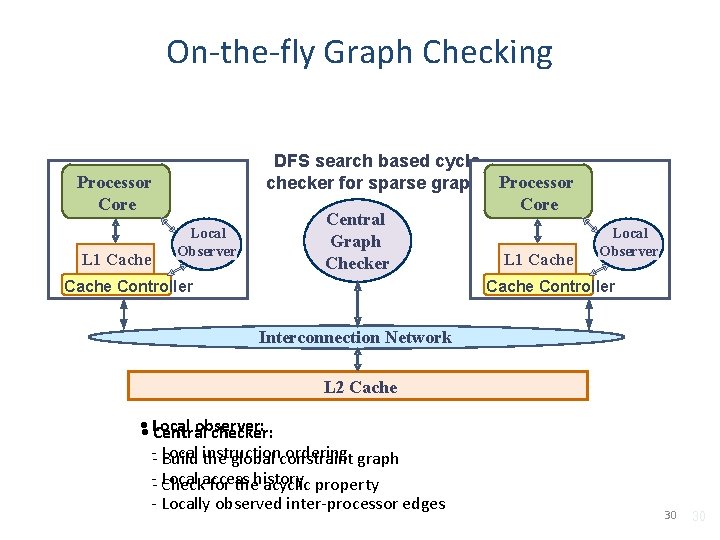
On-the-fly Graph Checking Processor Core L 1 Cache Local Observer DFS search based cycle Processor checker for sparse graphs. Processor Core Central Local Graph Observer L 1 Checker L 1 Cache Controller Cache Controller Interconnection Network L 2 Cache • • Local observer: Central checker: - Local instruction ordering - Build the global constraint graph - Local access history - Check for the acyclic property - Locally observed inter-processor edges 30 30
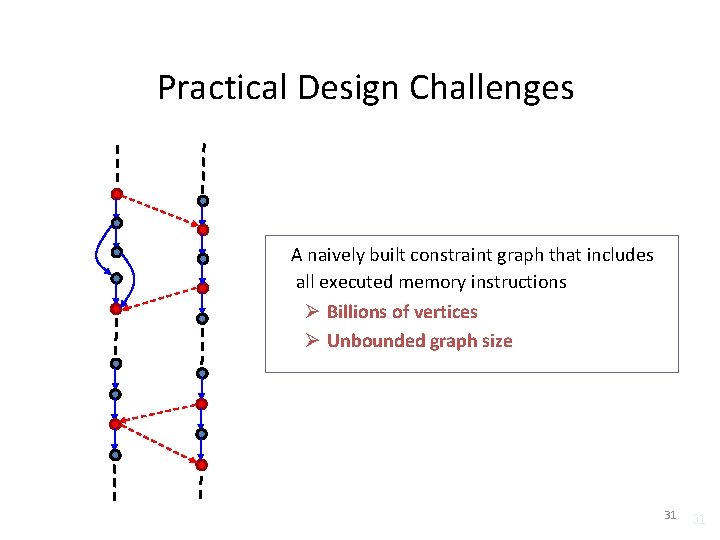
Practical Design Challenges A naively built constraint graph that includes all executed memory instructions Ø Billions of vertices Ø Unbounded graph size 31 31
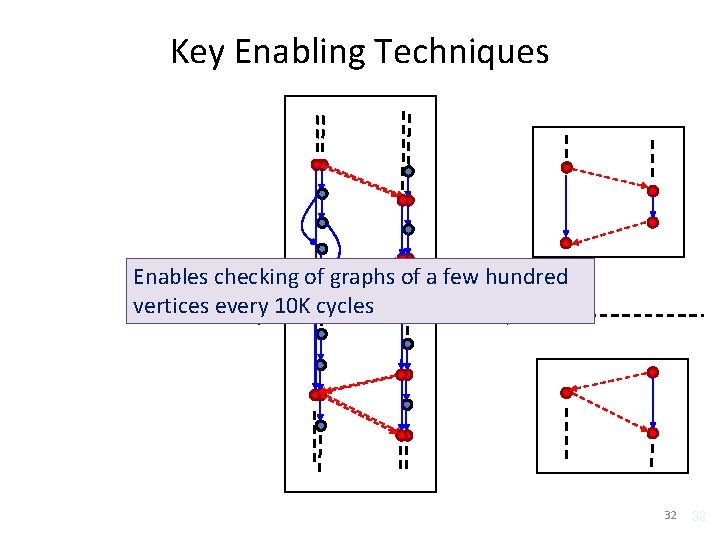
Key Enabling Techniques Graph Enables checking of graphs of a few hundred Slicing Reduction vertices every 10 K cycles 32 32
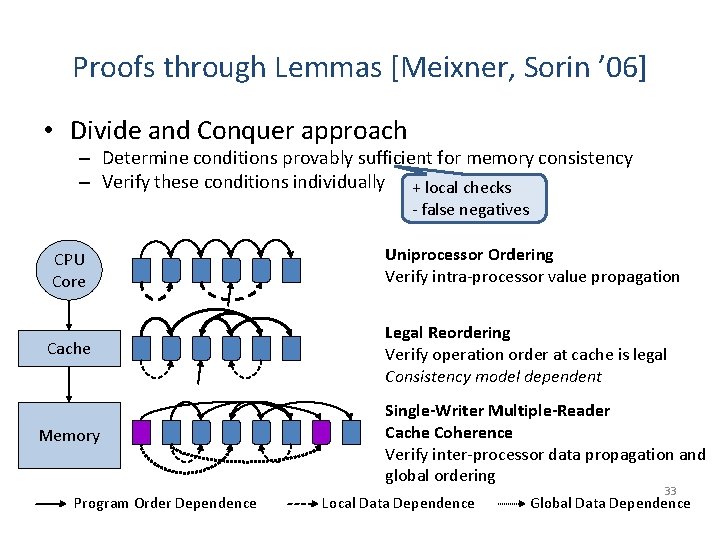
Proofs through Lemmas [Meixner, Sorin ’ 06] • Divide and Conquer approach – Determine conditions provably sufficient for memory consistency – Verify these conditions individually + local checks - false negatives CPU Core Uniprocessor Ordering Verify intra-processor value propagation Cache Legal Reordering Verify operation order at cache is legal Consistency model dependent Memory Program Order Dependence Single-Writer Multiple-Reader Cache Coherence Verify inter-processor data propagation and global ordering Local Data Dependence 33 Global Data Dependence
Micro-architectural Case-Studies for Runtime Verification • Uni-processor Verification – DIVA • Todd Austin, Michigan – Semantic Guardians • Valeria Bertacco, Michigan • Multi-Processor Verification – Memory Consistency • Sharad Malik, Princeton • Daniel Sorin, Duke • Recovery Mechanisms – Checkpointing and Rollback • Safety Net: Sorin, Hill, Wisconsin • Revive: Josep Torellas, UIUC (Not Covered) – Bug Patching • Josep Torellas, UIUC • FRi. CLe: Valeria Bertacco, Michigan 34
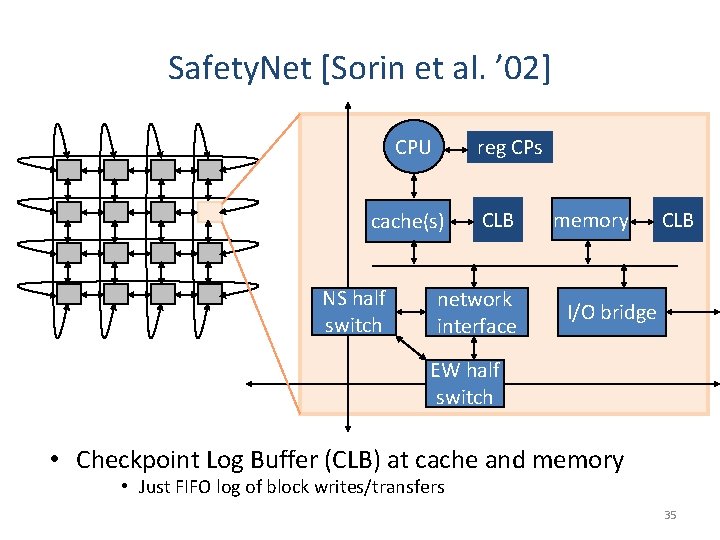
Safety. Net [Sorin et al. ’ 02] CPU reg CPs cache(s) NS half switch CLB network interface memory CLB I/O bridge EW half switch • Checkpoint Log Buffer (CLB) at cache and memory • Just FIFO log of block writes/transfers 35
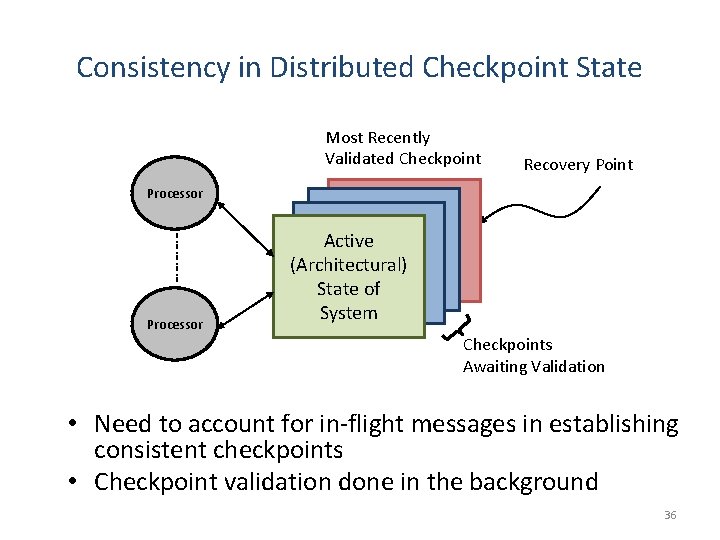
Consistency in Distributed Checkpoint State Most Recently Validated Checkpoint Recovery Point Processor Current Memory Active Current Memory Checkpoint Memory checkpoint (Architectural) Version Processor State of System Checkpoints Awaiting Validation • Need to account for in-flight messages in establishing consistent checkpoints • Checkpoint validation done in the background 36
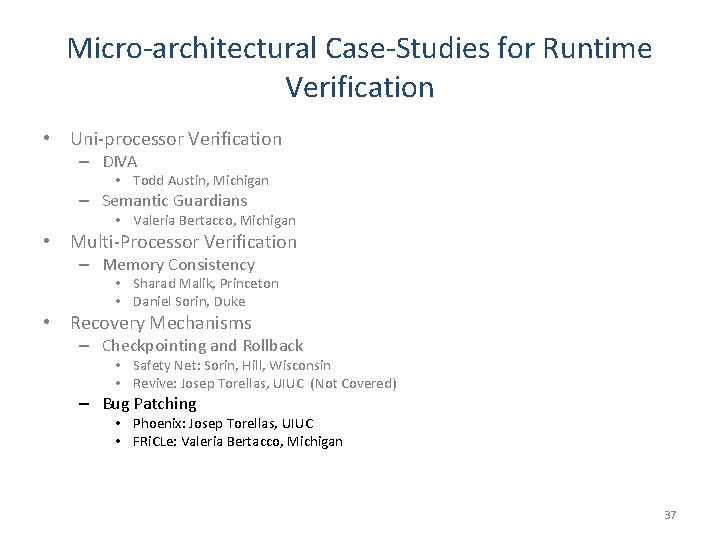
Micro-architectural Case-Studies for Runtime Verification • Uni-processor Verification – DIVA • Todd Austin, Michigan – Semantic Guardians • Valeria Bertacco, Michigan • Multi-Processor Verification – Memory Consistency • Sharad Malik, Princeton • Daniel Sorin, Duke • Recovery Mechanisms – Checkpointing and Rollback • Safety Net: Sorin, Hill, Wisconsin • Revive: Josep Torellas, UIUC (Not Covered) – Bug Patching • Phoenix: Josep Torellas, UIUC • FRi. CLe: Valeria Bertacco, Michigan 37
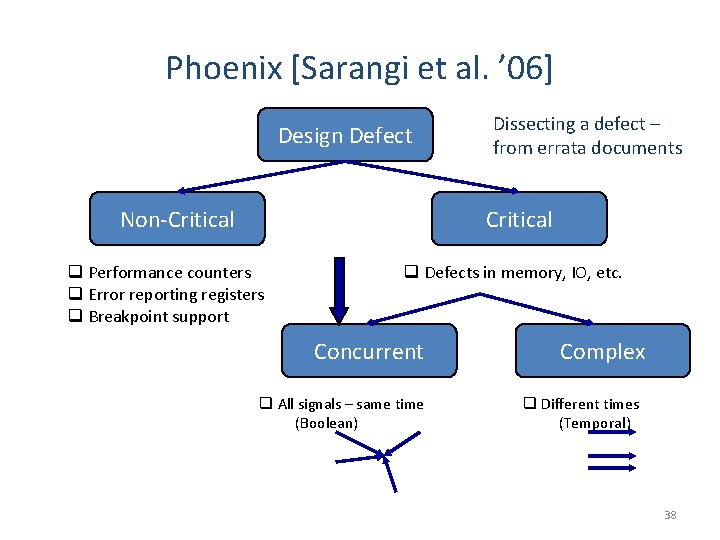
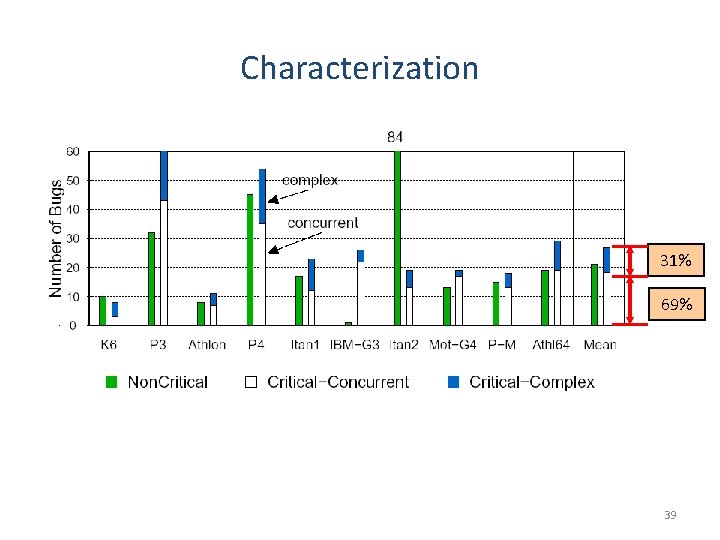
Phoenix [Sarangi et al. ’ 06] Design Defect Non-Critical Dissecting a defect – from errata documents Critical q Performance counters q Error reporting registers q Breakpoint support q Defects in memory, IO, etc. Concurrent q All signals – same time (Boolean) Complex q Different times (Temporal) 38
Characterization 31% 69% 39
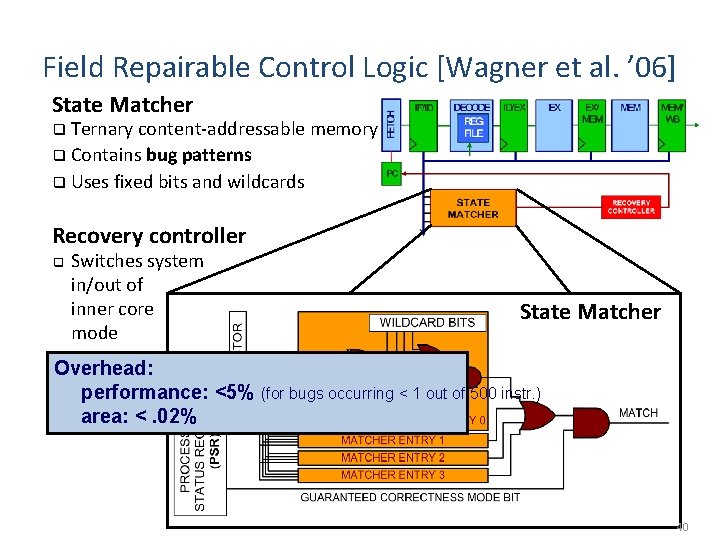
Field Repairable Control Logic [Wagner et al. ’ 06] State Matcher q Ternary content-addressable memory q Contains bug patterns q Uses fixed bits and wildcards Recovery controller q Switches system in/out of inner core mode State Matcher Overhead: performance: <5% (for bugs occurring < 1 out of 500 instr. ) area: <. 02% 40 40
Talk Outline • • Motivation Micro-Architectural Case-Studies Connections with Formal Verification Summary 41
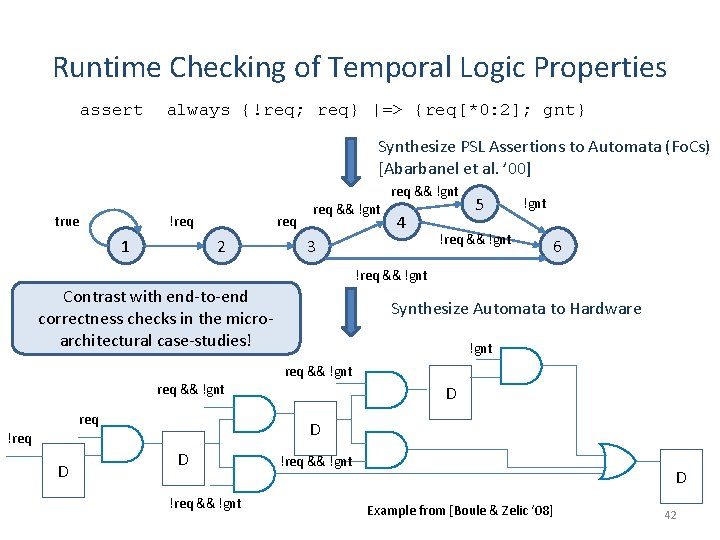
Runtime Checking of Temporal Logic Properties assert always {!req; req} |=> {req[*0: 2]; gnt} Synthesize PSL Assertions to Automata (Fo. Cs) [Abarbanel et al. ’ 00] req && !gnt true !req 1 req 2 req && !gnt 4 3 5 !gnt !req && !gnt 6 !req && !gnt Contrast with end-to-end correctness checks in the microarchitectural case-studies! Synthesize Automata to Hardware !gnt req && !gnt req D !req D D D !req && !gnt D Example from [Boule & Zelic ‘ 08] 42
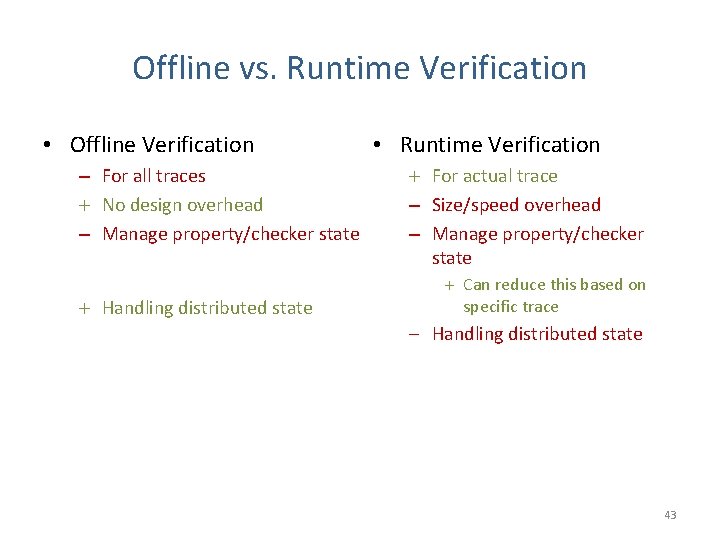
Offline vs. Runtime Verification • Offline Verification – For all traces No design overhead – Manage property/checker state Handling distributed state • Runtime Verification For actual trace – Size/speed overhead – Manage property/checker state Can reduce this based on specific trace Handling distributed state 43
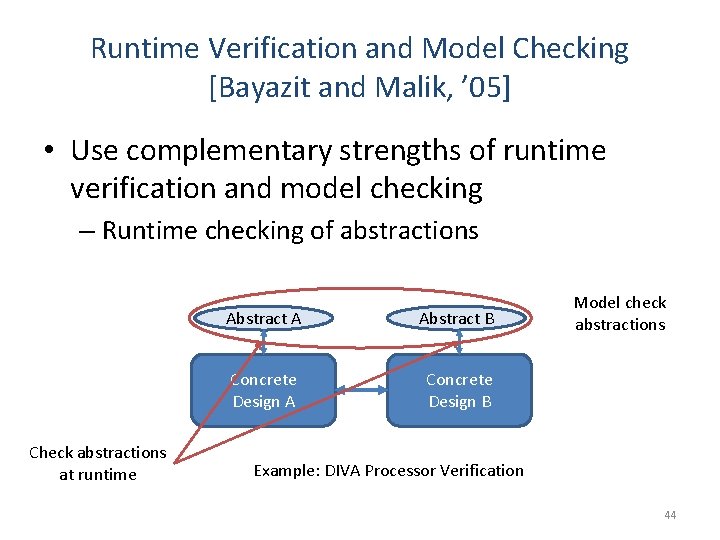
Runtime Verification and Model Checking [Bayazit and Malik, ’ 05] • Use complementary strengths of runtime verification and model checking – Runtime checking of abstractions Check abstractions at runtime Abstract A Abstract B Concrete Design A Concrete Design B Model check abstractions Example: DIVA Processor Verification 44
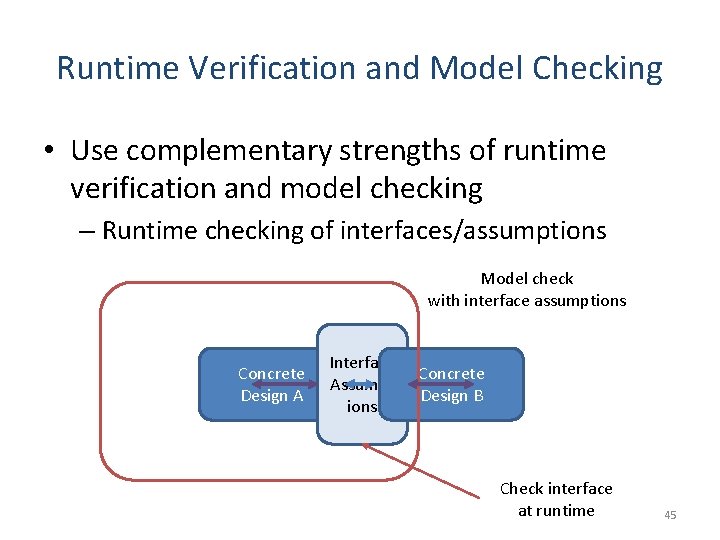
Runtime Verification and Model Checking • Use complementary strengths of runtime verification and model checking – Runtime checking of interfaces/assumptions Model check with interface assumptions Concrete Design A Interface Assumpt ions Concrete Design B Check interface at runtime 45
Talk Outline • • Motivation Micro-Architectural Case-Studies Connections with Formal Verification Summary 46
Summary Observations • Key Advantages – Common framework for a range of defects – Manage pre-silicon verification costs • Have predictable verification schedules • Support bug escapes through runtime validation • Complexity, Performance Tradeoffs – Common mode • High performance, high complexity – (Infrequent) Recovery mode • Low complexity, low performance • Leverage checkpointing support – Backward error recovery through rollback – Relevant for high-performance to support speculation 47
Summary Observations • Complementary Strengths – Large state space • Pre-silicon: Incomplete formal verification, simulation • Runtime: Easy - observe only actual state – State observability • Runtime: Challenging to observe – Distributed state, large number of variables • Pre-Silicon: Easy – just variables in software models for simulation or formal verification • Challenges – Keeping costs low, with increasing complexity and failure modes – Checking the checker? – A discipline for runtime validation? 48
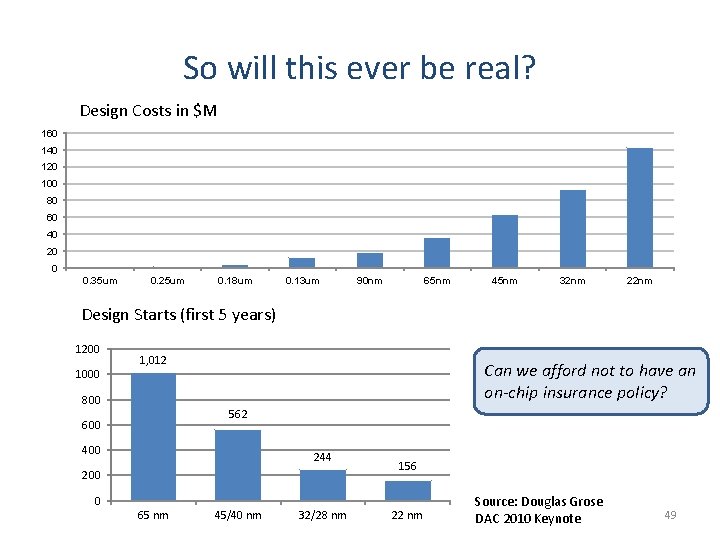
So will this ever be real? Design Costs in $M 160 140 120 100 80 60 40 20 0 0. 35 um 0. 25 um 0. 18 um 0. 13 um 90 nm 65 nm 45 nm 32 nm 22 nm Design Starts (first 5 years) 1200 1000 1, 012 800 Can we afford not to have an on-chip insurance policy? 562 600 400 244 200 156 0 65 nm 45/40 nm 32/28 nm 22 nm Source: Douglas Grose DAC 2010 Keynote 49
Acknowledgements • Several slides and other material provided by: – Todd Austin – Valeria Bertacco – Harry Foster – Divjyot Sethi – Daniel Sorin – Josep Torellas 50
References • • • Austin, T. M. 1999. DIVA: a reliable substrate for deep submicron microarchitecture design. In Proceedings of the 32 nd Annual ACM/IEEE international Symposium on Microarchitecture (Haifa, Israel, November 16 - 18, 1999). International Symposium on Microarchitecture. IEEE Computer Society, Washington, DC, 196 -207 Wagner, I. and Bertacco, V. 2007. Engineering trust with semantic guardians. In Proceedings of the Conference on Design, Automation and Test in Europe (Nice, France, April 16 - 20, 2007). Design, Automation, and Test in Europe. EDA Consortium, San Jose, CA, 743 -748. Kaiyu Chen; Malik, S. ; Patra, P. ; , "Runtime validation of memory ordering using constraint graph checking, " High Performance Computer Architecture, 2008. HPCA 2008. IEEE 14 th International Symposium on , vol. , no. , pp. 415 -426, 16 -20 Feb. 2008 doi: 10. 1109/HPCA. 2008. 4658657 URL: http: //ieeexplore. ieee. org/stamp. jsp? tp=&arnumber=4658657&isnumber=4658618 Meixner, A. ; Sorin, D. J. ; , "Dynamic Verification of Memory Consistency in Cache-Coherent Multithreaded Computer Architectures, " Dependable Systems and Networks, 2006. DSN 2006. International Conference on , vol. , no. , pp. 73 -82, 25 -28 June 2006 doi: 10. 1109/DSN. 2006. 29 URL: http: //ieeexplore. ieee. org/stamp. jsp? tp=&arnumber=1633497&isnumber=34248 Prvulovic, M. , Zhang, Z. , and Torrellas, J. 2002. Re. Vive: cost-effective architectural support for rollback recovery in shared-memory multiprocessors. In Proceedings of the 29 th Annual international Symposium on Computer Architecture(Anchorage, Alaska, May 25 - 29, 2002). International Symposium on Computer Architecture. IEEE Computer Society, Washington, DC, 111122. URL= http: //portal. acm. org/citation. cfm? id=545215. 54522 51
References • • • Sorin, D. J. , Martin, M. M. , Hill, M. D. , and Wood, D. A. 2002. Safety. Net: improving the availability of shared memory multiprocessors with global checkpoint/recovery. In Proceedings of the 29 th Annual international Symposium on Computer Architecture (Anchorage, Alaska, May 25 - 29, 2002). International Symposium on Computer Architecture. IEEE Computer Society, Washington, DC, 123134. URL= http: //portal. acm. org/citation. cfm? id=545215. 545229 Sarangi, S. R. , Tiwari, A. , and Torrellas, J. 2006. Phoenix: Detecting and Recovering from Permanent Processor Design Bugs with Programmable Hardware. In Proceedings of the 39 th Annual IEEE/ACM international Symposium on Microarchitecture (December 09 - 13, 2006). International Symposium on Microarchitecture. IEEE Computer Society, Washington, DC, 26 -37. DOI= http: //dx. doi. org/10. 1109/MICRO. 2006. 41 Wagner, I. , Bertacco, V. , and Austin, T. 2006. Shielding against design flaws with field repairable control logic. In. Proceedings of the 43 rd Annual Design Automation Conference (San Francisco, CA, USA, July 24 - 28, 2006). DAC '06. ACM, New York, NY, 344 -347. DOI= http: //doi. acm. org/10. 1145/1146909. 1146998 Abarbanel, Y. , Beer, I. , Glushovsky, L. , Keidar, S. , and Wolfsthal, Y. 2000. Fo. Cs: Automatic Generation of Simulation Checkers from Formal Specifications. In Proceedings of the 12 th international Conference on Computer Aided Verification (July 15 - 19, 2000). E. A. Emerson and A. P. Sistla, Eds. Lecture Notes In Computer Science, vol. 1855. Springer-Verlag, London, 538 -542. Bayazit, A. A. and Malik, S. 2005. Complementary use of runtime validation and model checking. In Proceedings of the 2005 IEEE/ACM international Conference on Computer-Aided Design (San Jose, CA, November 06 - 10, 2005). International Conference on Computer Aided Design. IEEE Computer Society, Washington, DC, 1052 -1059. 52