
WWW FPSI COM Using WorkSample Physical Ability Tests
WWW. FPSI. COM Using Work-Sample Physical Ability Tests to Maintain Fitness Standards of Incumbent Firefighters Stacy L. Bell, MS Dan Biddle, Ph. D Fire & Police Selection, Inc. (FPSI) © 2013
About the Speakers • Stacy L. Bell, MS—Executive Vice President of Fire & Police Selection, Inc. 98% • Dan Biddle, Ph. D—President/CEO of Fire & Police Selection, Inc. and Biddle Consulting Group Fire & Police Selection, Inc. (FPSI) © 2013

Overview of Fire & Police Selection, Inc. • Over 90 Physical Ability Test installations at fire departments across the U. S. • Over 1, 000 personnel, fire, and police clients across the U. S. and Canada • Entry-level written, physical, interview assessments, manipulative Skills tests, cognitive ability tests, and personality tests available for selection of fire personnel • Post-academy certification tests • Fire promotional tests and assessment exercises • Online national firefighter testing • Newly published Testing in the Fire Service Industry: A Handbook for Developing Balanced and Defensible Assessments Industry Leader Fire & Police Selection, Inc. (FPSI) © 2013
Presentation Overview • Review of critical firefighter physical abilities • Comparison of fitness testing vs. work-sample testing • National survey results regarding the need for incumbent testing • Legal pitfalls associated with arbitrary fitness tests and the risks associated with employing inappropriate standards at the incumbent level • Appropriate techniques to use for setting PAT cutoff scores for candidates and incumbents • Importance of “maintenance/wellness” testing of incumbents Fire & Police Selection, Inc. (FPSI) © 2013
Critical Firefighter Physical Abilities • 1994 -1996 Firefighter Physical Ability Validation Study ◦ 331 Fire Suppression Personnel from 41 fire departments identified the critical physical duties performed by fire suppression personnel: – Hose drags (dry and charged) – Ladder raises, removal, and carries – Walking and operating on ladders – Searching for fire extension – Removing conscious/unconscious victims from fire scene – Ventilation techniques – Climbing stairs while carrying tools/equipment – Hoisting operations Fire & Police Selection, Inc. (FPSI) © 2013
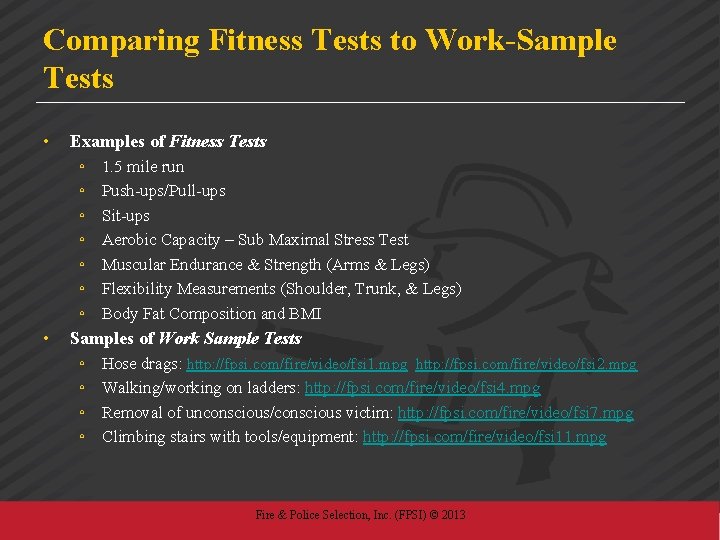
Comparing Fitness Tests to Work-Sample Tests • • Examples of Fitness Tests ◦ 1. 5 mile run ◦ Push-ups/Pull-ups ◦ Sit-ups ◦ Aerobic Capacity – Sub Maximal Stress Test ◦ Muscular Endurance & Strength (Arms & Legs) ◦ Flexibility Measurements (Shoulder, Trunk, & Legs) ◦ Body Fat Composition and BMI Samples of Work Sample Tests ◦ Hose drags: http: //fpsi. com/fire/video/fsi 1. mpg http: //fpsi. com/fire/video/fsi 2. mpg ◦ Walking/working on ladders: http: //fpsi. com/fire/video/fsi 4. mpg ◦ Removal of unconscious/conscious victim: http: //fpsi. com/fire/video/fsi 7. mpg ◦ Climbing stairs with tools/equipment: http: //fpsi. com/fire/video/fsi 11. mpg Fire & Police Selection, Inc. (FPSI) © 2013
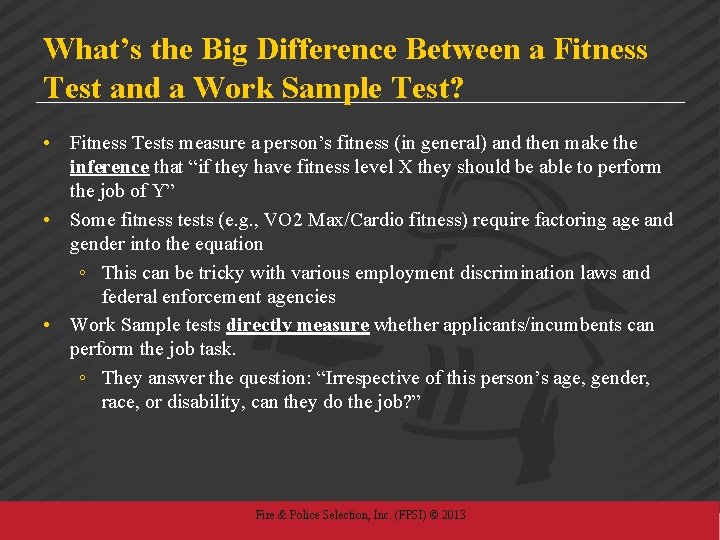
What’s the Big Difference Between a Fitness Test and a Work Sample Test? • Fitness Tests measure a person’s fitness (in general) and then make the inference that “if they have fitness level X they should be able to perform the job of Y” • Some fitness tests (e. g. , VO 2 Max/Cardio fitness) require factoring age and gender into the equation ◦ This can be tricky with various employment discrimination laws and federal enforcement agencies • Work Sample tests directly measure whether applicants/incumbents can perform the job task. ◦ They answer the question: “Irrespective of this person’s age, gender, race, or disability, can they do the job? ” Fire & Police Selection, Inc. (FPSI) © 2013
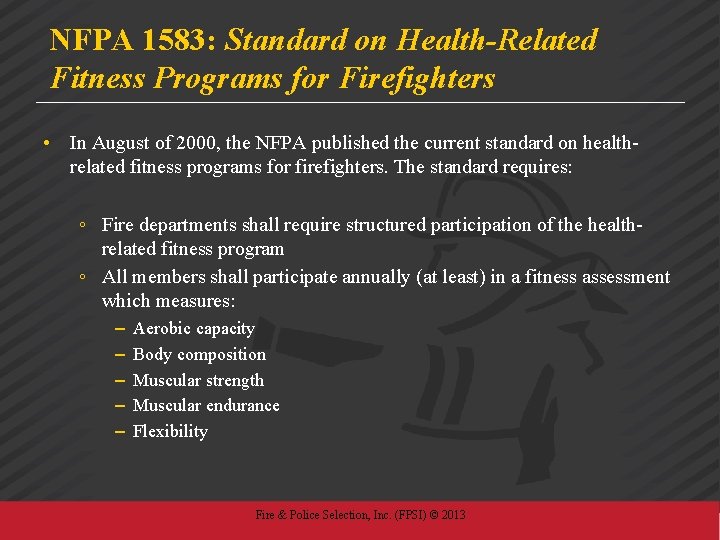
NFPA 1583: Standard on Health-Related Fitness Programs for Firefighters • In August of 2000, the NFPA published the current standard on healthrelated fitness programs for firefighters. The standard requires: ◦ Fire departments shall require structured participation of the healthrelated fitness program ◦ All members shall participate annually (at least) in a fitness assessment which measures: – – – Aerobic capacity Body composition Muscular strength Muscular endurance Flexibility Fire & Police Selection, Inc. (FPSI) © 2013
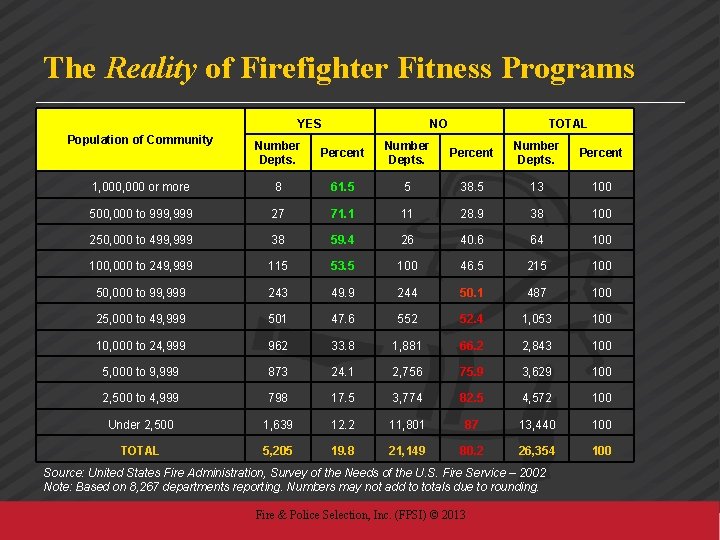
The Reality of Firefighter Fitness Programs YES NO TOTAL Population of Community Number Depts. Percent 1, 000 or more 8 61. 5 5 38. 5 13 100 500, 000 to 999, 999 27 71. 1 11 28. 9 38 100 250, 000 to 499, 999 38 59. 4 26 40. 6 64 100, 000 to 249, 999 115 53. 5 100 46. 5 215 100 50, 000 to 99, 999 243 49. 9 244 50. 1 487 100 25, 000 to 49, 999 501 47. 6 552 52. 4 1, 053 100 10, 000 to 24, 999 962 33. 8 1, 881 66. 2 2, 843 100 5, 000 to 9, 999 873 24. 1 2, 756 75. 9 3, 629 100 2, 500 to 4, 999 798 17. 5 3, 774 82. 5 4, 572 100 Under 2, 500 1, 639 12. 2 11, 801 87 13, 440 100 TOTAL 5, 205 19. 8 21, 149 80. 2 26, 354 100 Source: United States Fire Administration, Survey of the Needs of the U. S. Fire Service – 2002 Note: Based on 8, 267 departments reporting. Numbers may not add to totals due to rounding. Fire & Police Selection, Inc. (FPSI) © 2013
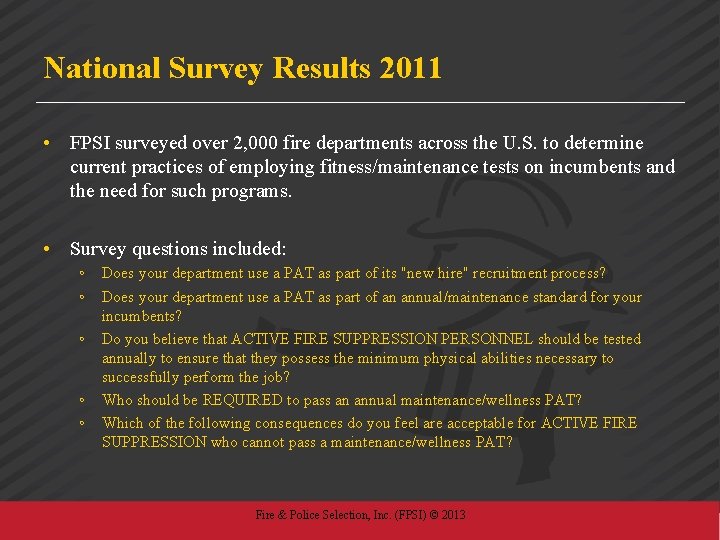
National Survey Results 2011 • FPSI surveyed over 2, 000 fire departments across the U. S. to determine current practices of employing fitness/maintenance tests on incumbents and the need for such programs. • Survey questions included: ◦ ◦ ◦ Does your department use a PAT as part of its "new hire" recruitment process? Does your department use a PAT as part of an annual/maintenance standard for your incumbents? Do you believe that ACTIVE FIRE SUPPRESSION PERSONNEL should be tested annually to ensure that they possess the minimum physical abilities necessary to successfully perform the job? Who should be REQUIRED to pass an annual maintenance/wellness PAT? Which of the following consequences do you feel are acceptable for ACTIVE FIRE SUPPRESSION who cannot pass a maintenance/wellness PAT? Fire & Police Selection, Inc. (FPSI) © 2013
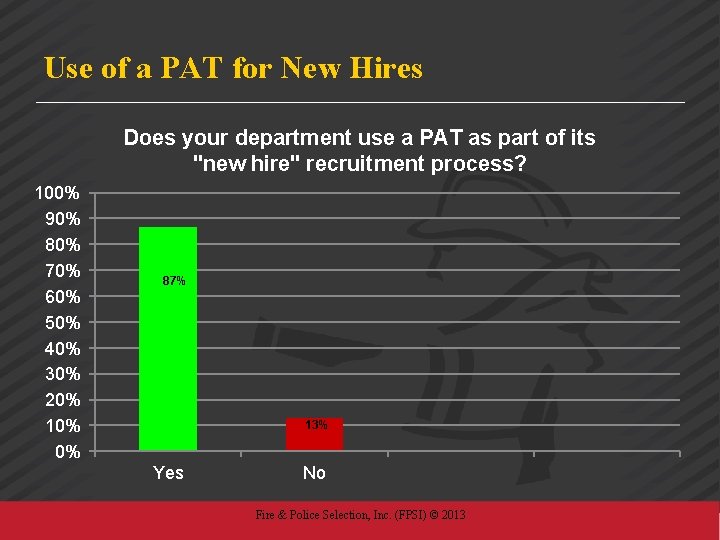
Use of a PAT for New Hires Does your department use a PAT as part of its "new hire" recruitment process? 100% 90% 80% 70% 60% 50% 40% 30% 20% 10% 0% 87% 13% Yes No Fire & Police Selection, Inc. (FPSI) © 2013
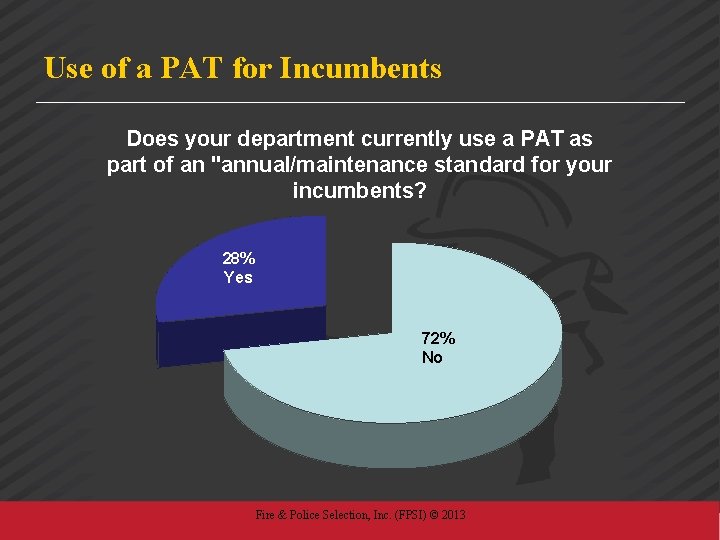
Use of a PAT for Incumbents Does your department currently use a PAT as part of an "annual/maintenance standard for your incumbents? 28% Yes 72% No Fire & Police Selection, Inc. (FPSI) © 2013
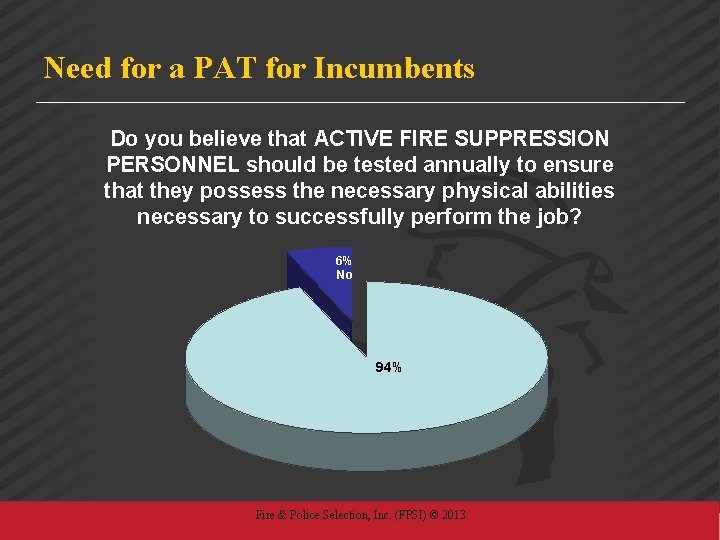
Need for a PAT for Incumbents Do you believe that ACTIVE FIRE SUPPRESSION PERSONNEL should be tested annually to ensure that they possess the necessary physical abilities necessary to successfully perform the job? 6% No 94% Fire & Police Selection, Inc. (FPSI) © 2013
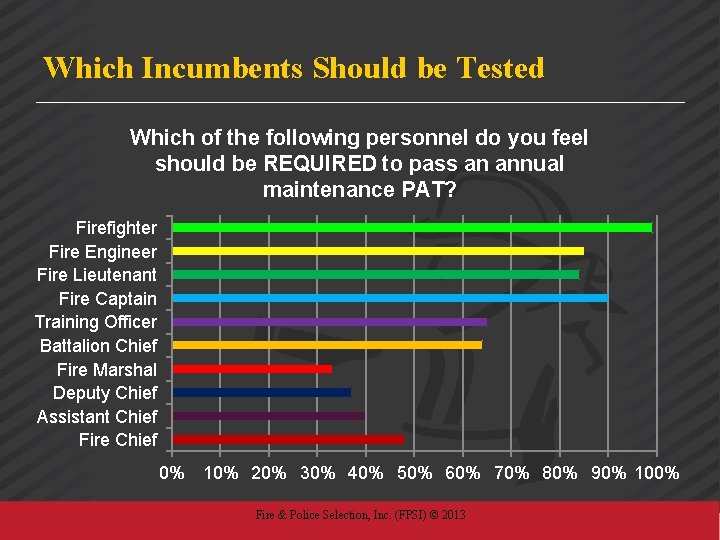
Which Incumbents Should be Tested Which of the following personnel do you feel should be REQUIRED to pass an annual maintenance PAT? Firefighter Fire Engineer Fire Lieutenant Fire Captain Training Officer Battalion Chief Fire Marshal Deputy Chief Assistant Chief Fire Chief 0% 10% 20% 30% 40% 50% 60% 70% 80% 90% 100% Fire & Police Selection, Inc. (FPSI) © 2013
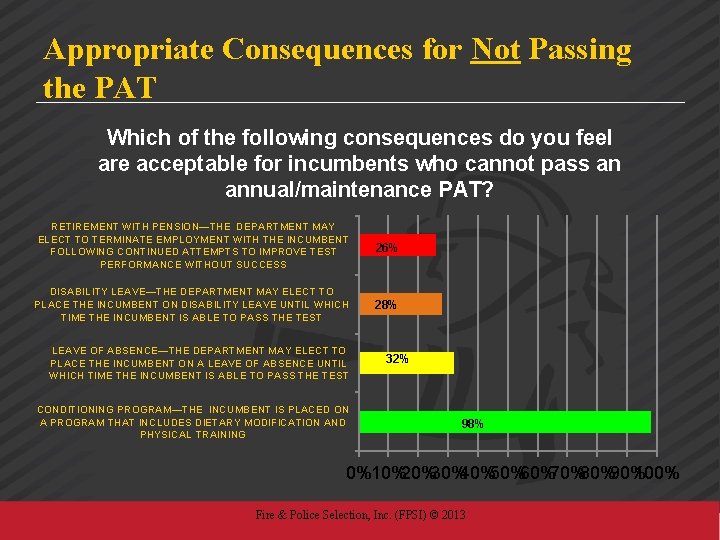
Appropriate Consequences for Not Passing the PAT Which of the following consequences do you feel are acceptable for incumbents who cannot pass an annual/maintenance PAT? RETIREMENT WITH PENSION—THE DEPARTMENT MAY ELECT TO TERMINATE EMPLOYMENT WITH THE INCUMBENT FOLLOWING CONTINUED ATTEMPTS TO IMPROVE TEST PERFORMANCE WITHOUT SUCCESS 26% DISABILITY LEAVE—THE DEPARTMENT MAY ELECT TO PLACE THE INCUMBENT ON DISABILITY LEAVE UNTIL WHICH TIME THE INCUMBENT IS ABLE TO PASS THE TEST 28% LEAVE OF ABSENCE—THE DEPARTMENT MAY ELECT TO PLACE THE INCUMBENT ON A LEAVE OF ABSENCE UNTIL WHICH TIME THE INCUMBENT IS ABLE TO PASS THE TEST CONDITIONING PROGRAM—THE INCUMBENT IS PLACED ON A PROGRAM THAT INCLUDES DIETARY MODIFICATION AND PHYSICAL TRAINING 32% 98% 0%10%20%30%40%50%60%70%80%90% 100% Fire & Police Selection, Inc. (FPSI) © 2013
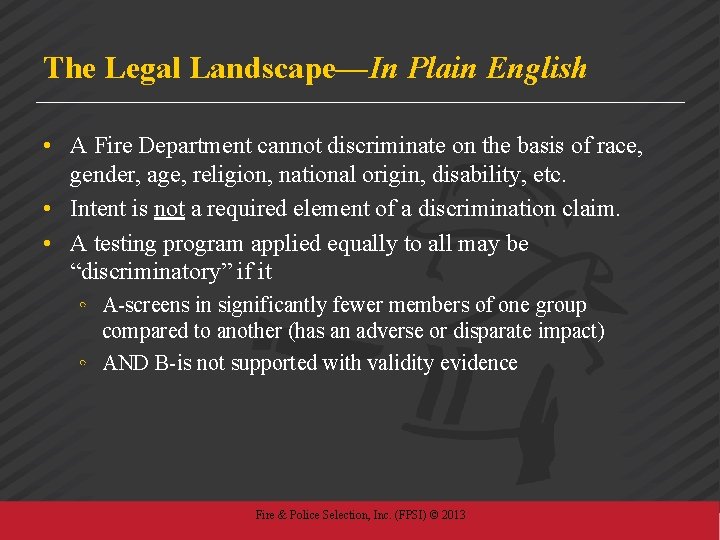
The Legal Landscape—In Plain English • A Fire Department cannot discriminate on the basis of race, gender, age, religion, national origin, disability, etc. • Intent is not a required element of a discrimination claim. • A testing program applied equally to all may be “discriminatory” if it ◦ A-screens in significantly fewer members of one group compared to another (has an adverse or disparate impact) ◦ AND B-is not supported with validity evidence Fire & Police Selection, Inc. (FPSI) © 2013
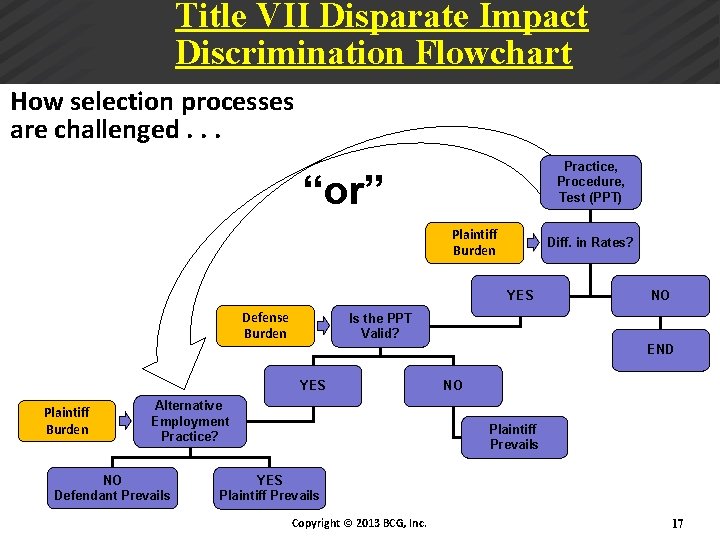
Title VII Disparate Impact Discrimination Flowchart How selection processes are challenged. . . Practice, Procedure, Test (PPT) “or” Plaintiff Burden Diff. in Rates? YES Defense Burden NO Is the PPT Valid? END YES Plaintiff Burden Alternative Employment Practice? NO Defendant Prevails NO Plaintiff Prevails YES Plaintiff Prevails Copyright © 2013 BCG, Inc. 17
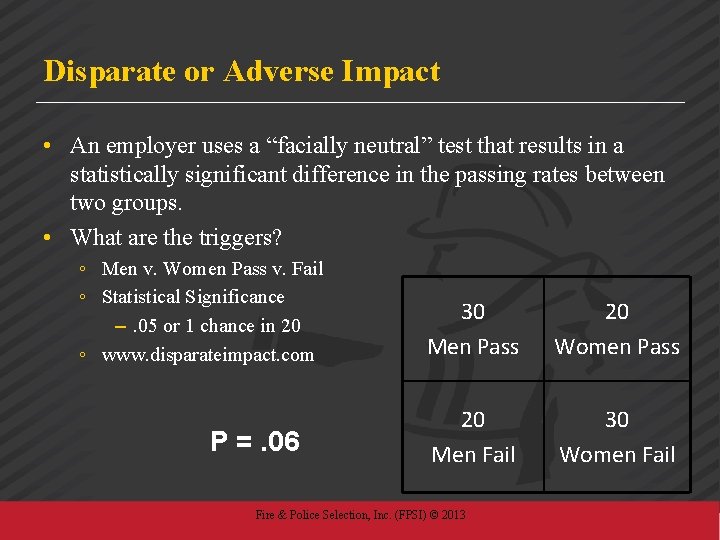
Disparate or Adverse Impact • An employer uses a “facially neutral” test that results in a statistically significant difference in the passing rates between two groups. • What are the triggers? ◦ Men v. Women Pass v. Fail ◦ Statistical Significance –. 05 or 1 chance in 20 ◦ www. disparateimpact. com P =. 06 30 Men Pass 20 Women Pass 20 Men Fail 30 Women Fail Fire & Police Selection, Inc. (FPSI) © 2013
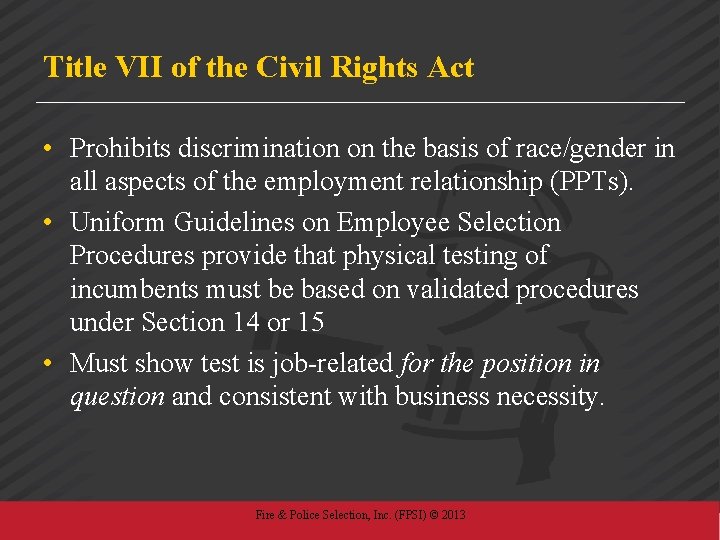
Title VII of the Civil Rights Act • Prohibits discrimination on the basis of race/gender in all aspects of the employment relationship (PPTs). • Uniform Guidelines on Employee Selection Procedures provide that physical testing of incumbents must be based on validated procedures under Section 14 or 15 • Must show test is job-related for the position in question and consistent with business necessity. Fire & Police Selection, Inc. (FPSI) © 2013
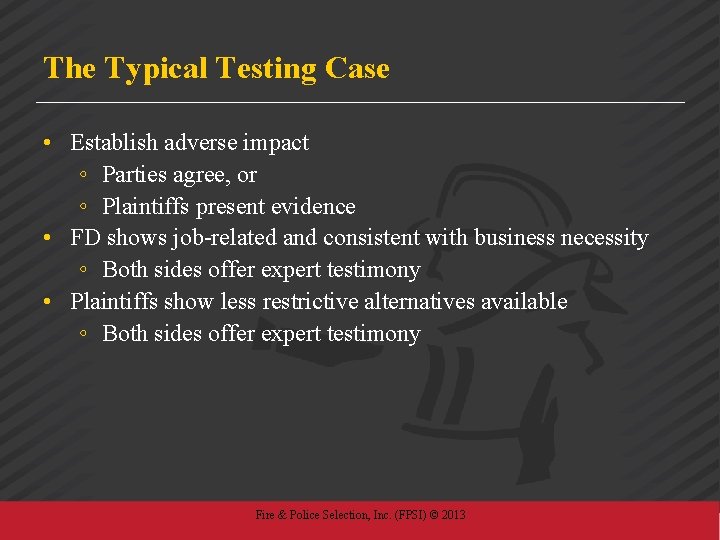
The Typical Testing Case • Establish adverse impact ◦ Parties agree, or ◦ Plaintiffs present evidence • FD shows job-related and consistent with business necessity ◦ Both sides offer expert testimony • Plaintiffs show less restrictive alternatives available ◦ Both sides offer expert testimony Fire & Police Selection, Inc. (FPSI) © 2013
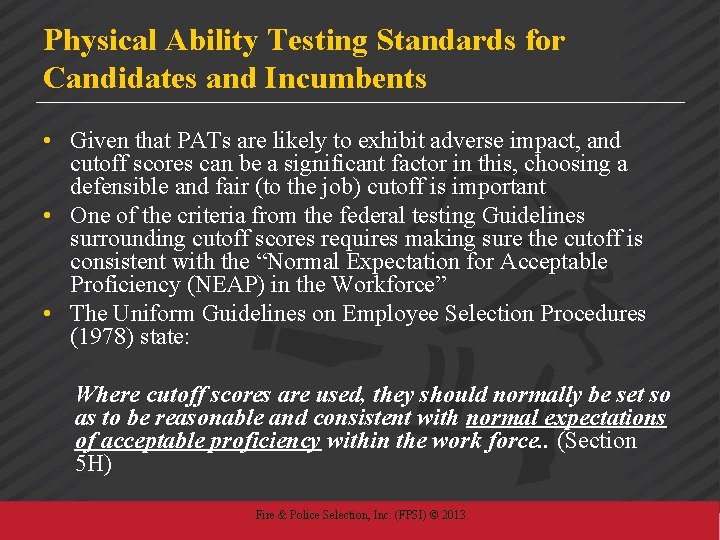
Physical Ability Testing Standards for Candidates and Incumbents • Given that PATs are likely to exhibit adverse impact, and cutoff scores can be a significant factor in this, choosing a defensible and fair (to the job) cutoff is important • One of the criteria from the federal testing Guidelines surrounding cutoff scores requires making sure the cutoff is consistent with the “Normal Expectation for Acceptable Proficiency (NEAP) in the Workforce” • The Uniform Guidelines on Employee Selection Procedures (1978) state: Where cutoff scores are used, they should normally be set so as to be reasonable and consistent with normal expectations of acceptable proficiency within the work force. . (Section 5 H) Fire & Police Selection, Inc. (FPSI) © 2013
Physical Ability Testing Standards for Candidates and Incumbents • Wait a minute… if we’re going to set a cutoff score, can’t we just use the average? • No… for (at least) five good reasons… • (1) Such an approach would assume that about one-half of the workforce (i. e. , those that scored below the average) are inadequate performers. • (2) Possible skill advantage of the incumbent workforce. • (3) Influential outliers • (4) Sampling error • (5) Test unreliability Fire & Police Selection, Inc. (FPSI) © 2013
Physical Ability Testing Standards for Candidates and Incumbents • There a six steps necessary to calculate cutoff scores for the candidate and incumbent PAT: ◦ Step 1: Run a representative sample of incumbents through the PAT and record their times ◦ Step 2: Adjust for the gap between incumbents and applicants ◦ Step 3: Remove outliers from the dataset ◦ Step 4: Correct for sampling error (using the SE Mean) ◦ Step 5: Account for test reliability (using the SE Measurement & SE Diff) ◦ Step 6: Combine the computation values for candidates and incumbents – For candidates, use the Trimmed Mean + (Trimmed Mean * 5. 56%) + (SE Mean * FPC) + (SED * 1. 96) – For incumbents, use the Trimmed Mean + (SE Mean * FPC)+ (SED * 1. 96) • The outcome is the “normal expectations of acceptable proficiency in the workforce” Fire & Police Selection, Inc. (FPSI) © 2013
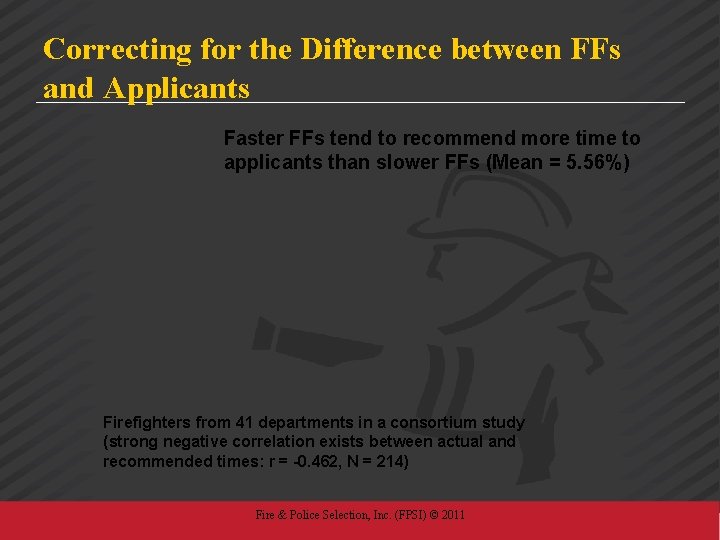
Correcting for the Difference between FFs and Applicants Faster FFs tend to recommend more time to applicants than slower FFs (Mean = 5. 56%) Firefighters from 41 departments in a consortium study (strong negative correlation exists between actual and recommended times: r = -0. 462, N = 214) Fire & Police Selection, Inc. (FPSI) © 2011
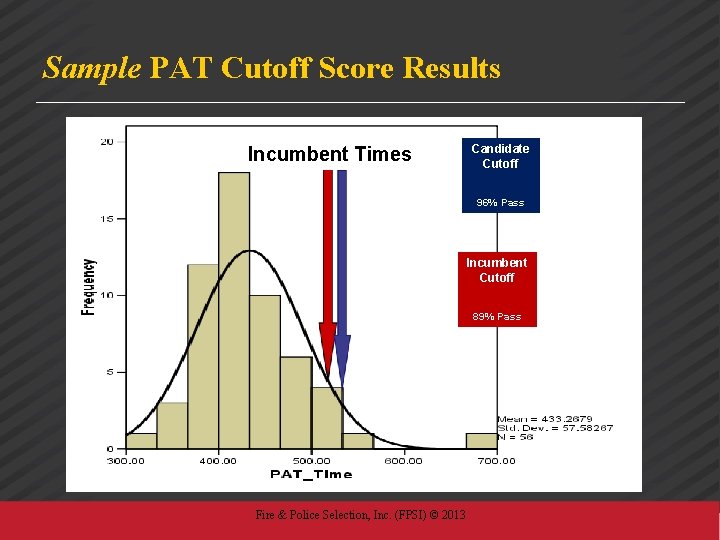
Sample PAT Cutoff Score Results Candidate Cutoff Incumbent Times 96% Pass Mean = 423. 15 SEM = 23. 69 Incumbent Cutoff SED = 33. 50 14. 6% “Remediate” 89% Pass Fire & Police Selection, Inc. (FPSI) © 2013
Remediate Status of Incumbents • FFs who clearly fall outside of the minimum proficiency levels relating to physical ability expectations (i. e. , 95% confidence interval that these scores are reliably different from the average) should be required to improve their abilities through possible dietary changes, weight-loss programs, and/or physical fitness programs. • These incumbents fall into a “remediate” category and are asked to retake the test after 10 -16 week training program. The 10 -16 week training program should consist of both cardio-vascular and strength training in the specific, fire suppression-related work behaviors that are measured by the test. • Departments can choose whether they want the training program to be self directed or conducted by a department-designated exercise specialist. Fire & Police Selection, Inc. (FPSI) © 2013
Remediate Status of Incumbents • If the incumbent fails the 2 nd (or 3 rd) retest opportunity after the 10 -16 week remediation process, any of the following four possible consequences can be considered: ◦ Conditioning program—The incumbent is placed on a program that include dietary modification and physical training. ◦ Leave of absence—The department may elect to place the incumbent on a leave of absence until which time the incumbent is able to pass the test. ◦ Disability leave—The department may elect to place the incumbent on disability leave until which time the incumbent is able to pass the test. ◦ Retirement with pension—The department may elect to terminate employment with the incumbent following continued attempts to improve test performance without success. Fire & Police Selection, Inc. (FPSI) © 2013
The Effect of Age on Test Performance • Data from a study consisting of 256 incumbent fire suppression personnel (mean age = 34. 83 years) resulted in a correlation of. 397*** when the age of the incumbent was correlated to test time. • Data from a study consisting of 710 firefighter applicants (mean age = 29. 47 years) resulted in a correlation of. 149*** when the age of the firefighter applicant was correlated to test time. • While age was statistically correlated with physical ability test performance in both the incumbent and the applicant study, there a number of other factors likely contributing to the correlation: – The motivation level of the applicants vs. the incumbents – The physical fitness level of the applicants vs. the incumbents Fire & Police Selection, Inc. (FPSI) © 2013
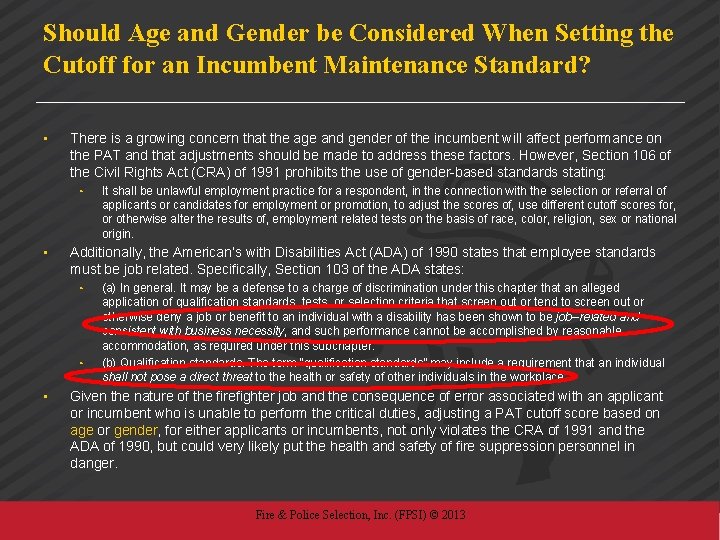
Should Age and Gender be Considered When Setting the Cutoff for an Incumbent Maintenance Standard? • There is a growing concern that the age and gender of the incumbent will affect performance on the PAT and that adjustments should be made to address these factors. However, Section 106 of the Civil Rights Act (CRA) of 1991 prohibits the use of gender-based standards stating: ◦ • Additionally, the American’s with Disabilities Act (ADA) of 1990 states that employee standards must be job related. Specifically, Section 103 of the ADA states: ◦ ◦ • It shall be unlawful employment practice for a respondent, in the connection with the selection or referral of applicants or candidates for employment or promotion, to adjust the scores of, use different cutoff scores for, or otherwise alter the results of, employment related tests on the basis of race, color, religion, sex or national origin. (a) In general. It may be a defense to a charge of discrimination under this chapter that an alleged application of qualification standards, tests, or selection criteria that screen out or tend to screen out or otherwise deny a job or benefit to an individual with a disability has been shown to be job related and consistent with business necessity, and such performance cannot be accomplished by reasonable accommodation, as required under this subchapter. (b) Qualification standards. The term “qualification standards” may include a requirement that an individual shall not pose a direct threat to the health or safety of other individuals in the workplace. Given the nature of the firefighter job and the consequence of error associated with an applicant or incumbent who is unable to perform the critical duties, adjusting a PAT cutoff score based on age or gender, for either applicants or incumbents, not only violates the CRA of 1991 and the ADA of 1990, but could very likely put the health and safety of fire suppression personnel in danger. Fire & Police Selection, Inc. (FPSI) © 2013
Importance of “Maintenance/Wellness” Testing of Incumbents • Ensuring Safety of the Crew ◦ Nearly 50% of all injuries to civilian firefighters in 2002 were a result of sprains, strains, and muscular pain—whereby overexertion is considered the primary causative factor. (NFPA) ◦ Nearly 50% of firefighter fatalities are heart attacks and about half of those who died had heart-related issues. (NFPA) ◦ “Overweight, out-of-shape fire fighters are an accident waiting to happen. ” (NFPA, 2000) • Ensuring Safety of the Public • Reduce Worker Compensation Claims ◦ The estimated total annual cost of firefighter injuries is between $2. 8 - $7. 8 billion. (NIST, 2005) Fire & Police Selection, Inc. (FPSI) © 2013
Contact Information Phone: 888 -990 -3473 Email: stacy@fpsi. com dan@biddle. com Website: www. FPSI. com Fire & Police Selection, Inc. (FPSI) © 2013
- Slides: 31