
www earthobservations org www gfoi org SESSION 7
www. earthobservations. org www. gfoi. org SESSION 7 Biomass SDCG-14: Ispra, 4 -6 September, 2018 SDCG-6 Oslo, Norway October 22 -24, 2014
www. earthobservations. org www. gfoi. org Draft Biomass WP Task SDCG-14: Ispra, 4 -6 September, 2018 SDCG-6 Oslo, Norway October 22 -24, 2014
Above Ground Biomass Products • Cited as priority from GFOI Leads in response to CEOS • Explosion of capable missions ahead – L-band SAR – New SAR bands, S- & P– Lidar instruments • Substantial technical activity underway in WGCV LPV on Biomass protocol • Draft SDCG WP task crafted to address opportunities 3
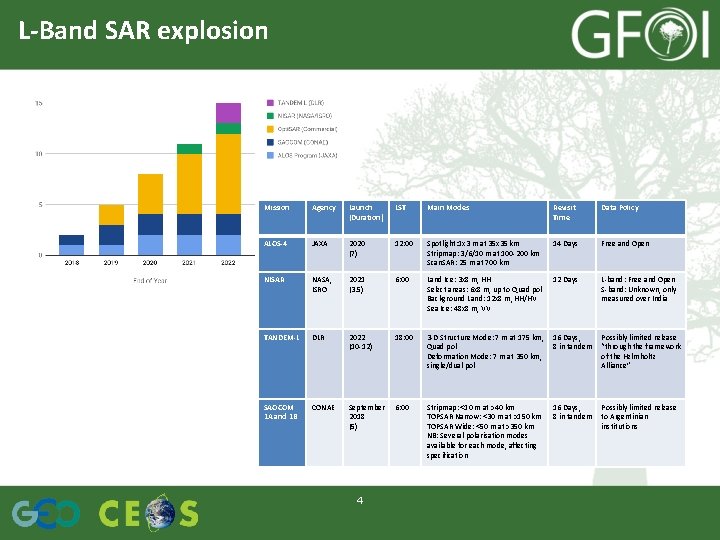
L-Band SAR explosion Mission Agency Launch (Duration) LST Main Modes Revisit Time Data Policy ALOS-4 JAXA 2020 (7) 12: 00 Spotlight: 1 x 3 m at 35 x 35 km Stripmap: 3/6/10 m at 100 -200 km Scan. SAR: 25 m at 700 km 14 Days Free and Open NISAR NASA, ISRO 2021 (3. 5) 6: 00 Land Ice: 3 x 8 m, HH Select areas: 6 x 8 m, up to Quad pol Background Land: 12 x 8 m, HH/HV Sea Ice: 48 x 8 m, VV 12 Days L-band: Free and Open S-band: Unknown, only measured over India TANDEM-L DLR 2022 (10 -12) 18: 00 3 -D Structure Mode: 7 m at 175 km, 16 Days, Quad pol 8 in tandem Deformation Mode: 7 m at 350 km, single/dual pol Possibly limited release “through the framework of the Helmholtz Alliance” SAOCOM 1 A and 1 B CONAE September 2018 (5) 6: 00 Stripmap: <10 m at >40 km TOPSAR Narrow: <30 m at >150 km TOPSAR Wide: <50 m at >350 km NB: Several polarisation modes available for each mode, affecting specification Possibly limited release to Argentinian institutions 4 16 Days, 8 in tandem
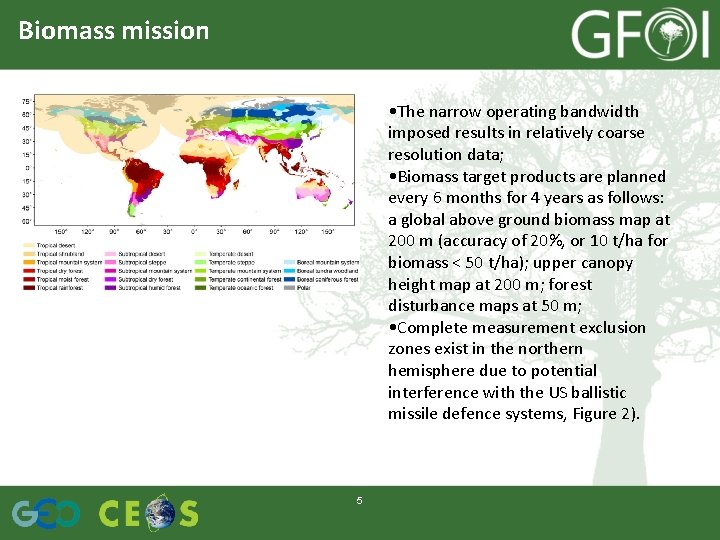
Biomass mission • The narrow operating bandwidth imposed results in relatively coarse resolution data; • Biomass target products are planned every 6 months for 4 years as follows: a global above ground biomass map at 200 m (accuracy of 20%, or 10 t/ha for biomass < 50 t/ha); upper canopy height map at 200 m; forest disturbance maps at 50 m; • Complete measurement exclusion zones exist in the northern hemisphere due to potential interference with the US ballistic missile defence systems, Figure 2). 5
Lidars • Cited as priority from GFOI Leads in response to CEOS • Explosion of capable missions ahead – L-band SAR – New SAR bands, S- & P– Lidar instruments • Substantial technical activity underway in WGCV LPV on Biomass protocol • Draft SDCG WP task crafted to address opportunities 6
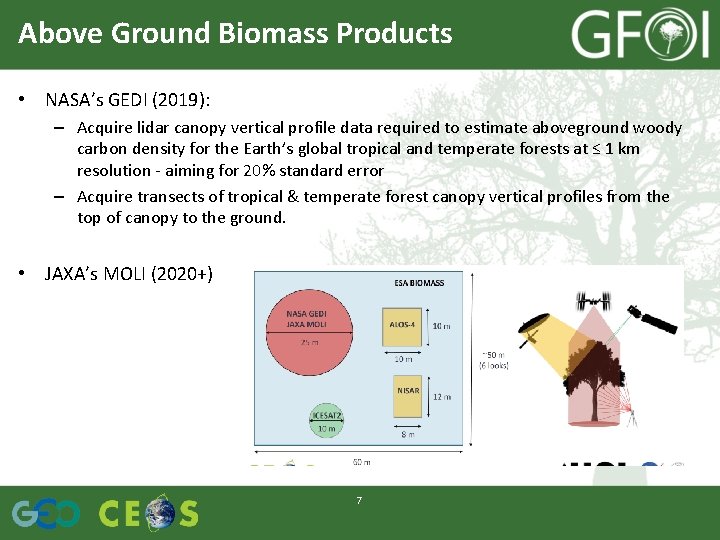
Above Ground Biomass Products • NASA’s GEDI (2019): – Acquire lidar canopy vertical profile data required to estimate aboveground woody carbon density for the Earth’s global tropical and temperate forests at ≤ 1 km resolution - aiming for 20% standard error – Acquire transects of tropical & temperate forest canopy vertical profiles from the top of canopy to the ground. • JAXA’s MOLI (2020+) 7
Proposed Work Plan thread • From 2018, inclusion of biomass measurements from space in the definition and maintenance of the baseline global acquisition strategy for GFOI. – explain the anticipated supply of relevant observations and their evolution over time; – characterise the accuracy and policy-relevance of the observations so that user community expectations are well managed; – provide a framework for coordination of improvements in accuracy and policy-relevance - driven by needs of the GFOI community; – identify R&D topics to be addressed in support of these goals and coordinate their execution. This work will be undertaken in close cooperation with the WGCV LPV Biomass protocol activity. • Provide a critical mass of space agency effort (in coordination with WGCV/LPV) on the key questions – Note the ISSI Workshop outcomes – The existing CEOS GFOI effort is a logical home and focus for this new activity 8
ISSI Workshop Nov 2017 • Key points 1. Carbon stocks are important but the critical information is in the change (loss and gain). While each mission provides data that may be used to determine the net balance between disturbance and subsequent regrowth, approaches and algorithms should be developed that facilitate fusion of these data across missions to determine contemporaneous changes in biomass. 2. Vertical and horizontal structure parameters derived from EO products have great potential to support the estimation of biomass but also to be used in an ecosystem modeling context (e. g. to determine the disturbance history of a forest). Agencies shall support the development of such products. 3. To support the joint exploitation of data products from different missions and to develop synergistic products mission teams shall agree on a common standard of formats, notations and units. 4. The collection of ground plot and lidar data shall be coordinated across different missions. The CEOS LPV cal/val group on biomass could take the responsibility of coordination. 5. To support a common framework for product validation, it is recommended to establish supersites. Forest ecologists made a proposal on the characteristics of such sites for tropical biomes. This need to be iterated with the mission teams and the CEOS LPV cal/val group for biomass. Data from supersites should be made available to benchmark forest models, understand their uncertainties and biases before undertaking computationally expensive global simulations. 6. There is a need to clarify how different user requirements translate to specifications for multi-mission biomass estimation and validation, and mechanisms for uptake of the data and products. The Global Forest Observations Initiative (GFOI) along with the CEOS LPV cal/val group could coordinate such an effort. 9
ISSI Workshop Nov 2017 • Recommendations to space agencies – Recommendation 1: To support the uptake of data by the user and science communities data has to be free and open. This should include full transparency of the algorithms used to derive Level-1, Level-2, and higher level products, which should be available as open source code. – Recommendation 2: There is an immense potential in synergistic products using data from different missions (enhancing the information content and reducing the uncertainty of products). Agencies shall support the development of such synergistic products with dedicated studies. – Recommendation 3: To support the joint exploitation of data products from different missions and to develop synergistic products common platforms for data exploitation are needed. Data access needs to be implemented in a way to allow efficient processing of different sensor data in a joint algorithm. These platforms shall also provide access to auxiliary data, training and validation data and computing resources. – Recommendation 4: To fully exploit the available sensor capability the SAOCOM, ALOS and MOLI missions shall be integrated in a joint exploitation framework with CONAE and JAXA. 10
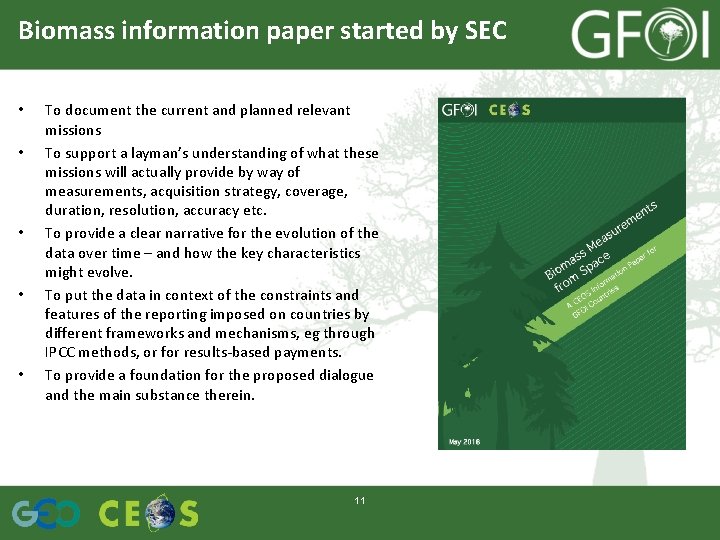
Biomass information paper started by SEC • • • To document the current and planned relevant missions To support a layman’s understanding of what these missions will actually provide by way of measurements, acquisition strategy, coverage, duration, resolution, accuracy etc. To provide a clear narrative for the evolution of the data over time – and how the key characteristics might evolve. To put the data in context of the constraints and features of the reporting imposed on countries by different frameworks and mechanisms, eg through IPCC methods, or for results-based payments. To provide a foundation for the proposed dialogue and the main substance therein. 11
Discussion (for end of session) • On an SDCG Biomass work plan thread • On the paper and contributions • On how we evolve the coordination efforts and establish critical mass 12
- Slides: 12