
www chronicpoverty org www gprg org Measuring and
- Slides: 15
www. chronicpoverty. org www. gprg. org Measuring and Understanding Chronic Poverty: Beyond Monetary Measures International Poverty Centre, Brasilia, 29 -31 August 2005 David Hulme, University of Manchester Andy Mc. Kay, University of Bath
What is chronic poverty? “Chronic poverty is that poverty that is ever present and never ceases. It is like the rains of the grasshopper season that beat you consistently and for a very long time. You become completely soaked because you have no way out. … … Some poverty passes from one generation to another, as if the offspring sucks it from the mother’s breast. They in turn pass it on to their children. ” - Group of disabled women in Nkokonjeru Providence Home, Mukono, Uganda (source: Lwanga-Ntale 2003).
Overview Importance of chronic poverty as an issue – analysis and policy Existing empirical work largely based on monetary measures Need for chronic poverty and poverty dynamic research to utilise recent conceptual and methodological developments
Limitations of conventional approaches (1) Conventional approach based on monetary measures and panel data Limitations of monetary indicators Means not ends Household versus individual Fluctuations over time Measurement error
Limitations (2) Also limits of panel data Measurement error Attrition and difficulty in matching Small # waves and short time horizons Difficulty of using non-monetary indicators Anyway we often do not have panel data
Limitations (3) Limitation of purely quantitative approach Focus on correlates Lack of information on processes Scope for combined qual-quant work
What are the alternatives (1)? Asset based approaches Less volatile more persistence than income Importance of assets: livelihoods plus framework Assets also important for security Help distinguish stochastic and structural poverty (Carter and associates) Still income based Livelihoods Approaches and the problem of social capital: Often narrow range of assets in empirical work
Alternatives? (2) Needs/human development Different variants Various advantages Focus on ultimate ends Multidimensional Material and non-material Lots of conceptual development: how to implement in practice?
Alternatives? (3) Issues Universal or local? Paternalistic or participatory? Which indicators, how to score, whether to combine and how? • These alternatives can enable broader understanding • In both assets and human development cases qualitative component still needed, to explore processes.
Possible examples Klasen’s deprivation measure Clark and Qizilbash on core poverty Barrientos’s wellbeing indicators In each case not specific to chronic poverty – but scope for adoption Illustrate with Klasen on South Africa
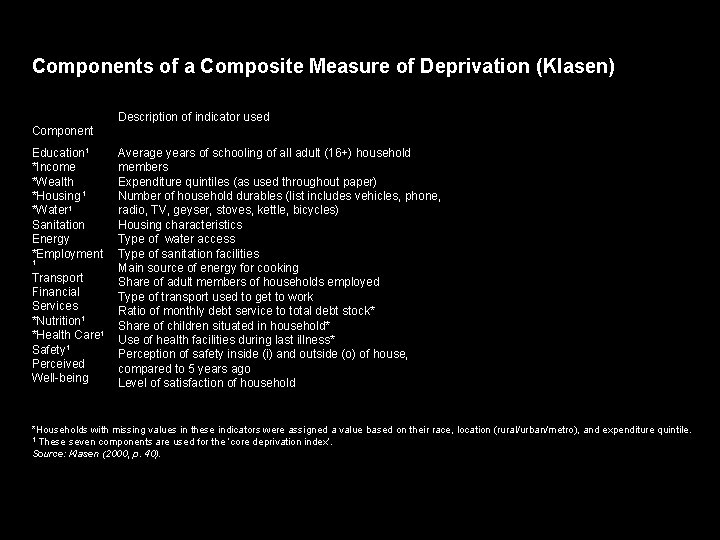
Components of a Composite Measure of Deprivation (Klasen) Description of indicator used Component Education 1 *Income *Wealth *Housing 1 *Water 1 Sanitation Energy *Employment 1 Transport Financial Services *Nutrition 1 *Health Care 1 Safety 1 Perceived Well-being Average years of schooling of all adult (16+) household members Expenditure quintiles (as used throughout paper) Number of household durables (list includes vehicles, phone, radio, TV, geyser, stoves, kettle, bicycles) Housing characteristics Type of water access Type of sanitation facilities Main source of energy for cooking Share of adult members of households employed Type of transport used to get to work Ratio of monthly debt service to total debt stock* Share of children situated in household* Use of health facilities during last illness* Perception of safety inside (i) and outside (o) of house, compared to 5 years ago Level of satisfaction of household *Households with missing values in these indicators were assigned a value based on their race, location (rural/urban/metro), and expenditure quintile. 1 These seven components are used for the ‘core deprivation index’. Source: Klasen (2000, p. 40).
Possible examples (2) Several components not strongly associated with chronic poverty if observed only once Core deprivation measure more strongly related to chronic poverty – but some components still highly dynamic Scope for use with panel data
Summary (1) Chronic poverty of key importance, but need to think about it more broadly Beyond income and panel data Stronger integration of qual and quant Wider range of quantitative indicators But also collecting a wider range of data
Summary (2) Asset approaches are one way forward – but, poverty is still assessed in monetary terms Applying needs and human development approaches should be prioritised – several routes Utilise the specific examples reviewed in the paper Develop a Common Capabilities Index (CCI) – health, nutrition, education Develop a Household Human Development Index (HHDI) – life expectancy, education/literacy and income Use a set of key measures and do not aggregate – don’t give policymakers what they want
Summary (3) Progress in moving beyond monetary measures still faces two foundational difficulties Conceptual/ideological – social relations and the ‘poverty measurement blues’ Who decides what poverty is? ‘Theorist vs theorist’ or ‘theorists vs poor people’