
www chemzblog wordpress com Zaid Mansuri 9824662116 CHAPTER
www. chemzblog. wordpress. com. . . Zaid Mansuri 9824662116 CHAPTER 3 PERIODIC CLASSIFICATION 1
EARLIER ATTEMPTS OF CLASSIFICATION OF ELEMENTS 2 1. Doberenier’s Triads 2. Newland’s Law of Octaves 3. Mendeleev’s Periodic Table 4. Long form of Periodic Table www. chemzblog. wordpress. com. . . Zaid Mansuri 9824662116
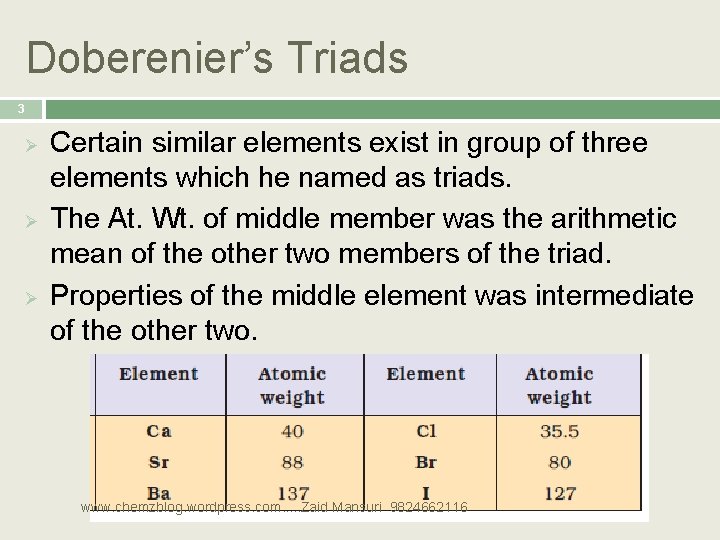
Doberenier’s Triads 3 Ø Ø Ø Certain similar elements exist in group of three elements which he named as triads. The At. Wt. of middle member was the arithmetic mean of the other two members of the triad. Properties of the middle element was intermediate of the other two. www. chemzblog. wordpress. com. . . Zaid Mansuri 9824662116
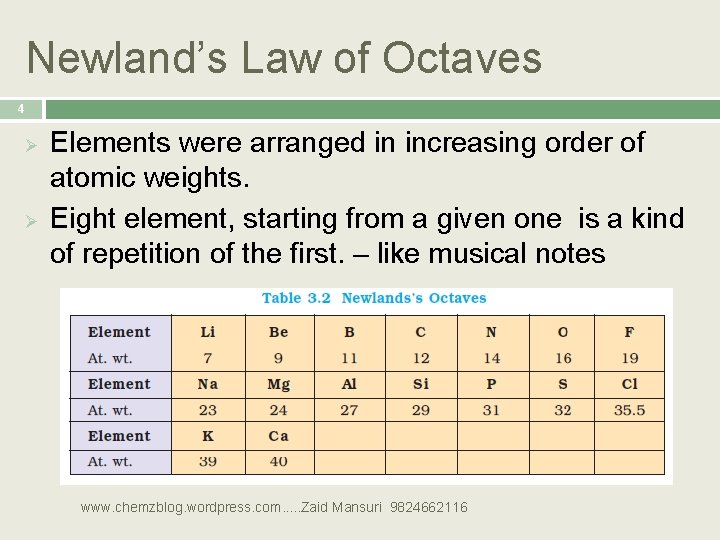
Newland’s Law of Octaves 4 Ø Ø Elements were arranged in increasing order of atomic weights. Eight element, starting from a given one is a kind of repetition of the first. – like musical notes www. chemzblog. wordpress. com. . . Zaid Mansuri 9824662116
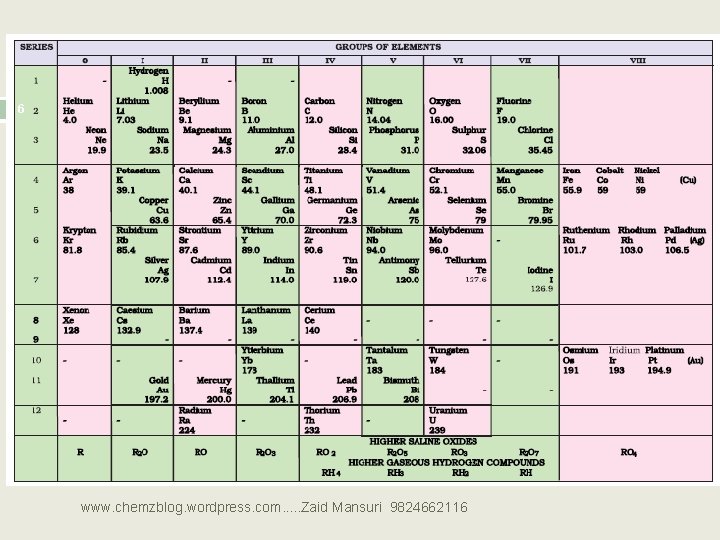
Mendeleev’s Periodic Table 5 Ø Ø “The properties of elements are a periodic function of their atomic weights”. Main criterion of the judgment of similarities in the properties was valency of the elements. www. chemzblog. wordpress. com. . . Zaid Mansuri 9824662116
6 www. chemzblog. wordpress. com. . . Zaid Mansuri 9824662116
Modern Periodic Law 7 The physical & chemical properties of the elements are the periodic function of their atomic numbers. Cause of Periodicity: Ø The periodic repetition is due to the recurrence of similar valence shell configurations after certain regular intervals. Ø www. chemzblog. wordpress. com. . . Zaid Mansuri 9824662116
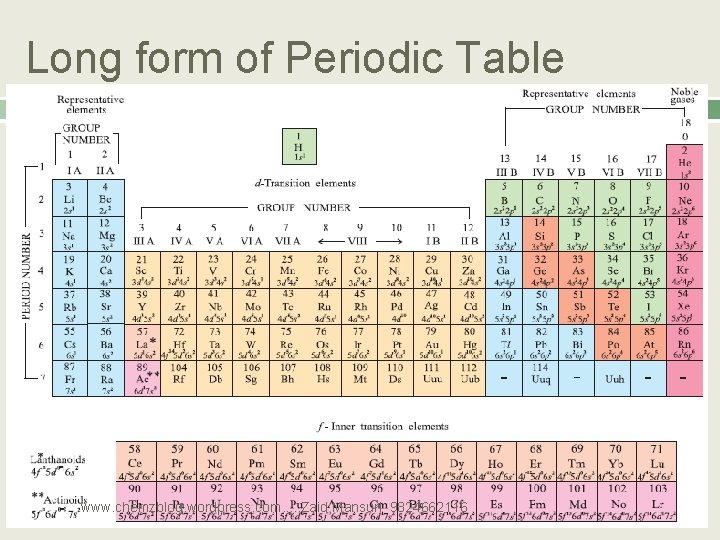
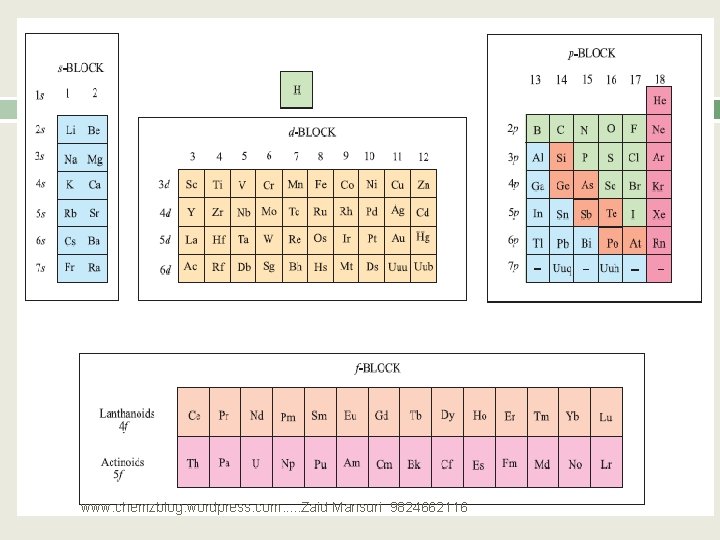
Long form of Periodic Table 8 www. chemzblog. wordpress. com. . . Zaid Mansuri 9824662116
9 www. chemzblog. wordpress. com. . . Zaid Mansuri 9824662116
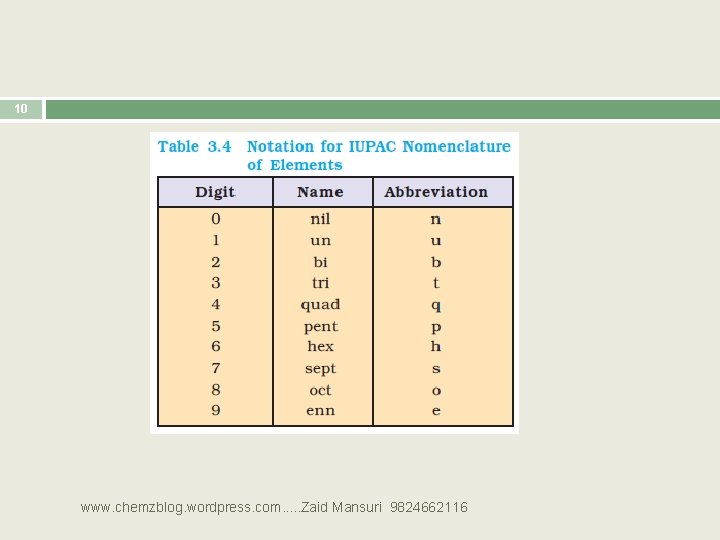
10 www. chemzblog. wordpress. com. . . Zaid Mansuri 9824662116
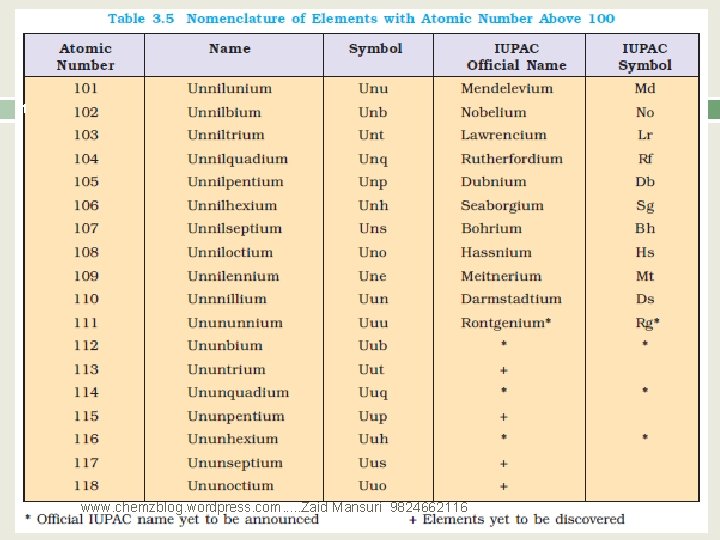
11 www. chemzblog. wordpress. com. . . Zaid Mansuri 9824662116
About Periodic table 12 No. of periods: 7 No. of Groups: 18 No. of periods represents the highest principal quantum number (n) of the elements present in it. First Period: n=1…. . (1 s) two elements (h & He) Second Period n=2…. (2 s & 2 p) eight elements (Li to Ne) Third Period n=3 …(3 s & 3 p) eight elements (Na to Ar) Fourth Period n=4 …(4 s, 3 d & 4 p) eighteen elements (K to Kr) Fifth Period n=5…(5 s, 4 d & 5 p) eighteen elements (Rb to Xe) Sixth Period n=6…(6 s, 4 f, 5 d & 6 p) thirty two elements (Cs to Rn) (Lanthanoids …Ce to Lu)…. 14 elements (4 f) Seventh Period n=7…(7 s, 5 f, 6 d, 7 p) (Actinoids…Th to Lr) www. chemzblog. wordpress. com. . . Zaid Mansuri 9824662116
About Periodic table 13 Period no. 2 & 3 are called ………. . Short Periods Period no. 4 & 5 are called ………. . Long Periods Period no. 6 is called ………………Longest Period www. chemzblog. wordpress. com. . . Zaid Mansuri 9824662116
s-block elements (ns 1 -2) 14 Also known as representative elements or main group elements “When last electron enters s-subshell, it is an s-block element. ” Gr. 1: Alkali metals, Gr. 2: Alkaline earth metals Properties of s-block elements: 1. Low IE, High e-+ve character. 2. Very reactive & hence do not occur in native state. 3. Good reducing agents www. chemzblog. wordpress. com. . . Zaid Mansuri 9824662116 Ø
p-Block elements (ns 2 np 1 -6) 15 Also known as representative elements or main group elements “The elements in which the last electron enters the p -subshell of their outermost energy level are called p-block elements” 1. Exhibit variable oxidation states 2. They form ionic as well as covalent compounds 3. They have relatively high values of IE 4. Most of them are non-metals, highly electronegative, form acidic oxides. www. chemzblog. wordpress. com. . . Zaid Mansuri 9824662116
d-Block elements [(n-1)1 -10 ns 2] 16 “The elements in which the last electron enters the dsubshell of their outermost energy level are called dblock elements” They 1. Are Hard, high Melting metals, 2. Have Variable oxidation states 3. Form coloured complexes 4. Form ionic as well as covalent compounds 5. Most of them exhibit paramagnetism, possess catalytic properties 6. Form alloys, www. chemzblog. wordpress. com. . . Zaid Mansuri 9824662116 7. Are good conductors of heat & electricity
f-Block elements [(n-2)f 1 -14(n-1)d 010 ns 2] 17 Also known as inner transition elements or ftransition elements (Lanthanoids & Actinoids) “The elements in which the last electron enters the fsubshell of their outermost energy level are called f-block elements” They 1. Show variable oxidation states 2. Have high MP, high densities 3. Form complexes, most of which are coloured 4. Most of the actinoid series are radioactive. www. chemzblog. wordpress. com. . . Zaid Mansuri 9824662116
Atomic Radius 18 “The distance from the centre of nucleus of the atom to the outermost shell of electrons. ” 1. Covalent Radius: One-half of the distance between the centres of the nuclei of two similar atoms bonded by a single covalent bond. 2. Metallic Radius: One-half of the internuclear distance between two adjacent atoms in the metallic lattice. ***The metallic radius is always larger than its www. chemzblog. wordpress. com. . . Zaid Mansuri 9824662116 covalent radius.
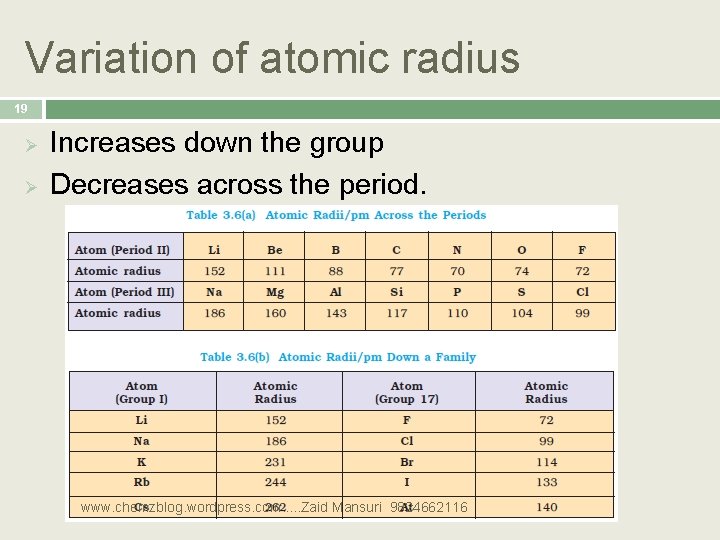
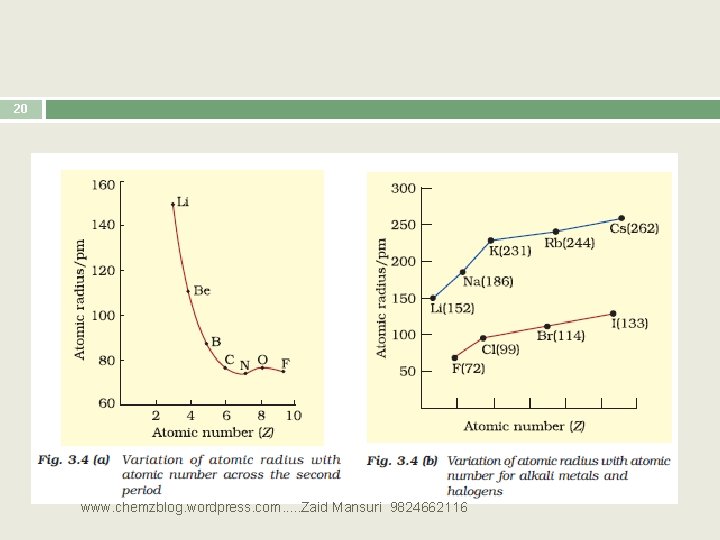
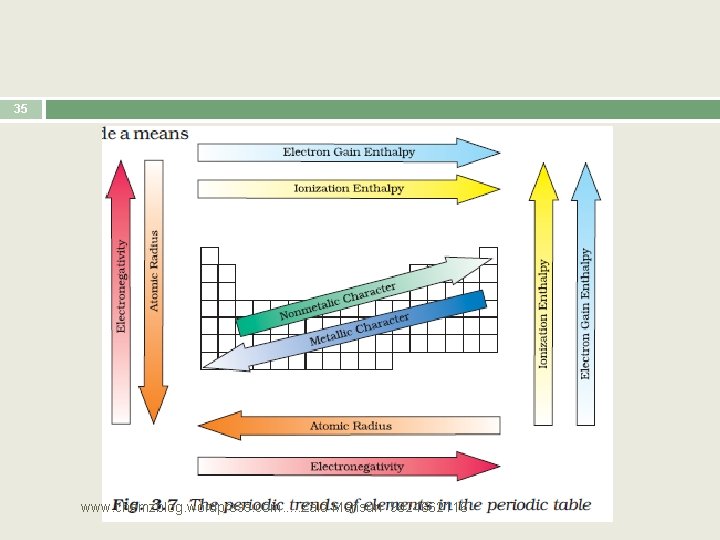
Variation of atomic radius 19 Ø Ø Increases down the group Decreases across the period. www. chemzblog. wordpress. com. . . Zaid Mansuri 9824662116
20 www. chemzblog. wordpress. com. . . Zaid Mansuri 9824662116
Ionic radius 21 “Ionic radius is defined as the effective distance from the nucleus fo the ion to the point up to which it has an influence in the ionic bond” (a) The size of cation is smaller than parent atom becoz of increase in the effective nuclear charge per electron. (b) The size of anion is greater than parent atom becoz of decrease in effective nuclear charge per electron. www. chemzblog. wordpress. com. . . Zaid Mansuri 9824662116
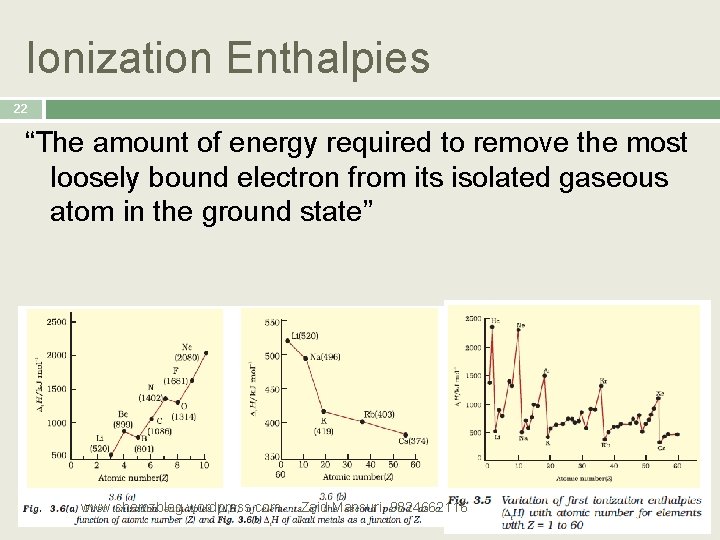
Ionization Enthalpies 22 “The amount of energy required to remove the most loosely bound electron from its isolated gaseous atom in the ground state” www. chemzblog. wordpress. com. . . Zaid Mansuri 9824662116
Ionization Enthalpy depends on… 23 1. Size of atom Ø Decreases with the increasing size of atom as the electrons are less tightly held with increasing distance 2. Magnitude of nuclear charge Ø Higher the nuclear charge, higher the IE. 3. Screening effect of the inner electrons Ø (Outermost electrons are shielded or screened by the inner electrons. This is screening effect. ) Ø IE decreases with increase in screening effect. Ø More the no. of inner electrons, greater is the screening and lower is the IE. 4. Penetration effect of the electrons: Ø Penetration effect for a given ‘n’ s>p>d>f. Ø Greater the penetration, lower the shielding by other electrons, higher the IE. 5. Electronic configuration: Ø Atom having more stable (half filled, fully filled subshells) config. has less tendency to lose e -, hence higher the IE. Ø noble gases (ns 2 np 6) Ø elements like N: [He] 2 s 22 px 12 py 12 pz 1 & P: [Ne] 3 s 23 px 13 py 13 pz 1 have half-filled stable configuration. www. chemzblog. wordpress. com. . . Zaid Mansuri 9824662116 Ø elements like Be: 1 s 22 s 2, Mg: [Ne]3 s 2 have electrons paired
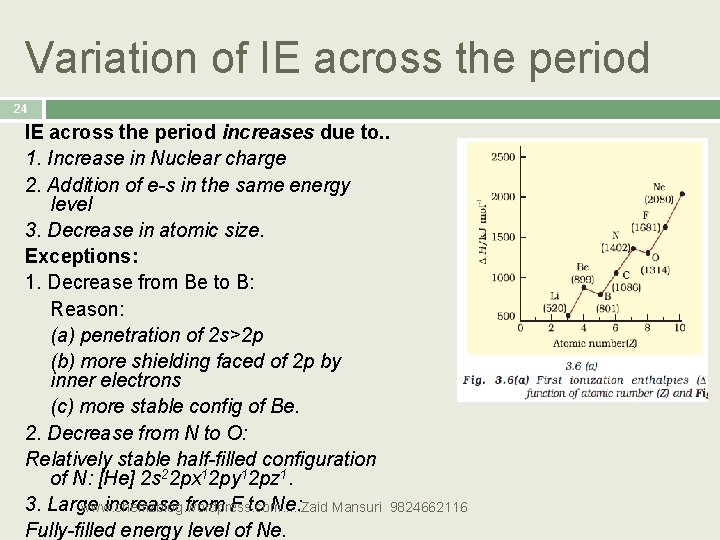
Variation of IE across the period 24 IE across the period increases due to. . 1. Increase in Nuclear charge 2. Addition of e-s in the same energy level 3. Decrease in atomic size. Exceptions: 1. Decrease from Be to B: Reason: (a) penetration of 2 s>2 p (b) more shielding faced of 2 p by inner electrons (c) more stable config of Be. 2. Decrease from N to O: Relatively stable half-filled configuration of N: [He] 2 s 22 px 12 py 12 pz 1. 3. Large increase from F to Ne: www. chemzblog. wordpress. com. . . Zaid Mansuri 9824662116 Fully-filled energy level of Ne.
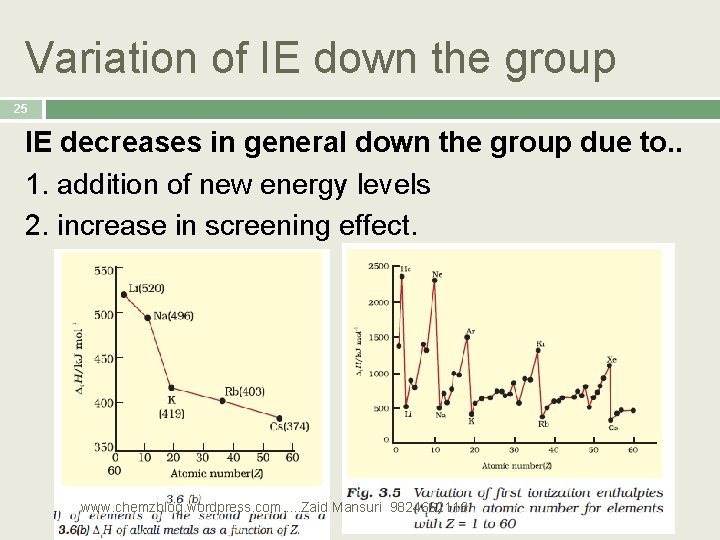
Variation of IE down the group 25 IE decreases in general down the group due to. . 1. addition of new energy levels 2. increase in screening effect. www. chemzblog. wordpress. com. . . Zaid Mansuri 9824662116
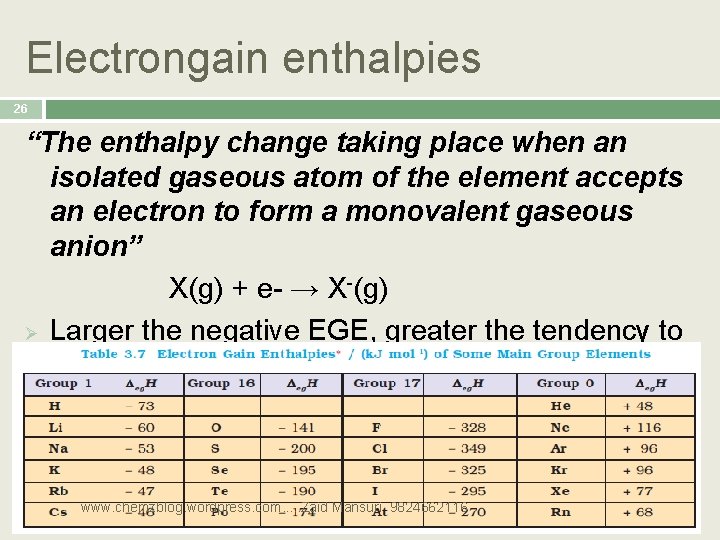
Electrongain enthalpies 26 “The enthalpy change taking place when an isolated gaseous atom of the element accepts an electron to form a monovalent gaseous anion” X(g) + e- → X-(g) Ø Larger the negative EGE, greater the tendency to accept electron. www. chemzblog. wordpress. com. . . Zaid Mansuri 9824662116
Factors affecting EGE 27 1. Nuclear charge: Greater the NC, more attraction, large –ve is the EGE 2. Atomic size: Smaller the size, higher the attraction, large –ve is the EGE 3. Electron configuration: More stable e- configuration, less tendency to accept the e-, less –ve EGE. Forwww. chemzblog. wordpress. com. . . Zaid example: Noble gases have high +ve EGE. Mansuri 9824662116
Variation of EGE across the period 28 Across the period, atomic size decreases & nuclear increases, therefore electron gain enthalpies tend to be more –ve. Ø Some irregularities… 1. in group 2 → filled ns subshells 2. in group 15 → half-filled np subshells 3. in group 18 → fully filled subshells These elec config are relatively stable & hence these have +ve or very low –ve EGEs. Ø www. chemzblog. wordpress. com. . . Zaid Mansuri 9824662116
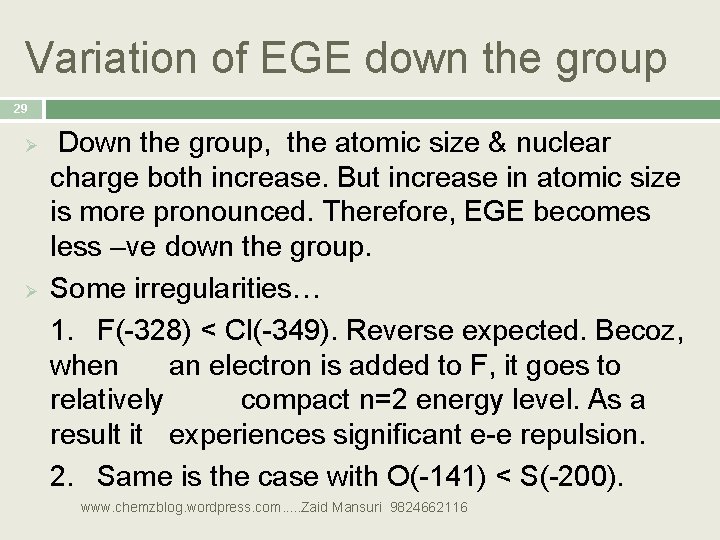
Variation of EGE down the group 29 Ø Ø Down the group, the atomic size & nuclear charge both increase. But increase in atomic size is more pronounced. Therefore, EGE becomes less –ve down the group. Some irregularities… 1. F(-328) < Cl(-349). Reverse expected. Becoz, when an electron is added to F, it goes to relatively compact n=2 energy level. As a result it experiences significant e-e repulsion. 2. Same is the case with O(-141) < S(-200). www. chemzblog. wordpress. com. . . Zaid Mansuri 9824662116

Successive EGE 30 Ø Ø Ø X(g) + e- → X-(g) ∆eg. H 1 X-(g) + e- → X-2(g) ∆eg. H 2 Always, ∆eg. H 2 is +ve. This is becoz, when e- is added to uninegative ion, it experiences significant repulsion. Hence energy has to be supplied to overcome the repulsive force to add electron. Hence values of successive EGEs are positive. For example: O(g) + e- → O-(g) ∆eg. H 1 =-141 k. J O-(g) + e- → O-2(g)Mansuri ∆ www. chemzblog. wordpress. com. . . Zaid 9824662116 eg. H 2 =+780 k. J
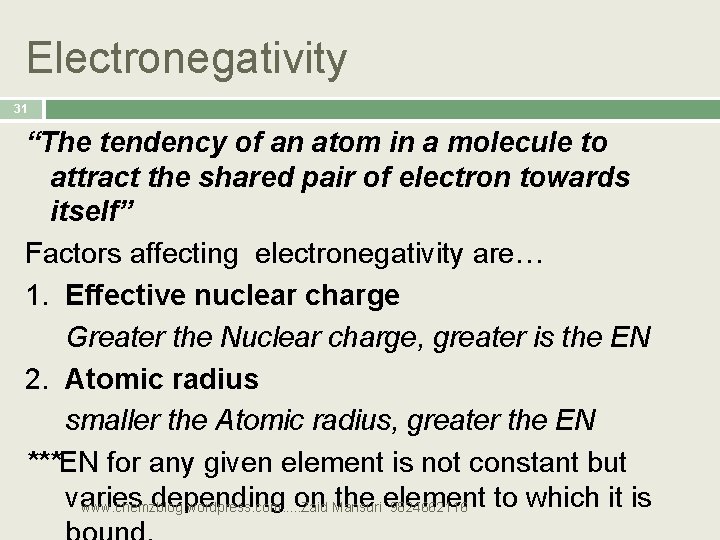
Electronegativity 31 “The tendency of an atom in a molecule to attract the shared pair of electron towards itself” Factors affecting electronegativity are… 1. Effective nuclear charge Greater the Nuclear charge, greater is the EN 2. Atomic radius smaller the Atomic radius, greater the EN ***EN for any given element is not constant but varies depending on Mansuri the element to which it is www. chemzblog. wordpress. com. . . Zaid 9824662116
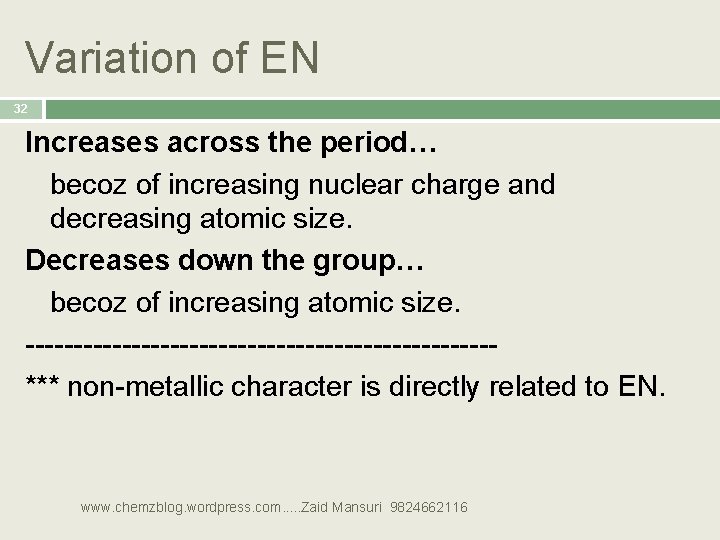
Variation of EN 32 Increases across the period… becoz of increasing nuclear charge and decreasing atomic size. Decreases down the group… becoz of increasing atomic size. ------------------------*** non-metallic character is directly related to EN. www. chemzblog. wordpress. com. . . Zaid Mansuri 9824662116
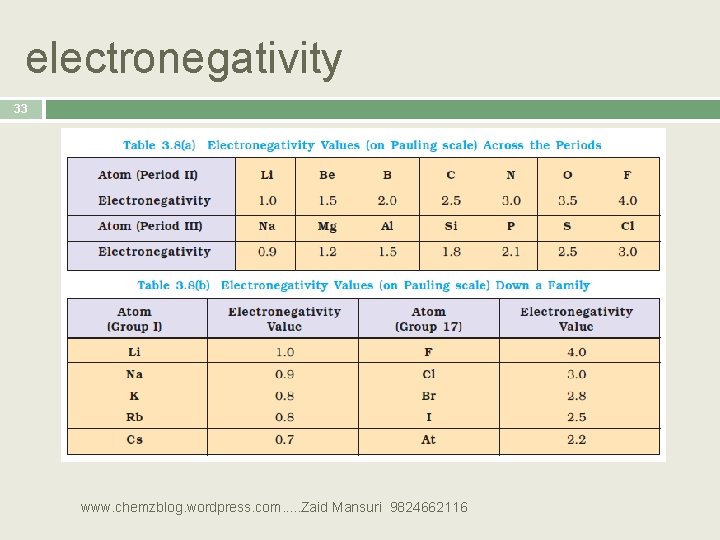
electronegativity 33 www. chemzblog. wordpress. com. . . Zaid Mansuri 9824662116
Electropositivity or metallic character 34 “ Tendency of atoms of an element to lose electrons and form +ve ions is known as Electropositivity” Ø A more electro+ve element has more metallic character. Variation of Electropositive character… Decreases across the period due to increase in IE Increases down the group due to decrease in IE Mansuri 9824662116 www. chemzblog. wordpress. com. . . Zaid
35 www. chemzblog. wordpress. com. . . Zaid Mansuri 9824662116
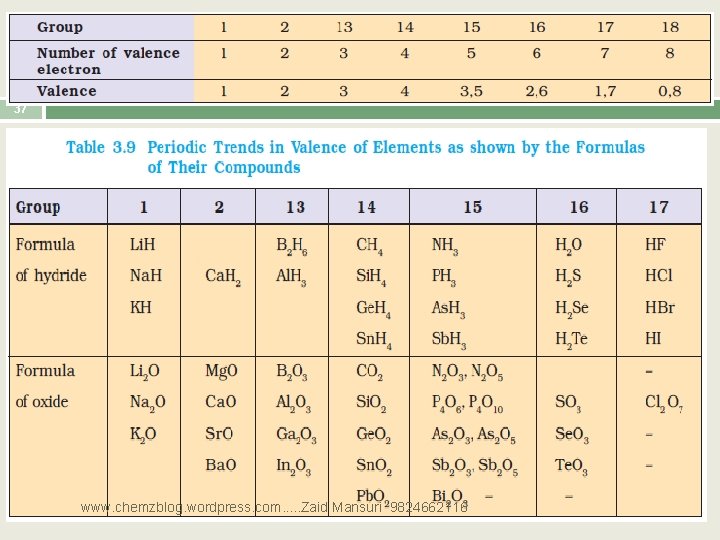
Valence 36 “ The valence of an element may be defined as the combining capacity of element ” Ø Valence= no. of H or Cl or double the no. of O atoms that combine with an atom of an element. Ø Electrons present in the outermost shell are called valence e-s. Ø Down the group, the valency remains the same. Ø Across the period, increases from 1 to 4 & then decreases from 4 to 0. www. chemzblog. wordpress. com. . . Zaid Mansuri 9824662116
37 www. chemzblog. wordpress. com. . . Zaid Mansuri 9824662116
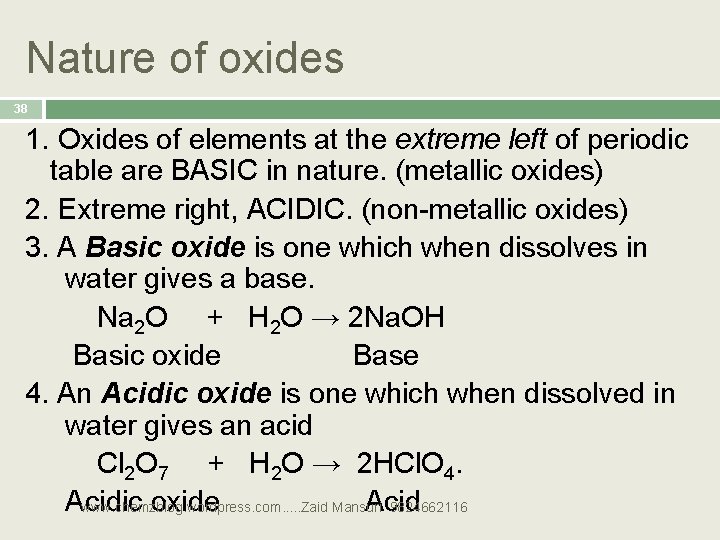
Nature of oxides 38 1. Oxides of elements at the extreme left of periodic table are BASIC in nature. (metallic oxides) 2. Extreme right, ACIDIC. (non-metallic oxides) 3. A Basic oxide is one which when dissolves in water gives a base. Na 2 O + H 2 O → 2 Na. OH Basic oxide Base 4. An Acidic oxide is one which when dissolved in water gives an acid Cl 2 O 7 + H 2 O → 2 HCl. O 4. Acidic oxide Acid www. chemzblog. wordpress. com. . . Zaid Mansuri 9824662116
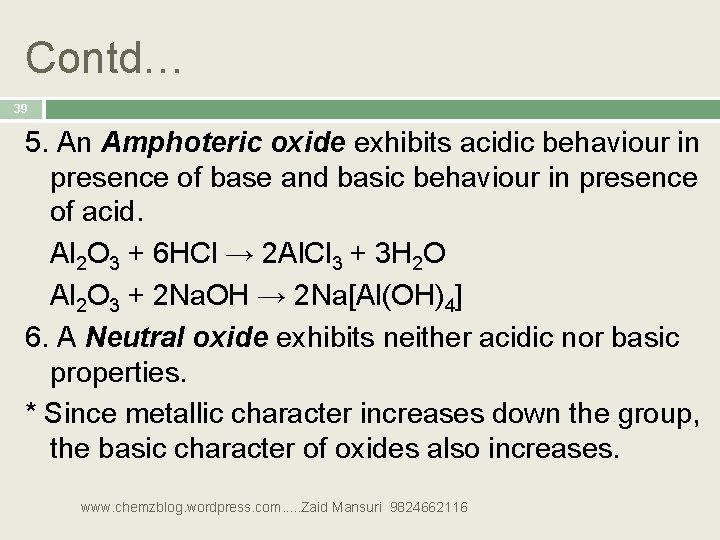
Contd… 39 5. An Amphoteric oxide exhibits acidic behaviour in presence of base and basic behaviour in presence of acid. Al 2 O 3 + 6 HCl → 2 Al. Cl 3 + 3 H 2 O Al 2 O 3 + 2 Na. OH → 2 Na[Al(OH)4] 6. A Neutral oxide exhibits neither acidic nor basic properties. * Since metallic character increases down the group, the basic character of oxides also increases. www. chemzblog. wordpress. com. . . Zaid Mansuri 9824662116
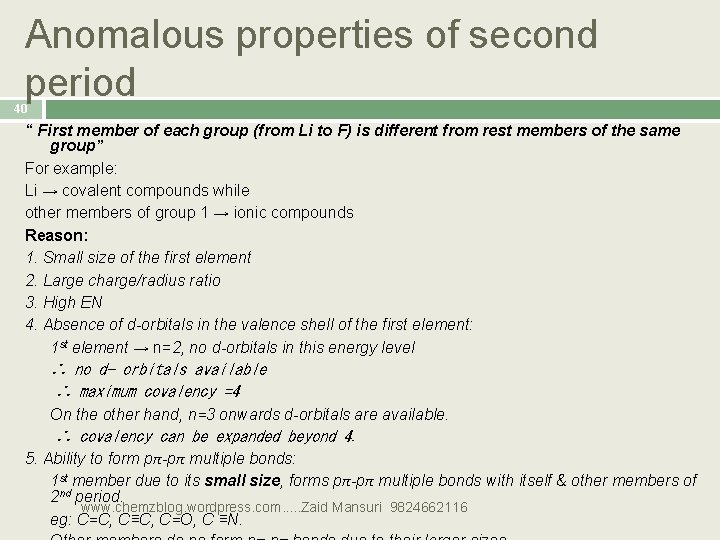
Anomalous properties of second period 40 “ First member of each group (from Li to F) is different from rest members of the same group” For example: Li → covalent compounds while other members of group 1 → ionic compounds Reason: 1. Small size of the first element 2. Large charge/radius ratio 3. High EN 4. Absence of d-orbitals in the valence shell of the first element: 1 st element → n=2, no d-orbitals in this energy level ∴ no d- orbitals available ∴ maximum covalency =4 On the other hand, n=3 onwards d-orbitals are available. ∴ covalency can be expanded beyond 4. 5. Ability to form pπ-pπ multiple bonds: 1 st member due to its small size, forms pπ-pπ multiple bonds with itself & other members of 2 nd period. www. chemzblog. wordpress. com. . . Zaid Mansuri 9824662116 eg: C=C, C≡C, C=O, C ≡N.
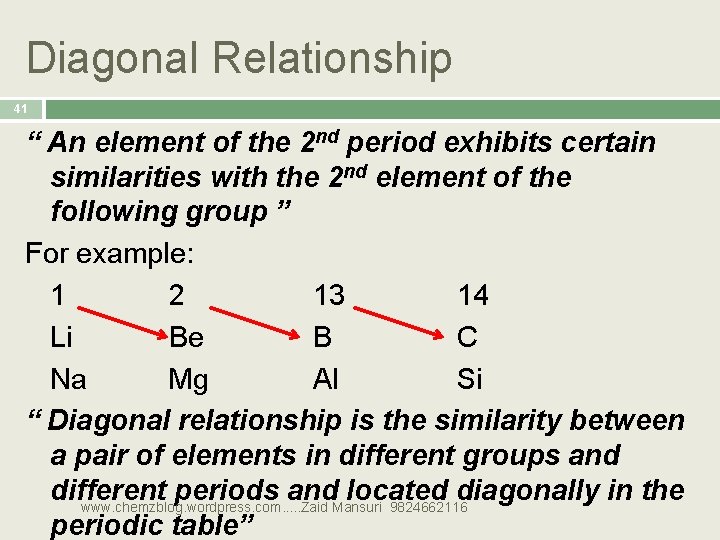
Diagonal Relationship 41 “ An element of the 2 nd period exhibits certain similarities with the 2 nd element of the following group ” For example: 1 2 13 14 Li Be B C Na Mg Al Si “ Diagonal relationship is the similarity between a pair of elements in different groups and different periods and located diagonally in the www. chemzblog. wordpress. com. . . Zaid Mansuri 9824662116 periodic table”
End of chapter 42 www. chemzblog. wordpress. com. . . Zaid Mansuri 9824662116
- Slides: 42