
www antt org all rights reserved ANTT is

- Slides: 47
© www. antt. org – all rights reserved ANTT® is a registered Trademark ANTT© is owned and overseen by The Association for Safe Aseptic Practice, a non profit organisation with a strategy to standardise aseptic technique internationally for the benefit of patients and healthcare organizations. Please note that these presentations must not be used to build ANTT titled/specific e-learning resources For advice please email enquiries@antt. org ANTT® Copyright 2015 www. antt. org enquiries@antt. org
To start this ANTT training slide show go to the top menu bar and select ‘View. Then ‘Slide Show’ Slides will change automatically every 20 seconds. Or, use the right/left arrow keys to change manually. ANTT® Copyright 2015 www. antt. org enquiries@antt. org
The ANTT Overview presentation explained the Principles and Safeguards that underpin the ANTT Clinical Practice Framework. It also explained how these Principles an Safeguards are applied to practice using the ANTT-Approach. This presentation demonstrates the 6 stages of the ANTT-Approach applied to Intravenous Therapy. ANTT® Copyright 2015 www. antt. org enquiries@antt. org
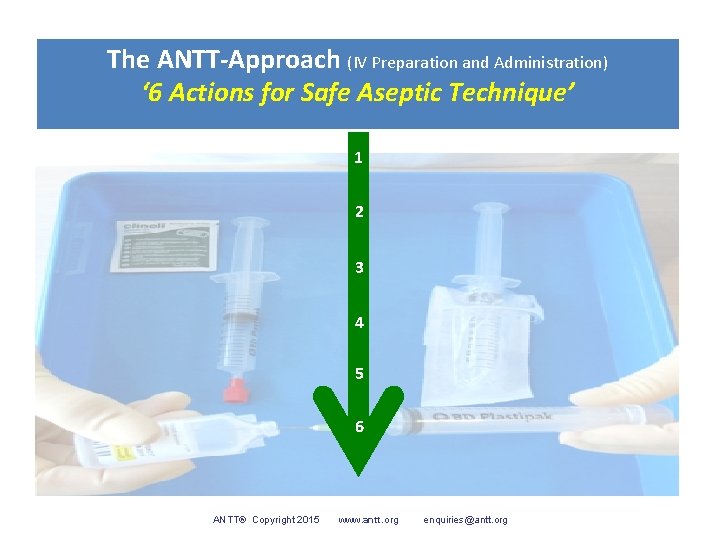
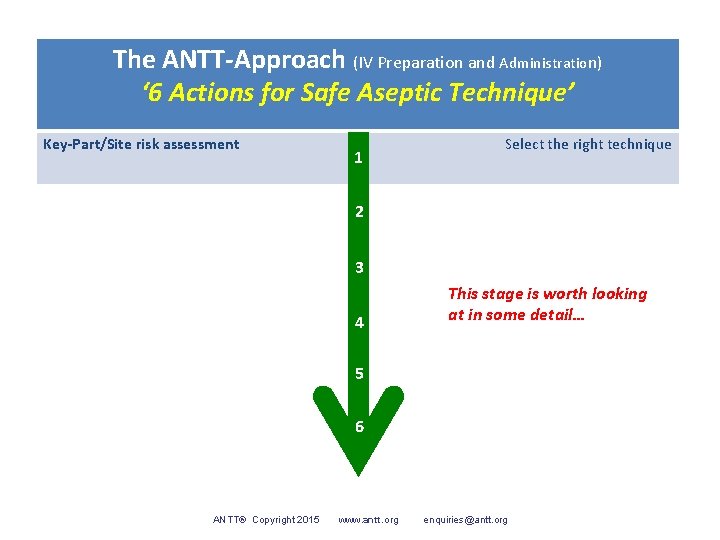
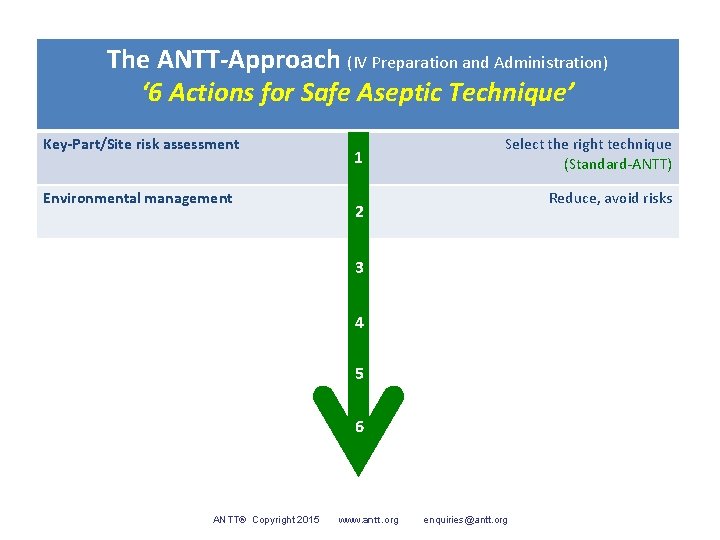
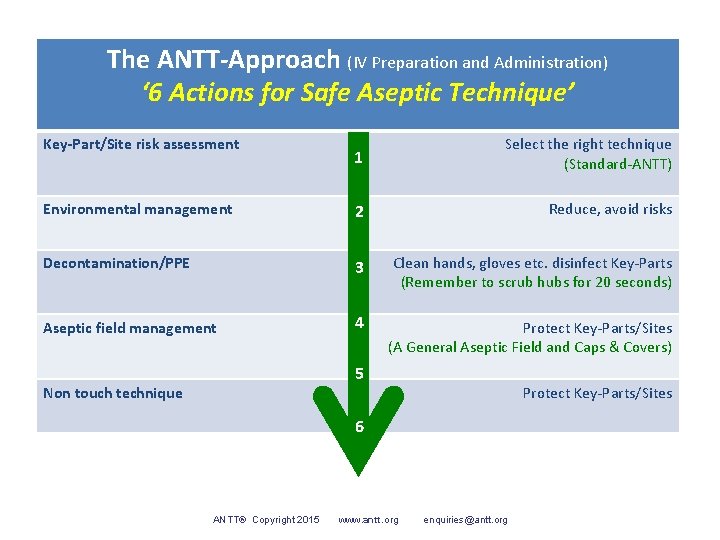
The ANTT-Approach (IV Preparation and Administration) ‘ 6 Actions for Safe Aseptic Technique’ 1 2 3 4 5 6 ANTT® Copyright 2015 www. antt. org enquiries@antt. org
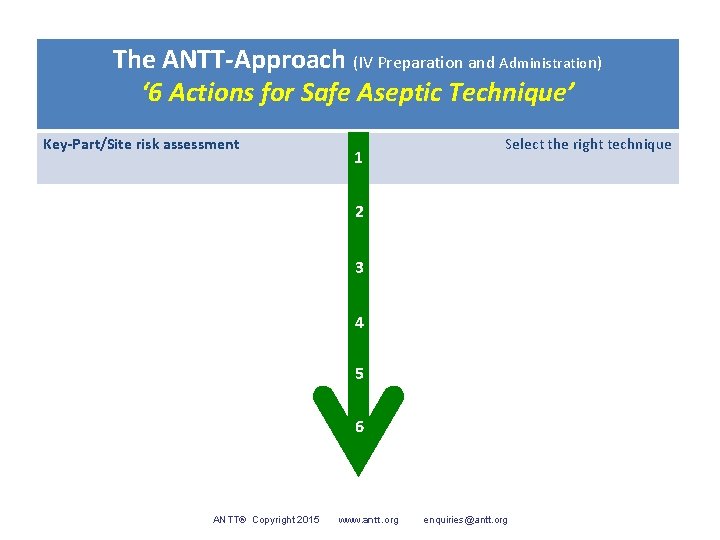
The ANTT-Approach (IV Preparation and Administration) ‘ 6 Actions for Safe Aseptic Technique’ Key-Part/Site risk assessment 1 Select the right technique 2 3 4 5 6 ANTT® Copyright 2015 www. antt. org enquiries@antt. org
The ANTT-Approach (IV Preparation and Administration) ‘ 6 Actions for Safe Aseptic Technique’ Key-Part/Site risk assessment 1 Select the right technique 2 3 4 This stage is worth looking at in some detail… 5 6 ANTT® Copyright 2015 www. antt. org enquiries@antt. org
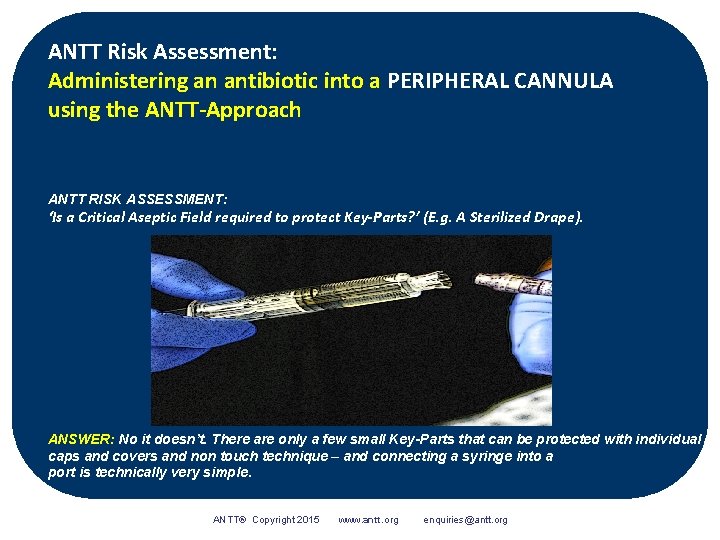
ANTT Risk Assessment: Administering an antibiotic into a PERIPHERAL CANNULA using the ANTT-Approach ANTT RISK ASSESSMENT: ‘Is a Critical Aseptic Field required to protect Key-Parts? ’ (E. g. A Sterilized Drape). ANSWER: No it doesn’t. There are only a few small Key-Parts that can be protected with individual caps and covers and non touch technique – and connecting a syringe into a port is technically very simple. ANTT® Copyright 2015 www. antt. org enquiries@antt. org
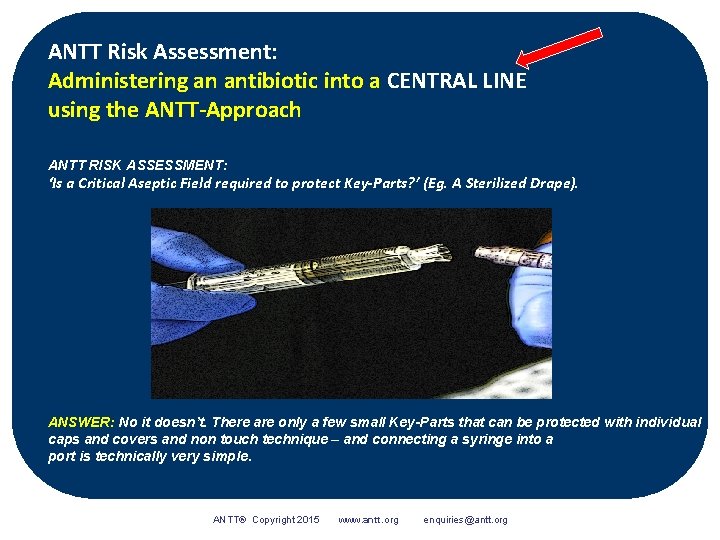
ANTT Risk Assessment: Administering an antibiotic into a CENTRAL LINE using the ANTT-Approach ANTT RISK ASSESSMENT: ‘Is a Critical Aseptic Field required to protect Key-Parts? ’ (Eg. A Sterilized Drape). ANSWER: No it doesn’t. There are only a few small Key-Parts that can be protected with individual caps and covers and non touch technique – and connecting a syringe into a port is technically very simple. ANTT® Copyright 2015 www. antt. org enquiries@antt. org
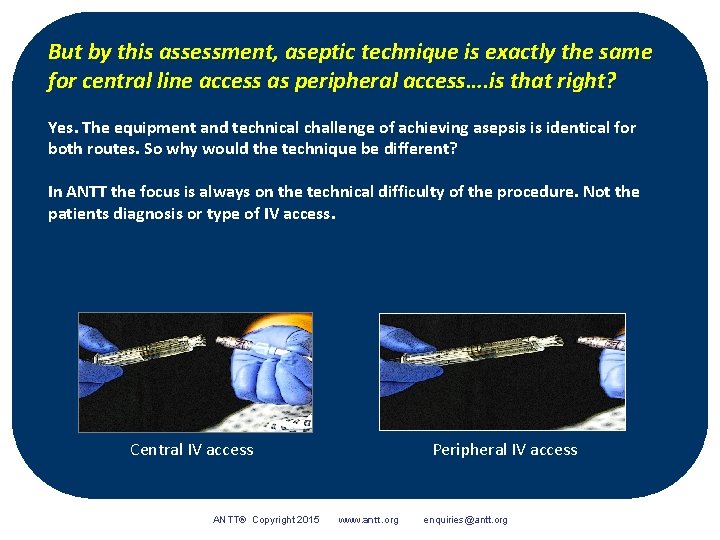
But by this assessment, aseptic technique is exactly the same for central line access as peripheral access…. is that right? Yes. The equipment and technical challenge of achieving asepsis is identical for both routes. So why would the technique be different? In ANTT the focus is always on the technical difficulty of the procedure. Not the patients diagnosis or type of IV access. Central IV access Peripheral IV access ANTT® Copyright 2015 www. antt. org enquiries@antt. org
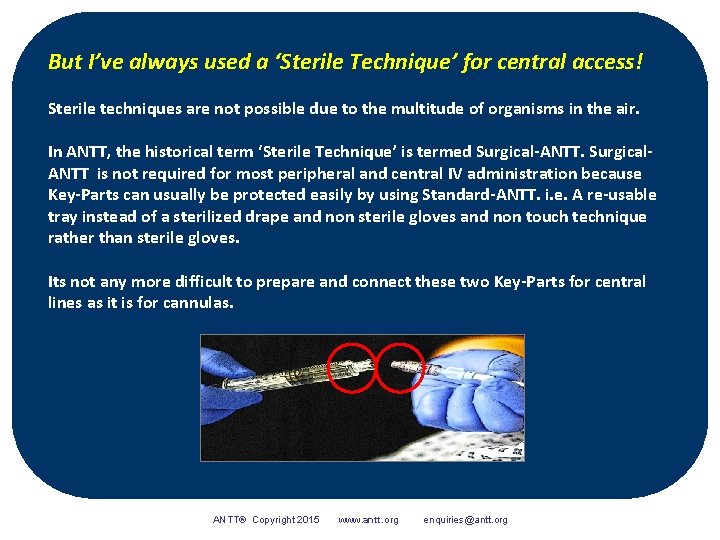
But I’ve always used a ‘Sterile Technique’ for central access! Sterile techniques are not possible due to the multitude of organisms in the air. In ANTT, the historical term ‘Sterile Technique’ is termed Surgical-ANTT. Surgical. ANTT is not required for most peripheral and central IV administration because Key-Parts can usually be protected easily by using Standard-ANTT. i. e. A re-usable tray instead of a sterilized drape and non sterile gloves and non touch technique rather than sterile gloves. Its not any more difficult to prepare and connect these two Key-Parts for central lines as it is for cannulas. ANTT® Copyright 2015 www. antt. org enquiries@antt. org
The ANTT-Approach (IV Preparation and Administration) ‘ 6 Actions for Safe Aseptic Technique’ Key-Part/Site risk assessment Environmental management 1 Select the right technique (Standard-ANTT) Reduce, avoid risks 2 3 4 5 6 ANTT® Copyright 2015 www. antt. org enquiries@antt. org
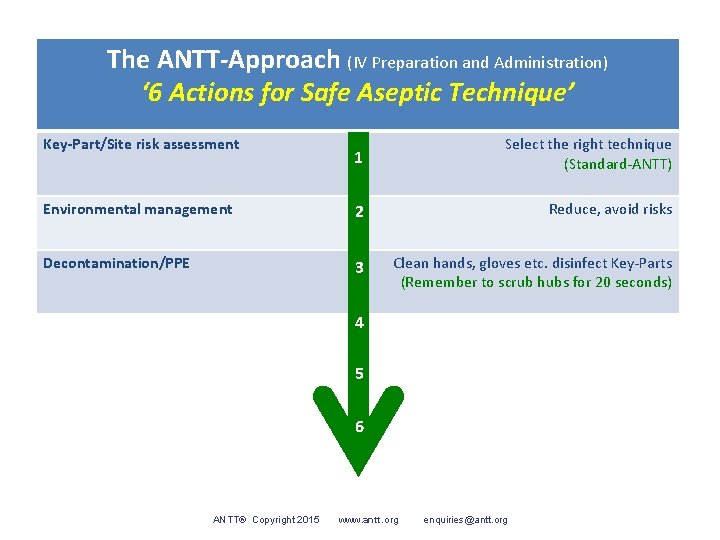
The ANTT-Approach (IV Preparation and Administration) ‘ 6 Actions for Safe Aseptic Technique’ Key-Part/Site risk assessment 1 Select the right technique (Standard-ANTT) Environmental management 2 Reduce, avoid risks Decontamination/PPE 3 Clean hands, gloves etc. disinfect Key-Parts (Remember to scrub hubs for 20 seconds) 4 5 6 ANTT® Copyright 2015 www. antt. org enquiries@antt. org
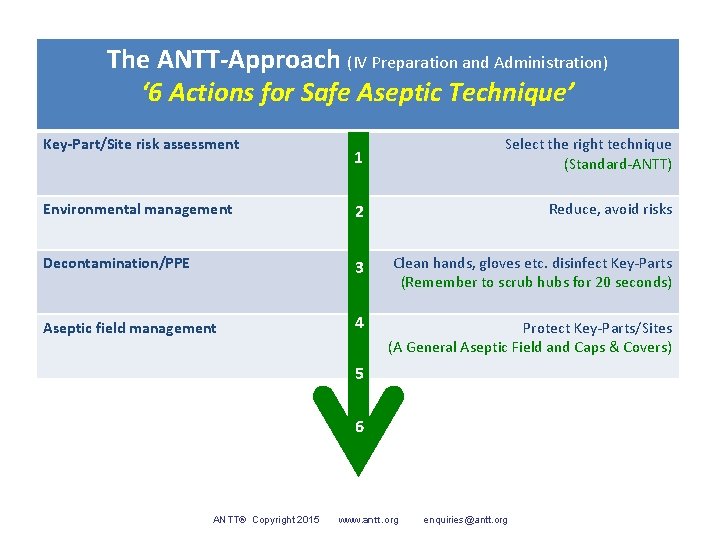
The ANTT-Approach (IV Preparation and Administration) ‘ 6 Actions for Safe Aseptic Technique’ Key-Part/Site risk assessment 1 Select the right technique (Standard-ANTT) Environmental management 2 Reduce, avoid risks Decontamination/PPE 3 Clean hands, gloves etc. disinfect Key-Parts (Remember to scrub hubs for 20 seconds) Aseptic field management 4 Protect Key-Parts/Sites (A General Aseptic Field and Caps & Covers) 5 6 ANTT® Copyright 2015 www. antt. org enquiries@antt. org
The ANTT-Approach (IV Preparation and Administration) ‘ 6 Actions for Safe Aseptic Technique’ Key-Part/Site risk assessment 1 Select the right technique (Standard-ANTT) Environmental management 2 Reduce, avoid risks Decontamination/PPE 3 Clean hands, gloves etc. disinfect Key-Parts (Remember to scrub hubs for 20 seconds) Aseptic field management 4 Protect Key-Parts/Sites (A General Aseptic Field and Caps & Covers) 5 Non touch technique Protect Key-Parts/Sites 6 ANTT® Copyright 2015 www. antt. org enquiries@antt. org
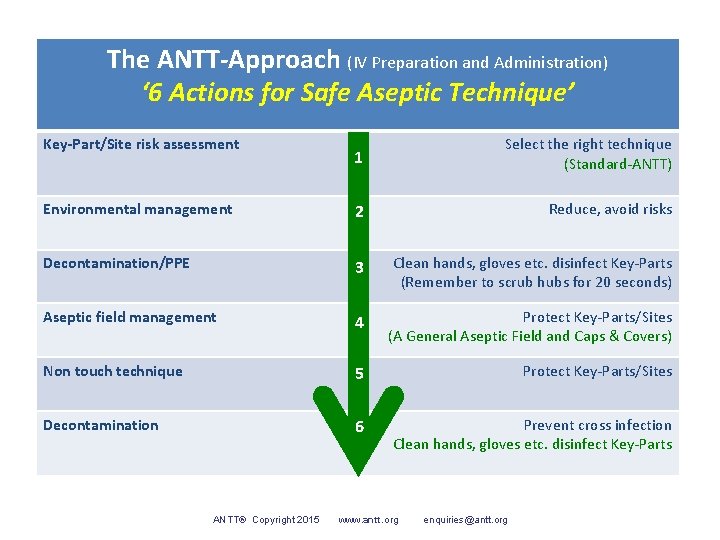
The ANTT-Approach (IV Preparation and Administration) ‘ 6 Actions for Safe Aseptic Technique’ Key-Part/Site risk assessment 1 Select the right technique (Standard-ANTT) Environmental management 2 Reduce, avoid risks Decontamination/PPE 3 Clean hands, gloves etc. disinfect Key-Parts (Remember to scrub hubs for 20 seconds) Aseptic field management 4 Protect Key-Parts/Sites (A General Aseptic Field and Caps & Covers) Non touch technique 5 Protect Key-Parts/Sites Decontamination 6 Prevent cross infection Clean hands, gloves etc. disinfect Key-Parts ANTT® Copyright 2015 www. antt. org enquiries@antt. org
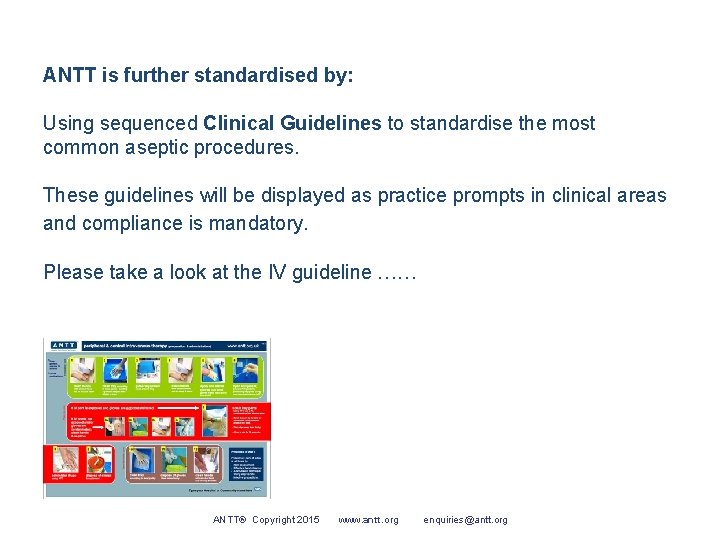
ANTT is further standardised by: Using sequenced Clinical Guidelines to standardise the most common aseptic procedures. These guidelines will be displayed as practice prompts in clinical areas and compliance is mandatory. Please take a look at the IV guideline …… ANTT® Copyright 2015 www. antt. org enquiries@antt. org
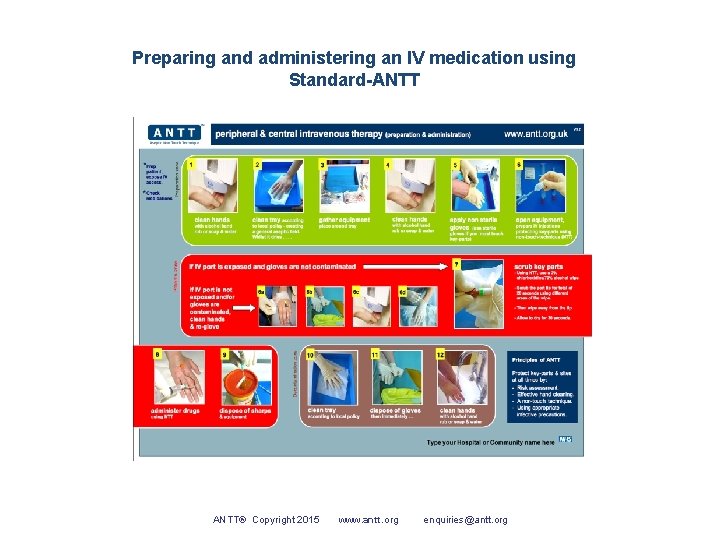
Preparing and administering an IV medication using Standard-ANTT® Copyright 2015 www. antt. org enquiries@antt. org
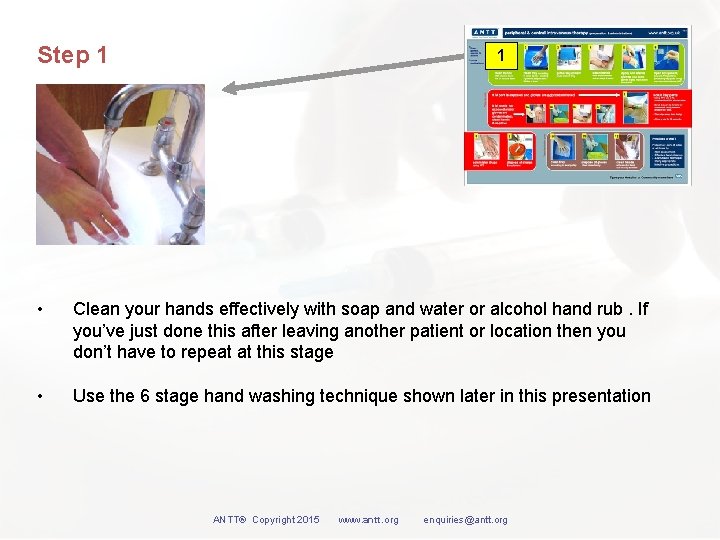
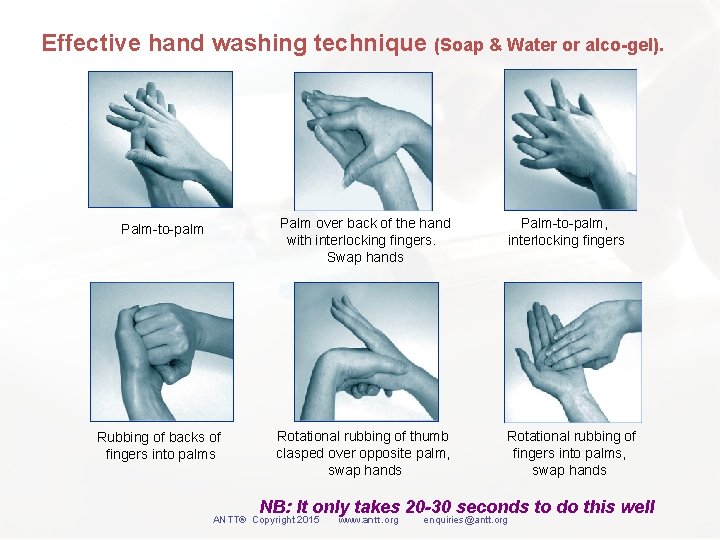
Step 1 1 • Clean your hands effectively with soap and water or alcohol hand rub. If you’ve just done this after leaving another patient or location then you don’t have to repeat at this stage • Use the 6 stage hand washing technique shown later in this presentation ANTT® Copyright 2015 www. antt. org enquiries@antt. org
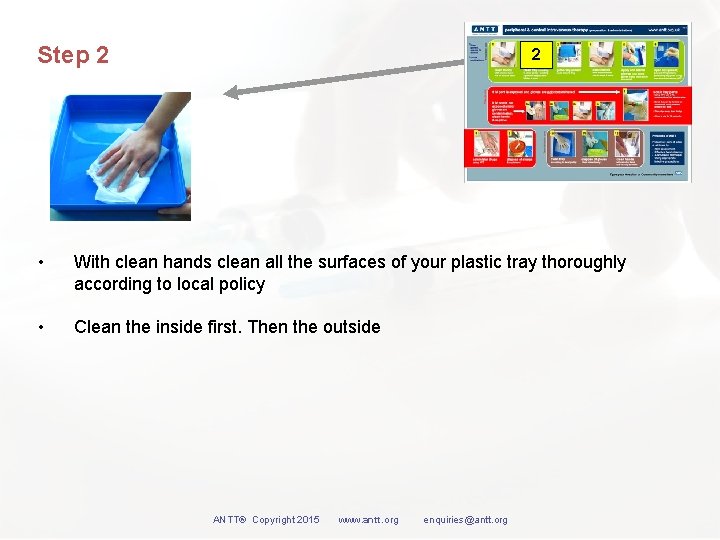
Step 2 2 • With clean hands clean all the surfaces of your plastic tray thoroughly according to local policy • Clean the inside first. Then the outside ANTT® Copyright 2015 www. antt. org enquiries@antt. org
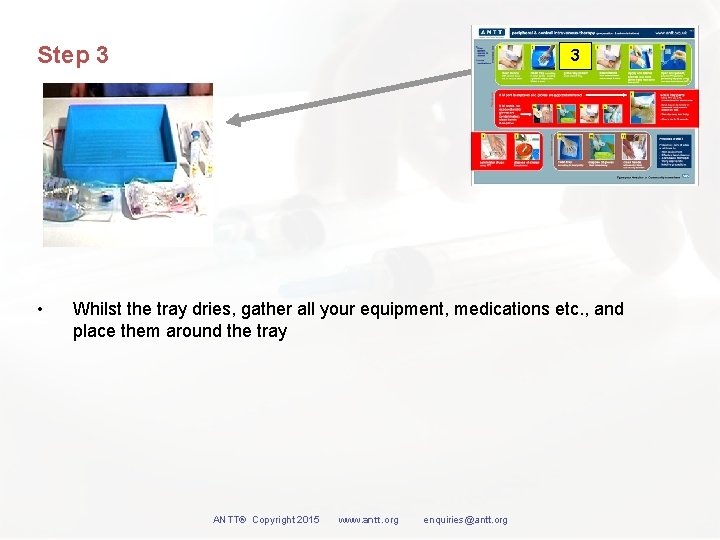
Step 3 • 3 Whilst the tray dries, gather all your equipment, medications etc. , and place them around the tray ANTT® Copyright 2015 www. antt. org enquiries@antt. org
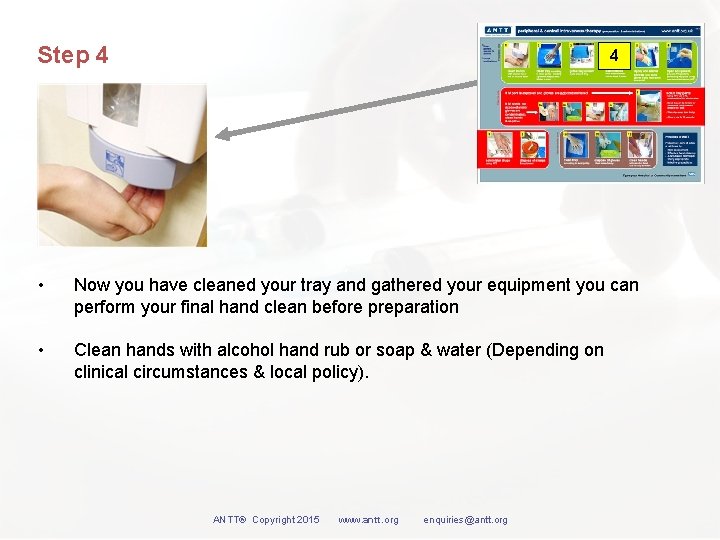
Step 4 4 • Now you have cleaned your tray and gathered your equipment you can perform your final hand clean before preparation • Clean hands with alcohol hand rub or soap & water (Depending on clinical circumstances & local policy). ANTT® Copyright 2015 www. antt. org enquiries@antt. org
Effective hand washing technique (Soap & Water or alco-gel). Palm-to-palm Palm over back of the hand with interlocking fingers. Swap hands Rubbing of backs of fingers into palms Rotational rubbing of thumb clasped over opposite palm, swap hands Palm-to-palm, interlocking fingers Rotational rubbing of fingers into palms, swap hands NB: It only takes 20 -30 seconds to do this well ANTT® Copyright 2015 www. antt. org enquiries@antt. org
So what are the hand cleaning steps again? Don’t move on until you can remember them – you will be assessed and observed. Use the same technique whether you are cleaning your hands with soap and water or using alcohol hand rub. ANTT® Copyright 2015 www. antt. org enquiries@antt. org
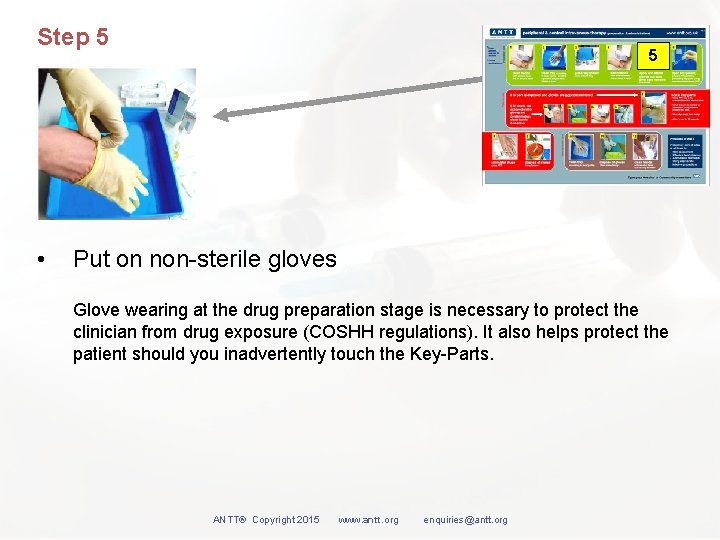
Step 5 • 5 Put on non-sterile gloves Glove wearing at the drug preparation stage is necessary to protect the clinician from drug exposure (COSHH regulations). It also helps protect the patient should you inadvertently touch the Key-Parts. ANTT® Copyright 2015 www. antt. org enquiries@antt. org
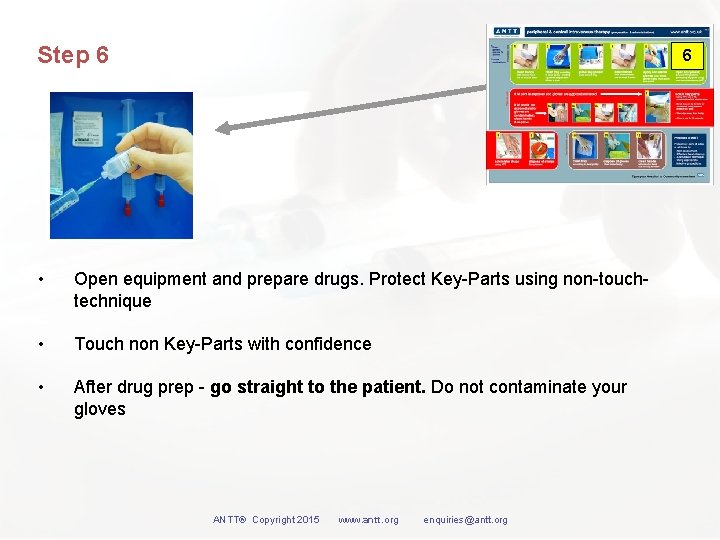
Step 6 6 • Open equipment and prepare drugs. Protect Key-Parts using non-touchtechnique • Touch non Key-Parts with confidence • After drug prep - go straight to the patient. Do not contaminate your gloves ANTT® Copyright 2015 www. antt. org enquiries@antt. org
A small point…. but one many people ask “What is and what is not permitted in the aseptic tray”? Ideally, nothing goes in the tray which is not required for the procedure However, in a well organised tray, one might include an unopened alcowipe or syringes protected in their paper packaging. Remember, for Standard-ANTT you are aiming for asepsis of the Key-Parts not sterility or asepsis of the whole procedure area. ANTT® Copyright 2015 www. antt. org enquiries@antt. org
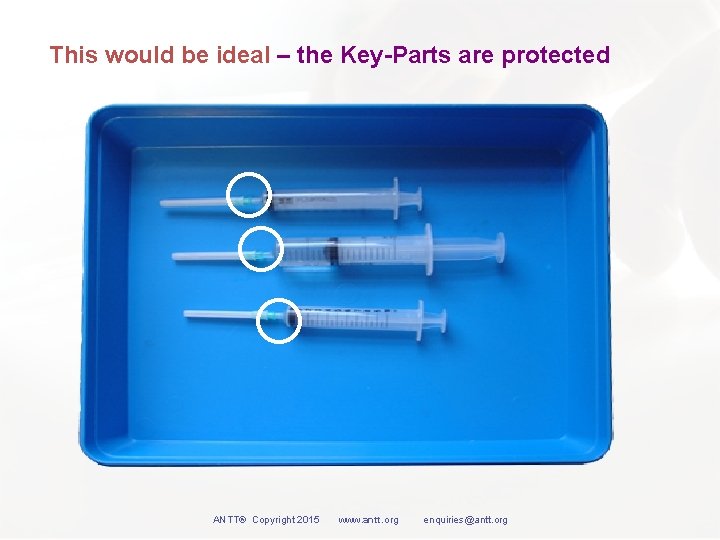
This would be ideal – the Key-Parts are protected ANTT® Copyright 2015 www. antt. org enquiries@antt. org
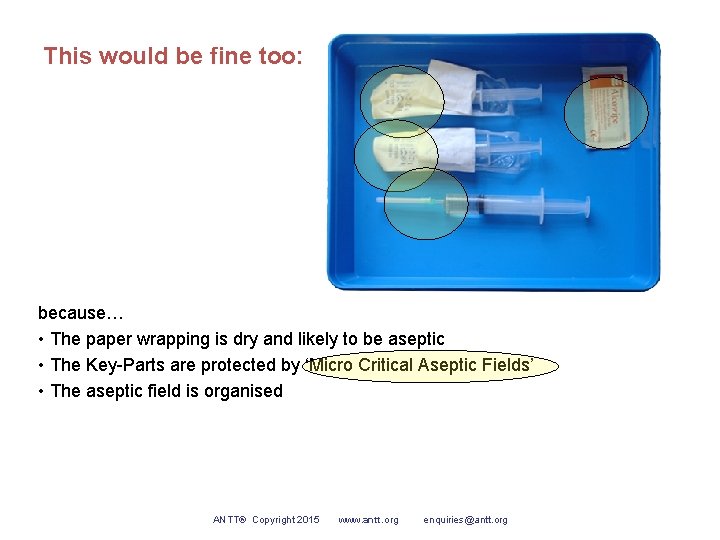
This would be fine too: because… • The paper wrapping is dry and likely to be aseptic • The Key-Parts are protected by ‘Micro Critical Aseptic Fields’ • The aseptic field is organised ANTT® Copyright 2015 www. antt. org enquiries@antt. org
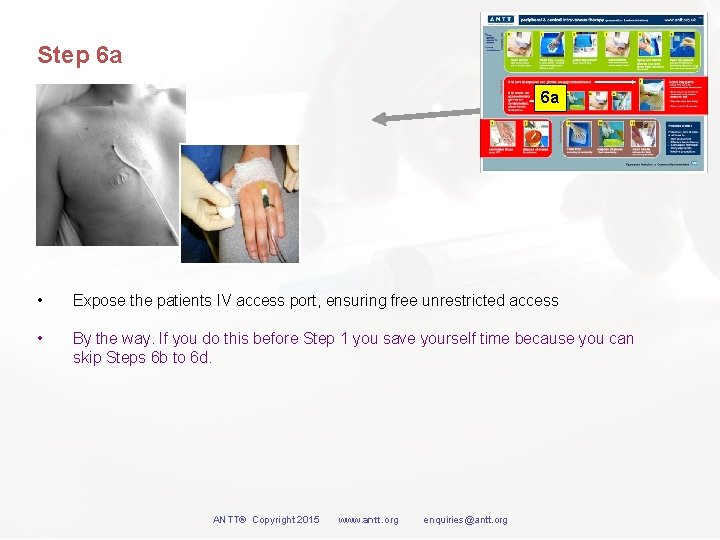
Step 6 a 6 a • Expose the patients IV access port, ensuring free unrestricted access • By the way. If you do this before Step 1 you save yourself time because you can skip Steps 6 b to 6 d. ANTT® Copyright 2015 www. antt. org enquiries@antt. org
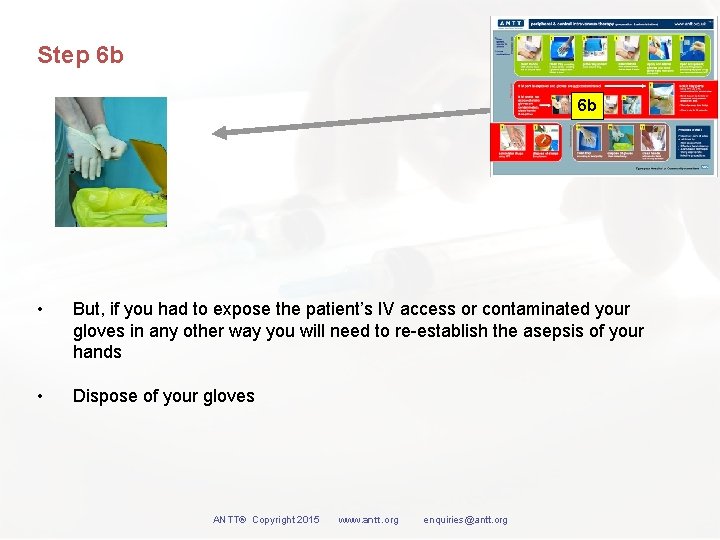
Step 6 b 6 b • But, if you had to expose the patient’s IV access or contaminated your gloves in any other way you will need to re-establish the asepsis of your hands • Dispose of your gloves ANTT® Copyright 2015 www. antt. org enquiries@antt. org
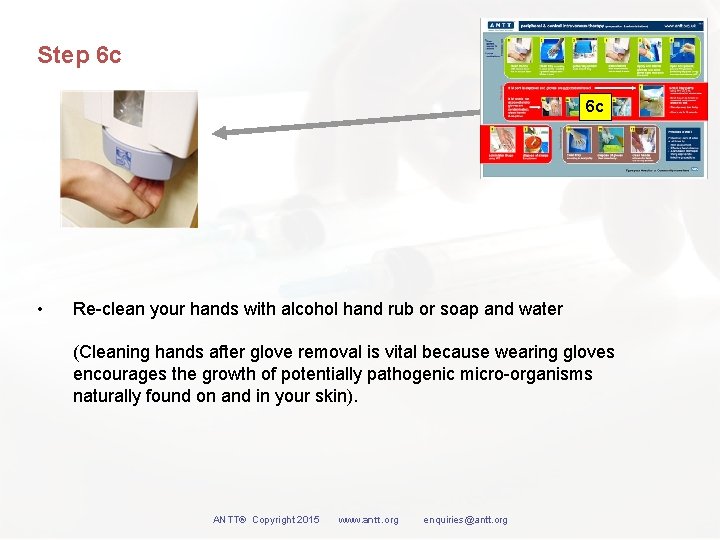
Step 6 c 6 c • Re-clean your hands with alcohol hand rub or soap and water (Cleaning hands after glove removal is vital because wearing gloves encourages the growth of potentially pathogenic micro-organisms naturally found on and in your skin). ANTT® Copyright 2015 www. antt. org enquiries@antt. org
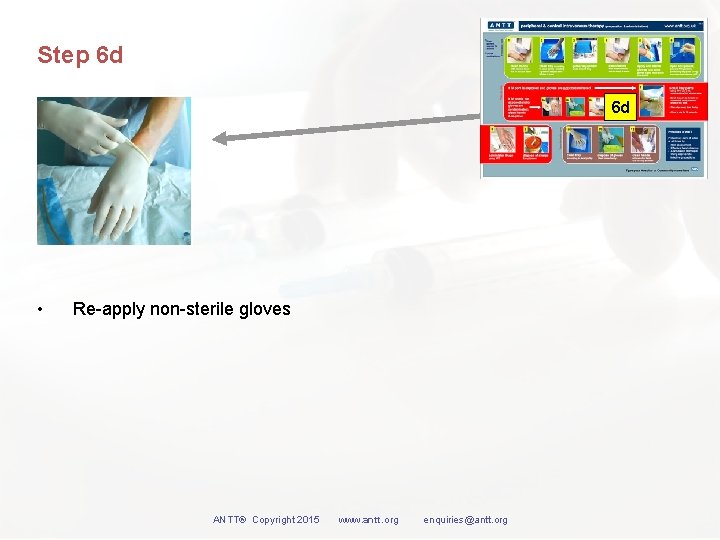
Step 6 d 6 d • Re-apply non-sterile gloves ANTT® Copyright 2015 www. antt. org enquiries@antt. org
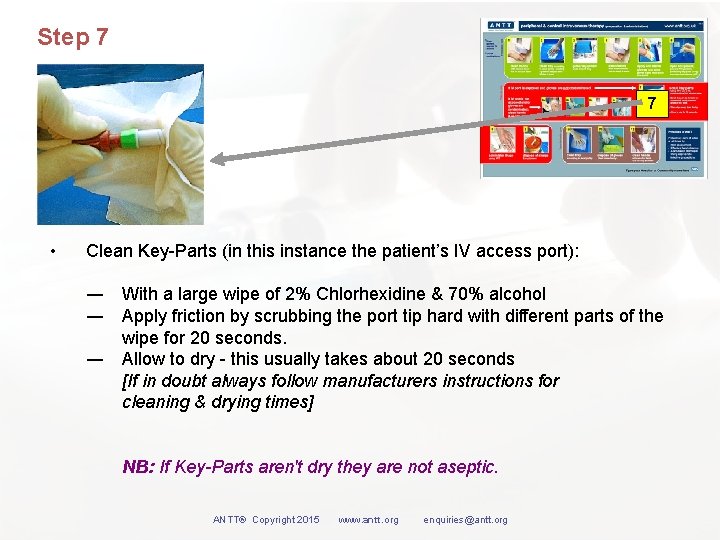
Step 7 7 • Clean Key-Parts (in this instance the patient’s IV access port): ― With a large wipe of 2% Chlorhexidine & 70% alcohol ― Apply friction by scrubbing the port tip hard with different parts of the wipe for 20 seconds. ― Allow to dry - this usually takes about 20 seconds [If in doubt always follow manufacturers instructions for cleaning & drying times] NB: If Key-Parts aren't dry they are not aseptic. ANTT® Copyright 2015 www. antt. org enquiries@antt. org
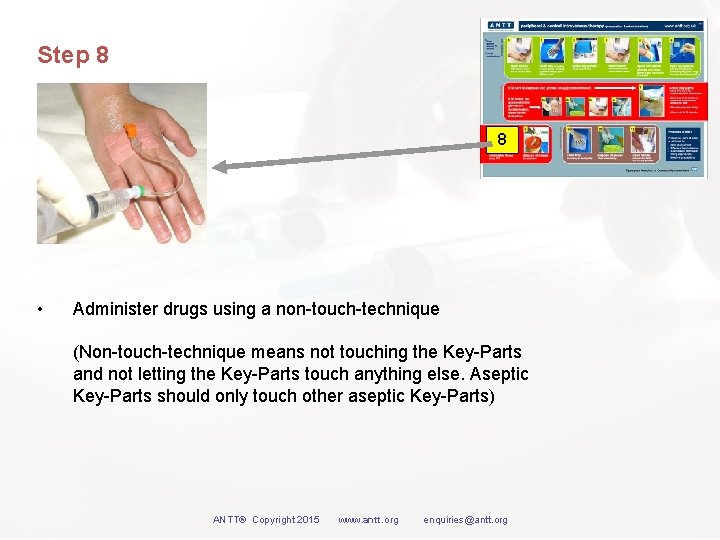
Step 8 8 • Administer drugs using a non-touch-technique (Non-touch-technique means not touching the Key-Parts and not letting the Key-Parts touch anything else. Aseptic Key-Parts should only touch other aseptic Key-Parts) ANTT® Copyright 2015 www. antt. org enquiries@antt. org
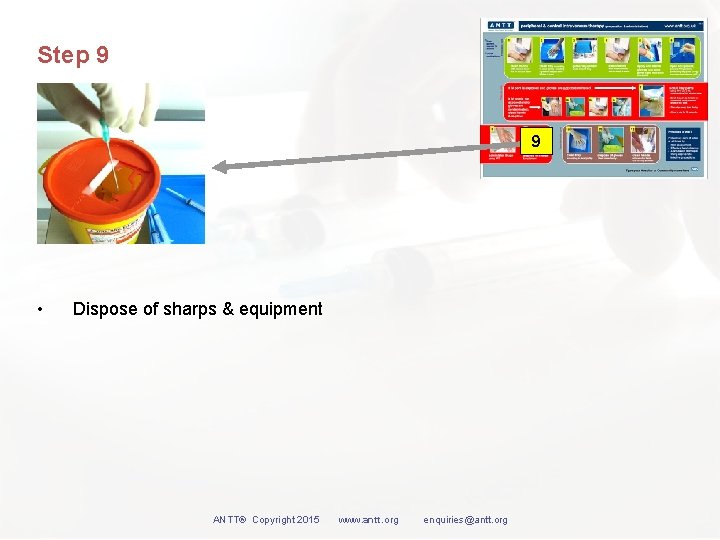
Step 9 9 • Dispose of sharps & equipment ANTT® Copyright 2015 www. antt. org enquiries@antt. org
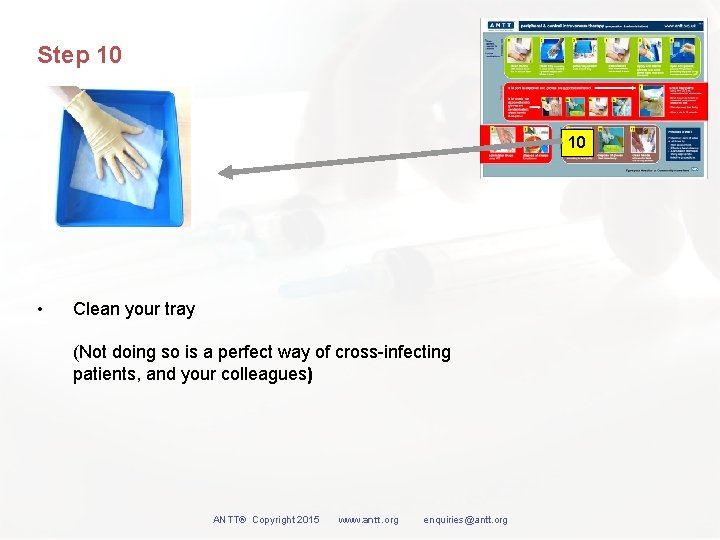
Step 10 10 • Clean your tray (Not doing so is a perfect way of cross-infecting patients, and your colleagues) ANTT® Copyright 2015 www. antt. org enquiries@antt. org
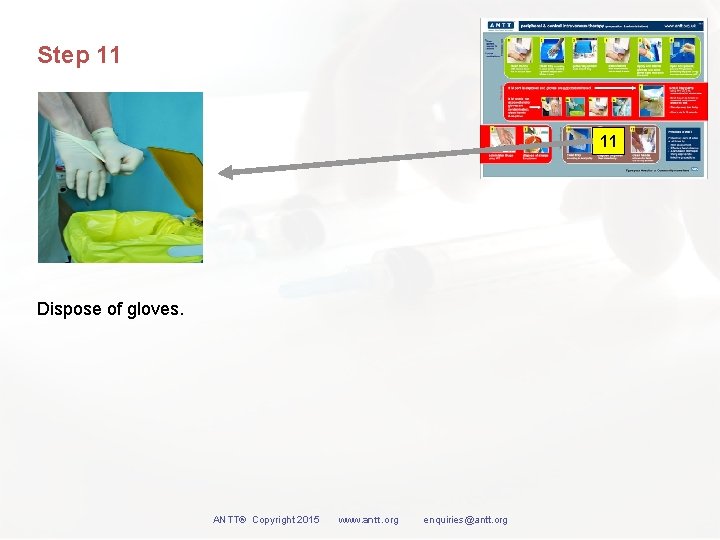
Step 11 11 Dispose of gloves. ANTT® Copyright 2015 www. antt. org enquiries@antt. org
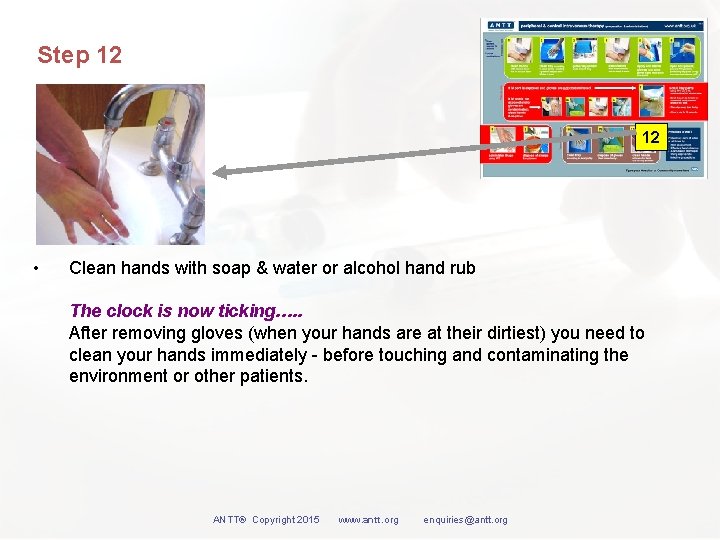
Step 12 12 • Clean hands with soap & water or alcohol hand rub The clock is now ticking…. . After removing gloves (when your hands are at their dirtiest) you need to clean your hands immediately - before touching and contaminating the environment or other patients. ANTT® Copyright 2015 www. antt. org enquiries@antt. org
The following practices and equipment are prohibited in this organization during ANTT procedures ANTT® Copyright 2015 www. antt. org enquiries@antt. org
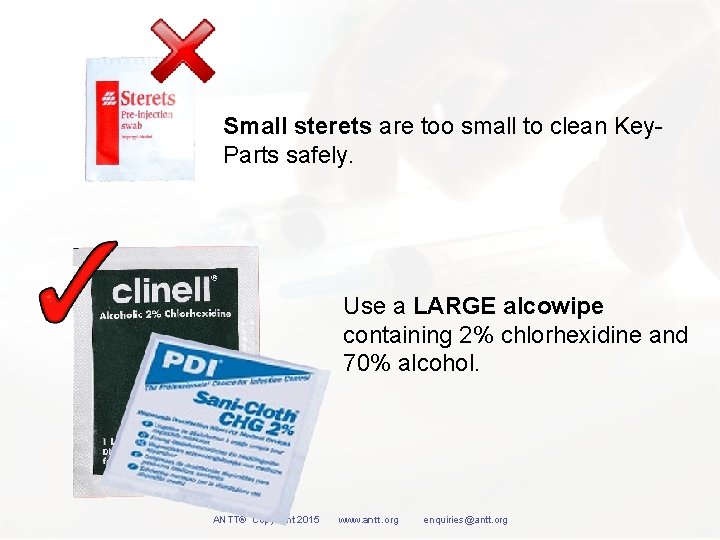
Small sterets are too small to clean Key. Parts safely. Use a LARGE alcowipe containing 2% chlorhexidine and 70% alcohol. ANTT® Copyright 2015 www. antt. org enquiries@antt. org
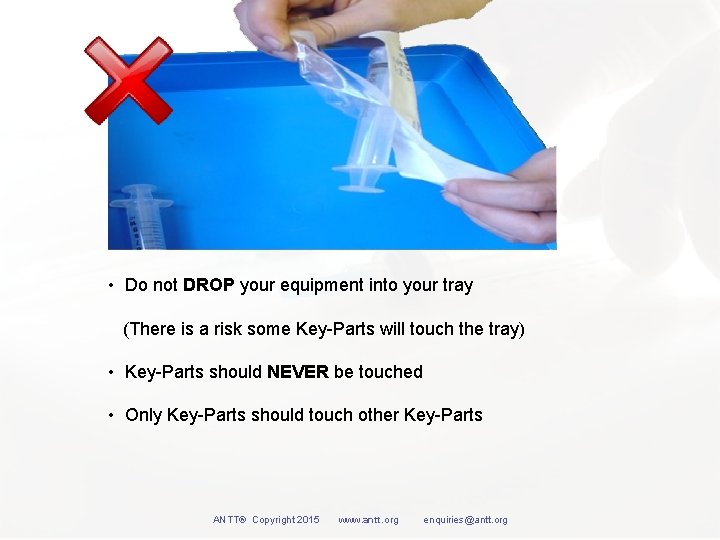
• Do not DROP your equipment into your tray (There is a risk some Key-Parts will touch the tray) • Key-Parts should NEVER be touched • Only Key-Parts should touch other Key-Parts ANTT® Copyright 2015 www. antt. org enquiries@antt. org
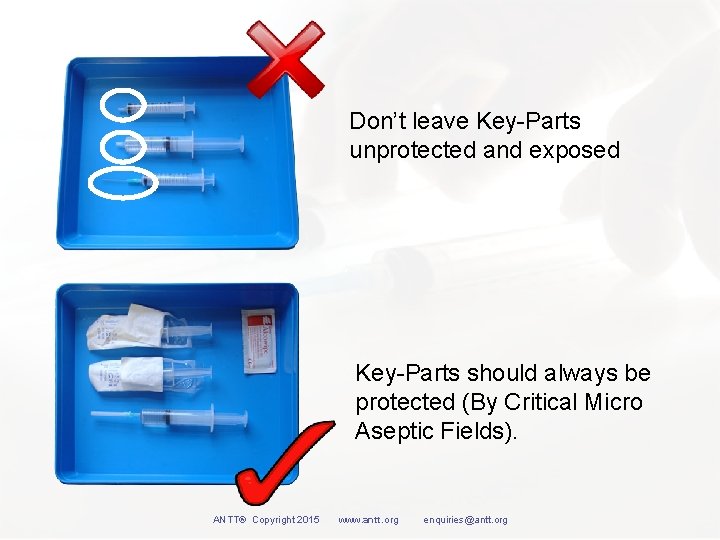
Don’t leave Key-Parts unprotected and exposed Key-Parts should always be protected (By Critical Micro Aseptic Fields). ANTT® Copyright 2015 www. antt. org enquiries@antt. org
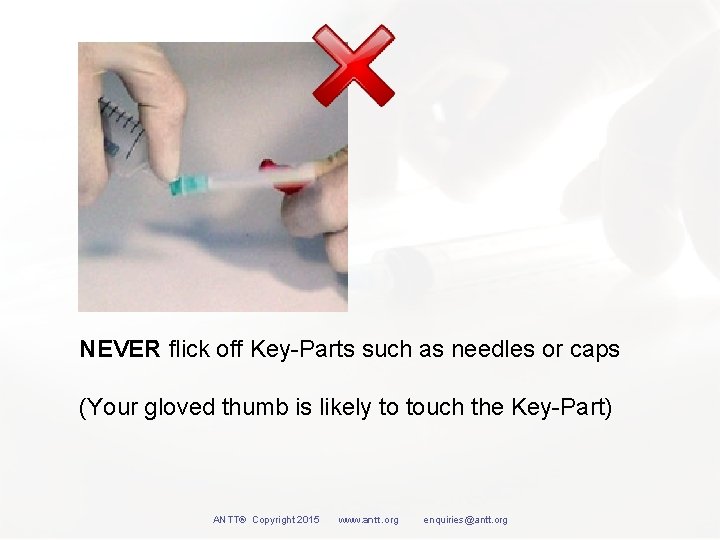
NEVER flick off Key-Parts such as needles or caps (Your gloved thumb is likely to touch the Key-Part) ANTT® Copyright 2015 www. antt. org enquiries@antt. org
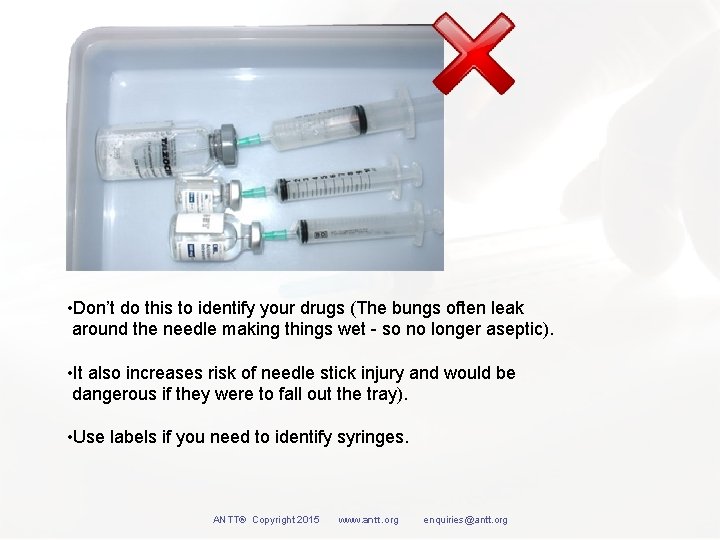
• Don’t do this to identify your drugs (The bungs often leak around the needle making things wet - so no longer aseptic). • It also increases risk of needle stick injury and would be dangerous if they were to fall out the tray). • Use labels if you need to identify syringes. ANTT® Copyright 2015 www. antt. org enquiries@antt. org
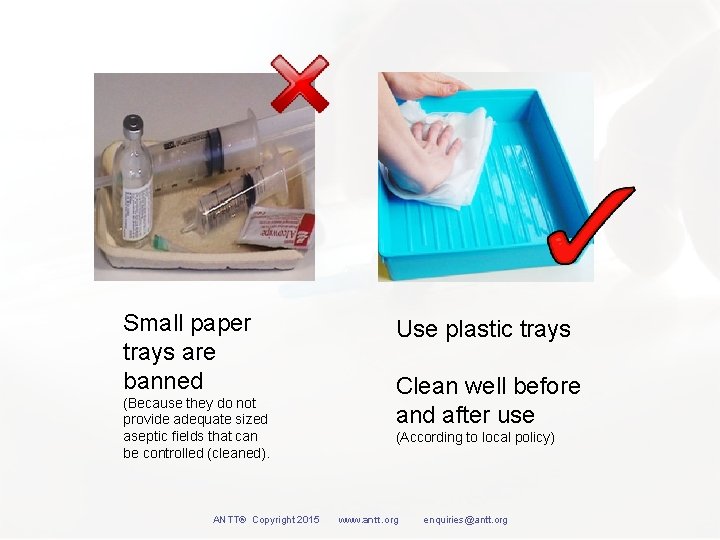
Small paper trays are banned (Because they do not provide adequate sized aseptic fields that can be controlled (cleaned). ANTT® Copyright 2015 Use plastic trays Clean well before and after use (According to local policy) www. antt. org enquiries@antt. org
What now? After you have read the ANTT teaching board, watched the DVD and this presentation you can start using ANTT in practice. (The guidelines will be displayed in all of the prep areas). Within the next few weeks you will be assessed. ANTT® Copyright 2015 www. antt. org enquiries@antt. org
© www. antt. org – all rights reserved ANTT® is a registered Trademark ANTT© is owned and overseen by The Association for Safe Aseptic Practice, a non profit organisation with a strategy to standardise aseptic technique internationally for the benefit of patients and healthcare organizations. Please note that these presentations must not be used to build ANTT titled/specific e-learning resources For advice please email enquiries@antt. org ANTT® Copyright 2015 www. antt. org enquiries@antt. org