
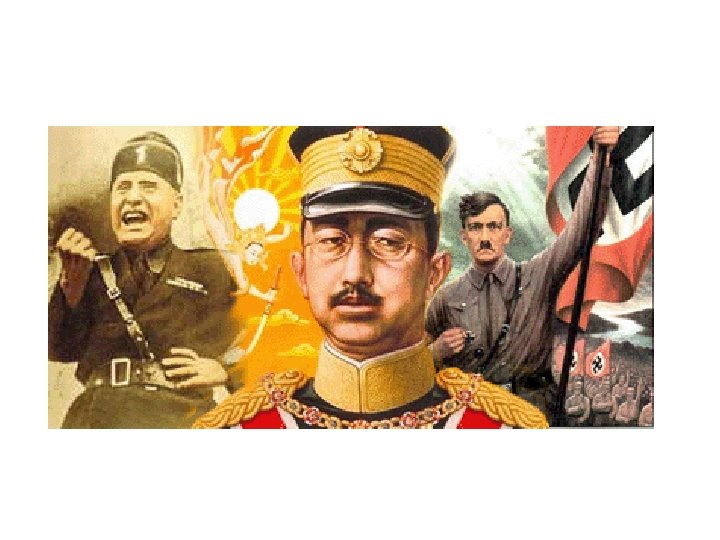
WWII Axis Powers Germany Italy Japan Allied Powers
![Vietnam [Indochina] War o. Reasons the United States participated in the Vietnam conflict §Similarities](https://slidetodoc.com/presentation_image_h2/01ded1ad288d04786e45ad9b2ba606b2/image-19.jpg "Vietnam [Indochina] War o. Reasons the United States participated in the Vietnam conflict §Similarities")
![§TET Offensive [T. O. ]- Although a statistical defeat for the Vietcong, the T.](https://slidetodoc.com/presentation_image_h2/01ded1ad288d04786e45ad9b2ba606b2/image-22.jpg "§TET Offensive [T. O. ]- Although a statistical defeat for the Vietcong, the T.")
- Slides: 36
WWII
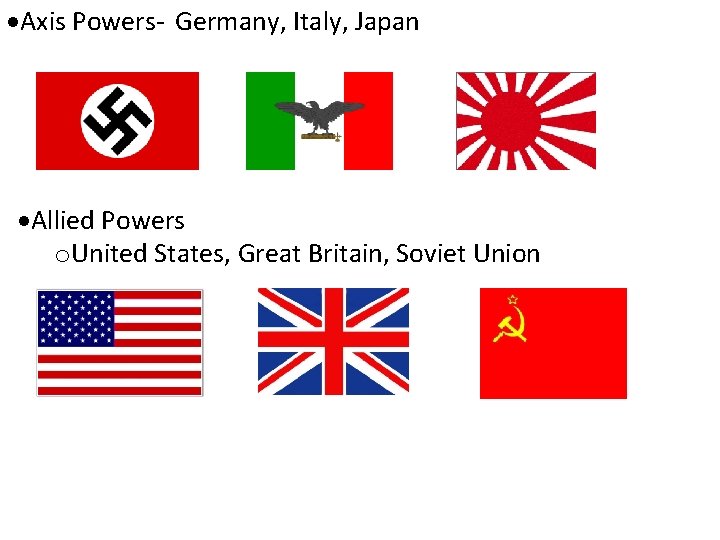
Axis Powers- Germany, Italy, Japan Allied Powers o. United States, Great Britain, Soviet Union
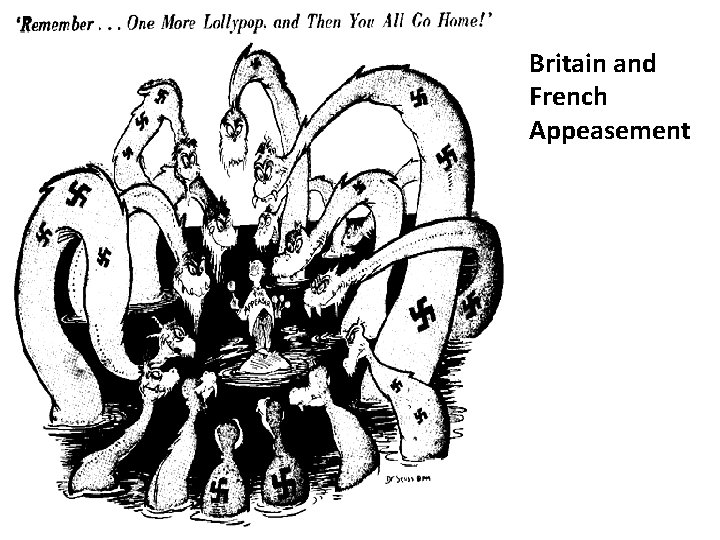
Britain and French Appeasement
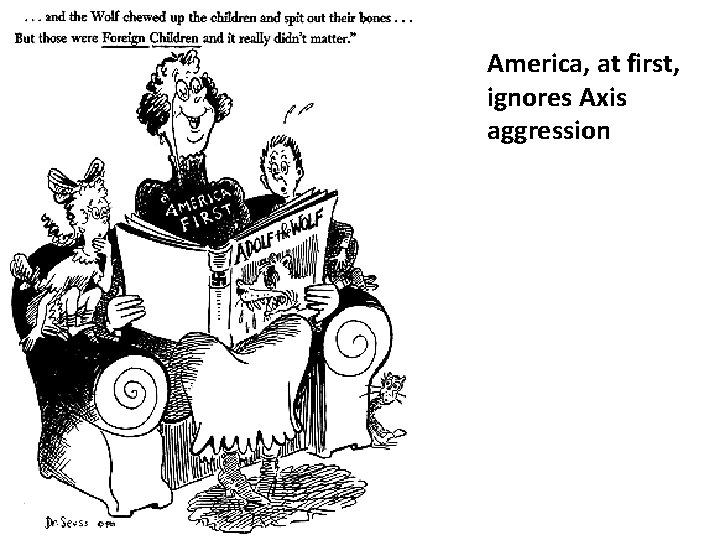
America, at first, ignores Axis aggression
1. The War Begins • Immediate Cause- Germany invades Poland on September 1 st, 1939 • December 7 th, 1941 - Japan attacks U. S. base at Pearl Harbor, forcing U. S. into the war “…a day that will live in infamy” - President Franklin D. Roosevelt
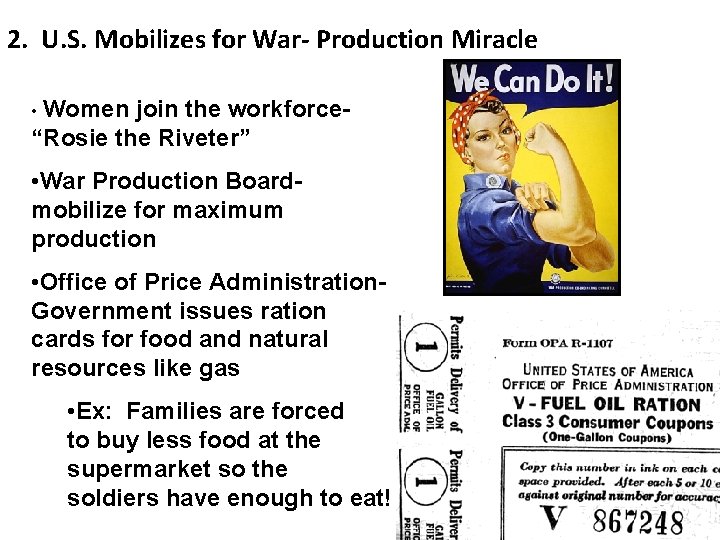
2. U. S. Mobilizes for War- Production Miracle • Women join the workforce“Rosie the Riveter” • War Production Boardmobilize for maximum production • Office of Price Administration. Government issues ration cards for food and natural resources like gas • Ex: Families are forced to buy less food at the supermarket so the soldiers have enough to eat!
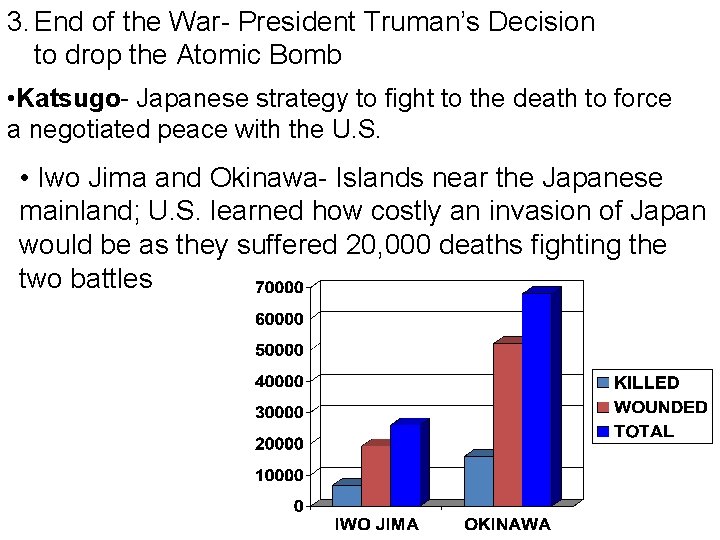
3. End of the War- President Truman’s Decision to drop the Atomic Bomb • Katsugo- Japanese strategy to fight to the death to force a negotiated peace with the U. S. • Iwo Jima and Okinawa- Islands near the Japanese mainland; U. S. learned how costly an invasion of Japan would be as they suffered 20, 000 deaths fighting the two battles
3. End of the War- President Truman’s Decision to drop the Atomic Bomb o Bushido- Code of the Samurai o Kamikaze attacks- suicide attacks against U. S. troops and ships o Training Civilians- women and children were being trained as kamikaze fighters if U. S. invaded Japan o… Truman decided to drop a second bomb on Nagasaki, because Japan didn’t surrender after the first dropped on Hiroshima
• Internment of Japanese Americans- Japanese Americans relocated without trial b/c government feared they were spies or saboteurs o. Korematsu v. U. S. - Supreme Court ruled internment was constitutional because the need to keep the country safe was more important than the rights of the individual
• End Of War o. United Nations- Organization of countries in which world issues can be discussed in an effort to avoid war and maintain peace o. Nuclear Age- Use of atomic weapons enters world into nuclear age arms race nuclear power plants
Cold War
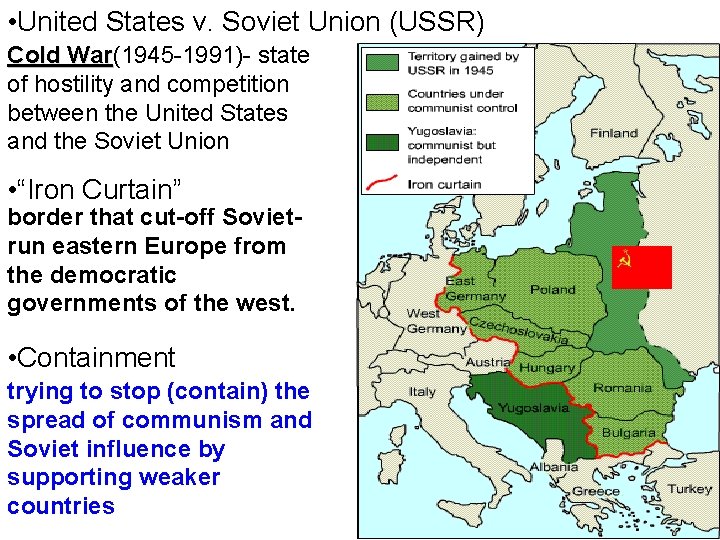
• United States v. Soviet Union (USSR) Cold War(1945 -1991)state War of hostility and competition between the United States and the Soviet Union • “Iron Curtain” border that cut-off Sovietrun eastern Europe from the democratic governments of the west. • Containment trying to stop (contain) the spread of communism and Soviet influence by supporting weaker countries
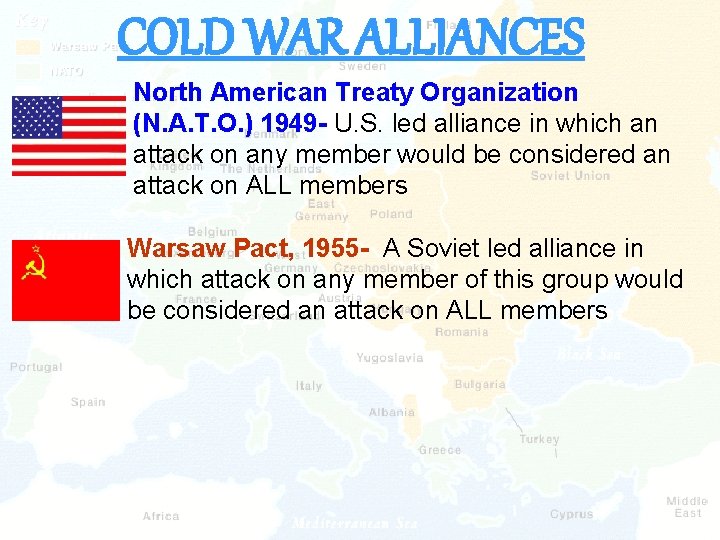
COLD WAR ALLIANCES North American Treaty Organization (N. A. T. O. ) 1949 - U. S. led alliance in which an attack on any member would be considered an attack on ALL members Warsaw Pact, 1955 - A Soviet led alliance in which attack on any member of this group would be considered an attack on ALL members
COLD WAR FEAR AND PANIC • Arms race ØLed to massive increase in defense spending • Mc. Carthyism 2 nd Red Scare! Mc. Carthyism- making public accusations of disloyalty to the United States without sufficient evidence • Bomb Shelters (Duck and Cover)
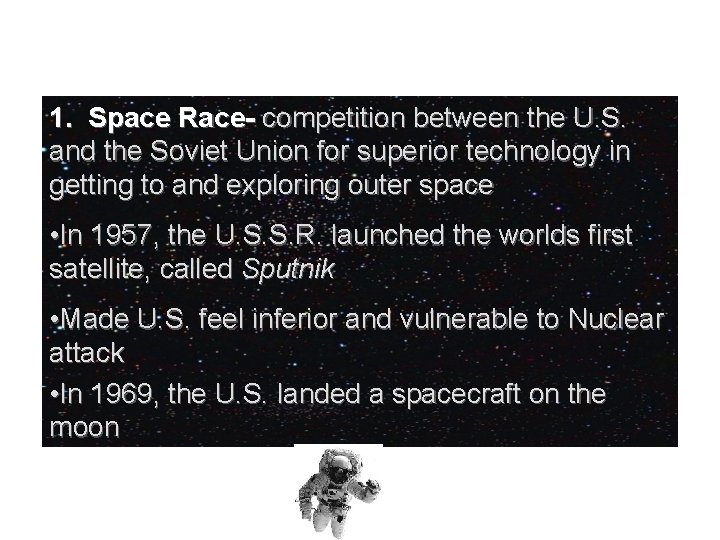
1. Space Race- competition between the U. S. and the Soviet Union for superior technology in getting to and exploring outer space • In 1957, the U. S. S. R. launched the worlds first satellite, called Sputnik • Made U. S. feel inferior and vulnerable to Nuclear attack • In 1969, the U. S. landed a spacecraft on the moon
• Cuban Missile Crisis • Reasons Soviet Premier Nikita Khrushchev put nuclear missiles in Cuba Øto protect Cuba [a Communist ally] Øto gain advantage in Arms Race • Panic of nuclear war in the United States and around the world
Reasons for President John F. Kennedy’s decision to blockade Cuba: - Did not want to start nuclear war -Thought blockade and negotiation would put pressure on USSR Results of the Cuban Missile Crisis being resolved: -USSR agrees to take missiles out of Cuba -U. S. promises never to invade Cuba (and secretly to take missiles out of Turkey)
Vietnam [Indochina] War o. Reasons the United States participated in the Vietnam conflict §Similarities with the Korean conflict Both countries divided between a communist north and non-communist south §Truman Doctrine- U. S. foreign policy, we would stop spread of communism anywhere §Domino Theory- idea that if one country in Asia fell to communism, the rest would follow
Gulf of Tonkin Incident Gulf of Tonkin Resolution §In response to alleged attacks on U. S. ships in the Gulf of Tonkin, Johnson asks for full power to use U. S. military "to prevent further aggression"- (Gulf of Tonkin Resolution) Gulf of Tonkin Resolution Escalates War: §Approves Operation Rolling Thunder [massive bombing campaign on North Vietnam, supply routes, and Vietcong hideouts. §By 1967, 500, 000 U. S. troops in Vietnam
o. Reasons for the antiwar movement and protest §Living Room War and credibility gap a. Constant television coverage of the war showed Americans the horror of the fighting (AKA Living Room War) b. media coverage led to a "credibility gap", in which what the government was saying and what was being reported by the news were very different §New Left- Much of the opposition and protest over the Vietnam war was led by young, college aged adults (New Left) -Saw war as civil war - unhappy with draft §Draft- seen as bias against minorities and the poor
§TET Offensive [T. O. ]- Although a statistical defeat for the Vietcong, the T. O. changed the minds of many Americans to believe that the war was un-winnable (Government's "Credibility Gap" widened §Underfunding the Great Society- LBJ’s social program (The Great Society) did not receive enough money b/c the Vietnam War was so expensive
o. Results of War §Vietnam is united under communism §War Powers Act- intended to check the power of the President in committing the United States to an armed conflict without the consent of Congress After Vietnam, President Nixon tries to improve relations between the United States and the Communist world with détente: - Nixon’s Visit to China- improves relationship between Communist China and U. S. ; leads to SALT talks with USSR, because Soviets want to avoid a strong American- Chinese alliance
§Watergate scandal- political scandal during the 1970 s in the United States resulting from the break-in of the Democratic National Committee headquarters at the Watergate office complex in Washington, D. C. Effects of the scandal eventually led to the resignation of the President of the United States, Richard Nixon, on August 9, 1974, the first and only resignation of any U. S. President. §Summit meetings between President Reagan and Gorbachev §Glasnost – Soviet government eases up on censorship §Fall of the Berlin Wall- Symbolic end to the Cold War
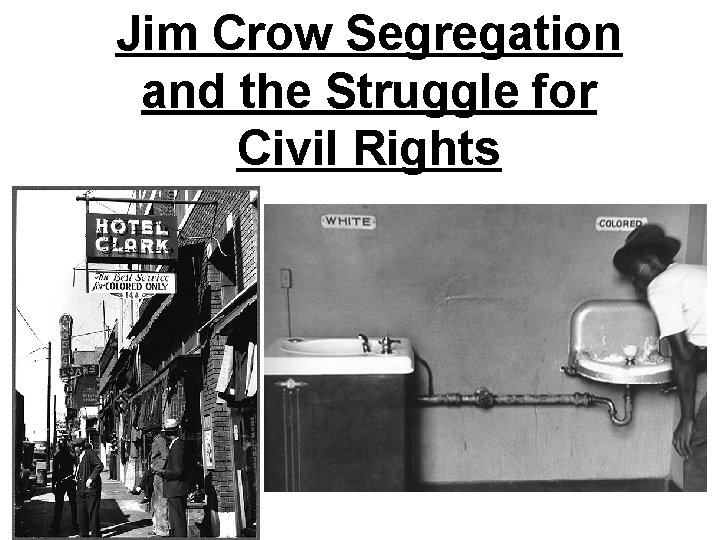
Jim Crow Segregation and the Struggle for Civil Rights
§Segregation/Jim Crow laws §Jackie Robinson §President Harry S. Truman de-segregates the U. S. Armed Forces [troops] §Brown v. Board of Education of Topeka, Kansas (1954)
§Civil Disobedience §Montgomery Bus Boycott Rosa Parks §Martin Luther King, Jr. SCLC §Little Rock crisis
§Sit-ins §March on Washington §Civil Rights Act of 1964 §Voting Rights Act of 1965
Middle East • Israel is recognized as democratic country in 1948 o. Conflict with Palestinians o. Conflict between the United States and Palestinians
Camp David accord- important step in the Middle-East peace process; tried to make peace between Israel and Egypt (and other Arab countries); mediated by President Jimmy Carter at the president’s vacation home in Camp David. Persian Gulf War • (August 2, 1990 – February 28, 1991) War between U. N. and U. S. forces and the Iraqi Army under Saddam Hussein • Iraq invaded Kuwait to gain control over the oil fields • President George H. W. Bush committed U. S. forces to protect Kuwait b/c U. S. wanted to keep oil supply from Kumait open
• September 11, 2001 Al-Qaeda terrorist attacks on the World Trade Center and Pentagon • Decision to invade Afghanistan after 9/11 attacks. Afghanistan seen as safe grounds for Al Qaeda (terrorist organization responsible for 911 attacks) § War on Terror § Patriot Act § Creation of Homeland Security
Issues of the 20 th/21 st Century • Baby Boom of the 1950 s a. baby boom- the large increase in the birthrate from the late 1940 s to the early 1960 s b. factors -----> post WWII baby boom • Improved healthcare • economic growth allowed many to afford more children §Increase of home construction and school population in late 1950 s and 1960 s §Increase demand on the Social Security System in 2011 - as “Baby Boomers” get older, Gov’t finding it difficult to pay pensions • Affirmative Action • Sandra Day O’Connor & Geraldine Ferraro • Illegal immigration
Impact of Technology on American Society [based on historical importance and what you have learned in social studies – NOT your personal experiences] §Henry Ford’s assembly line [mass production] -Allowed Ford to make cars affordable for average American -Led to a huge growth in automobile sales in the 1920 s -Technique copied by many other companies §The automobile -Led to economic growth in U. S. in the 1920 s (oil industry, rubber, glass, roadside restaurants and gas stations) -Growth of suburbs as people could live further away from work
• Radio -Consumer product of the 1920 s -Led to advertising and entertainment revolution -Fireside chats -Nixon/Kennedy debate- those who listened on radio though Nixon won • Nuclear power -Manhattan Project- Allied plan to develop nuclear weapons during WWII -Atomic weapons used to force Japanese surrender -Cold war nuclear arms race (Cuban Missile Crisis) -Nuclear Power Plant disasters! - Chernobyl, Three Mile Island Japan 2011
• Television -Consumer product of the 1950 s -Advertising and entertainment revolution -Army/Mc. Carthy hearings -Nixon/Kennedy debate- people who watched felt Kennedy won -Living Room War- TV coverage of Vietnam led to loss of public support and credibility gap • Computer Revolution • Steve Jobs & Bill Gates • Internet • “Shrinking World” • Instant news • Instant access to information • Instant communication with others via e-mail
Presidential Elections 2000 election- Controversial recount in the State of Florida; many suspicious voter problems in democratic counties; Bush is given victory in Florida and wins election 2008 election – Barack Obama becomes the country’s first African American president