
WWI AND ITS AFTERMATH WORLD WAR I 1914
- Slides: 18
WWI AND ITS AFTERMATH
WORLD WAR I • 1914– 18 • First great international conflict of the twentieth century • The trauma of the war would profoundly shape the attitudes and actions of both leaders and ordinary people during the Holocaust. • The impact of the conflict and its divisive peace would echo in the decades to come, giving rise to a second world war and genocide committed under its cover.
KEY FACTS • World War I represented one of the most destructive wars in modern history. Nearly ten million soldiers died as a result of the hostilities. This far exceeded military deaths in all the wars of the previous one hundred years combined. • A series of treaties were imposed upon the defeated nations (Germany, Austria, Hungary, Bulgaria, and Turkey). They held these powers, particularly Germany, responsible for starting the war and liable for massive material damages. • The Versailles Treaty of 1919 forced Germany to cede 13 percent of its territory and limit its armed forces. Many citizens linked the treaty to the humiliation of national defeat.
OUTBREAK OF WORLD WAR I • The assassination of Archduke Franz Ferdinand, heir to the Austro-Hungarian crown, and his wife, the Archduchess Sophie, in Sarajevo on June 28, 1914, sparked the hostilities. • Fighting began in August 1914, and continued on several fronts for the next four years.
ENTENTE AND CENTRAL POWERS • The opposing sides in World War I are known as the Entente Powers and the Central Powers. • Entente Powers: • Britain • France • Serbia • Imperial Russia • Joined later by Italy, Greece, Portugal, Romania, and the United States • Central Powers: • Germany • Austria-Hungary • Joined later by Ottoman Turkey and Bulgaria
THE SCOPE OF FIGHTING • Initially there was enthusiasm on all sides for a quick and decisive victory. • It became a stalemate of costly battles and trench warfare, particularly on the war's western front. • Trench warfare. • 475 miles
IMPACT OF US ENTRY INTO WWI • April 1917 • Unrestricted submarine warfare • Fresh troops and material from the American Expeditionary Force (AEF) • Shift the balance of the war effort
THE RUSSIAN REVOLUTION • Two revolutions took place in 1917. • The first overthrew the imperial government. • The second brought the Bolsheviks to power. These events are referred to collectively as the Russian Revolution. • The immediate effect of the Russian Revolution on the European stage was a brutal and enduring civil war in Russian lands (1917– 1922) and the decision of the new Bolshevik leadership to make a separate peace with the Kaiser's Germany. When negotiations foundered over German demands, the German army launched an all-out offensive on the eastern front, resulting in a peace treaty at Brest-Litovsk on March 6, 1918.
CENTRAL POWERS SURRENDER • Some successes for Germany. • Knocked Bolshevik Russia out of the war in late winter 1918 • Reached Paris during the summer • The Central Powers began to surrender, beginning with Bulgaria and the Ottoman Empire, in September and October, respectively. On November 3, Austro-Hungarian forces signed a truce near Padua, Italy. • In Germany, the mutiny of navy sailors in Kiel touched off a widespread revolt in German coastal cities, and in the major municipal areas of Hannover, Frankfurt on Main, and Munich. 1
ARMISTICE • On November 9, 1918 Emperor (Kaiser) William II abdicated the German throne. • On the same day, SPD delegate Philipp Scheidemann proclaimed Germany a republic, with an interim government led by Friedrich Ebert. • Two days later, German representatives met with a delegation of the victorious Entente powers in a railcar in Compiègne Forest and accepted armistice terms. • At 11: 00 a. m. on November 11 (11/11), 1918, fighting on the western front ceased.
MILITARY LOSSES • The enormous losses on all sides of the conflict resulted in part from the introduction of new weapons, like the machine gun and gas warfare. • Military leaders also failed to adjust their tactics to the increasingly mechanized nature of warfare. A policy of attrition, particularly on the western front, cost the lives of hundreds of thousands of soldiers. • July 1, 1916, saw the heaviest loss of life in a single day. On this day, the British Army on the Somme alone suffered over 57, 000 casualties. • Germany and Russia incurred the highest number of military deaths: an estimated 1, 773, 700 and 1, 700, 000, respectively. France lost sixteen percent of its mobilized forces, the highest mortality rate relative to troops deployed.
CIVILIAN LOSSES • No official agencies kept careful accounting of civilian losses during the war years, but scholars assert that as many as 13, 000 non-combatants died as a direct or indirect result of hostilities. Mortality for both military and civilian populations spiked at war's end with the outbreak of the "Spanish Flu, " the deadliest influenza epidemic in history. • Millions of people were uprooted or displaced from their homes in Europe and Asia Minor as a result of the conflict. Property and industry losses were catastrophic, especially in France and Belgium, where fighting had been the heaviest.
THE UNDERMINING OF DEMOCRACY IN GERMANY • Spiraling hyperinflation of the German currency • The causes included the burdensome reparations imposed after World War I, • The Great Depression (beginning in 1929) to seriously undermine the stability of the German economy, wiping out the personal savings of the middle class and spurring massive unemployment. • Economic chaos increased social unrest and destabilized the fragile Weimar Republic. "Weimar Republic" is the name given to the German government between the end of the Imperial period (1918) and the beginning of Nazi Germany (1933).
THE UNDERMINING OF DEMOCRACY IN GERMANY • Many Germans felt that Germany's prestige should be regained through remilitarization and expansion. • Radical right wing parties in Weimar Germany. • The harsh provisions of the Treaty of Versailles • Germans recalled only that the German Left—Socialists, Communists, and Jews, in common imagination—had surrendered German honor to a disgraceful peace when no foreign armies had even set foot on German soil. • This Dolchstosslegende (stab-in-the-back legend) was initiated and fanned by retired German wartime military leaders, who, well aware in 1918 that Germany could no longer wage war, had advised the Kaiser to sue for peace.
THE UNDERMINING OF DEMOCRACY IN GERMANY • The Weimar Republic was the least worst alternative. They tried to steer their compatriots away from polarization to the radical Left and Right. • The German nationalist Right promised to revise the Versailles Treaty. • Fear of an imminent Communist threat following the Bolshevik Revolution in Russia • Agitators from the political left served heavy prison sentences for inspiring political unrest. • Raw fear of the potential for a Communist takeover in the German middle classes, worked to undermine pluralistic democratic solutions in Weimar Germany. • These fears and challenges also increased public longing for more authoritarian direction
CULTURAL DESPAIR • Disillusionment with international and national politics and a sense of distrust in political leaders and government officials spread throughout the public • The vivid and realistic account of trench warfare portrayed in Erich Maria Remarque's 1929 masterpiece All Quiet on the Western Front (Im Westen nichts Neues) which captured the experience of frontline troops and expressed the alienation of the "lost generation" who returned from war and found themselves unable to adapt to peacetime and tragically misunderstood by a home front population who had not seen the horrors of war firsthand.
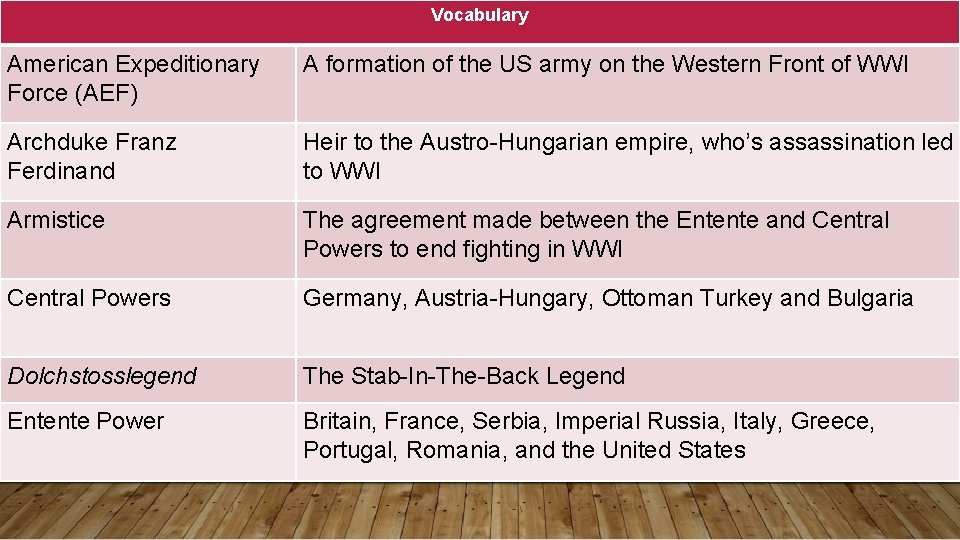
Vocabulary American Expeditionary Force (AEF) A formation of the US army on the Western Front of WWI Archduke Franz Ferdinand Heir to the Austro-Hungarian empire, who’s assassination led to WWI Armistice The agreement made between the Entente and Central Powers to end fighting in WWI Central Powers Germany, Austria-Hungary, Ottoman Turkey and Bulgaria Dolchstosslegend The Stab-In-The-Back Legend Entente Power Britain, France, Serbia, Imperial Russia, Italy, Greece, Portugal, Romania, and the United States
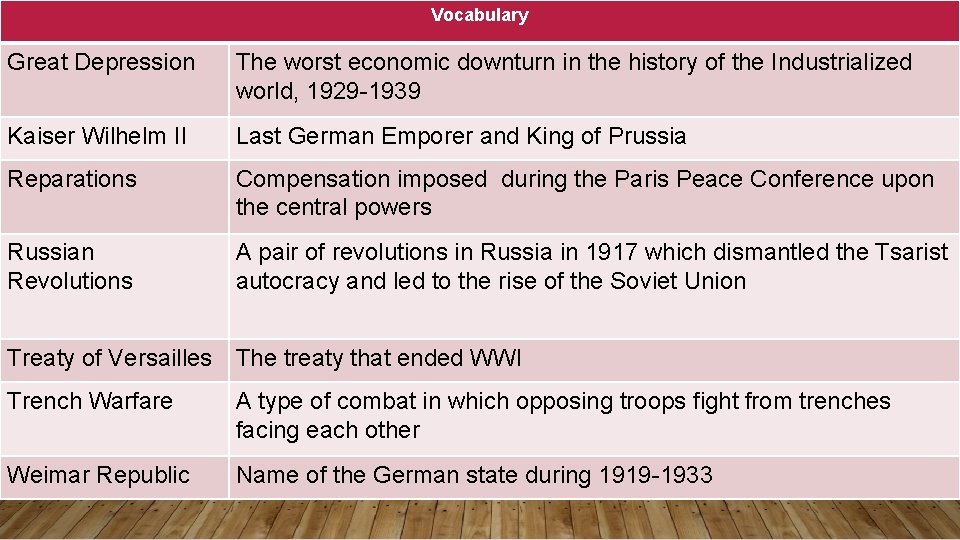
Vocabulary Great Depression The worst economic downturn in the history of the Industrialized world, 1929 -1939 Kaiser Wilhelm II Last German Emporer and King of Prussia Reparations Compensation imposed during the Paris Peace Conference upon the central powers Russian Revolutions A pair of revolutions in Russia in 1917 which dismantled the Tsarist autocracy and led to the rise of the Soviet Union Treaty of Versailles The treaty that ended WWI Trench Warfare A type of combat in which opposing troops fight from trenches facing each other Weimar Republic Name of the German state during 1919 -1933