
WWAMI Faculty Development Webinar Teaching Professionalism in a
WWAMI Faculty Development Webinar Teaching Professionalism in a Family Medicine Residency Shannon U Waterman, MD and Julie Taraday, MD Swedish Family Medicine Cherry Hill Seattle, WA November 1, 2017
Teaching Professionalism • • • Rationale – what is it and why teach it? National resources UW SOM experience Cherry Hill experience Regional experience - discussion
Medical professionalism is… the ability to meet the relationship-centered expectations required to practice medicine competently. Kuczewski et al, 2003; Lynch et al; Surdyk et al 2003
Why try to teach this? • Have to – ACGME mandate. • It’s the right thing to do. Explicit expectations. • Most patient complaints about providers involve unprofessional behavior. • Less burnout among residents may lead to less burnout in later practice, less unprofessional behavior, the development of greater resiliency leading to longer service and greater satisfaction.
ACGME Common Program Requirements (CPR) - Residents IV. A. 5. e) Professionalism - Residents must demonstrate a commitment to carrying out professional responsibilities and an adherence to ethical principles. Residents are expected to demonstrate: (1) compassion, integrity, and respect for others; (2) responsiveness to patient needs that supersedes self-interest; (3) respect for patient privacy and autonomy; (4) accountability to patients, society and the profession; (5) sensitivity and responsiveness to a diverse patient population, including but not limited to diversity in gender, age, culture, race, religion, disabilities, and sexual orientation.
STFM Guidance 2002 Physician Charter The professionalism principles include: • Altruism—dedication to serving the best interests of our patients • Patient autonomy—honesty with our patients and using each individual patient’s care wishes to guide therapy • Social justice—this includes the fair distribution of health care services and the elimination of discrimination in health care http: //www. stfm. org/Resourcesfor. New. Faculty. Medical. Professionalism
American Board Family Medicine (ABFM) Professionalism Milestones • PROF-1 Completes a process of professionalization • PROF-2 Demonstrates professional conduct and accountability • PROF-3 Demonstrates humanism and cultural proficiency • PROF-4 Maintains emotional, physical, and mental health; and pursues continual personal and professional growth https: //www. acgme. org/Portals/0/PDFs/Milestones/Family. Medicine. Milestones. pdf
POLL How many of you have a formal, longitudinal curriculum around professionalism? Yes No Other

Show me the…
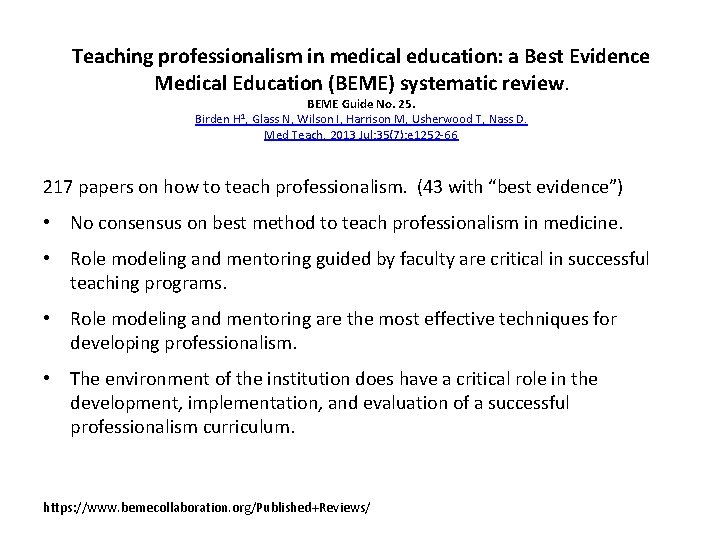
Teaching professionalism in medical education: a Best Evidence Medical Education (BEME) systematic review. Birden H 1, BEME Guide No. 25. Glass N, Wilson I, Harrison M, Usherwood T, Nass D. Med Teach. 2013 Jul; 35(7): e 1252 -66 217 papers on how to teach professionalism. (43 with “best evidence”) • No consensus on best method to teach professionalism in medicine. • Role modeling and mentoring guided by faculty are critical in successful teaching programs. • Role modeling and mentoring are the most effective techniques for developing professionalism. • The environment of the institution does have a critical role in the development, implementation, and evaluation of a successful professionalism curriculum. https: //www. bemecollaboration. org/Published+Reviews/
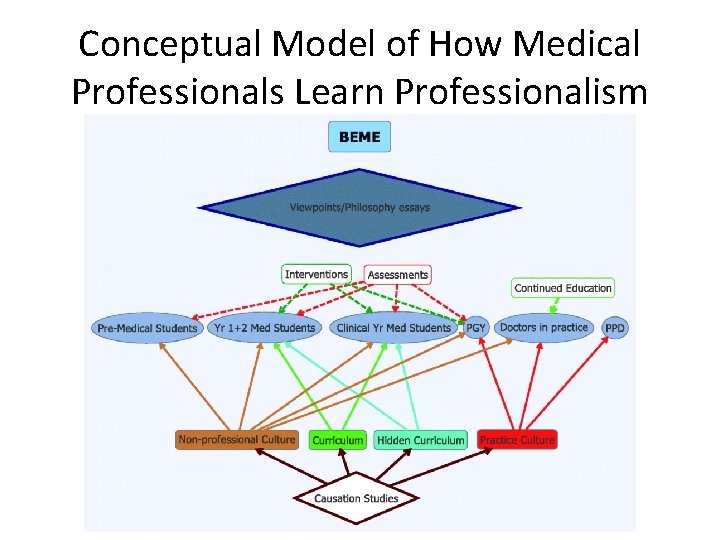
Conceptual Model of How Medical Professionals Learn Professionalism
POLL Think of a time you experienced growth in your own professionalism. What was the catalyst for that growth? One-on-one conversation with mentor Witnessing ethical behavior Witnessing UNethical behavior Critical conversation/disciplinary action Didactic Other – please give example
ACGME: Advancing Education in Medical Professionalism - 2004 • Different models of teaching and assessing professionalism from the ACGME Outcome Project https: //www. usahealthsystem. com /workfiles/com_docs/gme/2011%2 0 Links/Professionalism%20%20 Faculty%20 Dev. . pdf
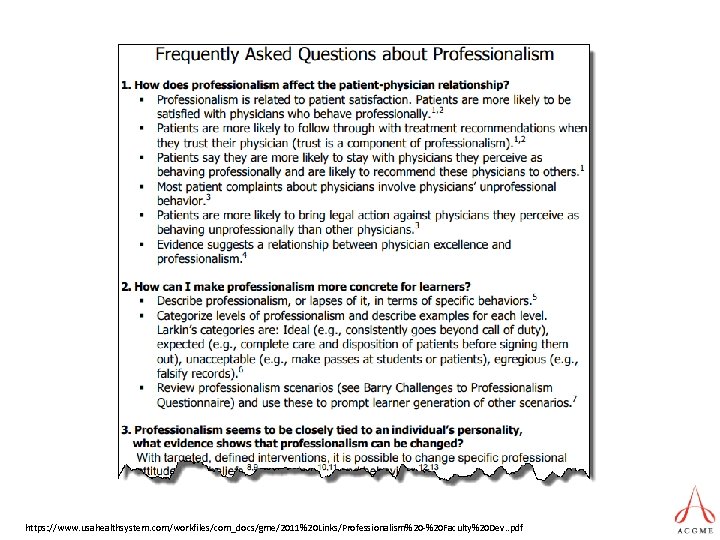
https: //www. usahealthsystem. com/workfiles/com_docs/gme/2011%20 Links/Professionalism%20 -%20 Faculty%20 Dev. . pdf
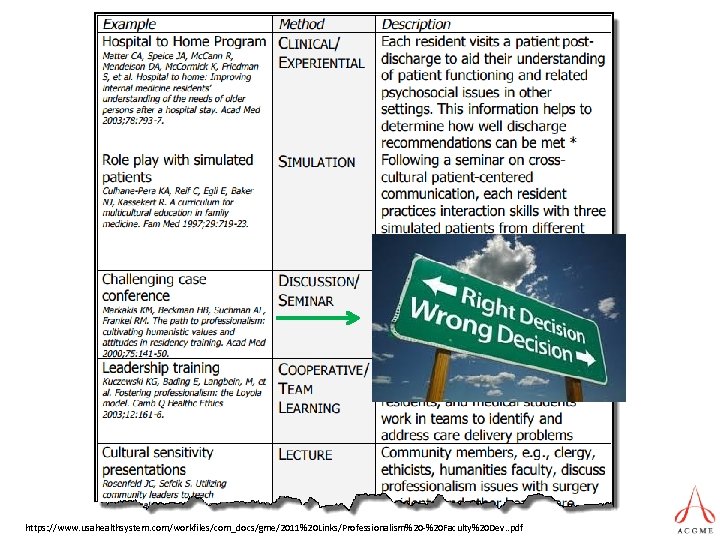
https: //www. usahealthsystem. com/workfiles/com_docs/gme/2011%20 Links/Professionalism%20 -%20 Faculty%20 Dev. . pdf
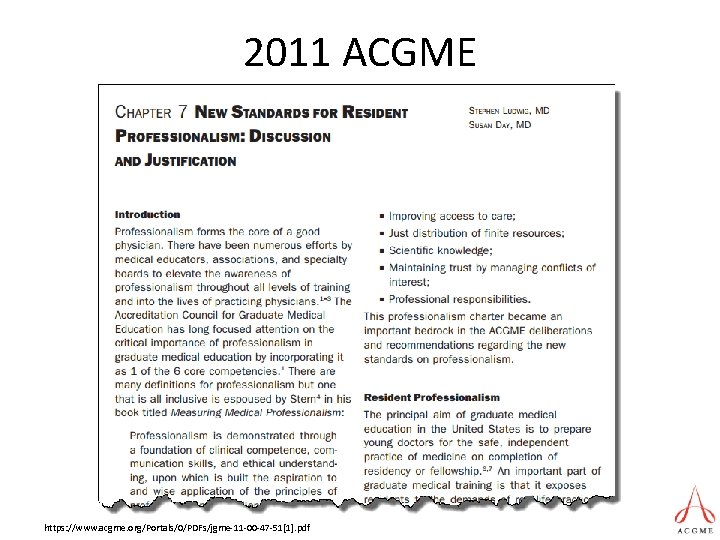
2011 ACGME https: //www. acgme. org/Portals/0/PDFs/jgme-11 -00 -47 -51[1]. pdf
UW SOM Experience • Immersion/Orientation • Ecology of Health – History of medical profession – Individual Responsibility in the Profession – Conflicts of interest in relationships – Physicians as leaders – Enabling culture of speaking up/patient safety – “Aftermath” – responding to major clinical event or error – Wellness of the system (negligence/malpractice) – Research professionalism – Writing professionalism
UW SOM Experience • Foundations of Clinical Medicine – Reflecting on practice – Substance use and abuse – Personal and professional boundaries – Student and physician wellness • Transition/Consolidation topics (before entering clinical rotations) – hidden curriculum
Swedish CHFM Experience • Intern Orientation – – Welcome by Dr. Taraday Imperfection Option Racism workshop and longitudinal anti-racism curriculum GME orientation (HIPAA, social media and dress code policies, etc. ) • Senior Orientation (R 1 R 2, R 2 R 3) – Continuity and back-up responsibilities – Supervision – Feedback culture • • • Clinic orientation(s) or retreats Didactics (including two behavioral health blocks) Practice Management Advising Other
POLL When does your program provide specific curriculum addressing professionalism? • • Intern Orientation Transition to Senioring/Senior Orientation Clinic orientation(s) or retreats Behavioral Health longitudinal curriculum Resident wellness curriculum Didactics Practice Management Other –give examples (free text)
ACGME Common Program – Well Being VI. C. Well-Being In the current health care environment, residents and faculty members are at increased risk for burnout and depression. Psychological, emotional, and physical wellbeing are critical in the development of the competent, caring, and resilient physician. Self-care is an important component of professionalism; it is also a skill that must be learned and nurtured in the context of other aspects of residency training. Programs, in partnership with their Sponsoring Institutions, have the same responsibility to address wellbeing as they do to evaluate other aspects of resident competence.
Organizational Impact of Burnout • Impact on team – Disrupts collaboration, consultation, collegialism, and morale – Staff splitting and conflict • Impact on patients – Patient dissatisfaction – Patient noncompliance • Impaired job performance – Decreased empathy, increased absenteeism • High job turnover – $600, 000 -$3. 5 million recruitment and lost billing costs/PCP • Increased malpractice events and medical errors Nurturing Resilience and Joy in Medicine. Laura Moss, MD, WAPHP. Oct 2017
CHFM Experience – Intern Orientation • • • Why introduce growth vs fixed mindset? Millennial era learners Service as learning Adult learning and accountability Positive role of stress Wellness and resilience
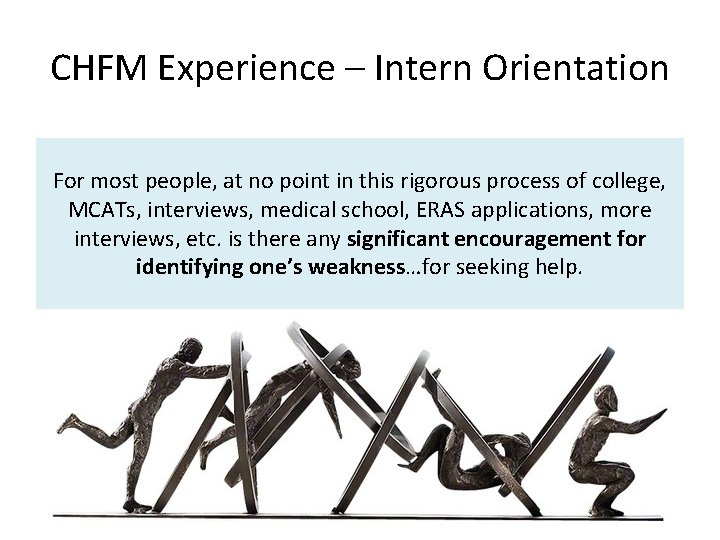
CHFM Experience – Intern Orientation For most people, at no point in this rigorous process of college, MCATs, interviews, medical school, ERAS applications, more interviews, etc. is there any significant encouragement for identifying one’s weakness…for seeking help.
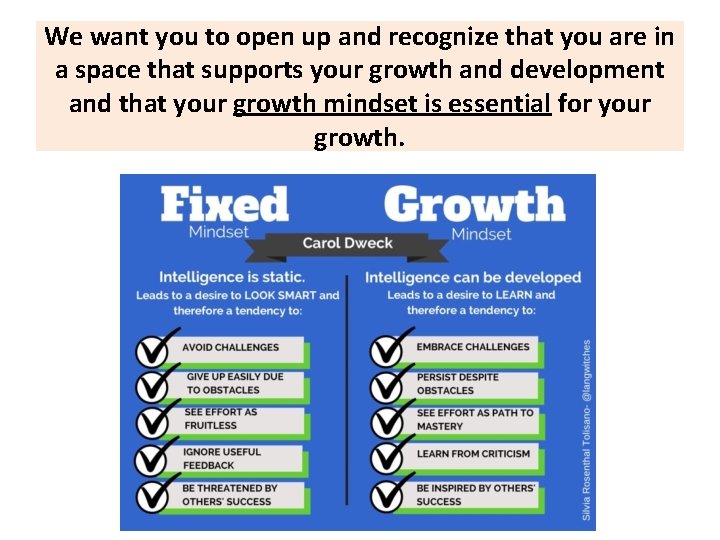
We want you to open up and recognize that you are in a space that supports your growth and development and that your growth mindset is essential for your growth.
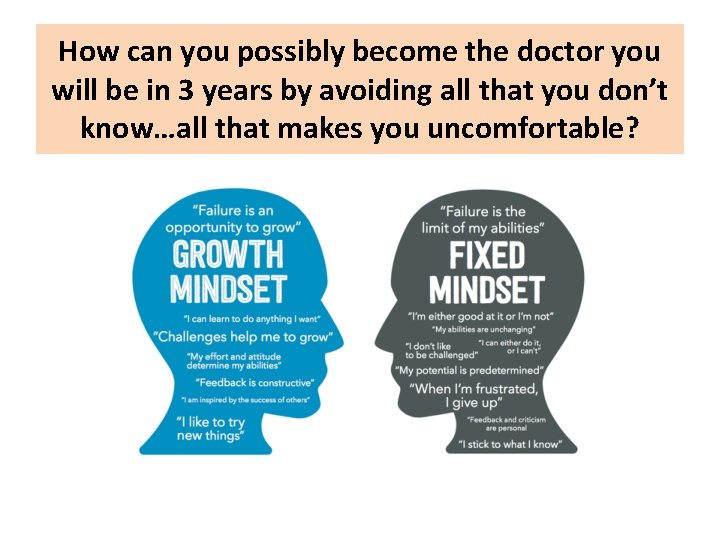
How can you possibly become the doctor you will be in 3 years by avoiding all that you don’t know…all that makes you uncomfortable?
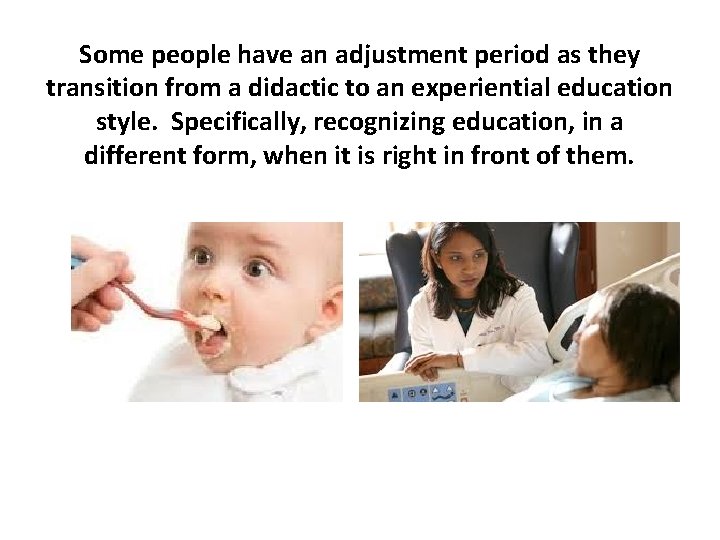
Some people have an adjustment period as they transition from a didactic to an experiential education style. Specifically, recognizing education, in a different form, when it is right in front of them.
CHFM Intern Orientation - Accountability You are incredibly privileged to be where you are. Your patients trust that, though you are still learning (as we all are), you will do your best for them, that you will advocate for them, that you will get help (for them) when you need it. It is your responsibility to learn with each patient encounter and to show them compassion and empathy. It is your responsibility to bring your positive growth mindset into every experience – your “A” attitude not your “A” grade. Ultimately, you must be accountable to who you become and what you get out of residency.
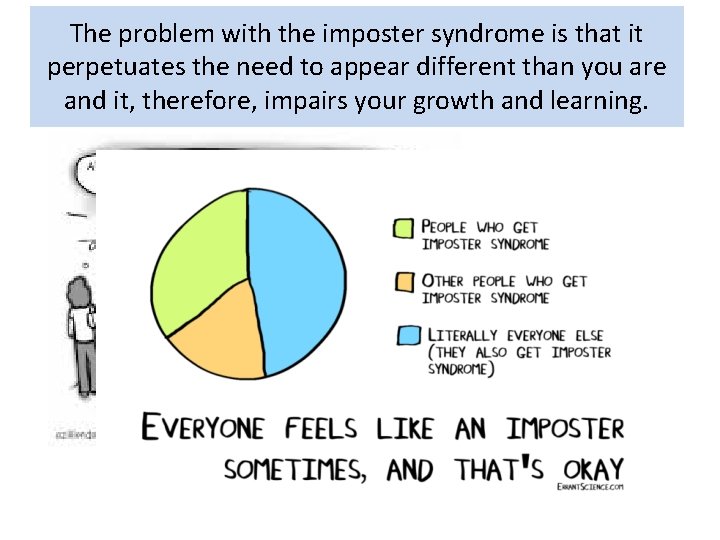
The problem with the imposter syndrome is that it perpetuates the need to appear different than you are and it, therefore, impairs your growth and learning.
Your ability to connect, to listen, to advocate, to empathize is available to you and your patients right now. So even if you have many more algorithms to learn, you can give yourself to your patients.
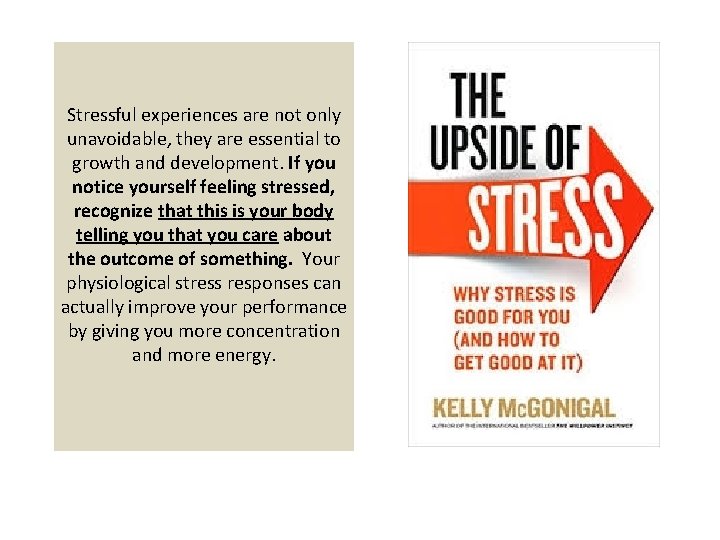
Stressful experiences are not only unavoidable, they are essential to growth and development. If you notice yourself feeling stressed, recognize that this is your body telling you that you care about the outcome of something. Your physiological stress responses can actually improve your performance by giving you more concentration and more energy.
You are stronger together than you are individually and your ability to care for each other will, in part, determine your resilience to some of the harder elements in residency. You aren’t alone and you are responsible for helping others remember that they aren’t alone
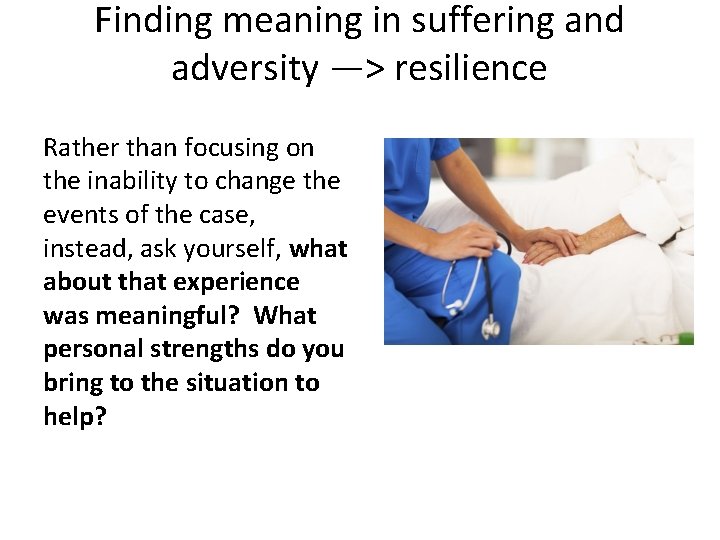
Finding meaning in suffering and adversity —> resilience Rather than focusing on the inability to change the events of the case, instead, ask yourself, what about that experience was meaningful? What personal strengths do you bring to the situation to help?
Exercise • Now, I’d like you to consider, what, if any, benefits have you experienced from the stress? • Are there ways that your life is better because of it? [caution to clarify that I’m not saying the actual event needs to be considered a positive event. ] • Have you changed in any positive ways to cope with this experience? • How has this experience revealed your strengths? • This change may be how you think about yourself and what you’re capable of. How you have personally grown or changed as a result of having to cope with this experience? What strengths you used to help yourself cope.
Post Traumatic Resilience If we pull back from our patients and from their suffering as a way to protect ourselves, we will be left with pity instead of empathy. Our patients don’t need our pity. It doesn’t help them. In almost every traumatic story, there is a story of resilience, a story of meaning and growth that is birthed from the trauma. Just like thought experiment you just completed about the benefits you gathered from your own stress, I encourage you to look for those stories of resilience and interview your patients about them. In the midst of acute grief, it may merely be the act of pointing out the courage to authentically experience grief and sadness instead of burying it. You may help your patient discover a source of pride, a source of strength, a source of resilience. This is a gift of listening for the resilience. You can give this to your patients and to yourself as well. And, in turn, you will find that you can remain empathetic without burning out.
Values Clarification Exercise • On the inside of your name tag write down three values. • Now I’d like to you write down one “bigger than self” goal based on one of your 3 values. • A “bigger than self” goal is a goal that goes beyond the goal of personal gain and success. It is more about how you see your role within your community. No pressure to attain this goal so OK to be aspirational. • What do you want to contribute? What do you want to create? How will you improve the lives of your patients? • How will this job as a resident allow you to help others and make a difference and make the kind of impact you want to have on the people around you?
CHFM Experience – Intern Orientation • Two years in… • Interns actively raise topics introduced
POLL Within professionalism, what topics do you wish your program addressed better? • Altruism • Boundaries • Medical mistakes • Recognition of impairment in self/others • Resilience • Burnout prevention • Other – please give examples
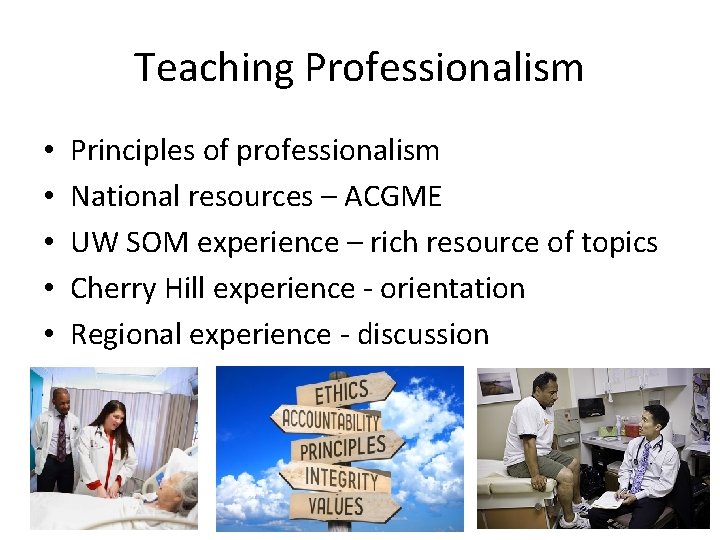
Teaching Professionalism • • • Principles of professionalism National resources – ACGME UW SOM experience – rich resource of topics Cherry Hill experience - orientation Regional experience - discussion
POLL Other ways to teach professionalism – How are you innovating?

Thank you for your participation QUESTIONS? THOUGHTS? Shannon U Waterman, MD – shannon. waterman@swedish. org Julie Taraday, MD – julie. taraday@swedish. org Swedish Family Medicine Cherry Hill
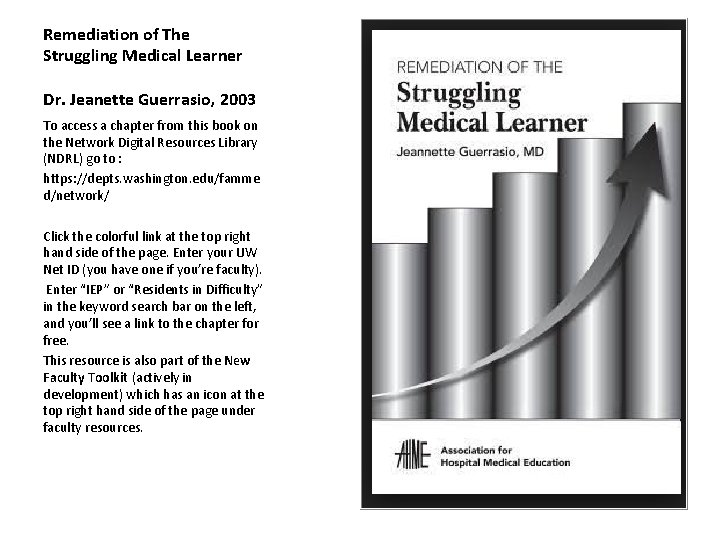
Remediation of The Struggling Medical Learner Dr. Jeanette Guerrasio, 2003 To access a chapter from this book on the Network Digital Resources Library (NDRL) go to : https: //depts. washington. edu/famme d/network/ Click the colorful link at the top right hand side of the page. Enter your UW Net ID (you have one if you’re faculty). Enter “IEP” or “Residents in Difficulty” in the keyword search bar on the left, and you’ll see a link to the chapter for free. This resource is also part of the New Faculty Toolkit (actively in development) which has an icon at the top right hand side of the page under faculty resources.
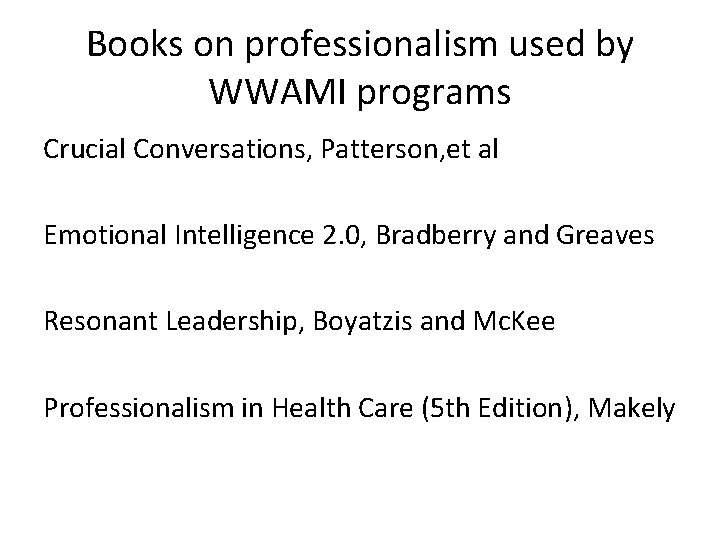
Books on professionalism used by WWAMI programs Crucial Conversations, Patterson, et al Emotional Intelligence 2. 0, Bradberry and Greaves Resonant Leadership, Boyatzis and Mc. Kee Professionalism in Health Care (5 th Edition), Makely
Additional ACGME Common Program Requirements Professionalism
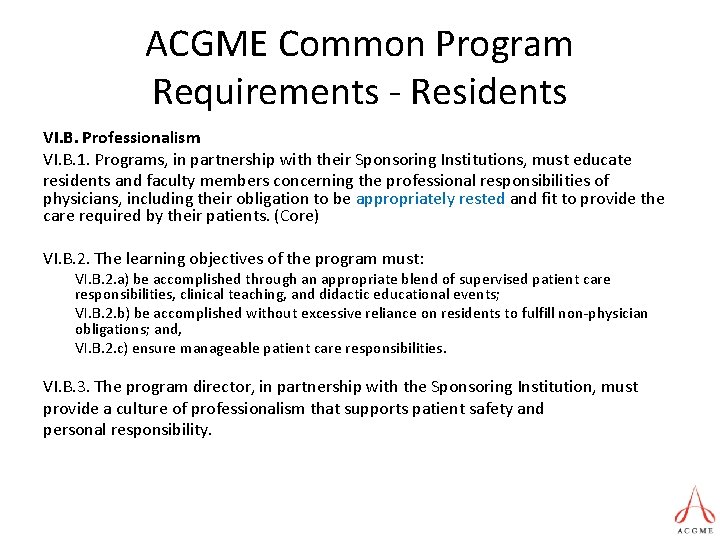
ACGME Common Program Requirements - Residents VI. B. Professionalism VI. B. 1. Programs, in partnership with their Sponsoring Institutions, must educate residents and faculty members concerning the professional responsibilities of physicians, including their obligation to be appropriately rested and fit to provide the care required by their patients. (Core) VI. B. 2. The learning objectives of the program must: VI. B. 2. a) be accomplished through an appropriate blend of supervised patient care responsibilities, clinical teaching, and didactic educational events; VI. B. 2. b) be accomplished without excessive reliance on residents to fulfill non-physician obligations; and, VI. B. 2. c) ensure manageable patient care responsibilities. VI. B. 3. The program director, in partnership with the Sponsoring Institution, must provide a culture of professionalism that supports patient safety and personal responsibility.
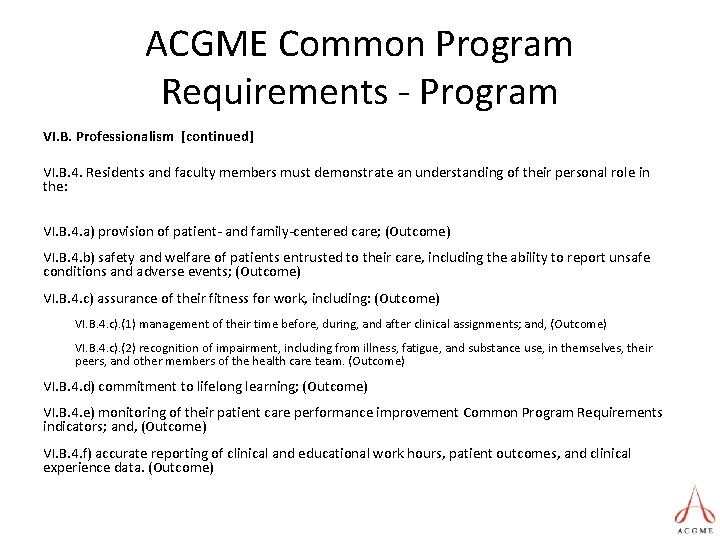
ACGME Common Program Requirements - Program VI. B. Professionalism [continued] VI. B. 4. Residents and faculty members must demonstrate an understanding of their personal role in the: VI. B. 4. a) provision of patient- and family-centered care; (Outcome) VI. B. 4. b) safety and welfare of patients entrusted to their care, including the ability to report unsafe conditions and adverse events; (Outcome) VI. B. 4. c) assurance of their fitness for work, including: (Outcome) VI. B. 4. c). (1) management of their time before, during, and after clinical assignments; and, (Outcome) VI. B. 4. c). (2) recognition of impairment, including from illness, fatigue, and substance use, in themselves, their peers, and other members of the health care team. (Outcome) VI. B. 4. d) commitment to lifelong learning; (Outcome) VI. B. 4. e) monitoring of their patient care performance improvement Common Program Requirements indicators; and, (Outcome) VI. B. 4. f) accurate reporting of clinical and educational work hours, patient outcomes, and clinical experience data. (Outcome)
ACGME – Well Being (VI. C) In the current health care environment, residents and faculty members are at increased risk for burnout and depression. Psychological, emotional, and physical well-being are critical in the development of the competent, caring, and resilient physician. Self-care is an important component of professionalism; it is also a skill that must be learned and nurtured in the context of other aspects of residency training. Programs, in partnership with their Sponsoring Institutions, have the same responsibility to address well-being as they do to evaluate other aspects of resident competence. VI. C. 1. This responsibility must include: a) efforts to enhance the meaning that each resident finds in the experience of being a physician, including protecting time with patients, minimizing non-physician obligations, providing administrative support, promoting progressive autonomy and flexibility, and enhancing professional relationships; b) attention to scheduling, work intensity, and work compression that impacts resident well-being; c) evaluating workplace safety data and addressing the safety of residents and faculty members; d) policies and programs that encourage optimal resident and faculty member well-being (residents must be given the opportunity to attend medical, mental health, and dental care appointments, including those scheduled during their working hours. ) e) attention to resident and faculty member burnout, depression, and substance abuse. The program, in partnership with its Sponsoring Common Program Requirements Institution, must educate faculty members and residents in identification of the symptoms of burnout, depression, and substance abuse, including means to assist those who experience these conditions. Residents and faculty members must also be educated to recognize those symptoms in themselves and how to seek appropriate care.
ACGME Common Program Requirements – Well Being VI. C. Well-Being [continued] VI. C. 1. e) Attention to resident and faculty member burnout, depression, and substance abuse. . . The program, in partnership with its Sponsoring Institution, must: (Core) VI. C. 1. e). (1) encourage residents and faculty members to alert the program director or other designated personnel or programs when they are concerned that another resident, fellow, or faculty member may be displaying signs of burnout, depression, substance abuse, suicidal ideation, or potential for violence; (Core) VI. C. 1. e). (2) provide access to appropriate tools for self-screening; and, (Core) VI. C. 1. e). (3) provide access to confidential, affordable mental health assessment, counseling, and treatment, including access to urgent and emergent care 24 hours a day, seven days a week. (Core) VI. C. 2. There are circumstances in which residents may be unable to attend work, including but not limited to fatigue, illness, and family emergencies. Each program must have policies and procedures in place that ensure coverage of patient care in the event that a resident may be unable to perform their patient care responsibilities. These policies must be implemented without fear of negative consequences for the resident who is unable to provide the clinical work. (Core)
ACGME Common Program Requirements - Program VI. B. 5. All residents and faculty members must demonstrate responsiveness to patient needs that supersedes self-interest. This includes the recognition that under certain circumstances, the best interests of the patient may be served by transitioning that patient’s care to another qualified and rested provider. (Outcome) VI. B. 6. Programs must provide a professional, respectful, and civil environment that is free from mistreatment, abuse, or coercion of students, residents, faculty, and staff. Programs, in partnership with their Sponsoring Institutions, should have a process for education of residents and faculty regarding unprofessional behavior and a confidential process for reporting, investigating, and addressing such concerns. (Core)
ACGME Common Program Requirements - Faculty VI. The Learning and Working Environment Residency education must occur in the context of a learning and working environment that emphasizes the following principles: • Excellence in the safety and quality of care rendered to patients by residents today • Excellence in the safety and quality of care rendered to patients by today’s residents in their future practice • Excellence in professionalism through faculty modeling of: • the effacement of self-interest in a humanistic environment that supports the professional development of physicians • the joy of curiosity, problem-solving, intellectual rigor, and discovery • Commitment to the well-being of the students, residents, faculty members, and all members of the health care team
- Slides: 54