
WSP A Network Coordinate based Web Service Positioning
WSP: A Network Coordinate based Web Service Positioning Framework for Response Time Prediction Jieming Zhu, Yu Kang, Zibin Zheng and Michael R. Lyu The Chinese University of Hong Kong ICWS 2012, Honolulu
Outline Motivation Related Work WSP Framework WSP-based Response Time Prediction Experiments Conclusions & Future Work 2
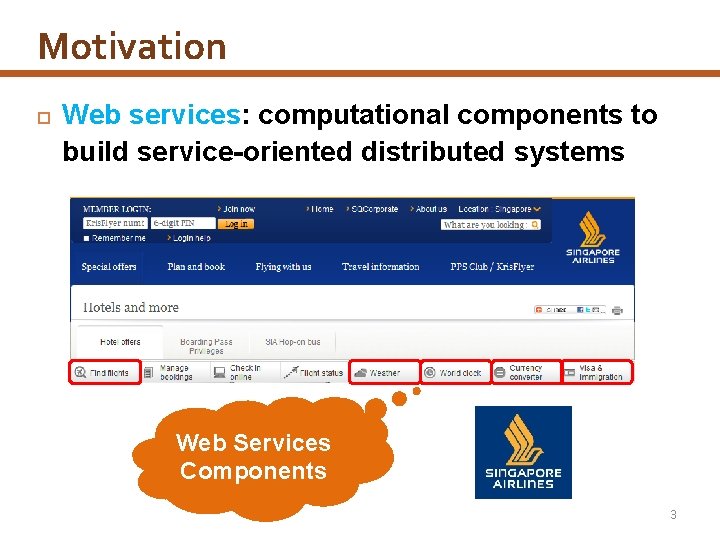
Motivation Web services: computational components to build service-oriented distributed systems Web Services Components 3
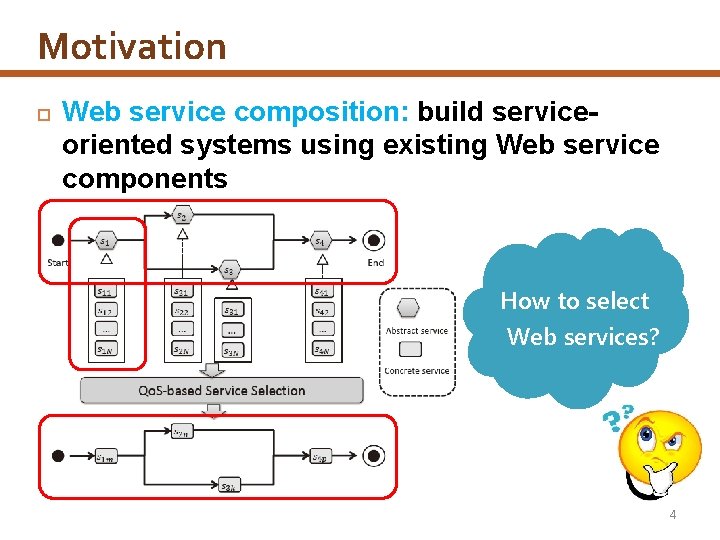
Motivation Web service composition: build serviceoriented systems using existing Web service components How to select Web services? 4
Motivation Quality-of-Service (Qo. S) � Response time, throughput, failure probability Qo. S evaluation of Web services � Service Level Agreement (SLA): static Qo. S � Dynamic Qo. S: Network conditions Time-varying server workload Service users at different locations How to evaluate the Qo. S from the users’ perspective? 5
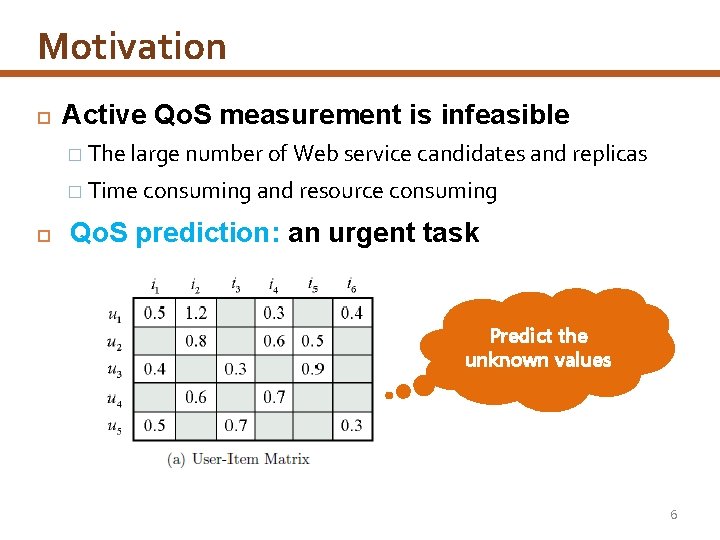
Motivation Active Qo. S measurement is infeasible � The large number of Web service candidates and replicas � Time consuming and resource consuming Qo. S prediction: an urgent task Predict the unknown values 6
Outline Motivation Related Work WSP Framework � Offline Coordinates Updating � Online Web Service Selection WSP-based Response Time Prediction � Landmark Coordinate Computation � Web Service Coordinate Computation � Service User Coordinate Computation � Response Time Prediction Experiments Conclusions & Future Work 7
Related Work Collaborative filtering (CF) based Qo. S prediction approaches � UPCC [Shao et al. 2007] � IPCC, UIPCC [Zheng et al. 2009] � Variants: Region. KNN [Chen et al. 2010], PHCF [Jiang et al. 2011] Network coordinate (NC) based network distance prediction approaches � Triangulated Heuristic, GNP [T. S. E. Ng et al. 2002] � IDES [Mao et al. 2006] � NC Survey [Donnet et al. 2010] 8
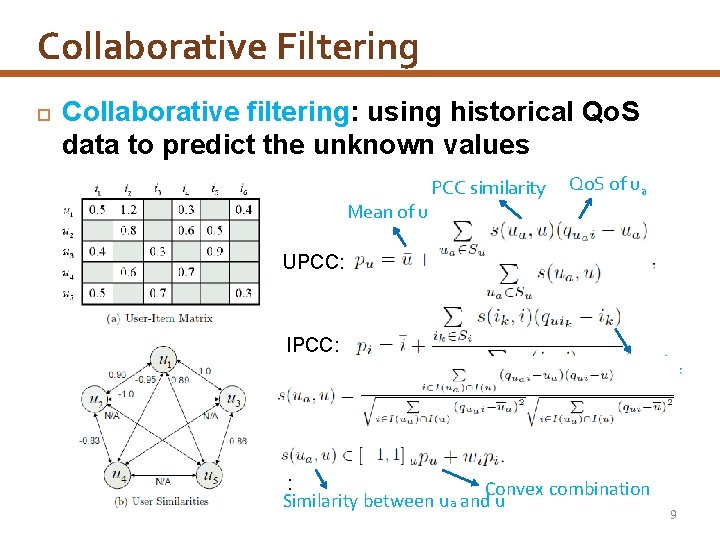
Collaborative Filtering Collaborative filtering: using historical Qo. S data to predict the unknown values Mean of u PCC similarity Qo. S of ua UPCC: IPCC: Mean of ik Mean of i Similar neighbors UIPCC : Convex combination Similarity between ua and u 9
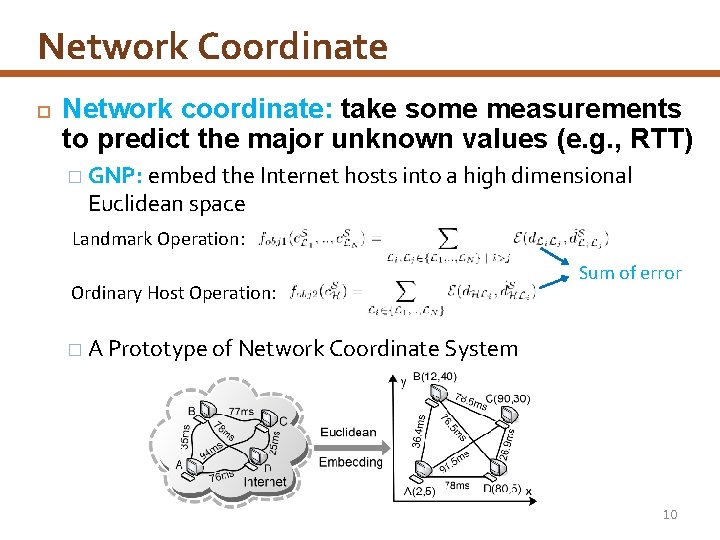
Network Coordinate Network coordinate: take some measurements to predict the major unknown values (e. g. , RTT) � GNP: embed the Internet hosts into a high dimensional Euclidean space Landmark Operation: Ordinary Host Operation: Sum of error � A Prototype of Network Coordinate System 10
Limitations CF-based Qo. S prediction approaches � Suffer from the sparsity of historical Qo. S data � Cold start problem: Incapable for handling new user without available historical data � Not applicable for mobile users NC-based approaches � Traditional approaches in P 2 P scenario � Take no advantage of useful historical information 11
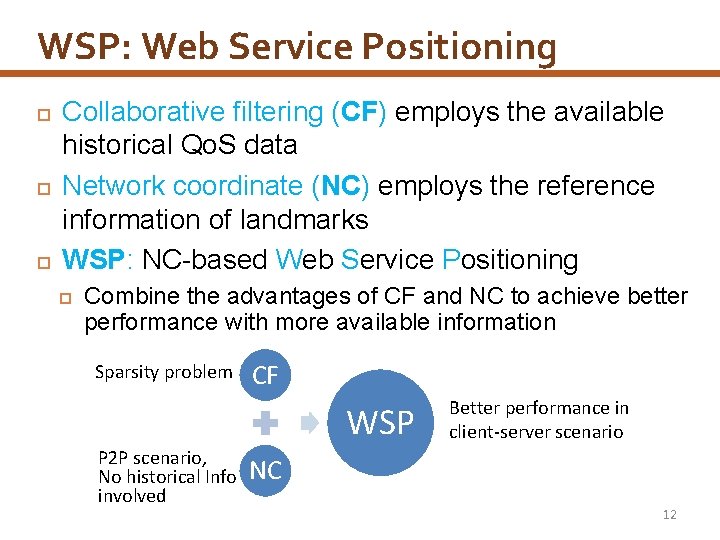
WSP: Web Service Positioning Collaborative filtering (CF) employs the available historical Qo. S data Network coordinate (NC) employs the reference information of landmarks WSP: NC-based Web Service Positioning Combine the advantages of CF and NC to achieve better performance with more available information Sparsity problem CF WSP P 2 P scenario, No historical Info involved Better performance in client-server scenario NC 12
Outline Motivation Related Work WSP Framework � Offline Coordinates Updating � Online Web Service Selection WSP-based Response Time Prediction � Landmark Coordinate Computation � Web Service Coordinate Computation � Service User Coordinate Computation � Response Time Prediction Experiments Conclusions & Future Work 13
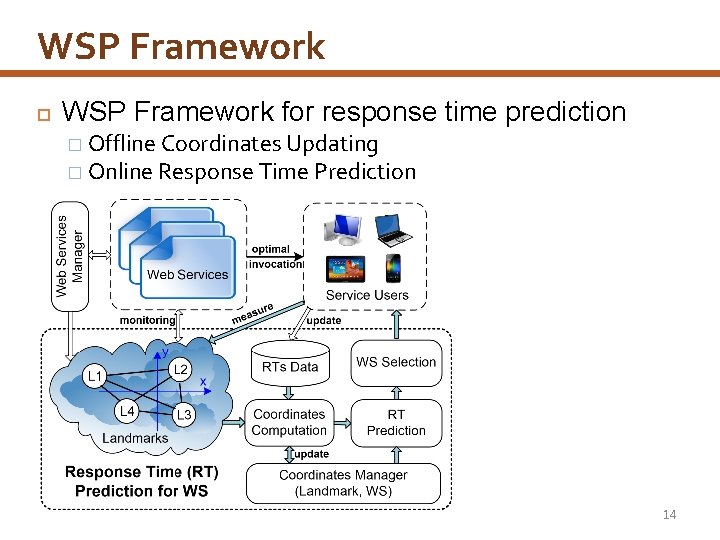
WSP Framework for response time prediction � Offline Coordinates Updating � Online Response Time Prediction 14
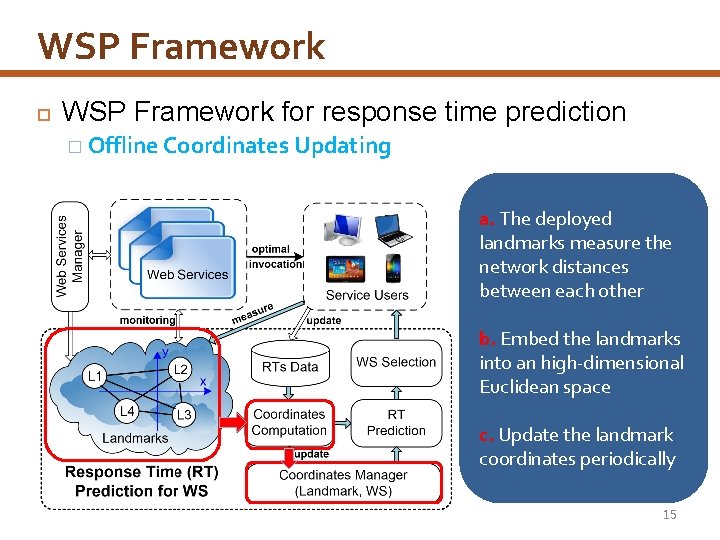
WSP Framework for response time prediction � Offline Coordinates Updating a. The deployed landmarks measure the network distances between each other b. Embed the landmarks into an high-dimensional Euclidean space c. Update the landmark coordinates periodically 15
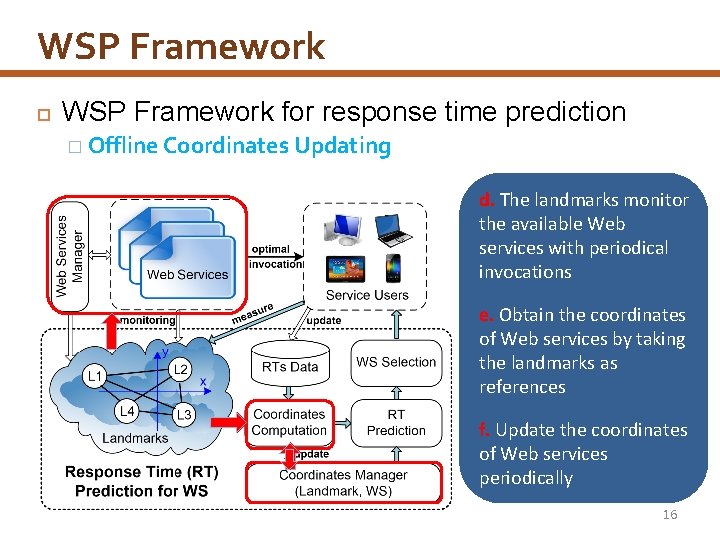
WSP Framework for response time prediction � Offline Coordinates Updating d. The landmarks monitor the available Web services with periodical invocations e. Obtain the coordinates of Web services by taking the landmarks as references f. Update the coordinates of Web services periodically 16
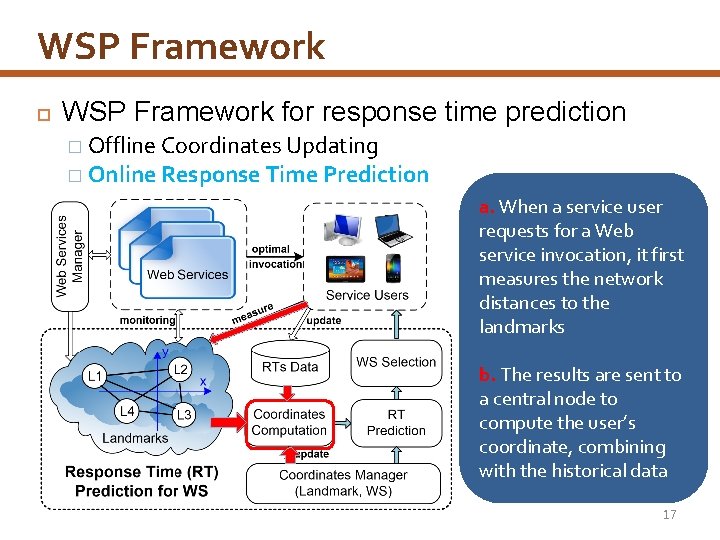
WSP Framework for response time prediction � Offline Coordinates Updating � Online Response Time Prediction a. When a service user requests for a Web service invocation, it first measures the network distances to the landmarks b. The results are sent to a central node to compute the user’s coordinate, combining with the historical data 17
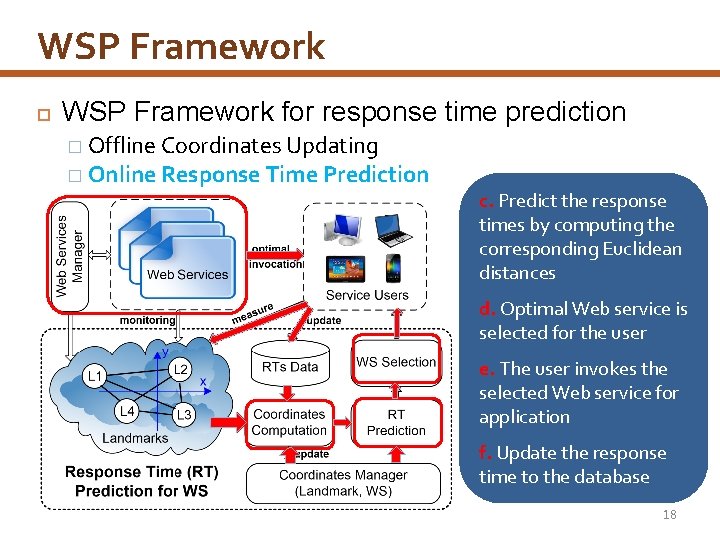
WSP Framework for response time prediction � Offline Coordinates Updating � Online Response Time Prediction c. Predict the response times by computing the corresponding Euclidean distances d. Optimal Web service is selected for the user e. The user invokes the selected Web service for application f. Update the response time to the database 18
Outline Motivation Related Work WSP Framework � Offline Coordinates Updating � Online Web Service Selection WSP-based Response Time Prediction � Landmark Coordinate Computation � Web Service Coordinate Computation � Service User Coordinate Computation � Response Time Prediction Experiments Conclusions & Future Work 19
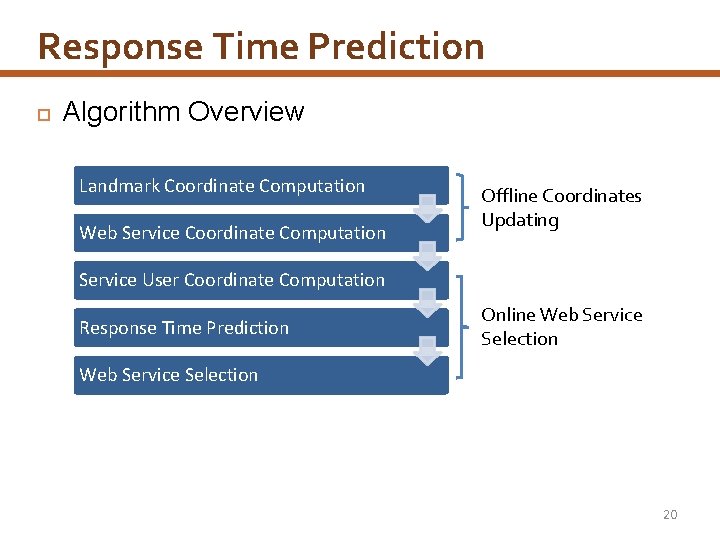
Response Time Prediction Algorithm Overview Landmark Coordinate Computation Web Service Coordinate Computation Offline Coordinates Updating Service User Coordinate Computation Response Time Prediction Online Web Service Selection 20
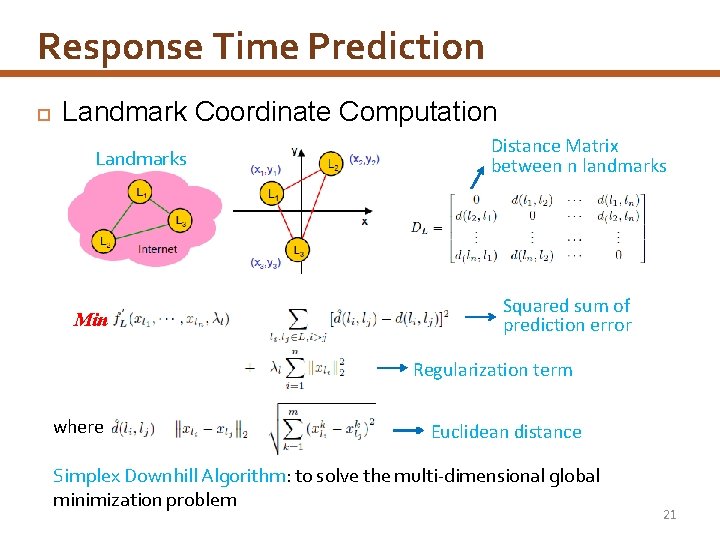
Response Time Prediction Landmark Coordinate Computation Landmarks Min Distance Matrix between n landmarks Squared sum of prediction error Regularization term where Euclidean distance Simplex Downhill Algorithm: to solve the multi-dimensional global minimization problem 21
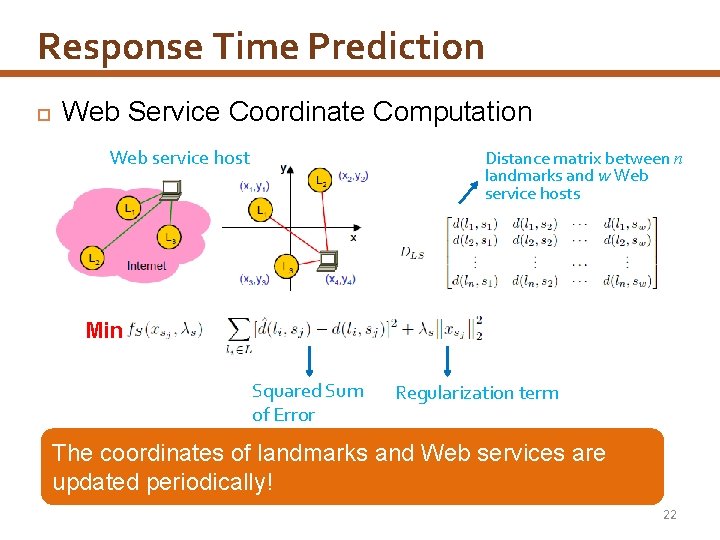
Response Time Prediction Web Service Coordinate Computation Web service host Distance matrix between n landmarks and w Web service hosts Min Squared Sum of Error Regularization term The coordinates of landmarks and Web services are updated periodically! 22
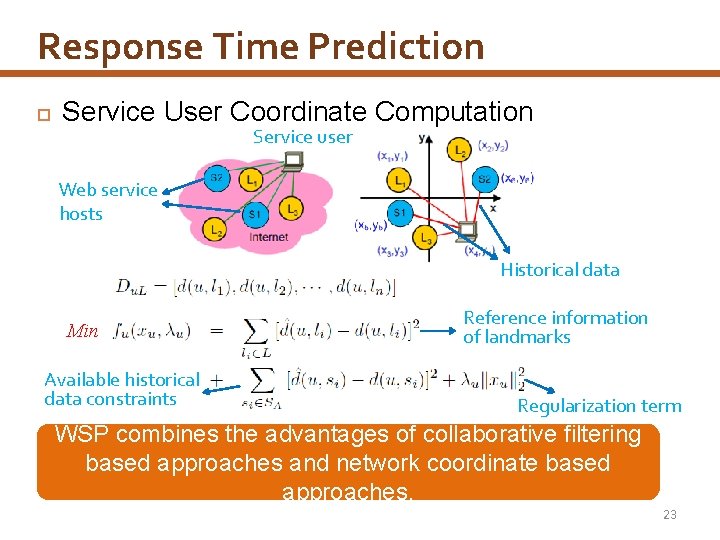
Response Time Prediction Service User Coordinate Computation Service user Web service hosts Historical data Min Available historical data constraints Reference information of landmarks Regularization term WSP combines the advantages of collaborative filtering based approaches and network coordinate based approaches. 23
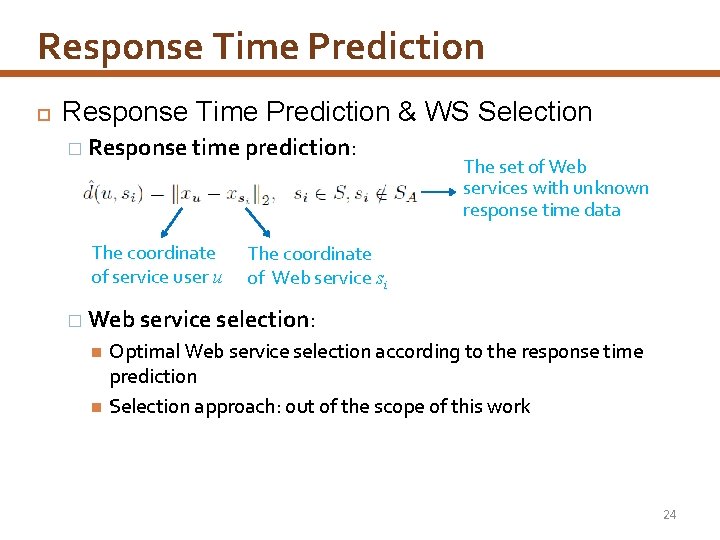
Response Time Prediction & WS Selection � Response time prediction: The coordinate of service user u The set of Web services with unknown response time data The coordinate of Web service si � Web service selection: Optimal Web service selection according to the response time prediction Selection approach: out of the scope of this work 24
Outline Motivation Related Work WSP Framework � Offline Coordinates Updating � Online Web Service Selection WSP-based Response Time Prediction � Landmark Coordinate Computation � Web Service Coordinate Computation � Service User Coordinate Computation � Response Time Prediction Experiments Conclusions & Future Work 25
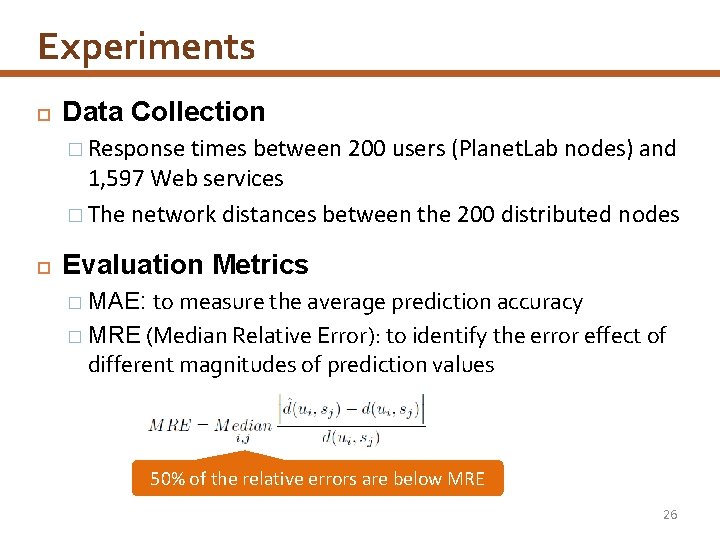
Experiments Data Collection � Response times between 200 users (Planet. Lab nodes) and 1, 597 Web services � The network distances between the 200 distributed nodes Evaluation Metrics to measure the average prediction accuracy � MRE (Median Relative Error): to identify the error effect of different magnitudes of prediction values � MAE: 50% of the relative errors are below MRE 26
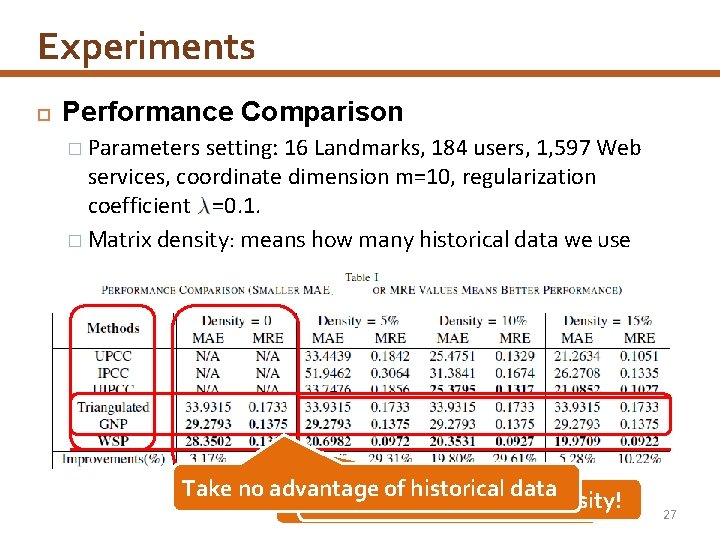
Experiments Performance Comparison � Parameters setting: 16 Landmarks, 184 users, 1, 597 Web services, coordinate dimension m=10, regularization coefficient =0. 1. � Matrix density: means how many historical data we use Take no advantage of historical data Less sensitive tothe data sparsity! WSP outperforms others! 27
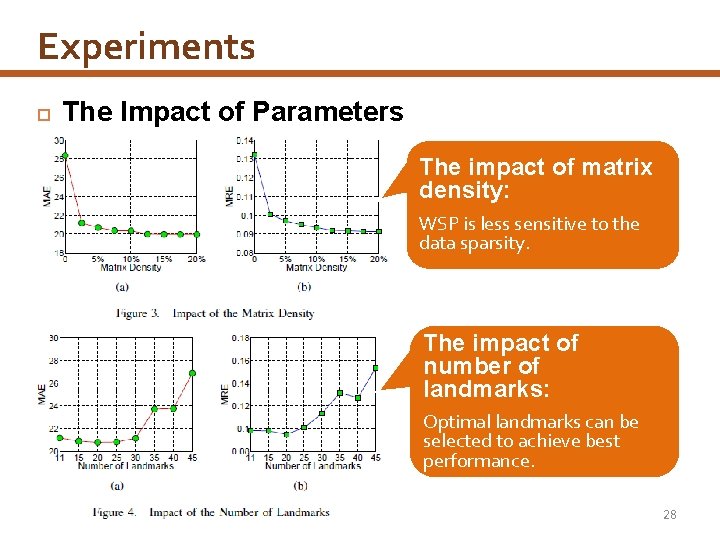
Experiments The Impact of Parameters The impact of matrix density: WSP is less sensitive to the data sparsity. The impact of number of landmarks: Optimal landmarks can be selected to achieve best performance. 28
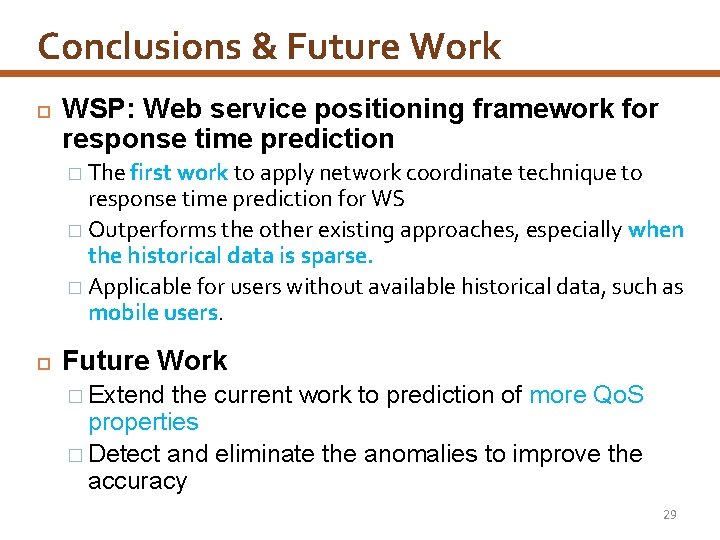
Conclusions & Future Work WSP: Web service positioning framework for response time prediction � The first work to apply network coordinate technique to response time prediction for WS � Outperforms the other existing approaches, especially when the historical data is sparse. � Applicable for users without available historical data, such as mobile users. Future Work � Extend the current work to prediction of more Qo. S properties � Detect and eliminate the anomalies to improve the accuracy 29

Thank you! Q&A Jieming Zhu Email: jmzhu@cse. cuhk. edu. hk 30
- Slides: 30