
Written Description of Algorithms High level discussion of
- Slides: 4
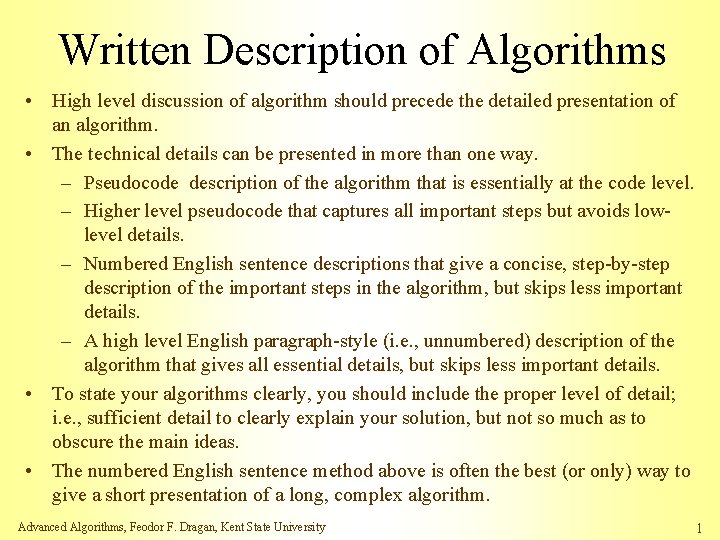
Written Description of Algorithms • High level discussion of algorithm should precede the detailed presentation of an algorithm. • The technical details can be presented in more than one way. – Pseudocode description of the algorithm that is essentially at the code level. – Higher level pseudocode that captures all important steps but avoids lowlevel details. – Numbered English sentence descriptions that give a concise, step-by-step description of the important steps in the algorithm, but skips less important details. – A high level English paragraph-style (i. e. , unnumbered) description of the algorithm that gives all essential details, but skips less important details. • To state your algorithms clearly, you should include the proper level of detail; i. e. , sufficient detail to clearly explain your solution, but not so much as to obscure the main ideas. • The numbered English sentence method above is often the best (or only) way to give a short presentation of a long, complex algorithm. Advanced Algorithms, Feodor F. Dragan, Kent State University 1
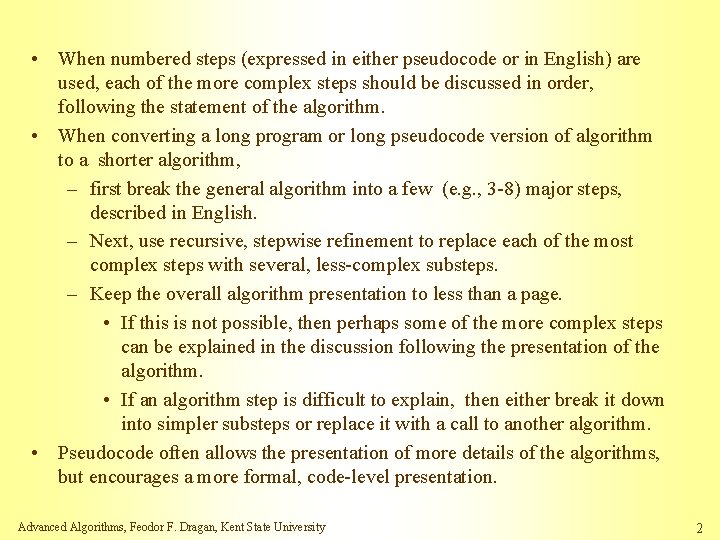
• When numbered steps (expressed in either pseudocode or in English) are used, each of the more complex steps should be discussed in order, following the statement of the algorithm. • When converting a long program or long pseudocode version of algorithm to a shorter algorithm, – first break the general algorithm into a few (e. g. , 3 -8) major steps, described in English. – Next, use recursive, stepwise refinement to replace each of the most complex steps with several, less-complex substeps. – Keep the overall algorithm presentation to less than a page. • If this is not possible, then perhaps some of the more complex steps can be explained in the discussion following the presentation of the algorithm. • If an algorithm step is difficult to explain, then either break it down into simpler substeps or replace it with a call to another algorithm. • Pseudocode often allows the presentation of more details of the algorithms, but encourages a more formal, code-level presentation. Advanced Algorithms, Feodor F. Dragan, Kent State University 2
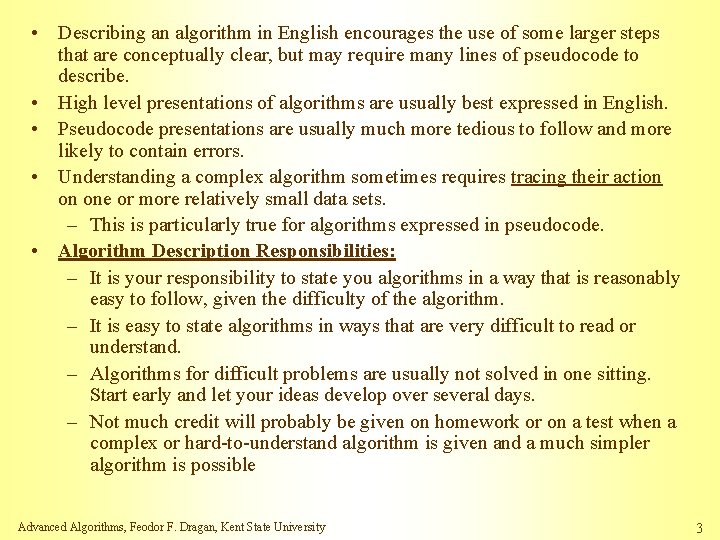
• Describing an algorithm in English encourages the use of some larger steps that are conceptually clear, but may require many lines of pseudocode to describe. • High level presentations of algorithms are usually best expressed in English. • Pseudocode presentations are usually much more tedious to follow and more likely to contain errors. • Understanding a complex algorithm sometimes requires tracing their action on one or more relatively small data sets. – This is particularly true for algorithms expressed in pseudocode. • Algorithm Description Responsibilities: – It is your responsibility to state you algorithms in a way that is reasonably easy to follow, given the difficulty of the algorithm. – It is easy to state algorithms in ways that are very difficult to read or understand. – Algorithms for difficult problems are usually not solved in one sitting. Start early and let your ideas develop over several days. – Not much credit will probably be given on homework or on a test when a complex or hard-to-understand algorithm is given and a much simpler algorithm is possible Advanced Algorithms, Feodor F. Dragan, Kent State University 3
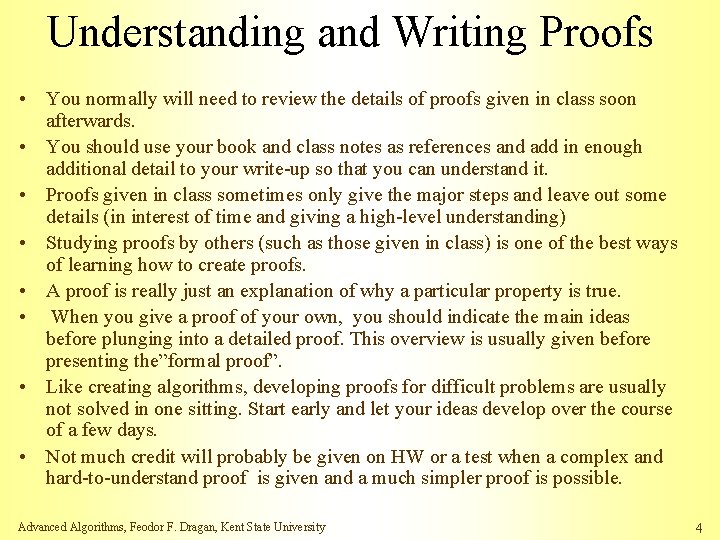
Understanding and Writing Proofs • You normally will need to review the details of proofs given in class soon afterwards. • You should use your book and class notes as references and add in enough additional detail to your write-up so that you can understand it. • Proofs given in class sometimes only give the major steps and leave out some details (in interest of time and giving a high-level understanding) • Studying proofs by others (such as those given in class) is one of the best ways of learning how to create proofs. • A proof is really just an explanation of why a particular property is true. • When you give a proof of your own, you should indicate the main ideas before plunging into a detailed proof. This overview is usually given before presenting the”formal proof”. • Like creating algorithms, developing proofs for difficult problems are usually not solved in one sitting. Start early and let your ideas develop over the course of a few days. • Not much credit will probably be given on HW or a test when a complex and hard-to-understand proof is given and a much simpler proof is possible. Advanced Algorithms, Feodor F. Dragan, Kent State University 4