
Writingpublishing Europeanisation Pat Thomson Thomson Pat what am
Writing/publishing “Europeanisation” Pat Thomson @Thomson. Pat
what am i? • • • linguistics/new literacy studies cultural geography sociology/cultural sociology/educational sociology education/pedagogy
writing and “me” • our own histories of reading and writing • encounters with academic writing • are we writers?
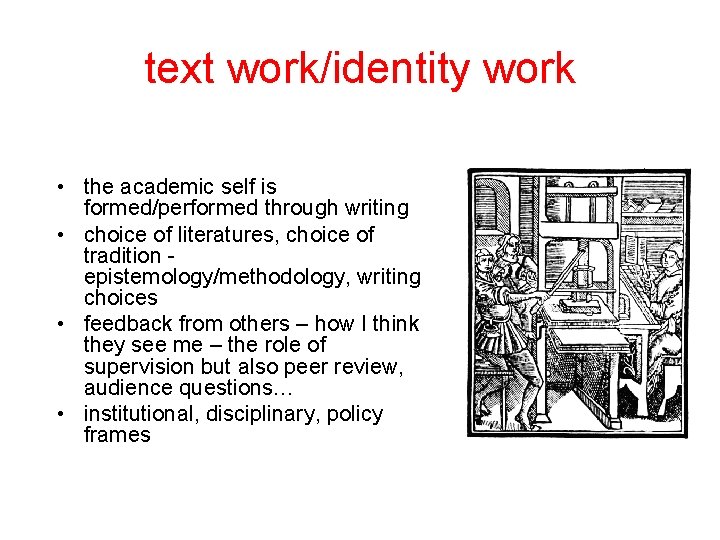
text work/identity work • the academic self is formed/performed through writing • choice of literatures, choice of tradition epistemology/methodology, writing choices • feedback from others – how I think they see me – the role of supervision but also peer review, audience questions… • institutional, disciplinary, policy frames
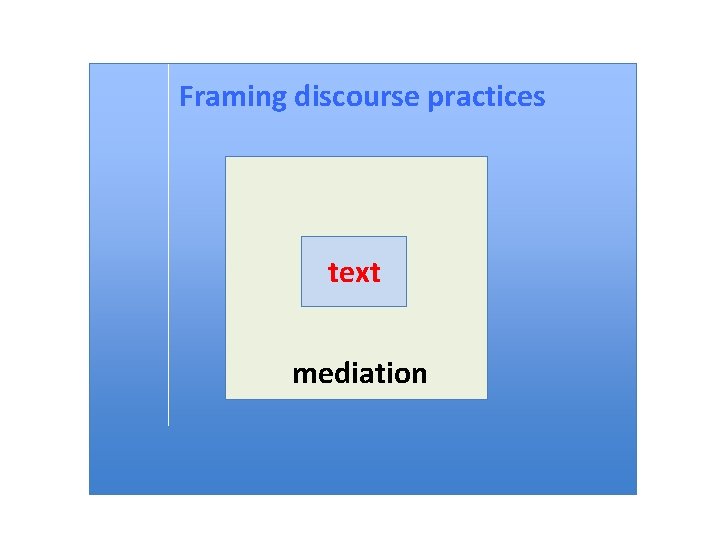
Framing discourse practices text mediay mediation
reflexivity - margaret archer • reflexivity: ‘the regular exercise of the mental ability, shared by all (normal) people, to consider themselves in relation to their (social) contexts and vice versa. ’ • reflexivity mediates structural /cultural influences on the courses of action we take
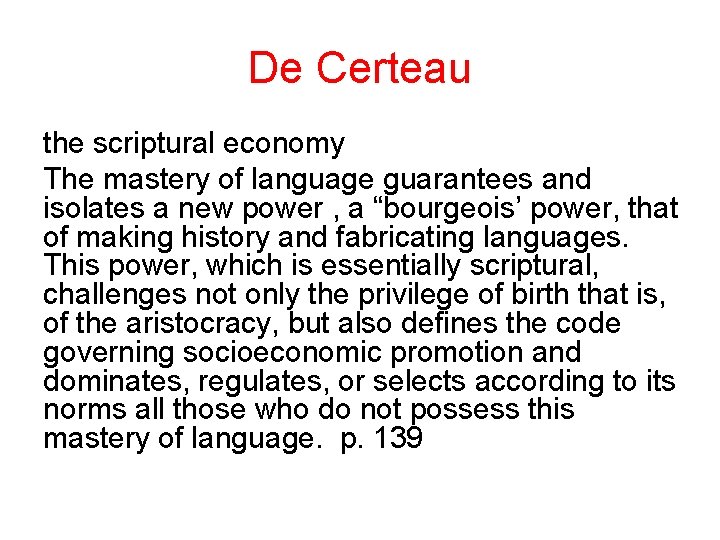
De Certeau the scriptural economy The mastery of language guarantees and isolates a new power , a “bourgeois’ power, that of making history and fabricating languages. This power, which is essentially scriptural, challenges not only the privilege of birth that is, of the aristocracy, but also defines the code governing socioeconomic promotion and dominates, regulates, or selects according to its norms all those who do not possess this mastery of language. p. 139
Writing is a social practice. It does specific work in the world. Writing Europe produces and reproduces Europe.
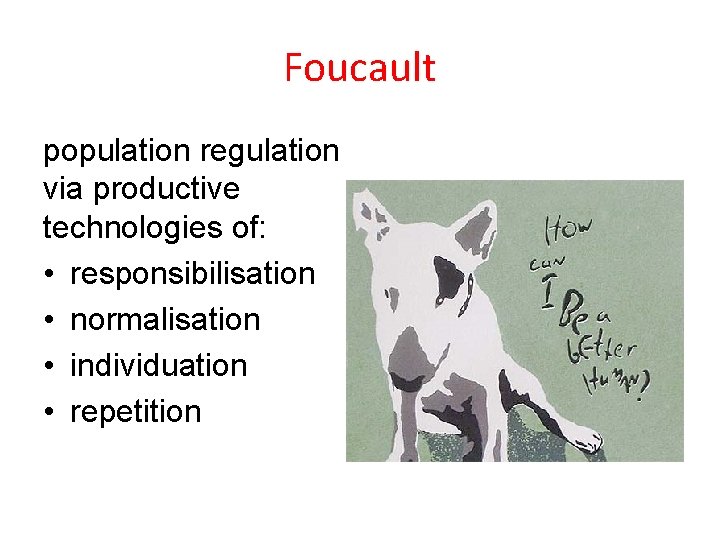
Foucault population regulation via productive technologies of: • responsibilisation • normalisation • individuation • repetition
the Hypomnemata • a material record of things read and a framework for reading, rereading and meditation • not a narrative of oneself, but…
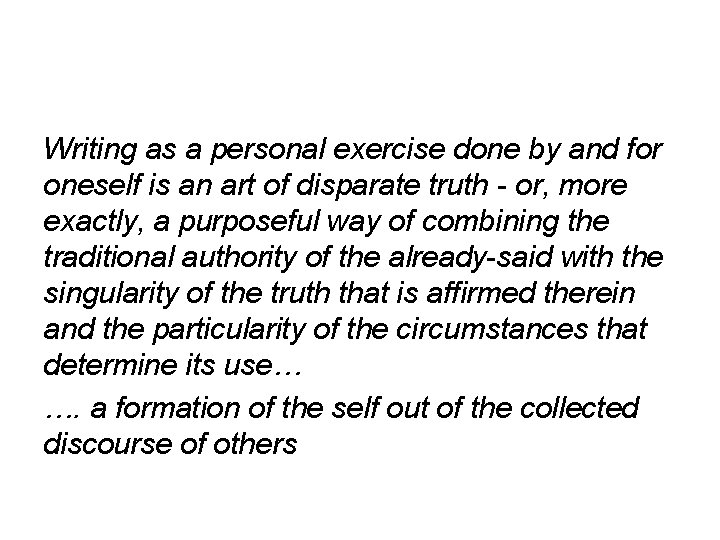
Writing as a personal exercise done by and for oneself is an art of disparate truth - or, more exactly, a purposeful way of combining the traditional authority of the already-said with the singularity of the truth that is affirmed therein and the particularity of the circumstances that determine its use… …. a formation of the self out of the collected discourse of others
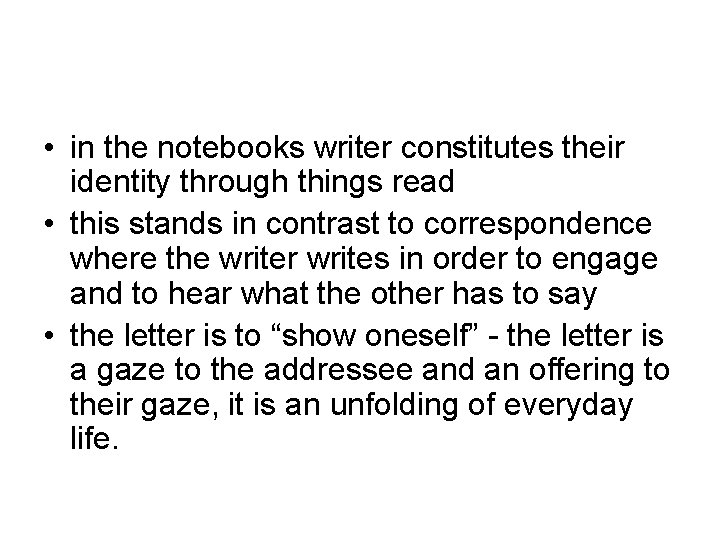
• in the notebooks writer constitutes their identity through things read • this stands in contrast to correspondence where the writer writes in order to engage and to hear what the other has to say • the letter is to “show oneself” - the letter is a gaze to the addressee and an offering to their gaze, it is an unfolding of everyday life.
the letter • resolves heterogeneity • constitutes identity • “… the letter one sends in order to help ones correspondent – advise him, exhort him, admonish him, console him – constitutes for the writer a kind of training….
DIY doctorate? • the rise and rise of advice • the proliferation of information available 24 hours • the development of a feral space – essay mills, rate my professors, editing and proofing services, coaching, online chats, personal experiences, pedagogical resources. (Referencing Giddens, Beck, Archer)
Mewburn and Thomson survey of doctoral bloggers: • creating a scholarly persona • ‘slow thinking’ • pleasure seeking • knowledge sharing
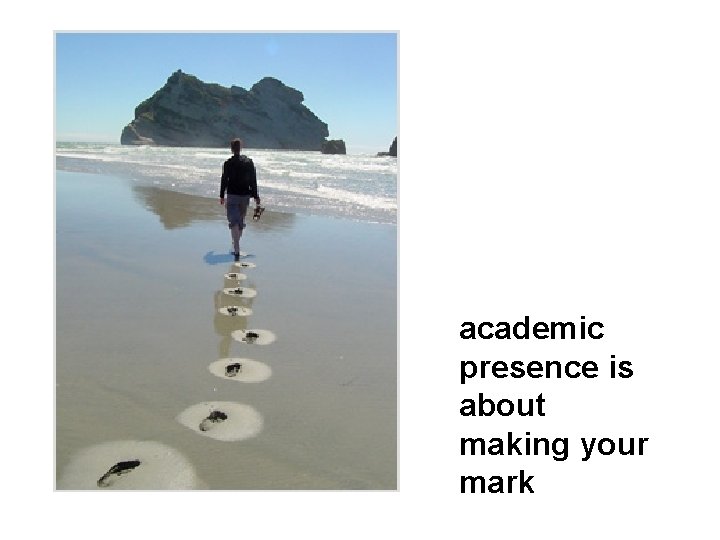
academic presence is about making your mark
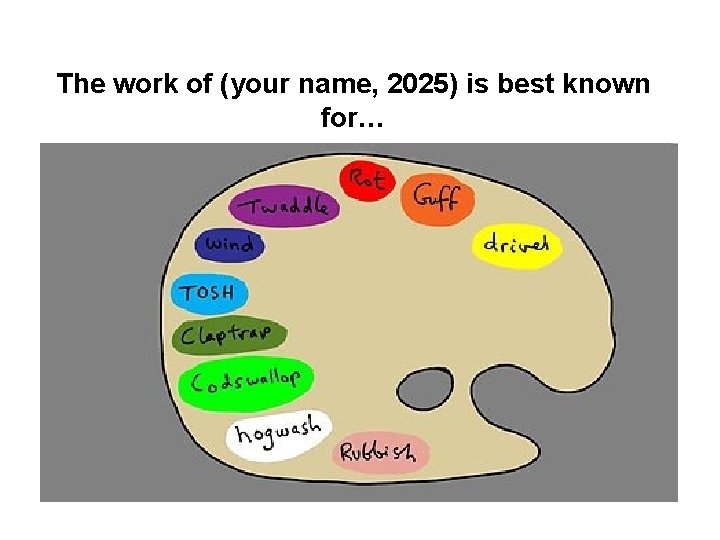
The work of (your name, 2025) is best known for…
Jane Kenway is a Professorial Fellow with the Australian Research Council, a Professor in the Education Faculty at Monash University and an elected Fellow of the Academy of Social Sciences; Australia. She has won many prestigious grants for her research. Her research expertise is in socio-cultural studies of education in the context of wider social and cultural change. Her more recent jointly written books are Masculinity Beyond the Metropolis (Palgrave, 2006), Haunting the Knowledge Economy (Routledge 2006) and Consuming Children: Education-Advertising-Entertainment, (Open University Press, 2001). Her more recent jointly edited books are (2009) Globalising the Research Imagination, (2009) Routledge, Innovation and Tradition: the Arts and Humanities in the Knowledge Economy (2004) and Globalising Education: policies, pedagogies and politics (2005) both Peter Lang. She has published numerous book chapters and journal articles including in British Journal of the Sociology of Education, Gender and Education, Journal of Education Policy, Social and Cultural Geography, Globalisation, Education and Societies, Emotion, Space and Society, Discourse: Studies in the Cultural Politics of Education. She leads the international team conducting the five year research project called Elite independent schools in globalising circumstances: a multi-sited global ethnography. See the website http: //www. education. monash. edu. au/research/projects/elite-schools/index. html
Professor Melanie Walker is a graduate of the University of Kwa. Zulu-Natal and the University of Cape Town where she completed her Ph. D after teaching at disadvantaged secondary schools for a number of years. She joined the University of the Free State in February 2012 as Senior Research Professor of Higher Education and Human Development, based in the Postgraduate School. In 2013 she was appointed as NRF Chair in Higher Education and Human Development. She is also currently Director of Research Training and a senior researcher in the EU-funded Marie Curie EDUWEL project (2010 -2014), which includes researchers from eight European countries and 15 early-stage researchers. Before joining the UFS, she was Professor of Higher Education at the University of Nottingham in the UK where she was Director of the Ph. D in Higher Education, Director of Postgraduate Students and a Director of Research in the Faculty of Social Sciences. She retains her link to Nottingham as an Honorary Professor Walker is also Vice President elect of the Human Development and Capability Association (2014 -2017) and a fellow of ASSAF. She has delivered numerous international keynotes and seminars, written more than 100 book chapters and refereed journal articles, and authored or edited 11 books, including two highly regarded volumes on doctoral education. She has books forth-coming in 2013 from Routledge on higher education and human development, as well as educating ‘public-good professionals’. Her extensive editorial experience has included editing roles on Teaching in Higher Education, Educational Action Research, and the Journal of Human Development and Capabilities. In addition, she currently holds editorial board memberships on the Journal of Human Development and Capabilities, Journal of Professional Development, and Power and Education, undertakes refereeing for a number of international journals and book publishers, and referees proposals for various research councils.
Lecturer in English Literature & Cultural History Before taking up my post at LJMU, I completed my undergraduate degree at the University of Salford and Ph. D. in English Literature at the University of Hull. My research covers Victorian and neo-Victorian literature and culture, feminist theory and practice, women’s fiction, and cultural histories of women and gender from the nineteenth century to the present day. I am currently working on two book projects: The Feminist Politics of Neo-Victorian Fiction, 2000 -2010 and The Widow in in British Literature and Culture, 18502010. I am a member of the Journal of Gender Studies editorial board, coeditor of Women and Belief, 1852 -1928 (2012), and a member of the Feminist & Women’s Studies Association executive committee. I have also developed a keen interest in postgraduate and early-career development. You can find out more about me and my academic activities by following me on Twitter (@Nadine_Muller) and by visiting my website (www. nadinemuller. org. uk).

Entering a conversation means understanding the genres and conventionsto then resist, conform, change them.
What is the journal – who are the editors? Who is the editorial board? What do they publish?
Audience and genre - Who am I writing for? - What do they expect? -What do they usually read? - What are the characteristics of these texts? - Do I want to push the boundaries of their world?
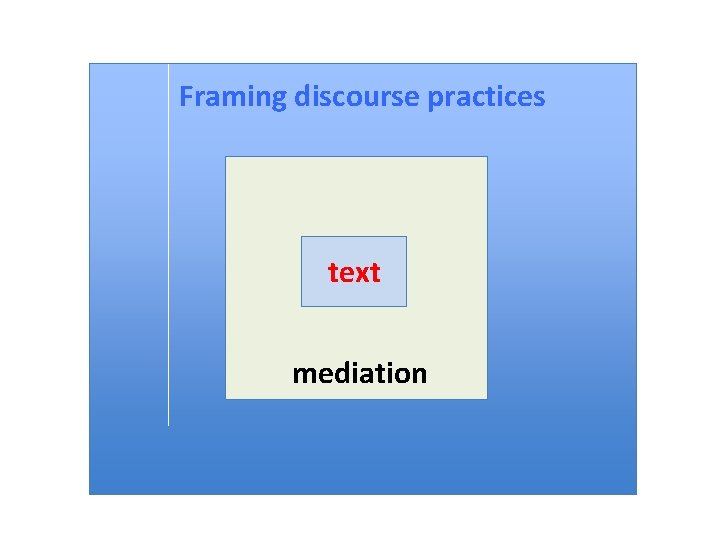
Framing discourse practices text mediay mediation

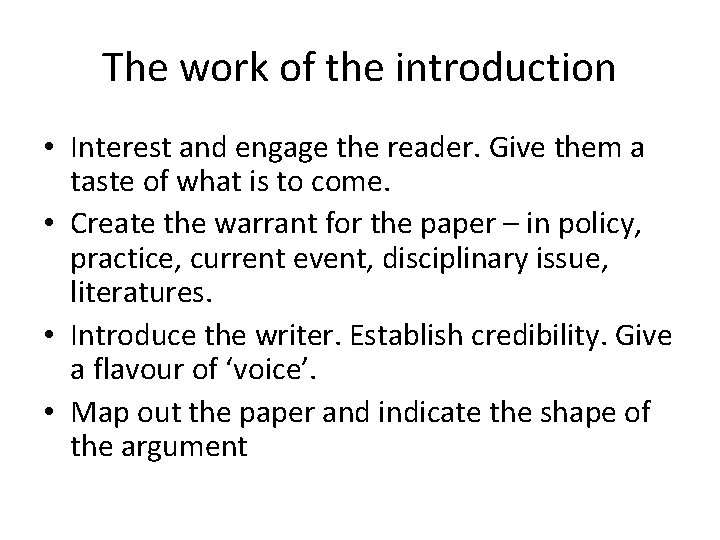
The work of the introduction • Interest and engage the reader. Give them a taste of what is to come. • Create the warrant for the paper – in policy, practice, current event, disciplinary issue, literatures. • Introduce the writer. Establish credibility. Give a flavour of ‘voice’. • Map out the paper and indicate the shape of the argument
The introduction moves • Locate • Focus • Argue/Expand • Outline
Some approaches • Narrative • Media headlines • Quotations • Lively and provocative proposition BUT YOU DON’T HAVE TO DO THIS FIRST TIME ROUND.
The work of The Literatures section • Always to show what is already known about the topic And thus to indicate the space/debate/gap/opportunity that you will occupy • Generally to indicate what key ideas from the literatures you will be using • Possibly to define terms or key concepts • Maybe to outline your theoretical toolkit
Literatures: not the same as your research proposal • The purpose is to position a piece of research that has already been undertaken. • The reader is going to get what’s-already-known, plus the newly conducted piece of research – this research as the contribution. • The literature is used to locate the contribution, the what-we-now-know-that-we-didn’t-before-and-whythis-is-important. Some texts and themes that were in your initial scoping review are omitted, and other things are now emphasized in order to make clear the connections and continuities, similarities and differences of your research to what’s gone before.
Problems with The Literatures section • A list which doesn’t indicate what are the texts most germane to your work, why and how they are to be used • The section is descriptive rather than evaluative • The section is too long and too detailed ( it looks like a cut and paste from a proposal or thesis) • Key texts in the field are left out.
The work of The Methods section This section establishes a firm foundation for the new research by • Positioning the researcher • Situating the research in a specific tradition • Showing how the researcher understands and used particular methods • Indicating the corpus of dat used and how it was analysed • Providing an audit trail for the reader (who, how many, how long, why these, when)
Methods Sections • Different journals have different expectations of how much will be written here • Some US journals expect quite detailed information • Some Australian and UK journals don’t expect a lot CHECK THIS OUT
Common problems in Methods Sections • A trawl of the quantitative qualitative binary • Too much general discussion and not enough about the particular approach taken, why and how. It reads like an assignment. • Not enough detail. The reader doesn’t have a clue about why they should believe a word of what is to come. • Not enough specificity about the tradition – Ethnography? Yes but what version and what does this mean for the conduct of the study?
The Methods section doesn’t have to be a riveting read. But it does have to be clearly written and logically ordered. The Methods section is a combination of argument – this is how the research was conducted and why – and a report – here is what I actually did.
The work of the Results section of the paper • Everything that you’ve done so far has been leading to this, you’ve been setting this up for the reader. • Now they’re there, the job is to make the case for the contribution - and to wow them.
Structure • This section can be organised as Results + Discussion or with the Discussion integrated into the Results. • If a theoretical framework is used then again, it can be integrated or a re-reading offered after the first results and discussion. • Whatever it is, you need to sign post this at the start.
Problems with results/discussion sections • Too much description – where’s the analysis? • Too abstract – where’s the evidence? • Not enough subheadings – what’s the point, where is this going? • Too many headings – I cant keep track of where this is going • Just a report – why did this happen , why does it matter? Where is this going? • Too much stuff – could have used a chart or table? • Not connected to the literatures – what’s the contribution, what’s been used, does the researcher think they live in a vacuum?
The work of the conclusion • It returns to the problem/question/niche/puzzle you identified in the Introduction • It shows how you have provided an answer – this is your contribution to the conversation • It then deals with the So What and Now What – by talking about implications for practice, policy and/or further research.
Problems with Conclusions • Introduces new material • Repeats what has already been said. Déjà vu. • Too short and says nothing • Doesn’t deal with the So What, and Now What • Is trite/hackneyed/cliched and/or states the obvious.
Moves • Summarise. Reprise reason for paper. Provides succinct summary of what you’ve done • So What – why your contribution is important to know and… • Now what –who needs to do what as a result of now knowing this – practice, policy, research? Anything that needs to happen immediately?


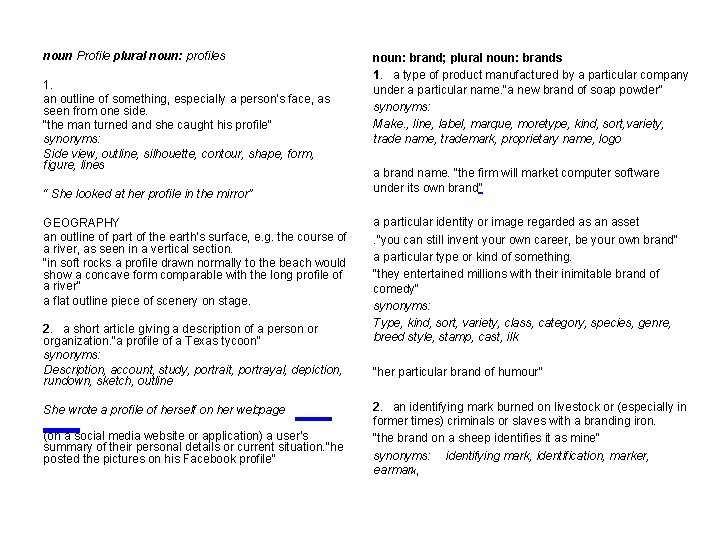
noun Profile plural noun: profiles 1. an outline of something, especially a person's face, as seen from one side. "the man turned and she caught his profile" synonyms: Side view, outline, silhouette, contour, shape, form, figure, lines “ She looked at her profile in the mirror” GEOGRAPHY an outline of part of the earth's surface, e. g. the course of a river, as seen in a vertical section. "in soft rocks a profile drawn normally to the beach would show a concave form comparable with the long profile of a river" a flat outline piece of scenery on stage. 2. a short article giving a description of a person or organization. "a profile of a Texas tycoon" synonyms: Description, account, study, portrait, portrayal, depiction, rundown, sketch, outline She wrote a profile of herself on her webpage (on a social media website or application) a user's summary of their personal details or current situation. "he posted the pictures on his Facebook profile" noun: brand; plural noun: brands 1. a type of product manufactured by a particular company under a particular name. "a new brand of soap powder" synonyms: Make. , line, label, marque, moretype, kind, sort, variety, trade name, trademark, proprietary name, logo a brand name. "the firm will market computer software under its own brand” a particular identity or image regarded as an asset. "you can still invent your own career, be your own brand" a particular type or kind of something. "they entertained millions with their inimitable brand of comedy" synonyms: Type, kind, sort, variety, class, category, species, genre, breed style, stamp, cast, ilk “her particular brand of humour” 2. an identifying mark burned on livestock or (especially in former times) criminals or slaves with a branding iron. "the brand on a sheep identifies it as mine" synonyms: identifying mark, identification, marker, earmark,
noun Profile plural noun: profiles 1. an outline of something, especially a person's face, as seen from one side. "the man turned and she caught his profile" synonyms: Side view, outline, silhouette, contour, shape, form, figure, lines “ She looked at her profile in the mirror” GEOGRAPHY an outline of part of the earth's surface, e. g. the course of a river, as seen in a vertical section. "in soft rocks a profile drawn normally to the beach would show a concave form comparable with the long profile of a river" a flat outline piece of scenery on stage. 2. a short article giving a description of a person or organization. "a profile of a Texas tycoon" synonyms: description, account, study, portrait, portrayal, depiction, rundown, sketch, outline She wrote a profile of herself on her webpage (on a social media website or application) a user's summary of their personal details or current situation. "he posted the pictures on his Facebook profile" noun: brand; plural noun: brands 1. a type of product manufactured by a particular company under a particular name. "a new brand of soap powder" synonyms: Make. , line, label, marque, moretype, kind, sort, variety, trade name, trademark, proprietary name, logo a brand name. "the firm will market computer software under its own brand” a particular identity or image regarded as an asset. "you can still invent your own career, be your own brand" a particular type or kind of something. "they entertained millions with their inimitable brand of comedy" synonyms: Type, kind, sort, variety, class, category, species, genre, breed style, stamp, cast, ilk “her particular brand of humour” 2. an identifying mark burned on livestock or (especially in former times) criminals or slaves with a branding iron. "the brand on a sheep identifies it as mine" synonyms: identifying mark, identification, marker, earmark,
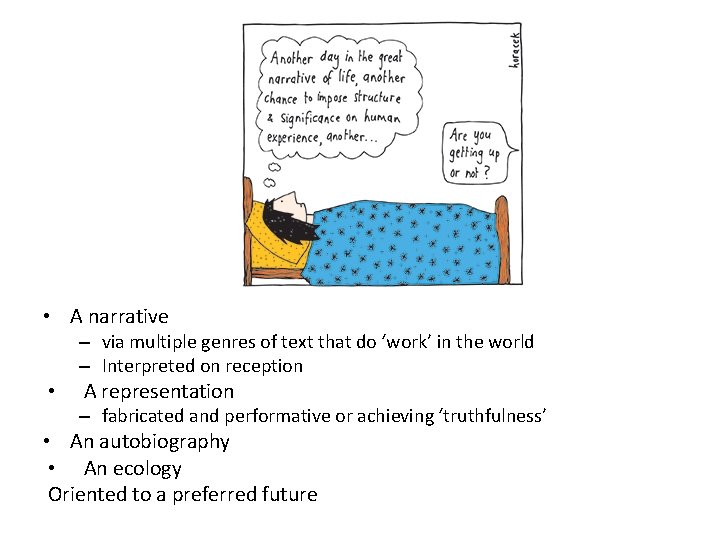
• A narrative – via multiple genres of text that do ‘work’ in the world – Interpreted on reception • A representation – fabricated and performative or achieving ‘truthfulness’ • An autobiography • An ecology Oriented to a preferred future
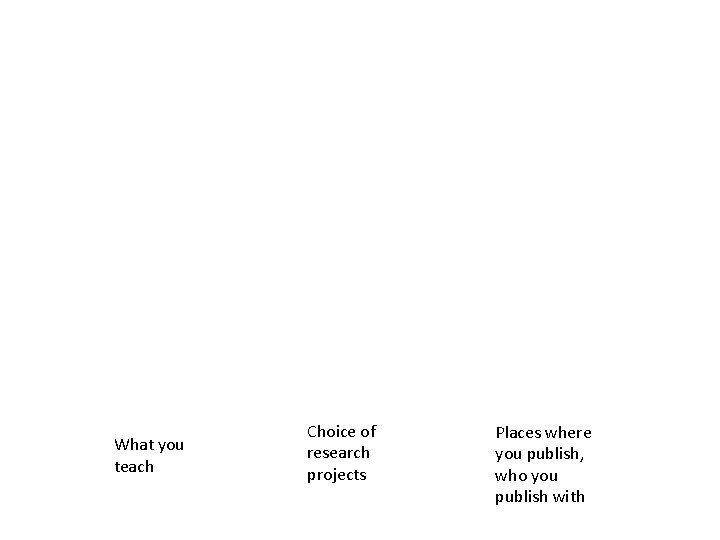
What you teach Choice of research projects Places where you publish, who you publish with
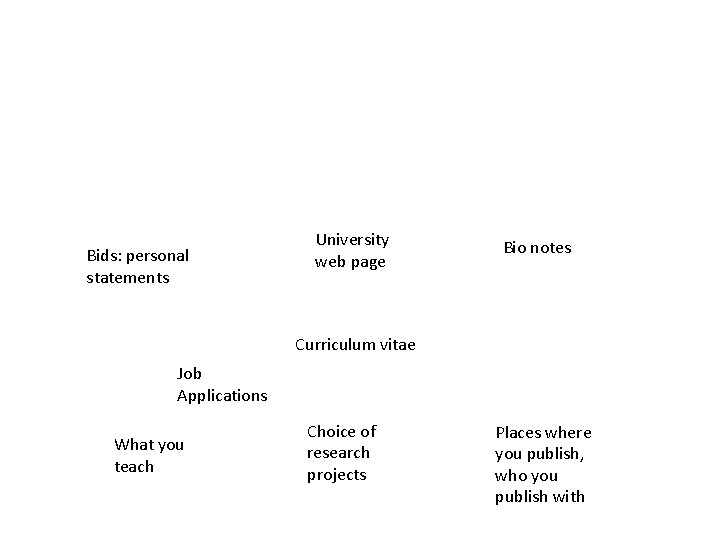
Bids: personal statements University web page Bio notes Curriculum vitae Job Applications What you teach Choice of research projects Places where you publish, who you publish with
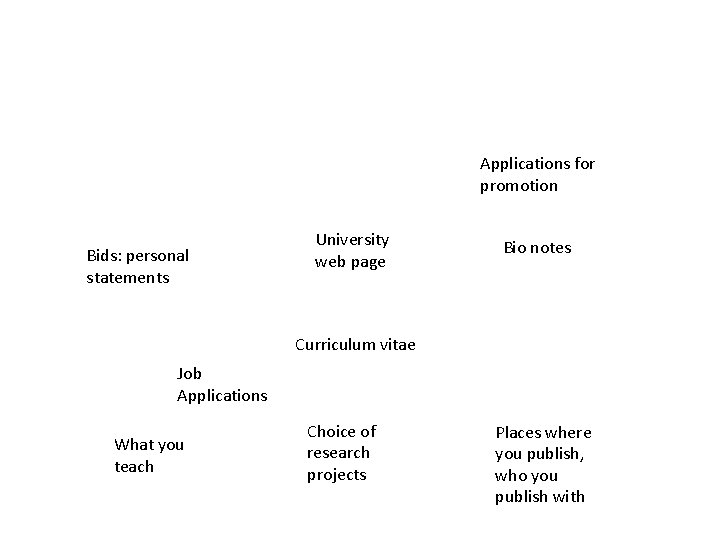
Applications for promotion Bids: personal statements University web page Bio notes Curriculum vitae Job Applications What you teach Choice of research projects Places where you publish, who you publish with
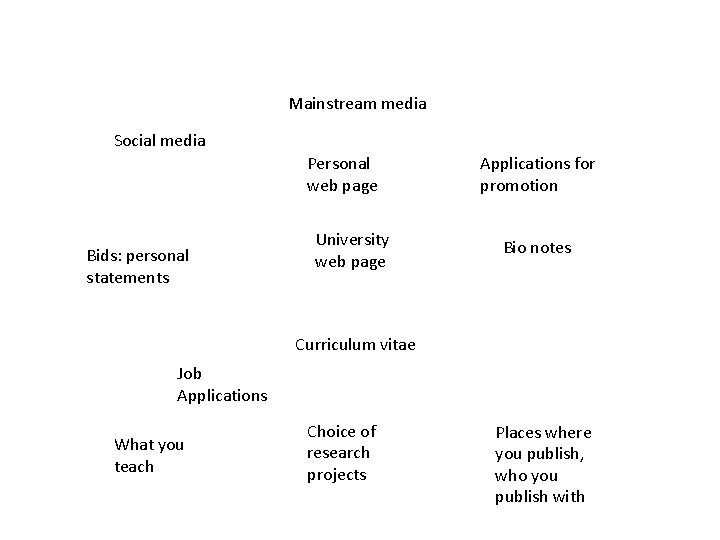
Mainstream media Social media Personal web page Bids: personal statements University web page Applications for promotion Bio notes Curriculum vitae Job Applications What you teach Choice of research projects Places where you publish, who you publish with
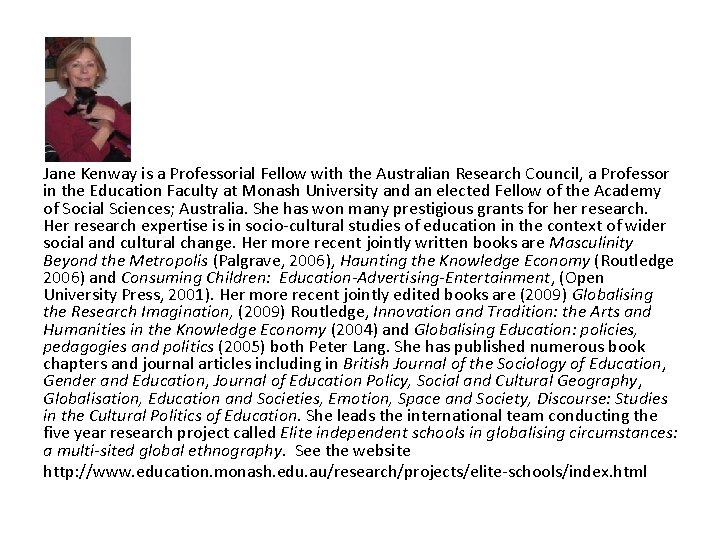
Jane Kenway is a Professorial Fellow with the Australian Research Council, a Professor in the Education Faculty at Monash University and an elected Fellow of the Academy of Social Sciences; Australia. She has won many prestigious grants for her research. Her research expertise is in socio-cultural studies of education in the context of wider social and cultural change. Her more recent jointly written books are Masculinity Beyond the Metropolis (Palgrave, 2006), Haunting the Knowledge Economy (Routledge 2006) and Consuming Children: Education-Advertising-Entertainment, (Open University Press, 2001). Her more recent jointly edited books are (2009) Globalising the Research Imagination, (2009) Routledge, Innovation and Tradition: the Arts and Humanities in the Knowledge Economy (2004) and Globalising Education: policies, pedagogies and politics (2005) both Peter Lang. She has published numerous book chapters and journal articles including in British Journal of the Sociology of Education, Gender and Education, Journal of Education Policy, Social and Cultural Geography, Globalisation, Education and Societies, Emotion, Space and Society, Discourse: Studies in the Cultural Politics of Education. She leads the international team conducting the five year research project called Elite independent schools in globalising circumstances: a multi-sited global ethnography. See the website http: //www. education. monash. edu. au/research/projects/elite-schools/index. html
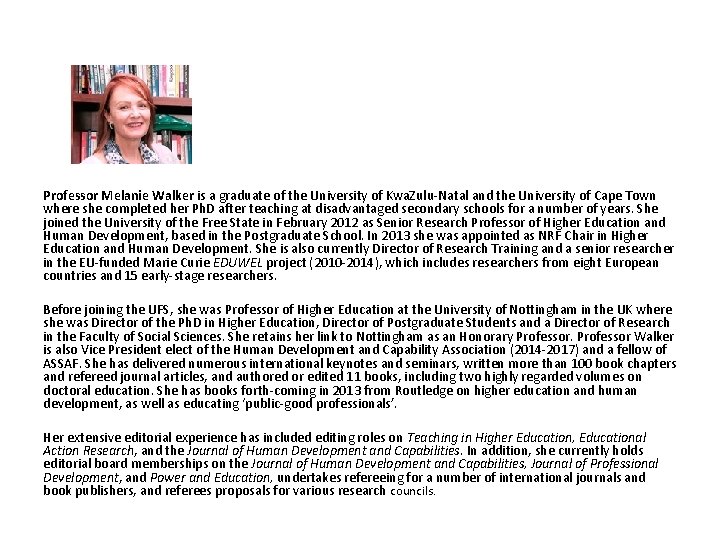
Professor Melanie Walker is a graduate of the University of Kwa. Zulu-Natal and the University of Cape Town where she completed her Ph. D after teaching at disadvantaged secondary schools for a number of years. She joined the University of the Free State in February 2012 as Senior Research Professor of Higher Education and Human Development, based in the Postgraduate School. In 2013 she was appointed as NRF Chair in Higher Education and Human Development. She is also currently Director of Research Training and a senior researcher in the EU-funded Marie Curie EDUWEL project (2010 -2014), which includes researchers from eight European countries and 15 early-stage researchers. Before joining the UFS, she was Professor of Higher Education at the University of Nottingham in the UK where she was Director of the Ph. D in Higher Education, Director of Postgraduate Students and a Director of Research in the Faculty of Social Sciences. She retains her link to Nottingham as an Honorary Professor Walker is also Vice President elect of the Human Development and Capability Association (2014 -2017) and a fellow of ASSAF. She has delivered numerous international keynotes and seminars, written more than 100 book chapters and refereed journal articles, and authored or edited 11 books, including two highly regarded volumes on doctoral education. She has books forth-coming in 2013 from Routledge on higher education and human development, as well as educating ‘public-good professionals’. Her extensive editorial experience has included editing roles on Teaching in Higher Education, Educational Action Research, and the Journal of Human Development and Capabilities. In addition, she currently holds editorial board memberships on the Journal of Human Development and Capabilities, Journal of Professional Development, and Power and Education, undertakes refereeing for a number of international journals and book publishers, and referees proposals for various research councils.
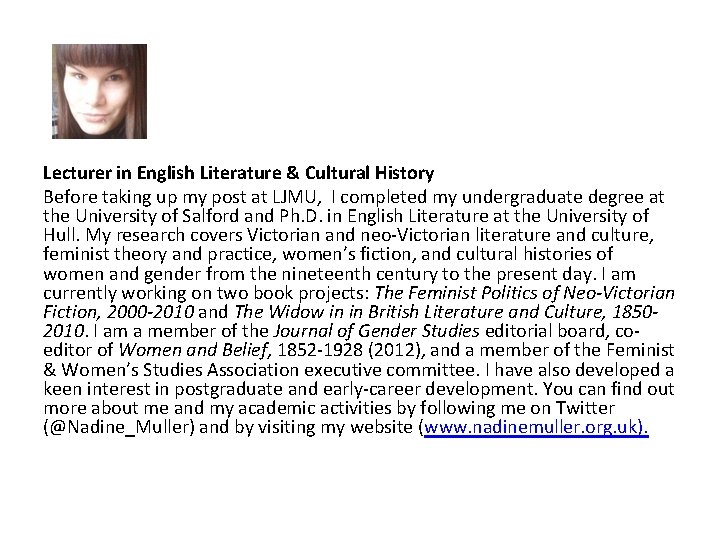
Lecturer in English Literature & Cultural History Before taking up my post at LJMU, I completed my undergraduate degree at the University of Salford and Ph. D. in English Literature at the University of Hull. My research covers Victorian and neo-Victorian literature and culture, feminist theory and practice, women’s fiction, and cultural histories of women and gender from the nineteenth century to the present day. I am currently working on two book projects: The Feminist Politics of Neo-Victorian Fiction, 2000 -2010 and The Widow in in British Literature and Culture, 18502010. I am a member of the Journal of Gender Studies editorial board, coeditor of Women and Belief, 1852 -1928 (2012), and a member of the Feminist & Women’s Studies Association executive committee. I have also developed a keen interest in postgraduate and early-career development. You can find out more about me and my academic activities by following me on Twitter (@Nadine_Muller) and by visiting my website (www. nadinemuller. org. uk).
text work/identity work • the academic self is formed/performed through writing • choice of literatures, choice of tradition epistemology/methodology, writing choices • feedback from others – how I think they see me – the role of supervision but also peer review, audience questions… • institutional, disciplinary, policy frames
practices of reflexivity Jon Rainford: used social media for communicative reflexivity ( internal conversation held with another), found social media a stimulus for autonomous reflexivity, and engaged with others in meta-reflexivity
writing is your friend • yes you can write. you can already make a case, summarise information and communicate it clearly - you now just need to take these practices into other genres. the bigger issue is one around identity and this may manifest as ‘writing issues’. • becoming meta- reflexive about this process is helpful. use diaries, blogs, creative forms to consider what is going on in your research, but also the process of becoming doctor.
- Slides: 59