
Writing your literature review for your undergraduate dissertation


- Slides: 32
Writing your literature review for your undergraduate dissertation
Aims of the session • Explore what a literature review is and the purpose of it • Critical reading (to ensure critical writing) • Writing the review: – Structure – Introductions – conclusions – Critical approaches to writing
Activity 1: Discuss on your tables 1. What is a literature review? 2. What is the purpose of the literature review in your dissertation/final year project?
What is the literature review? • A literature review summarises, critically analyses and evaluates previous research available on the subject, presenting this in an organised way. It should address a clearly articulated question or series of questions • It is NOT: – A descriptive list or summaries of books/articles etc – An exhaustive bibliography on everything ever written on the topic- you need to make a decision about what to include – Your arguments and ideas (like an essay)
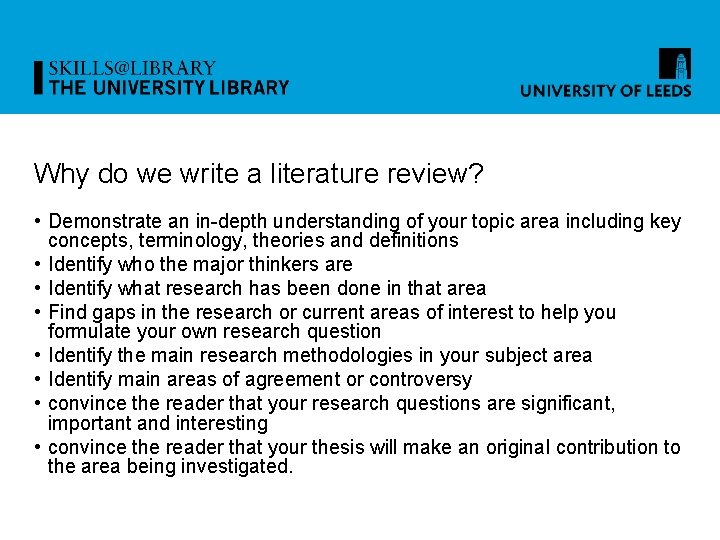
Why do we write a literature review? • Demonstrate an in-depth understanding of your topic area including key concepts, terminology, theories and definitions • Identify who the major thinkers are • Identify what research has been done in that area • Find gaps in the research or current areas of interest to help you formulate your own research question • Identify the main research methodologies in your subject area • Identify main areas of agreement or controversy • convince the reader that your research questions are significant, important and interesting • convince the reader that your thesis will make an original contribution to the area being investigated.
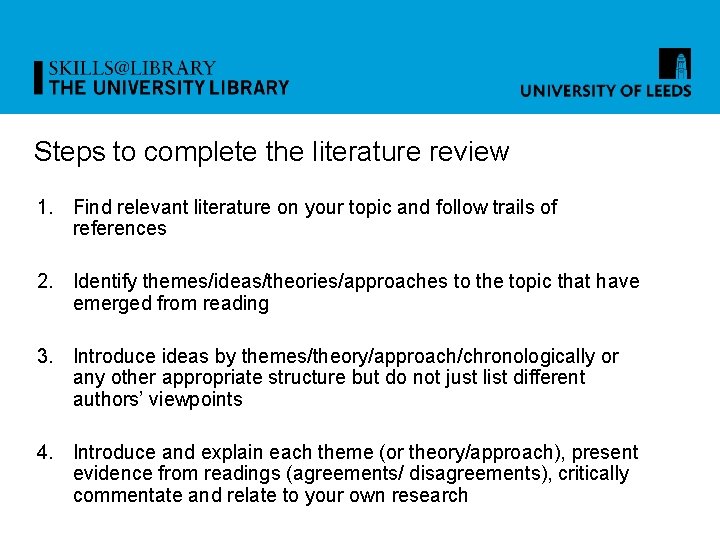
Steps to complete the literature review 1. Find relevant literature on your topic and follow trails of references 2. Identify themes/ideas/theories/approaches to the topic that have emerged from reading 3. Introduce ideas by themes/theory/approach/chronologically or any other appropriate structure but do not just list different authors’ viewpoints 4. Introduce and explain each theme (or theory/approach), present evidence from readings (agreements/ disagreements), critically commentate and relate to your own research
Critical reading
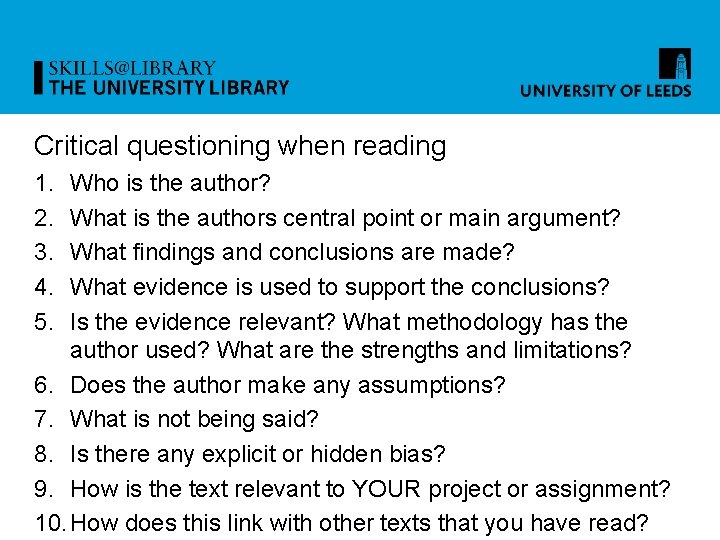
Activity 2: The importance of critical reading • In your groups come up with at least 5 questions that you would ask yourself when critically analysing a text for your review
Critical questioning when reading 1. 2. 3. 4. 5. Who is the author? What is the authors central point or main argument? What findings and conclusions are made? What evidence is used to support the conclusions? Is the evidence relevant? What methodology has the author used? What are the strengths and limitations? 6. Does the author make any assumptions? 7. What is not being said? 8. Is there any explicit or hidden bias? 9. How is the text relevant to YOUR project or assignment? 10. How does this link with other texts that you have read?
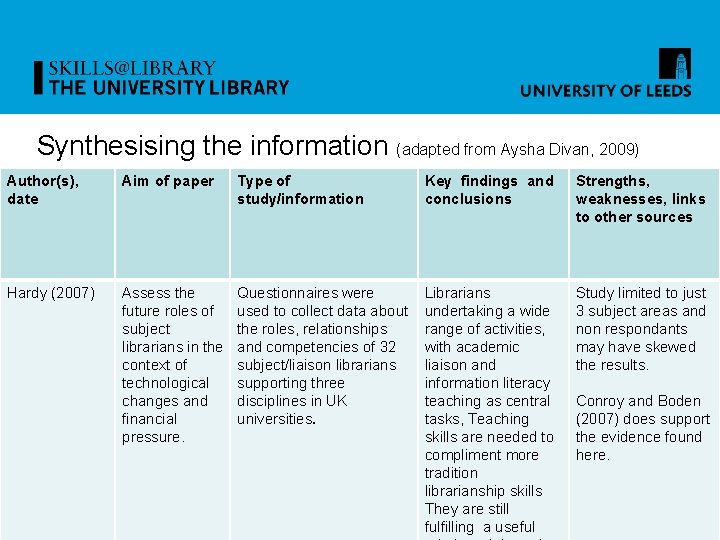
Synthesising the information (adapted from Aysha Divan, 2009) Author(s), date Aim of paper Type of study/information Key findings and conclusions Strengths, weaknesses, links to other sources Hardy (2007) Assess the future roles of subject librarians in the context of technological changes and financial pressure. Questionnaires were used to collect data about the roles, relationships and competencies of 32 subject/liaison librarians supporting three disciplines in UK universities. Librarians undertaking a wide range of activities, with academic liaison and information literacy teaching as central tasks, Teaching skills are needed to compliment more tradition librarianship skills They are still fulfilling a useful Study limited to just 3 subject areas and non respondants may have skewed the results. Conroy and Boden (2007) does support the evidence found here.
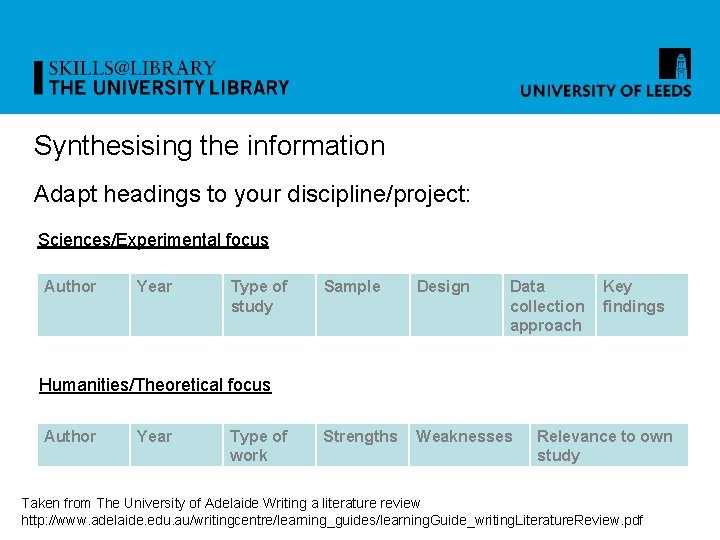
Synthesising the information Adapt headings to your discipline/project: Sciences/Experimental focus Author Year Type of study Sample Design Data collection approach Strengths Weaknesses Key findings Humanities/Theoretical focus Author Year Type of work Relevance to own study Taken from The University of Adelaide Writing a literature review http: //www. adelaide. edu. au/writingcentre/learning_guides/learning. Guide_writing. Literature. Review. pdf
What is the big picture? photo by oddsock on Flickr
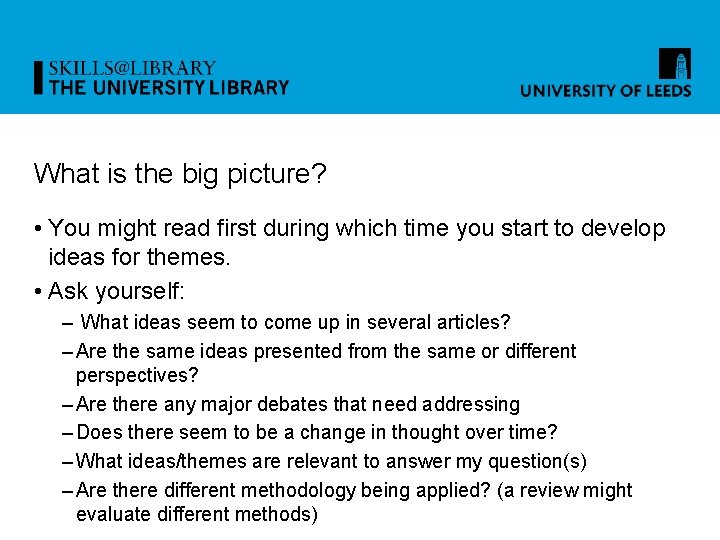
What is the big picture? • You might read first during which time you start to develop ideas for themes. • Ask yourself: – What ideas seem to come up in several articles? – Are the same ideas presented from the same or different perspectives? – Are there any major debates that need addressing – Does there seem to be a change in thought over time? – What ideas/themes are relevant to answer my question(s) – Are there different methodology being applied? (a review might evaluate different methods)
What is the big picture? You might already have a “big picture” idea. Your reading may then either: • Confirm and support the structure of your initial plan • OR • Lead you to change your plan due to new ideas you’ve developed in your reading
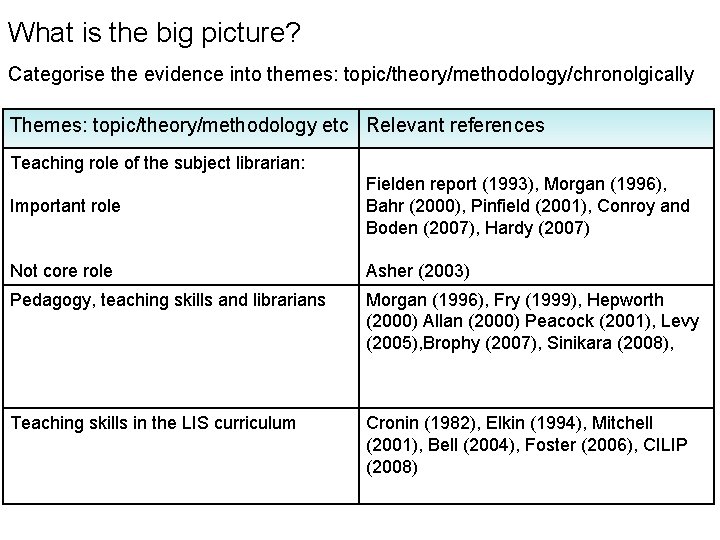
What is the big picture? Categorise the evidence into themes: topic/theory/methodology/chronolgically Themes: topic/theory/methodology etc Relevant references Teaching role of the subject librarian: Important role Fielden report (1993), Morgan (1996), Bahr (2000), Pinfield (2001), Conroy and Boden (2007), Hardy (2007) Not core role Asher (2003) Pedagogy, teaching skills and librarians Morgan (1996), Fry (1999), Hepworth (2000) Allan (2000) Peacock (2001), Levy (2005), Brophy (2007), Sinikara (2008), Teaching skills in the LIS curriculum Cronin (1982), Elkin (1994), Mitchell (2001), Bell (2004), Foster (2006), CILIP (2008)
Writing the review: The structure
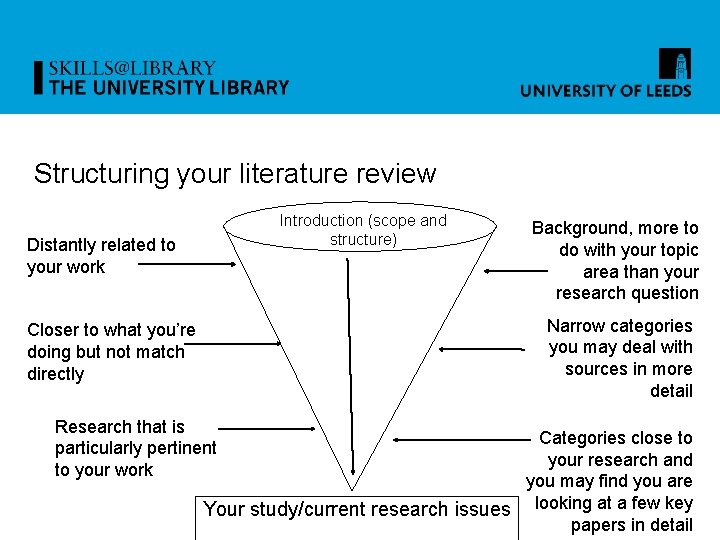
Structuring your literature review Introduction (scope and structure) Distantly related to your work Background, more to do with your topic area than your research question Narrow categories you may deal with sources in more detail Closer to what you’re doing but not match directly Research that is particularly pertinent to your work Categories close to your research and you may find you are Your study/current research issues looking at a few key papers in detail
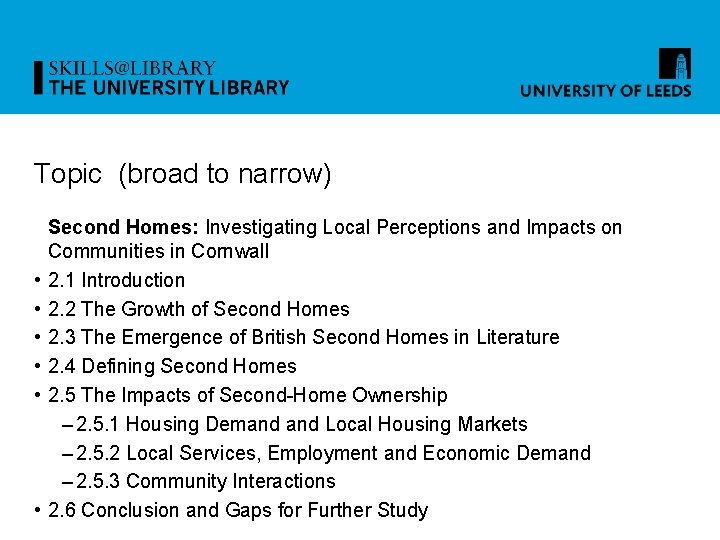
Topic (broad to narrow) • • • Second Homes: Investigating Local Perceptions and Impacts on Communities in Cornwall 2. 1 Introduction 2. 2 The Growth of Second Homes 2. 3 The Emergence of British Second Homes in Literature 2. 4 Defining Second Homes 2. 5 The Impacts of Second-Home Ownership – 2. 5. 1 Housing Demand Local Housing Markets – 2. 5. 2 Local Services, Employment and Economic Demand – 2. 5. 3 Community Interactions 2. 6 Conclusion and Gaps for Further Study
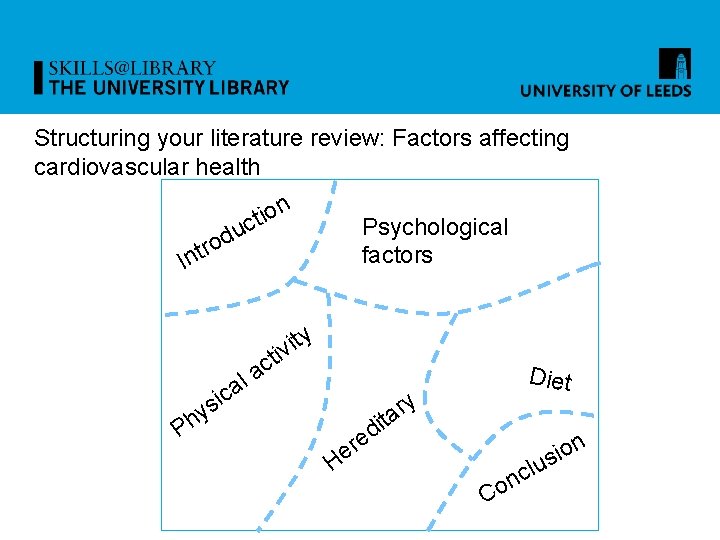
Structuring your literature review: Factors affecting cardiovascular health n o i t Psychological uc d ro t factors n I y t i iv t c a l a ic ry a it s y h P Diet He d e r Co lu c n n o i s
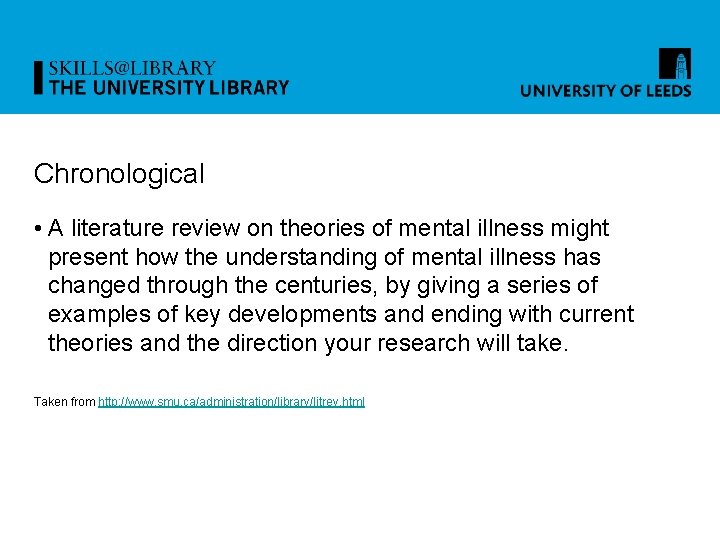
Chronological • A literature review on theories of mental illness might present how the understanding of mental illness has changed through the centuries, by giving a series of examples of key developments and ending with current theories and the direction your research will take. Taken from http: //www. smu. ca/administration/library/litrev. html
Writing the literature review
Activity 4: The introduction Compare the two introductions on your handout and answer the questions underneath the extracts
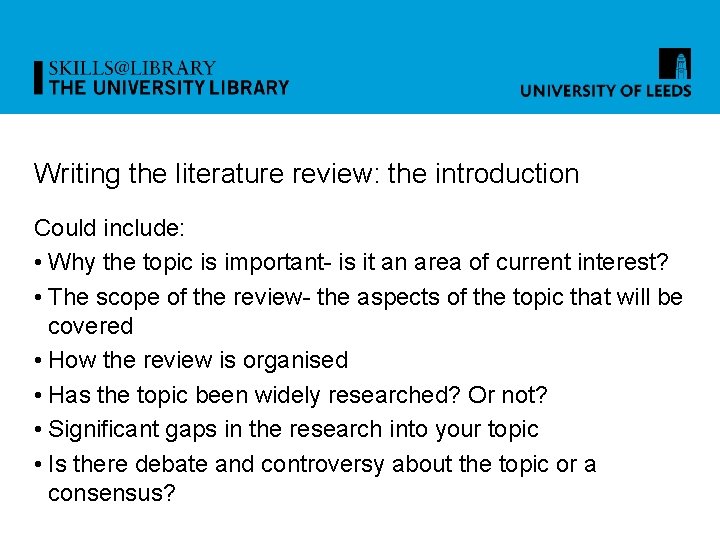
Writing the literature review: the introduction Could include: • Why the topic is important- is it an area of current interest? • The scope of the review- the aspects of the topic that will be covered • How the review is organised • Has the topic been widely researched? Or not? • Significant gaps in the research into your topic • Is there debate and controversy about the topic or a consensus?
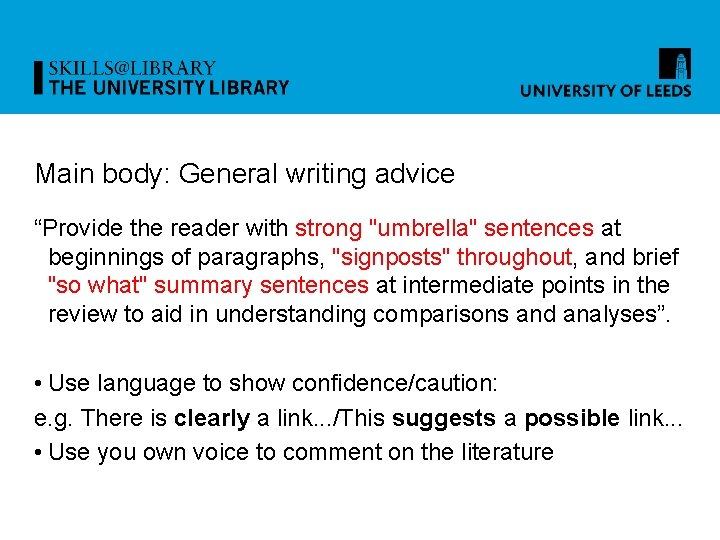
Main body: General writing advice “Provide the reader with strong "umbrella" sentences at beginnings of paragraphs, "signposts" throughout, and brief "so what" summary sentences at intermediate points in the review to aid in understanding comparisons and analyses”. • Use language to show confidence/caution: e. g. There is clearly a link. . . /This suggests a possible link. . . • Use you own voice to comment on the literature
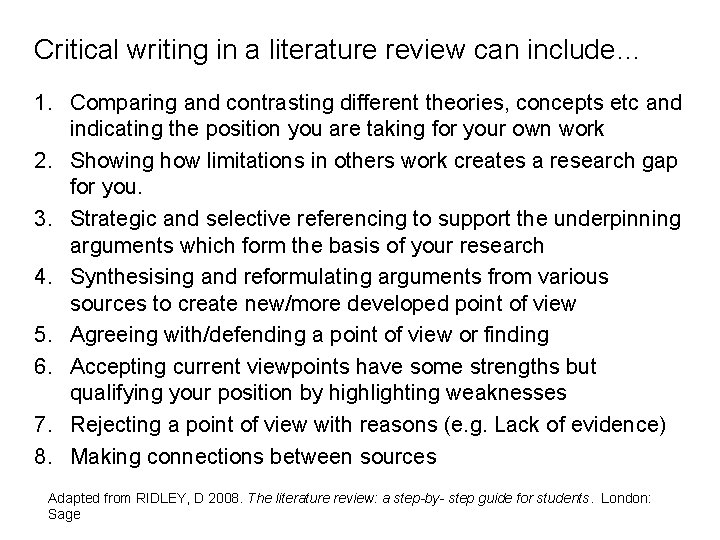
Critical writing in a literature review can include… 1. Comparing and contrasting different theories, concepts etc and indicating the position you are taking for your own work 2. Showing how limitations in others work creates a research gap for you. 3. Strategic and selective referencing to support the underpinning arguments which form the basis of your research 4. Synthesising and reformulating arguments from various sources to create new/more developed point of view 5. Agreeing with/defending a point of view or finding 6. Accepting current viewpoints have some strengths but qualifying your position by highlighting weaknesses 7. Rejecting a point of view with reasons (e. g. Lack of evidence) 8. Making connections between sources Adapted from RIDLEY, D 2008. The literature review: a step-by- step guide for students. London: Sage
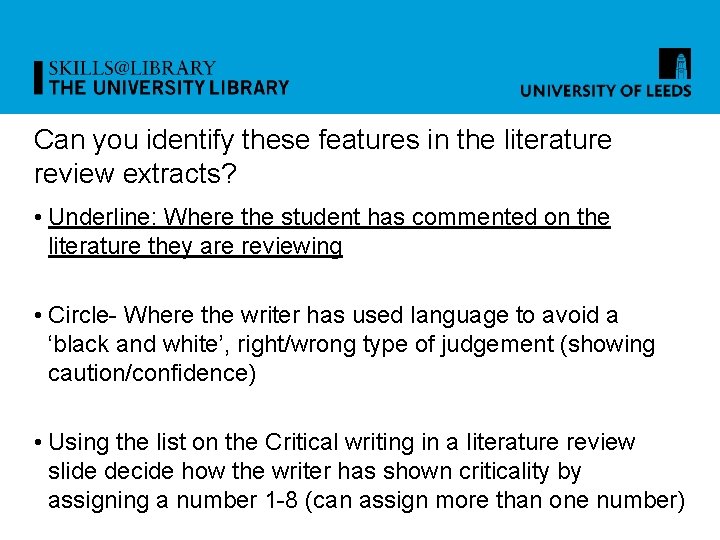
Can you identify these features in the literature review extracts? • Underline: Where the student has commented on the literature they are reviewing • Circle- Where the writer has used language to avoid a ‘black and white’, right/wrong type of judgement (showing caution/confidence) • Using the list on the Critical writing in a literature review slide decide how the writer has shown criticality by assigning a number 1 -8 (can assign more than one number)
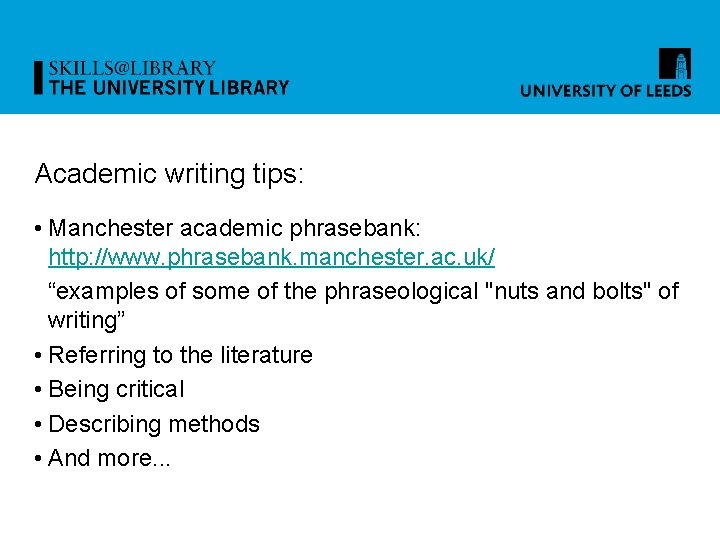
Academic writing tips: • Manchester academic phrasebank: http: //www. phrasebank. manchester. ac. uk/ “examples of some of the phraseological "nuts and bolts" of writing” • Referring to the literature • Being critical • Describing methods • And more. . .
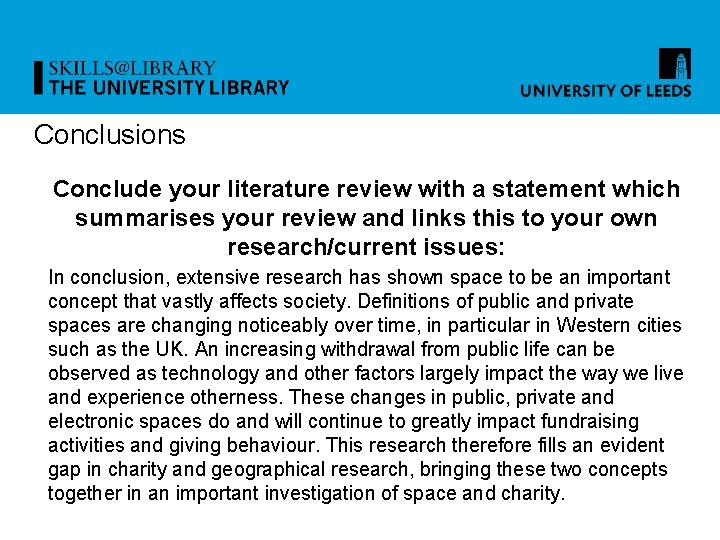
Conclusions Conclude your literature review with a statement which summarises your review and links this to your own research/current issues: In conclusion, extensive research has shown space to be an important concept that vastly affects society. Definitions of public and private spaces are changing noticeably over time, in particular in Western cities such as the UK. An increasing withdrawal from public life can be observed as technology and other factors largely impact the way we live and experience otherness. These changes in public, private and electronic spaces do and will continue to greatly impact fundraising activities and giving behaviour. This research therefore fills an evident gap in charity and geographical research, bringing these two concepts together in an important investigation of space and charity.
Don’t forget about the referencing! • Keep a record of all the sources that you use! • Use the referencing style recommended by your School – Skills@Library referencing pages http: //library. leeds. ac. uk/referencing
Reviewing your review Checklist 1. 2. 3. 4. 5. 6. ~~~~~~~~ 3 ~~~~~~~~~
Grammar, spelling and punctuation University of Bradford: • http: //www. brad. ac. uk/learnerdevelopment/resources/study/GSP/
Further help Online: • The Final Chapter: http: //library. leeds. ac. uk/tutorials/thefinalchapter/ • Skills@Library writing pages: http: //library. leeds. ac. uk/skills-writing • Academic Phrasebank: http: //www. phrasebank. manchester. ac. uk/ Books: • RIDLEY, D. 2008. The literature review: a step-by-step guide for students. London: SAGE. • DIVAN, A. 2009. Communication skills for the biosciences: a graduate guide. Oxford: Oxford University Press. • Aveyard, H. 2010. Doing a literature review in health and social care : a practical guide. Maidenhead: Mc. Graw-Hill