
WRITING WORKSHOP PHIL 443 112918 ELISE WOODARD Paper
- Slides: 29
WRITING WORKSHOP PHIL 443 11/29/18 ELISE WOODARD
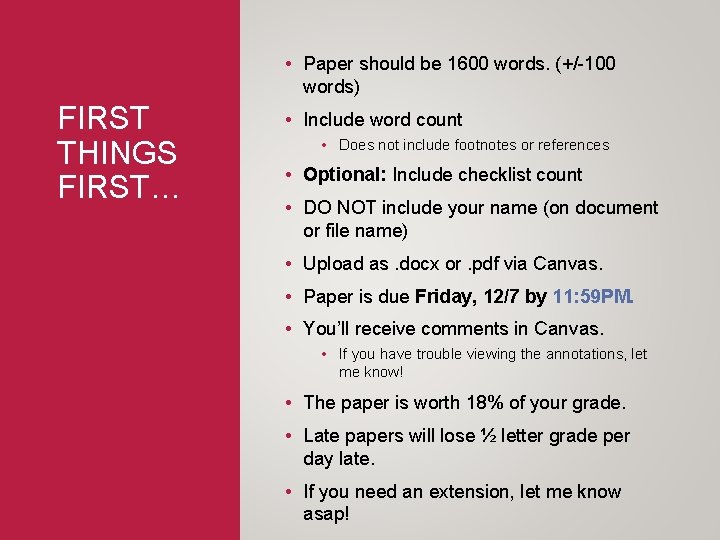
• Paper should be 1600 words. (+/-100 words) FIRST THINGS FIRST… • Include word count • Does not include footnotes or references • Optional: Include checklist count • DO NOT include your name (on document or file name) • Upload as. docx or. pdf via Canvas. • Paper is due Friday, 12/7 by 11: 59 PM. • You’ll receive comments in Canvas. • If you have trouble viewing the annotations, let me know! • The paper is worth 18% of your grade. • Late papers will lose ½ letter grade per day late. • If you need an extension, let me know asap!
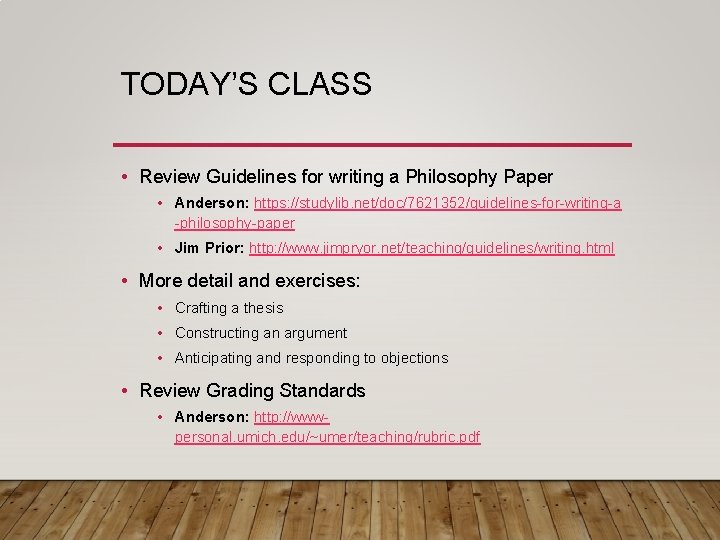
TODAY’S CLASS • Review Guidelines for writing a Philosophy Paper • Anderson: https: //studylib. net/doc/7621352/guidelines-for-writing-a -philosophy-paper • Jim Prior: http: //www. jimpryor. net/teaching/guidelines/writing. html • More detail and exercises: • Crafting a thesis • Constructing an argument • Anticipating and responding to objections • Review Grading Standards • Anderson: http: //wwwpersonal. umich. edu/~umer/teaching/rubric. pdf
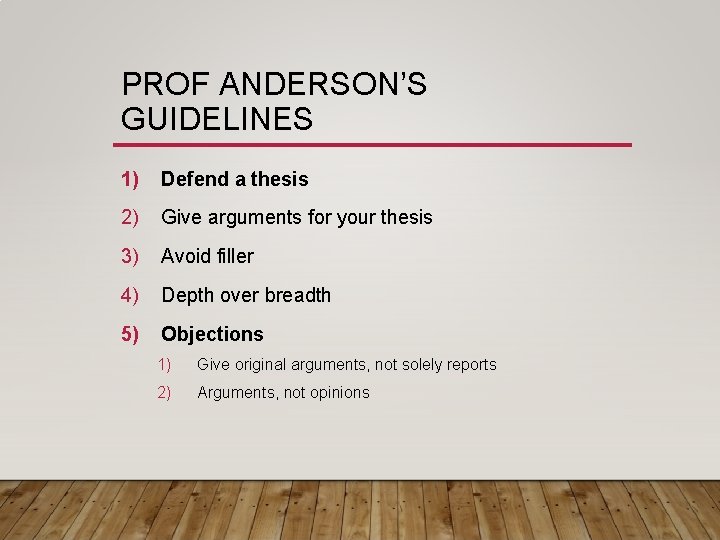
PROF ANDERSON’S GUIDELINES 1) Defend a thesis 2) Give arguments for your thesis 3) Avoid filler 4) Depth over breadth 5) Objections 1) Give original arguments, not solely reports 2) Arguments, not opinions
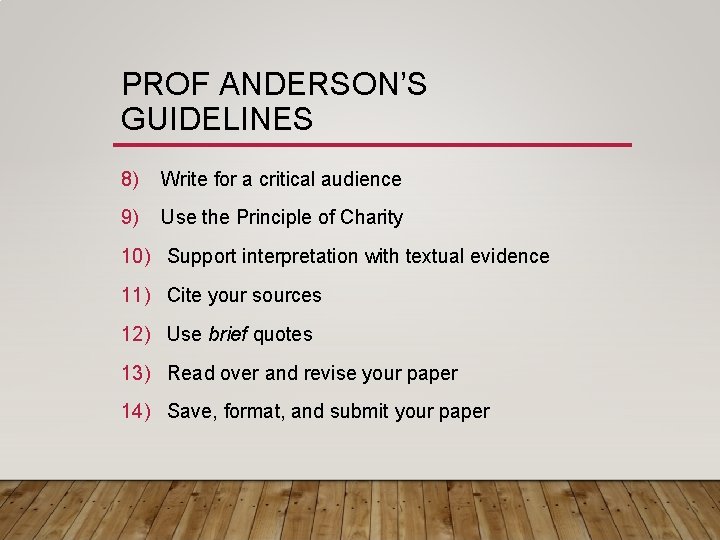
PROF ANDERSON’S GUIDELINES 8) Write for a critical audience 9) Use the Principle of Charity 10) Support interpretation with textual evidence 11) Cite your sources 12) Use brief quotes 13) Read over and revise your paper 14) Save, format, and submit your paper
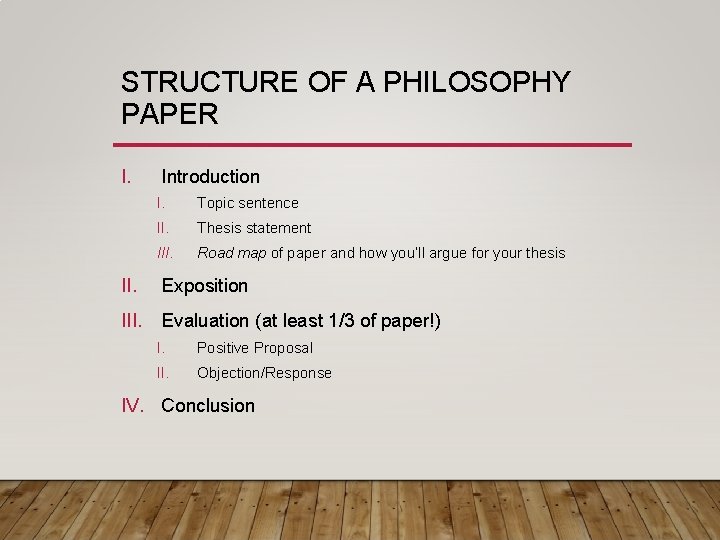
STRUCTURE OF A PHILOSOPHY PAPER I. Introduction I. Topic sentence II. Thesis statement III. Road map of paper and how you’ll argue for your thesis Exposition III. Evaluation (at least 1/3 of paper!) I. Positive Proposal II. Objection/Response IV. Conclusion
CRAFTING A THESIS NOTE: SEVERAL OF THE FORTHCOMING SLIDES (BESIDES THE EXERCISES) WERE ADAPTED FROM EDUARDO MARTINEZ’S POWERPOINT. • Your thesis should make a claim that is at least somewhat controversial or at issue • you should have to convince your reader • It should have a manageable scope • Keep word limit in mind
CRAFTING A THESIS Set a clear target: • Make clear what you want to convince the reader of by the end of the paper • If you are criticizing what an author says, make clear exactly what you will argue against • FOCUS: Throughout the paper, stay focused on defending your thesis
CRAFTING A THESIS Include a roadmap: pair your thesis with an introduction to your argument: • Make the structure of your paper clear • Let your reader know where you are leading them and where you are not leading them • Sometimes, it’s also helpful to remind your author where you have been • FLAGGING is super important in philosophy papers!
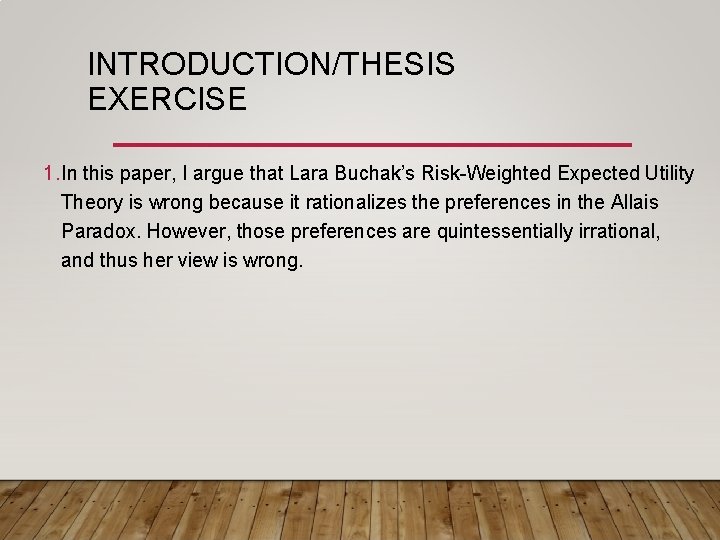
INTRODUCTION/THESIS EXERCISE 1. In this paper, I argue that Lara Buchak’s Risk-Weighted Expected Utility Theory is wrong because it rationalizes the preferences in the Allais Paradox. However, those preferences are quintessentially irrational, and thus her view is wrong.
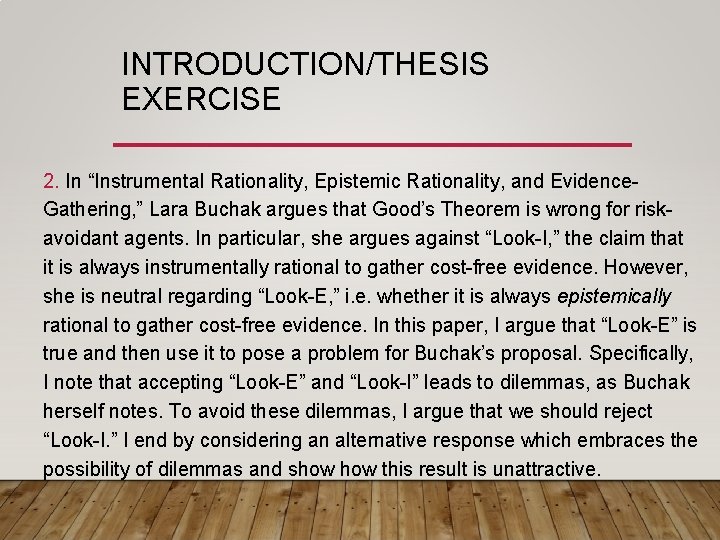
INTRODUCTION/THESIS EXERCISE 2. In “Instrumental Rationality, Epistemic Rationality, and Evidence. Gathering, ” Lara Buchak argues that Good’s Theorem is wrong for riskavoidant agents. In particular, she argues against “Look-I, ” the claim that it is always instrumentally rational to gather cost-free evidence. However, she is neutral regarding “Look-E, ” i. e. whether it is always epistemically rational to gather cost-free evidence. In this paper, I argue that “Look-E” is true and then use it to pose a problem for Buchak’s proposal. Specifically, I note that accepting “Look-E” and “Look-I” leads to dilemmas, as Buchak herself notes. To avoid these dilemmas, I argue that we should reject “Look-I. ” I end by considering an alternative response which embraces the possibility of dilemmas and show this result is unattractive.
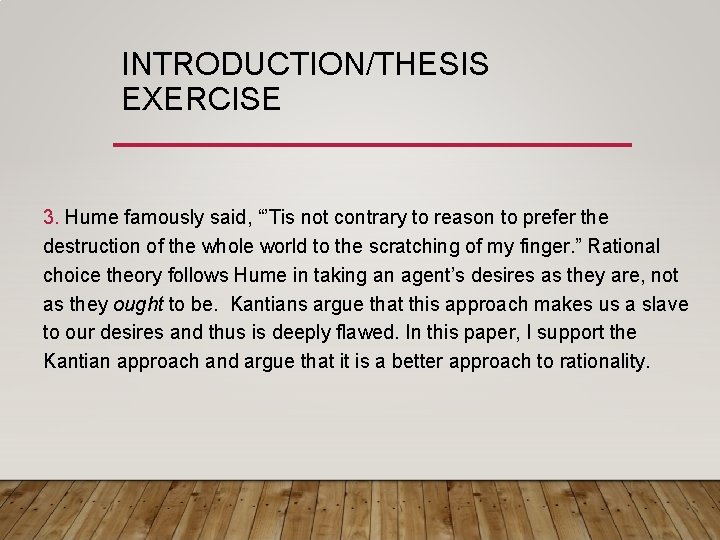
INTRODUCTION/THESIS EXERCISE 3. Hume famously said, “’Tis not contrary to reason to prefer the destruction of the whole world to the scratching of my finger. ” Rational choice theory follows Hume in taking an agent’s desires as they are, not as they ought to be. Kantians argue that this approach makes us a slave to our desires and thus is deeply flawed. In this paper, I support the Kantian approach and argue that it is a better approach to rationality.
EXPOSITION • Good exposition is: • Clear • Accurate • Charitable • Balance simplicity & strength • Avoid fluff/irrelevant details • But include enough detail to set you up for your positive proposal • Class exercise: • Looking at the prompts, what sorts of things would go into the “exposition” section of the paper?
CONSTRUCTING AN ARGUMENT Gather materials: Determine what kind of support you need for your thesis. • What assumptions will you make? • How are you interpreting the author(s)? • What evidence will you appeal to? • What are your key premises?
CONSTRUCTING AN ARGUMENT Set up a clear structure: • How do your claims relate to your conclusion? • How are the premises related to one another? • Is everything you argue for necessary to defend your thesis?
CONSTRUCTING AN ARGUMENT Be honest and modest: • Make clear when you are making an assumption • Try to defend your assumptions (at least minimally). Sometimes, you just need to take certain starting points for granted, but flag when you do so. • Establish what you need to make your point. If possibility is enough, you do not have to establish necessity
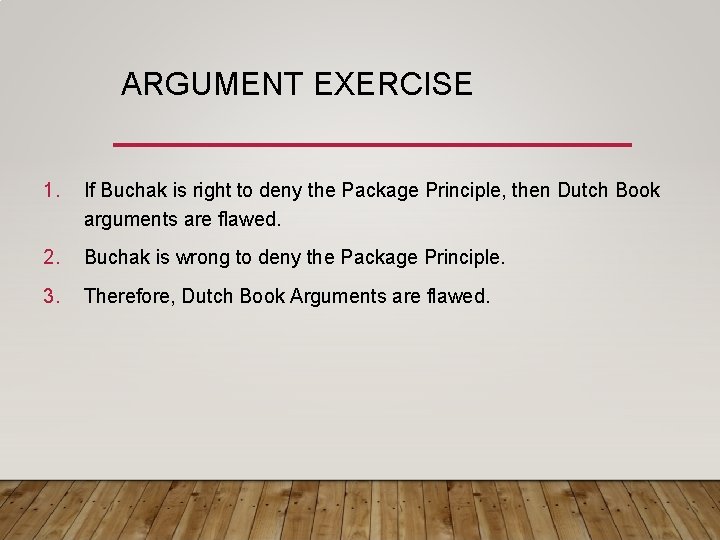
ARGUMENT EXERCISE 1. If Buchak is right to deny the Package Principle, then Dutch Book arguments are flawed. 2. Buchak is wrong to deny the Package Principle. 3. Therefore, Dutch Book Arguments are flawed.
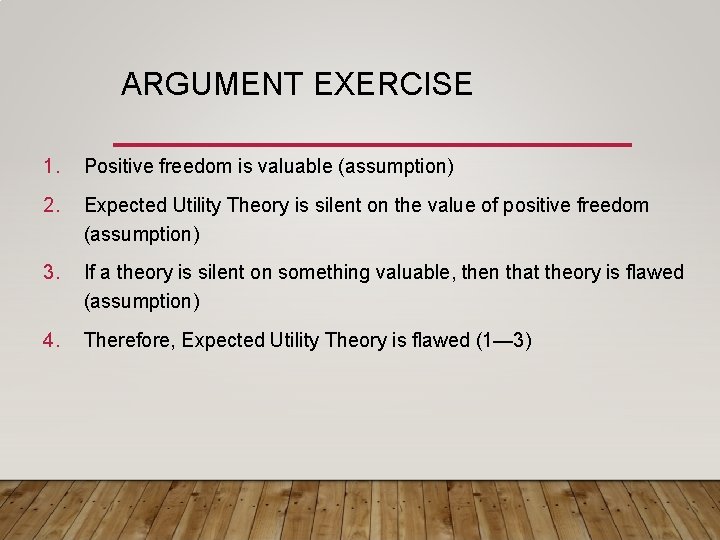
ARGUMENT EXERCISE 1. Positive freedom is valuable (assumption) 2. Expected Utility Theory is silent on the value of positive freedom (assumption) 3. If a theory is silent on something valuable, then that theory is flawed (assumption) 4. Therefore, Expected Utility Theory is flawed (1— 3)
ARGUMENTS • NB: you do not need to put your argument in premise/conclusion form. • Most people prefer to put their arguments in prose form, however, sometimes it can be a helpful exercise to try to translate your argument into premise/conclusion form. • Help you make sure your argument is valid • Makes clear what assumptions you’re making
OBJECTIONS Give yourself a formidable opponent: • To make your paper more convincing, anticipate how others might object. • If you are criticizing an author, you might use the text to construct possible responses to your criticism.
OBJECTIONS Objection-generating strategies: • Have you made a controversial assumption? • What are you least confident about? • Run your argument by a friend and see what they find questionable
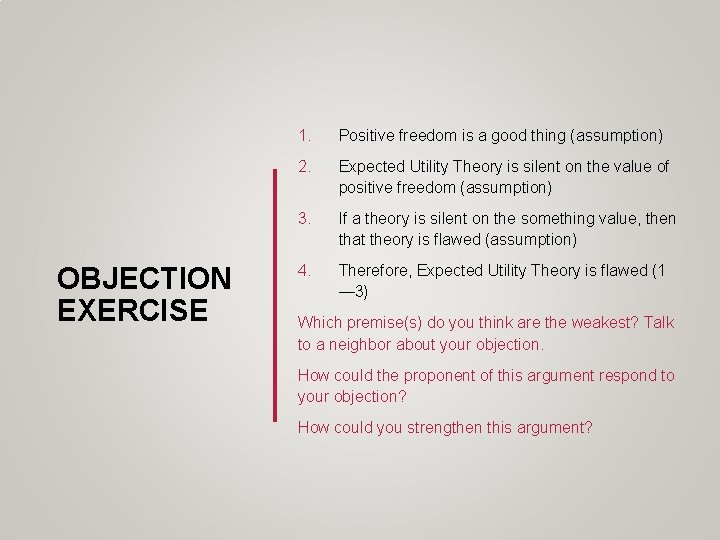
OBJECTION EXERCISE 1. Positive freedom is a good thing (assumption) 2. Expected Utility Theory is silent on the value of positive freedom (assumption) 3. If a theory is silent on the something value, then that theory is flawed (assumption) 4. Therefore, Expected Utility Theory is flawed (1 — 3) Which premise(s) do you think are the weakest? Talk to a neighbor about your objection. How could the proponent of this argument respond to your objection? How could you strengthen this argument?
SOME WRITING PITFALLS ADOPTED FROM JOSH HUNT • Paragraph pitfalls: a paragraph that is too long and winding, trying to cover too many points in a disjointed or unfocused manner. • Remedy: typically, try to develop and defend a single key idea in each paragraph. The paragraph should begin with a clear topic sentence. Generally, a topic sentence introduces the main idea of the paragraph or states a claim similar to the one that you ultimately defend in the paragraph.
SOME WRITING PITFALLS ADOPTED FROM JOSH HUNT • Plagaristic Paraphrase: a sentence or long phrase that is pretty easily identifiable as merely a slightly reworded or slightly modified sentence in some other piece of work. At the very least, you should provide a page number citation if you do this, and even then it still looks bad. • Remedy: generally, if you use three or more words verbatim, then you should put these words in quotation marks and provide a page number citation, e. g. Josh says, “if you use three or more words verbatim, then you should put these words in quotation marks and provide a page number citation” (Hunt 2018, 1) • Extremedy: just avoid quoting anything! Put everything in your own words, using a nontrivial paraphrase if necessary. This demonstrates comprehension and avoids quotation marks popping up everywhere. • You may also cite LECTURE NOTES and HANDOUTS
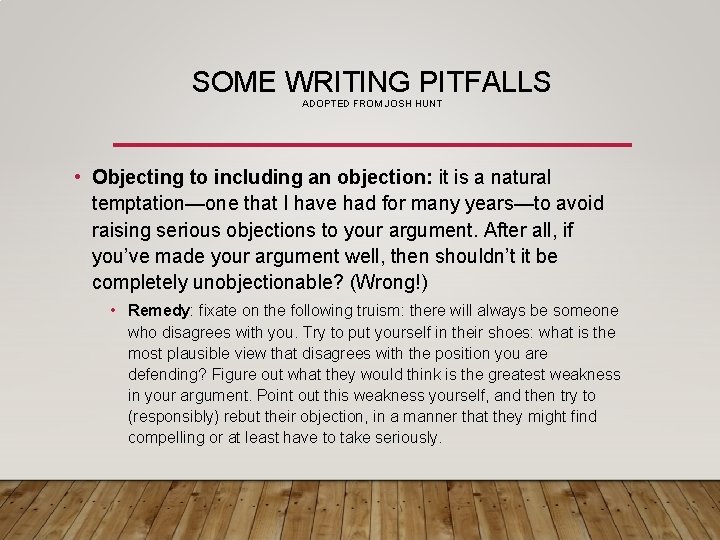
SOME WRITING PITFALLS ADOPTED FROM JOSH HUNT • Objecting to including an objection: it is a natural temptation—one that I have had for many years—to avoid raising serious objections to your argument. After all, if you’ve made your argument well, then shouldn’t it be completely unobjectionable? (Wrong!) • Remedy: fixate on the following truism: there will always be someone who disagrees with you. Try to put yourself in their shoes: what is the most plausible view that disagrees with the position you are defending? Figure out what they would think is the greatest weakness in your argument. Point out this weakness yourself, and then try to (responsibly) rebut their objection, in a manner that they might find compelling or at least have to take seriously.
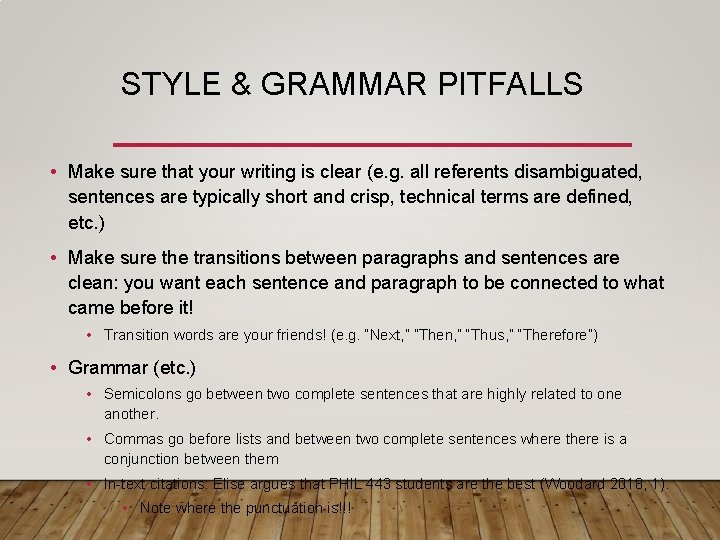
STYLE & GRAMMAR PITFALLS • Make sure that your writing is clear (e. g. all referents disambiguated, sentences are typically short and crisp, technical terms are defined, etc. ) • Make sure the transitions between paragraphs and sentences are clean: you want each sentence and paragraph to be connected to what came before it! • Transition words are your friends! (e. g. “Next, ” ”Then, ” “Thus, ” “Therefore”) • Grammar (etc. ) • Semicolons go between two complete sentences that are highly related to one another. • Commas go before lists and between two complete sentences where there is a conjunction between them • In-text citations: Elise argues that PHIL 443 students are the best (Woodard 2018, 1). • Note where the punctuation is!!!
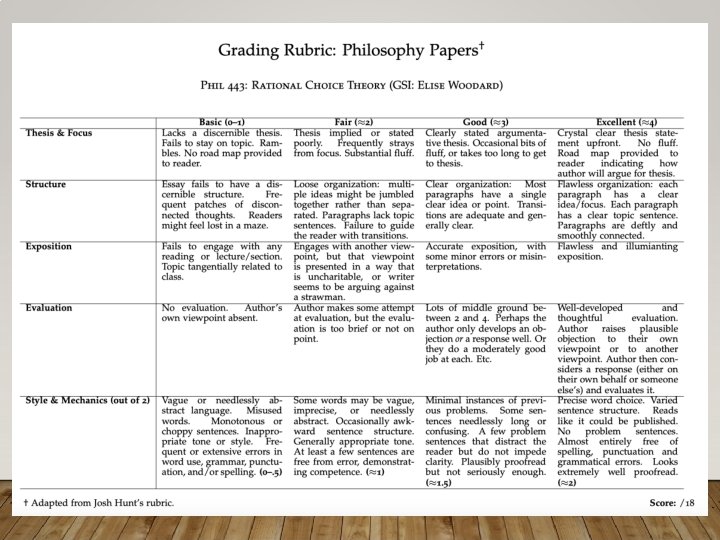
GRADING STANDARDS
OTHER RESOURCES Sweetland: https: //lsa. umich. edu/sweetland/undergraduates/writingsupport. html Mumford Method: https: //www. nottingham. ac. uk/Arts/Documents/Mumford. Method. pdf - suggested by Calum Mc. Namara - THINK SLOW, WRITE FAST
BONUS TIPS FROM ELISE • Vote Write early and often • Focus energy from the beginning on your positive proposal • Choose your prompt partly based on whether you think you have something original/substantive to say about — not on what you think It’s easiest to present. • Create an outline (Workflowy is great for this!) • First: do a rough sketch of your paper before you start writing • Throughout the writing process: continue to update your outline • Finally: check your outline against the final version of your paper • Did you do everything you said you’d do? Does your paragraph structure correspond with your outline? Does each paragraph have a topic sentence? Etc.