
WRITING WORKSHOP OUC Class 2 Class Objectives Grammar
WRITING WORKSHOP OUC Class 2
Class Objectives ■ Grammar: Parts of Speech ■ Syntax: Subject and Predicates ■ Review Proficiency Assessments ■ Workshop: 8/31 Homework Assignment ■ Homework
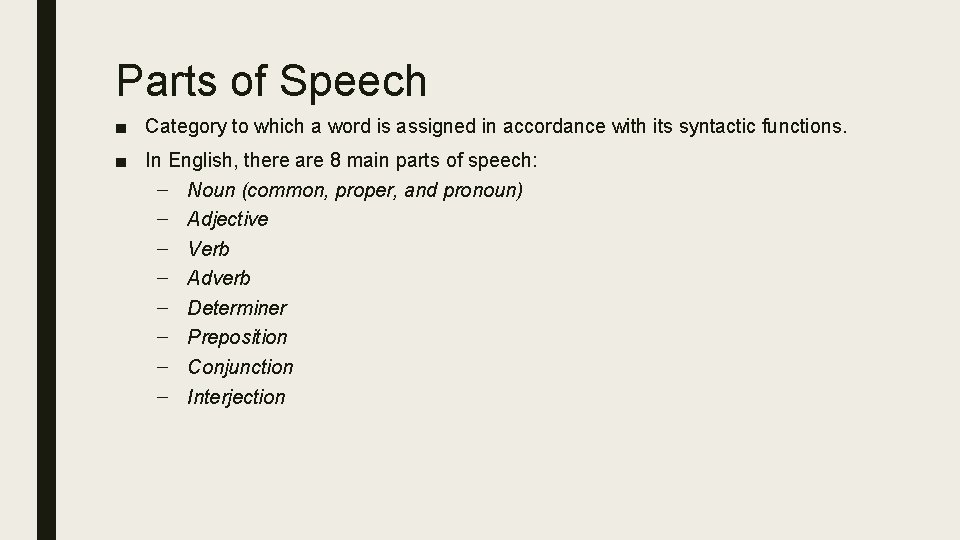
Parts of Speech ■ Category to which a word is assigned in accordance with its syntactic functions. ■ In English, there are 8 main parts of speech: – Noun (common, proper, and pronoun) – Adjective – Verb – Adverb – Determiner – Preposition – Conjunction – Interjection
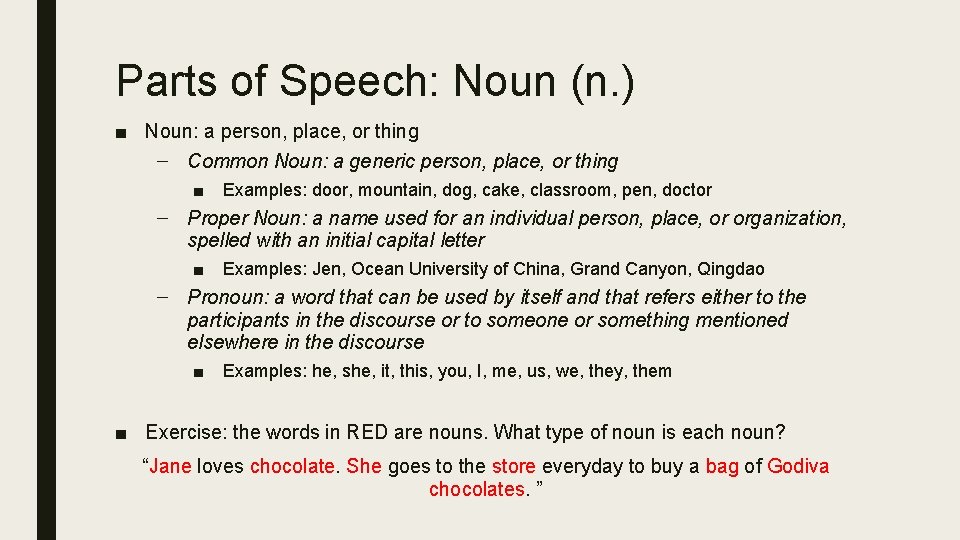
Parts of Speech: Noun (n. ) ■ Noun: a person, place, or thing – Common Noun: a generic person, place, or thing ■ Examples: door, mountain, dog, cake, classroom, pen, doctor – Proper Noun: a name used for an individual person, place, or organization, spelled with an initial capital letter ■ Examples: Jen, Ocean University of China, Grand Canyon, Qingdao – Pronoun: a word that can be used by itself and that refers either to the participants in the discourse or to someone or something mentioned elsewhere in the discourse ■ Examples: he, she, it, this, you, I, me, us, we, they, them ■ Exercise: the words in RED are nouns. What type of noun is each noun? “Jane loves chocolate. She goes to the store everyday to buy a bag of Godiva chocolates. ”
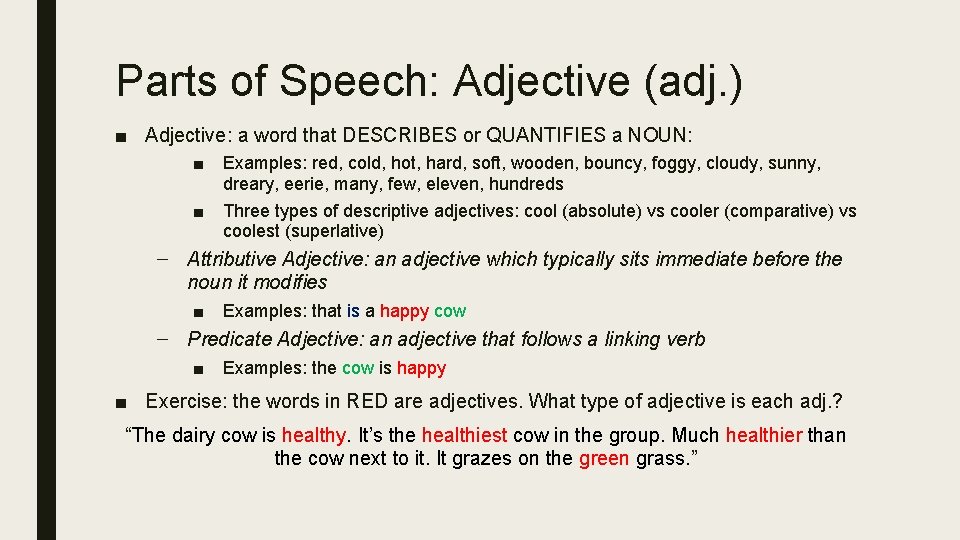
Parts of Speech: Adjective (adj. ) ■ Adjective: a word that DESCRIBES or QUANTIFIES a NOUN: ■ Examples: red, cold, hot, hard, soft, wooden, bouncy, foggy, cloudy, sunny, dreary, eerie, many, few, eleven, hundreds ■ Three types of descriptive adjectives: cool (absolute) vs cooler (comparative) vs coolest (superlative) – Attributive Adjective: an adjective which typically sits immediate before the noun it modifies ■ Examples: that is a happy cow – Predicate Adjective: an adjective that follows a linking verb ■ Examples: the cow is happy ■ Exercise: the words in RED are adjectives. What type of adjective is each adj. ? “The dairy cow is healthy. It’s the healthiest cow in the group. Much healthier than the cow next to it. It grazes on the green grass. ”
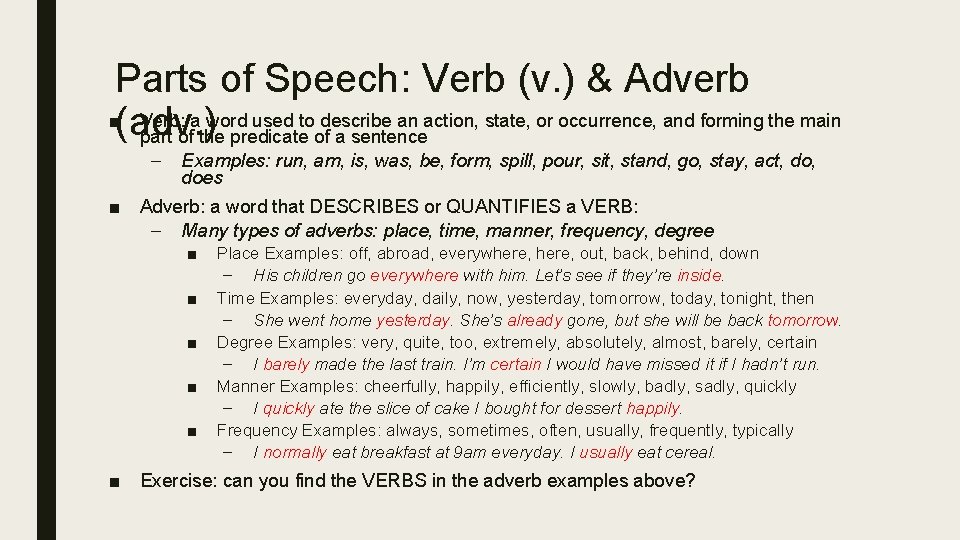
Parts of Speech: Verb (v. ) & Adverb ■(adv. ) Verb: a word used to describe an action, state, or occurrence, and forming the main part of the predicate of a sentence – Examples: run, am, is, was, be, form, spill, pour, sit, stand, go, stay, act, does ■ Adverb: a word that DESCRIBES or QUANTIFIES a VERB: – Many types of adverbs: place, time, manner, frequency, degree ■ ■ ■ Place Examples: off, abroad, everywhere, out, back, behind, down – His children go everywhere with him. Let’s see if they’re inside. Time Examples: everyday, daily, now, yesterday, tomorrow, today, tonight, then – She went home yesterday. She’s already gone, but she will be back tomorrow. Degree Examples: very, quite, too, extremely, absolutely, almost, barely, certain – I barely made the last train. I’m certain I would have missed it if I hadn’t run. Manner Examples: cheerfully, happily, efficiently, slowly, badly, sadly, quickly – I quickly ate the slice of cake I bought for dessert happily. Frequency Examples: always, sometimes, often, usually, frequently, typically – I normally eat breakfast at 9 am everyday. I usually eat cereal. ■ Exercise: can you find the VERBS in the adverb examples above?
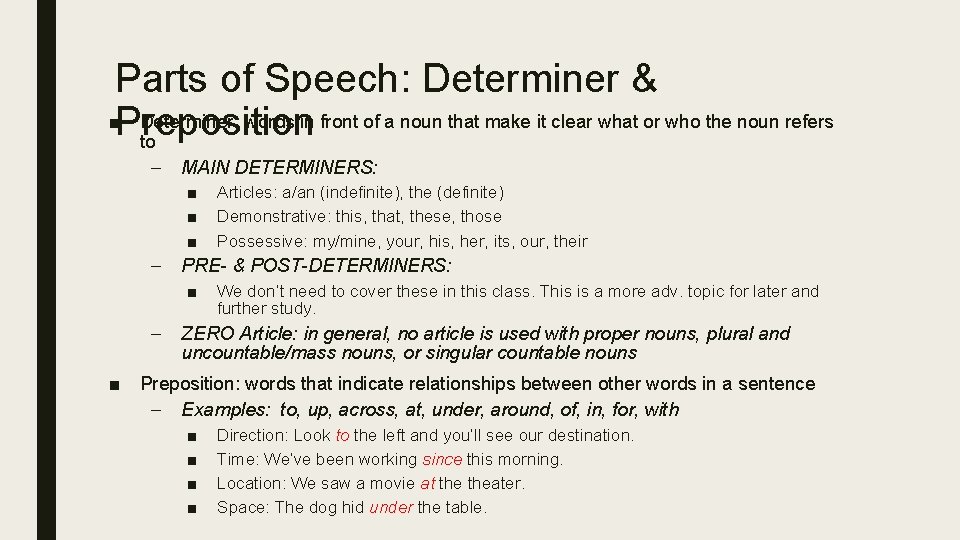
Parts of Speech: Determiner & ■Preposition Determiner: words in front of a noun that make it clear what or who the noun refers to – MAIN DETERMINERS: ■ ■ ■ – PRE- & POST-DETERMINERS: ■ – Articles: a/an (indefinite), the (definite) Demonstrative: this, that, these, those Possessive: my/mine, your, his, her, its, our, their We don’t need to cover these in this class. This is a more adv. topic for later and further study. ZERO Article: in general, no article is used with proper nouns, plural and uncountable/mass nouns, or singular countable nouns ■ Preposition: words that indicate relationships between other words in a sentence – Examples: to, up, across, at, under, around, of, in, for, with ■ ■ Direction: Look to the left and you’ll see our destination. Time: We’ve been working since this morning. Location: We saw a movie at theater. Space: The dog hid under the table.
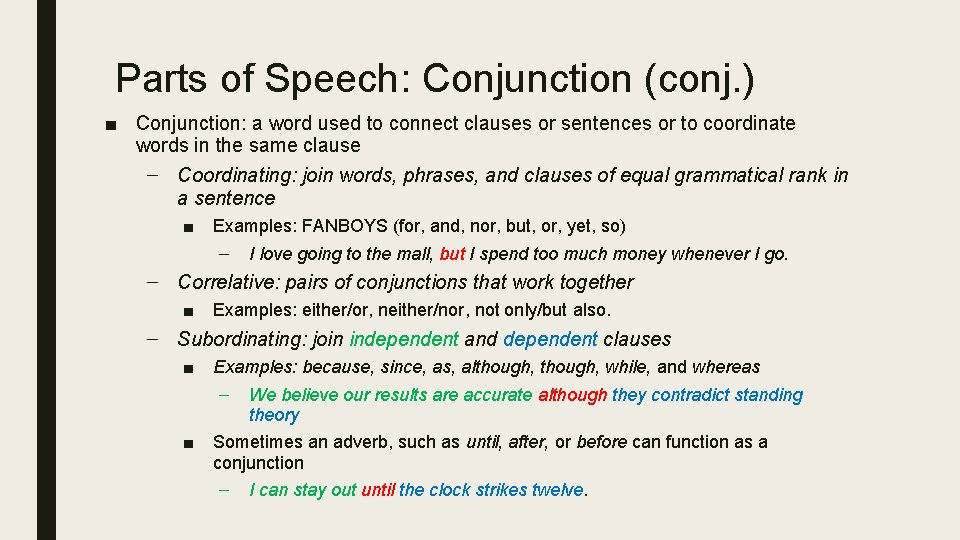
Parts of Speech: Conjunction (conj. ) ■ Conjunction: a word used to connect clauses or sentences or to coordinate words in the same clause – Coordinating: join words, phrases, and clauses of equal grammatical rank in a sentence ■ Examples: FANBOYS (for, and, nor, but, or, yet, so) – I love going to the mall, but I spend too much money whenever I go. – Correlative: pairs of conjunctions that work together ■ Examples: either/or, neither/nor, not only/but also. – Subordinating: join independent and dependent clauses ■ Examples: because, since, as, although, while, and whereas – ■ We believe our results are accurate although they contradict standing theory Sometimes an adverb, such as until, after, or before can function as a conjunction – I can stay out until the clock strikes twelve.
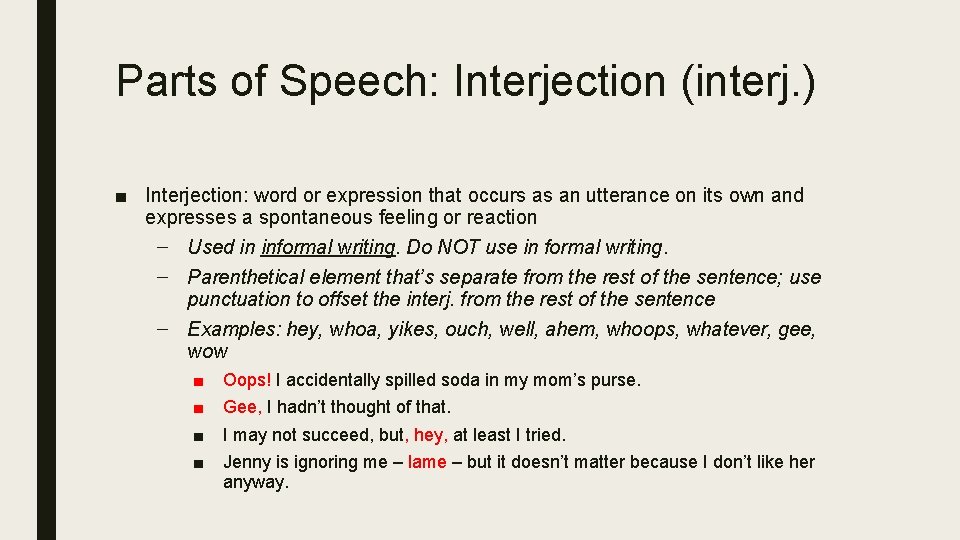
Parts of Speech: Interjection (interj. ) ■ Interjection: word or expression that occurs as an utterance on its own and expresses a spontaneous feeling or reaction – Used in informal writing. Do NOT use in formal writing. – Parenthetical element that’s separate from the rest of the sentence; use punctuation to offset the interj. from the rest of the sentence – Examples: hey, whoa, yikes, ouch, well, ahem, whoops, whatever, gee, wow ■ ■ Oops! I accidentally spilled soda in my mom’s purse. Gee, I hadn’t thought of that. I may not succeed, but, hey, at least I tried. Jenny is ignoring me – lame – but it doesn’t matter because I don’t like her anyway.
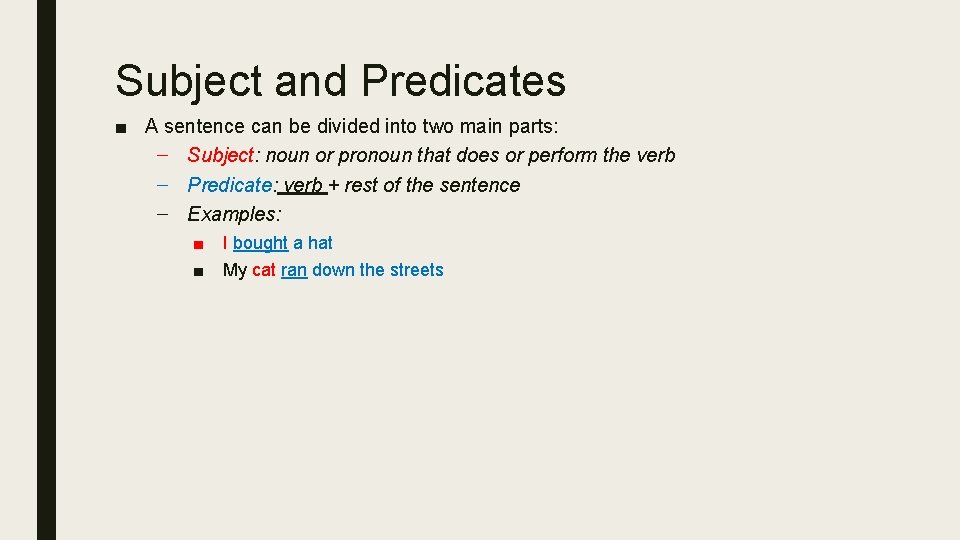
Subject and Predicates ■ A sentence can be divided into two main parts: – Subject: noun or pronoun that does or perform the verb – Predicate: verb + rest of the sentence – Examples: ■ ■ I bought a hat My cat ran down the streets
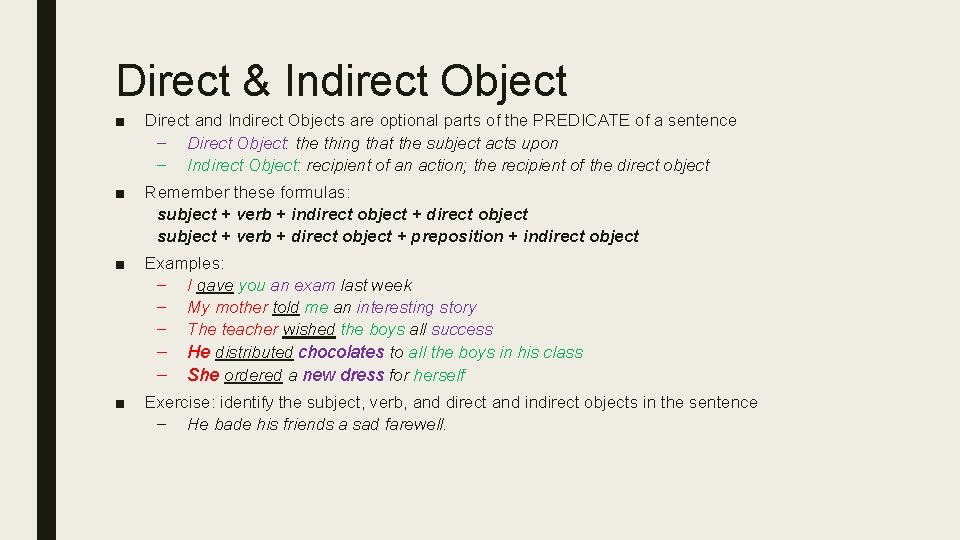
Direct & Indirect Object ■ Direct and Indirect Objects are optional parts of the PREDICATE of a sentence – Direct Object: the thing that the subject acts upon – Indirect Object: recipient of an action; the recipient of the direct object ■ Remember these formulas: subject + verb + indirect object + direct object subject + verb + direct object + preposition + indirect object ■ Examples: – I gave you an exam last week – My mother told me an interesting story – The teacher wished the boys all success – He distributed chocolates to all the boys in his class – She ordered a new dress for herself ■ Exercise: identify the subject, verb, and direct and indirect objects in the sentence – He bade his friends a sad farewell.
Helpful Online Resources ■ Pronouns: https: //www. grammarly. com/blog/pronouns/ ■ Adjectives: https: //www. grammarly. com/blog/adjective/ ■ Adverbs: https: //www. grammarly. com/blog/adverb/ ■ Determiners: https: //www. englishclub. com/grammar/determiners. htm, https: //www. ef. com/wwen/english-resources/english-grammar/determiners/ ■ Prepositions: https: //www. grammarly. com/blog/prepositions/ ■ Conjunctions: https: //www. grammarly. com/blog/conjunctions/, https: //owl. purdue. edu/owl/general_writing/punctuation/independent_and_depen dent_clauses/index. html ■ Interjections: https: //www. grammarly. com/blog/interjection/
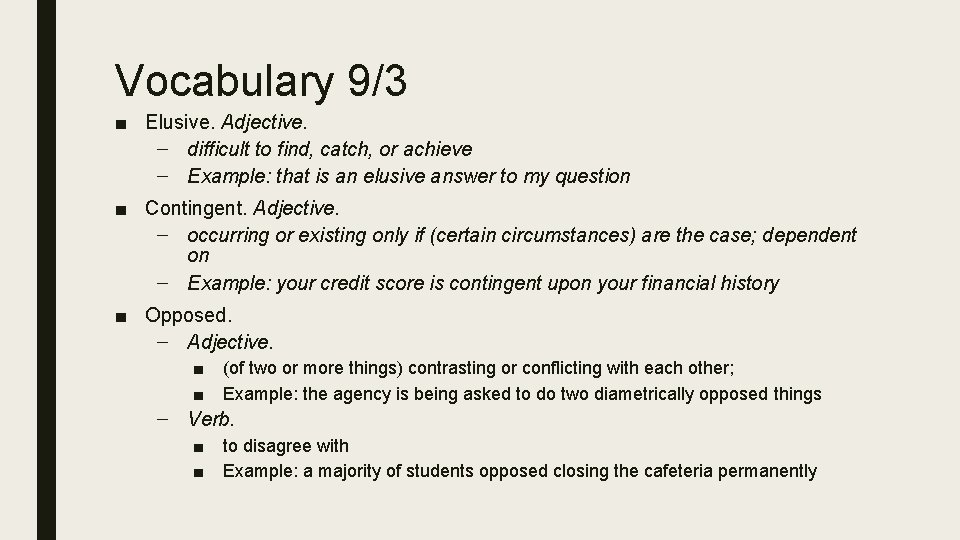
Vocabulary 9/3 ■ Elusive. Adjective. – difficult to find, catch, or achieve – Example: that is an elusive answer to my question ■ Contingent. Adjective. – occurring or existing only if (certain circumstances) are the case; dependent on – Example: your credit score is contingent upon your financial history ■ Opposed. – Adjective. ■ ■ (of two or more things) contrasting or conflicting with each other; Example: the agency is being asked to do two diametrically opposed things – Verb. ■ ■ to disagree with Example: a majority of students opposed closing the cafeteria permanently
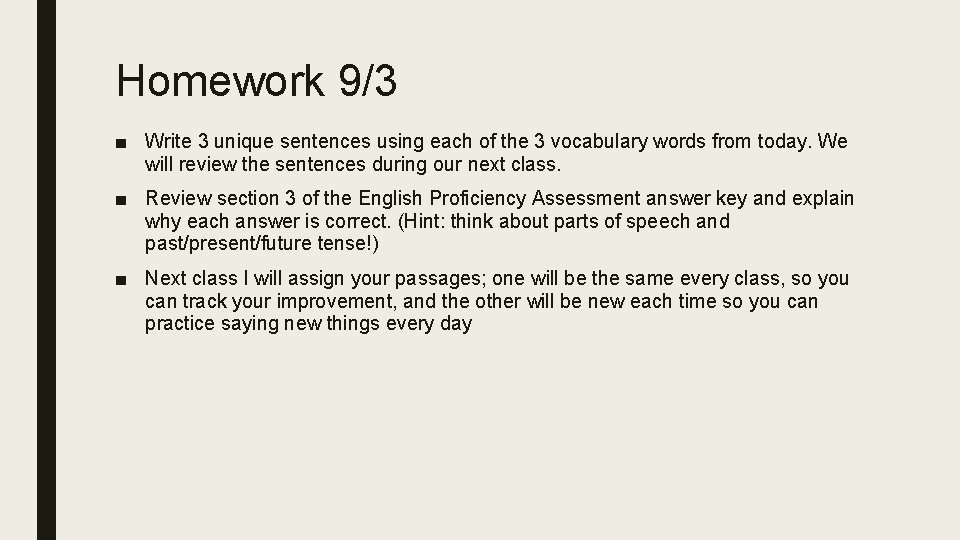
Homework 9/3 ■ Write 3 unique sentences using each of the 3 vocabulary words from today. We will review the sentences during our next class. ■ Review section 3 of the English Proficiency Assessment answer key and explain why each answer is correct. (Hint: think about parts of speech and past/present/future tense!) ■ Next class I will assign your passages; one will be the same every class, so you can track your improvement, and the other will be new each time so you can practice saying new things every day
- Slides: 14