
Writing while reading registers Seth Gilbert Distributed Programming
Writing while reading registers Seth Gilbert Distributed Programming Laboratory © R. Guerraoui, M. Vukolic, S. Gilbert 1
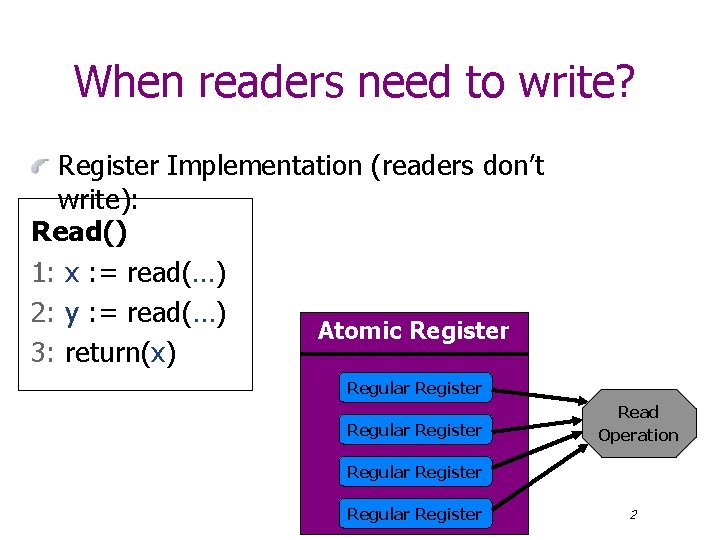
When readers need to write? Register Implementation (readers don’t write): Read() 1: x : = read(…) 2: y : = read(…) Atomic Register 3: return(x) Regular Register Read Operation Regular Register 2
When readers need to write? 1. To improve complexity: • reader-writer communication 2. To facilitate multiple readers: atomic registers • reader-reader communication • 3
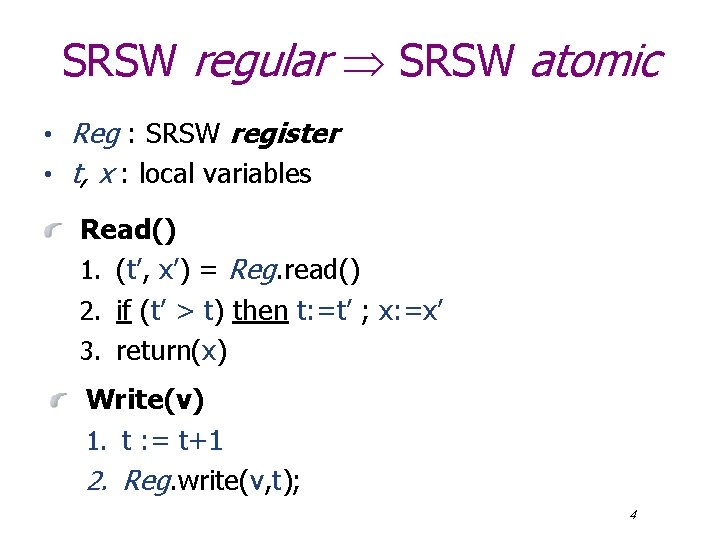
SRSW regular SRSW atomic • Reg : SRSW register • t, x : local variables Read() 1. (t’, x’) = Reg. read() 2. if (t’ > t) then t: =t’ ; x: =x’ 3. return(x) Write(v) 1. t : = t+1 2. Reg. write(v, t); 4
SRSW regular SRSW atomic Not for multiple readers… Not without timestamps… • variable t representing logical time What is behind these limitations? 5
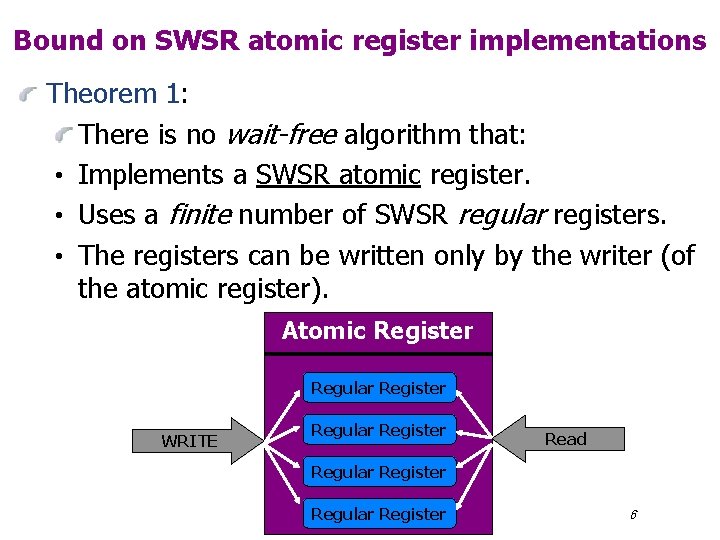
Bound on SWSR atomic register implementations Theorem 1: There is no wait-free algorithm that: • Implements a SWSR atomic register. • Uses a finite number of SWSR regular registers. • The registers can be written only by the writer (of the atomic register). Atomic Register Regular Register WRITE Regular Register Read Regular Register 6
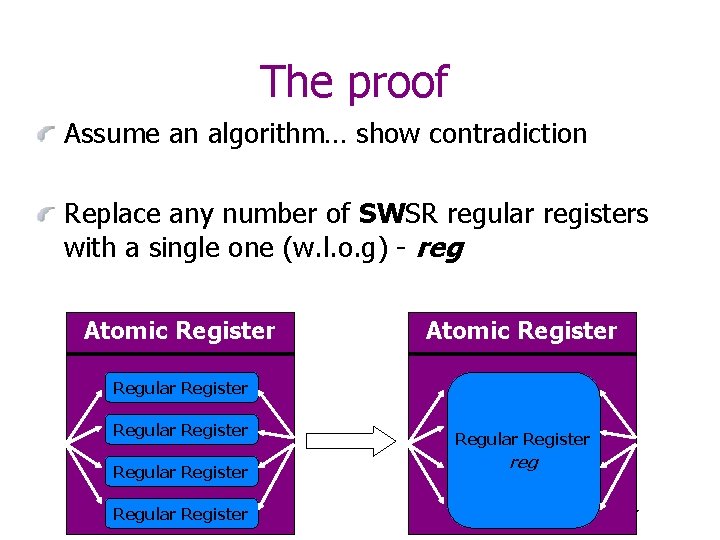
The proof Assume an algorithm… show contradiction Replace any number of SWSR regular registers with a single one (w. l. o. g) - reg Atomic Register Regular Register Regular Register reg 7
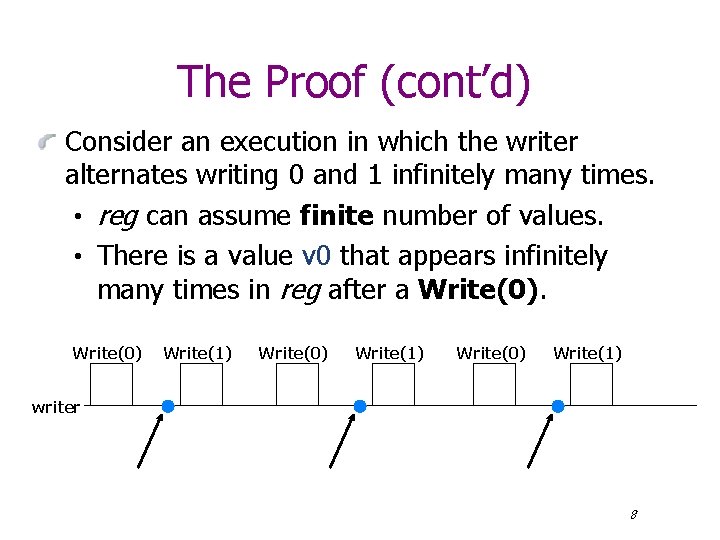
The Proof (cont’d) Consider an execution in which the writer alternates writing 0 and 1 infinitely many times. • reg can assume finite number of values. • There is a value v 0 that appears infinitely many times in reg after a Write(0) Write(1) writer 8
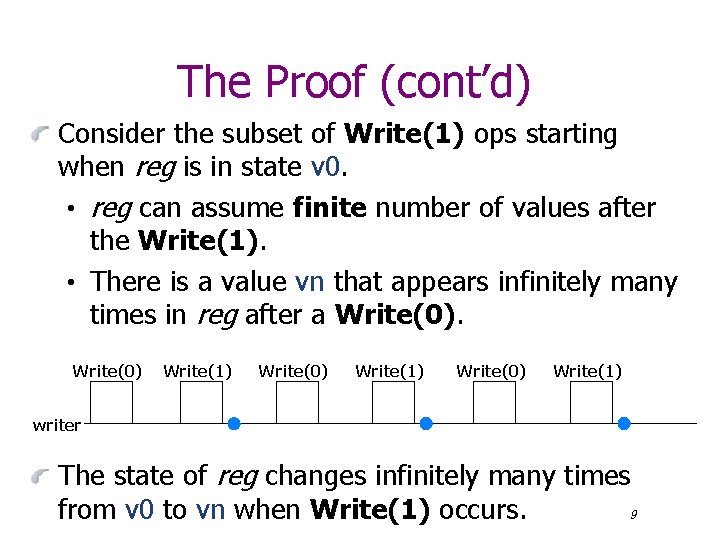
The Proof (cont’d) Consider the subset of Write(1) ops starting when reg is in state v 0. • reg can assume finite number of values after the Write(1). • There is a value vn that appears infinitely many times in reg after a Write(0) Write(1) writer The state of reg changes infinitely many times 9 from v 0 to vn when Write(1) occurs.
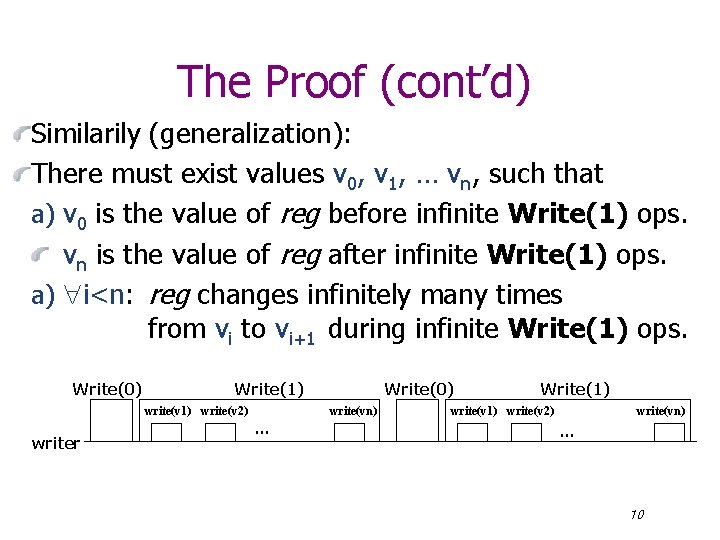
The Proof (cont’d) Similarily (generalization): There must exist values v 0, v 1, … vn, such that a) v 0 is the value of reg before infinite Write(1) ops. vn is the value of reg after infinite Write(1) ops. a) i<n: reg changes infinitely many times from vi to vi+1 during infinite Write(1) ops. Write(0) Write(1) write(v 2) writer Write(0) write(vn) … Write(1) write(v 2) write(vn) … 10
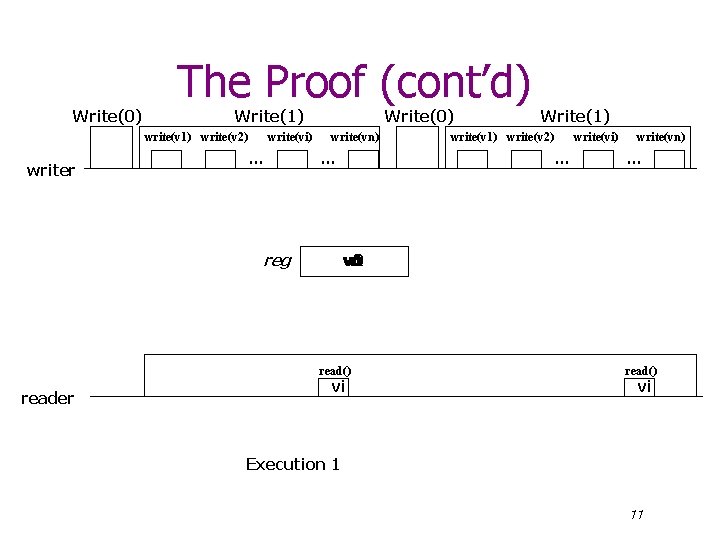
Write(0) The Proof (cont’d) Write(1) write(v 2) writer write(vi) … Write(0) write(vn) … reg write(v 1) write(v 2) write(vi) … write(vn) … vn v 1 … v 0 v 2 vi read() reader Write(1) vi read() vi Execution 1 11
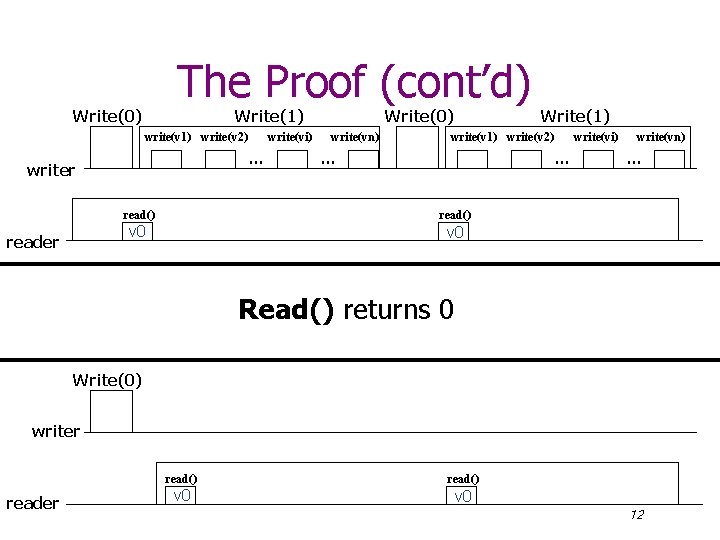
The Proof (cont’d) Write(0) Write(1) write(v 2) … writer read() write(vn) Write(1) write(v 2) … write(vi) … write(vn) … read() v 0 reader write(vi) Write(0) v 0 Read() returns 0 Write(0) writer read() reader v 0 read() v 0 12
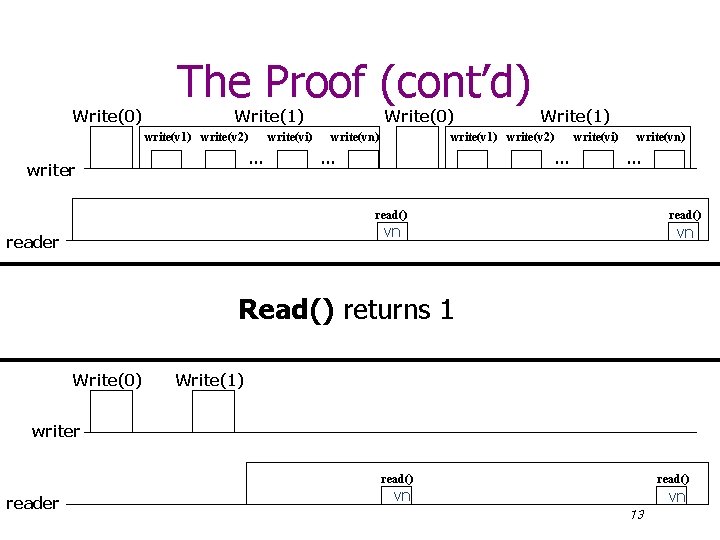
Write(0) The Proof (cont’d) Write(1) write(v 2) write(vi) … writer Write(0) write(vn) Write(1) write(v 2) … write(vi) … write(vn) … read() vn reader vn Read() returns 1 Write(0) Write(1) writer read() reader read() vn vn 13
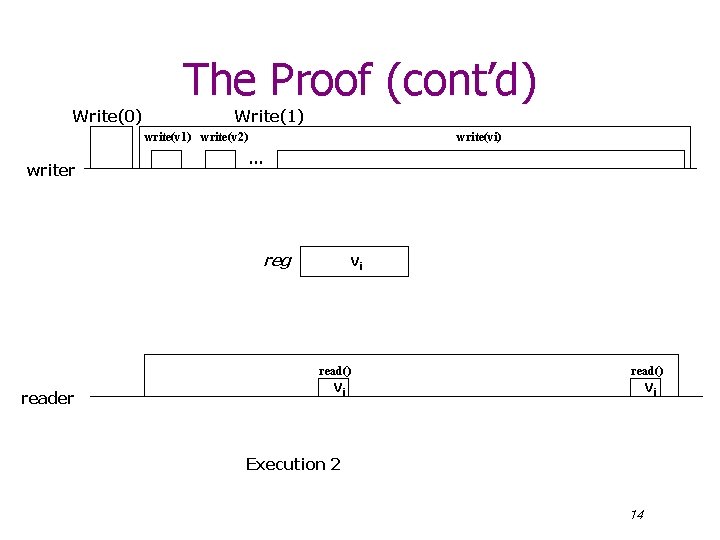
The Proof (cont’d) Write(0) Write(1) write(v 2) writer write(vi) … reg vi read() reader vi read() vi Execution 2 14
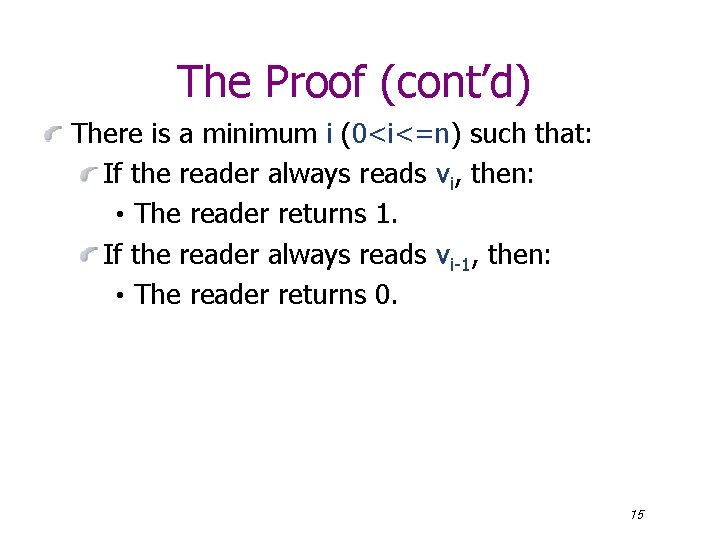
The Proof (cont’d) There is a minimum i (0<i<=n) such that: If the reader always reads vi, then: • The reader returns 1. If the reader always reads vi-1, then: • The reader returns 0. 15
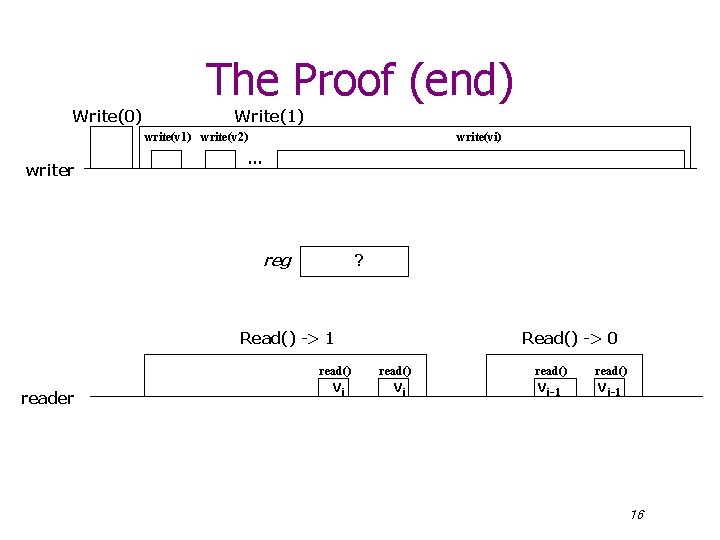
The Proof (end) Write(0) Write(1) write(v 2) writer write(vi) … reg ? Read() -> 1 read() reader vi Read() -> 0 read() vi-1 16
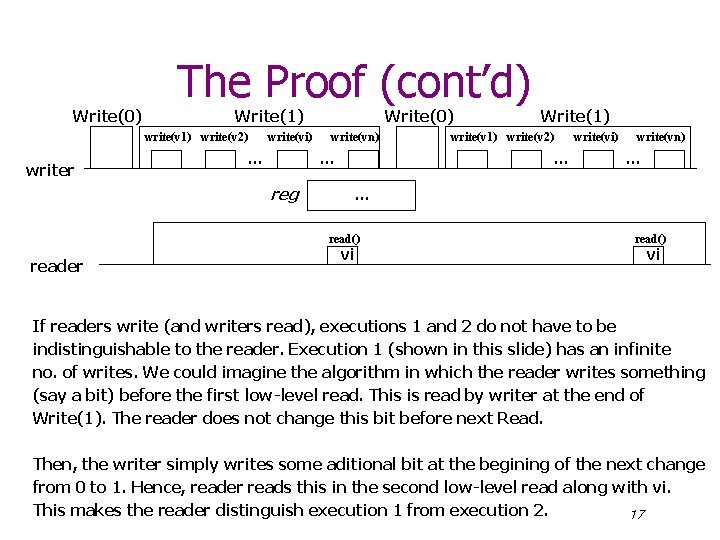
Write(0) The Proof (cont’d) Write(1) write(v 2) writer write(vi) … Write(0) write(vn) … write(v 1) write(v 2) write(vi) … reg write(vn) … … read() reader Write(1) vi read() vi If readers write (and writers read), executions 1 and 2 do not have to be indistinguishable to the reader. Execution 1 (shown in this slide) has an infinite no. of writes. We could imagine the algorithm in which the reader writes something (say a bit) before the first low-level read. This is read by writer at the end of Write(1). The reader does not change this bit before next Read. Then, the writer simply writes some aditional bit at the begining of the next change from 0 to 1. Hence, reader reads this in the second low-level read along with vi. This makes the reader distinguish execution 1 from execution 2. 17
Summary The reader needs to write in order to reduce the space complexity: Reduce space from unbounded to bounded. Key requirement: reader–writer communication The (bounded) algorithm will come a bit later 18
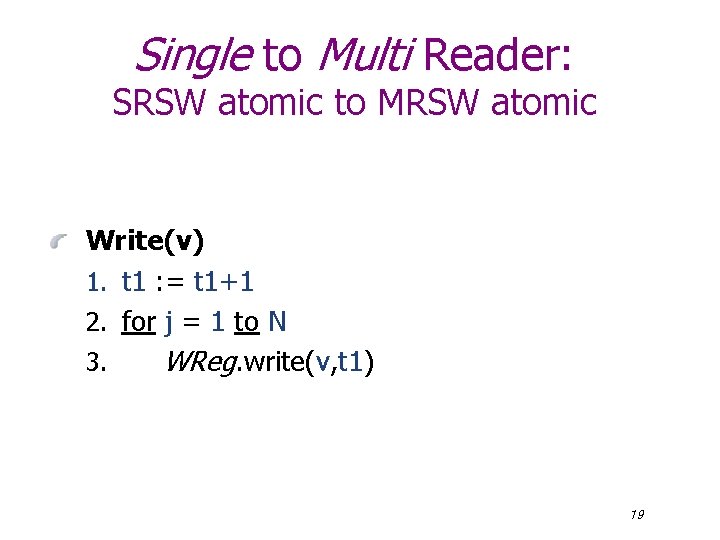
Single to Multi Reader: SRSW atomic to MRSW atomic Write(v) 1. t 1 : = t 1+1 2. for j = 1 to N 3. WReg. write(v, t 1) 19
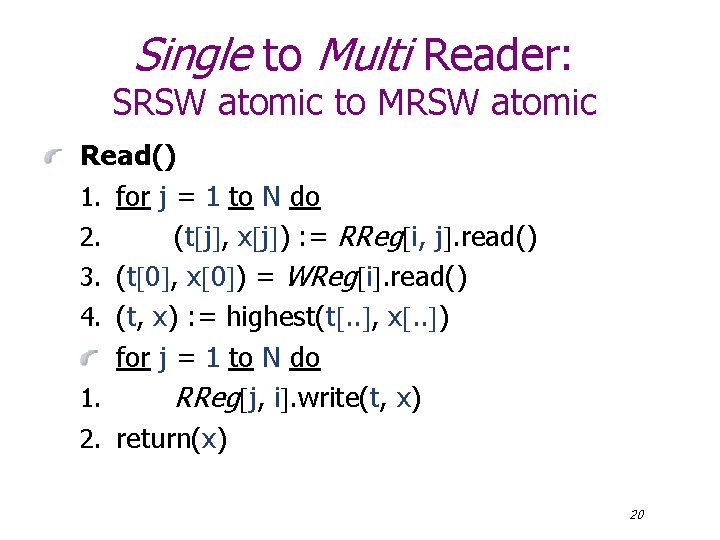
Single to Multi Reader: SRSW atomic to MRSW atomic Read() 1. for j = 1 to N do 2. (t j , x j ) : = RReg i, j. read() 3. (t 0 , x 0 ) = WReg i. read() 4. (t, x) : = highest(t. . , x. . ) for j = 1 to N do 1. RReg j, i. write(t, x) 2. return(x) 20
Single to Multi Reader: SRSW atomic to MRSW atomic The transformation would not work for multiple writers The transformation would not work if the readers do not communicate (i. e. , if a reader does not write) 21
Bound on SWMR atomic register implementations Theorem 2: There is no wait-free algorithm that implements a (SWMR) atomic register using any number of (SWSR) atomic registers that can be written by the writer (of the SWMR atomic register). 22
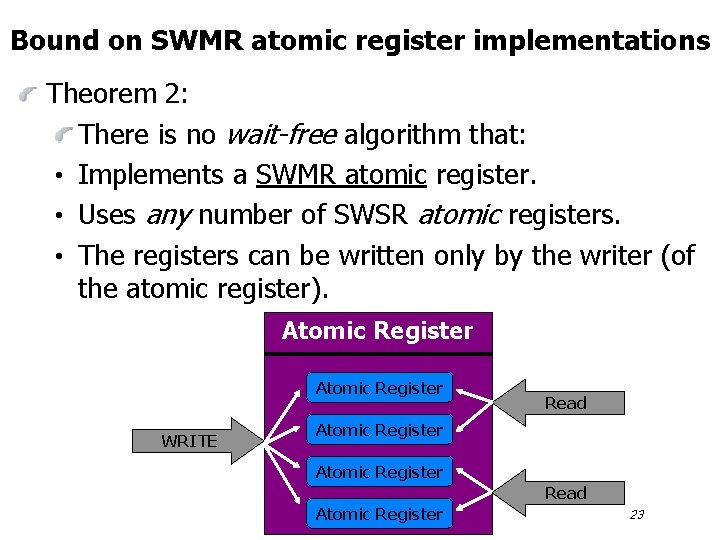
Bound on SWMR atomic register implementations Theorem 2: There is no wait-free algorithm that: • Implements a SWMR atomic register. • Uses any number of SWSR atomic registers. • The registers can be written only by the writer (of the atomic register). Atomic Register WRITE Read Atomic Register 23
The proof We assume such an algorithm and show contradiction Denote the SWMR register by reg* We assume 2 readers p 1 and p 2. The writer is pw. 24
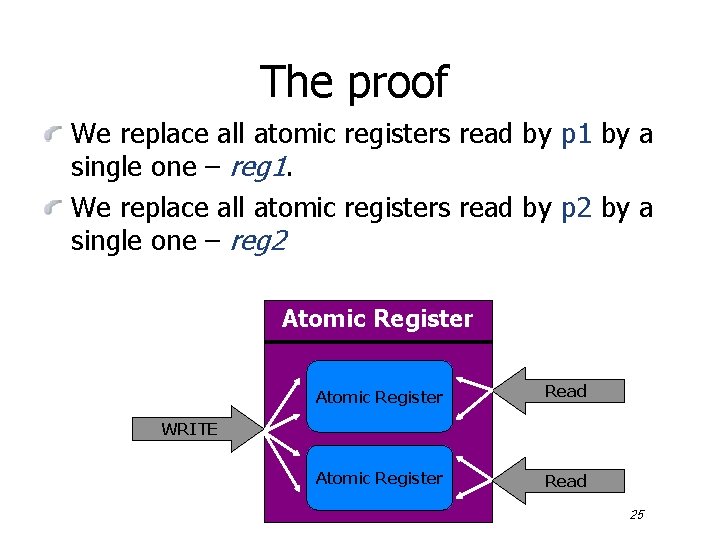
The proof We replace all atomic registers read by p 1 by a single one – reg 1. We replace all atomic registers read by p 2 by a single one – reg 2 Atomic Register Read WRITE 25
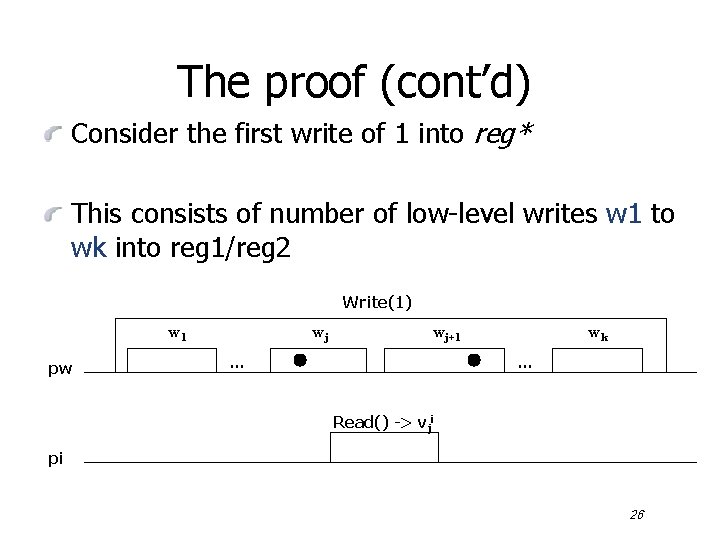
The proof (cont’d) Consider the first write of 1 into reg* This consists of number of low-level writes w 1 to wk into reg 1/reg 2 Write(1) w 1 pw wj wj+1 … wk … Read() -> vji pi 26
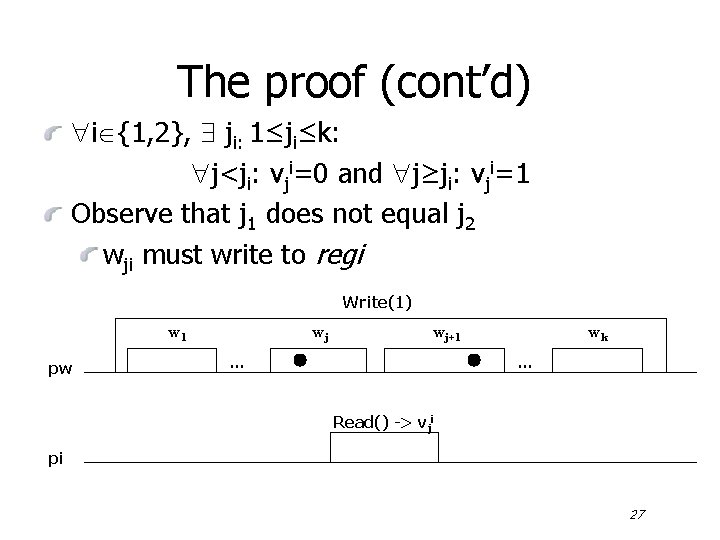
The proof (cont’d) i {1, 2}, ji: 1≤ji≤k: j<ji: vji=0 and j≥ji: vji=1 Observe that j 1 does not equal j 2 wji must write to regi Write(1) w 1 pw wj wj+1 … wk … Read() -> vji pi 27
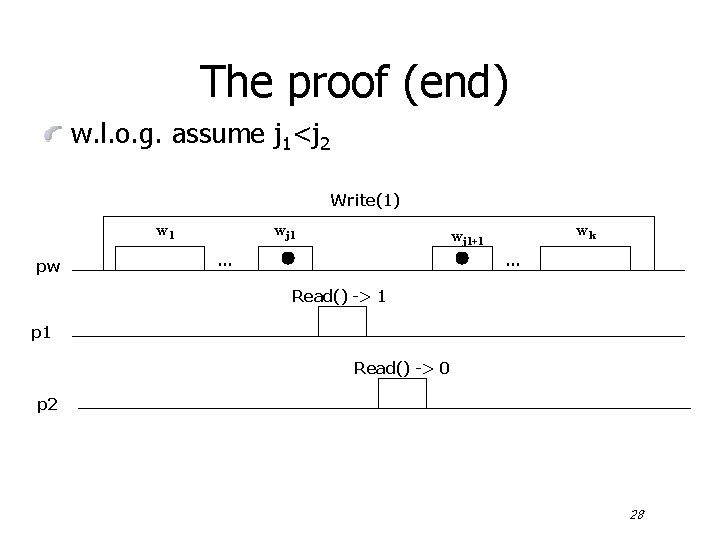
The proof (end) w. l. o. g. assume j 1<j 2 Write(1) w 1 pw wj 1 wk wj 1+1 … … Read() -> 1 p 1 Read() -> 0 p 2 28
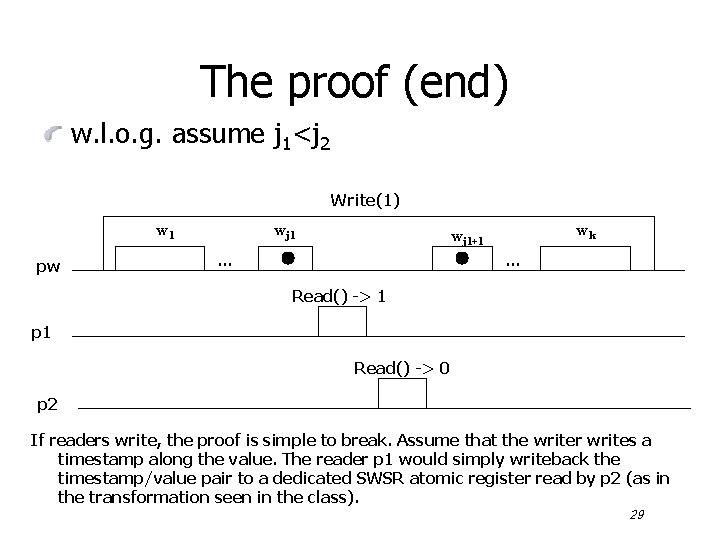
The proof (end) w. l. o. g. assume j 1<j 2 Write(1) w 1 pw wj 1 wk wj 1+1 … … Read() -> 1 p 1 Read() -> 0 p 2 If readers write, the proof is simple to break. Assume that the writer writes a timestamp along the value. The reader p 1 would simply writeback the timestamp/value pair to a dedicated SWSR atomic register read by p 2 (as in the transformation seen in the class). 29
Summary The readers need to write in implementations of: • multi-reader • wait-free • atomic (out of weaker base objects) Even when the available space is unbounded Same idea: • Implementing SWMR atomic from SWMR regular We can implement SWMR regular from SWSR atomic 30
From safe to atomic: one bit Wait-free implementation one SWSR atomic Brute force (the reader does not write): 1. SWSR safe to SWSR regular bit Simple 2. SWSR regular bit to SWMR multivalued O(N) in space and time SWMR regular to SWSR atomic 1. Timestamps (unbounded space) 31
From safe to atomic: one bit Wait-free implementation one SWSR atomic bit Something different: The reader should write! Aim for O(1) complexity in space and in time 32
How many safe bits? A single one will not be enough (Theorem 1) We need at least: • one for writer to write value • one for reader will write Can we do it with only 2 SWSR safe bits? No… Assume two bits • V, written by the writer and read by the reader 33 • R, written by the reader and read by the writer
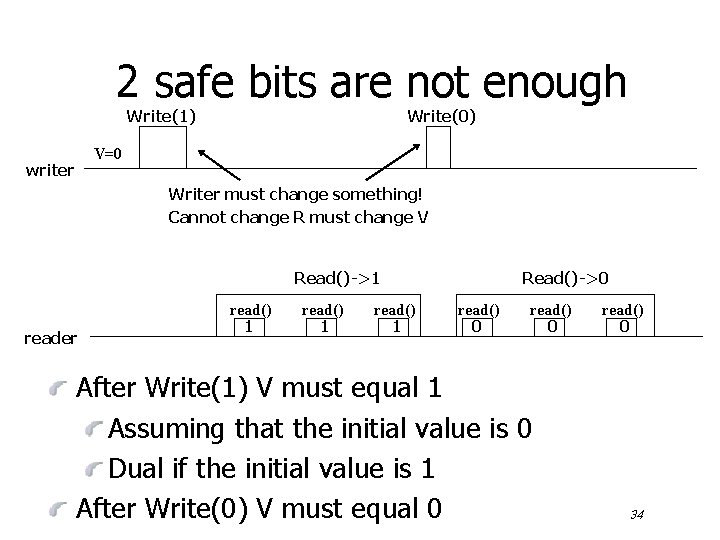
2 safe bits are not enough Write(1) Write(0) V=0 writer Writer must change something! Cannot change R must change V Read()->1 reader read() 1 Read()->0 read() 0 After Write(1) V must equal 1 Assuming that the initial value is 0 Dual if the initial value is 1 After Write(0) V must equal 0 read() 0 34
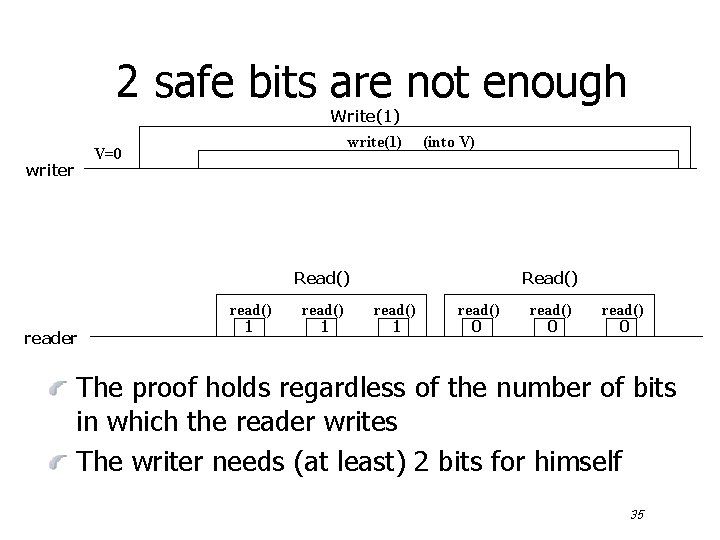
2 safe bits are not enough Write(1) write(1) V=0 writer (into V) Read() reader read() 1 Read() read() 1 read() 0 The proof holds regardless of the number of bits in which the reader writes The writer needs (at least) 2 bits for himself 35
3 bits are enough (Tromp’s algorithm) 2 bits owned (written) by the writer V (for a value) and W (control flag) 1 bit owned by the reader (R – control flag) When the writer executes: if W=R then { … } We mean: 1) r : =read(R) 2) if (W=r) then … r is a local variable A copy of W is stored localy 36
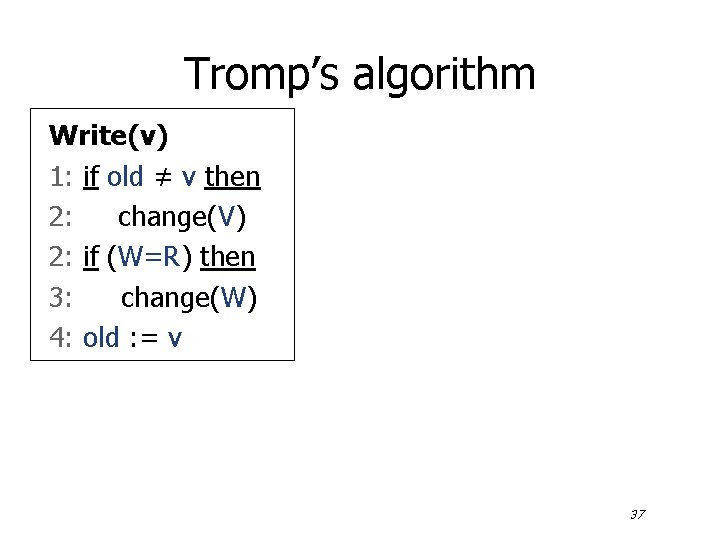
Tromp’s algorithm Write(v) 1: if old ≠ v then 2: change(V) 2: if (W=R) then 3: change(W) 4: old : = v 37
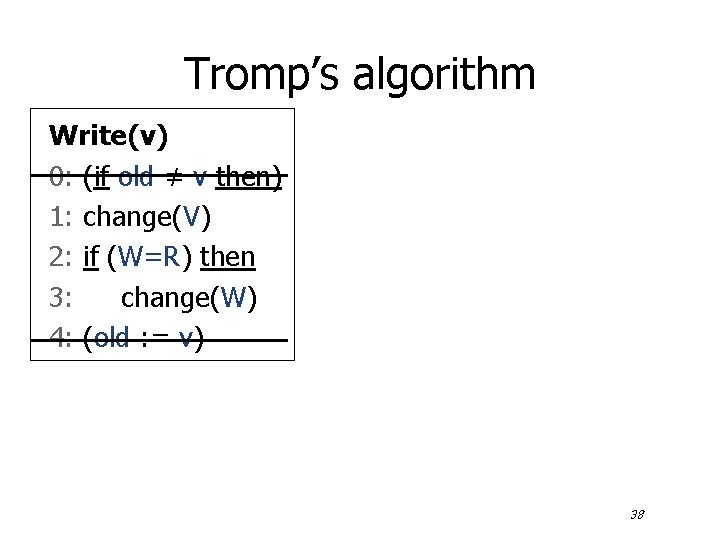
Tromp’s algorithm Write(v) 0: (if old ≠ v then) 1: change(V) 2: if (W=R) then 3: change(W) 4: (old : = v) 38
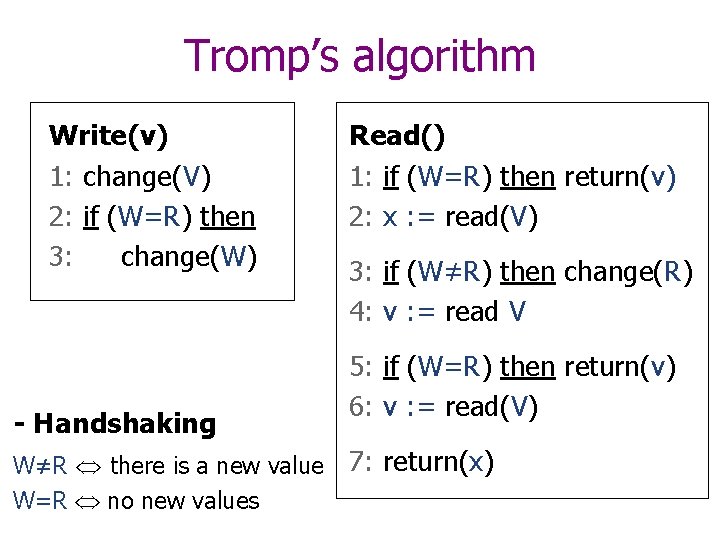
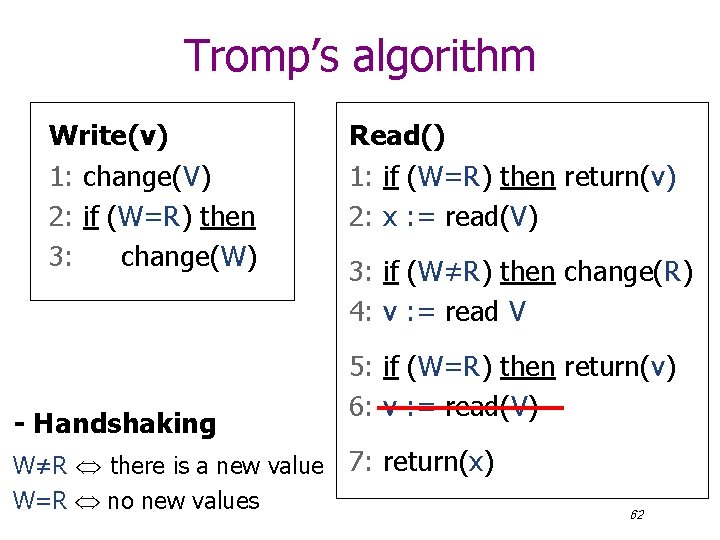
Tromp’s algorithm Write(v) 1: change(V) 2: if (W=R) then 3: change(W) - Handshaking W≠R there is a new value W=R no new values Read() 1: if (W=R) then return(v) 2: x : = read(V) 3: if (W≠R) then change(R) 4: v : = read V 5: if (W=R) then return(v) 6: v : = read(V) 7: return(x) 39
Correctness Liveness – straigthforward Safety – a bit more difficult 40
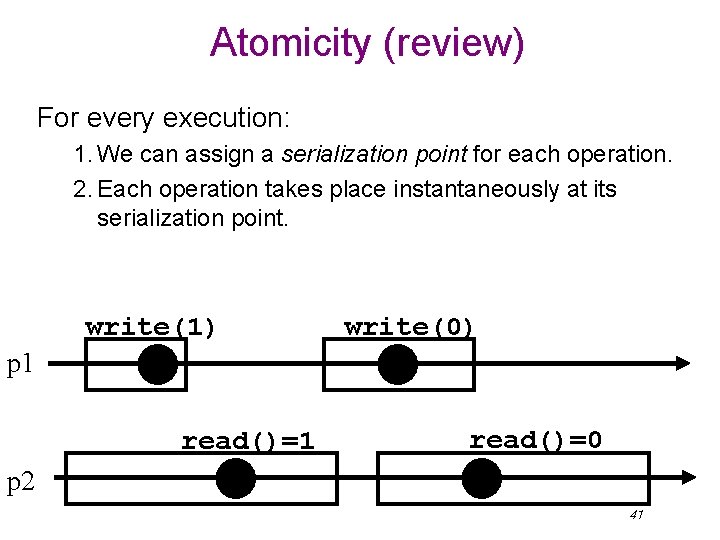
Atomicity (review) For every execution: 1. We can assign a serialization point for each operation. 2. Each operation takes place instantaneously at its serialization point. write(1) write(0) p 1 read()=0 p 2 41
Atomicity (conditions) For every execution: There exists a partial order of operations such that: 1. All Write operations are ordered. 2. Each Read operation is ordered with respect to all write ops. 3. Each Read operation returns the value of the immediately preceding Write operation. 4. If op 1 precedes op 2, then not(op 2 < op 1) in the ordering. 42
Atomicity (conditions) For every execution: There exists a partial order of operations such that: 1. All Write operations are ordered. 2. Each Read operation is ordered with respect to all write ops. 3. Each Read operation returns the value of the immediately preceding Write operation. 4. If op 1 precedes op 2, then not(op 2 < op 1) in the ordering. Define ordering: 1. Writes are (trivially) ordered. 2. Reads: • Find last “Read(V)” that precedes return for Read. • Find “Write(V)” that wrote that value. • Write that contains “Write(V)” ordered before Read. 43
Atomicity (conditions) For every execution: There exists a partial order of operations such that: 1. All Write operations are ordered. 2. Each Read operation is ordered with respect to all Write ops. 3. Each Read operation returns the value of the immediately preceding Write operation. 4. If op 1 precedes op 2, then not(op 2 < op 1) in the ordering. Define ordering: 1. Writes are (trivially) ordered. 2. Reads: • Find last “Read(V)” that precedes return for Read. • Find “Write(V)” that wrote that value. • Write that contains “Write(V)” ordered before Read. 44
Correctness 1 Each Read operation returns the value of the immediately preceding Write operation. 45
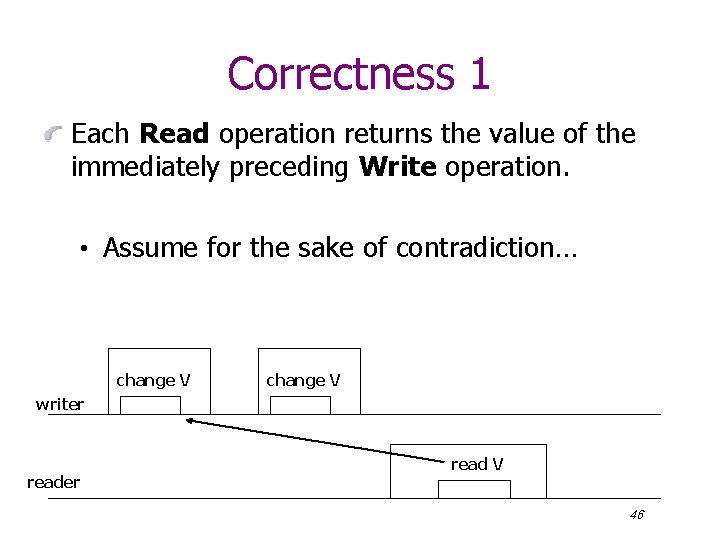
Correctness 1 Each Read operation returns the value of the immediately preceding Write operation. • Assume for the sake of contradiction… change V writer read V 46
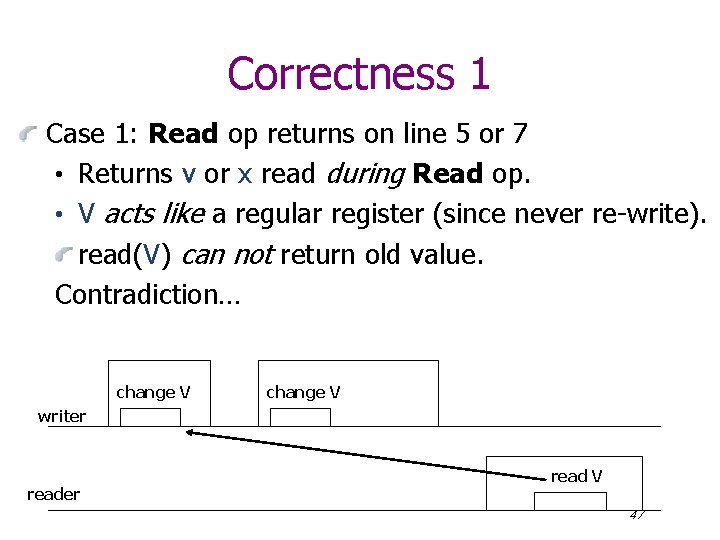
Correctness 1 Case 1: Read op returns on line 5 or 7 • Returns v or x read during Read op. • V acts like a regular register (since never re-write). read(V) can not return old value. Contradiction… change V writer read V 47
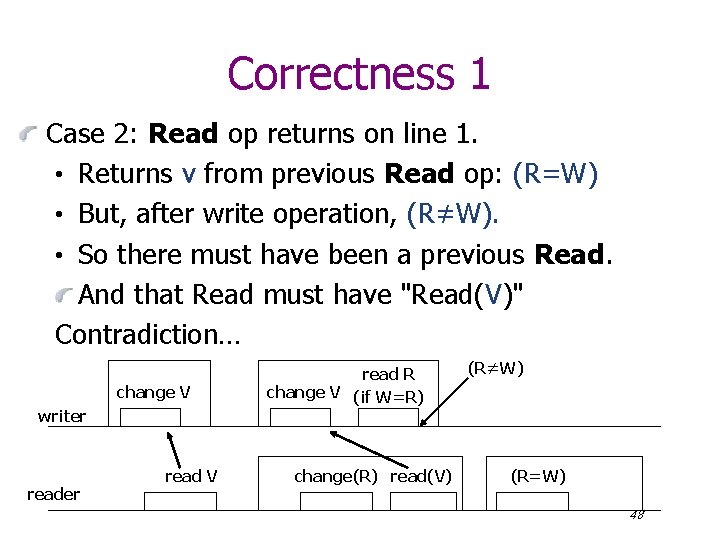
Correctness 1 Case 2: Read op returns on line 1. • Returns v from previous Read op: (R=W) • But, after write operation, (R≠W). • So there must have been a previous Read. And that Read must have "Read(V)" Contradiction… change V writer read V read R change V (if W=R) change(R) read(V) (R≠W) (R=W) 48
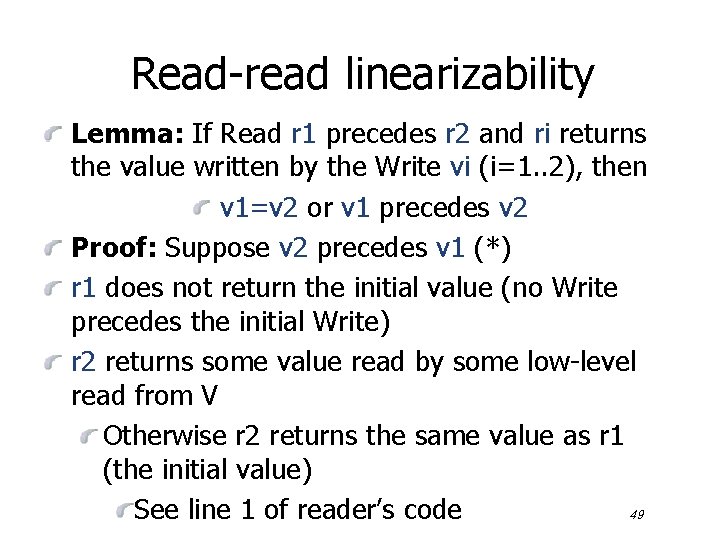
Read-read linearizability Lemma: If Read r 1 precedes r 2 and ri returns the value written by the Write vi (i=1. . 2), then v 1=v 2 or v 1 precedes v 2 Proof: Suppose v 2 precedes v 1 (*) r 1 does not return the initial value (no Write precedes the initial Write) r 2 returns some value read by some low-level read from V Otherwise r 2 returns the same value as r 1 (the initial value) 49 See line 1 of reader’s code
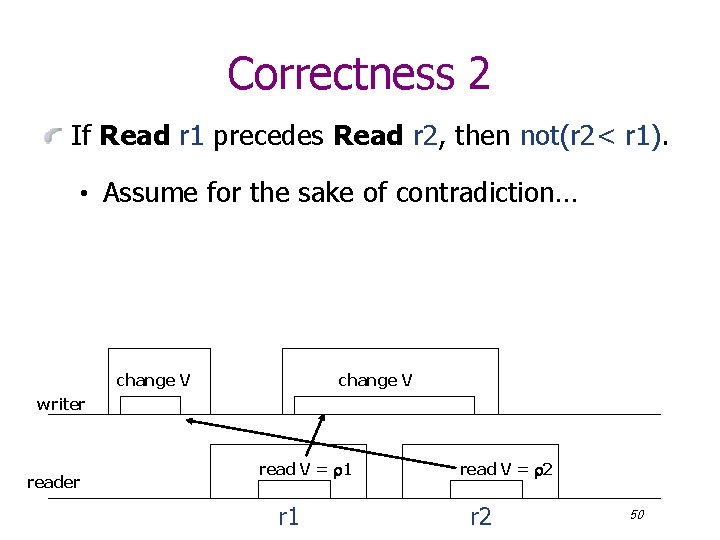
Correctness 2 If Read r 1 precedes Read r 2, then not(r 2< r 1). • Assume for the sake of contradiction… change V writer read V = 1 read V = 2 r 2 50
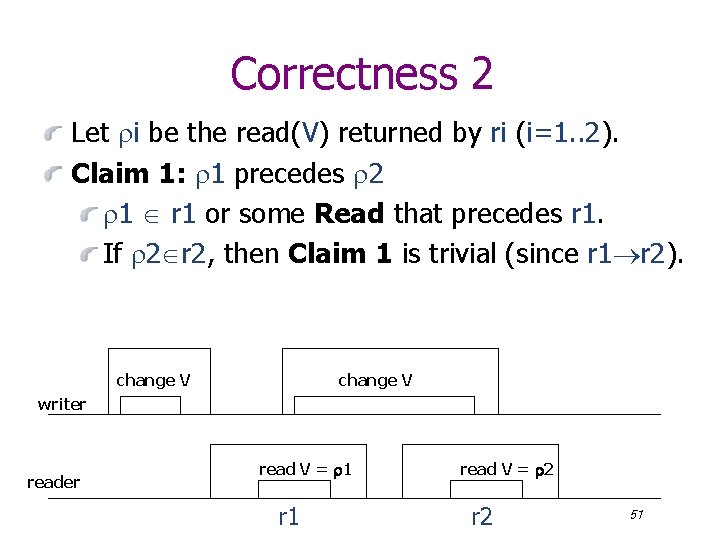
Correctness 2 Let i be the read(V) returned by ri (i=1. . 2). Claim 1: 1 precedes 2 1 r 1 or some Read that precedes r 1. If 2 r 2, then Claim 1 is trivial (since r 1 r 2). change V writer read V = 1 read V = 2 r 2 51
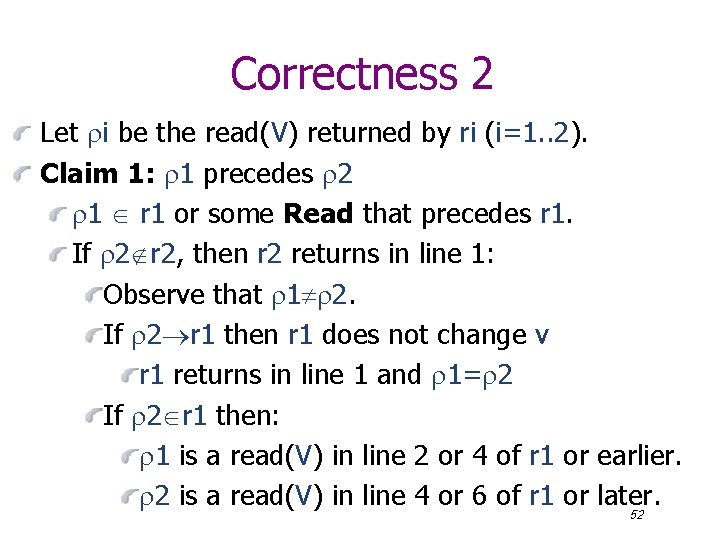
Correctness 2 Let i be the read(V) returned by ri (i=1. . 2). Claim 1: 1 precedes 2 1 r 1 or some Read that precedes r 1. If 2 r 2, then r 2 returns in line 1: Observe that 1 2. If 2 r 1 then r 1 does not change v r 1 returns in line 1 and 1= 2 If 2 r 1 then: 1 is a read(V) in line 2 or 4 of r 1 or earlier. 2 is a read(V) in line 4 or 6 of r 1 or later. 52
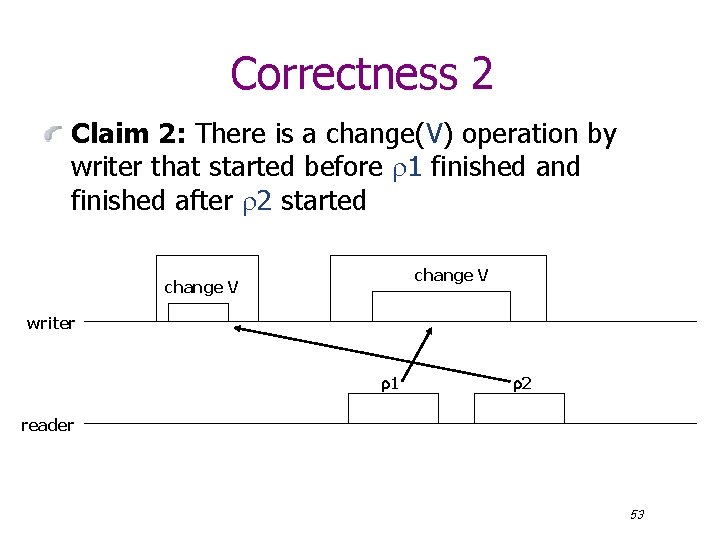
Correctness 2 Claim 2: There is a change(V) operation by writer that started before 1 finished and finished after 2 started change V writer 1 2 reader 53
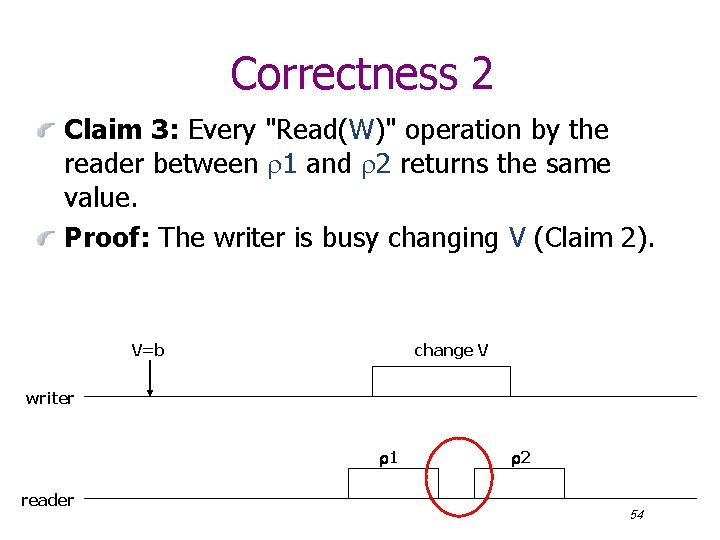
Correctness 2 Claim 3: Every "Read(W)" operation by the reader between 1 and 2 returns the same value. Proof: The writer is busy changing V (Claim 2). V=b change V writer 1 reader 2 54
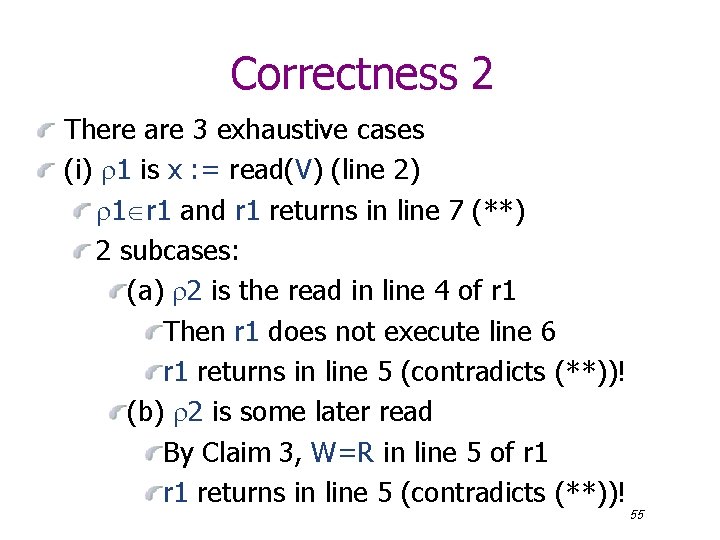
Correctness 2 There are 3 exhaustive cases (i) 1 is x : = read(V) (line 2) 1 r 1 and r 1 returns in line 7 (**) 2 subcases: (a) 2 is the read in line 4 of r 1 Then r 1 does not execute line 6 r 1 returns in line 5 (contradicts (**))! (b) 2 is some later read By Claim 3, W=R in line 5 of r 1 returns in line 5 (contradicts (**))! 55
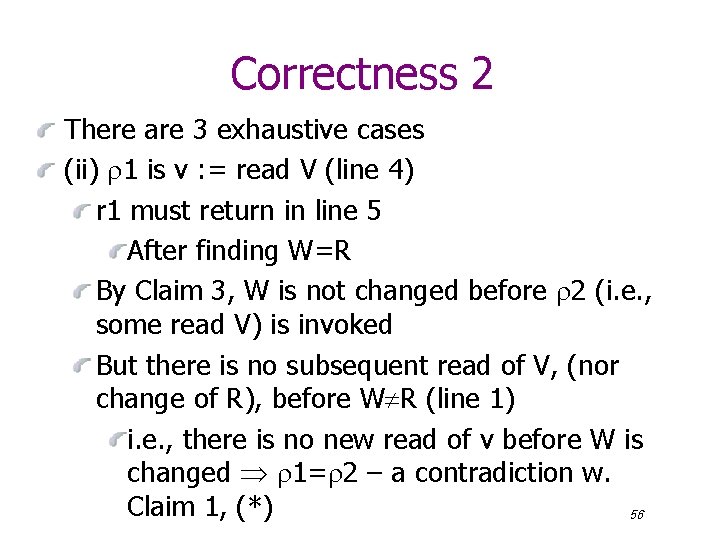
Correctness 2 There are 3 exhaustive cases (ii) 1 is v : = read V (line 4) r 1 must return in line 5 After finding W=R By Claim 3, W is not changed before 2 (i. e. , some read V) is invoked But there is no subsequent read of V, (nor change of R), before W R (line 1) i. e. , there is no new read of v before W is changed 1= 2 – a contradiction w. Claim 1, (*) 56
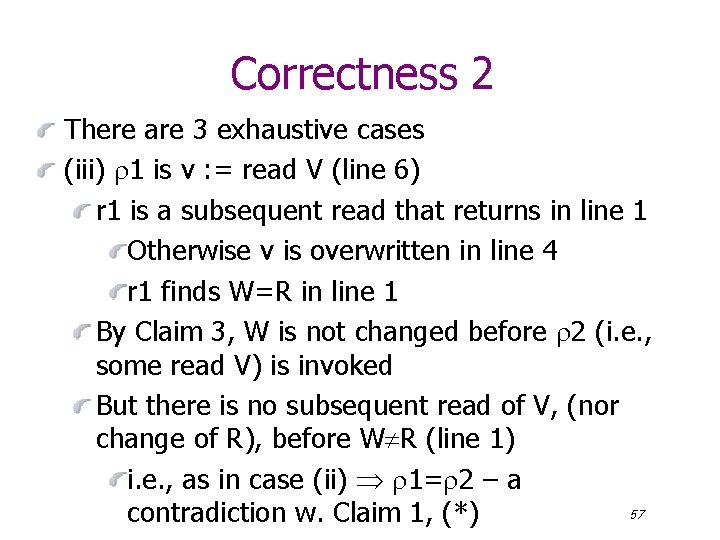
Correctness 2 There are 3 exhaustive cases (iii) 1 is v : = read V (line 6) r 1 is a subsequent read that returns in line 1 Otherwise v is overwritten in line 4 r 1 finds W=R in line 1 By Claim 3, W is not changed before 2 (i. e. , some read V) is invoked But there is no subsequent read of V, (nor change of R), before W R (line 1) i. e. , as in case (ii) 1= 2 – a 57 contradiction w. Claim 1, (*)
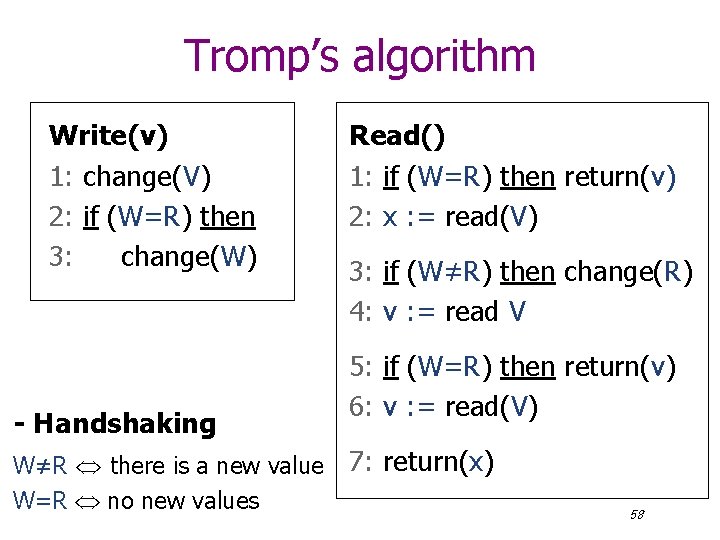
Tromp’s algorithm Write(v) 1: change(V) 2: if (W=R) then 3: change(W) - Handshaking W≠R there is a new value W=R no new values Read() 1: if (W=R) then return(v) 2: x : = read(V) 3: if (W≠R) then change(R) 4: v : = read V 5: if (W=R) then return(v) 6: v : = read(V) 7: return(x) 58
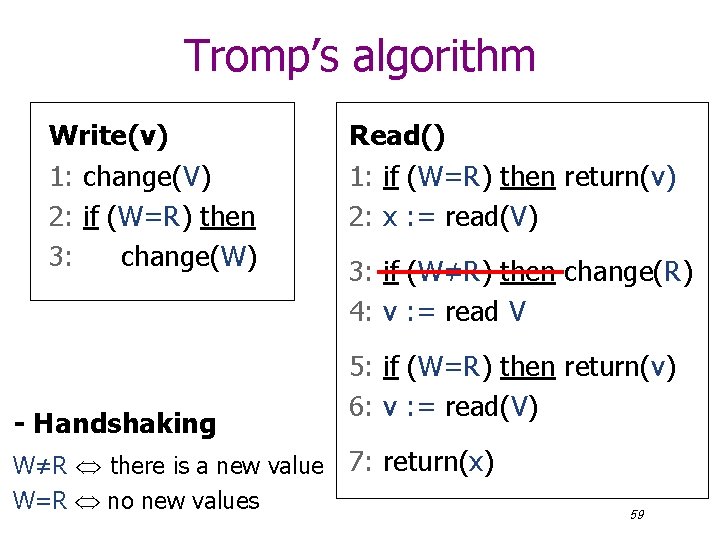
Tromp’s algorithm Write(v) 1: change(V) 2: if (W=R) then 3: change(W) - Handshaking W≠R there is a new value W=R no new values Read() 1: if (W=R) then return(v) 2: x : = read(V) 3: if (W≠R) then change(R) 4: v : = read V 5: if (W=R) then return(v) 6: v : = read(V) 7: return(x) 59
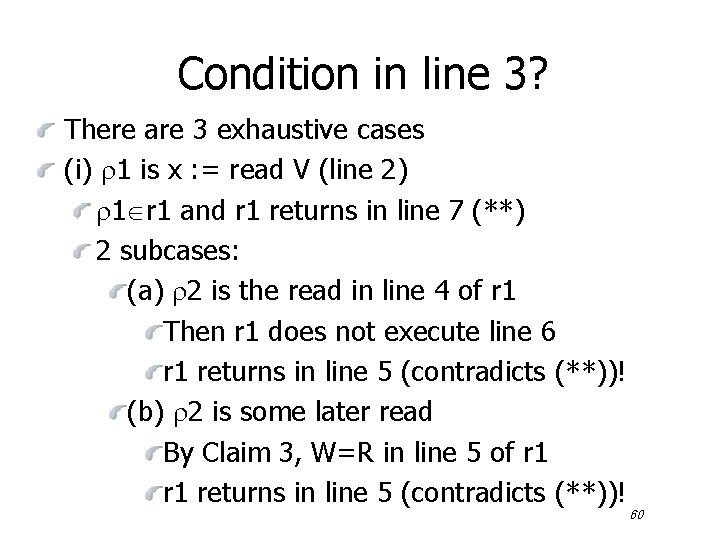
Condition in line 3? There are 3 exhaustive cases (i) 1 is x : = read V (line 2) 1 r 1 and r 1 returns in line 7 (**) 2 subcases: (a) 2 is the read in line 4 of r 1 Then r 1 does not execute line 6 r 1 returns in line 5 (contradicts (**))! (b) 2 is some later read By Claim 3, W=R in line 5 of r 1 returns in line 5 (contradicts (**))! 60
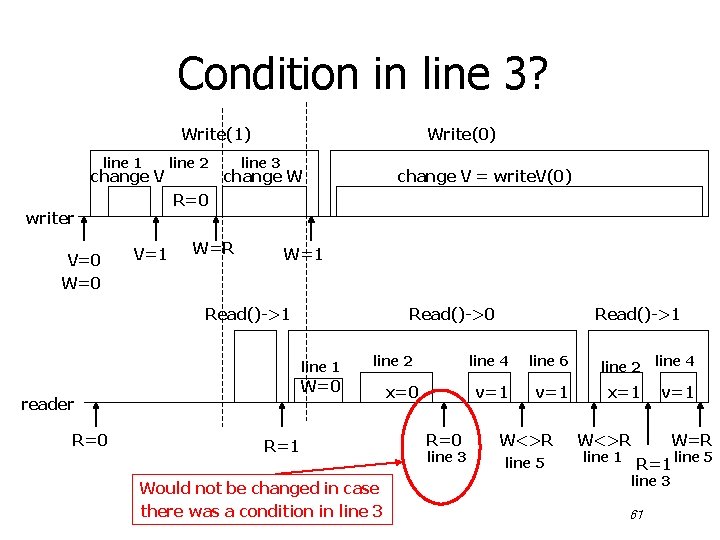
Condition in line 3? Write(1) line 1 change V line 3 change W change V = write. V(0) R=0 writer V=0 W=0 line 2 Write(0) V=1 W=R W=1 Read()->0 line 1 W=0 reader R=0 line 2 R=1 Would not be changed in case there was a condition in line 3 x=0 R=0 line 3 Read()->1 line 4 line 6 line 2 line 4 v=1 x=1 v=1 W<>R line 5 W<>R W=R line 1 R=1 line 5 line 3 61
Tromp’s algorithm Write(v) 1: change(V) 2: if (W=R) then 3: change(W) - Handshaking W≠R there is a new value W=R no new values Read() 1: if (W=R) then return(v) 2: x : = read(V) 3: if (W≠R) then change(R) 4: v : = read V 5: if (W=R) then return(v) 6: v : = read(V) 7: return(x) 62
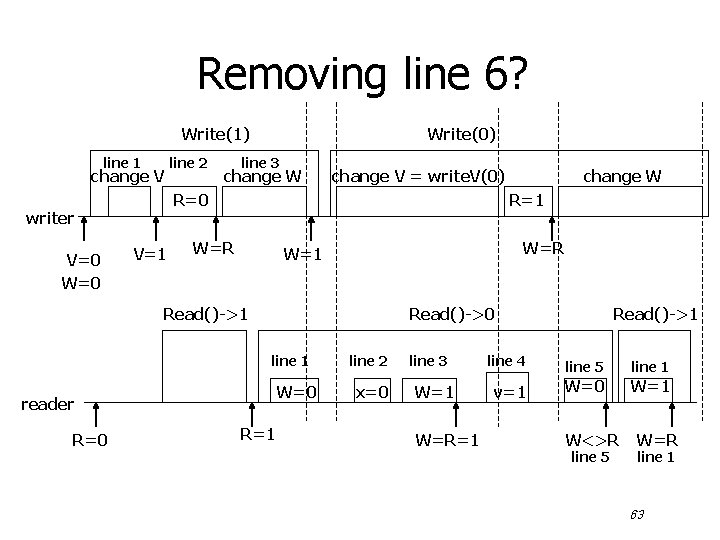
Removing line 6? Write(1) line 1 change V line 3 change W change V = write. V(0) R=0 writer V=0 W=0 line 2 Write(0) V=1 R=1 W=R W=1 Read()->0 line 1 W=0 reader R=0 change W R=1 line 2 x=0 line 3 W=1 W=R=1 Read()->1 line 4 line 5 line 1 v=1 W=0 W=1 W<>R line 5 W=R line 1 63
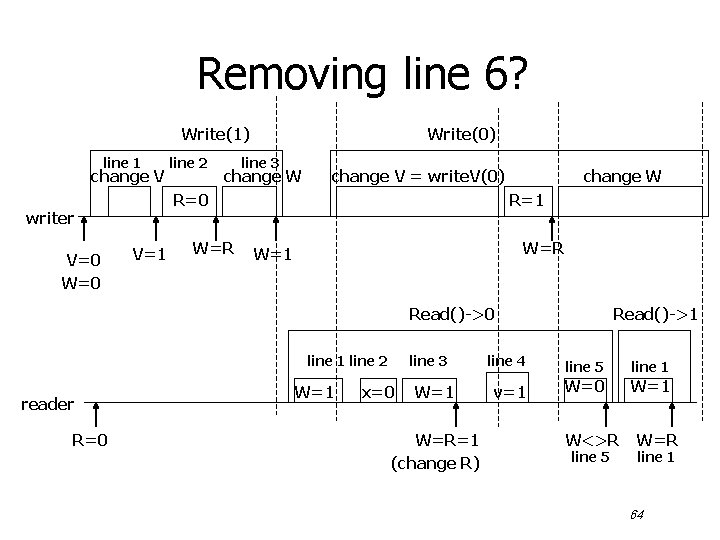
Removing line 6? Write(1) line 1 change V line 3 change W change V = write. V(0) R=0 writer V=0 W=0 line 2 Write(0) V=1 W=R change W R=1 W=R W=1 Read()->0 line 1 line 2 reader R=0 W=1 line 3 x=0 W=1 W=R=1 (change R) Read()->1 line 4 line 5 line 1 v=1 W=0 W=1 W<>R line 5 W=R line 1 64
- Slides: 64