
Writing Thesis Statements A Formulaic Process The Formula

- Slides: 11
Writing Thesis Statements: A Formulaic Process
The Formula: q Topic or Title and Author q Preview of Support q Verb q Theme/Cause/Argument
Step One: Topics or Title/Author Topics Censorship Holocaust High school Title/Author Elie Wiesel’s Night Steinbeck’s Of Mice and Men Shakespeare’s Romeo and Juliet College Poe’s “The Cask of Amontillado” French Revolution Lee’s To Kill a Mockingbird Firemen Catholicism The Dust Bowl
Step Two: Preview of Support What is the author using or showing to make his/her point? “uses imagery and symbolism to…” “employs foreshadowing, characterization, and imagery to…” “portrays female characters negatively to…” “conveys a contrasting opinion of the necessity of war to…”
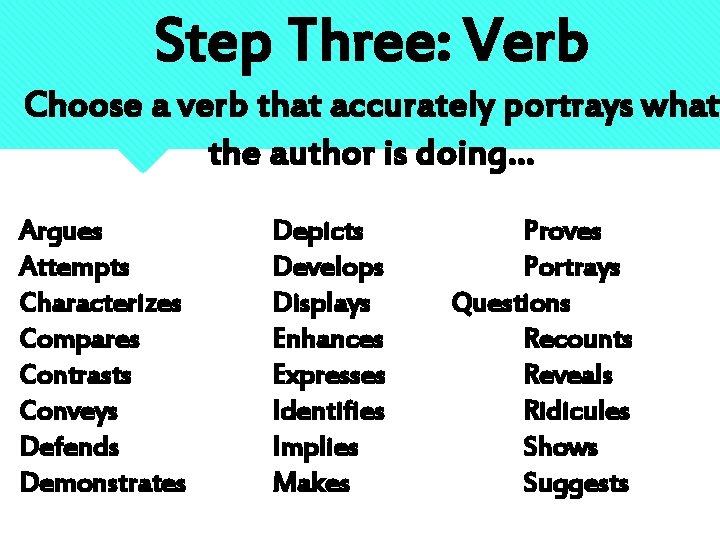
Step Three: Verb Choose a verb that accurately portrays what the author is doing… Argues Attempts Characterizes Compares Contrasts Conveys Defends Demonstrates Depicts Develops Displays Enhances Expresses Identifies Implies Makes Proves Portrays Questions Recounts Reveals Ridicules Shows Suggests
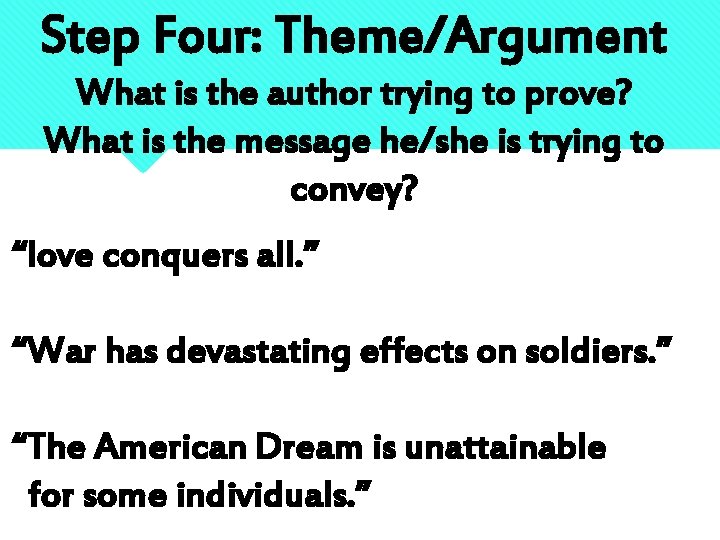
Step Four: Theme/Argument What is the author trying to prove? What is the message he/she is trying to convey? “love conquers all. ” “War has devastating effects on soldiers. ” “The American Dream is unattainable for some individuals. ”
Put all four steps together to create a well-written thesis statement…
Step 1: In The Tragedy of Romeo and Juliet, William Shakespeare… Step 2: …uses imagery and symbolism… Step 3: …to prove… Step 4: …that love conquers all.
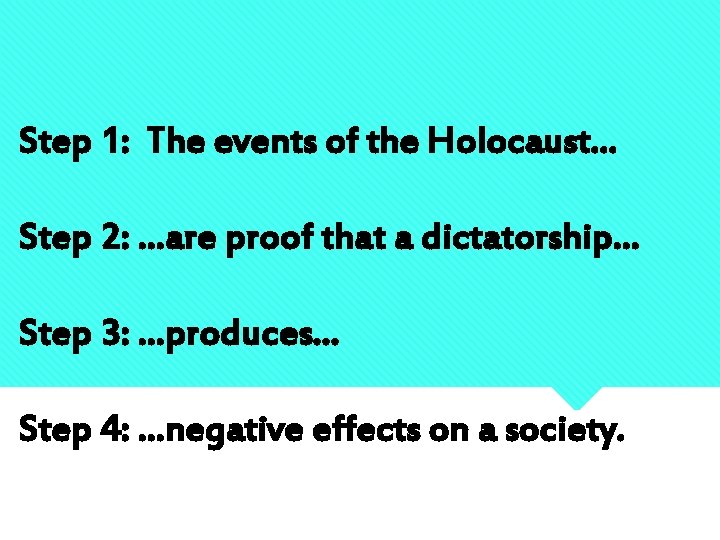
Step 1: The events of the Holocaust… Step 2: …are proof that a dictatorship… Step 3: …produces… Step 4: …negative effects on a society.
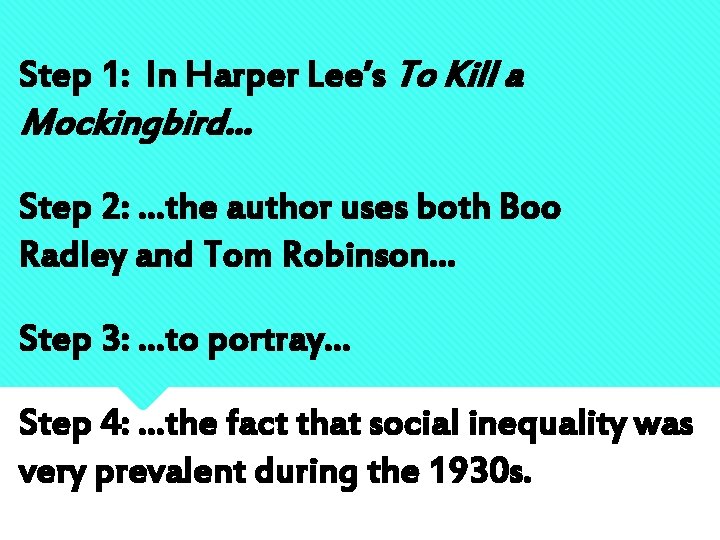
Step 1: In Harper Lee’s To Kill a Mockingbird… Step 2: …the author uses both Boo Radley and Tom Robinson… Step 3: …to portray… Step 4: …the fact that social inequality was very prevalent during the 1930 s.
Now it’s your turn… Using this formula, create your own thesis statement using the prompts given to you on the handout.