
Writing the procedure in a Lab Report Practical
Writing the procedure in a Lab Report Practical: Demonstration of the action of an enzyme
Lesson plan Level: Form 4 Lesson duration: 50 mins Lesson Objective: Learn to write procedure in lab report in passive voice and past tense. Summary of task / actions: Setting the context 1. Explain the differences between lab manual and lab report. 2. Explain why we use past tense and passive voice in lab report Modelling and deconstruction 1. Highlight words about action and what receives the action. 2. Constructing procedure in passive voice (with step 1 -3 as example) Guided construction 1. Write procedure in passive voice (do step 4 -6 together) Independent construction 1. Write procedure in passive voice (do step 7 -11 independently)
The procedure or steps in an experiment A Lab manual, tells you what to do, so the writer uses the Imperative form, eg: Heat the test-tube. Add a drop of distilled water to a slide.
We will start with the procedures in the Lab menu 1. Grind 10 g of fresh pig liver tissue in a mortar with 10 cm 3 of cold distilled water. 2. Filter the ground mixture by using muslin cloth to obtain the liver extract. 3. Dilute the liver extract by adding 5 cm 3 of cold distilled water. 4. Label test tubes A to C. 5. Add 5 cm 3 of 3% hydrogen peroxide solution to test tubes A and B and add 5 cm 3 of distilled water to test tube C. 6. Add a few drops of diluted liver extract to test tubes A and C. 7. Add a few drops of distilled water to test tube B. 8. Cap the test tubes loosely with a stopper. 9. Observe the evolution of gas bubbles. 10. Wait for a while to collect enough gas. 11. Test the gas produced in each tube with a glowing splint.
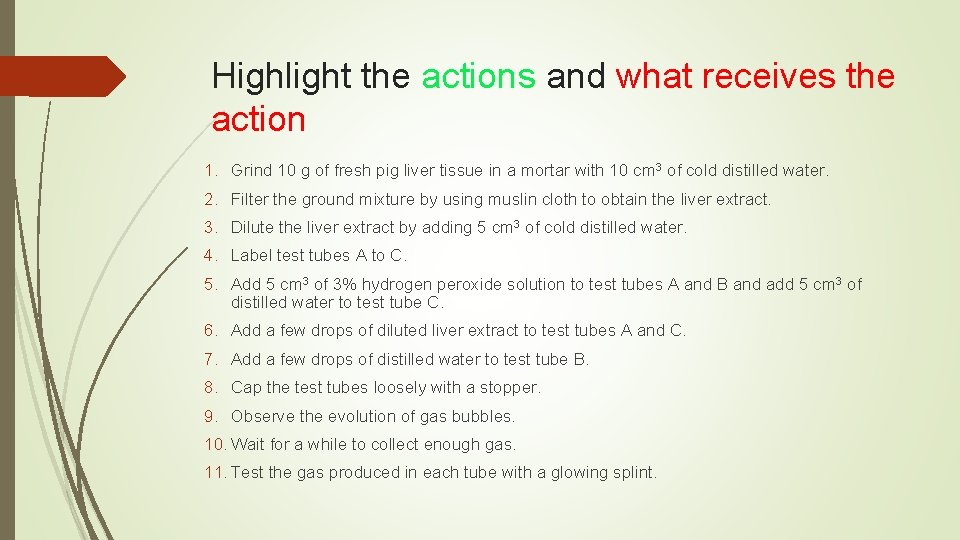
Highlight the actions and what receives the action 1. Grind 10 g of fresh pig liver tissue in a mortar with 10 cm 3 of cold distilled water. 2. Filter the ground mixture by using muslin cloth to obtain the liver extract. 3. Dilute the liver extract by adding 5 cm 3 of cold distilled water. 4. Label test tubes A to C. 5. Add 5 cm 3 of 3% hydrogen peroxide solution to test tubes A and B and add 5 cm 3 of distilled water to test tube C. 6. Add a few drops of diluted liver extract to test tubes A and C. 7. Add a few drops of distilled water to test tube B. 8. Cap the test tubes loosely with a stopper. 9. Observe the evolution of gas bubbles. 10. Wait for a while to collect enough gas. 11. Test the gas produced in each tube with a glowing splint.
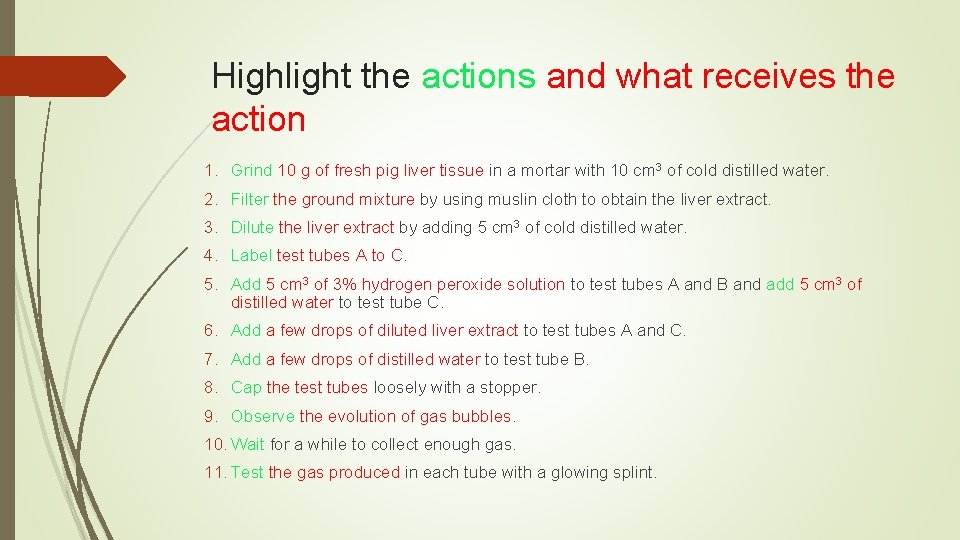
Highlight the actions and what receives the action 1. Grind 10 g of fresh pig liver tissue in a mortar with 10 cm 3 of cold distilled water. 2. Filter the ground mixture by using muslin cloth to obtain the liver extract. 3. Dilute the liver extract by adding 5 cm 3 of cold distilled water. 4. Label test tubes A to C. 5. Add 5 cm 3 of 3% hydrogen peroxide solution to test tubes A and B and add 5 cm 3 of distilled water to test tube C. 6. Add a few drops of diluted liver extract to test tubes A and C. 7. Add a few drops of distilled water to test tube B. 8. Cap the test tubes loosely with a stopper. 9. Observe the evolution of gas bubbles. 10. Wait for a while to collect enough gas. 11. Test the gas produced in each tube with a glowing splint.
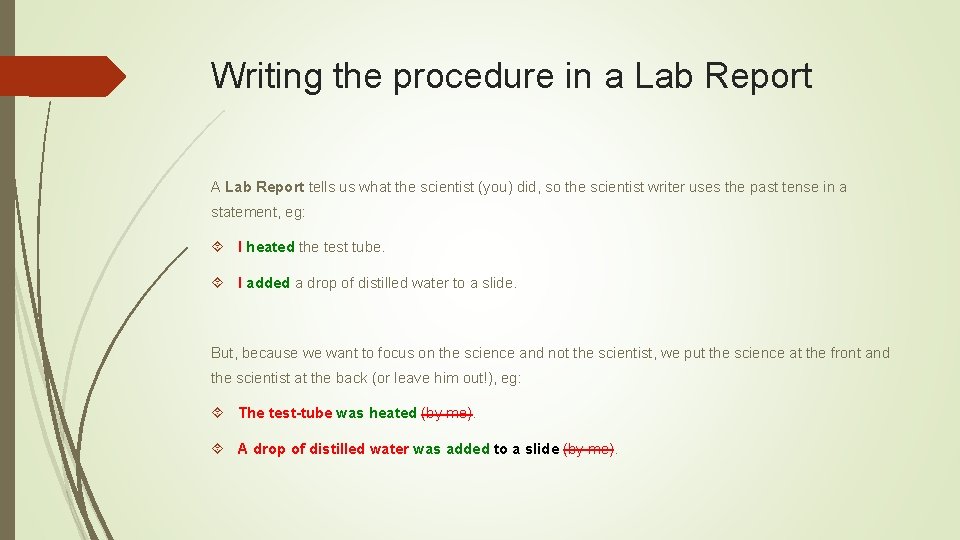
Writing the procedure in a Lab Report A Lab Report tells us what the scientist (you) did, so the scientist writer uses the past tense in a statement, eg: I heated the test tube. I added a drop of distilled water to a slide. But, because we want to focus on the science and not the scientist, we put the science at the front and the scientist at the back (or leave him out!), eg: The test-tube was heated (by me). A drop of distilled water was added to a slide (by me).
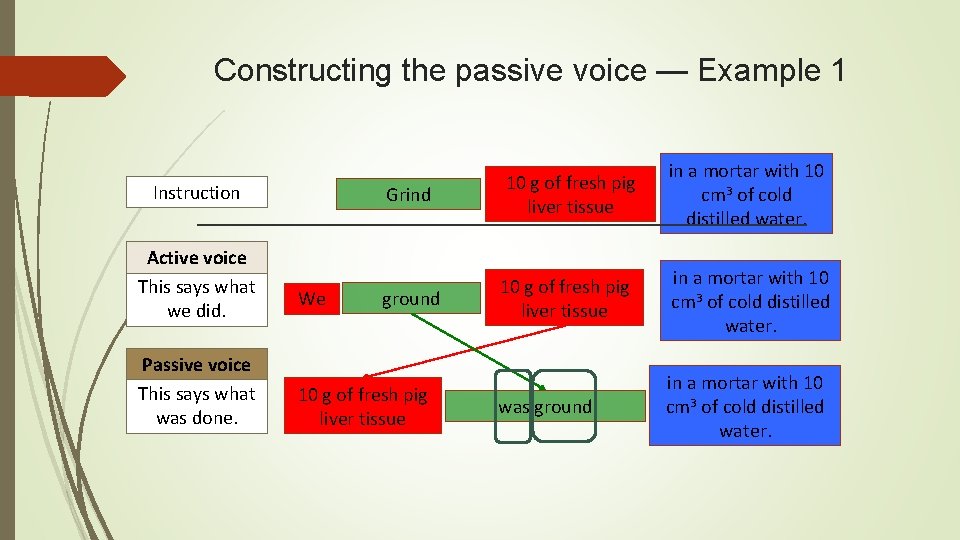
Constructing the passive voice — Example 1 Instruction Active voice This says what we did. Passive voice This says what was done. Grind We ground 10 g of fresh pig liver tissue in a mortar with 10 cm 3 of cold distilled water. was ground in a mortar with 10 cm 3 of cold distilled water.
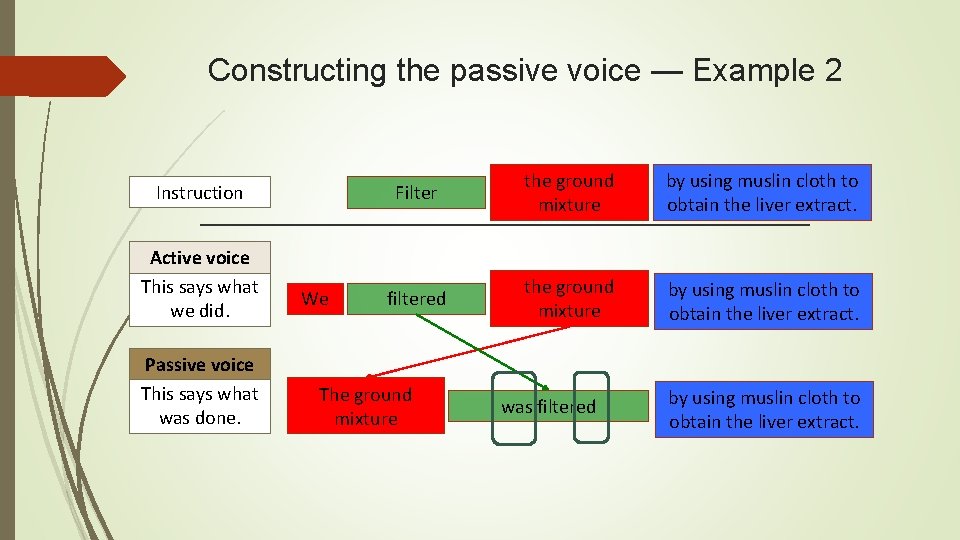
Constructing the passive voice — Example 2 Instruction Active voice This says what we did. Passive voice This says what was done. We Filter the ground mixture by using muslin cloth to obtain the liver extract. filtered the ground mixture by using muslin cloth to obtain the liver extract. The ground mixture was filtered by using muslin cloth to obtain the liver extract.
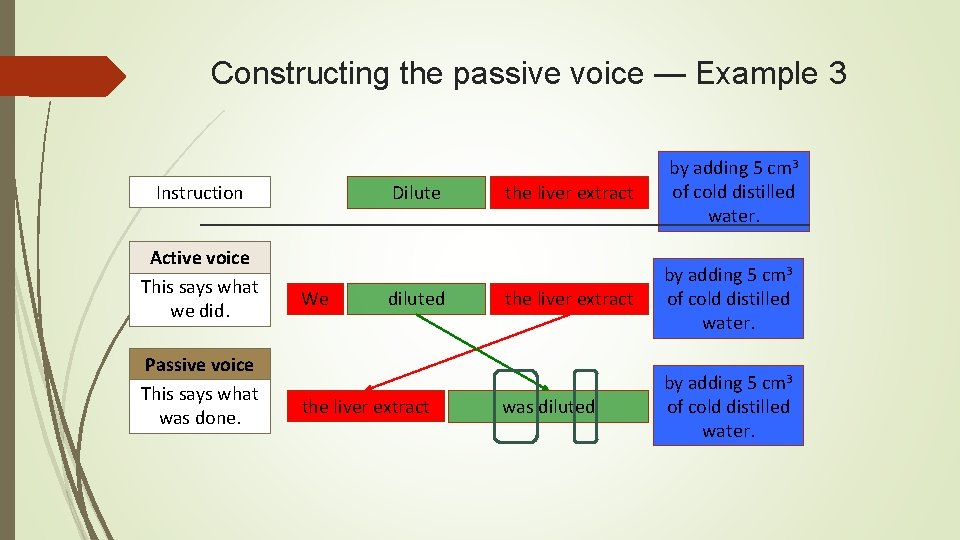
Constructing the passive voice — Example 3 Instruction Active voice This says what we did. Passive voice This says what was done. Dilute We diluted the liver extract by adding 5 cm 3 of cold distilled water. was diluted by adding 5 cm 3 of cold distilled water.
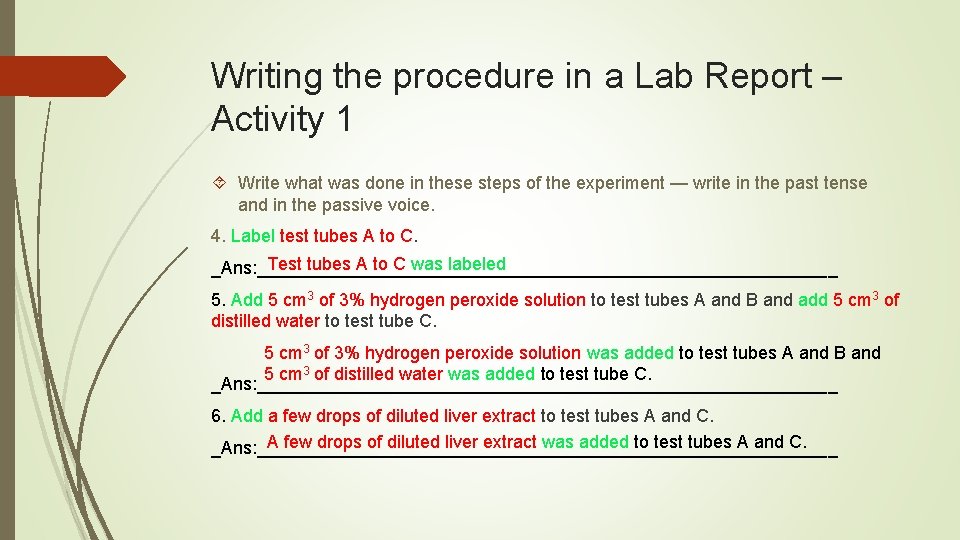
Writing the procedure in a Lab Report – Activity 1 Write what was done in these steps of the experiment — write in the past tense and in the passive voice. 4. Label test tubes A to C. Test tubes A to C was labeled _Ans: _____________________________ 5. Add 5 cm 3 of 3% hydrogen peroxide solution to test tubes A and B and add 5 cm 3 of distilled water to test tube C. 5 cm 3 of 3% hydrogen peroxide solution was added to test tubes A and B and 5 cm 3 of distilled water was added to test tube C. _Ans: _____________________________ 6. Add a few drops of diluted liver extract to test tubes A and C. A few drops of diluted liver extract was added to test tubes A and C. _Ans: _____________________________
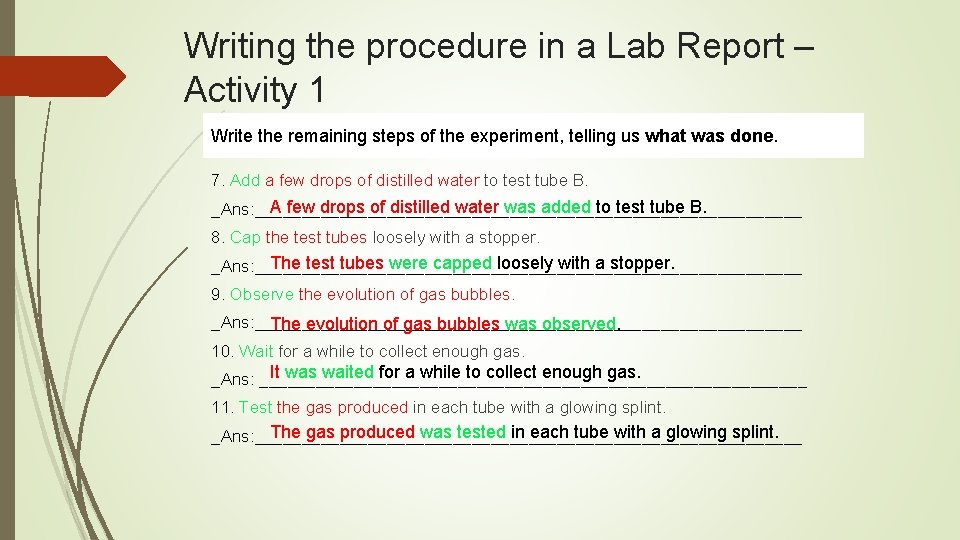
Writing the procedure in a Lab Report – Activity 1 Write the remaining steps of the experiment, telling us what was done. 7. Add a few drops of distilled water to test tube B. A few drops of distilled water was added to test tube B. _Ans: _____________________________ 8. Cap the test tubes loosely with a stopper. The test tubes were capped loosely with a stopper. _Ans: _____________________________ 9. Observe the evolution of gas bubbles. _Ans: _____________________________ The evolution of gas bubbles was observed. 10. Wait for a while to collect enough gas. It was waited for a while to collect enough gas. _Ans: _____________________________ 11. Test the gas produced in each tube with a glowing splint. The gas produced was tested in each tube with a glowing splint. _Ans: _____________________________
You did it! Well done!
- Slides: 13