
Writing the impact of the disability statement PLEP
Writing the impact of the disability statement (PLEP) Allan S Blume, M. Ed. , M. S. Ed. , Ed. S. Educational Consultant ©�Allan S Blume 1
IDEA Requirements • IDEA regulations set forth the requirements for what must be included in an IEP • Among these requirements are: • Present levels of academic achievement and functional performance and • A statement of measurable annual goals designed to • Meet the child’s needs that result from the child’s disability…to be involved in and make progress in the general curriculum; and • Meet each of the child’s other educational needs that result from the child’s disability [Emphasis added] • 34 CFR 300. 320 (a) (1 – 2) https: //sites. ed. gov/idea/regs/b/d/300. 320 © Allan S Blume 2
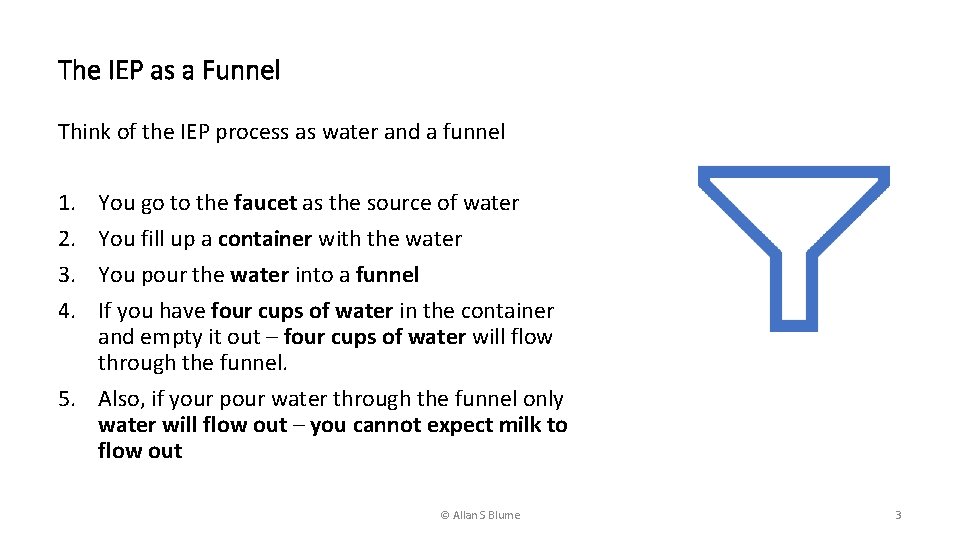
The IEP as a Funnel Think of the IEP process as water and a funnel 1. 2. 3. 4. You go to the faucet as the source of water You fill up a container with the water You pour the water into a funnel If you have four cups of water in the container and empty it out – four cups of water will flow through the funnel. 5. Also, if your pour water through the funnel only water will flow out – you cannot expect milk to flow out © Allan S Blume 3
Using the funnel analogy • Faucet = Evaluations completed as part of the eligibility/reevaluation process (Student strengths and key evaluations) • Container/Water = The areas of need that result from the disability (skills that impact participation in curriculum (general curriculum) or life of the school (other educational needs) • Funnel = The impact of the disability statement (impact on general curriculum or other educational needs (PLEP A and PLEP B) • Four cups of water = Potential goal focus areas – the needs identified in the PLEP statement become the focus of subsequent goal areas (needs that arise from the disability) – if four needs were identified in the PLEP statement, then there will likely be four goal focus areas • Water not milk = If a goal area is identified without having been identified in the evaluations or impact of the disability statement – calls into question – where did the goal come from? © Allan S Blume 4
Areas of need that result from the disability • Needs are internal not external • What is internal? - When naming the areas of need that result from the disability – and the subsequent goal focus areas – identify needs/skill sets that are present as a result of the student’s disability • What is external? – Curriculum areas (ELA, Mathematics, Science, History, etc. ), Related services (Speech, OT, PT, etc. ), Support services (Guidance, Counseling, Academic support, etc. ) – Goal areas are not named for the externals © Allan S Blume 5
Writing the PLEP statements • The PLEP statement should likely provide three levels of information: 1. The student’s eligibility category or categories 2. Major need (skill) areas that impact participation in curriculum (PLEP A) or Life of the School (PLEP B) • Skill areas 3. Subset skills of the major skill areas • Individually identified subset skills ©�Allan S Blume 6
The Impact of Disability (PLEP)statements It’s about the student’s eligibility and its impact This PLEP statement should be the place to restate the student’s eligibility category. Restating the eligibility category makes this part of the IEP more userfriendly. Anyone can quickly and easily know the disability area being written about without having to search other parts of the IEP for disability identification. ©�Allan S Blume 7
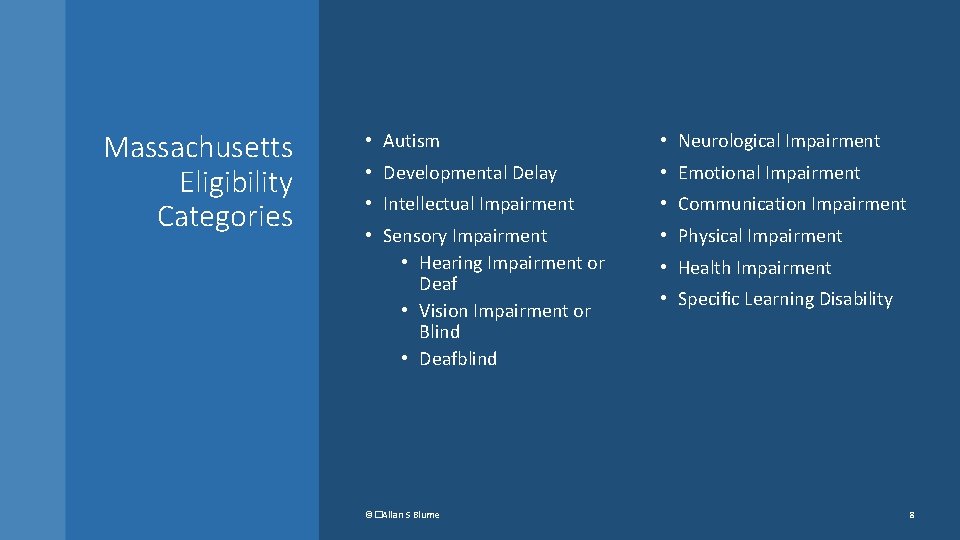
Massachusetts Eligibility Categories • Autism • Neurological Impairment • Developmental Delay • Emotional Impairment • Intellectual Impairment • Communication Impairment • Sensory Impairment • Hearing Impairment or Deaf • Vision Impairment or Blind • Deafblind • Physical Impairment ©�Allan S Blume • Health Impairment • Specific Learning Disability 8
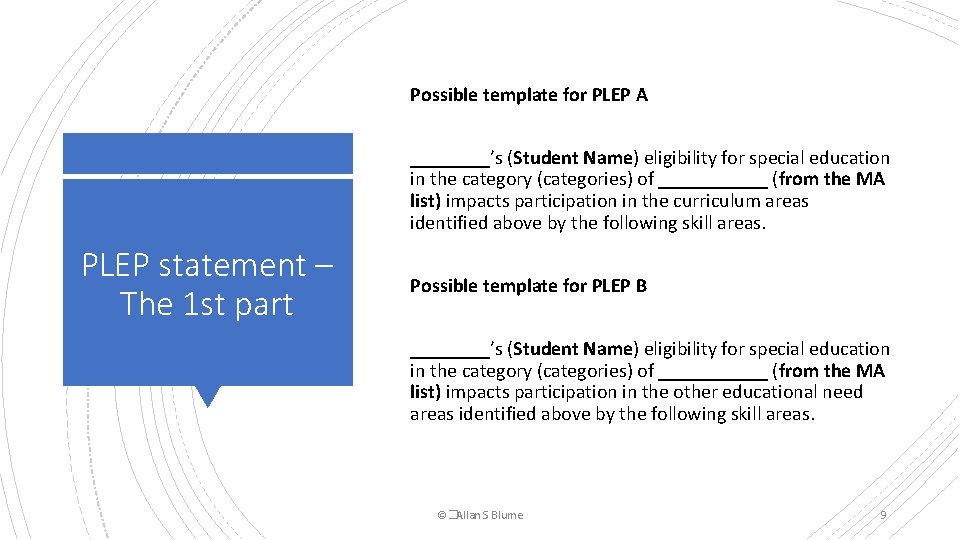
Possible template for PLEP A ____’s (Student Name) eligibility for special education in the category (categories) of ______ (from the MA list) impacts participation in the curriculum areas identified above by the following skill areas. PLEP statement – The 1 st part Possible template for PLEP B ____’s (Student Name) eligibility for special education in the category (categories) of ______ (from the MA list) impacts participation in the other educational need areas identified above by the following skill areas. ©�Allan S Blume 9
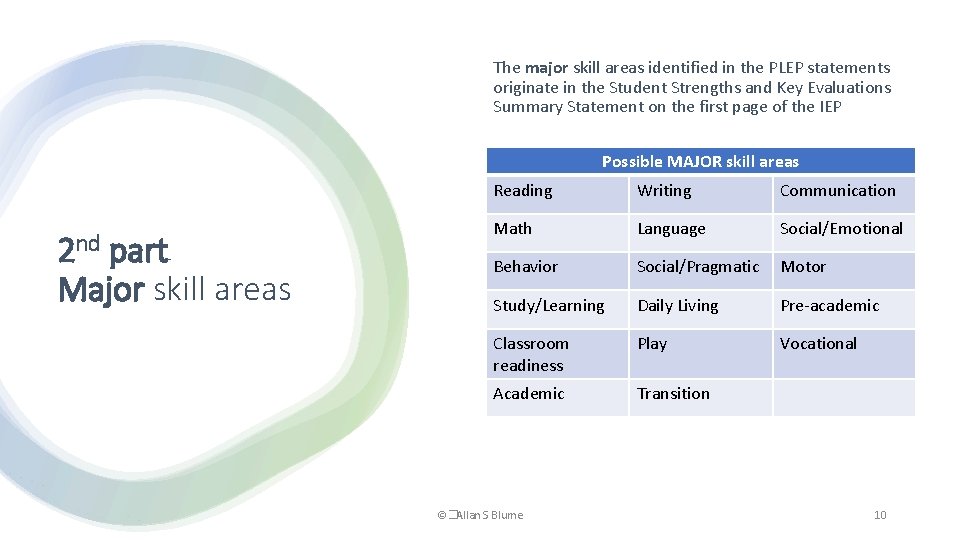
The major skill areas identified in the PLEP statements originate in the Student Strengths and Key Evaluations Summary Statement on the first page of the IEP Possible MAJOR skill areas 2 nd part Major skill areas Reading Writing Communication Math Language Social/Emotional Behavior Social/Pragmatic Motor Study/Learning Daily Living Pre-academic Classroom readiness Play Vocational Academic Transition ©�Allan S Blume 10
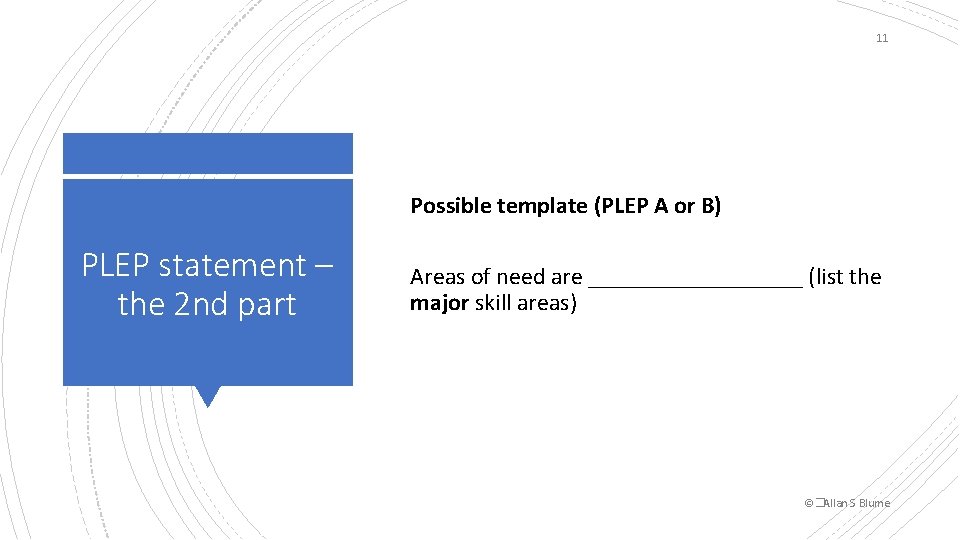
11 Possible template (PLEP A or B) PLEP statement – the 2 nd part Areas of need are _________ (list the major skill areas) ©�Allan S Blume
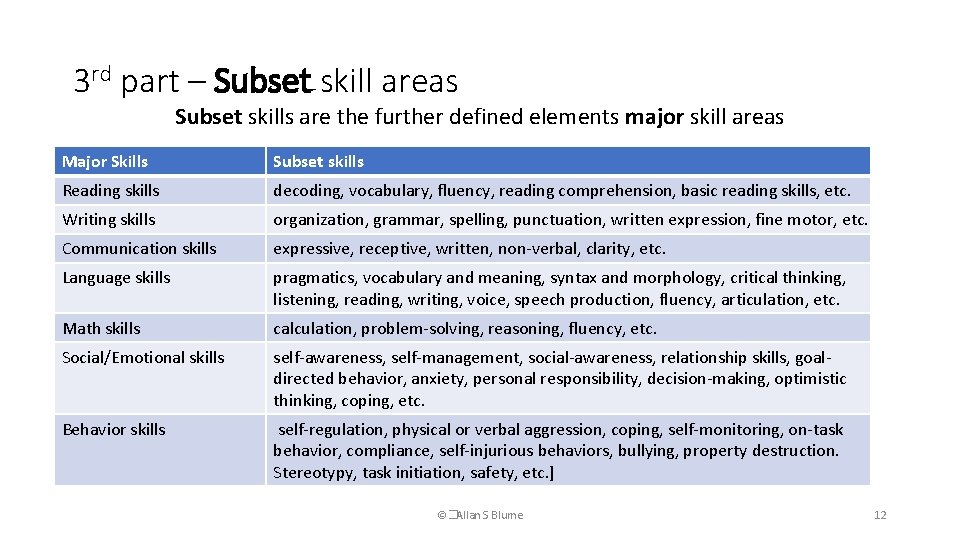
3 rd part – Subset skill areas Subset skills are the further defined elements major skill areas Major Skills Subset skills Reading skills decoding, vocabulary, fluency, reading comprehension, basic reading skills, etc. Writing skills organization, grammar, spelling, punctuation, written expression, fine motor, etc. Communication skills expressive, receptive, written, non-verbal, clarity, etc. Language skills pragmatics, vocabulary and meaning, syntax and morphology, critical thinking, listening, reading, writing, voice, speech production, fluency, articulation, etc. Math skills calculation, problem-solving, reasoning, fluency, etc. Social/Emotional skills self-awareness, self-management, social-awareness, relationship skills, goaldirected behavior, anxiety, personal responsibility, decision-making, optimistic thinking, coping, etc. Behavior skills self-regulation, physical or verbal aggression, coping, self-monitoring, on-task behavior, compliance, self-injurious behaviors, bullying, property destruction. Stereotypy, task initiation, safety, etc. ] ©�Allan S Blume 12
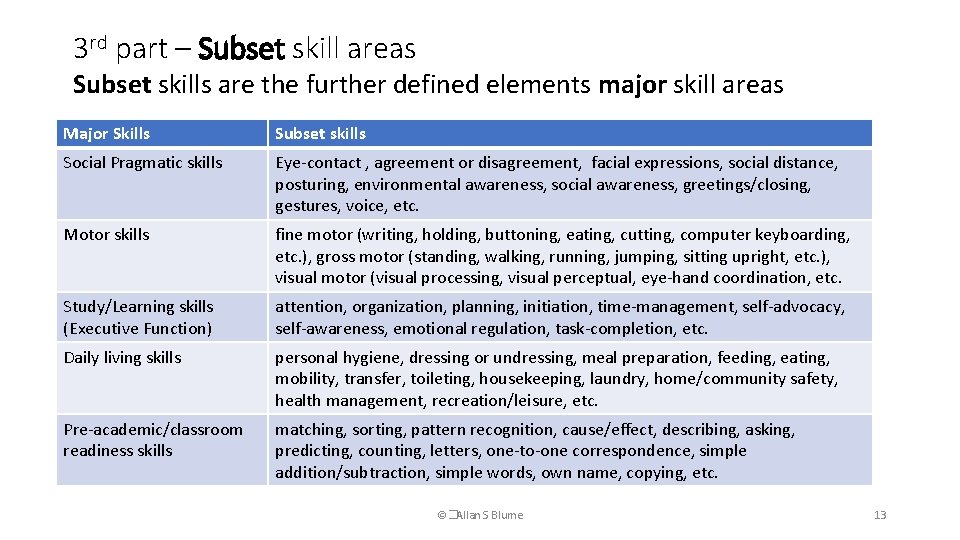
3 rd part – Subset skill areas Subset skills are the further defined elements major skill areas Major Skills Subset skills Social Pragmatic skills Eye-contact , agreement or disagreement, facial expressions, social distance, posturing, environmental awareness, social awareness, greetings/closing, gestures, voice, etc. Motor skills fine motor (writing, holding, buttoning, eating, cutting, computer keyboarding, etc. ), gross motor (standing, walking, running, jumping, sitting upright, etc. ), visual motor (visual processing, visual perceptual, eye-hand coordination, etc. Study/Learning skills (Executive Function) attention, organization, planning, initiation, time-management, self-advocacy, self-awareness, emotional regulation, task-completion, etc. Daily living skills personal hygiene, dressing or undressing, meal preparation, feeding, eating, mobility, transfer, toileting, housekeeping, laundry, home/community safety, health management, recreation/leisure, etc. Pre-academic/classroom readiness skills matching, sorting, pattern recognition, cause/effect, describing, asking, predicting, counting, letters, one-to-one correspondence, simple addition/subtraction, simple words, own name, copying, etc. ©�Allan S Blume 13
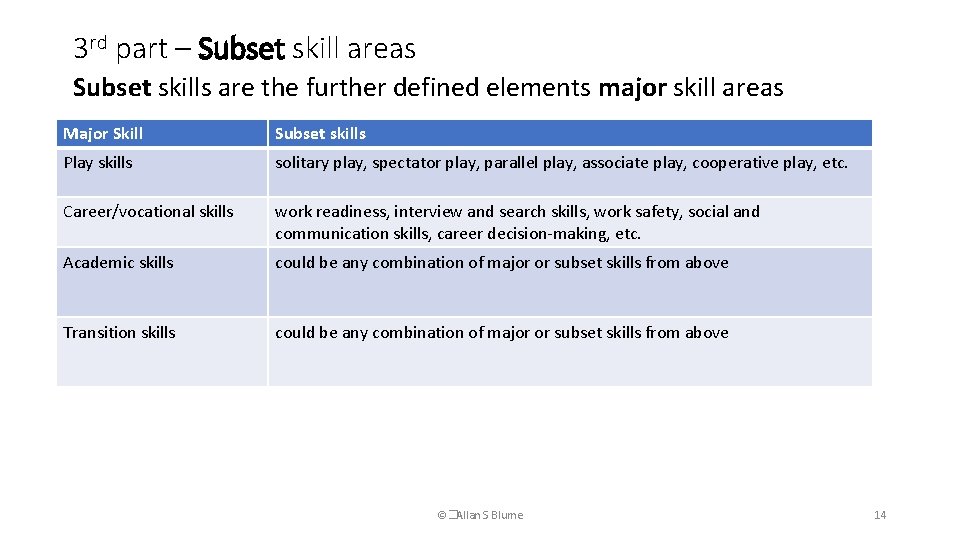
3 rd part – Subset skill areas Subset skills are the further defined elements major skill areas Major Skill Subset skills Play skills solitary play, spectator play, parallel play, associate play, cooperative play, etc. Career/vocational skills work readiness, interview and search skills, work safety, social and communication skills, career decision-making, etc. Academic skills could be any combination of major or subset skills from above Transition skills could be any combination of major or subset skills from above ©�Allan S Blume 14
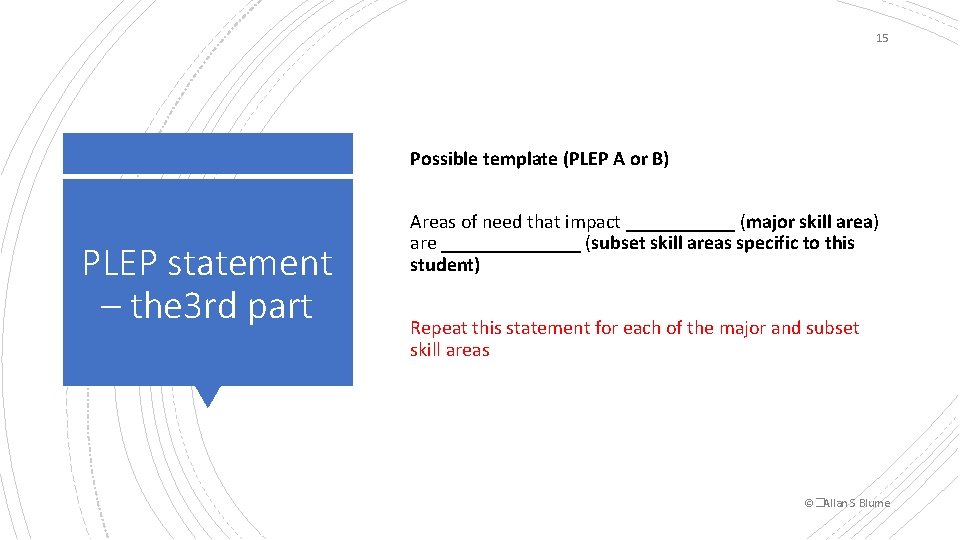
15 Possible template (PLEP A or B) PLEP statement – the 3 rd part Areas of need that impact ______ (major skill area) are _______ (subset skill areas specific to this student) Repeat this statement for each of the major and subset skill areas ©�Allan S Blume
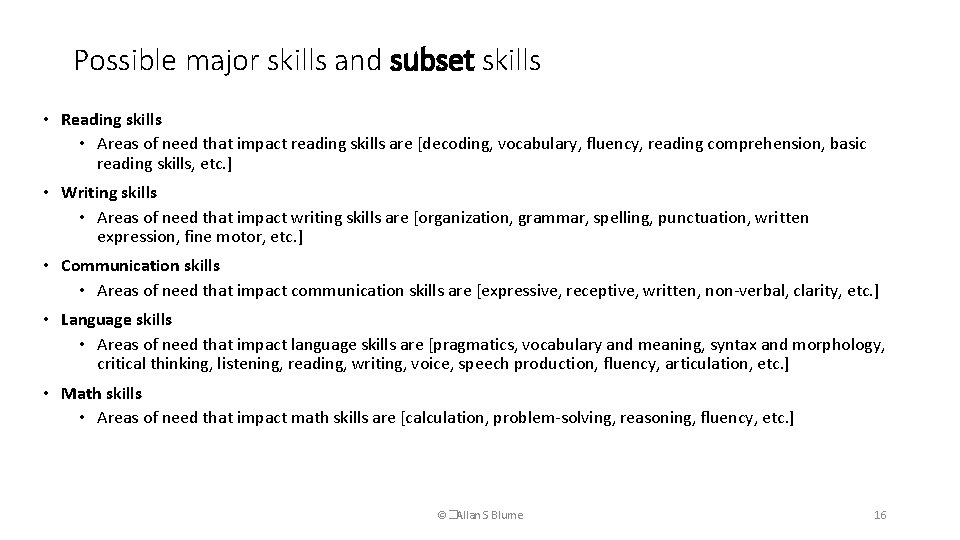
Possible major skills and subset skills • Reading skills • Areas of need that impact reading skills are [decoding, vocabulary, fluency, reading comprehension, basic reading skills, etc. ] • Writing skills • Areas of need that impact writing skills are [organization, grammar, spelling, punctuation, written expression, fine motor, etc. ] • Communication skills • Areas of need that impact communication skills are [expressive, receptive, written, non-verbal, clarity, etc. ] • Language skills • Areas of need that impact language skills are [pragmatics, vocabulary and meaning, syntax and morphology, critical thinking, listening, reading, writing, voice, speech production, fluency, articulation, etc. ] • Math skills • Areas of need that impact math skills are [calculation, problem-solving, reasoning, fluency, etc. ] ©�Allan S Blume 16
More possible major skills and subset skills • Social/Emotional skills • Areas of need that impact social/emotional skills are [self-awareness, self-management, socialawareness, relationship skills, goal-directed behavior, anxiety, personal responsibility, decision-making, optimistic thinking, coping, etc. ] • Behavior skills • Area of need that impact behavior skills are [self-regulation, physical or verbal aggression, coping, selfmonitoring, on-task behavior, compliance, self-injurious behaviors, bullying, property destruction. Stereotypy, task initiation, safety, etc. ] • Social Pragmatic skills • Areas of need that impact social pragmatic skills are [eye-contact, agreement or disagreement, facial expressions, social distance, posturing, environmental awareness, social awareness, greetings/closing, gestures, voice, etc. ] • Motor skills • Areas of need that impact motor skills are [fine motor (writing, holding, buttoning, eating, cutting, computer keyboarding, etc. ), gross motor (standing, walking, running, jumping, sitting upright, etc. ), visual motor (visual processing, visual perceptual, eye-hand coordination, etc. )] ©�Allan S Blume 17
More possible major skills and subset skills • Study/Learning skills • Areas of need that impact study/learning skills are (attention, organization, planning, initiation, timemanagement, self-advocacy, self-awareness, emotional regulation, task-completion, etc. ] • Daily Living skills • Areas of need that impact daily living skills are [personal hygiene, dressing or undressing, meal preparation, feeding, eating, mobility, transfer, toileting, housekeeping, laundry, home/community safety, health management, recreation/leisure, etc. ] • Pre-Academic/Classroom Readiness skills • Areas of need that impact pre-academic/classroom readiness skills are: [matching, sorting, pattern recognition, cause/effect, describing, asking, predicting, counting, letters, one-to-one correspondence, simple addition/subtraction, simple words, own name, copying, etc. ] • Play skills • Areas of need that impact play skills are [solitary play, spectator play, parallel play, associate play, cooperative play, etc. ] ©�Allan S Blume 18
More possible major skills and subset skills • Vocational skills • Areas of need that impact vocational skills are [work readiness, interview and search skills, work safety, social and communication skills, career decision-making, etc. ] • Academic skills • Areas of need that impact academic skills are [could be any combination of skills from above] ©�Allan S Blume 19
• The names of subsequent goals come from needs that arise from the disability • Skills • Curriculum does not arise from the disability Remember, • No goals named for - English Language Arts, Mathematics, Science and Technology or History and Social Science • Goals named for skills that impact participation in the curriculum and the life of the school ©�Allan S Blume 20
Mathematics or Math? • If Mathematics is identified as a curriculum area impacted by the student’s disability… • It does not mean that the student needs a Math goal… • But it does mean that the student needs a goal in Mathematics. • WHAT? ? ©�Allan S Blume 21
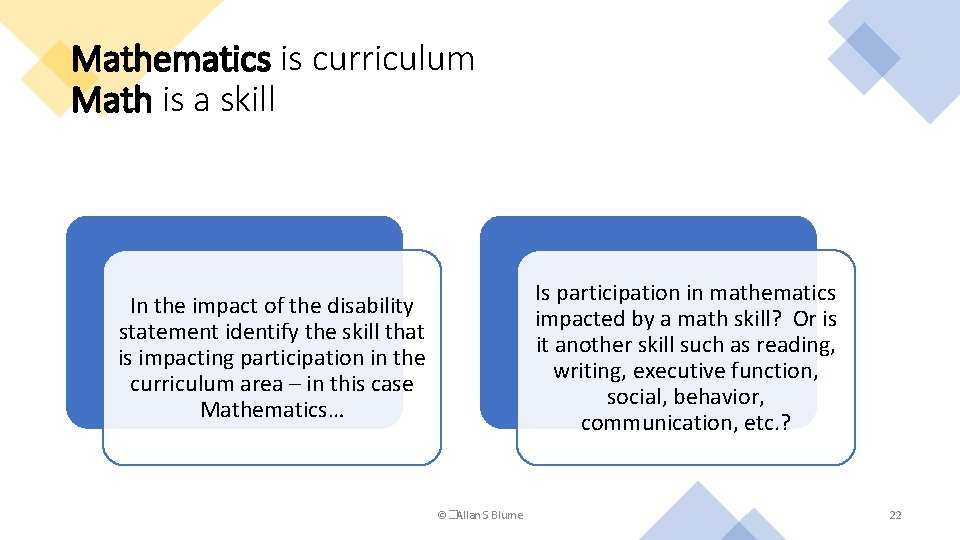
Mathematics is curriculum Math is a skill Is participation in mathematics impacted by a math skill? Or is it another skill such as reading, writing, executive function, social, behavior, communication, etc. ? In the impact of the disability statement identify the skill that is impacting participation in the curriculum area – in this case Mathematics… ©�Allan S Blume 22
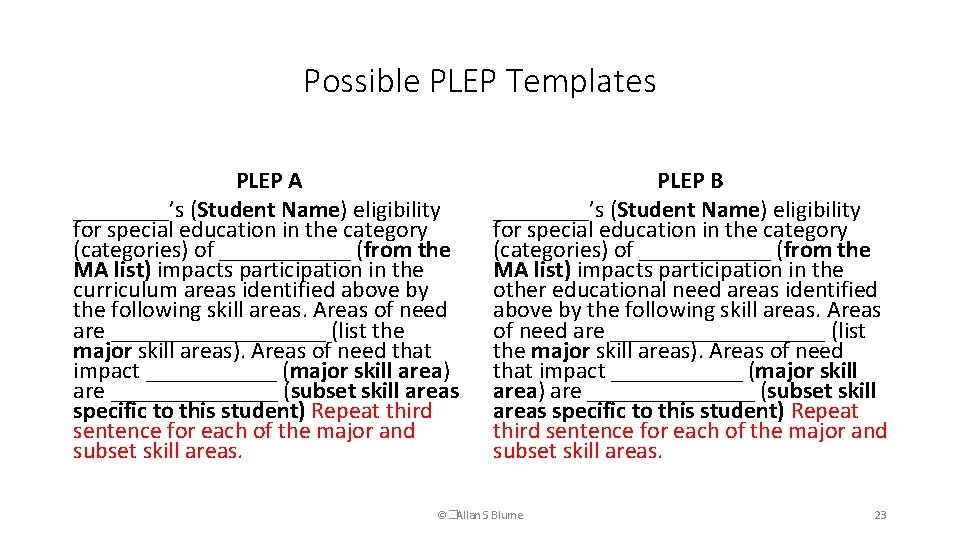
Possible PLEP Templates PLEP A ____’s (Student Name) eligibility for special education in the category (categories) of ______ (from the MA list) impacts participation in the curriculum areas identified above by the following skill areas. Areas of need are _________ (list the major skill areas). Areas of need that impact ______ (major skill area) are _______ (subset skill areas specific to this student) Repeat third sentence for each of the major and subset skill areas. PLEP B ____’s (Student Name) eligibility for special education in the category (categories) of ______ (from the MA list) impacts participation in the other educational need areas identified above by the following skill areas. Areas of need are _________ (list the major skill areas). Areas of need that impact ______ (major skill area) are _______ (subset skill areas specific to this student) Repeat third sentence for each of the major and subset skill areas. ©�Allan S Blume 23
How detailed does the impact of the disability statement need to be? No need to be overly detailed in PLEP statements – details and data already exist in the evaluation summaries and will be detailed in the data-based Current Performance Levels in subsequent parts of the IEP. ©�Allan S Blume 24
Does every Major skill (area of need) become the name of a goal? Not necessarily Consider the funnels again ©�Allan S Blume 25
The 3 Funnels • The ideal - 4 cups of water in, 4 cups of water out • Funnel with a filter – 6 cups of water in, 4 cups of water out, 2 cups of water caught in the filter • Physical impossibility – 4 cups of water in, 6 cups of water out? ? © Allan S Blume 26
The ideal • 4 areas of need arise from the disability • Written into the impact of the disability statement as skills • 4 goal focus areas © Allan S Blume 27
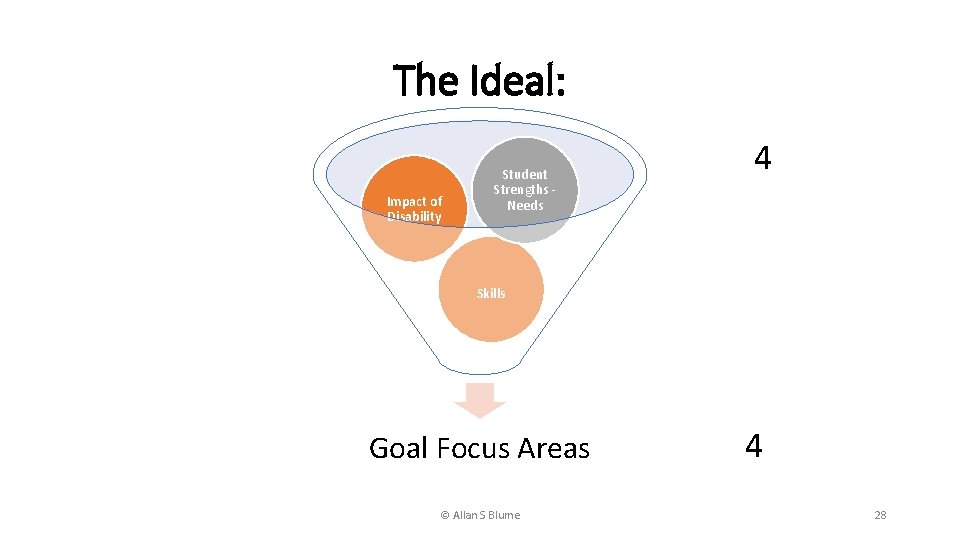
The Ideal: Impact of Disability Student Strengths Needs 4 Skills Goal Focus Areas © Allan S Blume 4 28
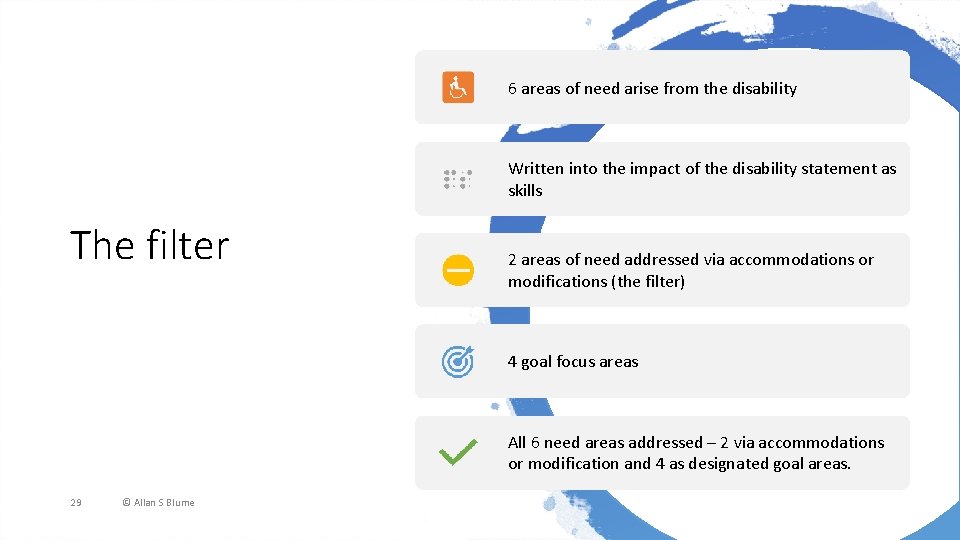
6 areas of need arise from the disability Written into the impact of the disability statement as skills The filter 2 areas of need addressed via accommodations or modifications (the filter) 4 goal focus areas All 6 need areas addressed – 2 via accommodations or modification and 4 as designated goal areas. 29 © Allan S Blume
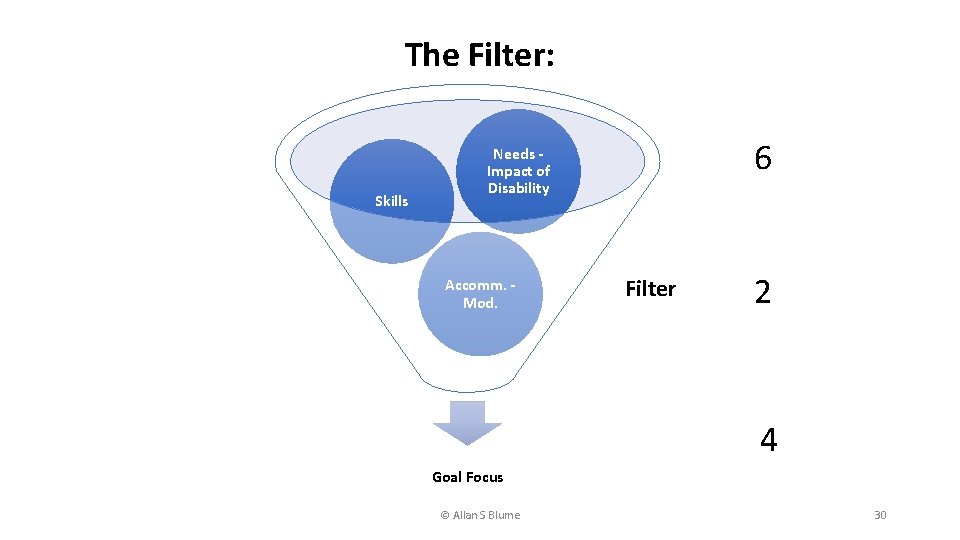
The Filter: Skills 6 Needs Impact of Disability Accomm. Mod. Filter 2 4 Goal Focus © Allan S Blume 30
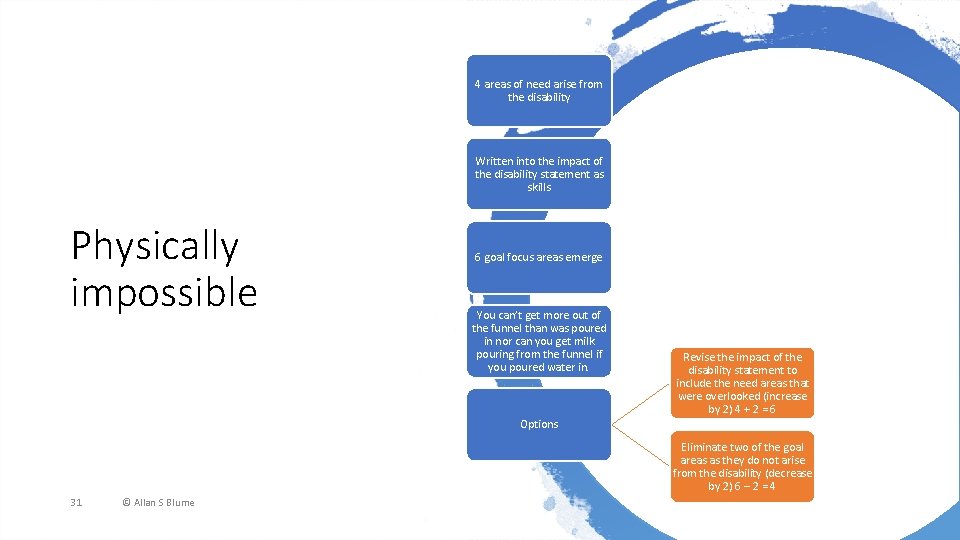
4 areas of need arise from the disability Written into the impact of the disability statement as skills Physically impossible 6 goal focus areas emerge You can’t get more out of the funnel than was poured in nor can you get milk pouring from the funnel if you poured water in. Revise the impact of the disability statement to include the need areas that were overlooked (increase by 2) 4 + 2 = 6 Options Eliminate two of the goal areas as they do not arise from the disability (decrease by 2) 6 – 2 = 4 31 © Allan S Blume
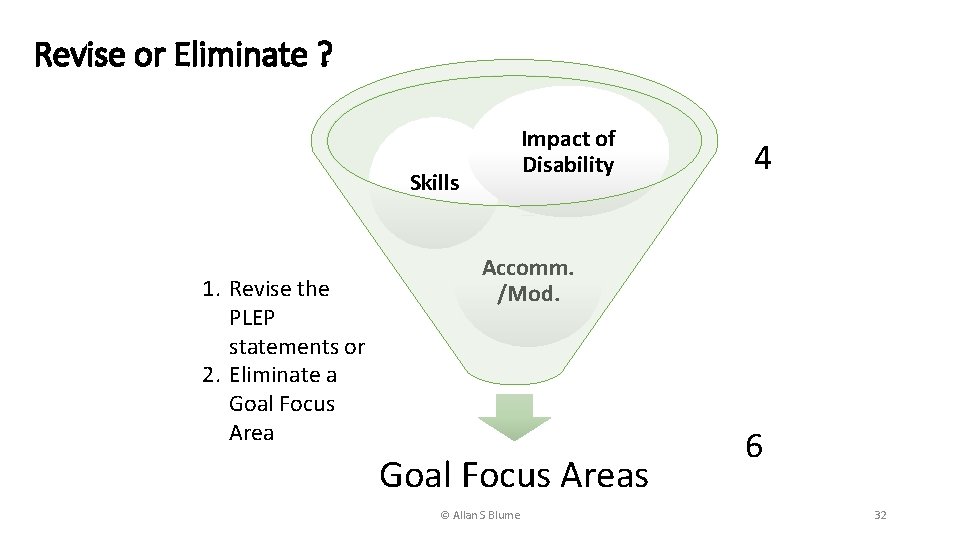
Revise or Eliminate ? Impact of Disability Skills 1. Revise the PLEP statements or 2. Eliminate a Goal Focus Area 4 Accomm. /Mod. Goal Focus Areas © Allan S Blume 6 32
The impact of Transition Planning (TPF) • For students of transition age there is an additional source of information for Areas of Need • The TPF • In addition to evaluation information, transition planning may likely reveal additional need areas specific to transition planning • Some, or all, of those need areas may become part of the impact of the disability statement (PLEP) • Before writing the PLEP, the TPF should be written © Allan S Blume 33
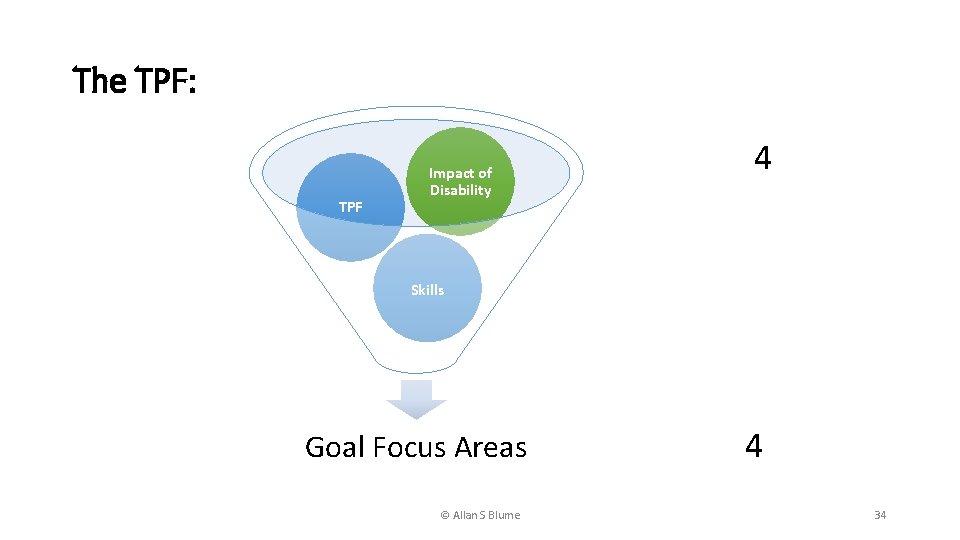
The TPF: TPF Impact of Disability 4 Skills Goal Focus Areas © Allan S Blume 4 34
![Sample Curriculum Impact of Disability statement (PLEP A) ________[Student name]’s eligibility for special education](http://slidetodoc.com/presentation_image_h2/912c19fe0233d32c502722b4ec8b9829/image-35.jpg "Sample Curriculum Impact of Disability statement (PLEP A) ________[Student name]’s eligibility for special education")
Sample Curriculum Impact of Disability statement (PLEP A) ________[Student name]’s eligibility for special education in the category of Specific Learning Disability impacts participation in the curriculum areas identified above. Areas of need include reading, writing and communication. Areas of need that impact reading are decoding and fluency. Areas of need that impact writing are organization and spelling. Areas of need that impact communication are expressive and receptive skills. ©�Allan S Blume 35
![Sample Life of the School disability statement (PLEP B) ________[Student name]’s eligibility for special](http://slidetodoc.com/presentation_image_h2/912c19fe0233d32c502722b4ec8b9829/image-36.jpg "Sample Life of the School disability statement (PLEP B) ________[Student name]’s eligibility for special")
Sample Life of the School disability statement (PLEP B) ________[Student name]’s eligibility for special education in the category of Specific Learning Disability impacts participation in the life of the school areas identified above. Areas of need include reading, communication and daily living skills. Areas of need that impact reading are decoding and fluency. Areas of need that impact communication are expressive and receptive skills. Areas of need that impact daily living skills are personal hygiene and meal preparation. ©�Allan S Blume 36
Sample Transition Impact of the Disability statement (PLEP A or B page) As ______ [Student name] is age _____ [insert student age] [he/she/they] is also working on transition related skills that align with [his/her/their] vision statement and the transition planning form. Areas of need that impact transition skills are reading, writing, communication and daily living skills. Areas of need that impact reading are decoding and fluency. Areas of need that impact writing are organization and spelling. Areas of need that impact communication are expressive and receptive skills. Areas of need that impact daily living skills are personal hygiene and meal preparation. 37 ©�Allan S Blume
- Slides: 37