
WRITING THE EMPIRICAL JOURNAL ARTICLE A Guide to

- Slides: 14
WRITING THE EMPIRICAL JOURNAL ARTICLE A Guide to APA-Style Paper-Writing
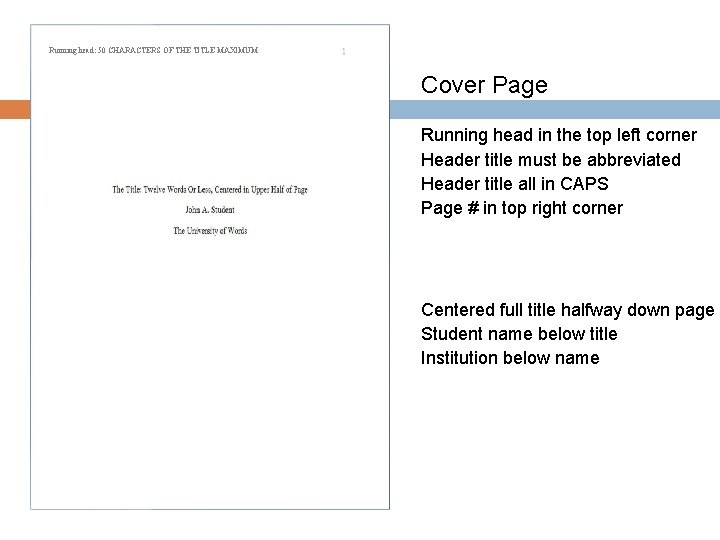
Running head: 50 CHARACTERS OF THE TITLE MAXIMUM Cover Page Running head in the top left corner Header title must be abbreviated Header title all in CAPS Page # in top right corner Centered full title halfway down page Student name below title Institution below name
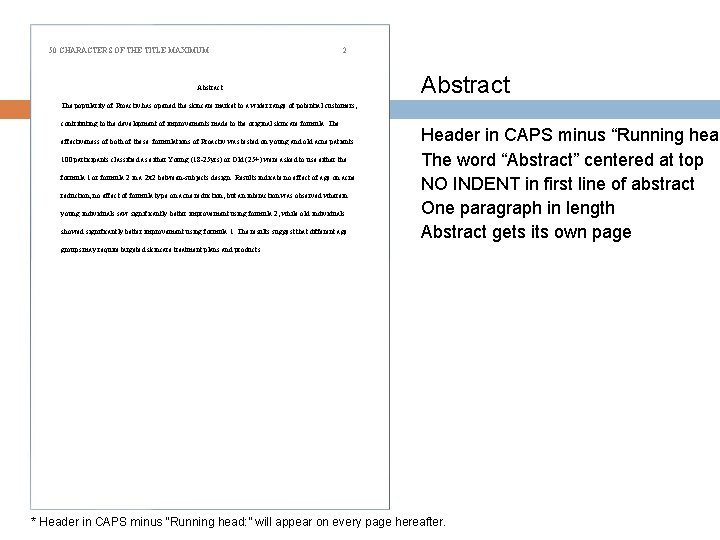
50 CHARACTERS OF THE TITLE MAXIMUM 2 Abstract The popularity of Proactiv has opened the skincare market to a wider range of potential customers, contributing to the development of improvements made to the original skincare formula. The effectiveness of both of these formulations of Proactiv was tested on young and old acne patients. 100 participants classified as either Young (18 -25 yrs) or Old (25+) were asked to use either the formula 1 or formula 2 in a 2 x 2 between-subjects design. Results indicate no effect of age on acne reduction, no effect of formula type on acne reduction, but an interaction was observed wherein young individuals saw significantly better improvement using formula 2, while old individuals showed significantly better improvement using formula 1. The results suggest that different age Header in CAPS minus “Running head The word “Abstract” centered at top NO INDENT in first line of abstract One paragraph in length Abstract gets its own page groups may require targeted skincare treatment plans and products. * Header in CAPS minus “Running head: ” will appear on every page hereafter.
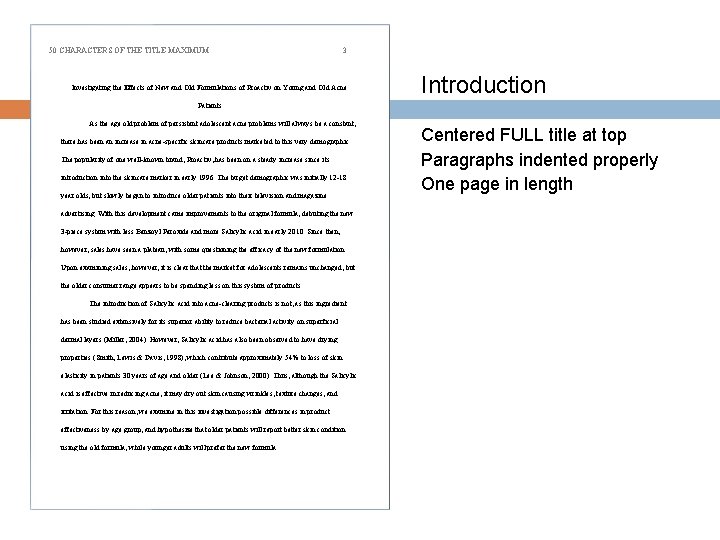
50 CHARACTERS OF THE TITLE MAXIMUM 3 Investigating the Effects of New and Old Formulations of Proactiv on Young and Old Acne Introduction Patients As the age old problem of persistent adolescent acne problems will always be a constant, there has been an increase in acne-specific skincare products marketed to this very demographic. The popularity of one well-known brand, Proactiv, has been on a steady increase since its introduction into the skincare marker in early 1996. The target demographic was initially 12 -18 year olds, but slowly began to introduce older patients into their television and magazine advertising. With this development came improvements to the original formula, debuting the new 3 -piece system with less Benzoyl Peroxide and more Salicylic acid in early 2010. Since then, however, sales have seen a plateau, with some questioning the efficacy of the new formulation. Upon examining sales, however, it is clear that the market for adolescents remains unchanged, but the older consumer range appears to be spending less on this system of products. The introduction of Salicylic acid into acne-clearing products is not, as this ingredient has been studied extensively for its superior ability to reduce bacterial activity on superficial dermal layers (Miller, 2004). However, Salicylic acid has also been observed to have drying properties (Smith, Lewis & Davis, 1998), which contribute approximately 54% to loss of skin elasticity in patients 30 years of age and older (Lee & Johnson, 2000). Thus, although the Salicylic acid is effective in reducing acne, it may dry out skin causing wrinkles, texture changes, and irritation. For this reason, we examine in this investigation possible differences in product effectiveness by age group, and hypothesize that older patients will report better skin condition using the old formula, while younger adults will prefer the new formula. Centered FULL title at top Paragraphs indented properly One page in length
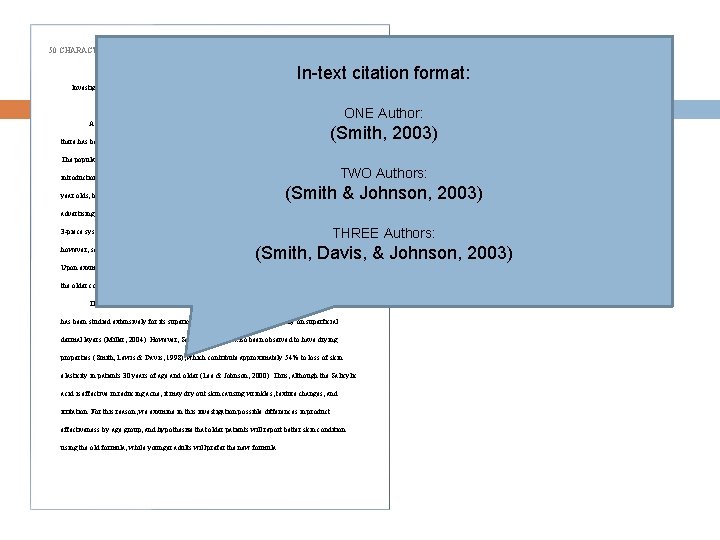
50 CHARACTERS OF THE TITLE MAXIMUM 3 In-text citation format: Investigating the Effects of New and Old Formulations of Proactiv on Young and Old Acne Patients Introduction ONE Author: As the age old problem of persistent adolescent acne problems will always be a constant, (Smith, 2003) Centered FULL title at top there has been an increase in acne-specific skincare products marketed to this very demographic. Paragraphs indented properly One page in length year olds, but slowly began to introduce older patients into their television (Smith and magazine & Johnson, 2003) The popularity of one well-known brand, Proactiv, has been on a steady increase since its TWO Authors: introduction into the skincare marker in early 1996. The target demographic was initially 12 -18 advertising. With this development came improvements to the original formula, debuting the new THREE Authors: 3 -piece system with less Benzoyl Peroxide and more Salicylic acid in early 2010. Since then, (Smith, Davis, & Johnson, 2003) however, sales have seen a plateau, with some questioning the efficacy of the new formulation. Upon examining sales, however, it is clear that the market for adolescents remains unchanged, but the older consumer range appears to be spending less on this system of products. The introduction of Salicylic acid into acne-clearing products is not, as this ingredient has been studied extensively for its superior ability to reduce bacterial activity on superficial dermal layers (Miller, 2004). However, Salicylic acid has also been observed to have drying properties (Smith, Lewis & Davis, 1998), which contribute approximately 54% to loss of skin elasticity in patients 30 years of age and older (Lee & Johnson, 2000). Thus, although the Salicylic acid is effective in reducing acne, it may dry out skin causing wrinkles, texture changes, and irritation. For this reason, we examine in this investigation possible differences in product effectiveness by age group, and hypothesize that older patients will report better skin condition using the old formula, while younger adults will prefer the new formula.
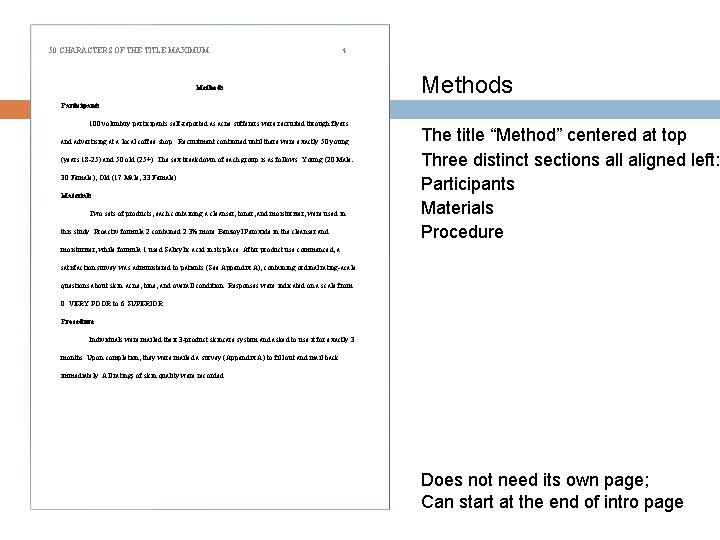
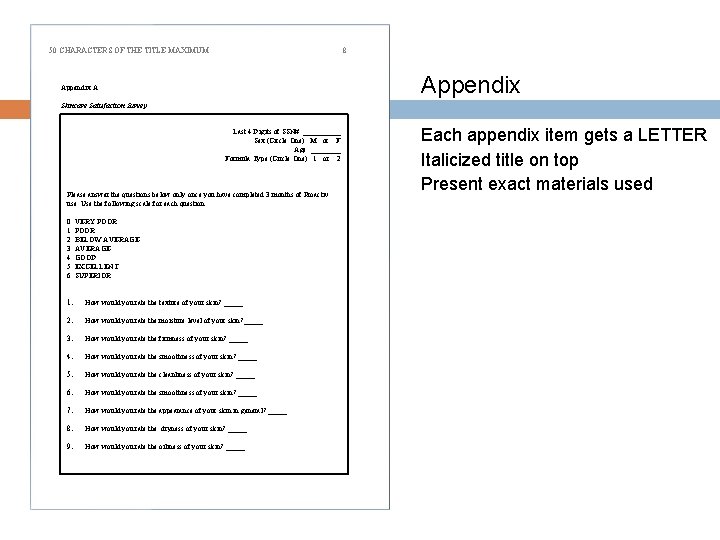
50 CHARACTERS OF THE TITLE MAXIMUM 4 Methods Participants 100 voluntary participants self-reported as acne sufferers were recruited through flyers and advertising at a local coffee shop. Recruitment continued until there were exactly 50 young (years 18 -25) and 50 old (25+). The sex breakdown of each group is as follows: Young (20 Male; 30 Female), Old (17 Male, 33 Female). Materials Two sets of products, each containing a cleanser, toner, and moisturizer, were used in this study. Proactiv formula 2 contained 2. 3% more Benzoyl Peroxide in the cleanser and The title “Method” centered at top Three distinct sections all aligned left: Participants Materials Procedure moisturizer, while formula 1 used Salicylic acid in its place. After product use commenced, a satisfaction survey was administered to patients (See Appendix A), containing ordinal rating-acale questions about skin acne, tone, and overall condition. Responses were indicated on a scale from 0: VERY POOR to 6: SUPERIOR. Procedure Individuals were mailed their 3 -product skincare system and asked to use it for exactly 3 months. Upon completion, they were mailed a survey (Appendix A) to fill out and mail back immediately. All ratings of skin quality were recorded. Does not need its own page; Can start at the end of intro page
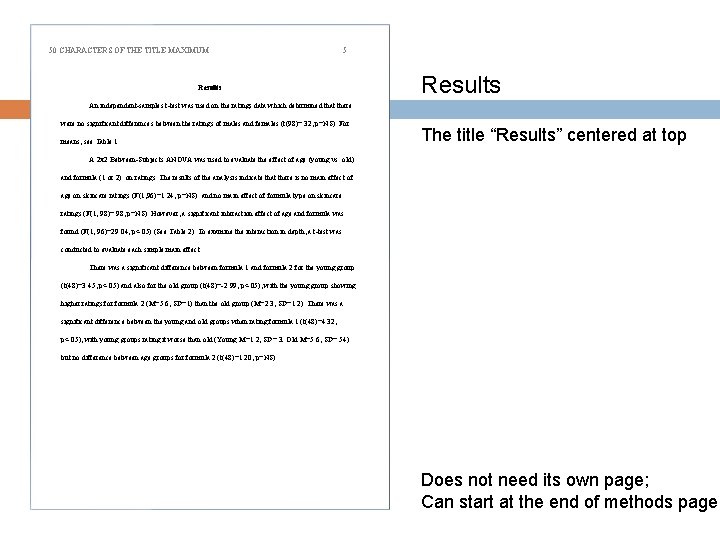
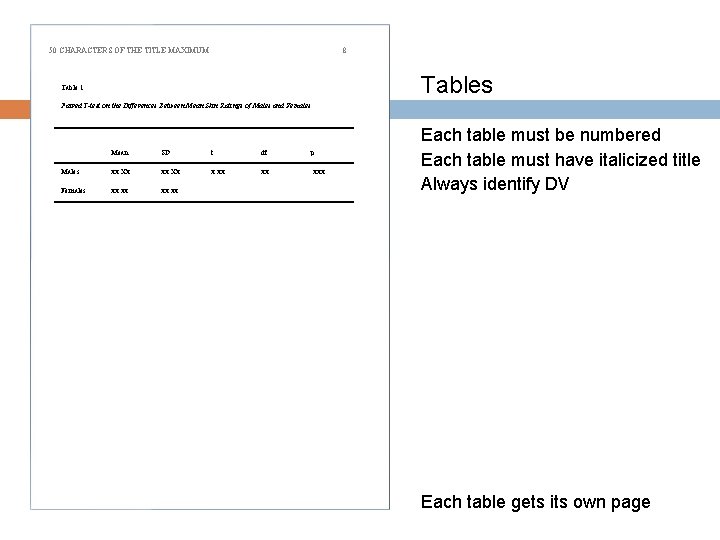
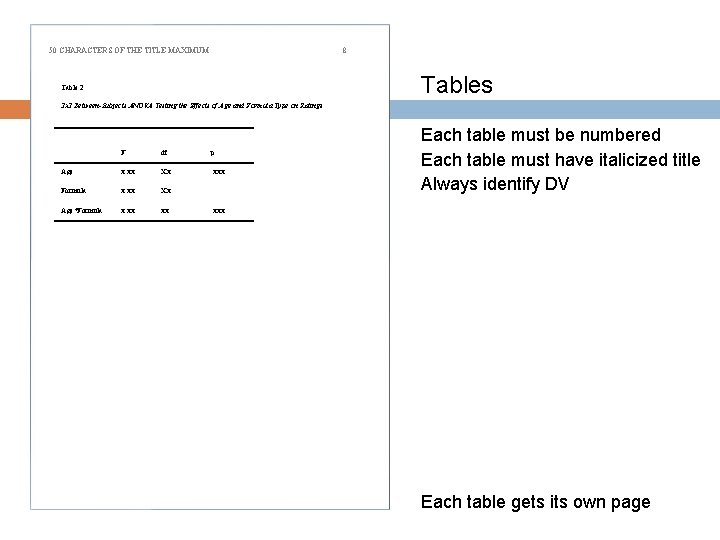
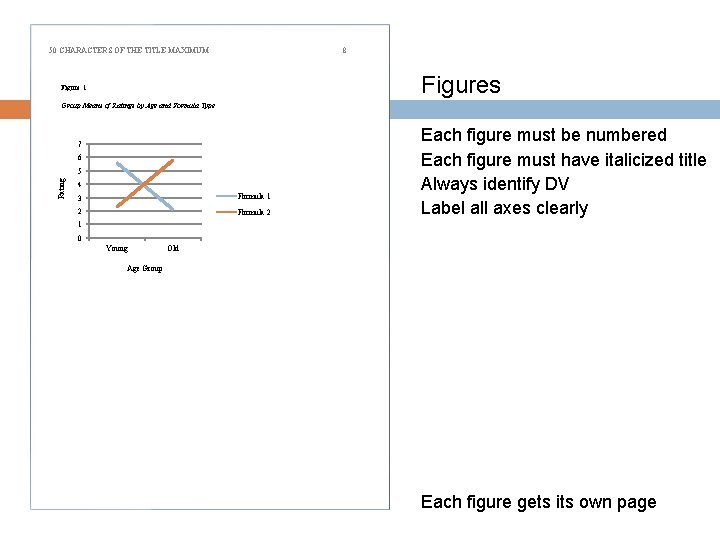
50 CHARACTERS OF THE TITLE MAXIMUM 5 Results An independent-samples t-test was used on the ratings data which determined that there were no significant differences between the ratings of males and females (t(98)=. 32, p=NS). For means, see Table 1. The title “Results” centered at top A 2 x 2 Between-Subjects ANOVA was used to evaluate the effect of age (young vs. old) and formula (1 or 2) on ratings. The results of the analysis indicate that there is no main effect of age on skincare ratings (F(1, 96)=1. 24, p=NS) and no main effect of formula type on skincare ratings (F(1, 98)=. 98, p=NS). However, a significant interaction effect of age and formula was found (F(1, 96)=29. 04, p<. 05) (See Table 2). To examine the interaction in depth, a t-test was conducted to evaluate each simple main effect. There was a significant difference between formula 1 and formula 2 for the young group (t(48)=3. 45, p<. 05) and also for the old group (t(48)=-2. 99, p<. 05), with the young group showing higher ratings formula 2 (M=5. 6, SD=1) than the old group (M=2. 3, SD=1. 2). There was a significant difference between the young and old groups when rating formula 1 (t(48)=4. 32, p<. 05), with young groups rating it worse than old (Young M=1. 2, SD=. 3; Old M=5. 6, SD=. 54) but no difference between age groups formula 2 (t(48)=1. 20, p=NS). Does not need its own page; Can start at the end of methods page
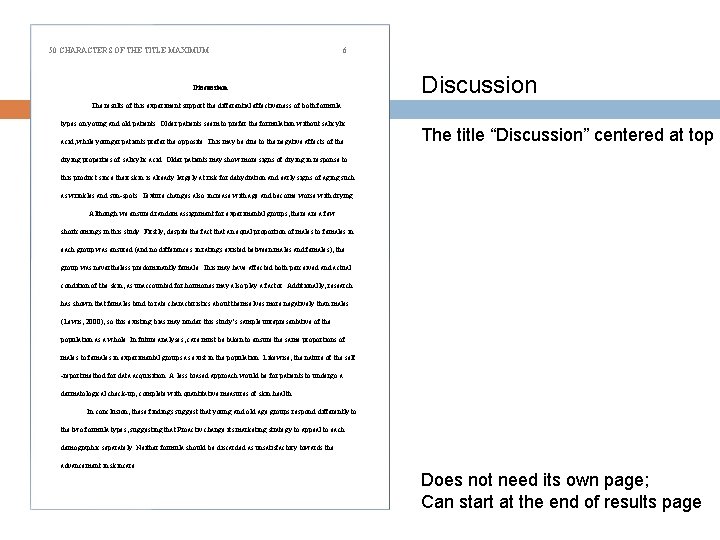
50 CHARACTERS OF THE TITLE MAXIMUM 6 Discussion The results of this experiment support the differential effectiveness of both formula types on young and old patients. Older patients seem to prefer the formulation without salicylic acid, while younger patients prefer the opposite. This may be due to the negative affects of the The title “Discussion” centered at top drying properties of salicylic acid. Older patients may show more signs of drying in response to this product since their skin is already largely at risk for dehydration and early signs of aging such as wrinkles and sun-spots. Texture changes also increase with age and become worse with drying. Although we ensured random assignment for experimental groups, there a few shortcomings in this study. Firstly, despite the fact that an equal proportion of males to females in each group was ensured (and no differences in ratings existed between males and females), the group was nevertheless predominantly female. This may have affected both perceived and actual condition of the skin, as unaccounted for hormones may also play a factor. Additionally, research has shown that females tend to rate characteristics about themselves more negatively than males (Lewis, 2000), so this existing bias may render this study’s sample unrepresentative of the population as a whole. In future analyses, care must be taken to ensure the same proportions of males to females in experimental groups as exist in the population. Likewise, the nature of the self -report method for data acquisition. A less biased approach would be for patients to undergo a dermatological check-up, complete with quantitative measures of skin health. In conclusion, these findings suggest that young and old age groups respond differently to the two formula types, suggesting that Proactiv change its marketing strategy to appeal to each demographic separately. Neither formula should be discarded as unsatisfactory towards the advancement in skincare. Does not need its own page; Can start at the end of results page
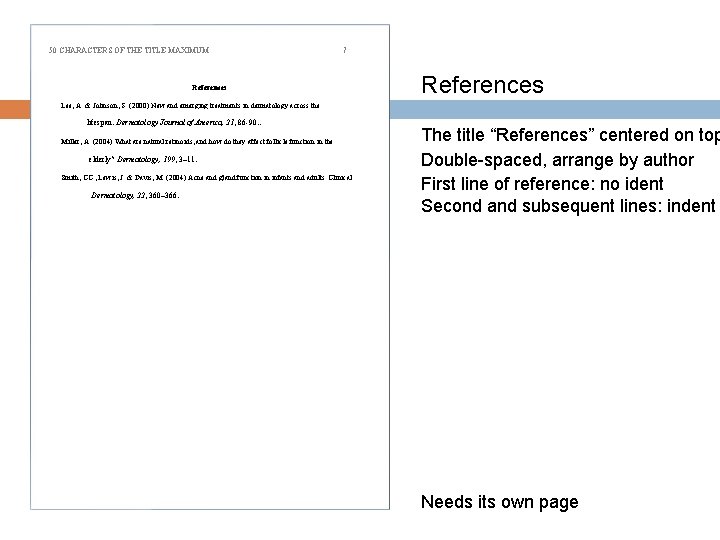
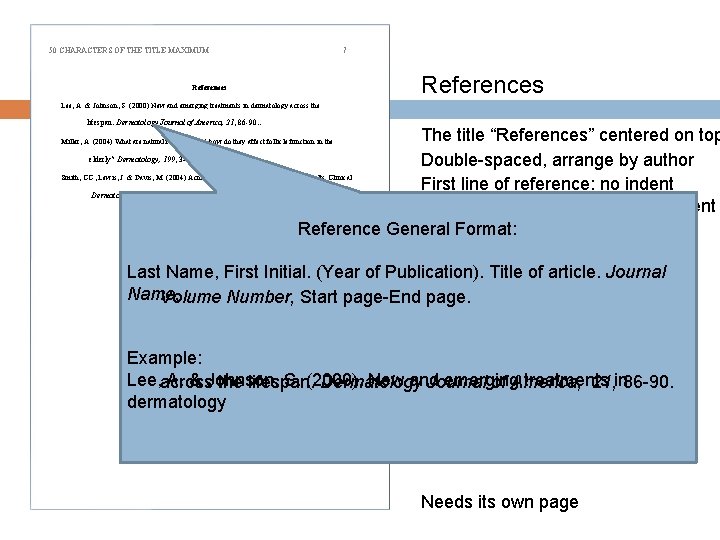
50 CHARACTERS OF THE TITLE MAXIMUM 7 References Lee, A. & Johnson, S. (2000) New and emerging treatments in dermatology across the lifespan. Dermatology Journal of America, 21, 86 -90. . Miller, A. (2004) What are natural retinoids, and how do they affect follicle function in the elderly? Dermatology, 199, 3– 11. Smith, CC. , Lewis, J. & Davis, M. (2004) Acne and gland function in infants and adults. Clinical Dermatology, 22, 360– 366. The title “References” centered on top Double-spaced, arrange by author First line of reference: no ident Second and subsequent lines: indent Needs its own page
50 CHARACTERS OF THE TITLE MAXIMUM References 7 References Lee, A. & Johnson, S. (2000) New and emerging treatments in dermatology across the lifespan. Dermatology Journal of America, 21, 86 -90. . The title “References” centered on top elderly? Dermatology, 199, 3– 11. Double-spaced, arrange by author Smith, CC. , Lewis, J. & Davis, M. (2004) Acne and gland function in infants and adults. Clinical First line of reference: no indent Dermatology, 22, 360– 366. Second and subsequent lines: indent Reference General Format: Miller, A. (2004) What are natural retinoids, and how do they affect follicle function in the Last Name, First Initial. (Year of Publication). Title of article. Journal Name, Volume Number, Start page-End page. Example: Lee, across A. & Johnson, S. (2000). New and emerging treatments the lifespan. Dermatology Journal of America, 21, in 86 -90. dermatology Needs its own page
50 CHARACTERS OF THE TITLE MAXIMUM 8 Tables Table 1. Paired T-test on the Differences Between Mean Skin Ratings of Males and Females Mean SD t df p Males xx. Xx x. xx xx . xxx Females xx. xx Each table must be numbered Each table must have italicized title Always identify DV Each table gets its own page
50 CHARACTERS OF THE TITLE MAXIMUM 8 Tables Table 2. 2 x 2 Between-Subjects ANOVA Testing the Effects of Age and Formula Type on Ratings F df p Age x. xx Xx . xxx Formula x. xx Xx Age*Formula x. xx xx Each table must be numbered Each table must have italicized title Always identify DV . xxx Each table gets its own page
50 CHARACTERS OF THE TITLE MAXIMUM 8 Figures Figure 1. Group Means of Ratings by Age and Formula Type 7 6 Rating 5 4 3 Formula 1 2 Formula 2 Each figure must be numbered Each figure must have italicized title Always identify DV Label all axes clearly 1 0 Young Old Age Group Each figure gets its own page
50 CHARACTERS OF THE TITLE MAXIMUM 8 Appendix A. Skincare Satisfaction Survey Last 4 Digits of SSN#: _____ Sex (Circle One): M or F Age: ____ Formula Type (Circle One): 1 or 2 Please answer the questions below only once you have completed 3 months of Proactiv use. Use the following scale for each question: 0: VERY POOR 1: POOR 2: BELOW AVERAGE 3: AVERAGE 4: GOOD 5: EXCELLENT 6: SUPERIOR 1. How would you rate the texture of your skin? _____ 2. How would you rate the moisture level of your skin? _____ 3. How would you rate the firmness of your skin? _____ 4. How would you rate the smoothness of your skin? _____ 5. How would you rate the cleanliness of your skin? _____ 6. How would you rate the smoothness of your skin? _____ 7. How would you rate the appearance of your skin in general? _____ 8. How would you rate the dryness of your skin? _____ 9. How would you rate the oiliness of your skin? _____ Each appendix item gets a LETTER Italicized title on top Present exact materials used