
Writing the Constitution Essential Questions Why did the

- Slides: 60
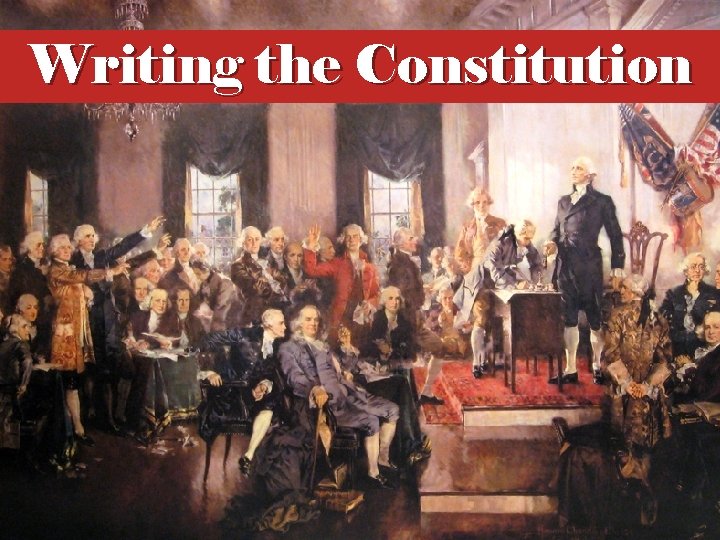
Writing the Constitution
Essential Questions • Why did the colonists seek to develop a weak central government at the close of the Revolutionary War? • What problems were inherent in the Articles of Confederation? • What philosophical and political ideals did the Framers draw from writing the Constitution? • How did the Framers use compromise to ensure that the Constitution would reflect different points of view? • How did the Framers ensure that governmental power would be shared between national and state governments, as well as among the three branches of the federal government? • How does the Constitution ensure civil liberties?
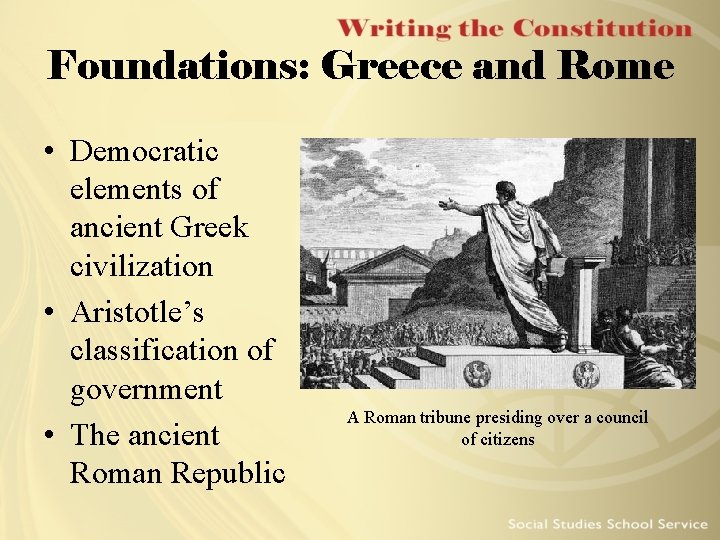
Foundations: Greece and Rome • Democratic elements of ancient Greek civilization • Aristotle’s classification of government • The ancient Roman Republic A Roman tribune presiding over a council of citizens
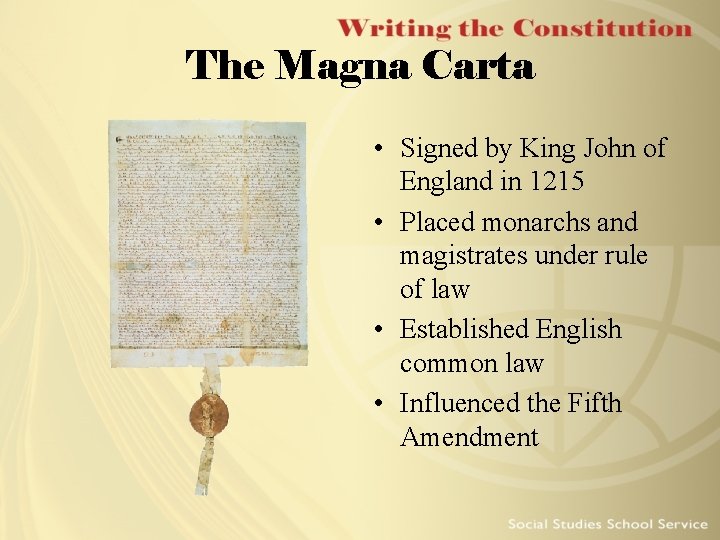
The Magna Carta • Signed by King John of England in 1215 • Placed monarchs and magistrates under rule of law • Established English common law • Influenced the Fifth Amendment
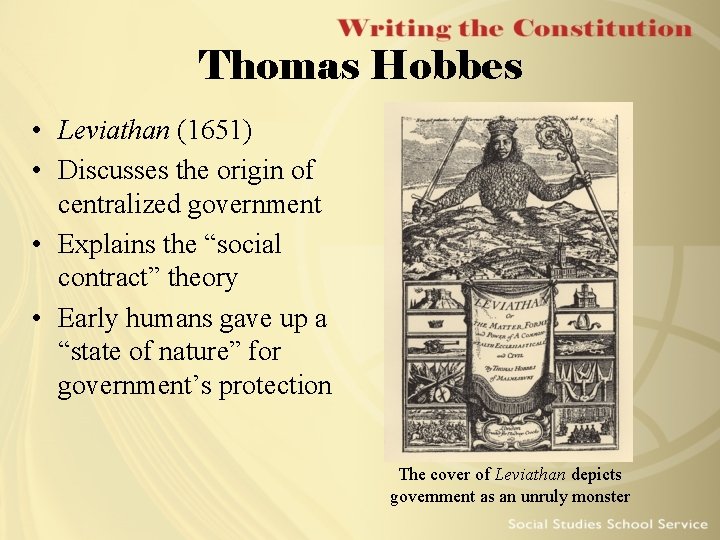
Thomas Hobbes • Leviathan (1651) • Discusses the origin of centralized government • Explains the “social contract” theory • Early humans gave up a “state of nature” for government’s protection The cover of Leviathan depicts government as an unruly monster
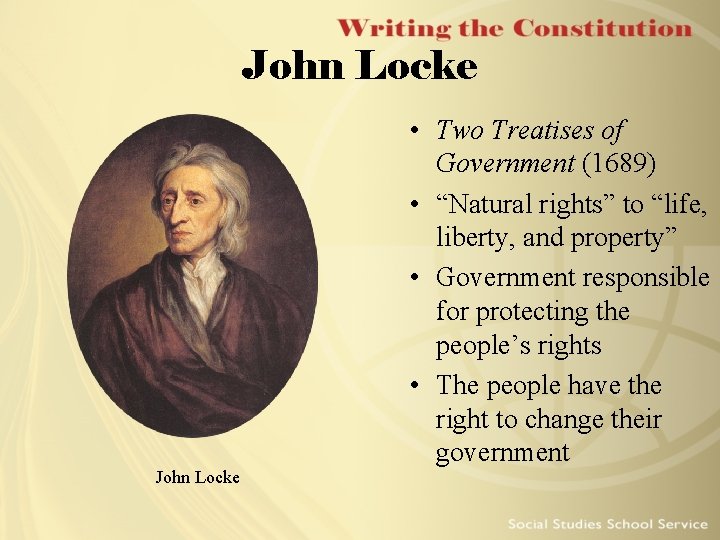
John Locke • Two Treatises of Government (1689) • “Natural rights” to “life, liberty, and property” • Government responsible for protecting the people’s rights • The people have the right to change their government
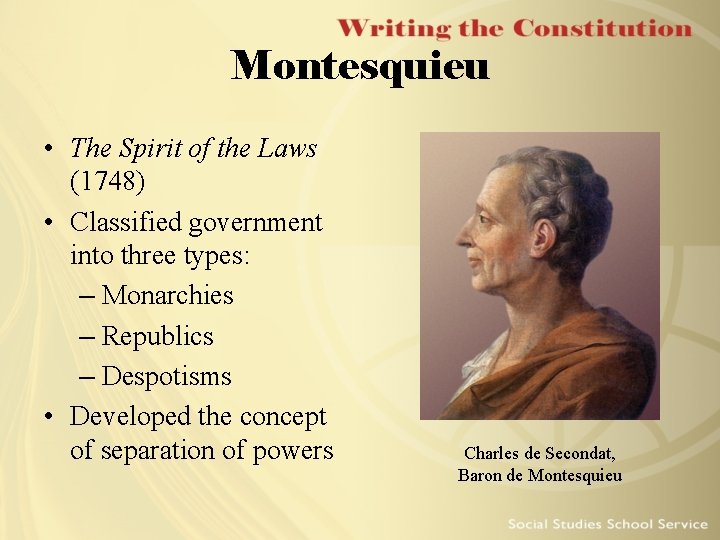
Montesquieu • The Spirit of the Laws (1748) • Classified government into three types: – Monarchies – Republics – Despotisms • Developed the concept of separation of powers Charles de Secondat, Baron de Montesquieu
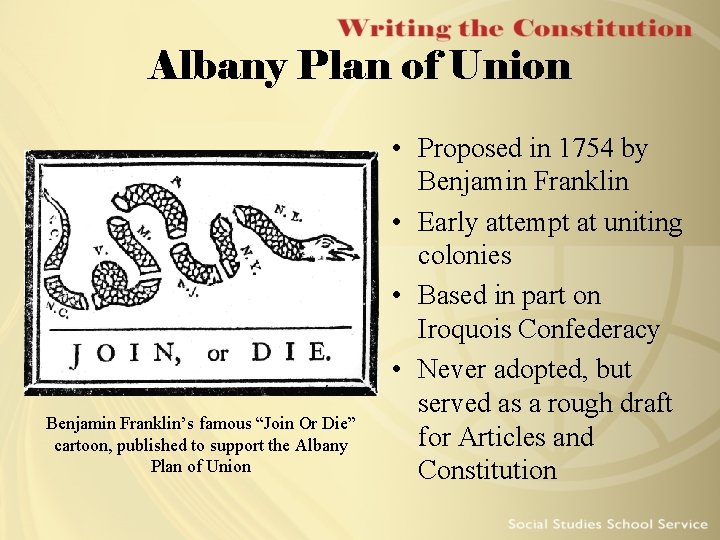
Albany Plan of Union Benjamin Franklin’s famous “Join Or Die” cartoon, published to support the Albany Plan of Union • Proposed in 1754 by Benjamin Franklin • Early attempt at uniting colonies • Based in part on Iroquois Confederacy • Never adopted, but served as a rough draft for Articles and Constitution
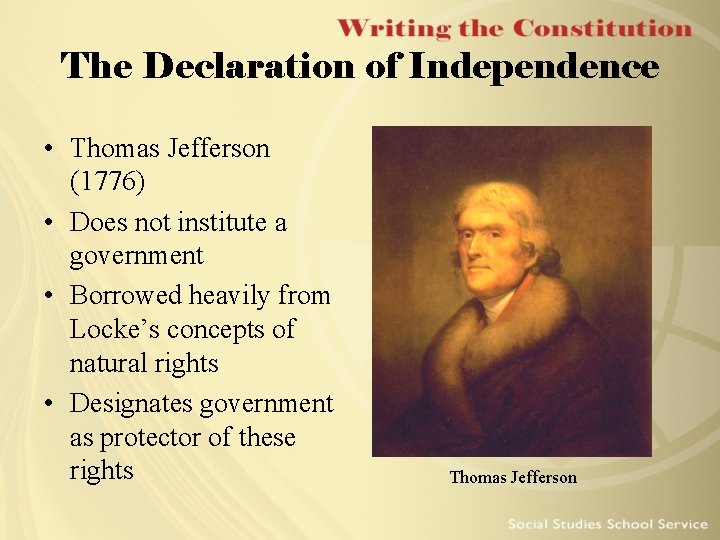
The Declaration of Independence • Thomas Jefferson (1776) • Does not institute a government • Borrowed heavily from Locke’s concepts of natural rights • Designates government as protector of these rights Thomas Jefferson
Discussion Questions 1. What elements of ancient Greek and Roman government are evident in the Constitution? 2. What concepts from Enlightenment philosophers influenced the content of the Constitution? 3. What “American” influences does the Constitution include? Why might these sources have been included?
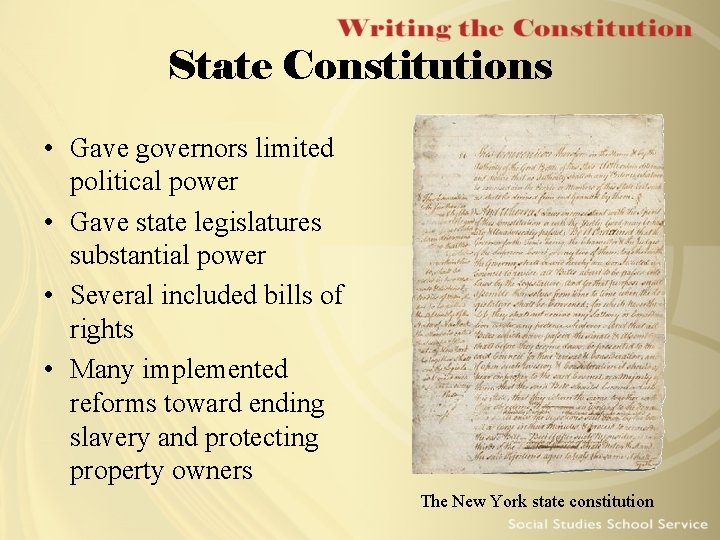
State Constitutions • Gave governors limited political power • Gave state legislatures substantial power • Several included bills of rights • Many implemented reforms toward ending slavery and protecting property owners The New York state constitution
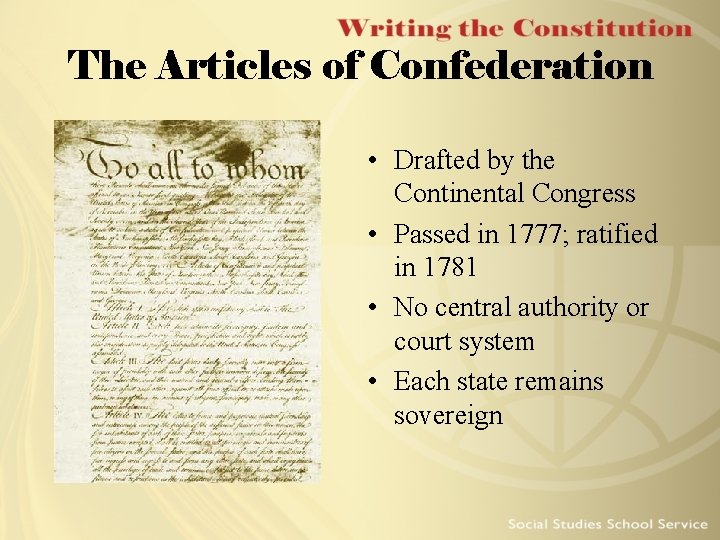
The Articles of Confederation • Drafted by the Continental Congress • Passed in 1777; ratified in 1781 • No central authority or court system • Each state remains sovereign
The Articles: Provisions • • States given sovereignty over central government Each state had a single vote in Congress No power of taxation National government afforded certain powers: – Declare war and conduct foreign affairs – Standardize currency and measures – Arbitrate disputes between states
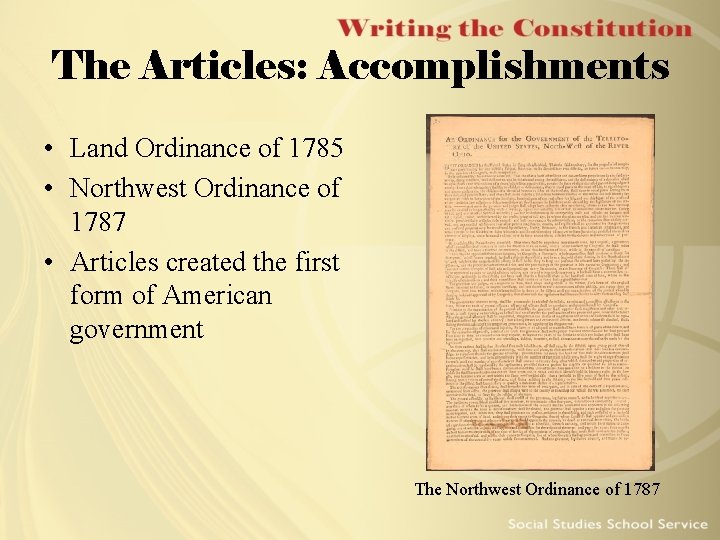
The Articles: Accomplishments • Land Ordinance of 1785 • Northwest Ordinance of 1787 • Articles created the first form of American government The Northwest Ordinance of 1787
The Articles: Weaknesses • Congress could not: – Force states to pay taxes – Raise an army without state support – Regulate trade • Each state had one vote in the legislature, regardless of population • Difficult to pass laws and amend Articles • No court system or executive branch
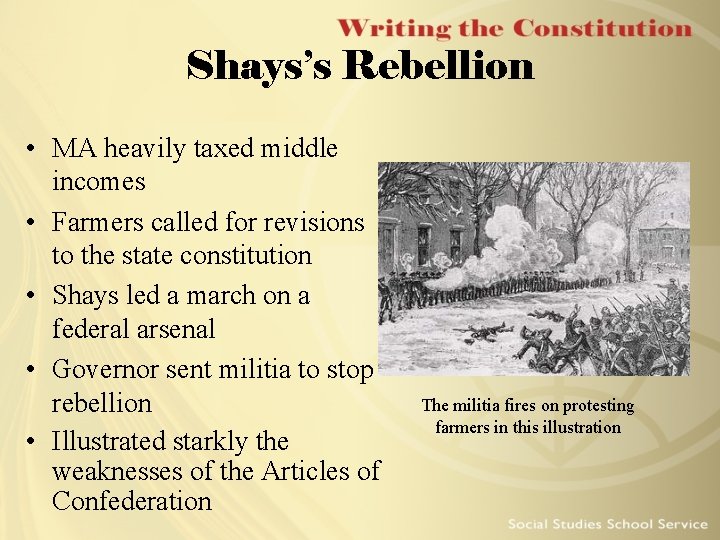
Shays’s Rebellion • MA heavily taxed middle incomes • Farmers called for revisions to the state constitution • Shays led a march on a federal arsenal • Governor sent militia to stop rebellion • Illustrated starkly the weaknesses of the Articles of Confederation The militia fires on protesting farmers in this illustration
Discussion Questions 1. Why did the government under the Articles first seem effective in the years immediately following the Revolution? 2. What were the characteristics of state constitutions created during the period after the American Revolution? 3. What were some of the main achievements of the Articles? What major weaknesses made the Articles ineffective? 4. What impact did Shays’s Rebellion have on concerns about government under the Articles?
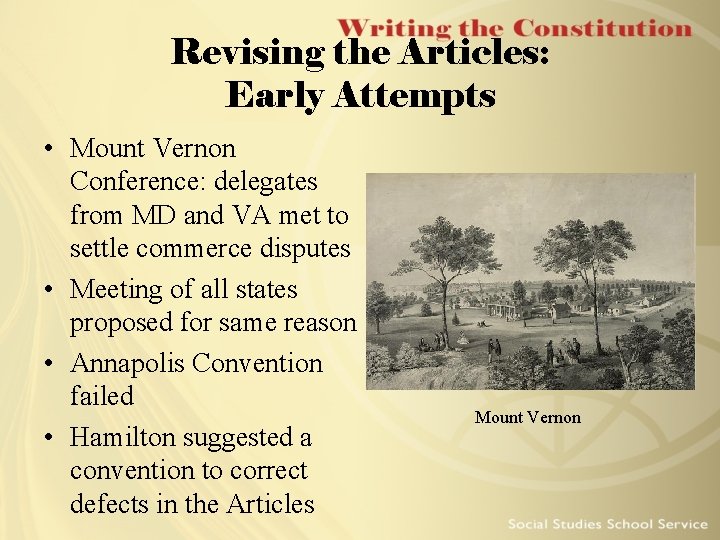
Revising the Articles: Early Attempts • Mount Vernon Conference: delegates from MD and VA met to settle commerce disputes • Meeting of all states proposed for same reason • Annapolis Convention failed • Hamilton suggested a convention to correct defects in the Articles Mount Vernon
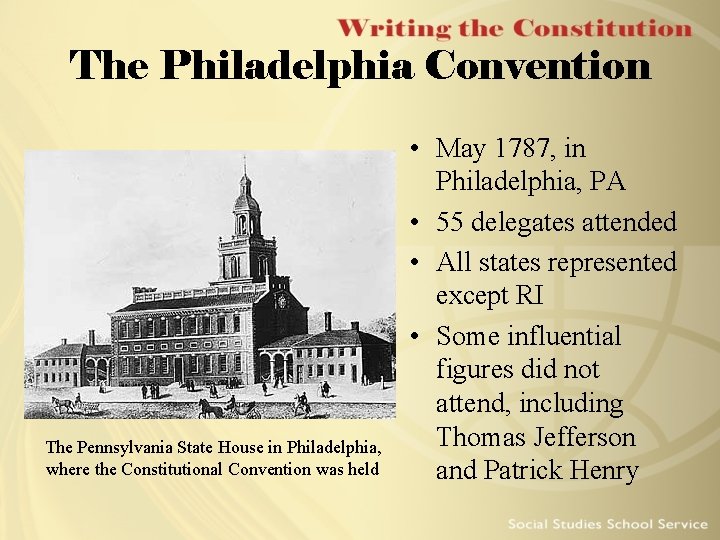
The Philadelphia Convention The Pennsylvania State House in Philadelphia, where the Constitutional Convention was held • May 1787, in Philadelphia, PA • 55 delegates attended • All states represented except RI • Some influential figures did not attend, including Thomas Jefferson and Patrick Henry
The Philadelphia Convention: Demographics • • Most delegates were wealthy Nearly two-thirds were lawyers Forty had served in Confederation Congress Over half had been officers in the Continental Army Seven former state governors Eight signers of the Declaration of Independence Average of 42
Discussion Questions 1. Why were the Mount Vernon and Annapolis meetings called? How effective do you think they were? 2. For what purpose was the Philadelphia Convention originally called? What was the makeup of its delegates?
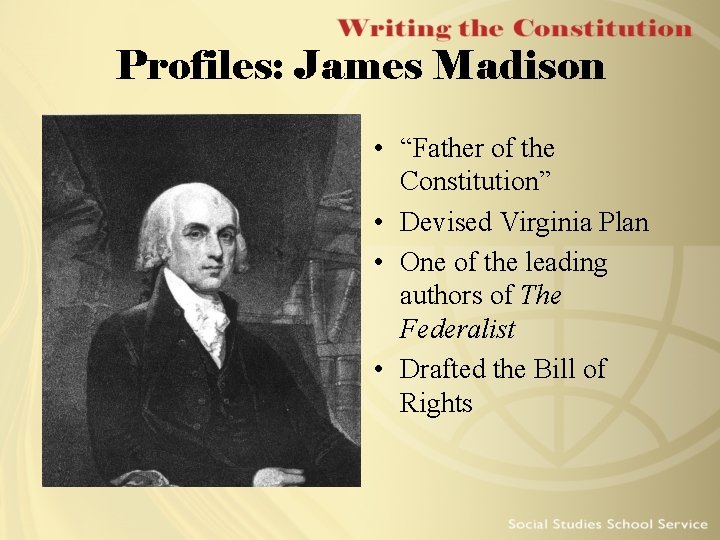
Profiles: James Madison • “Father of the Constitution” • Devised Virginia Plan • One of the leading authors of The Federalist • Drafted the Bill of Rights
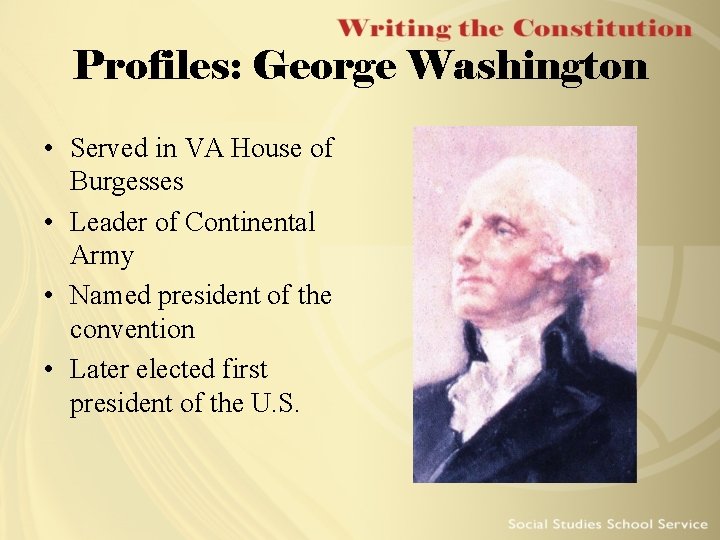
Profiles: George Washington • Served in VA House of Burgesses • Leader of Continental Army • Named president of the convention • Later elected first president of the U. S.
Profiles: Benjamin Franklin • Although in his 80 s, he attended most sessions • Did not approve of parts of the document • Lent his prestige to helping along the ratification process • Gave famous “Rising Sun” speech
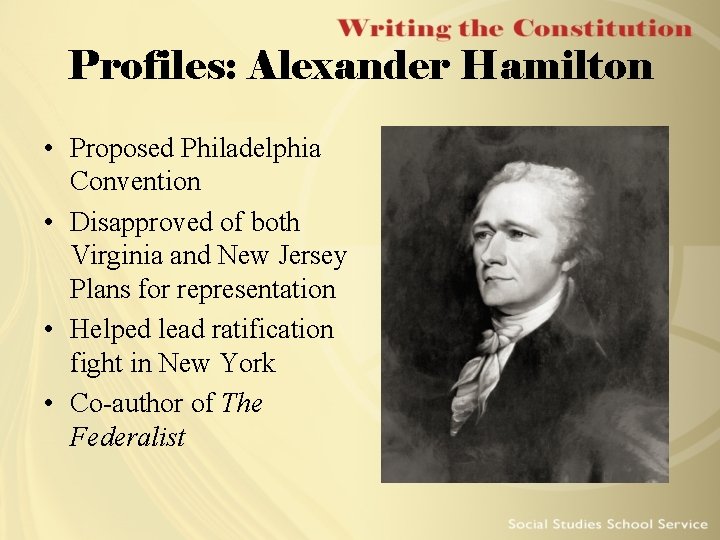
Profiles: Alexander Hamilton • Proposed Philadelphia Convention • Disapproved of both Virginia and New Jersey Plans for representation • Helped lead ratification fight in New York • Co-author of The Federalist
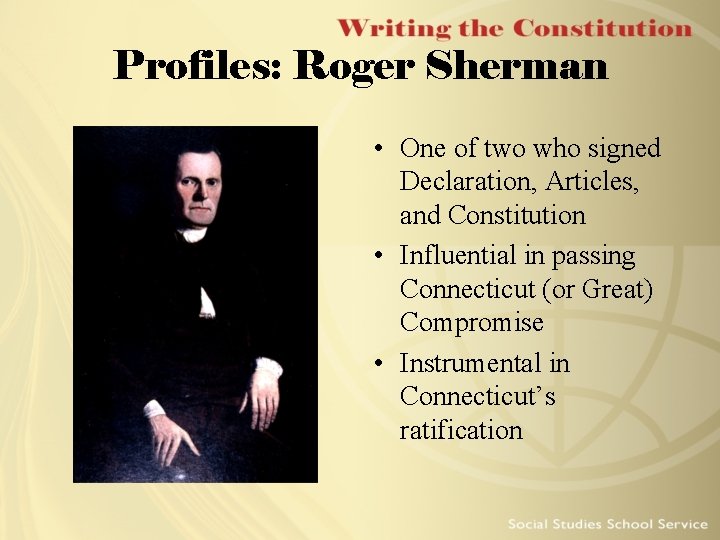
Profiles: Roger Sherman • One of two who signed Declaration, Articles, and Constitution • Influential in passing Connecticut (or Great) Compromise • Instrumental in Connecticut’s ratification
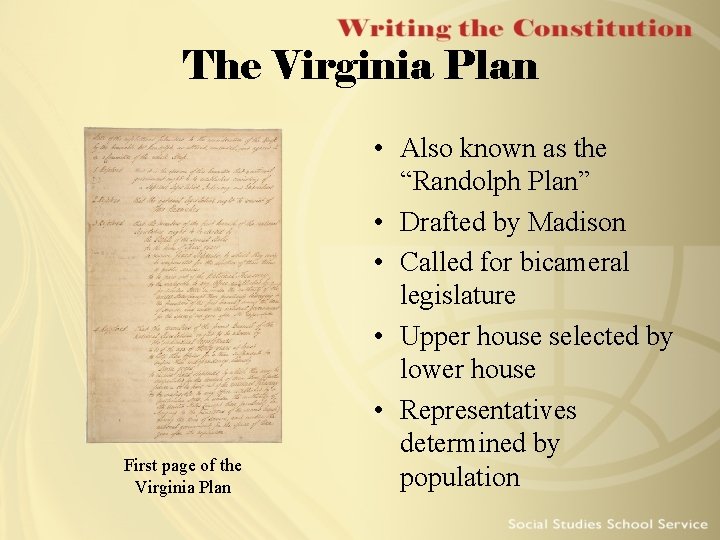
The Virginia Plan First page of the Virginia Plan • Also known as the “Randolph Plan” • Drafted by Madison • Called for bicameral legislature • Upper house selected by lower house • Representatives determined by population
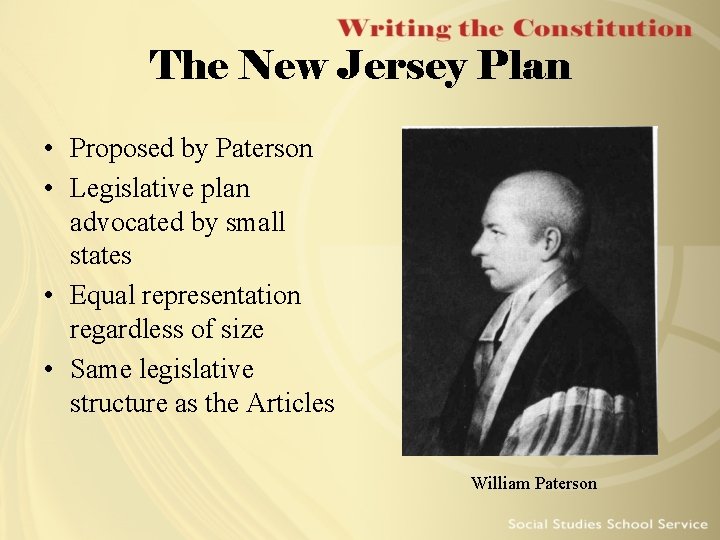
The New Jersey Plan • Proposed by Paterson • Legislative plan advocated by small states • Equal representation regardless of size • Same legislative structure as the Articles William Paterson
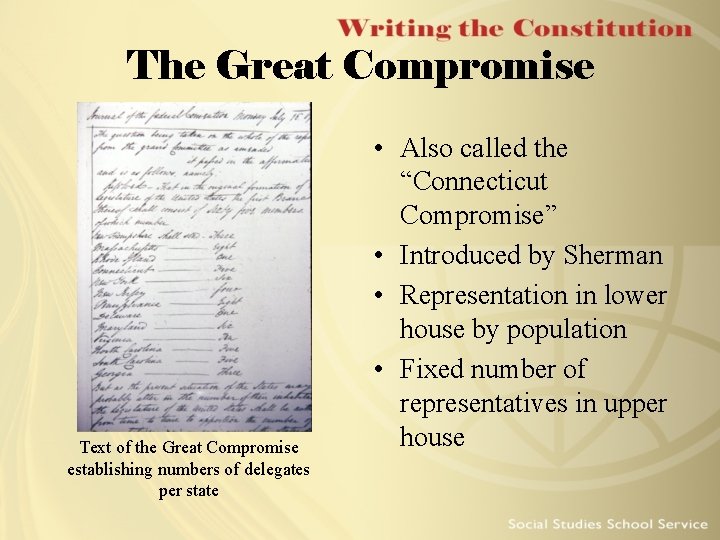
The Great Compromise Text of the Great Compromise establishing numbers of delegates per state • Also called the “Connecticut Compromise” • Introduced by Sherman • Representation in lower house by population • Fixed number of representatives in upper house
The House and Senate: Differences • House considered to represent “ordinary Americans” because voters elect members directly • Bills for raising revenue must originate in House • Senate viewed as “advisory” in nature: – Ratifies treaties – Approves presidential appointments • Senate designed to represent the “aristocracy”
The “Three-Fifths Compromise” • North wanted to count slaves for taxation purposes, not representation in Congress • South wanted to count slaves for representation, not taxation • Compromise counted three-fifths of “other persons” for both representation and taxation • Congress also forbidden to interfere with slave trade until 1808
Discussion Questions 1. What were the main points of the Virginia Plan? The New Jersey Plan? 2. How did the Great Compromise solve the controversy between supporters of the Virginia Plan and those favoring the New Jersey Plan?
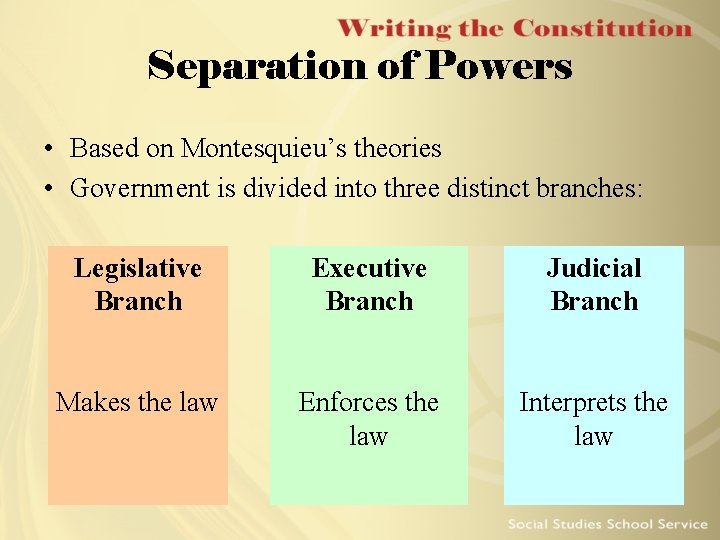
Separation of Powers • Based on Montesquieu’s theories • Government is divided into three distinct branches: Legislative Branch Executive Branch Judicial Branch Makes the law Enforces the law Interprets the law
The Executive Branch • Headed by the Office of the President • Responsible for carrying out the law • Can veto bills • Appointment power • Commander-in-chief of armed forces • Also in charge of foreign relations
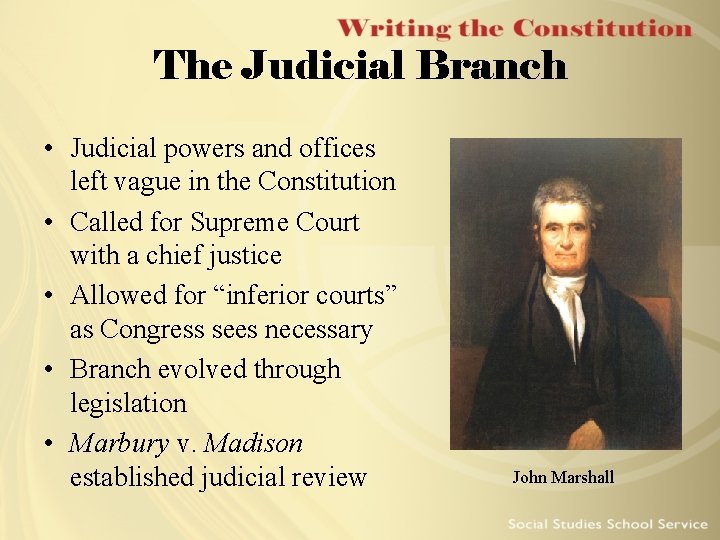
The Judicial Branch • Judicial powers and offices left vague in the Constitution • Called for Supreme Court with a chief justice • Allowed for “inferior courts” as Congress sees necessary • Branch evolved through legislation • Marbury v. Madison established judicial review John Marshall
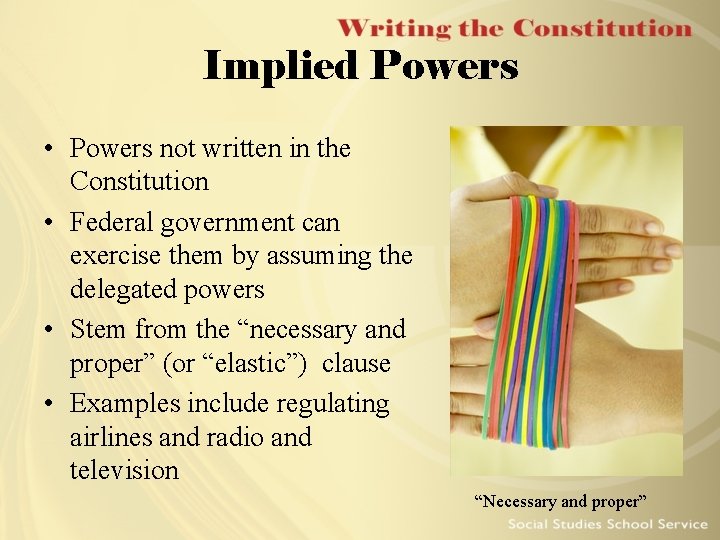
Implied Powers • Powers not written in the Constitution • Federal government can exercise them by assuming the delegated powers • Stem from the “necessary and proper” (or “elastic”) clause • Examples include regulating airlines and radio and television “Necessary and proper”
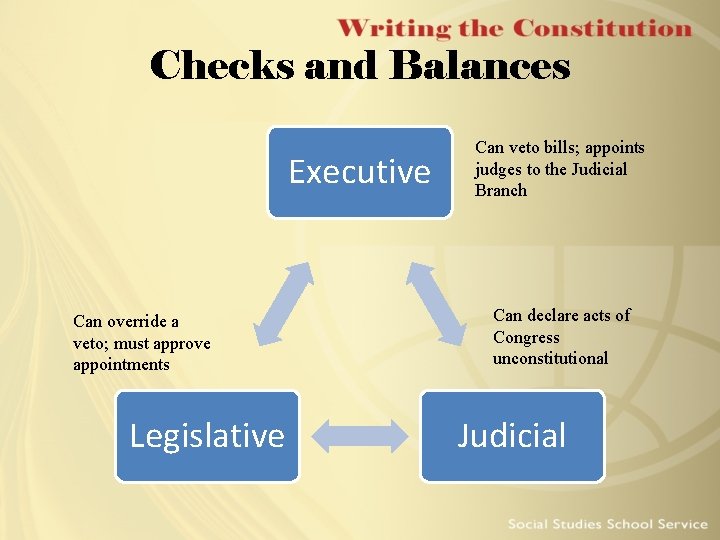
Checks and Balances Executive Can override a veto; must approve appointments Legislative Can veto bills; appoints judges to the Judicial Branch Can declare acts of Congress unconstitutional Judicial
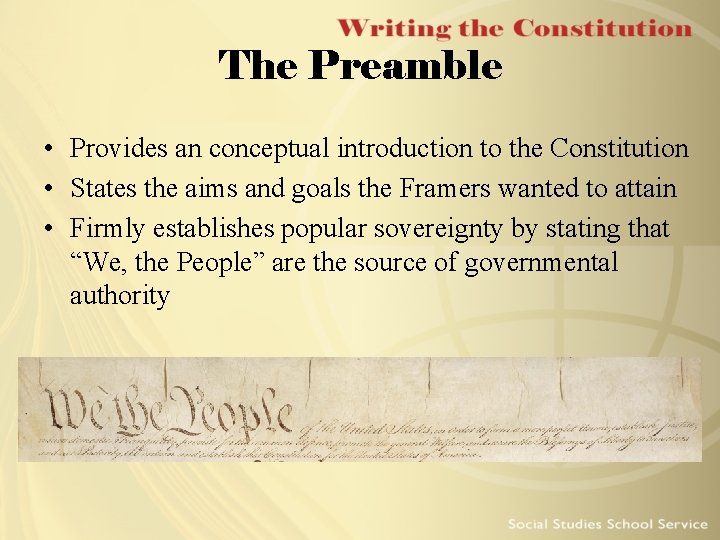
The Preamble • Provides an conceptual introduction to the Constitution • States the aims and goals the Framers wanted to attain • Firmly establishes popular sovereignty by stating that “We, the People” are the source of governmental authority
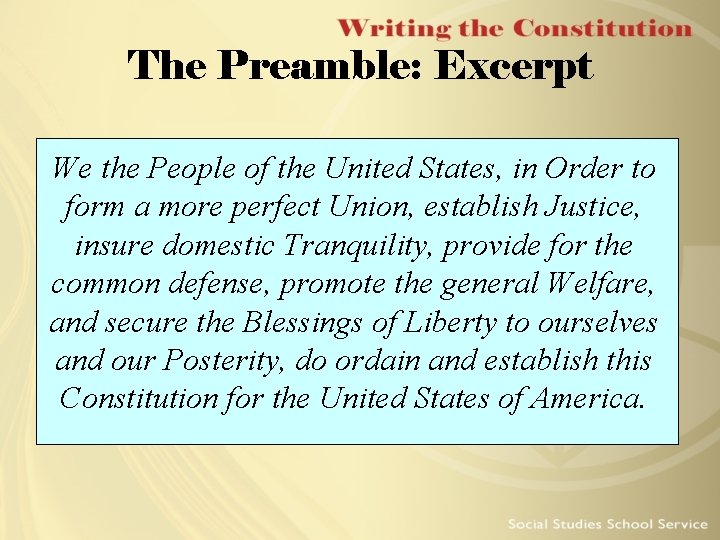
The Preamble: Excerpt We the People of the United States, in Order to form a more perfect Union, establish Justice, insure domestic Tranquility, provide for the common defense, promote the general Welfare, and secure the Blessings of Liberty to ourselves and our Posterity, do ordain and establish this Constitution for the United States of America.
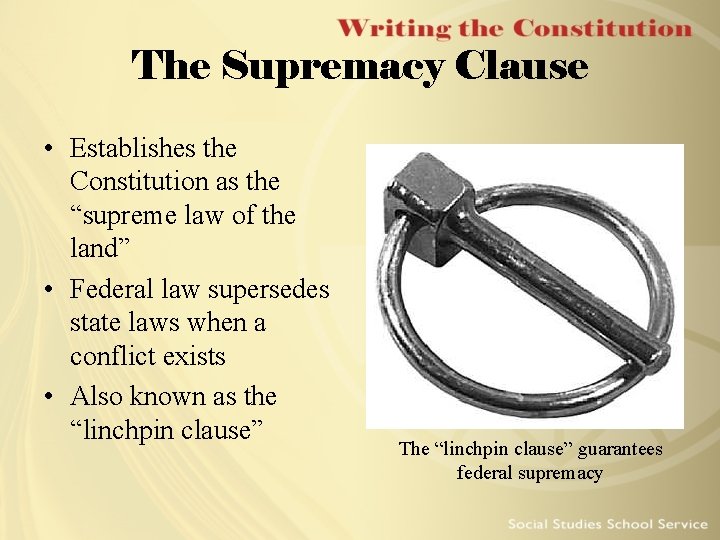
The Supremacy Clause • Establishes the Constitution as the “supreme law of the land” • Federal law supersedes state laws when a conflict exists • Also known as the “linchpin clause” The “linchpin clause” guarantees federal supremacy
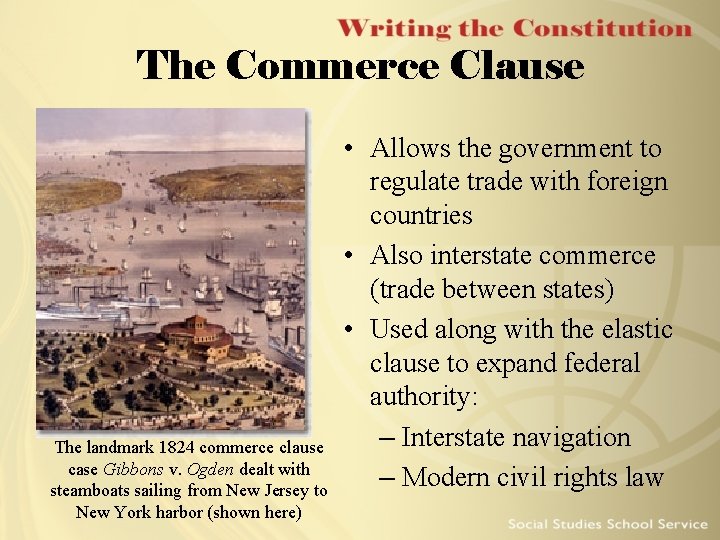
The Commerce Clause The landmark 1824 commerce clause case Gibbons v. Ogden dealt with steamboats sailing from New Jersey to New York harbor (shown here) • Allows the government to regulate trade with foreign countries • Also interstate commerce (trade between states) • Used along with the elastic clause to expand federal authority: – Interstate navigation – Modern civil rights law
The Electoral College • Used for presidential elections • Framers had concerns that voters wouldn’t make informed decisions • Each state selects electors equal in number to its congressional representation • Electors vote twice: once for president, once for vice president • Political parties have made the Electoral College a “rubber stamp”
The Constitution: Problems Solved • System of checks and balances curbed excessive power by a single branch • Created powerful executive who can veto acts of Congress • Established national judiciary • Different constituencies select members of each branch • Elastic clause allows for expansions to federal authority
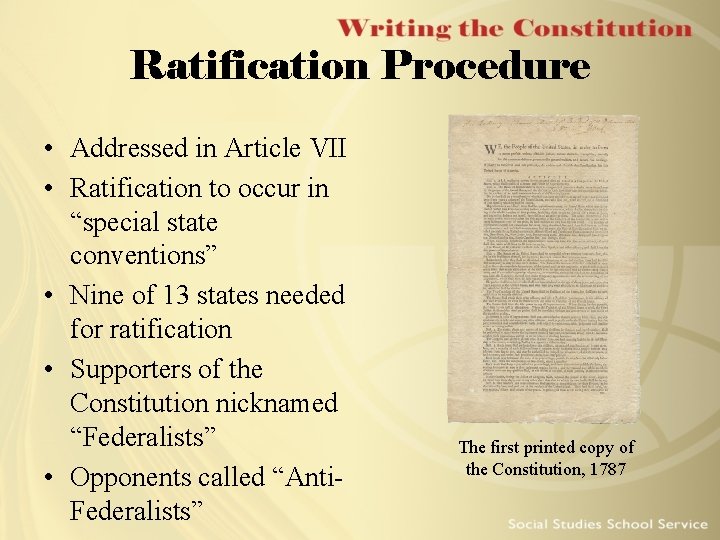
Ratification Procedure • Addressed in Article VII • Ratification to occur in “special state conventions” • Nine of 13 states needed for ratification • Supporters of the Constitution nicknamed “Federalists” • Opponents called “Anti. Federalists” The first printed copy of the Constitution, 1787
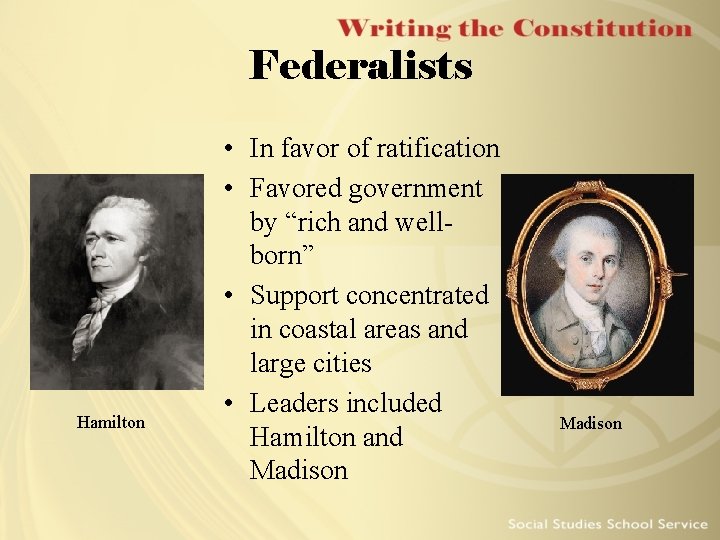
Federalists Hamilton • In favor of ratification • Favored government by “rich and wellborn” • Support concentrated in coastal areas and large cities • Leaders included Hamilton and Madison
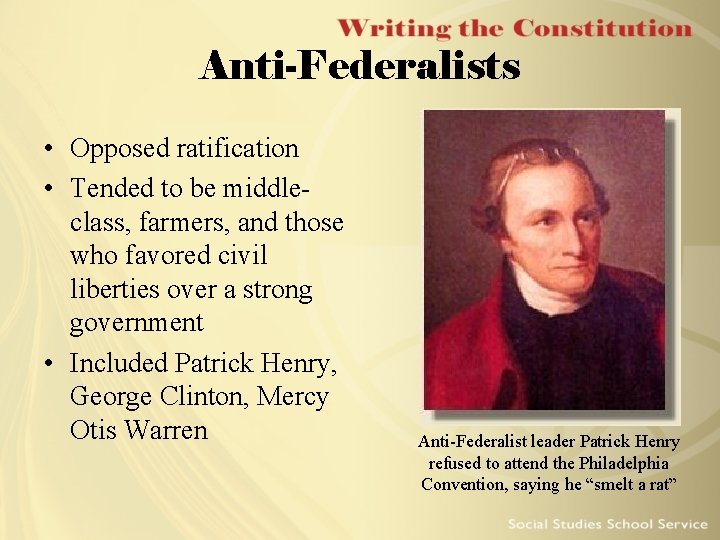
Anti-Federalists • Opposed ratification • Tended to be middleclass, farmers, and those who favored civil liberties over a strong government • Included Patrick Henry, George Clinton, Mercy Otis Warren Anti-Federalist leader Patrick Henry refused to attend the Philadelphia Convention, saying he “smelt a rat”
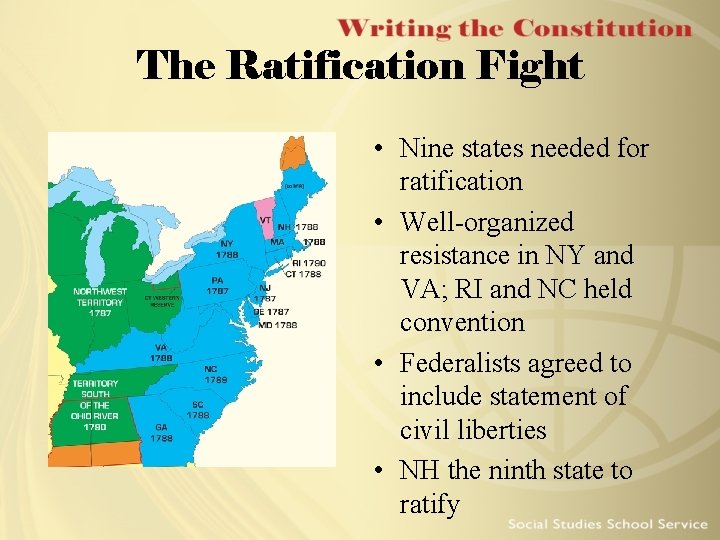
The Ratification Fight • Nine states needed for ratification • Well-organized resistance in NY and VA; RI and NC held convention • Federalists agreed to include statement of civil liberties • NH the ninth state to ratify
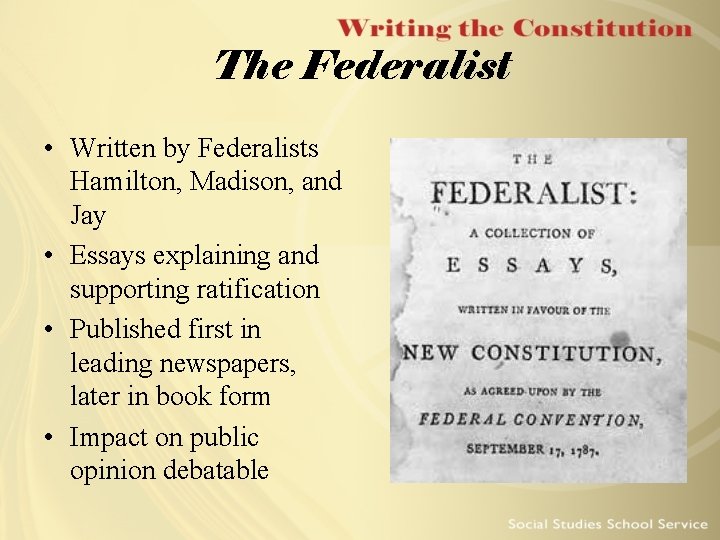
The Federalist • Written by Federalists Hamilton, Madison, and Jay • Essays explaining and supporting ratification • Published first in leading newspapers, later in book form • Impact on public opinion debatable
From Federalist #10 A republic, by which I mean a government in which the scheme of representation takes place, opens a different prospect, and promises the cure for which we are seeking. Let us examine the points in which it varies from pure democracy, and we shall comprehend both the nature of the cure and the efficacy which it must derive from the Union… Hence, it clearly appears, that the same advantage which a republic has over a democracy, in controlling the effects of faction, is enjoyed by a large over small republic—is enjoyed by the Union over the States composing it. Does the advantage consist in the substitution of representatives whose enlightened views and virtuous sentiments render them superior to local prejudices and schemes of injustice? It will not be denied that the representation of the Union will be most likely to possess these requisite endowments.
More From Federalist #10 Does it consist in the greater security afforded by a greater variety of parties, against the event of any one party being able to outnumber and oppress the rest? In an equal degree does the increased variety of parties comprised within the Union, increase this security. Does it, in fine, consist in the greater obstacles opposed to the concert and accomplishment of the secret wishes of an unjust and interested majority? Here, again, the extent of the Union gives it the most palpable advantage… In the extent and proper structure of the Union, therefore, we behold a republican remedy for the diseases most incident to republican government. And according to the degree of pleasure and pride we feel in being republicans, ought to be our zeal in cherishing the spirit and supporting the character of Federalists. PUBLIUS
From Federalist #84 “WE, THE PEOPLE of the United States, to secure the blessings of liberty to ourselves and our posterity, do ORDAIN and ESTABLISH this Constitution for the United States of America. ” Here is a better recognition of popular rights, than volumes of those aphorisms which make the principal figure in several of our State bills of rights, and which would sound much better in a treatise of ethics than in a constitution of government. …I go further, and affirm that bills of rights, in the sense and to the extent in which they are contended for, are not only unnecessary in the proposed Constitution, but would even be dangerous. They would contain various exceptions to powers not granted; and, on this very account, would afford a colorable pretext to claim more than were granted. For why declare that things shall not be done which there is no power to do? Why, for instance, should it be said that the liberty of the press shall not be restrained, when no power is given by which restrictions may be imposed?
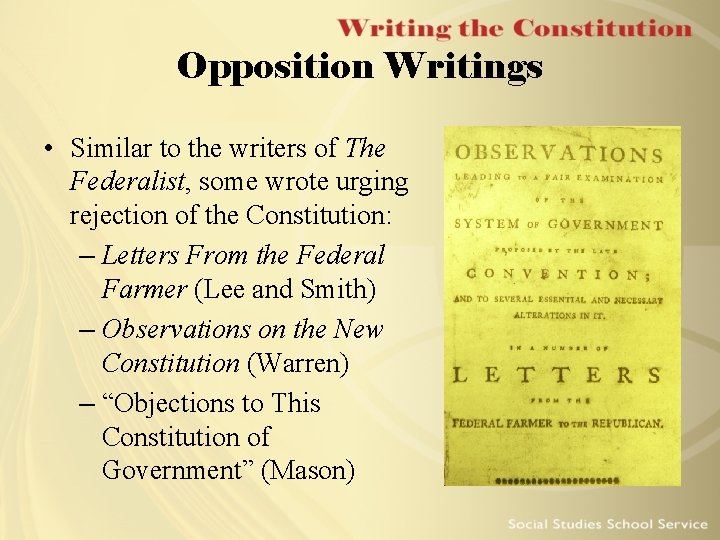
Opposition Writings • Similar to the writers of The Federalist, some wrote urging rejection of the Constitution: – Letters From the Federal Farmer (Lee and Smith) – Observations on the New Constitution (Warren) – “Objections to This Constitution of Government” (Mason)
From Observations on the New Constitution 2. There is no security in the proffered system, either for the rights of conscience or the liberty of the Press: Despotism usually while it is gaining ground, will suffer men to think, say, or write what they please; but when once established, if it is thought necessary to subserve the purposes, of arbitrary power, the most unjust restrictions may take place in the first instance, and an imprimatur on the Press in the next, may silence the complaints, and forbid the most decent remonstrances of an injured and oppressed people… 14. There is no provision by a bill of rights to guard against the dangerous encroachments of power in too many instances to be named: but I cannot pass over in silence the insecurity in which we are left with regard to warrants unsupported by evidence—the daring experiment of granting writs of assistance in a former arbitrary administration is not yet forgotten in…Massachusetts; nor can we be so ungrateful to the memory of the patriots who counteracted their operation, as so soon after their manly exertions to save us from such a detestable instrument of arbitrary power, to subject ourselves to the insolence of any petty revenue officer to enter our houses, search, insult, and seize at pleasure…
From “Objections to This Constitution of Government” There is no Declaration of Rights, and the laws of the general government being paramount to the laws and constitutions of the several States, the Declarations of Rights in the separate States are no security. Nor are the people secured even in the enjoyment of the benefits of the common law… This government will set out a moderate aristocracy: it is at present impossible to foresee whether it will, in its operation, produce a monarchy, or a corrupt, tyrannical aristocracy; it will most probably vibrate some years between the two, and then terminate in the one or the other… George Mason
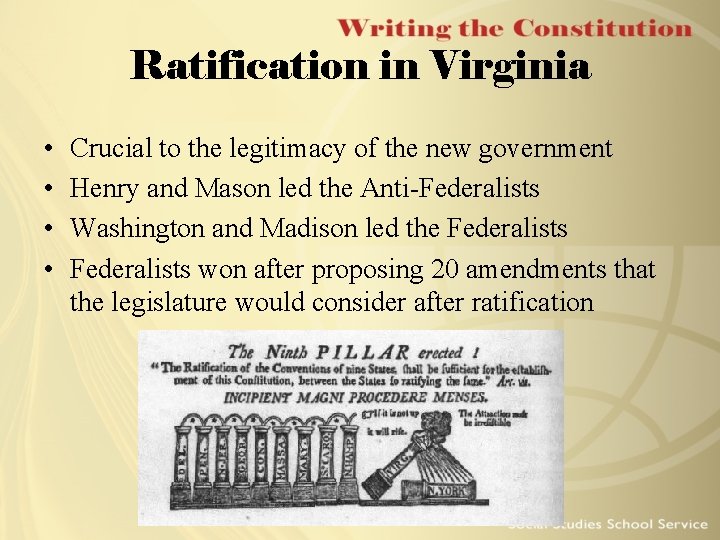
Ratification in Virginia • • Crucial to the legitimacy of the new government Henry and Mason led the Anti-Federalists Washington and Madison led the Federalists won after proposing 20 amendments that the legislature would consider after ratification
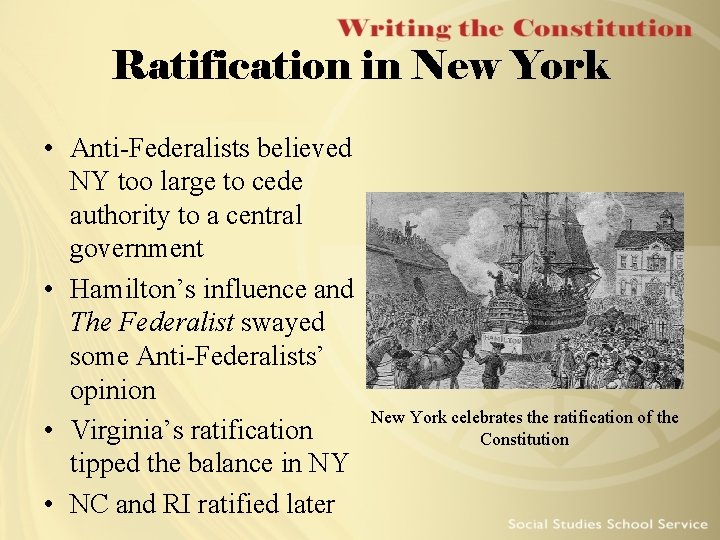
Ratification in New York • Anti-Federalists believed NY too large to cede authority to a central government • Hamilton’s influence and The Federalist swayed some Anti-Federalists’ opinion • Virginia’s ratification tipped the balance in NY • NC and RI ratified later New York celebrates the ratification of the Constitution
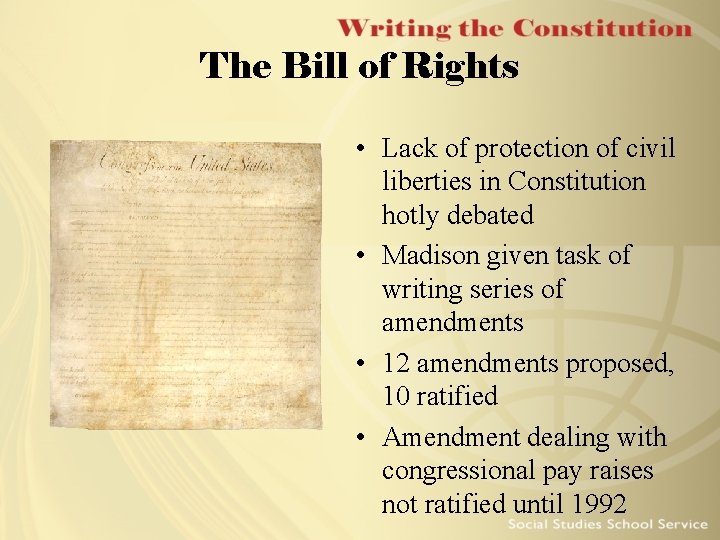
The Bill of Rights • Lack of protection of civil liberties in Constitution hotly debated • Madison given task of writing series of amendments • 12 amendments proposed, 10 ratified • Amendment dealing with congressional pay raises not ratified until 1992
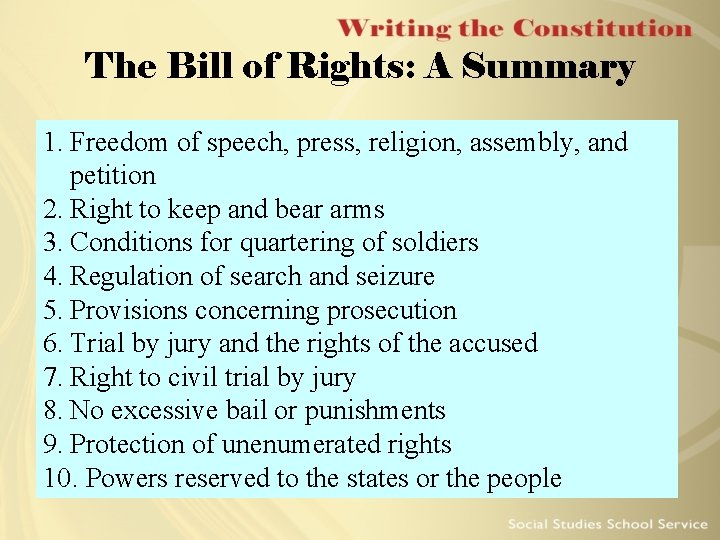
The Bill of Rights: A Summary 1. Freedom of speech, press, religion, assembly, and petition 2. Right to keep and bear arms 3. Conditions for quartering of soldiers 4. Regulation of search and seizure 5. Provisions concerning prosecution 6. Trial by jury and the rights of the accused 7. Right to civil trial by jury 8. No excessive bail or punishments 9. Protection of unenumerated rights 10. Powers reserved to the states or the people
Discussion Questions 1. What system did the Framers devise for ratifying the Constitution? How did this improve upon the Articles’ method? 2. What were some characteristics of the Federalists? The Anti-Federalists? What did opponents of the Constitution dislike the most? 3. How did the Constitution gain ratification in Virginia and New York, despite major objections?
Discussion Questions (cont. ) 4. Who received the task of writing a bill of rights? What sources did he rely on for developing a list of amendments? 5. What four general categories of rights does the Bill of Rights protect?